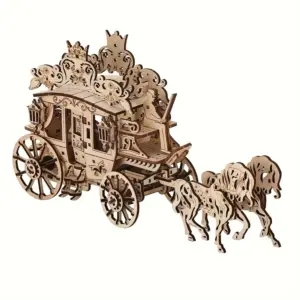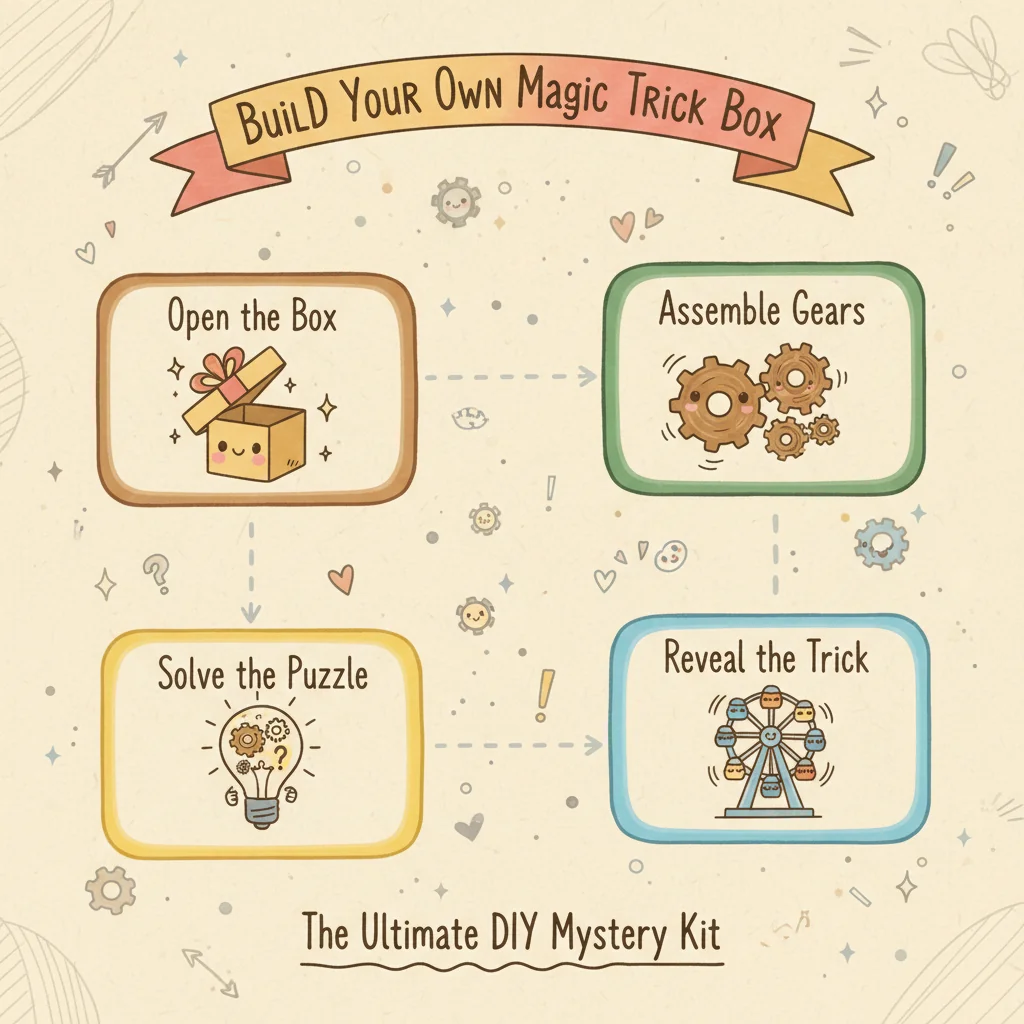
Beyond the Hidden Drawer: Why a Build-It-Yourself Puzzle Box is a Different Kind of Trick
When you search for a “trick puzzle box,” you’re met with a familiar world. Sites like Kubiya Games and Puzzle Master Inc. are filled with beautiful, self-contained wooden cubes and rectangles. Their trick is singular: a hidden latch, a clever slide, a disguised panel. The “aha!” moment is in the discovery of that one secret mechanism, and the reward is a small, hidden compartment. As one Redditor on r/PuzzleBox puts it, the appeal is in the “novel locking mechanism, or a trick, to opening them.” It’s a satisfying, contained experience—find the trick, open the box, maybe stash a gift card inside, and then you’re done. The box becomes a static curio, its secret known.
But what if the trick wasn’t just in the opening, but in the very creation of the object? What if the puzzle wasn’t a sequence of moves to find a void, but a sequence of logical, physical steps to build a complex, functional machine? This is the fundamental pivot offered by the build-it-yourself puzzle kit. It transforms the “trick box” from a noun—a finished product with a secret—into a verb: the prolonged, engaging act of puzzling through assembly. The final, display-worthy object is your prize, but the journey to get there is the primary, and profoundly different, puzzle.
Consider the Wooden Ferris Wheel Music Box Kit. On the surface, it shares DNA with traditional puzzle boxes: it’s made of wood, it requires patience and dexterity, and it culminates in a delightful, almost magical reveal. But its trick is layered. The first “trick” is the assembly itself—a 3D mechanical puzzle comprising hundreds of precisely laser-cut plywood pieces. You’re not searching for a hidden catch; you’re logically interpreting diagrams, fitting interlocking gears, and aligning axles to create a working gear train. The challenge isn’t “how does this open?” but “how does this even go together to function?”
The second “trick” is the glorious function. Once built, it’s not a box with a secret drawer; it’s a kinetic sculpture, a functional music box with a turning Ferris wheel. The secret it holds isn’t a physical object, but an experience. You wind it up and reveal the charming interplay of music and motion. This makes it a perpetual trick box—you can delight others with its operation long after your own assembly puzzle is solved. It subverts the standard commercial intent of a stash box for gifts; its purpose is to be the gift, and its value is in the hours of immersive engagement and the lasting display piece it becomes.
This dual appeal taps into a deeper vein of user desire often voiced in forums. When enthusiasts discuss puzzle boxes, there’s a clear divide between simple “one-step trick” boxes and the coveted “intricate” designs. As one user seeking recommendations noted, some beautiful boxes can be “a bit on the easy side,” while they crave more substantial mechanical intrigue. The build-it-yourself kit answers this by offering inherent complexity. You are literally constructing the intricacy. The “trick” is distributed across every gear tooth and joint, making the final, satisfying turn of the crank feel like a hard-earned personal achievement, not just a discovered secret.
In this way, the kit transcends the category. It merges the meditative challenge of a mechanical puzzle with the hands-on reward of model building. It’s for the person who finds a standard secret-opening box fun for an afternoon but wants a project that demands a weekend of focused, rewarding effort. The trick isn’t hidden in the finish; it’s engineered by your own hands, piece by piece, continuing the 130-year love story between Ferris wheels and music boxes.
Unboxing the Mystery: First Impressions of the Ferris Wheel Kit

The box arrives deceptively slim and light. If you’re expecting a hefty, pre-assembled puzzle box, this isn’t it. The first clue to its nature is the illustration: a completed, ornate Ferris wheel, not a simple cube. Sliding off the lid reveals not a single object, but a promise of one. You’re greeted with several large, densely packed sheets of laser-cut plywood, a small bag of mechanical components (axles, gears, rubber bands), the music box mechanism, and an instruction manual. The immediate impression is one of potential complexity. This isn’t a “find the hidden latch” trick; the trick is the entire construction process.
Handling the wood sheets is your first tactile test. The quality is a critical make-or-break point for any kit. Here, the birch plywood is firm and smoothly sanded on the face, with a clean, slightly charred scent from the laser-cutting process. The pieces pop out with satisfying precision; a gentle push with a fingertip is usually enough, and you’ll rarely need to wrestle with stubborn tabs or risk splintering. This initial ease is crucial—it builds confidence that the manufacturer respects the builder. The pieces themselves are intricate, with tiny gear teeth and delicate struts that immediately communicate this is more than a simple model. You can see the puzzle forming already: how will this curved piece connect to that gear train?
The instruction manual is the next hurdle. It’s image-heavy, employing a universal visual language of arrows, numbers, and exploded diagrams. There’s minimal text. For a visual learner, this is a blessing. For someone who needs verbose, step-by-step procedural guidance, it may cause initial anxiety. The first few pages are clear, showing how to organize the sheets and remove parts. But a flick through reveals sequences where dozens of pieces come together in a single diagram. This is where the “puzzle” aspect of the build truly begins—deciphering the instructions is part one of the challenge. It’s not opaque, but it demands your full attention and spatial reasoning.
Then there’s the music box mechanism. It’s a compact, metal-cased unit with a winding key and a visible metal cylinder with raised pins. It feels substantial, not toy-like. Its inclusion answers a silent buyer objection: “Is this just a static model?” No, it promises a kinetic, auditory payoff. You can give the key a tentative turn, and the soft, clear chime of the tune (often a classic like “Memory” or “You Are My Sunshine”) plays, setting the goal for the entire project. You’re not just building a wheel; you’re building a functional music box that will animate your creation.
The scale becomes apparent as you lay out the largest base pieces. This will be a significant display object, likely 8-10 inches tall once complete. The unboxing experience successfully shifts your mindset. You move from a consumer expecting a finished trick box to an active participant holding the raw ingredients of the trick itself. The quality of materials is reassuring, and the complexity is evident but not intimidating. It squarely addresses the “is this for me?” question: if the sight of those precise wooden gears sparks curiosity rather than dread, you’re holding the right kit. If you wanted a quick, ready-to-solve secret box, this is not it. This is the deep end, and you’ve just been handed the blueprint to build your own pool.
The Assembly Puzzle: A Step-by-Step Journey Through Gears, Axles, and ‘Aha!’ Moments
The true nature of this kit reveals itself not in the unboxing, but in the first ten minutes of assembly. This is where the “trick puzzle box” concept is turned inside out. You are not solving a secret to find a compartment; you are constructing the secret mechanism itself, piece by painstaking piece. The instruction booklet, a series of pictograms with minimal text, becomes your first puzzle. It’s a universal language of arrows and exploded diagrams, demanding a shift from passive reading to active spatial reasoning. This initial deciphering is the first “aha!” moment—realizing you must think like the puzzle’s designer.
The journey begins deceptively simply with the base and central column. Sanding the tiny dowel axles for a smooth fit is a quiet, meditative start. But the heart of the mechanical trick—the gear train that converts the wind-up key’s rotation into the wheel’s majestic turn—is where the real mental labor begins. Laying out the five or six interlocking wooden gears feels like setting up a clockwork brain. The challenge isn’t force; it’s precision. Each gear must be pinned to its axle with microscopic tolerance. One misaligned tooth, one axle pushed a millimeter too far, and the entire system binds. This stage is a masterclass in patience. You learn the haptic feedback of good engineering: the satisfying, almost silent meshing of perfectly aligned wooden cogs versus the gritty, resistant grind of an error.
Here, the guide intent of typical puzzle box resources becomes internalized. WikiHow’s “use a small amount of force” and Kubiya’s tips on starting points translate directly. You learn that “forcing it” is always the wrong answer. The solution is to backtrack, to examine the orientation of a gear’s spokes against the diagram, to check for an unseen burr of laser-cut wood. Solving this sub-assembly delivers a profound satisfaction distinct from opening a trick box. You haven’t found a hidden thing; you have created hidden function.
The next major puzzle is attaching the gondolas. Each swings freely from a tiny U-shaped bracket, and connecting them to the rotating wheel frame is a delicate ballet of balance and temporary fixation. The trick here is logistical: you must pre-assemble all eight gondolas, lay out the wheel frame flat, and attach them in sequence before finally connecting the completed ring to the central hub. It’s a lesson in thinking ahead, a core principle of both mechanical engineering and sequential discovery puzzles. The moment you lift the fully gondola-adorned wheel and connect it to the driving gear, seeing it hang balanced and ready to spin, is a pure victory.
The final integration of the music box mechanism is the grand reveal of the ultimate trick. This small, pre-assembled brass unit is the treasure at the center of your constructed labyrinth. Mounting it involves aligning its drive shaft with a final gear in the train. Turning the key now has consequence: it should both play the tune and, through the gear train, turn the Ferris wheel. But what if it doesn’t? This is the last puzzle. The solution often lies in a subtle oversight—a locking pin on the wind-up key’s shaft that must be disengaged for “play” mode, or a final gear mesh that needs a hair’s breadth of adjustment. When you finally turn the key and the melody begins while the wheel carries its tiny passengers in a slow, graceful circle, the “trick” is complete. You experience the full sequence not as a user, but as the builder who enabled it.
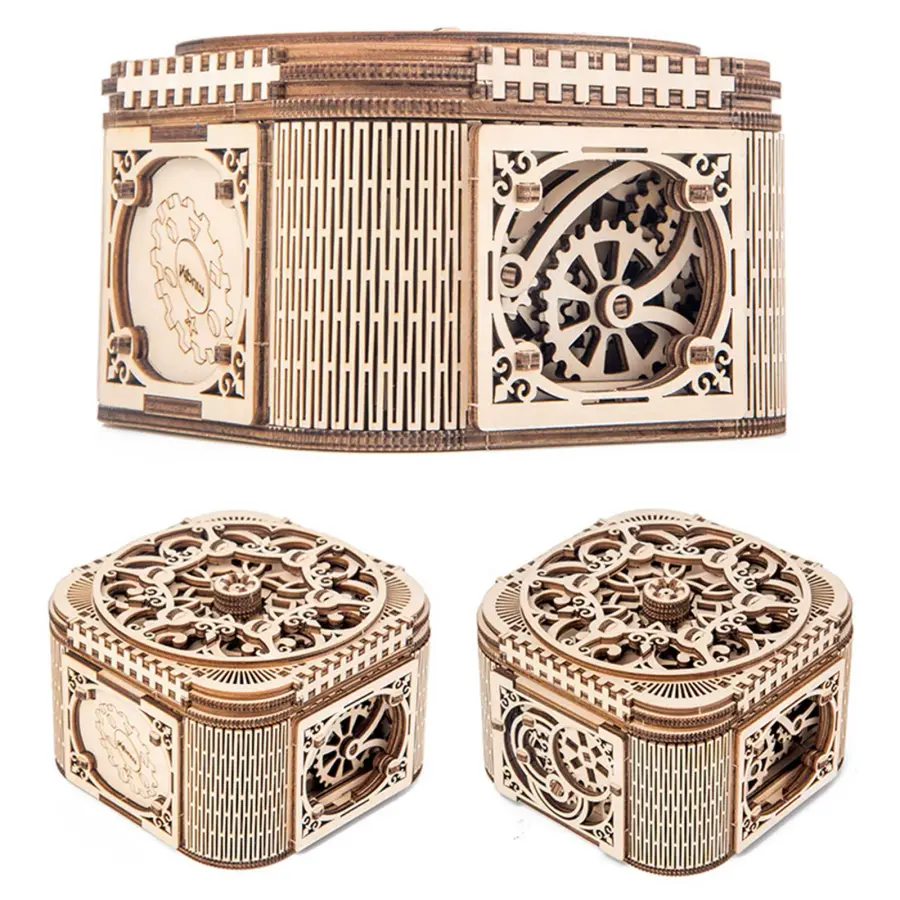
This build process mirrors the philosophy behind more complex trick boxes. As explored in our guide on puzzle design through the lens of mechanical engineering, the joy stems from interacting with clear physical logic. Unlike a purely decorative model, every part here has a purpose in the kinetic chain. The struggle to align the gears is not a flaw; it is the core engagement, the very thing that makes the final operation feel earned. It’s what separates this from a simpler, static secret box. For instance, a like the 3D Wooden Puzzle Treasure Box offers a different but related satisfaction—building a functional, secret-locked container from scratch, much like following a first-timer’s guide to crafting your own mechanical secret. Both demand you understand the mechanism to assemble it, forging a deeper connection to the object.
The assembly is punctuated by smaller, delightful “aha!”s: discovering why a certain oddly-shaped piece exists only when it perfectly braces a structural joint, or realizing that a seemingly redundant step actually pre-tensions the system for smooth operation. These are the designer’s little winks, the hidden compartments in the build process itself. By the end, you haven’t just followed instructions. You’ve undergone a practical crash course in gear ratios, axle load, and kinetic sequencing. You’ve solved the meta-puzzle: how does this beautiful, musical trick even come to exist? The answer, of course, is that you built it.
Who is This Puzzle Box Really For? Matching the Kit to Your Personality
This isn’t a generic trick box you buy, fumble with for ten minutes, and shelve. The Wooden Ferris Wheel Music Box Kit is a specific experience, and whether it’s a brilliant buy or a frustrating mismatch depends entirely on who you are and what you’re seeking. Let’s match it to some real-world profiles.
The Patient Puzzle Purist
You live for the “click.” Your shelves might hold a or a classic Japanese himitsu-bako. You appreciate craftsmanship and a clever, non-obvious solution. For you, the assembly of this kit is the primary puzzle—a 3D mechanical logic problem. The final “trick” to start the music is the satisfying proof you solved it correctly. This kit is a strong buy if you enjoy process-oriented challenges and derive deep satisfaction from understanding a mechanism from the inside out. It’s a potential skip if your joy comes purely from the tactile hunt for a hidden slide or latch on a pre-made box. You might prefer the curated challenge of a traditional Japanese puzzle box, where the craftsmanship is in the hidden mechanism, not your own hands (our guide to Japanese puzzle boxes that will humble your IQ can point you there).
The Gift Giver Seeking a Meaningful Gesture
You want to give more than an object; you want to give an experience and a story. A simple, store-bought trick money box says, “Here’s a fun obstacle for your cash.” This Ferris Wheel kit says, “I trust you with patience and skill, and the reward is something beautiful we can both admire.” It’s a phenomenal gift for a detail-oriented partner, a graduating engineer, or a puzzle-loving parent. The key is knowing your recipient: are they likely to embrace the 6-8 hour build, or will it become a guilt-inducing closet fixture? For the right person, it’s an unforgettable buy. For someone with less time or patience, a beautifully finished, ready-to-solve trick box is a safer choice.
The Model Builder Looking for a Challenge
You’ve built Gundams, LEGO Technic, or wooden ship models. You love following intricate instructions to a precise, impressive result. This kit sits at the intersection of model building and puzzling. The challenge isn’t just assembly; it’s ensuring the mechanical function works flawlessly. You’ll need fine motor skills, the ability to troubleshoot friction points, and the patience to sand a gear for smoother operation. If that sounds appealing, this is a fantastic and unique buy that expands your hobby. If you prefer the guaranteed, snap-together perfection of a branded model kit, the friction-fit nature of this wooden puzzle might frustrate you.
The Parent/Adult Wanting a Collaborative Project
Looking for a screen-free activity to share with a teen or a partner? This kit can be a brilliant collaborative project. It naturally splits into roles: one person can manage the structural frame, another the delicate gear assembly. The process teaches communication, patience, and shared problem-solving. The triumphant moment when the music plays is a shared victory. It’s a buy for fostering connection through a tangible achievement. However, for younger children or a shorter attention span, a simpler, quicker-to-solve trick box would be more appropriate.
Decision Fit: When to Choose This Over a Commercial Trick Box
Scan the commercial intent SERP, and you’ll see two dominant categories: the quick-trick money box (like the “Good Luck Secret Puzzle Box”) and the narrative-driven escape-room-in-a-box (like “ClueBox: Davy Jones’ Locker”).
- Choose this Ferris Wheel Kit when you want the puzzle to be in the creation, not just the opening. You want a lasting display piece that is a testament to your effort. You value the meditative, hands-on process and the deeper understanding of mechanics it provides.
- Choose a quick-trick money box when you need a novel, inexpensive vessel for a gift card or cash. The puzzle is a brief, fun interaction, not a lasting hobby. The object itself is often secondary to its contents.
- Choose an escape-room-in-a-box when you want a one-time, story-driven group activity with a clear beginning and end. It’s about narrative discovery and teamwork, not craftsmanship or permanent display.
Ultimately, the Wooden Ferris Wheel Music Box Kit is for the process-oriented person. It’s not a casual diversion; it’s a commitment that pays off in profound satisfaction and a unique mechanical heirloom. If you see yourself in the Patient Purist, the thoughtful Gift Giver, or the collaborative Model Builder, this kit is likely a deeply rewarding purchase. If you just want a clever container or a fast brain teaser, the wider world of puzzle boxes for adults that actually reward your patience holds better options for you.
Common Pitfalls and How to Avoid Them: Lessons from My Build
Let’s be honest: the journey from a flat pack of wood to a spinning, musical Ferris wheel is paved with potential for small, frustrating errors. These aren’t flaws in the kit, but rather the natural friction points where a first-time builder’s assumptions meet the reality of precision mechanics. Learning from my own missteps, here’s how to sidestep the most common pitfalls and transform frustration into a masterclass in problem-solving.
The Perils of Force: Laser-Cut Wood is Not Lego. The single biggest mistake is using brute strength. These plywood pieces are precision-cut, and they should snugly fit together, not be hammered. If a part won’t slot in, don’t push harder. Stop. Examine the pieces for a nearly invisible “nub” of leftover laser-cut material (a “tab”) in the slot or on the tab itself. A few light passes with the included sandpaper or a craft knife is almost always the solution. Forcing it will split the wood, compromising structural integrity and your sanity. This is the cardinal rule of all wooden model kits, from complex puzzle boxes to a classic .
Diagram Decoder Ring: What Those Symbols Actually Mean. The instructions rely heavily on icons, and misreading them leads to backtracking. The most critical is the orientation symbol (often a circled dot or arrow). It doesn’t just mean “this side up”; it means this specific face of this specific piece must face this exact direction relative to the assembly. Cross-reference the diagram with the actual piece, noting grain direction or unique cut patterns. Also, a dashed line in a diagram almost always indicates something is behind another piece, not an alternative placement. Taking two minutes to truly decipher the key saves an hour of disassembly later.
Gear Mesh Mayhem: The Sound of Grinding Mistakes. Getting the gear train right is where the music happens—or doesn’t. The pitfall is meshing gears too tightly or too loosely. After placing them on their axles but before finalizing the frame, manually turn the drive gear. The transferred motion should be smooth and silent. If you hear grinding or feel stiff resistance, the gear teeth are likely binding. This is often caused by a slightly warped axle or a gear not sitting perfectly perpendicular. Gently adjust the gear’s position on its axle or check that the supporting frame pieces are fully seated. A properly meshed gear train will have a slight, almost imperceptible “play” between teeth.
Glue: The Double-Edged Sword. The kit advises using glue sparingly, and you must heed this. The pitfall is gluing too early or too much. Never glue moving parts: axles, gears, the crank handle, and the music box mechanism itself must remain free. Glue is for structural joints only. My advice: complete the entire “dry fit” of a major sub-assembly (like the central tower) to ensure everything moves correctly before applying any adhesive. Use a toothpick for control, and wipe excess immediately. A stray drop of glue in the gear train will permanently silence your music box.
Tuning the Music Box: It’s Not Broken, It’s Delicate. The music mechanism is pre-wound and protected by a cardboard slip. The common panic moment comes after assembly: you turn the crank and nothing happens, or it’s jerky. Before assuming it’s defective, check these points: 1) Did you fully remove the cardboard lock from the mechanism’s gear? 2) Is the drive gear from the Ferris wheel cleanly engaging with the music box’s pinion gear? Often, it’s a millimeter out of alignment. 3) The mechanism has a very specific winding direction. If it’s locked, you’re likely turning it the wrong way; try the reverse. For more on the patience required for mechanical puzzles, see our guide on how to solve a puzzle box without losing your mind.
The “Finished But Wobbly” Syndrome. If, upon completion, your Ferris wheel has a slight wobble or the structure isn’t rock-solid, don’t despair. This is almost always due to cumulative, tiny compressions in the layered plywood. Go back and methodically check every major joint, especially where large base pieces connect and where the central tower meets the base. Applying a tiny additional drop of glue into these primary seams and clamping them (or using rubber bands) for an extended dry can work wonders.
View each of these pitfalls not as failures, but as the hidden curriculum of the kit. Solving them—learning to finesse over force, to read the subtle language of diagrams, to calibrate by feel and sound—is where you truly move from assembling a product to understanding a machine. This internalized knowledge is the real prize, making the final, flawless rotation of the wheel feel like a genuine personal achievement.
The Grand Reveal: Completing the Build and the Final ‘Trick’
The final step is deceptively simple: insert the winding key, turn it, and let go. But after hours of aligning gears and calibrating axles, this moment is anything but mundane. It’s the culmination. You hear the initial, tentative click of the spring mechanism engaging, followed by the soft, precise plinking of the music box comb. Then, the wheel begins to turn. Not in a jerky, hesitant shuffle, but in a smooth, majestic rotation. The tiny, painstakingly attached gondolas sway gently as they ascend and descend. The complex machine you’ve just built—a tangle of wooden logic—vanishes, and in its place is a mesmerizing piece of kinetic art. This is the kit’s ultimate ‘trick.’
In the world of traditional trick puzzle boxes, the payoff is a quiet click and a hidden drawer sliding open. The secret is revealed, the puzzle is solved, and the object’s function becomes static storage. The magic is in the concealment of the mechanism. The Wooden Ferris Wheel Music Box Kit performs the same core deception but in reverse. Its ‘hidden compartment’ isn’t a physical space for a ring or cash; it’s the intricate clockwork itself, now perfectly concealed within its own graceful operation. The puzzle isn’t just solved—it’s animated. The final, flawless function is the secret it was keeping all along. As discussed in our piece on why every puzzle box with a hidden compartment is a filter for your focus, the value is in the earned revelation, and here, the revelation is perpetual motion.
This is where the kit transcends being a mere assembly project. You’re left with a stunning display piece that is a constant, quiet testament to your patience. It’s a conversation starter that doesn’t require explanation—until someone leans in, amazed, and asks “How does it work?” Then, you get to reveal the real trick: that you built it. You understand the relationship between the drive gear and the cam disc that makes the gondolas bob. You know the exact point where the music box worm gear meshes. The ‘solution’ to this 3D puzzle isn’t forgotten once executed; it’s performed on loop, every time you wind it.
The emotional payoff is surprisingly profound. There’s a deep, tactile satisfaction in watching it work that you simply cannot get from buying a pre-assembled music box. It mirrors the feeling shared in puzzle communities when a particularly stubborn trick box finally yields—that mix of triumph and admiration for the cleverness of the design. The difference is that your admiration is now also for yourself and the new skills you’ve layered together.
For those bitten by the bug, this grand reveal is just the beginning. The satisfying rhythm of construction and the joy of a complex, working result creates a clear “what’s next?” path. A logical successor is the . It applies the same principles of layered mechanical assembly and music box integration to a new, equally charming form. Where the Ferris wheel offers a vertical, rotating spectacle, a carousel introduces a different set of engineering puzzles—likely involving a central column with rotating platforms and vertically moving animals. It’s the next level of the same delightful challenge, akin to the process of solving the 3D wooden carousel music box.
Ultimately, completing this kit delivers a double revelation. First, the beautiful, functioning Ferris wheel itself. Second, the personal realization that you are capable of building such a thing. It cleverly disguises a lesson in mechanical reasoning and persistent problem-solving within a gorgeous art object. In the end, the final ‘trick’ isn’t just hidden in the gears; it’s the quiet confidence it leaves behind, long after the music has stopped.
Frequently Asked Questions (FAQ)
How many hours does the build take?
For a first-timer, expect 8-12 hours of total work, spread over several sessions. The time is less about manual dexterity and more about careful reading, dry-fitting parts, and problem-solving the mechanical sequences. Rushing almost guarantees a misstep.
What tools are required?
You need a small hammer, wood glue (PVA/carpenter’s glue), and a flat surface. A small file or sandpaper for the rare burr is helpful. The kit includes everything else. Don’t use power tools; the precision is in the manual assembly.
Is this suitable for a beginner?
Yes, but with a caveat. If you’re a patient beginner who enjoys detailed instructions and doesn’t mind re-reading steps, you’ll succeed. If you’re easily frustrated by tiny, similar-looking parts, start with a simpler puzzle. The instructions are good, but they demand your full attention.
How does the puzzle difficulty compare to a Karakuri box?
It’s a different kind of challenge. A traditional Karakuri box is a discovery puzzle—finding the hidden slides and sequences to open it. This Ferris wheel is a construction puzzle. The “trick” is in logically assembling the mechanism from the ground up. The satisfaction comes from building the trick, not just solving it.
Can it hold items like a traditional secret box?
No. This is a kinetic sculpture, not a storage container. The central tower is hollow, but it’s packed with gears and the music mechanism. There’s no designed secret compartment. For a beautiful, functional secret box, consider the .
Is the music mechanism repairable/replaceable?
The 18-note metal comb and cylinder are standard, replaceable music box movements. If it fails, you can find a same-sized replacement online. During assembly, be gentle when installing it; the key is to not get glue on the mechanism.
What’s the most common build mistake?
Misaligning the large central gear assembly on its axle before the glue dries. This causes binding and prevents the wheel from turning smoothly. The fix is to dry-fit and test the rotation multiple times before applying any glue in that step.
Is the finished model fragile?
It’s sturdier than it looks but should be treated as a display piece, not a toy. The wheel rotates smoothly but shouldn’t be forced. Keep it in a dust-free area to prevent grit from jamming the fine gears.
Does it require painting or finishing?
No. The laser-cut birch plywood has a natural, clean look. You can apply a clear varnish or wood stain if you wish, but do so before assembly for an even finish. Painting after assembly risks gluing moving parts together.
What if I get truly stuck during the build?
First, walk away and come back later with fresh eyes—this solves most issues. Second, search for video builds of “Ferris wheel music box kit”; visual guides often clarify tricky steps. The puzzle is in the assembly, and there’s no shame in seeking a visual hint.
How does this compare to other 3D wooden puzzles?
It’s more complex and integrated than most. Many 3D puzzles are static models. This one adds the functional layers of a precise gear train and a music box, creating a unified mechanical system. It’s a step up in engineering satisfaction.
Is this a good gift for a puzzle fanatic?
For a fan who enjoys building puzzles, absolutely. For someone who only enjoys solving sequential discovery trick boxes (like a ), it might not hit the same note. It’s a “process” gift, best for those who appreciate the journey as much as the destination.
The Final Verdict: Is This the Ultimate Trick Puzzle Box Experience?
Let’s cut to the chase. The Wooden Ferris Wheel Music Box Kit is not the ultimate trick puzzle box—if your definition is a small, sequential-discovery lockbox you hand to a friend to watch them fumble. That’s a different, albeit wonderful, category. What this kit offers is something rarer and, for the right person, far more profound: the ultimate buildable mechanical puzzle experience.
The value proposition here is unique within the SERP landscape. While competitors like offer a pure, portable solving challenge for under $20, and high-end Japanese puzzle boxes deliver exquisite craftsmanship and secret mechanisms, this Ferris wheel sits in its own niche. It’s a three-in-one hybrid: a complex 3D puzzle during assembly, a functional mechanical model upon completion, and a “trick” in the grand, theatrical sense of a hidden, delightful function (the music and motion). You’re not just solving for an opening; you’re constructing the trick itself.
So, who should buy this? Buy it if:
* You derive deep satisfaction from process and creation, not just solution.
* You want a display-worthy conversation piece that has a story (your build story) attached.
* The idea of building a precise, working gear train from scratch is more appealing than finding a hidden latch.
* You want a long, engaging project (10+ hours) that results in a permanent heirloom, not a momentary “aha!”
Who should skip it? Skip it if:
* You want a traditional “trick box” to stash a gift card or ring and stump your friends. A simpler, dedicated secret box will serve you better and faster.
* Your patience for meticulous, sometimes finicky, assembly is low. This is not a 30-minute fidget.
* You primarily enjoy the logical deduction of sequential moves. The “puzzle” here is spatial reasoning and instruction-following, not cryptographic discovery.
The core trade-off is time investment for immersive satisfaction. Compared to the instant gratification of solving a compact trick box, this kit demands hours. But in return, it gives you an intimate understanding of a beautiful mechanism. You’ll know every gear, every lever, and exactly why it works. That knowledge is the real treasure inside this particular box.
Final Recommendation:
For the builder, the tinkerer, or the puzzle fan looking to expand their horizon into mechanical creation, this kit is a resounding YES. It’s a flagship experience that stands apart from standard puzzle box fare. It delivers immense pride upon completion and a mesmerizing object that continues to delight long after the final piece is glued.
For the pure solver who just wants the clever “click” of a hidden compartment opening, start with a dedicated trick box. The journey is shorter, but the thrill is more immediate.
If this hybrid model of puzzle-as-project resonates with you, your next step is clear. Seek out this specific kit and prepare for a wonderfully absorbing build. And if you find yourself fascinated by the broader world of clever mechanisms, dive deeper by exploring the history and categories of these crafts. The Wikipedia pages on Puzzle boxes and Mechanical puzzles are perfect starting points to understand the tradition this modern kit so innovatively continues. For more curated explorations, you can also check out our comprehensive puzzle box guide or dive deeper into mechanical puzzles.