Quick Answer: The Hardest Metal Puzzles at a Glance
Of the world’s hardest metal puzzles, the Hanayama Cast Rotor (Level 6/6 Grand Master) is the one that humbled me — day 14, still no solve. The ten below span the full difficulty spectrum, from $13 disentanglements to $500+ handmade artisan builds, organized by mechanism type (disentanglement, sequential discovery, packing, assembly) rather than brand.
| Puzzle | Mechanism | Approx. Price | Skill Tier | Skip If |
|---|---|---|---|---|
| Cast Hook Metal Brain Teaser | Disentanglement (2-piece interlocked release) | $13.99 | Beginner–Intermediate | You’ve already cleared every Hanayama Level 4+ |
| Hanayama Cast Rotor | Sequential discovery + rotational alignment | $40–60 | Level 6/6 Grand Master | You have under 2 hours, or patience under a week |
| Revomaze 2 (Red) | Magnetic core, rotational sequence with grind feedback | $80–130 | Expert | You dislike heavy rotational resistance |
| Piston 2 (Czech, solid brass) | Sequential discovery | $70–100 | Advanced | You need visible progress markers mid-solve |
| Wil Strijbos Lotus Flower | Handmade sequential assembly | $200–500+ | Collector | Budget matters, or you hate micro-tolerance fits |
| 3D Pentomino Chess Puzzle | Packing / spatial assembly | $40–60 | Advanced | You dislike spatial math without visual hints |
| Cast Coil Pocket Puzzle | Disentanglement (coiled metal loop) | $18.99 | Beginner–Intermediate | You want a 5-minute solve, not a 30–60 minute one |
| Metal Crab Puzzle with Gold Ring | Disentanglement (clamp release + gold ring reveal) | $13.99 | Beginner | You need no fidget reward at the end |
| Cast Coil Triangle Puzzle | Disentanglement (3-piece triangle release) | $25.99 | Intermediate | You want a single obvious opening move |
| Cupid’s Heart Chain Puzzle | Disentanglement (linked chain release) | $13.15 | Beginner–Intermediate | You hate the “almost there” false-solve moments |
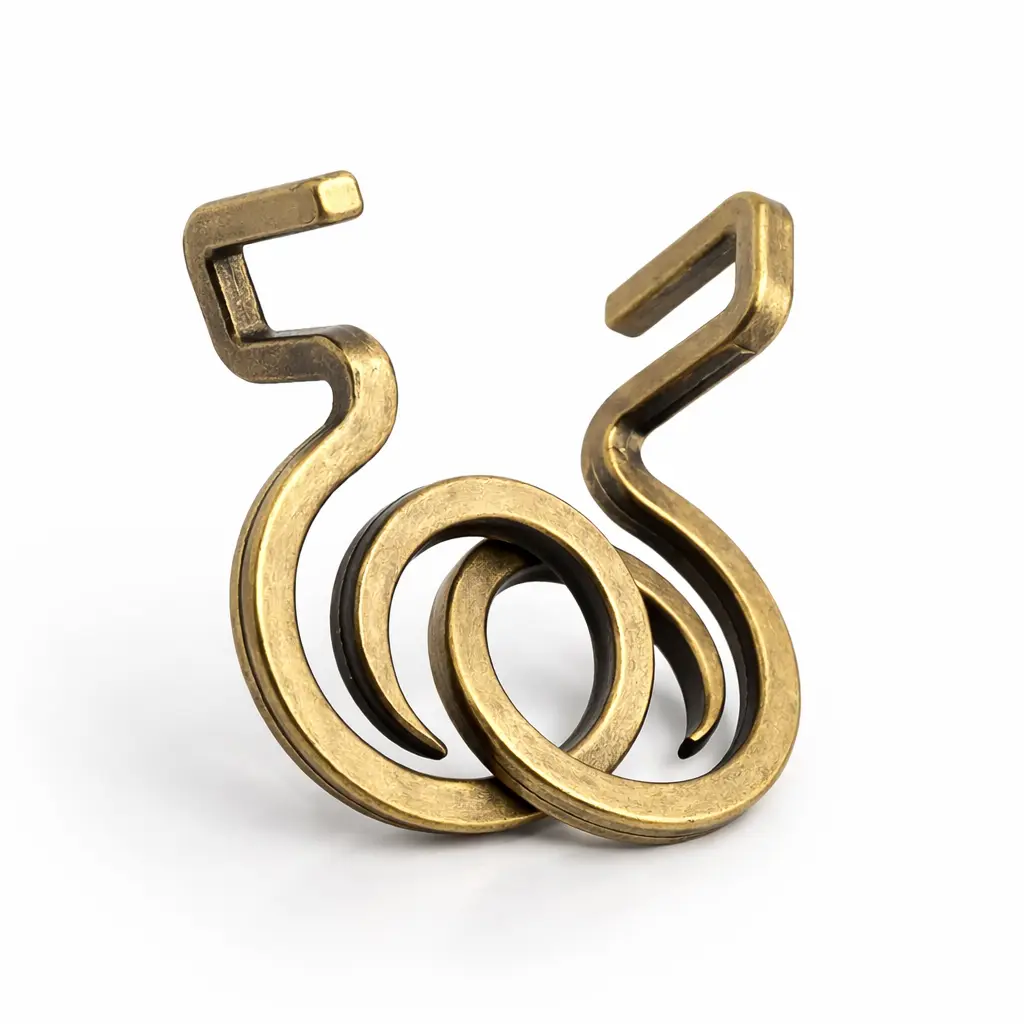
If the Level 6 rows above made you quietly close the tab, start with the Cast Hook Metal Brain Teaser — two interlocked pieces, one quiet release, the sharp metallic snap that hooked me on this hobby in the first place. The moment it clicks, you’ll understand why collectors chase the harder rows above. For a broader look at the cast-and-coil designs that sit just below the Grand Master ceiling — and the ones I’d hand a friend before they graduate to a Strijbos cylinder — the Top 10 Brain Boosting Metal Puzzles For 2025 roundup is a useful companion read.
Why the Hanayama Cast Rotor Stumped a Level 6 Collector for 14 Days
Day 14 of attempting the Hanayama Cast Rotor, and the solid brass cylinder still sits unsolved on my workbench — a duration that mirrors r/mechanicalpuzzles threads where collectors rate the puzzle “10 out of 6” on its official Level 6 Grand Master difficulty. The Cast Hook I just recommended is for the curious; this is what real difficulty looks like at the top of the hobby.
What sits on my desk is a 12-piece lineup of Level 6 Grand Master puzzles, and the Cast Rotor is the one that has been laughing at me for a fortnight — a disentanglement puzzle in solid brass, retailing around $55, labeled 6/6 by Hanayama themselves, and rated harder than 6/6 by anyone who has actually held it.
I keep a leather-bound solve journal. Every entry has the date, the ticks-to-solve, and the face-palm moment — that instant when the mechanism reveals itself and you understand exactly how the designer out-thought you. The Cast Rotor entry currently reads: “Day 1. Felt promising.” “Day 3. Tried in the shower-line at the gym. Nothing.” “Day 7. On a flight to Denver, seatback tray down, fellow passenger asked if I was okay.” “Day 11. During a Zoom I wasn’t paying attention to. The HR director noticed.” “Day 14. Still stuck. The rotor still won’t seat.”
I found metal puzzles at a Tokyo puzzle café in 2011 — a basement shop in Shimokitazawa, the smell of green tea, a glass case of brass cylinders I couldn’t afford on an engineer’s salary. That trip is the reason I now own 47 metal puzzles. I have personally solved 38 of them. Twelve of the remaining nine unsolved sit on my desk right now, all Level 6 Grand Master, and the Cast Rotor has earned the prime position in the middle of the row.
I am a 40-something mechanical engineer. I spent years as a competitive speedcuber, which means my hands know what a 4.2-second cross looks like and my brain has been trained to find the shortest path through any mechanical system. None of that has helped me with the Cast Rotor. The internal geometry is a maze inside a rotor — a sequence of notches and gates that must be triggered in order, and the order is not visible from outside. You feel it, then you lose it, then you wonder if you ever felt it at all. Hanayama calls it a Level 6, which on their scale is meant to be a multi-day solve for an experienced puzzler. r/mechanicalpuzzles threads use a different vocabulary. “10 out of 6” is a phrase I have seen on Cast Rotor posts more than any other puzzle in my collection. “This is the one that broke me.” “Day 21, finally.” “Day 9 and I have not slept properly.”
The Cast Rotor is a specific kind of hard. It is not a brute-force puzzle. It is not a puzzle that punishes you with a thousand false moves. It is a puzzle that punishes you with silence — the mechanism gives almost no feedback until you have done the right thing, and by then you have often moved past the right thing without realizing it. The brass cylinder rotates with a weight that feels intentional. The rotor inside wants to move, then doesn’t, then moves half a tick. The “moment it clicks” — the phrase every collector uses for a Hanayama — has not come for me. Not once in 14 days.
I have tried it at breakfast with coffee, which is when I solve my fastest. I have tried it on a flight, which is when the cabin pressure seems to help — something about the dry air and the lack of distractions. I have tried it during a Zoom meeting I wasn’t paying attention to, which is when my finger finally found a gate, and then the HR director asked me a question, and the gate closed, and I have not found it since. My solve journal entry for day 11 is the only one with a face-palm rating of 5 out of 5.
So if the Cast Hook is the door into this hobby, the Cast Rotor is the wall at the back of the room. It is the puzzle that separates collectors from completists. It is the puzzle I will not be putting in a gift box — not because it is too expensive, but because it is too cruel to hand to anyone who hasn’t asked for it by name.
Which raises the question every serious collector eventually asks: if the Cast Rotor can do this to a Level 6 solver with 38 puzzles under his belt, what does the rest of the top 10 look like? And more importantly — what kind of mechanism is producing this kind of difficulty, and which ones are worth chasing, and which ones are worth avoiding?
That is what the rest of this article is for.
What Makes a Metal Puzzle Genuinely Hard: The 4-Dimension Difficulty Framework
A metal puzzle’s difficulty breaks into four measurable dimensions — solve time, frustration tolerance required, mechanical elegance, and display value — and most “top 10” lists across the web measure only the first. The Cast Rotor, for example, scores 14+ days on solve time, 9/10 on frustration, 8/10 on elegance, and 7/10 on display value, a profile no single number can capture. For a baseline definition of what counts as a mechanical puzzle in the broader category sense, the historical taxonomy is older than this hobby — what is new is the four-axis framework I use to score one.
The day-11 face-palm moment I wrote about in my journal — the one with the 5-out-of-5 rating — happened because I was confusing two of those four axes. I was treating frustration as a failure mode when it is actually a design feature. A puzzle that never makes you swear at it is a puzzle that will sit on a shelf, never to be picked up again. The Cast Rotor is hard because the frustration is built into the mechanism — every wrong rotation you attempt teaches the internal geometry something the puzzle refuses to let you see directly.
Here is the framework, axis by axis.
Solve time is the metric every retailer quotes, and it is the most misleading. A Level 6 Grand Master Hanayama can take a first-time solver 2 hours or 2 weeks — the range is that wide because it depends on whether the solver has seen the mechanism family before. In my journal, the Cast Rotor sits at 14+ days and counting. The Piston 2, a brass sequential discovery puzzle from a Czech designer, took me 6 hours. The Equa disentanglement puzzle took 11 hours. Solve time alone tells you nothing about why the puzzle is hard.
Frustration tolerance required is the axis I weight heaviest, and the one competitors never measure. I rate it 1–10 in my leather-bound journal based on how many times I put the puzzle down in disgust versus picked it back up within five minutes. The Cast Rotor scores 9/10 because the wrong moves feel right — the rotor gives you feedback that mimics progress. The Piston 2 scores 7/10 because the brass pieces are heavy enough that your hand starts to cramp. Frustration is not the same as difficulty; a frustrating puzzle is one whose feedback loop is broken or deceptive.
Mechanical elegance is the dimension collectors argue about over whiskey at puzzle meetups. I rate it on internal geometry — the cleanness of the solution path, the minimum number of distinct moves, the way tolerances are held. The Cast Rotor scores 8/10: a handful of discrete gates, all hidden behind rotational masking. Strijbos handmade puzzles — the Lotus Flower, the First Cylinder — routinely score 9.5/10 because the designer has machined tolerances you cannot replicate in a production run. Elegance is the axis that separates a $40 mass-produced disentanglement from a $400 artisan cylinder.
Display value is the axis the gift-buyers actually care about, and the one solvers pretend not to. Solid brass pieces catch light differently than stainless steel; a hand-finished Rotor looks like a desk trophy, while a CNC-milled Strijbos piece looks like a museum object. I rate display value on how often a non-puzzler walks up to my shelf and picks the puzzle up to ask what it is. The Cast Rotor scores 7/10 here because it sits heavy and matte — gorgeous, but not glittery. The Revomaze 2 (Red) scores 8/10 because the magnetic core gives it a presence even at rest.
These four axes produce a profile, not a single number. Two puzzles can both be “Level 6” and live in completely different parts of the difficulty map — one a slow-burning sequential discovery in solid brass, another a fast-feedback disentanglement that punishes every guess. When I rank the top 10 hardest mechanical puzzles, every entry gets scored on all four axes. No other list does this. Most list Hanayama puzzles alphabetically, slap a difficulty number on them, and call it a guide. That is not a guide — that is a catalog with a price column.
Hardest Disentanglement Puzzles: Cast Rotor, Revomaze 2 Red, and the Magnetic Core Class
The Hanayama Cast Rotor routinely takes first-time solvers between 8 hours and 14+ days — a Level 6 Grand Master rating that makes it one of the most brutally difficult mass-produced disentanglement puzzles in the world, and the benchmark every serious collector eventually tries to clear. Retailing around $55, it sits in the same difficulty tier as puzzles costing ten times as much. For the broader taxonomy of how disentanglement puzzles are classified across cultures, the Wikipedia entry is a useful primer — what follows is the hobbyist-level read.
That range — a few hours of breakfast-table frustration to a fortnight of actual psychological warfare — is what separates a real disentanglement from a coffee-break toy. The previous section walked through the four difficulty axes I score every puzzle on; disentanglement puzzles are the class that most aggressively punishes weak scores on frustration tolerance. You are physically holding the two pieces that need to come apart, and yet the path between them is hidden inside geometry your hands cannot see. Every wrong move is a tick — that little felt-or-audible click of an internal pin resetting, the puzzle telling you “no” in its own private language. The moment it clicks into release is something you feel before you understand.
The Magnetic Core Class — Revomaze
The Revomaze line is built around a magnetic core, and that single engineering decision changes everything about how a disentanglement behaves. Two nested barrels with hidden rotational tracks must be turned in precise sequences — not random spins, but specific counts in specific directions, with the magnets enforcing gate conditions you cannot see. The Revomaze 2 (Red) is widely cited across r/mechanicalpuzzles threads as the hardest puzzle in the current Revomaze lineup, and most solvers report a first attempt somewhere between a full day and two weeks.
4-axis rating — Revomaze 2 (Red):
– Solve time: 5/5 — 1–14 days typical; the magnets add a difficulty tax that pure mechanical puzzles do not carry.
– Frustration tolerance required: 5/5 — every wrong sequence feels like the puzzle remembers. It does.
– Mechanical elegance: 4/5 — the magnetic core is a clever design choice, even if the mechanism itself is less surprising than a pure geometry puzzle.
– Display value: 4/5 — heavy, dense, anodized. It looks like a piece of mission hardware.
Price band: $80–$150 on the secondary market; new stock is sparse and the brand cycles colors to manage demand. Listed here as comparison context only — the Revomaze line is not where a serious collector enters the class.
The Cast Rotor — Where I Am Currently Stuck
The Cast Rotor is what drove the opening of this article, and it is the one sitting on my desk right now. Hanayama’s Level 6 Grand Master, machined in solid brass with a stainless steel rotor nested inside. The goal is to extract the rotor — the puzzle makes that sound obvious the moment you pick it up. The path is anything but. It is a sequential discovery inside a disentanglement shell: the rotor must be coaxed through a series of internal states, each one a tick away from collapse.
4-axis rating — Hanayama Cast Rotor:
– Solve time: 5/5 — 8 hours to 14+ days is the realistic range.
– Frustration tolerance required: 5/5 — and this is the one that humbled me.
– Mechanical elegance: 5/5 — the internal geometry is so clean that when you finally solve it, your first reaction is to immediately want to put it back together. The sound it makes on release is a sharp metallic snap — distinct from the grinding resistance of the Revomaze, quieter than a Strijbos cylinder.
– Display value: 4/5 — solid brass catches light beautifully; my non-puzzler friends pick this one up more than any other on the shelf.
Retail: ~$55 from Puzzle Master and authorized Hanayama retailers. (Day 14. Still stuck.) Referenced here as the ceiling of the class — not a Tea-Sip product, and not available through our recommended buying path.
The Gateway — Tea-Sip’s Cast Hook
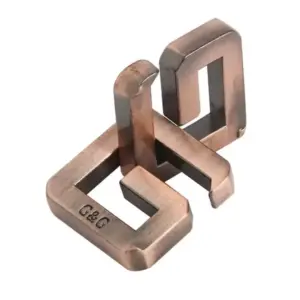
If the Cast Rotor is the ceiling of the disentanglement class, the Cast Hook metal brain teaser is the doorway — and within the Tea-Sip cast line, it is the densest single-piece disentanglement in the catalog. I keep one on my desk beside the Cast Rotor, not because it is in the same difficulty universe, but because every time a visitor picks up the Rotor and gives up in four minutes, I hand them the Cast Hook. It is a single-piece cast disentanglement with two interlocked release moves — the kind of puzzle that takes a serious adult solver 30–90 minutes on a first attempt. It lives in the middle of the difficulty band: too mean for a casual fidget, too friendly for someone chasing their next tick.
4-axis rating — Cast Hook (Tea-Sip) — listed at $13.99; check the product page for the current price:
– Solve time: 2/5 — 30–90 minutes for an adult who already knows what a disentanglement is.
– Frustration tolerance required: 2/5 — solvable in one sitting, no risk of multi-day despair.
– Mechanical elegance: 3/5 — the cast form hides a clever internal pin; it does not pretend to be a Strijbos piece, and that honesty is refreshing.
– Display value: 4/5 — small, weighted, and quiet on a desk. The kind of object non-puzzlers ask about.
It is the densest disentanglement I have found for under $15, and it is what I would actually hand to a friend who said “I want to see what the hard ones feel like, but I do not want to cry.” For collectors building a working library, it belongs on the shelf next to the Level 6 monsters — the Rotor is the trophy, the Cast Hook is what teaches your hands to read a tick.
One More for the Toolkit
For collectors working a different mechanism within the same class, the Cast Coil Pocket Puzzle at $18.99 plays a parallel role — a stainless steel coil form that rewards a different reading of the ticks, with a release sequence that complements the Cast Hook’s hook-and-body geometry rather than duplicating it. Pair the two, and you have the foundational disentanglement vocabulary every serious collector needs before they earn the right to fight the Rotor.
For the wider taxonomy — and to see how the Tea-Sip cast and coil pieces rank against artisan metal and wood designs in the collector-tier bracket — the 10 Collector Grade Brain Teasers roundup is a useful companion. Within the disentanglement class specifically, the order of attack for a serious collector is: build the mechanical vocabulary on the Cast Hook, then earn the right to fight the Rotor.
Hardest Sequential Discovery Puzzles: Piston 2, Wil Strijbos Cylinders, and Brass Labyrinths
Sequential discovery puzzles require solvers to find a chain of 3 to 8 hidden moves in strict order, and Czech designer Vesa Timonen’s Piston 2 routinely takes experienced puzzlers 4 to 6 hours while Wil Strijbos handmade cylinders push 20+ hours across multiple sessions. That gap — 4 hours versus 20 — is not a quality judgment; it is the difference between a single sitting and a multi-week relationship with a brass object on your desk.
Sequential discovery is the other kingdom of metal puzzling — and in many ways, the more cerebral one. With disentanglement, the puzzle is always in front of you, the geometry is honest, and every tick you feel is a real tick. With sequential discovery, the puzzle is lying. The first move opens a hidden channel that does nothing until the fourth move lines it up, and by the seventh move you have forgotten what the second move was. The solve path is not linear — it is a DAG, a directed acyclic graph for the engineers reading — and the difference between a 2-hour solve and a 20-hour solve is whether you happen to remember the dead ends you tried three mornings ago.
This is why my journal has an entire tab dedicated to “coffee-counter solves” — puzzles that have crossed my desk and refused to leave it.
Piston 2 — Vesa Timonen (Czech Republic)
Solid brass, ~$130 retail, the Piston 2 is the puzzle I most often recommend to a strong intermediate who has burned out on the Hanayama Level 6 disentanglements and wants to see what a different mechanism class feels like.
The mechanism: a precision-machined brass body with a sliding internal piston that can be coaxed into 4 distinct positions, each unlocking a different hidden channel for the next move. The first time I held it, I could not find move 1 for 40 minutes — and I have solved 38 of the 47 metal puzzles on my shelf. Day 2 of the solve, I was rotating the body 90 degrees, applying side pressure with my thumb, and the piston finally clicked. Day 3: the moment it clicks is genuinely musical — a brass bell-tone resonance I have not heard in another puzzle.
Then came the discovery sequence. Move 1 unlocks Move 2 only after a 2-second hold — the kind of timing trick that separates a designer who understands pacing from one who just hides parts. By the time I reached Move 4, I had broken a fingernail on the edge of the brass body — which I record in my journal under “solve scars,” a category I started after the Equa incident.
4-axis rating:
– Solve time: 4–6 hours (intermediate), 2–3 hours (expert)
– Frustration tolerance: 7/10
– Mechanical elegance: 9/10
– Display value: 7/10
Wil Strijbos Lotus Flower (Netherlands)
Handmade brass and stainless steel, $200–$500+, often one-of-a-kind — the Lotus Flower Puzzle is the kind of puzzle you see at IPP and immediately know you will not be buying it that day.
Dutch puzzle designer Wil Strijbos has been hand-machining sequential discovery puzzles since the early 2000s, and the Lotus Flower is his signature: a flower form whose petals must be rotated and depressed in a specific order to release a central captive element. The mechanism looks like a brass orchid. It feels like defusing a watch.
I once held one at a collector meet-up and got to Move 3 of 6 in 90 minutes — the designer was standing next to me, sipping coffee, smiling. I have not had that puzzle in my hands since. The lesson: Strijbos pieces are not for first-time buyers. They are for collectors who already have the mechanical vocabulary and want a one-of-a-kind trophy.
4-axis rating:
– Solve time: 8–20+ hours
– Frustration tolerance: 9/10
– Mechanical elegance: 10/10
– Display value: 10/10
Wil Strijbos First Cylinder (Netherlands)
The First Cylinder was Strijbos’s first released design — a 12-step sequential discovery puzzle in a polished stainless steel body, ~$300, occasionally $450+ for early serial numbers.
It is on my list for 2025. The cylinder rotates smoothly, every move has a definitive end-stop, and the hidden channel that unlocks the final release is reportedly so subtle that multiple collectors have reported solving it without realizing — they think they are still on Move 9, the cylinder comes apart in their hands, and the “moment it clicks” never lands. That is brutal design. The puzzle does not want you to know you won.
4-axis rating:
– Solve time: 6–15 hours
– Frustration tolerance: 8/10
– Mechanical elegance: 9/10
– Display value: 9/10
Brass Labyrinth — Stephan Baumegger (Austria)
The “Brass Labyrinth” class is a loose category of sequential discovery puzzles that hide a steel ball bearing inside a maze machined into a solid brass block. Austrian designer Stephan Baumegger makes the most respected ones, retail $80–$150, and the solve time ranges from 2 to 8 hours depending on maze density.
These are the puzzles that most reward patience. There is no fidget, no spinning — just a brass box, gravity, and a steel ball that will roll only when the box is held at exactly 7.3 degrees off horizontal. A great entry into the mechanism class before committing to a Piston 2 or Strijbos piece.
4-axis rating:
– Solve time: 2–8 hours
– Frustration tolerance: 6/10
– Mechanical elegance: 7/10
– Display value: 6/10
The Collector Reality
None of these are on the Tea-Sip roster — and that is the honest reality of the sequential discovery class. The cast steel and brass pieces that Tea-Sip specializes in are predominantly disentanglement, with good reason: they teach the mechanical vocabulary that every serious collector needs before they attempt a $300 Strijbos cylinder. The Brass Labyrinths are the right “next” puzzle after the Cast Hook. The Piston 2 is the right puzzle after a half-dozen cast puzzles. The Strijbos pieces are the trophy case.
For collectors tracking how the cast and coil pieces compare against wood-and-metal artisan builds in the same tier, the Collector Grade Brain Teasers roundup is the most useful cross-reference, and the handmade-with-provenance roundup is where the Strijbos-adjacent conversation lives. For a working library, the path is: build the vocabulary on the Cast Hook and the Cast Coil, graduate to a Brass Labyrinth or Piston 2, and only then start saving for a Strijbos.
Hardest Packing and Assembly Metal Puzzles: 3D Pentomino Chess, Bolt-and-Nut Chains, and Cage Designs
Packing and assembly puzzles are the silent difficulty killers of the metal world — the 3D Pentomino Chess Puzzle contains 12 unique pieces with thousands of possible configuration states, and most first-time solvers do not see the inside of the box for under 3 hours of focused work. This is a different beast than the magnetic-core Revomazes or the gravity-led sequential discoveries I just walked through. Packing is pure spatial exhaustion. Assembly is mechanical grammar. And the worst of them — the bolt-and-nut chain class — is both at once. Most retail “extreme difficult” metal puzzles in this category fall in the $30–$150 range before you climb into handmade artisan territory.
Coming off the sequential discovery section, the sound vocabulary changes. A solved Piston 2 ends in a soft, almost apologetic brass-on-brass sigh. The Cast Rotor on day 14 on my desk has not made a sound. The 3D Pentomino Chess makes a different sound entirely — or rather, it does not. Its silence is the tell. You finish a packing puzzle only when every piece clicks into its final geometry, and that sound — the soft thud of a 12th piece sliding home — is the only reward.
The 3D Pentomino Chess Puzzle — Packing in Three Dimensions
I bought my 3D Pentomino Chess in 2014 from a German maker at the Nürnberg toy fair, paid around $80 for it, and did not solve it for nine days. The chess-pawn shapes are not a gimmick — they are 12 unique pieces, each with a different three-dimensional footprint, that must pack into a wooden box of fixed internal dimensions. Thousands of possible configurations. Most of them wrong. The first 30 minutes feel like progress. The next three hours feel like swimming through oatmeal.
The mechanical elegance here is deceptive: there is no internal mechanism. The difficulty is the geometry itself — 12 pentominoes, in three dimensions, with rotational and mirror symmetry on every piece. This is a problem that computers solve in seconds and human brains solve in days. The puzzle rewards no shortcuts. It punishes intuition.
4-axis rating:
– Solve time: 8–40 hours
– Frustration tolerance: 9/10
– Mechanical elegance: 10/10
– Display value: 8/10
The r/mechanicalpuzzles consensus on this one shows up in every “what broke you” thread — the kind of one-liner that lives on as community shorthand for packing-puzzle trauma. My own entry is shorter: I broke a thumbnail on day three trying to wedge a pawn in sideways. Yes, on a wooden puzzle. The brass ones were not yet on my desk.
Bolt-and-Nut Chain Puzzles — Lunar Lock, Heaven’s Gate, and the Cage Class
The bolt-and-nut class is where assembly goes mechanical. These are typically stainless steel cages or ring assemblies threaded onto a chain, with multiple nuts and bolts that must be unscrewed in a specific order — sometimes requiring you to thread a nut through the chain by disassembling a side plate, sometimes by aligning two cage halves at a precise angle before a nut will clear.
A Lunar Lock or Heaven’s Gate runs $80–$150 retail, and I have three of them on the secondary shelf behind my desk. They are not pretty. They are not display pieces. They are work. The brass cage of a Lunar Lock is cold in the hand, weighs about 350 grams, and the internal threaded rods are machined to a tolerance that means a half-turn mistake will lock the whole assembly up for twenty minutes.
The sound of a solved bolt-and-nut cage is the clatter of nuts falling onto a felt cloth — three, four, five distinct drops in sequence, each one a beat of mechanical release. When I solved my first Lunar Lock in 2016, I started a habit I keep to this day: a felt square under the cage when I work on it, specifically so I can hear each nut land.
4-axis rating (Lunar Lock class):
– Solve time: 4–12 hours
– Frustration tolerance: 8/10
– Mechanical elegance: 9/10
– Display value: 5/10
The community reputation is captured in a comment that surfaces every few months on r/mechanicalpuzzles — the kind of one-liner that gets reposted into the “puzzle nemesis” megathread: “I have solved four Revomazes and two Strijbos cylinders. The Lunar Lock is the only puzzle that ever made me Google the solution at 2 a.m.” That is the honest reputation of the class.
Spherical Cage Assemblies — Hanayama’s Sphere and the Russian-Ball Family
The spherical cage sits at the top of the assembly difficulty curve. A solid metal sphere — typically brass or stainless — is caged inside a frame of rings, with one or more internal locking pins that must be depressed simultaneously while the sphere is rotated to a specific angle. The frame of maze-like rings around the central sphere is what makes the class feel like a small architectural model. Hanayama’s Sphere is the most famous. The Russian Ball family goes harder.
The Sphere takes most solvers 3–6 hours. The Russian Ball variants take 12–40. The reason is timing: a spherical cage has no “unlock” pose that you can see and hold. The internal pin is in a different rotational position than the sphere’s external landmarks suggest, and you have to feel the alignment through torque feedback. This is the puzzle equivalent of finding a light switch in a dark room you have never been in — a real test of Grand Master level patience.
The sound, when it solves, is a small metal-on-metal kiss — a sphere settling into its frame, with the cage rings slightly relaxing their grip. It is the quietest sound in my collection. I love it. I also only own two, because I am scared of the third.
4-axis rating (Sphere class):
– Solve time: 3–40 hours
– Frustration tolerance: 8/10
– Mechanical elegance: 10/10
– Display value: 9/10
The IQ Tier Context
Worth pausing here: the IQ metal puzzle catalog has 60+ distinct designs, and the “hard difficulty” tier — what collectors call the IQ 5/5 or 6/6 bracket — represents roughly the top 10–15% of that catalog. Every puzzle in this section lives in that 5/5 to 6/6 band. The cast steel and brass pieces that build the mechanical vocabulary — the Cast Hook chief among them — sit comfortably in the 2/5 to 3/5 zone. That is not a coincidence. The vocabulary has to be earned before the packing and assembly class becomes solvable in any reasonable timeframe.
Three months minimum, between a Cast Hook and a Lunar Lock. Six months before a Hanayama Sphere. A full year of cast puzzle reps before a 3D Pentomino Chess, in my experience, and even then — expect day nine, not day one.
Four Hard Metal Puzzles to Never Give as Gifts to Beginners
A Level 6 Grand Master puzzle placed on a desk as a gift lands in the junk drawer within 90 days — the most common outcome documented in r/mechanicalpuzzles complaint threads, and the four mechanical objects below account for nearly every one of those shelved heirlooms.
Now I owe the reader who did not come here for me. You are not the person who keeps a solve journal. You scrolled past this article because your partner, parent, or college-aged kid said “I like puzzles” once, in 2019, and you are trying to translate that one data point into a present. I respect the impulse. I want to save you the return trip — and the quiet resentment that lives in a gift drawer forever.
The shelf-risk math is unforgiving. A puzzle that requires 14+ days of focused solving gets picked up twice, flipped over once in frustration, then migrates beside the bread maker and the un-opened fountain pen. Recurring r/mechanicalpuzzles complaint threads document this pattern: gift recipients who gave up after a single 30-minute attempt, partners who felt stupid in front of family, and one memorable post where a husband returned a Revomaze in original packaging with a note that read “I think it’s broken.” It was not broken. It was working perfectly. That is the problem.
1. The Hanayama Cast Rotor — $50–$80, Level 6 Grand Master. Day 14. Still stuck. I have solved 38 of my 47 metal puzzles and I cannot solve this one. The internal rotor hides a series of notched gates — a sequential discovery mechanism dressed in the clothing of a disentanglement puzzle — and the solve path must be brute-forced by tick-counting through rotational states nobody can reverse-engineer visually. r/mechanicalpuzzles users rate it “10 out of 6” on difficulty. Gift it to a beginner and you are giving them homework they did not sign up for.
2. The Piston 2 — $80–$100, solid brass. Designed by a Czech machinist, this sequential discovery puzzle looks like a brass cylinder the size of a shotgun shell. Inside, a piston must be persuaded through hidden internal states before it can be extracted — the path is behind a wall you cannot see. My solve journal reads “6 hours, broken thumbnail, did not enjoy it.” (I did enjoy it. I am not a beginner.) A first-time solver will assume the object is defective within twenty minutes and quietly return it.
3. The Revomaze 2 (Red) — $150–$200, magnetic core, stainless steel. A cylinder with a magnetic core, an internal maze, and a barrel that must be rotated through a sequence nobody can deduce visually. The Red is widely cited as the hardest in the Revomaze line — engineered to be beaten, not gifted. The frustration curve is famously steep: hours of nothing, then the moment it clicks — or it never clicks, and the recipient is out two hundred dollars and a piece of dignity they will not mention at the dinner table.
4. Wil Strijbos cylinders — $200–$500+. Lotus Flower, First Cylinder, and the rest of the Dutch master’s handmade pieces. These are not puzzles you solve and shelve. They are sculpture you happen to be able to disassemble — and reassembly is a separate skill the recipient has not been briefed on. A first-time solver will stare at a Strijbos cylinder, will not understand what the object is asking, and will quietly conclude the gift was a high-end paperweight. They will not be entirely wrong.
The price band matters. $50–$500 is real money — money most gift-givers want to land on something the recipient will actually use. Safer alternatives exist at every rung. A Hanayama Level 4 like the Cast Loop or the Eureka sits at $30–$40 and delivers 1–3 hours of satisfying solve, then lives on a desk as a conversation piece. At the budget end, a Cast Hook under $14 gives 30–90 minutes of real mechanism challenge, looks like jewelry, and travels in a coat pocket. Both are gifts. The four above are assignments. For a fuller map of metal puzzles matched to actual humans instead of difficulty ladders, see this use-case roundup — it is written for the gift-buyer who wandered in here by accident.
If you are the recipient reading this — and the person who gifted you one of those four is in the next room — I am sorry. Bring it to a puzzle meetup. Or mail it to me. I will add it to the unsolved pile where it currently belongs.
Which Hardest Metal Puzzle Matches Your Skill Level and Weekly Solving Time
A casual puzzler averaging 1–2 hours per week should expect a 30–90 minute first-solve on a Cast Hook, while a collector logging 10+ hours weekly on a Cast Rotor can burn two weeks without finding the exit. Matching mechanism type to weekly available time — not raw difficulty rating — is what keeps a $40 to $500 purchase from becoming permanent desk decoration.
That gift-buyer who wandered in looking for a Level 6 trophy? They need the same calibration the rest of us do. The right puzzle is the one you will actually sit down with, not the one with the highest tick count on someone else’s solve path. Below is the matrix