Quick Answer: Best Wooden 3D Puzzles for Adults at a Glance
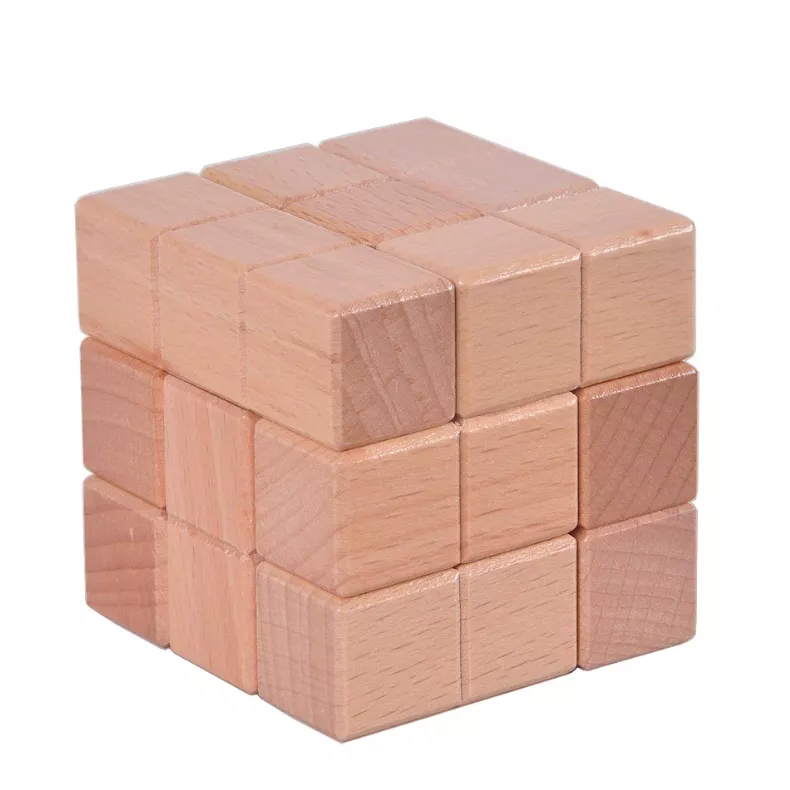
The Luban Cube Puzzle is the best wooden 3D puzzle for adults who want a fast, skill-building brain teaser — 6 interlocking pieces of laser-cut birch plywood that snap together in 20–40 minutes without glue, priced at $21.99. It earns the top spot by delivering genuine mechanical puzzle satisfaction in a single sitting, unlike multi-day kits that demand hours before the first gear turns. For the wider category browse, see the full wooden puzzles collection.
| Pick | Best For | Price | Skip If |
|---|---|---|---|
| Luban Cube Puzzle (Best Overall) | First-timers who want a no-glue brain teaser with real mechanical satisfaction | $21.99 | You want a multi-day build or a purely decorative display |
| 3D Wooden Carousel Music Box | Adults who want a music box mechanism paired with a display-worthy finished model | $43.99 | You’d rather have pure mechanical movement with no melody |
| 3D Wooden Mechanical Pistol Kit | Hobbyists who want moving parts you can hold, operate, and fiddle with | $29.99 | You dislike themed kits or want something abstract |
| 3D Zodiac Owl Mechanical Clock Puzzle | Collectors building a shelf display with personality and a functional clock mechanism | $39.99 | You want a pure logic puzzle, not a decorative object |
Most adult wooden 3D puzzle kits sit between $25 and $90, with mechanical and music box models clustering at the higher end — but the Luban Cube undercuts all of them while still being precision-cut from natural plywood. Last Sunday at 11pm I was hunched over a ROKR pinball machine with tweezers and a headlamp when my partner walked by and said, “You’re 40 years old.” That’s the hobby. The table above is sorted by what kind of experience you actually want — logic challenge, music box, mechanical transmission, or decorative display — so you can self-select in 30 seconds. For the full build-tested breakdown of every pick, see our 7 Best Wooden 3D Puzzles For Adults In 2025 Tested guide.
The Four Categories of Wooden 3D Puzzles Adults Actually Build
The pinball kit from last Sunday was a mechanical/movement build — and the experience you get from any adult wooden 3D puzzle depends almost entirely on which of the four functional categories you reach for first. Wooden 3D puzzles for adults fall into mechanical/movement, marble run, music box, and decorative display categories — and most first-time buyers benefit from picking a category before picking a model. Wikipedia’s entry on 3D jigsaw puzzles covers the structural family, but the functional split is what matters at the shelf.
Mechanical/movement kits are the headline act. Gears, camshafts, escapements, differentials, working pinball flippers, spinning rotors — the works. These are the kits where you’re not just assembling a self-assembling model; you’re building a small machine. Piece count typically runs 150 to 500-plus (Ugears’ flagship gear models sit at the top end), and a first-timer should budget 4 to 15 hours. A ROKR pinball machine eats a full weekend; a simpler Ugears clock escapement can be knocked out in a long evening. The reward is that the thing actually moves when you’re done — wind it, flip a switch, and a camshaft drives a chain of mechanical transmission events. If you’ve ever been the person who takes a clock apart to see what’s inside, this is your category, and it’s the busiest lane for wooden mechanical puzzles on the market right now. Wikipedia’s mechanical puzzle entry is the deeper background read.
Marble run kits are a sub-genre of mechanical but they earn their own slot because the experience is fundamentally different. You’re not watching gears mesh; you’re watching steel balls fall, bounce, get lifted, and fall again. ROKR’s Marble Night City at 294 pieces and 10 steel marbles (6-10 hours for a first-time build) is the canonical example — you crank a handle, the marbles cycle up, and the whole table becomes a kinetic sculpture. Piece counts usually run 200 to 400, build time 6 to 12 hours. These are noisier builds (the balls click against the rails), and the assembly requires more patience with track alignment than a pure gear kit — get one rail out of true and your marble jumps the gap on the first run.
Music box kits trade visual spectacle for audio payoff. The build is the same no-glue snap-fit technique as the other categories — laser-cut birch plywood, numbered sheets, step-by-step instructions — but the reward is a hand-cranked music mechanism playing a few bars of a recognizable tune (“Castle in the Sky,” “Fur Elise,” whatever the brand licensed). Piece counts sit lower, typically 100 to 300, with build times of 3 to 8 hours. Robotime’s Magic Amusement Park Swing Ride is the recurring flagship: a rotating carousel that plays while it spins. For wooden 3d puzzles for beginners this is often the safest entry point — fewer moving parts to misalign, and the result is instantly tactile and aural.
Decorative display kits are the ones you build for the shelf, not the desk fidget pile. Tonecheer’s Onsen Saga — a desktop display piece with a tiny storage compartment — is the high-water mark of this category, alongside the cello and owl-shaped display kits sitting in the same lane. Piece counts are manageable (50 to 200), build times short (2 to 6 hours), and the finished model is meant to live on a bookshelf or side table as desktop decor, not be wound up. These are great gifts because the recipient doesn’t have to “do” anything with it after — it just sits there looking good and gathering compliments from people who don’t know what it is.
Then there’s a fifth form worth naming because it keeps showing up in adult puzzle hands: the brain teaser / hand-held mechanical wooden puzzle. Think Luban locks, cube-assembly puzzles, and spatial disentanglement boxes. These aren’t models you build over a weekend; they’re pick-up-and-fiddle objects designed to be solved, then re-solved by someone else. They function as fidget toys in the best sense — a tactile object you can manipulate for ten minutes between meetings, then put back on the shelf looking like a piece of modern sculpture. The 54-T Cube Puzzle is a good example of this brain-teaser lane — 54 T-shaped pieces you assemble into a cube, with the satisfaction coming from figuring out the geometric pattern rather than watching a mechanism run.
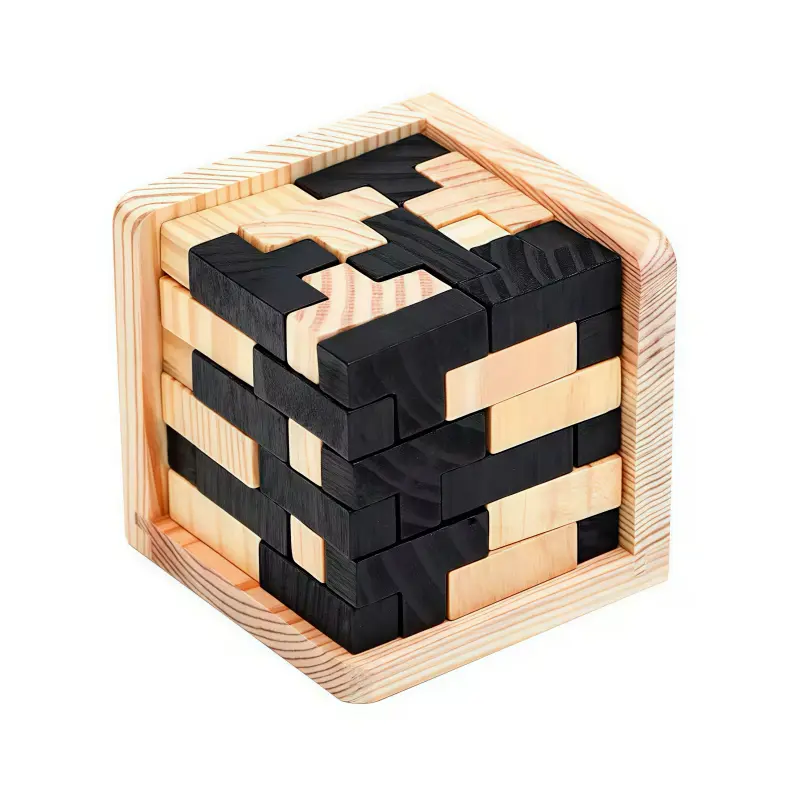
54‑T Cube Puzzle — $18.99
If you’re shopping your first kit and have no idea where to start, the category does the choosing for you: music box for low-risk first wins, marble run for spectacle, mechanical for the hobbyists who’ll build another next month, and decorative display for gifts to people who already have a shelf with a gap on it. Skip the brain-teaser lane until you’ve finished a model kit at least once — it teaches you how the precision-cut tolerances actually feel in your hands, which makes the fiddly locks much less frustrating later.
What Separates a $30 Kit from a $90 Kit: The Five-Criteria Rubric
The five criteria used to score every kit in this guide are build quality (laser-cut precision and tab tolerance), mechanism function (do gears actually mesh), display value (will it survive the shelf), difficulty curve (piece count to realistic hours), and instruction clarity (can you build it without YouTube). Now that you know which category fits the kind of build you actually want — mechanical, music box, marble run, or decorative display — the next question is why two kits sitting in the same category can be priced $30 to $60 apart. The answer almost always comes down to five measurable things, and publishing the rubric upfront means you can apply the same lens to any wooden 3D puzzle you find on a shelf next year, not just the ones on this list.
Build quality is the first thing your fingers will tell you. A good kit uses 2–3mm birch plywood or natural plywood with laser-cut tabs that snap cleanly without splintering and without being so loose the joint flops in your hand. Press a small tree piece out of its frame and watch the edge: it should release as a single clean cut, not a fuzzy furball of torn fibers. On smaller brain-teaser kits like the Blockade Puzzle or 54-T Cube Puzzle, this is the single most important criterion — there are no gears to distract you, so the wood itself is the entire experience. On larger model kits, the same standard applies to a hundred small parts, and you feel the difference on the third tab you press out.
Mechanism function is the test of whether anything actually moves. A kit with a camshaft, gear train, or escapement either works smoothly or it doesn’t — and “almost” is the enemy. The ROKR Marble Night City (a 294-piece, 10-marble benchmark in the category) is a useful reference here: when its lift and drop mechanisms work, the marbles click through with a satisfying clack; when they don’t, they jam on the second ramp and the fun is over. Tea-Sip’s 3D Wooden Carousel Music Box and the 3D Wooden Perpetual Calendar Puzzle both ship with simple, well-trodden movement designs that prioritize reliable operation over visual spectacle. If the moving parts of your finished model can’t run for two minutes without a stall, it failed this criterion.
Display value is the question “will this survive the shelf.” Some kits look great in the box photo and end up with visible glue lines, yellowed plywood, or a wobbling base. Others — like the 3D Zodiac Owl Mechanical Clock Puzzle or the 3D Wooden Cello Puzzle Model Kit — were designed as desktop decor from day one, with proportions and finish that hold up under living-room light. Ask yourself honestly whether you’d leave the finished model on your desk for a year. If not, the kit probably isn’t worth the box it came in.
Difficulty curve is where most first-timers misjudge. The relationship between number of pieces and realistic hours works like this: under 100 pieces is an evening project (2–4 hours for a careful adult first-timer), 100–250 is a weekend (6–12 hours, often split across two days), and 250+ is a multi-day commitment that lives on the dining room table. The 3D Wooden Puzzle Treasure Box sits at the lower end of the model-kit range and is a real “sit down and finish it” build, while the 3D Wooden Puzzle Clock DIY Kit is more of a coffee-table project that takes a full Saturday with a podcast in the background.
Instruction clarity is the silent killer. A good manual uses isometric diagrams, numbers every part, and tells you which way a tab faces. A bad one forces you to scroll YouTube at 2am with tweezers in one hand and your phone propped against the box. Every Tea-Sip model kit in this guide ships with a step-by-step booklet in the right format, which is part of why they’re on the list at all.
The rubric is yours to steal — apply it to whatever kit catches your eye next quarter, including the cross-brand comparison we put together in I Tested 6 Premium Wooden Puzzle Brands Here’s The Honest Comparison.
Mechanical and Marble Run Puzzles: The Movement-Driven Picks
Mechanical and marble run puzzles in the adult range run 150–400+ pieces and typically take 5–12 hours to build, with the ROKR Marble Night City (294 pieces, 10 steel marbles, 6–10 hour first-build) and the ROKR Pinball Machine as the movement-driven benchmarks.
The rubric we just walked through was stress-tested most aggressively on this category. A static decorative box can hide flaws; a marble run that doesn’t actually cascade, or a clock whose hands skip a minute, gets returned with a one-star review. Movement is the unforgiving feature — it works or it doesn’t.
If you spend time in the r/woodenpuzzles or r/hobbies threads, two kits surface as the default recommendation: the ROKR Marble Night City and the ROKR Pinball Machine. The Marble Night City is the conversion kit — 294 laser-cut plywood pieces, 10 steel marbles, 6–10 hour first-build. Watching the marbles trace a path through a plywood skyline you’ve spent a Saturday constructing is the moment most people go “oh, this is actually a real hobby.” The pinball machine is the louder cousin — flippers, bumpers, a score wheel, the works. Both show up in nearly every rokr wooden puzzle review you’ll read.
Before we get to the kits that ship from us, here’s a side-by-side of the five brands that dominate the movement-driven space — ROKR, Robotime, Ugears, Wood Trick, Wooden.City — scored on the same five criteria.
| Criteria | ROKR | Robotime | Ugears | Wood Trick | Wooden.City | Winner |
|---|---|---|---|---|---|---|
| Build quality (plywood grade, fit) | Very good | Good | Excellent | Good | Excellent | Ugears / Wooden.City |
| Mechanism precision (gear mesh, escapement) | Good | Good | Best in class | Fair | Good | Ugears |
| Display value (finished look) | Good | Excellent | Good | Fair | Good | Robotime |
| Difficulty curve (beginner → expert) | Mid | Entry–mid | Widest (100+ models) | Entry–mid | Mid–hard | Ugears |
| Instruction clarity | Very good | Good | Fair (text-heavy) | Fair | Good | ROKR |
A few things jump out of this ugears vs rokr vs robotime comparison. Ugears owns the mechanism column — their 100+ model catalog includes escapements, differentials, and full gear trains no one else in the category executes as cleanly. The trade-off: their manuals are text-heavy and the English translations can test your patience. ROKR is the inverse — slightly less ambitious mechanisms, but the best manuals in the category. Robotime wins on finished display value; their decorative pieces look the most “store-bought” on a shelf. Wooden.City ties Ugears on plywood grade but their marble run designs skew architectural and forgiving. Wood Trick sits middle-of-the-pack — a solid second-tier option if you find one discounted. And for the adult asking which is better — ROKR, Robotime, or Ugears — the answer genuinely depends on which of the five criteria you care about most.
Now, the movement-driven kits that ship from the Tea-Sip shelf — five picks, each at a different price point, aimed at a slightly different kind of adult builder. All are laser-cut birch plywood, no glue required, snap-fit assembly. (None of these are a traditional wooden marble run puzzle adult setup with the long gravity cascade — for that specific format, Wooden.City’s Archipelago series is the closest mainstream option — but each kit here has a moving mechanism that earns its place in this category.)
1. 3D Wooden Mechanical Pistol Kit — $29.99. The first kit I hand to anyone who says “I want something with moving parts I can hold.” Around 200 pieces, 6–10 hour first build, the action cocks and the trigger releases a spring-loaded hammer on the assembled model. This is a 3D wooden puzzle with moving parts that you operate, not just watch — pull the slide back, hear the click, then dry-fire at the cat. The laser cuts on the small interior parts are clean, which matters more than usual because a misaligned sear in the firing mechanism means the trigger does nothing.

Weakness: this is a themed kit, and themed kits divide people. If you don’t want a pistol-shaped object on your shelf, skip it. Buy it for the friend with a desk drawer full of fidget spinners who wants the steampunk puzzle version of one. Skip it if you want something abstract — the Zodiac Owl in the next section is a better fit.
2. 3D Wooden Perpetual Calendar Puzzle — $39.99. The most mechanically interesting non-music-box kit in our roster, and the one that comes closest to a ROKR-style gear train in a desktop-display format. Around 280 pieces, 10–14 hour build. You set the date with a series of wooden dials, and the calendar mechanism uses a small cam-and-lever system to advance the day when you turn the side crank. The intricate design hides its function well — it looks like a decorative block until you realize it’s a working machine. Quiet, perpetual, and useful.
Weakness: the dials need to be aligned by eye when you set the date, and getting them perfectly square takes patience. I made a template card out of scrap paper to mark the position before each turn. Buy it for someone who has a real desk and a real need to know what day it is. Skip it if you want a kit that runs itself — this one needs a daily turn.
3. 3D Wooden Puzzle Tanker Truck Kit — $22.99. The budget entry in the movement category and a real surprise. Around 180 pieces, 5–8 hour first build, the truck rolls on functional wooden wheels and the tanker body detaches from the cab on a small hitch mechanism. Not as ambitious a mechanism as the Pistol or Calendar, but the price is the draw — it’s a working vehicle model for under $25, which is unusual in this category. Good for a first-timer who isn’t sure they want to commit to a 10-hour build.
Weakness: the wheel axles are thin and snap if you push them too hard into the frame. Wax the axle ends before final assembly. Buy it for the parent who wants a child to see how wheels actually go together. Skip it if you want a kit with a complex functional mechanism — this is rolling, not engineering.
4. 3D Wooden Puzzle Treasure Box – Mechanical Jewelry Storage Gift — $29.99. The most useful kit in the movement-driven lineup, because the finished model does something besides look good. Around 220 pieces, 7–11 hour build, the box opens via a hidden cam-and-pin combination that takes a few tries to learn and a few seconds to operate once you do. Stores rings, earrings, small watches, or whatever fits through the 8cm × 5cm opening. The combination mechanism is a small but real mechanical transmission, and the secret to operating it is satisfying to learn.
Weakness: the secret to opening it is genuinely a secret, which means a gift recipient may need a 30-second demonstration the first time. Build it yourself first, learn the sequence, then include a card with the box. Buy it for the person in your life who has a real jewelry problem and a small desk. Skip it if you want a visible display mechanism — the action is hidden inside the box walls.
5. 3D Wooden Puzzle Safe with Combination Lock — $30.99. The puzzle your engineer friend will actually keep on the shelf. Around 240 pieces, 8–12 hour build, the safe has a working combination dial on the front that opens the door when you turn to the right three-number sequence. The mechanical transmission is the star: a series of cams behind the dial need to align before the bolt releases, and you can feel the resistance change as each number slots in. Heavier plywood than most kits in this price range, which makes the finished safe feel solid on the desk.
Weakness: setting your own combination requires aligning three cams during the build, which is a step most first-timers get wrong once. Read the combination-setting pages twice before you commit. Buy it for the puzzle-curious adult who already has a desk safe and wants to see how the lock works. Skip it if you want a decorative display model — this is a working safe, not a sculpture.
Music Box and Decorative Display Puzzles: The Desk-Worthy Picks
Music box and decorative display puzzles typically run 150–300 pieces, $35–$80, and produce models you actually leave on the desk — the Robotime Magic Amusement Park Swing Ride Music Box and the Tonecheer Onsen Saga being the clearest mainstream examples. The Tea-Sip catalog for this category leans on carousel music boxes, mechanical clocks, and ornamental instrument models that hit the same use case: a build you finish on a Sunday and then stare at on Monday morning while your coffee cools.
This is the second of the four adult-targeted categories, and it answers a question the marble-run kits in the previous section don’t: what do you do with the model after the build? A movement-driven kit earns its place by running. A decorative display puzzle earns its place by being present on your shelf, your desk, or your credenza for years afterward. The aesthetic bar is therefore higher — warped plywood and sloppy laser cuts show from across the room — and the mechanism is often simpler. You trade gear-train complexity for visual finish.
1. 3D Wooden Carousel Music Box — $43.99. The headline pick for this section and the most direct answer to the “wooden music box 3d puzzle” search intent in our catalog. The kit pairs a rotating carousel platform with a real pinned-cylinder music box movement, so when you turn the crank the canopy spins and a tune plays at the same time. Upper end of the piece-count band at roughly 280–320 pieces, first build runs 10–14 hours for a careful adult. The cylinder mechanism is the make-or-break detail: a cheap movement sounds tinny and skips a beat every rotation. This one doesn’t.
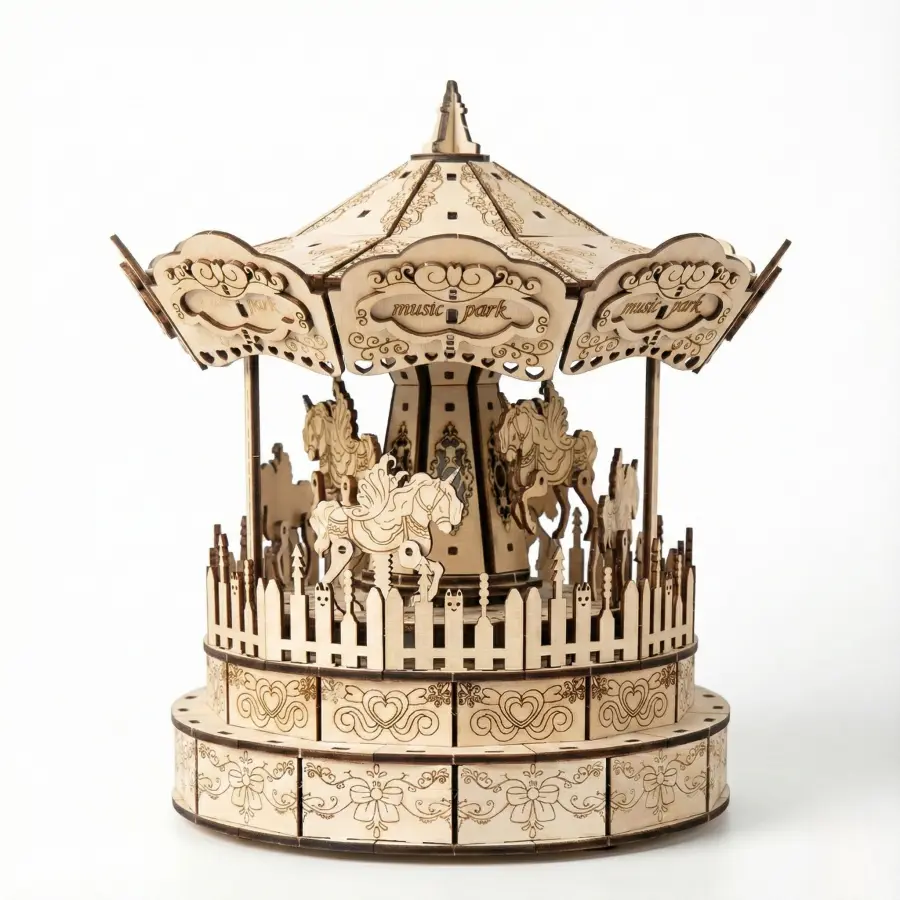
Honest weakness: the carousel poles are thin, and a couple snapped on me when seating the canopy. I glued them back, and the glue line is invisible because the cylinders hide the joint — but if you’re a strict no-glue purist, file this as a kit that may need a single discreet drop of wood glue during assembly. Buy it if you want a kinetic desktop piece that visitors will actually ask about. Skip it if you want silence; music box kits are not quiet, and your partner will hear the tune from the next room.
2. 3D Wooden Cello Puzzle Model Kit — $29.99. The instrument-shaped decorative model in the roster, and the cheapest way to put a finished puzzle on a bookshelf that doesn’t look like a kit. Around 200 pieces, 6–10 hour build, no mechanism beyond a static display. The curves of the cello body and the scrollwork at the neck are where the laser cutter earns its keep — these are details a 2D puzzle can’t fake. This is the pick I’d hand to someone who wants a build for the satisfaction of a clean silhouette on the shelf rather than a working mechanism.
Weakness: there’s no moving part, no music box, no lighting. If you want the cello to do something, this isn’t it. Buy it for the music lover on your gift list who has a real instrument and will appreciate the replica. Skip it if you specifically need a 3D wooden puzzle with lights — this is wood, glue-free, and silent.
3. 3D Zodiac Owl Mechanical Clock Puzzle — $39.99. The lit-LED model in the category, and the answer to anyone searching for a 3D wooden puzzle with lights that isn’t a Christmas-decoration knockoff. The owl is the housing, the eyes glow via a small LED module, and the mechanical clock movement ticks inside the body. Around 240 pieces, 9–13 hour build. The owl form is doing real work here — it disguises the fact that the clock movement is a standard quartz module, so the result reads as a sculpture first and a clock second.
Weakness: the LED wiring is fiddly. Tea-Sip ships a small battery box, and routing the leads through the body without pinching them is the make-or-break moment in the build. (Mine took two attempts because the first time the negative lead got trapped under a wing joint and the eyes wouldn’t light.) Buy it for a den, a child’s room, or a nightstand — the warm light is a nice 2am companion. Skip it if you’ve never built a kit with a battery module before; start with a simpler mechanical kit first to learn how those routes work.
4. 3D Wooden Puzzle Clock DIY Kit — $26.99. The budget entry in the clock category, and the pick I’d make for a first-timer who wants a working desktop clock at the end of the build. Around 180–220 pieces, 6–10 hour build, sub-$30 price point that puts it in the same band as the cheap Amazon kits the previous section warned about — except the laser cuts are clean, the birch ply is furniture-grade, and the step-by-step instructions actually correspond to the parts in the box. The clock face is plain Roman numerals on a wood dial, which I prefer over printed graphics because it ages well.
Weakness: the hour and minute hands are thin and warp if you store the kit in a humid room. Build it in a dry space. Buy it as a gift for the coworker who keeps asking what you do on Sunday nights. Skip it if you wanted the owl’s personality — this is a quiet, traditional clock.
5. 3D Wooden Carousel Music Box — $43.99 (Repeat reference): Listed above as the music box flagship; the 3D Wooden Cello Puzzle Model Kit at $29.99 is the most natural display-piece fifth option if you want a pure visual. Tonecheer’s Onsen line offers hollow-body storage designs in the same lane, but the cello wins on silhouette and gift-giving clarity.
What to do with it after the build. Don’t glue the final assembly — snap-fit joints let you disassemble for cleaning if a tab cracks years from now. Keep the model out of direct sunlight (birch ply yellows fast), and dust with a soft makeup brush, not a feather duster, because feather dusters just relocate the dust into the gear train. For deeper coverage of music box kits across skill levels, Tea-Sip’s separate guide to the best wooden music box kits is worth a read before you commit to a build.
First-Build Expectations: Time, Tools, and the Frustration Curve
A first wooden 3D puzzle build for an adult takes 3–8 hours spread over 1–3 sessions, requires only a craft knife and tweezers in roughly 90% of kits, and typically hits its first real frustration point around the 60% completion mark when gear alignment or cam placement becomes critical. That’s the honest answer to the “how long will this take” question most listicles skip, and the one that comes before you even think about where to put the finished model on your shelf.
Here’s the actual tool list, stripped of affiliate-blog bloat: a sharp craft knife, a pair of fine-tip tweezers, and a flat work surface. That’s it. About 90% of wooden 3d puzzle kits no glue required ship with everything else you need in the box. The laser-cut plywood is precise enough that pieces practically fall out of the frame with a fingertip push — no tools required for extraction, only for the occasional stubborn nub. The remaining 10% of kits — usually the marble-run kits and the larger ROKR models — also want a small headlamp and a tube of beeswax or paraffin for gear lubrication. The headlamp matters more than you’d think: once you’re aligning tiny camshafts at 10pm under a desk lamp, you’ll understand why every experienced builder I know owns three.
Piece count is the best predictor of total build time, and the bands I’ve settled on after five years are these. Under 100 pieces is an evening project — a Luban Lock, a Soma Cube, the small brain teasers — finishing in 90 minutes to three hours for a first-timer. The 100 to 250 piece range is a weekend build: think the 3D Wooden Cello Puzzle Model Kit, most Tonecheer desk pieces, the smaller Robotime music boxes. Budget two afternoons, or a Saturday-morning-to-Saturday-night push if you’re in flow. 250-plus is a multi-day commitment: ROKR Marble Night City at 294 pieces, the bigger ROKR pinball machines, anything with a marble run. First-timers should expect six to ten hours of hands-on time and a strong urge to walk away at hour four. Don’t. The last 20% is where the model actually comes together. For a deeper phase-by-phase walkthrough, the 57 essential 3D wooden puzzle assembly tips guide covers the full workflow in detail.
The 60% frustration point is real, and I wish someone had warned me on my first build. Around the three-quarters mark, the easy snap-fits are gone, the step-by-step instructions have gotten more abstract, and you’re trying to mate a gear train to a camshaft while holding three other sub-assemblies in place. This is where most beginners quit, snap a tab, and blame the kit. The kit is rarely the problem. The fix is almost always one of three things: stop, re-read the last four steps, and verify the part number you actually pulled out of the frame (a surprising number of “broken” builds are a part placed one slot off in the tree). If gear mesh is the issue, back the sub-assembly out, wax the contact points, and rebuild dry before final click-in. You’ll sometimes fiddle with a single gear for twenty minutes before realizing it’s the right gear on the wrong sub-assembly — that moment, painful as it is, is where the hobby actually starts.
A snapped tab is not a death sentence. Finish the build first — you can’t evaluate the damage until you see how the joint loads in the final structure. Often the tab is non-load-bearing and the model is fine. If it is load-bearing, a tiny dab of cyanoacrylate on a toothpick, applied from the inside so it doesn’t bleed into the visible surface, holds for the life of the model. If you’ve never built anything in this category before, the 7 Color Soma Cube Puzzle is the smartest entry point: under 100 pieces, a one-evening build, desk-worthy enough to leave out after, and the spatial-reasoning lessons carry directly into every bigger mechanical wooden puzzle you’ll touch later.
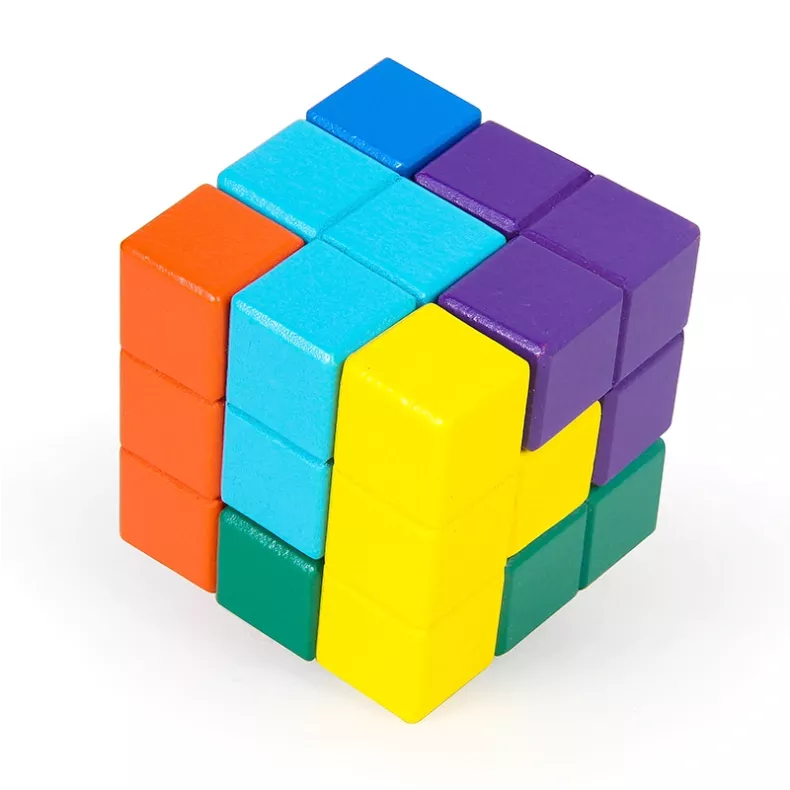
7 Color Soma Cube Puzzle — $21.88
It’s also one of the best wooden 3d puzzle for beginners kits on the market because it teaches the “look before you snap” habit that prevents most first-build tab breaks on larger models. The universal 6-step method I break down in How To Solve 3D Wooden Puzzles: The Universal 6-Step Method applies — sort, dry-fit, build sub-assemblies, integrate, test, finish. It’s the workflow that turned my first 12-hour Ugears build into a 5-hour one, and it’s the only piece of hobby advice I’ll give twice in one article.
Cheap Amazon Kits vs Brand-Name Kits: Where the Extra $50 Goes
That 6-step method only works if the kit underneath you isn’t fighting back. A $20 no-name kit and an $80 ROKR or Ugears kit list the same material spec on the box — 2-3mm laser-cut birch plywood, no-glue snap-fit assembly — but the $60 gap shows up in three places: tab tolerance, instruction clarity, and mechanism alignment. That gap is where your money actually goes.
The tabs on a cheap kit are cut to a sloppy tolerance, fine for a 30-piece decorative model and fatal for a 200-piece gear train. I’ve watched three friends try to build a $19 marble run from a marketplace seller; two of them bailed halfway through because the cam gears wouldn’t seat, the instructions were clearly photocopied, and one tab was mislabeled by about 15°. Same material spec, same product category, completely different result. A 12-piece Luban lock can survive a sloppy laser cut because the mechanism is simple. A marble run cannot.
The Under-$20 Tier: Skip Unless It’s a Brain Teaser
If you’re browsing a laser cut wood puzzle kit under $20 that promises 200+ pieces and a moving mechanism, walk away. The price floor for a usable mechanical wooden 3D puzzle is around $25, and even that gets you only the smallest ROKR pinball or Robotime music box. Below that line you’re paying for stamped plywood and step-by-step instructions printed on copy paper. The exception: small interlocking puzzles like the Luban family, which are precision-cut but simple enough that minor tab slop doesn’t kill the solve.

Blockade Puzzle — $16.99
The Blockade Puzzle at $16.99 is a fair example of that exception. It works because it’s a small wooden brain teaser, not because it’s cheap. Don’t confuse the two.
The $25–$40 Entry Tier: The Sweet Spot for First Builds
This is the wooden 3d puzzle under 50 range where most adult first-timers should actually shop. A $30 Robotime music box or a $35 ROKR marble run gives you decent tab tolerance, real printed instructions, and a mechanism that actually moves when you finish. Brand-name kits in this range typically run 100–200 pieces and finish in 4–8 hours, which is exactly the right scale for a weekend project.
The $40–$70 Mid Tier: Where Mechanisms Start Working
Past $40, you’re paying for precision gear meshes, multi-stage camshafts, and instruction booklets that won’t make you squint. A ROKR pinball machine or a Robotime Swing Ride in this range has the engineering headroom to keep its mechanism working after a year of desk life. This is the tier where the wood model kit stops being a one-evening project and becomes a self-assembling model you actually want to keep built.
The $70–$90+ Premium Tier: For the Hardest Wooden 3D Puzzle You Want to Build This Year
This is the hardest wooden 3D puzzle territory — Ugears’ larger mechanical transmissions, Tonecheer’s more elaborate Onsen display models, the ROKR Marble Night City with its 294 pieces and 10 steel marbles. You’re paying roughly $1.50–$3.00 per piece for a kit that will still look like a desktop decor piece a year from now. The piece count alone takes this from a weekend into a multi-day commitment.
The Per-Hour Math That Sells the Hobby
Reddit users on r/hobbies and r/woodworking have run this calculation more than once: a $60 wooden 3D puzzle with 200 pieces and an 8-hour build works out to about $7.50 per hour of engagement. A $60 Lego set of similar complexity runs 4–6 hours and lands at $10–$15 per hour. The wooden kit is cheaper per hour, and you end up with a display model instead of a plastic toy. The cheap kit, by contrast, takes 12+ hours because you spend half of it fighting the instructions and prying out broken tabs — a worse deal than either.
If you want the hobby to stick, buy once in the $30–$60 range and skip the $20 lottery. For first-build guidance on which kit to actually start with, The 3D Wooden Puzzle You Should Build First And Why lays out the path I wish someone had handed me five years ago.
What to Skip, How to Gift-Match, and How to Display the Finished Model
Three categories of wooden 3D puzzle are worth skipping in 2024-2025: kits under $15 with documented brittle tabs, decorative kits built from glued plywood layers rather than interlocking cuts, and the highest-piece-count ROKR sets (400+ pieces)