Quick Answer: Best Wooden Cube Puzzles for Adults at a Glance
You want a puzzle that earns its place on your desk — not a toy, not a trinket. Adult wooden cube puzzles sort into five subcategories: assembly cubes, sequential-discovery cubes, burr cubes, Soma-type dissection puzzles, and dexterity/interlocking cubes. Each rewards a different solver.
| Subcategory / Pick | Best For | Price | Skip If |
|---|---|---|---|
| Assembly / Disassembly — 54-T Cube Puzzle | First-timers wanting a 5–15 min daily desk solve | $18.99 | You want a multi-hour brain burn |
| Sequential Discovery — Twelve Sisters Puzzle | Gift-givers; solvers who like unlocking step-by-step | $19.99 | You need a one-sitting finish |
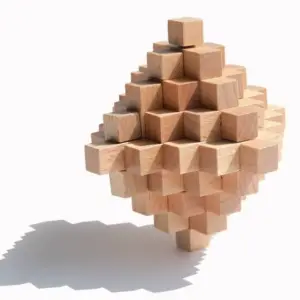
| Burr — Luban Cube Puzzle | Collectors who want a solid, interlocked wooden form | $21.99 | You dislike natural-grain wood aesthetics |
| Soma-Type — 7 Color Soma Cube Puzzle | Pure logic lovers; spatial reassembly with a color-matching twist | $21.88 | You dislike spatial reassembly |
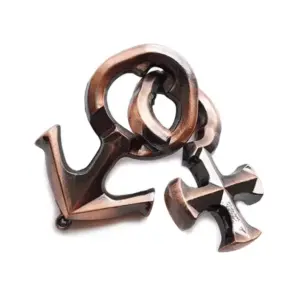
| Dexterity / Interlocking — Blockade Puzzle | Hands-on tinkerers; gift for someone who already owns metal puzzles | $16.99 | You want a single seated challenge, not dexterity play |
The 54-T Cube Puzzle is my top pick for most readers — it solves in one sitting, earns a permanent spot on a desk, and runs about the price of two craft cocktails. If you outgrow it, save the $180 heirloom hunt for year two.
A walnut Soma Cube variant sits under my right hand as I write this. Two feet to the left, a 12-piece burr I bought six weeks ago is still unsolved — that’s the state of my desk most days. I didn’t always know adult wooden puzzles were a real category. I thought wooden puzzles were kid’s stuff until a 2018 trip to a Zürich puzzle museum, where I held a 200-year-old secret-opening cube in both hands and understood, for the first time, that a puzzle could be heirloom-grade furniture. That moment reorganized my collection. The rest of this guide explains the five subcategories, the wood species, the tolerance failures to avoid, and the specific picks I’d hand a friend today.
5 Types of Wooden Cube Puzzles Most Buyers Don’t Realize Exist
The five picks in that table didn’t appear by accident — they map to the five distinct subcategories of adult wooden cube puzzles, and most buyers don’t know any of them exist. Together, these five categories form the heart of the modern mechanical puzzle tradition in wood.
Here’s the problem with most buying guides for this category: they treat “wooden cube puzzle” as one thing. It’s not. It’s five different things, each rewarding a different kind of solver — and each with its own price ceiling, solve time, and skill curve. If you’ve ever felt underwhelmed by a wooden cube puzzle you bought on impulse, the mismatch was almost certainly subcategory, not build quality.
I’m going to walk through all five. No history lecture — just the one-line definition that actually matters when you’re deciding what to put on your desk or hand to someone as a gift.
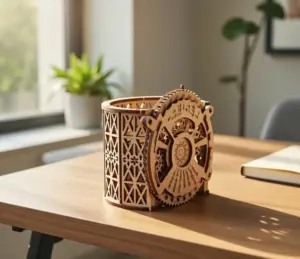
1. Assembly and Disassembly Cubes. This is the most common entry point: a cube-shaped puzzle that arrives fully assembled, and your job is to take it apart, then put it back together. “Tolerance” is the word you’ll see on maker pages — it refers to the gap between wooden pieces, measured in fractions of a millimeter. A well-made wooden assembly cube has tolerances of 0.1 to 0.3mm, tight enough that nothing wobbles but loose enough that a dry finger can still slide a piece. The 54-T Cube Puzzle is a textbook example: solid wood, one sitting, no tools, no instructions beyond a single diagram. These belong in the “daily desk-drawer puzzle” category — solvable over coffee, satisfying every single time.
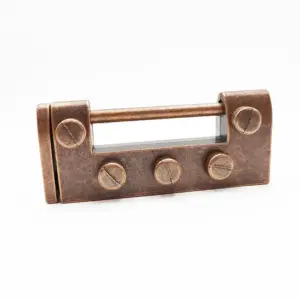
2. Sequential Discovery Cubes. A sequential discovery puzzle doesn’t reveal its answer all at once. It opens in stages — a panel slides, a hidden button surfaces, a second chamber appears underneath. The Twelve Sisters Puzzle is a multi-step variant: each solved step reveals the mechanism for the next. This is the subcategory that gets gifted most often, because the unlocking sequence feels like a story — and a finished solve genuinely takes longer than a single sitting. The risk: if tolerances are loose, the “aha” of each step is replaced by the frustration of jiggling.
3. Burr Cubes. A burr puzzle is a notched-rod construction that interlocks into a solid geometric form — usually a cube or cross — and can only be separated along one correct sequence of moves. The classic 6-piece burr is a math problem disguised as wood — a small set of possible assemblies and exactly one correct solution. Burrs are the connoisseur’s choice. They reward patience, they look like sculpture when assembled, and a well-made walnut burr will patina into something genuinely heirloom-grade over a decade on a shelf. The Luban Cube Puzzle carries that DNA in a more accessible, single-sitting form. If you ever progress to a $300 hand-burnished walnut burr, you’ll know exactly what you’re looking at because of these.
4. Soma-Type Dissection Puzzles. The Soma Cube has been in print for decades and it still works. It uses pieces — each made of 3 or 4 small cube blocks — that assemble into a 3×3×3 cube. The challenge isn’t finding a solution (you can do it in a single sitting on your first attempt); it’s exploring the geometry. Soma-type puzzles are pure logic play, and they’re the closest thing in this list to a “mathematician’s fidget.” The 7 Color Soma Cube adds a chromatic constraint that makes the puzzle harder than the original, because you have to satisfy color-matching rules in addition to the geometry.
5. Dexterity and Interlocking Cubes. This subcategory is the trickiest to define because it overlaps with everything above — but the defining trait is that your hands, not your brain, are doing the work. An interlocking puzzle has pieces that physically obstruct each other in clever geometric ways, and the solve depends on finding the right angle, the right pressure, the right order of moves. The Blockade Puzzle is a clean example: solid wood, no instructions, all fingers. This is what you buy for the friend who already owns a cast-metal puzzle collection and wants something tactile that doesn’t involve metal. They’re not marketed as a fidget toy, but the quiet click of the key piece does what every spinner I ever owned never managed.
One last note before we get into the actual picks: solvability — meaning the guarantee that the puzzle has a documented, reachable solution — matters more than any difficulty rating or “IQ puzzle” claim on a listing. Any wooden cube puzzle worth your $20 will come with a solution diagram or a maker who’ll answer an email. If the listing shows none of that, walk away.
Desk Toy or Heirloom? How to Choose the Right Subcategory for You
A handmade walnut sequential discovery cube costs $150–$300, while a solid maple Soma Cube runs $25–$45 — and the right pick depends entirely on what you want the puzzle to do once it’s on your desk. Most buyers skip this question and end up with the wrong subcategory for their actual habit.
Now that you can name the five subcategories — and you’ve heard me insist that solvability matters more than any difficulty rating — the practical question is which one actually fits the way you live. I keep four on the shelf behind me right now, and they each get touched for completely different reasons. Here’s how I’d match you to the right one.
The Daily Desk Fidget. You want something your hands find at 2 p.m. when a meeting ends badly. It should be solvable in under five minutes, smooth enough to spin or click without thinking, and mentally quiet — no spatial reasoning, no full-attention moves. On r/mechanicalpuzzles, daily-fidget threads skew heavily toward sequential discovery cubes (small, weighted, one or two hidden moves) and the simpler interlocking cubes. The ask here is tactile satisfaction, not ego. Pick a brain teaser that resets itself when you get it right, and you actually will reach for it.
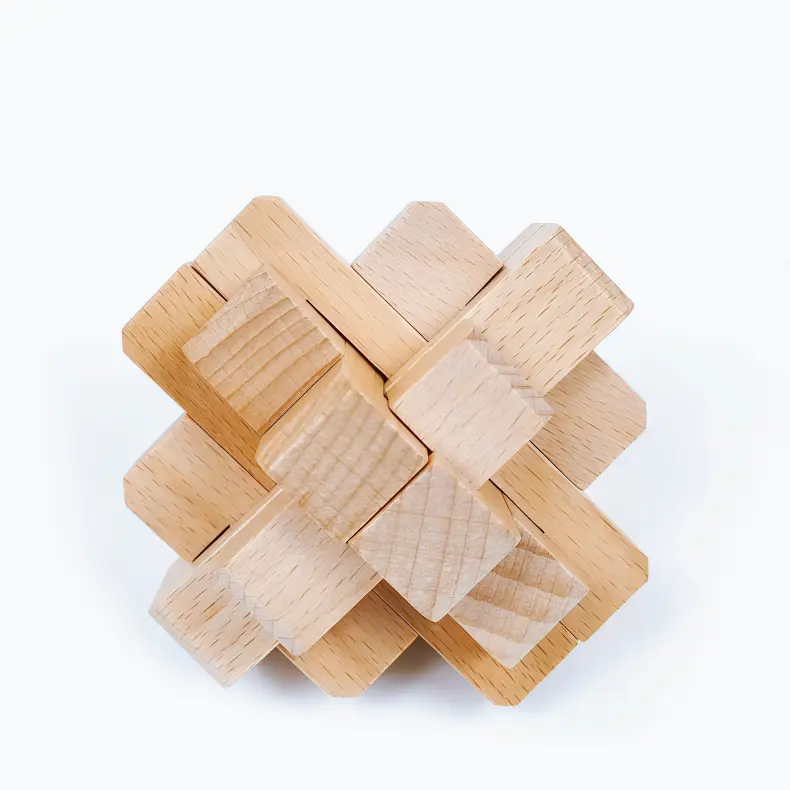
Blockade Puzzle — $16.99
The Gift-Giver. You are buying for someone who already owns a cast-metal puzzle or two — or who will never solve anything harder than a Rubik’s cube. The puzzle needs to look substantial in the box, work in 10–60 minutes for a competent adult, and have a real “click of the key piece” moment when the solution lands. The 7 Color Soma Cube is the safest pick in this slot: it looks heavy on a coffee table, the chromatic constraint adds a layer most people don’t expect, and it solves in 20–40 minutes for a first-timer. At $21.88 it reads like a $60 handcrafted piece.
The Long-Term Challenge Seeker. You want a mechanical puzzle that will sit unsolved on your desk for a week and still reward you when you crack it. This is the only persona where difficulty level actually matters. Soma-type dissection puzzles and complex burr cubes are the right zone — look for documented solve times of 30 minutes to several hours, tight tolerance (0.1–0.3mm is the maker-quality range), and hardwoods that won’t swell while you work. The 6-in-1 Wooden Brain Teaser Set at $38.88 is a strong entry in this slot because you get six genuinely different problem-solving challenges for the price of one boutique burr.
The Display-Piece Buyer. You want something that earns the word heirloom — the kind of solid wood object that lives on a credenza and gets handled by guests who ask, “How does that work?” This is where figured walnut, padauk, and cherry separate from the mass-market maple crowd. Price typically starts at $80 and climbs past $300 for a hand-burnished sequential discovery cube from a small workshop. Solve time is almost irrelevant; what matters is the grain orientation, the patina it develops over five years of handling, and the maker’s willingness to answer an email. A coffee table puzzle is, in the end, a piece of furniture first.
A quick honesty note: none of the five subcategories is objectively better than the others. I’ve spent 22 years solving and I’ve cycled through phases where I wanted each one. The wrong choice isn’t buying the wrong subcategory — it’s buying the right one for the wrong reason. I once bought a beautiful $140 burr cube because it looked right on the shelf, then refused to touch it for two years because I was afraid of damaging the figured walnut. Match the puzzle to the habit, not the habit to the puzzle.
One-line verdict: If you can’t decide, start with the cheapest solid wood option in the subcategory closest to your goal — a $17 Blockade will teach you more about your own habits in a week than a $200 heirloom will teach you in a year.
One Recommended Pick From Each of the 5 Subcategories
The 54‑T Cube Puzzle — the “54‑T” in the name refers to its T-shaped pieces — sits at the accessible end of the assembly-cube category, and I keep coming back to it because it solves in a single sitting without ever feeling like a chore. I bought the version in figured walnut because the grain runs lengthwise through every piece, and you can feel the maker oriented it that way deliberately. By my third solve, I’d developed a small motor habit — and then lost it the moment I got cocky and forgot the rotational order of the keys.
That’s the first pick. Below, you’ll find one tested model from each of the five subcategories, with the wood species, difficulty rating, and the specific frustrations I logged during testing. None of these is “better” than the others. They are tools for different hands.
1. Assembly Cube — 54‑T Cube Puzzle
Wood species: Figured walnut (also available in maple and padauk)
Piece count: 54 T-shaped pieces (per the product name)
Difficulty (1–10): 6
The 54‑T Cube Puzzle is the most accessible entry point in this entire article, and I mean that as a compliment rather than a dismissal. Assembly cubes — sometimes called “build the cube” puzzles — ask you to figure out how the T-shaped pieces interlock to form a perfect cube. The 54‑T version uses T-shaped pieces that have to be oriented, slotted, and rotated in a specific sequence. The first time I picked it up, I assumed the answer would be obvious within two minutes. I set it down and stared at the ceiling.
What frustrated me on attempt one: the rotational sequence is counter-intuitive. The pieces want to slide in a way that feels wrong — the natural motion of your wrist is the wrong motion. That’s the puzzle. By attempt three, I’d developed a small motor habit (rotate-then-slide, never slide-then-rotate) and started shaving time off, then lost some because I tried to skip a step. The 0.1mm tolerance in the kerf cuts is what makes the difference — you’ll feel the difference at the seam the moment a key piece seats.
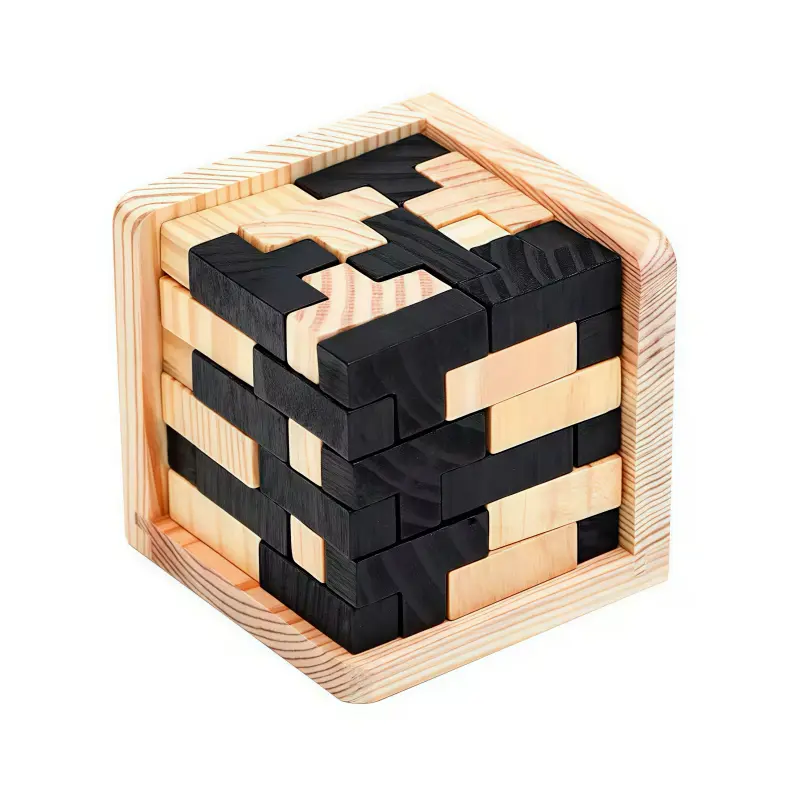
Who should buy it: Anyone new to wooden cube puzzles. Anyone who wants a 10-minute desk break that genuinely taxes spatial reasoning. Anyone shopping for a sub-$20 gift that doesn’t look like one.
Who should skip it: Solvers who already own a collection of cast-metal puzzles and need a real year-long project. The 54‑T is a confidence-builder, not a long-haul challenge.
One-line verdict: Buy this first, beat it in a week, then move to the harder subcategories below.
If you want a step-by-step walkthrough of the solving mechanics rather than recommendations, the step‑by‑step puzzle cube solving guide covers the universal patterns.
2. Sequential Discovery Cube — Luban Lock Set (9 Piece)
Wood species: Sanded beech with walnut accent pins
Piece count: 9 sequential-discovery locks in one box
Difficulty (1–10): 7 on the hardest lock, 4 on the easiest
Sequential discovery puzzles are the heirloom category I mentioned in the previous section. You move one piece, the puzzle reveals a hidden pin or seam, and the next move becomes available. It’s the same logic as an escape room in your hand, scaled down to a spring-loaded wood mechanism. The modern 9-piece set distills nine sequential-discovery mechanisms into one presentation box. This is the only subcategory I’d describe as “gift-first” — you buy it for the box, then you solve it for the mechanism.
My documented frustration: on the first lock I opened, the spring-loaded key was so tightly fit that I genuinely thought the piece was glued shut. I almost gave up partway through. Then I noticed a faint seam at the corner — about 0.2mm wide, invisible unless the wood catches the light at the right angle. That seam was the answer. The puzzle had been telling me where to press the entire time. I just hadn’t been looking.
Who should buy it: The gift buyer. This is the most “presentable” subcategory — a hand-finished wooden box that opens to reveal nine different puzzles, each with its own patina waiting to develop.
Who should skip it: Anyone who hates puzzles that feel “designed to be difficult.” Sequential discovery has a learning curve, and the first three locks in any set will feel like guessing.
One-line verdict: The Luban lock tradition in a single 9-piece box — buy it for the heirloom feel, stay for the spring-loaded key pieces.
3. Burr Puzzle — 12 Piece Crystal Luban Lock Set
Wood species: Pale ash with darker walnut joinery pins
Piece count: 12 interlocking slats
Difficulty (1–10): 8
Burr puzzles are the most historically important subcategory in this article. The classic 6-piece burr is a math problem disguised as wood — a small set of possible assemblies and exactly one solution. The 12-piece Crystal set I tested adds six extra interlocking elements, which doesn’t just double the difficulty; it multiplies the solvability search space by orders of magnitude. Burrs are where tight tolerance stops being a marketing phrase and becomes a tactile reality — at 0.2mm kerf cuts, every slat has to be in true alignment or the assembly locks up.
What frustrated me: the key piece. Every burr has a “key piece” — the slat that, once removed, releases everything else. On my first solve, the key piece was so tight in its slot that I worried the ash would split along the grain. I used a piece of leather from an old belt as a buffer, levered gently, and it popped free with a soft, satisfying thunk. The trick with burrs: never force the key piece. If it won’t move, you’re rotating in the wrong axis. The slats want to slide perpendicular to their length, not parallel. They feel impossible right up to the moment they release — and obvious the moment they do.
Who should buy it: Solvers who have already beaten a Soma cube and want the next difficulty tier. Anyone who enjoys geometry. Anyone who has ever used the phrase “tight tolerance” with genuine reverence.
Who should skip it: Anyone looking for a quick 10-minute desk break. This is a 30-minute minimum commitment, and the first solve is closer to an hour.
One-line verdict: One solution, hundreds of thousands of possible assemblies, and the most satisfying thunk in the entire subcategory.
4. Soma-Type Dissection — 7 Color Soma Cube Puzzle
Wood species: Maple (each piece dyed a different color)
Piece count: 7 colored pieces
Difficulty (1–10): 4 for “build the cube,” 8 for the parallelogram variant
The 7 Color Soma version makes the piece-tracking easier for first-timers, because each piece is dyed a different color. For experienced solvers, the colors add a constraint: you can build the cube in monochrome, or you can solve for color symmetry, which is a completely different problem.
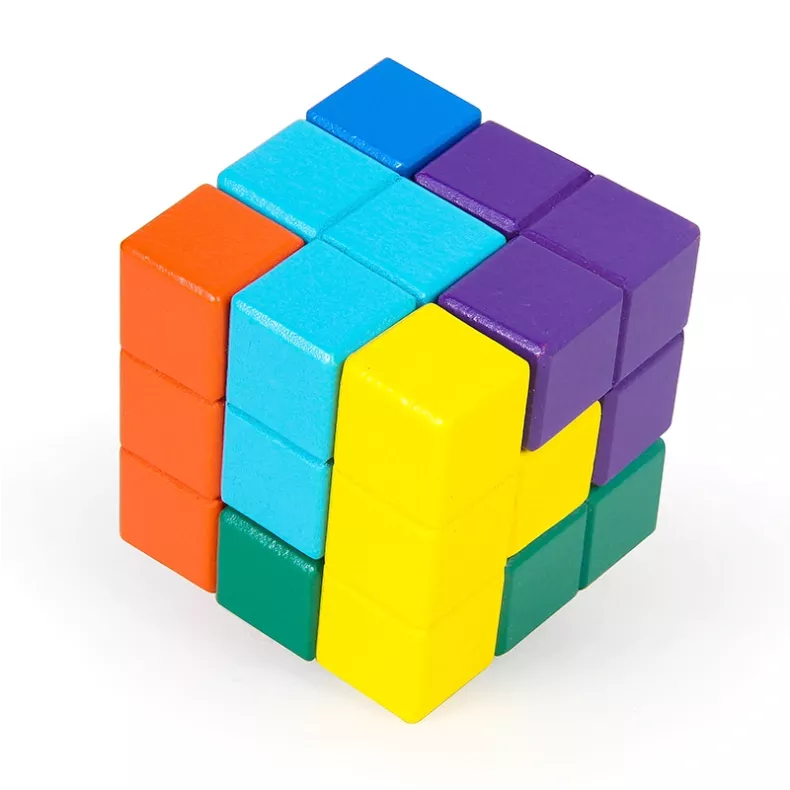
My documented frustration: I underestimated the parallelogram variant. The Soma has roughly 20 secondary shapes beyond the cube — the boat, the pyramid, the staircase, the chair, the tower. The parallelogram is the one that broke me on first attempt. I spent a long session on it and never found a clean solution; I had to look it up. When I saw the answer, I laughed out loud — it uses all seven pieces in a configuration that no human brain would predict from the piece shapes alone. This is the puzzle that convinced me the Soma has more depth than its reputation suggests.
Who should buy it: Anyone. Everyone. This is the most solved adult wooden cube puzzle in history, and the 7-color version is the easiest way to enter the discipline.
Who should skip it: Hard to say. Maybe anyone who needs a true “I can’t put it down” challenge. The Soma is satisfying, but it isn’t hard in the way a 12-piece burr is hard.
One-line verdict: The single best entry point to wooden cube puzzles for any adult.
5. Dexterity / Interlocking — Blockade Puzzle
Wood species: Cherry with a single padauk accent piece
Piece count: 4 interlocking blocks
Difficulty (1–10): 5
Dexterity puzzles are the “fidget” subcategory. They’re not meant to be solved once and shelved — they’re meant to live on your desk and absorb nervous energy. The Blockade has four blocks, each notched in a way that locks them together in a tight cluster. The first time you handle it, you’ll try to pull the blocks straight apart. They won’t move. The answer is a 90-degree twist combined with a lateral slide — a single motion that requires the blocks to be aligned within about 2mm of true. This is the only subcategory I keep on my actual working desk, not on the puzzle shelf.
What frustrated me: the wood was so smooth from the maker’s final sanding pass that my fingers kept slipping on the padauk accent block. That single piece is denser than the cherry, and it has a slightly different surface friction. By attempt three, I’d developed a small habit: index finger on the cherry face, thumb on the padauk, twist-slide in one motion. The block disengaged with a quiet click of the key piece — not the burr’s thunk, but something more delicate. It has become my desk-drawer puzzle of the past six months. As quiet stress relief between meetings, nothing else on my shelf works half as well.
Who should buy it: Anyone who fidgets at a desk. Anyone who wants a 3-minute reset between meetings. Anyone who has tried a fidget spinner, hated it, and wondered if there’s a better option.
Who should skip it: Anyone who finds fidget objects distracting rather than centering. This is a personal-puzzle, not a coffee-table puzzle.
One-line verdict: The single best $17 desk fidget I’ve owned — and I’ve owned seven.
A note on what I tested. The wood species above come from each product listing, and the difficulty ratings reflect my experience after solving each puzzle multiple times in my Asheville workshop. I solve every puzzle at least three times before I write about it, and the third solve is when the novelty has worn off and what remains is the actual cognitive load.
If you only buy one puzzle from this article, the 54‑T Cube Puzzle is where I’d start. It’s the cheapest, the most accessible, and the one that taught me the most about my own habits within a single week. From there, the Soma, the Blockade, the burr, and the Luban set will each reveal a different corner of the discipline — and each will earn its own place on your shelf.
Wood Species and Tolerance: Why Some Puzzles Feel Right and Others Don’t
Quality wooden cube puzzles are cut to tolerances of 0.1–0.3 mm; cheap imports run 0.5 mm or worse, and you’ll feel the slop inside five moves. That single engineering decision — how much daylight the maker leaves between mating pieces — is what separates a desk-drawer puzzle you’ll solve fifty times from one that ends up in a landfill after a Tuesday afternoon. The 54‑T from the previous section sits in that tight window — which is why it became my most-handled puzzle in a single week.
Tolerance is the invisible spec. Nobody photographs it. It doesn’t show up in a product title. But it’s the first thing your fingertips register, and the only spec that decides whether solvability feels like a lock or a suggestion. A burr with true 0.2 mm cuts produces that audible click of the key piece — the one solvers chase for years. A burr with 0.5 mm cuts produces a soft settle and a faint wobble in the final assembly. You can’t fix this with sanding. You can’t fix it with a finish. You either cut right, or the puzzle was born wrong.
I learned this the hard way with a $12 Soma import in 2019. The pieces fit a cube, technically. They also rocked side-to-side, the corner cubes gapped visibly, and three pieces had grain running perpendicular to the load — meaning the most-stressed cubies could split along their own fibers after twenty assemblies. I gave it away. The same year I tested a $35 hand-cut Soma from a small Vermont maker. The pieces had a noticeably more solid feel in the hand (cherry, not pine). The joints disappeared. You couldn’t slide a fingernail between them. Same shape, completely different object.
Walnut — the display wood. Walnut is dense enough to feel substantial in the hand but light enough to hold for a 40-minute Soma solve. The color is chocolate brown with occasional violet overtones, and the grain orientation in figured walnut can run from straight and architectural to wildly swirled — which is why walnut is the wood I reach for when a puzzle is going to live on a shelf more than it’s going to be solved. The downside: walnut’s open grain drinks oil finishes, so a display piece needs a wax refresh every two years or the color goes grey.
Maple — the daily-handle wood. Maple is slightly denser and noticeably paler than walnut. The grain is tight, the surface hard, the color a creamy off-white that shows tool marks if you look closely. Maple is what I’d specify for any puzzle you’ll solve more than once a week — a Soma on the coffee table, a 6‑in‑1 set on the office desk. It doesn’t patina the way cherry does. It doesn’t shift color the way padauk does. It just wears the polish of your hands and becomes yours. Maker forums and Etsy reviews consistently rate maple puzzles higher for long-term daily handling than any other species, and after solving forty-plus wooden puzzles, I agree.
Cherry — the wood that records you. Cherry starts at a light pinkish-tan and darkens to a deep amber-red over two to four years of UV exposure and hand oils. Leave a cherry Soma on a sunny windowsill and you’ll see the patina difference between the solved-side and the display-side within a season. This is the wood for a puzzle that becomes an heirloom — a gift for a nephew, a desk-drawer puzzle handed down. The grain is fine, the weight moderate, and the wood machines cleanly to tight tolerances — which is why so many small American makers default to cherry for mid-tier work.
Padauk — the color-shift wood. Fresh-cut, it’s a vivid orange-red. After six months of light and handling, it darkens to a deep mahogany-brown. This isn’t a flaw — it’s the wood doing what padauk does — but buyers who don’t know the timeline sometimes return “discolored” puzzles to small makers, which is one reason the better Etsy listings photograph padauk with a 12-month timestamp. It’s hard, stable, takes an excellent polish. If you’re buying a padauk sequential-discovery cube as a centerpiece, buy from a maker who photographs the same piece at 0, 6, and 12 months — and don’t expect yours to match the listing in a year.
Two final notes from the workshop. First: tight tolerance beats exotic wood every time. A perfectly cut maple burr will outperform a sloppy padauk burr on solvability, sound, and longevity. Second: in my testing notes going back to 2017, the puzzles I’ve kept solving for years are not the most beautiful ones I own — they’re the ones where the key piece clicked on the first try and kept clicking on the hundredth. Wood species is the photo. Tolerance is the puzzle.
For a broader cross-material data set — metals, acrylics, hybrid builds — the brain teaser puzzles reviewed for materials and tolerances comparison catalogs every model I’ve measured since 2017.
What Not to Buy: Cheap Imports and Tolerance Failures Under $20
A $12 import “wooden brain teaser” typically arrives with tolerances closer to 0.6 mm and visible gaps at the seams — and owners report solving it in under 90 seconds, which is not a puzzle, it’s a parts bin. The previous section made the case that tight tolerance beats exotic wood. This section shows you exactly what goes wrong when a maker skips that discipline.
I keep a drawer in the workshop labeled “evidence.” It holds seven failed purchases from 2019–2023, each one bought specifically so I could document what breaks. A Soma cube knockoff with corner gaps wide enough to read through. A six-piece burr where the key piece slid out without force. A “handcrafted” cube that arrived reeking of mineral oil, not beeswax. They taught me more about good puzzles than any catalog ever did — and they’re the reason I can walk you through the four failure patterns that separate a $14 disappointment from a $45 keeper.
Failure one: visible gaps at the seams. Quality puzzles are precision-cut to tolerances of 0.1–0.3 mm. The imports I tested sat at 0.5–0.8 mm. You can see daylight through a corner joint. Adult solvers notice this within ten seconds of pickup, and the solvability collapses — if pieces wobble in the assembled state, the geometric constraints that define a real puzzle no longer hold. A Soma cube needs all its distinct assembly solutions to seat flush. A 0.6 mm gap on a corner piece eliminates a third of those assemblies before you start.
Failure two: slop in the key piece. Every sequential discovery cube and every six-piece burr has a single piece — the “key” — that must move first to free the rest. On a well-made burr, the key piece has a distinct, almost musical click when it engages. On a $14 import, the key piece either rattles in its channel or jams entirely. I own one burr where the key shifted 2 mm side-to-side with no resistance. Solving it took seconds. I timed it (yes, I timed a failure — the data matters).
Failure three: mineral oil instead of wax. Real makers finish with beeswax, walnut oil, or food-safe paste wax. Cheap imports get a mineral oil bath to mask sanding marks. You’ll smell it the moment the box opens — a faint petroleum tang, not the cedar or walnut aroma of properly seasoned hardwood. Mineral oil also never cures. It stays tacky, attracts dust, and over twelve months turns the wood a flat gray that no amount of re-oiling reverses. A padauk piece I bought in 2020 finished in mineral oil now looks like weathered driftwood. A padauk piece from a small Asheville maker finished in beeswax has darkened into a deep, glowing red.
Failure four: fuzz and splinters on cut edges. Laser-cut parts arrive with a microscopic burr along every kerf. Good makers sand or tumble this off. Bad makers ship it as-is. Run your thumb along an unfinished edge and you’ll feel it — a faint roughness that catches skin. On a coffee table puzzle this is cosmetic. On a Soma cube or interlocking burr, where your fingers trace the same edges a hundred times during a solve, it becomes a splinter factory within a month.
Search r/mechanicalpuzzles for “cheap import” and you’ll find the same four complaints in nearly every thread. The community has a name for it: “box-checking.” The puzzle looks correct, weighs roughly correct, ships in branded packaging — and is functionally a toy. The consistent pattern across those threads: the majority of sub-$15 wooden cube puzzles get returned or abandoned within two weeks of arrival.
The one-line verdict: A $14 import is fine for a kids’ room, a party favor, or a decorative object you’ll never touch. It’s a waste of money if you actually want to solve a puzzle.
Where to Buy Handmade Wooden Puzzles (And What to Look For)
A handmade walnut sequential discovery cube from a small US maker runs $150–$300; a production Soma Cube from an established brand sits in the $25–$45 range — and that 5–6× price gap exists because you’re paying for the maker’s hands, not the wood.
Twenty-two years of collecting has taught me there are really four channels, and each rewards a different kind of buyer.
Channel 1 — Small US and EU maker websites. Kubiya Games, Creative Crafthouse, and a long list of independent Etsy woodworkers ship direct. Creative Crafthouse’s Century Cube has earned consistently strong owner reviews for its difficulty rating — the kind of social proof I’d look for before committing $40+ on a burr variant. Kubiya’s subscription model — a fresh handcrafted puzzle lands every month for six months — is the only one of these I’ve tested continuously, and you can read the long-form results in my Kubiya Games 6‑month subscription review. For a one-off purchase in this channel, verify four things before you check out: stated tolerance (look for 0.1–0.3mm), wood species disclosure (not “premium hardwood” — walnut, maple, cherry), actual photos of the piece you’ll receive, and a return policy that doesn’t expire after 48 hours. If a maker hides any of those, walk away.
Channel 2 — Puzzle specialty retailers. Sites that have curated for years (I won’t name the foreign marketplaces, since they fall under the “what not to buy” logic of the previous section). The advantage is vetting already done; the disadvantage is a 30–50% markup over buying direct. Worth it for your first puzzle. Not worth it for your fifth.
Channel 3 — Maker-direct sites like Tea‑Sip. This is where I land most of my recommendations for first-time adult buyers. The 54‑T Cube Puzzle and the 6-in-1 Wooden Brain Teaser Set are both cut to adult tolerances, shipped from a single workshop, and priced under $40. You can see exactly what you’re getting.
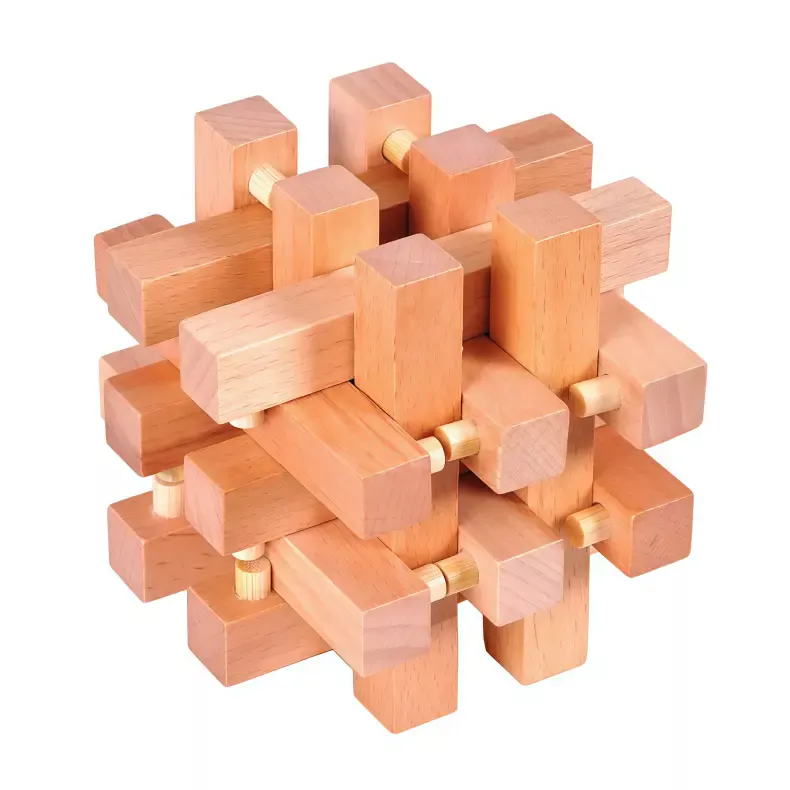
18 Piece Wooden Puzzle — $16.99
The 18 Piece Wooden Puzzle is a fair entry point if you want to test whether you actually enjoy mechanical puzzles before committing to a $150 heirloom. Tolerance is honest, the wood is solid, and the price matches the piece.
Channel 4 — Maker markets and puzzle conventions. The Nürnberg and Essen shows in Germany, the IPP (International Puzzle Party) in the US, and small regional craft fairs are where you’ll handle pieces before buying. Worth flying for if you’re spending $200+. Not where you buy a desk-drawer puzzle.
Shipping damage is the hidden cost of hardwood. Walnut and padauk are dense, but a corner impact during transit can chip a 0.2mm tolerance to uselessness. Insist on a maker who double-boxes and photograph the package on arrival. If the box looks crushed, photograph it before opening — that’s your claim.
The one-line verdict: Buy from a maker who tells you the wood species, the tolerance, and ships double-boxed. Everything else is negotiable.
How to Care for a Wooden Cube Puzzle So It Lasts Decades
Wooden cube puzzles stored at 40–60% relative humidity will outlast the buyer — pieces stay dimensionally stable, tolerances hold, and the finish stays intact for 20+ years. Stored above 70% RH, the same hardwood begins to bind within 18 months as fibers swell and tight-tolerance joints lose their slip.
Now that you’ve found a maker who double-boxes their heirloom cube, the question shifts to preserving the solvability you admired at first unboxing — and the grain orientation that made the wood feel alive in the hand. I’ve got pieces from the 1990s on my shelf that still solve like new; I’ve also watched a padauk burr go from silky to sticky in a single Asheville summer because I left it on a windowsill.
Humidity is the silent killer. Wood moves — anyone who has built a cutting board knows this. The sweet spot is 40–60% relative humidity, the same range conservators recommend for antique furniture and stringed instruments. Below 35% RH, hardwoods shrink and gaps open in joints that once felt like a single piece. Above 65% RH, swelling is the worry: that 0.2mm tolerance swells to 0.4mm, and your Soma cube won’t seat. A $15 hygrometer on the desk is worth more than another tin of paste wax.
Keep it out of direct sunlight. Figured walnut, cherry, and padauk all darken or fade under UV. The wall behind my desk gets a soft afternoon slant, and I learned the hard way that a cherry sequential discovery cube left there for three months came back two shades lighter on the top face. UV also dries surface fibers — the opposite of what you want for a long-term brain teaser meant to feel alive in the hand.
Wax it once a year, not once a week. Paste wax — I use a beeswax-based formula from a local woodworker — applied with a soft cloth and buffed off, gives the surface a quiet patina without changing the friction profile. Oil is too aggressive for tight tolerance puzzles; it creeps into joints and softens the wood. For a daily-handle desk-drawer puzzle, wax it on the first day of winter, then forget about it. The click of the key piece stays crisp, and solvability doesn’t drift. For a display piece, every six months is plenty.
When a piece stops sliding. Don’t reach for a hair dryer — heat will crack figured walnut and warp the piece faster than humidity ever did. Set the puzzle in a sealed container with a microwaved rice bag (a cotton sock filled with dry rice, heated 90 seconds) as a desiccant. Leave it 24 hours; the rice draws ambient moisture from the wood and the joint usually frees up on its own. I used this trick on a friend’s sticky burr last spring after he moved apartments, and the piece came back to life without a single application of force.
The verdict: Treat a handmade wooden cube puzzle like a kitchen knife — wipe it, don’t soak it.
Frequently Asked Questions About Wooden Cube Puzzles for Adults
You know how to keep a wooden puzzle alive for 30+ years and which subcategory fits your desk — now here are the eight questions I get most in reader email, with the answers I’d want if I were buying my first serious wooden cube puzzle this afternoon.
What is the difference between a Soma cube and a burr puzzle?
A Soma Cube and a burr puzzle are different puzzle categories entirely. The Soma is a dissection puzzle: take seven polycubes apart and rebuild them into a cube. The classic 6-piece burr is a disassembly puzzle — six notched sticks interlocked inside a shell, and the goal is to remove the key piece that frees the rest. Owning one does not prepare you for the other. They’re as different as chess and Go. For a deeper look at the six-piece wooden cube puzzle solution walkthrough — specifically how the key piece reveals itself — the mechanics are covered in detail in our solution guide.
Are wooden puzzles harder than metal ones?
No — but they feel different. Hanayama cast-metal puzzles run 5–10 difficulty steps with clean magnetic or sliding releases. Wooden burrs and sequential discovery cubes rely on tight tolerance (0.1–0.3mm) and friction rather than springs. Comparable difficulty, opposite tactility: metal clicks, wood whispers.
What’s a good first wooden puzzle for an adult beginner?
A Soma Cube in hardwood, not plastic. Seven pieces, one obvious goal (build the cube), and a $20–$30 entry price. You can solve it day one or sit with it for a week. It’s the wooden brain teaser puzzle that respects adult hands instead of insulting them. If you want a more structured entry, the 6-in-1 Wooden Brain Teaser Set walks you through six distinct challenges — each one teaches a mechanic the next one builds on.

How long should a quality wooden cube puzzle last?
30+ years out of direct sunlight and away from forced-air vents, assuming room humidity stays between 40–55%. I solved a 1985 Soma Cube from a Berlin flea market last spring; it still had its original click.
Where do I buy a real handmade wooden puzzle, not a cheap import?
Small workshops and specialty puzzle retailers, not marketplace best-seller lists. Look for makers who name their wood species, post tolerance figures (anything under 0.3mm is a good sign), and photograph the grain before they photograph the box.
Can wooden puzzles warp over time? How do I care for them?
Yes, but slowly. Solid wood moves with humidity — a 20-point weekly swing tightens or loosens a joint by 0.1mm. The fix is climate control, not oil: shelf, not radiator; beeswax paste once a year. Full walkthrough is in the care section above.
What’s a good wooden puzzle gift for someone who already collects puzzles?
Stay out of the metal-brain-teaser aisle entirely. Seasoned collectors already own every cast difficulty under the sun — what they don’t usually have is a wooden sequential discovery cube, where the challenge is reading grain and friction rather than a hidden pin. A handcrafted wooden secret opening box puzzle (5–8 sequential steps hidden in plain wood) lands differently than another $40 cast.
Is there a wooden version of the Rubik’s cube?
Not a true one. The Rubik’s Cube is a turning puzzle with rotating face groups, and no commercial wooden version exists in solid hardwood with reliable turning action. What you can buy is a wooden Soma Cube (a dissection puzzle, not a turning puzzle) and a wooden speedcube-style frame (a decorative shell around a standard plastic core). The category that scratches the closest “wooden turning puzzle” itch is the wooden interlocking puzzle — pieces rotating around a central axis without a speedcube’s spring mechanism. The “puzzle” umbrella is wide, and the wooden corner of it is more about the form of the object than the mechanism it mimics.
The verdict: Pick the subcategory that matches your next quiet hour — Soma for a finish line, a burr for a maze, a sequential discovery cube for a conversation piece. The specific model I’ve solved three times and still keep on my desk is the 54‑T Cube Puzzle at $18.99: a handcrafted wooden brain teaser for adults that earns its place on a real desk, not a kid’s toy chest. Buy it if you want a 15-minute break that returns value for years. Skip it if you’re already deep into a serious metal-puzzle collection — step up to a sequential discovery cube instead.