Quick Answer: Barrel Lu Ban Lock Gift for Adults: Who It Suits and What to Check
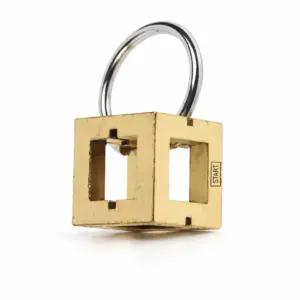
Yes — The Barrel Luban Lock from Tea-Sip is the top barrel Lu Ban lock gift for most adults who enjoy hands-on, low-tech puzzles. Skip it for gadget-first recipients or anyone wanting instant gratification. Four checks decide the buy: recipient personality, material quality, piece count, and price-to-presentation ratio.
The cleanest starting route: confirm the recipient enjoys tactile, low-tech puzzles before anything else. A barrel-shaped Lu Ban lock is a Lu Ban woodworking heritage object, a piece of traditional Chinese woodworking held together by mortise-and-tenon joinery. No nails. No glue. That joinery is the single most important spec to verify on the product page, because it separates a credible hardwood version from a fragile knockoff.
| Recipient fit | What to check on the listing | Skip if… |
|---|---|---|
| Tinkerer who likes mechanical objects | Piece count and joinery type named in description | Listing only says “wooden puzzle” with no joinery detail |
| Desk-decor minimalist | Dimensions and finish quality | No dimensions listed, or finish described vaguely |
| History-curious adult | Origin language and cultural context provided | Listing skips the Lu Ban reference entirely |
| Secret Santa or coworker gift | Packaging, presentation, price-to-presentation ratio | Item ships loose with no gift-ready box |
Two conditions change the pick. If the recipient already owns a square or fish-shaped Lu Ban lock, the barrel adds visual variety rather than repeating the same challenge. If the recipient wants a one-and-done reveal, note that the barrel is a disassembly puzzle designed to be solved and reassembled repeatedly, not a single-use object. Move next to the recipient-matching framework in 01 Match the recipient to narrow the decision further.
01. Match the Recipient: Which Adult Actually Enjoys a Barrel Lu Ban Lock
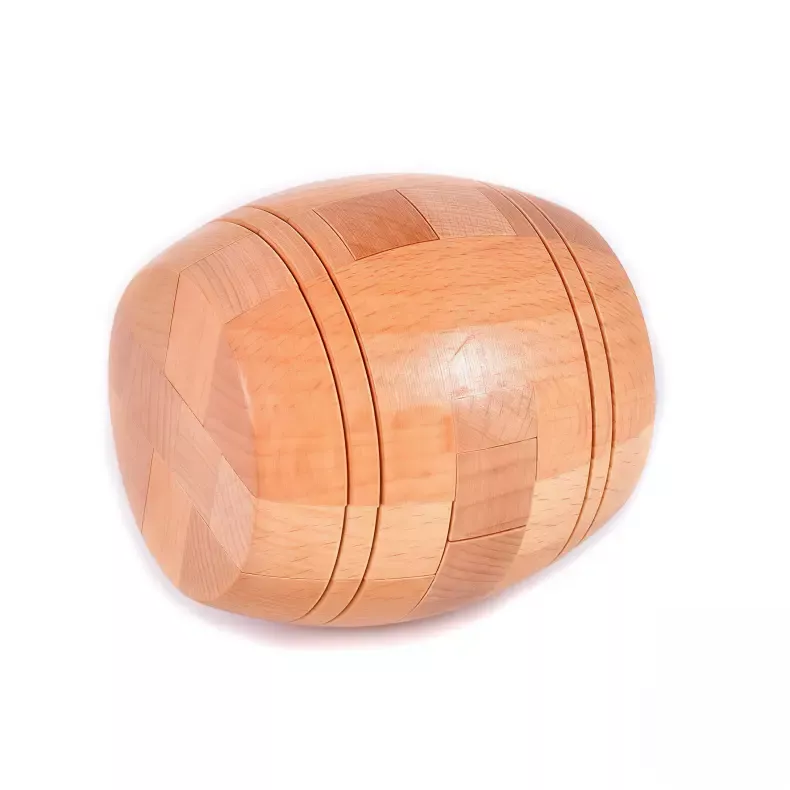
A barrel Lu Ban lock fits four adult archetypes well: the mechanical tinkerer, the desk-decor minimalist, the history-curious generalist, and the Secret Santa buyer working with a modest budget. Each archetype values a different trait of the same object, and matching the puzzle to the recipient’s personality starts with the barrel shape’s compact footprint, hardwood construction, and nail-free mortise-and-tenon joinery — the observable features that do the actual matching work. Pick the trait the recipient would notice first, not the trait the listing leads with.
The tinkerer buys for the joinery. This is the adult who already owns a few mechanical puzzles, keeps a small Allen key set in a desk drawer, and reads a product page looking for the mechanism rather than the marketing language. For this person, the barrel Lu Ban lock earns its place because the pieces are held together by precision mortise-and-tenon joinery — no nails, no glue, no screws. A barrel-shaped variant of the Lu Ban family signals an internal block structure that is visually different from a standard square lock, which makes the assembly step itself a second challenge after the disassembly. When shopping for a tinkerer, check that the listing names the joinery type and the wood species; a page that says only “wooden puzzle” with no construction detail is a red flag for this audience.
The desk-decor minimalist buys for the footprint. This is the adult whose workspace is curated down to one small object on a credenza, and who would rather display a single well-made thing than a shelf of toys. The barrel form factor matters here because it sits upright like a small drum, takes up roughly the space of a coffee mug, and reads as a wooden object first and a puzzle second. The barrel variant’s standing profile is the visual cue a minimalist responds to. Verify the dimensions on the product page before buying, because a barrel that arrives noticeably larger or smaller than expected breaks the desk-display logic for this recipient.
The history-curious adult buys for the origin story. This is the reader who has bookmarked museum podcasts, enjoys the cultural context section of museum gift shops, and treats a puzzle as a small object with a long backstory. The Lu Ban reference — a nod to the legendary Chinese woodworker honored in carpentry tradition and mortise-and-tenon joinery — is the hook, and the barrel form is the visual reinforcement of the woodworking heritage. For this person, the gift lands because the puzzle carries cultural weight, not because it stumps them. Listings that include the Lu Ban reference and frame the object within traditional Chinese woodworking speak directly to this audience; a listing that strips out the origin context flattens the gift into a generic brain teaser.
The Secret Santa buyer buys for the price-to-presentation ratio. This is the coworker gift scenario where the budget is tight, the recipient is loosely known, and the package needs to look considered rather than last-minute. The barrel Lu Ban lock’s listed price of $19.77 sits comfortably inside most Secret Santa caps, and the wooden object reads as a deliberate choice rather than a filler item. What separates a successful Secret Santa gift here is whether the item ships in presentation-ready packaging, so confirm that on the listing before checkout. If the barrel arrives loose in a padded mailer, upgrade the wrapping yourself with a small kraft box and a short note — the gift still works, but the unboxing is on you.
Two recipient types should skip the barrel entirely. The adult who prefers high-tech gadgets and screen-based interactivity will find a wooden disassembly puzzle slow and dated, regardless of the craftsmanship. The adult who dislikes wooden objects — a real preference that exists — will never convert to the barrel form no matter how well it is presented. The age 8+ rating on the listing means the puzzle is designed to be solvable by older children, which signals that the challenge sits in the moderate range for most adults; a puzzle-hardcore adult may find it quick and want a multi-piece set instead, such as the 12 Piece Crystal Luban Lock Set or the Luban Lock Set 9 Piece for a longer engagement.
For the gift card, skip generic phrasing. A note that names the joinery — “No nails, no glue, just the joinery Lu Ban is famous for” — signals that you chose the object for a reason rather than at random. A second line that names the recipient’s archetype lands harder than a generic sentiment: “For your desk” works for the minimalist, “for your next slow afternoon” works for the tinkerer, and “a small object with a long history” works for the history-curious reader. The note is what turns a wooden puzzle into a considered present.
Your next check is the listing itself. The barrel Lu Ban lock is the right object for any of the four archetypes above; the wrong listing of the same object is not. Section 02 Read the listing like a buyer walks through what to verify — material, joinery, piece count, dimensions, age rating — before the order goes in.
02. Read the Listing Like a Buyer: Material, Joinery, Piece Count, and Size
Treat every claim on the barrel Luban lock’s product page as a check, not a guarantee. A listing written in a few lines can make “hardwood” sound like oak when it means rubberwood, and can make “age 8+” sound like a children’s toy when it actually signals a moderate challenge. The four checks below turn listing language into buyer-side decisions you can make in two minutes, before the order goes in.
What “hardwood” actually covers. The Tea-Sip listing says the barrel lock is “crafted from premium hardwood with precision mortise-and-tenon joinery,” and the language is deliberate. Premium hardwood is the seller-side phrase; the buyer-side question is which species. Beech, walnut, and rosewood all qualify as hardwood and all sit at different price points. Ask the seller or check the photos for grain density and color: pale, even grain usually means beech; darker, more figured grain often means walnut. Both are legitimate, but a beech barrel at one price and a walnut barrel at another is a real difference the listing may not spell out.
What “age 8+” really implies. The product page lists the barrel lock as suitable for kids 8+, teens, adults, and seniors. That span is wide on purpose. For an adult recipient, the age rating is less about difficulty and more about the absence of small swallowable parts and sharp edges. A 30-year-old who has never touched a burr puzzle will find the barrel lock moderate; a puzzle-hardcore adult will find it quick. If you suspect your recipient is in the second camp, look at a multi-piece set instead, where piece count adds hours.
Mortise-and-tenon versus dovetail. The Tea-Sip barrel listing specifies mortise-and-tenon joinery, which is the traditional Lu Ban approach: a projecting tenon cut on one piece fits into a matching cavity on another, and friction holds the whole assembly together. For the cultural context behind this joint, see the Lu Ban Jing carpentry tradition behind mortise-and-tenon. A different seller (Wooobe) describes its Luban lock with dovetail joints, where flared tails and pins lock the pieces mechanically. Both are real joinery techniques from the Chinese woodworking tradition, and both are nail-free. The buyer-side check is consistency: a listing that mentions joinery should also show close-up photos of the seam where the pieces meet. If the photo shows clean, gap-free joints, the claim is credible. If the listing only describes joinery in marketing copy and the photos are tight on the barrel’s silhouette, ask for an interior shot.
Dimensions and where it will live. The barrel shape is part of its gift appeal because it sits well on a desk or in a hand. Listings vary in how they state dimensions; some give length and diameter in centimeters, some only in inches, and a few omit them entirely. The verification step is simple: confirm the barrel fits the space you picture. For most adult desk setups, a barrel roughly 12–18 cm tall and 6–8 cm wide tucks next to a pen cup without dominating. If the recipient’s desk is already crowded, or if the gift is meant to live in a bag, a smaller form factor like The Mystic Orb Lock makes the same joinery point in a tighter footprint.
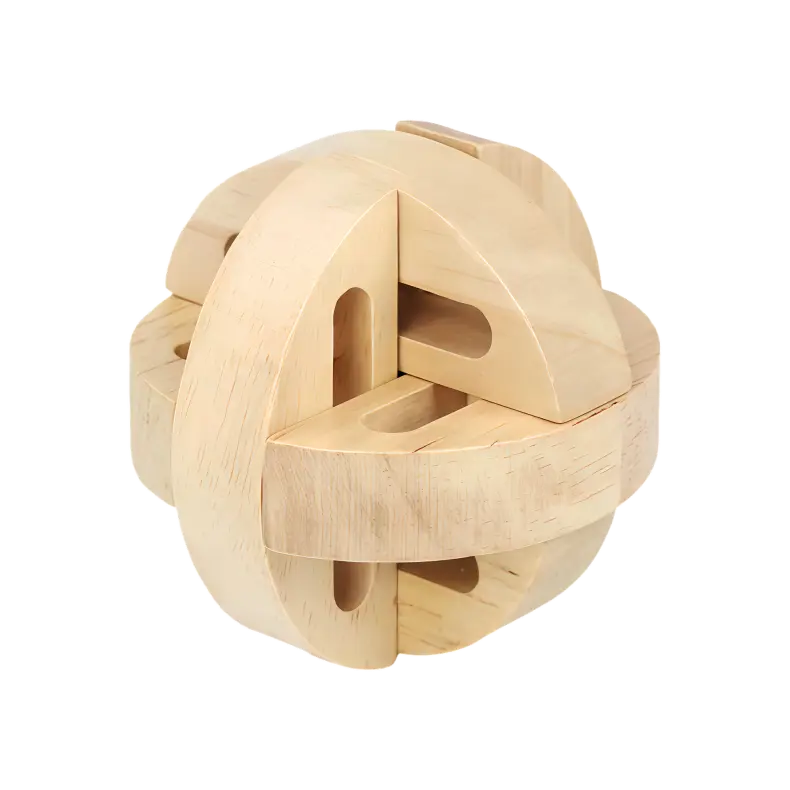
The Mystic Orb Lock — $16.99
Copy-paste checklist before you buy. Before checkout, confirm four things on the listing: (1) the wood species or a close-up photo that shows grain, (2) an explicit joinery phrase with a matching interior photo, (3) dimensions in both centimeters and inches if the listing only gives one, and (4) a piece count or a clear statement that the barrel is a single-puzzle assembly. If all four appear, the listing has done the work for you. If any are missing, that is the gap to message the seller about, not the gap to fill with assumption. The barrel Luban lock is a sound gift object; the listing you buy it from is the variable.
03. Barrel vs Square vs Fish vs Ox: How the Shape Changes the Gift
Choose the barrel shape when the gift will live on a desk or shelf and the recipient is more likely to admire it than solve it on day one. The barrel is the most display-friendly Lu Ban lock variant because its rounded profile sits comfortably in the hand and reads as a single object rather than a bundle of sticks. Square, fish, and ox shapes each carry their own trade-off, and the wrong match can turn a thoughtful present into a drawer orphan.
The buyer checklist from the previous section — wood species, joinery phrase, dimensions, piece count — applies to every shape on the market, but the shape itself changes what you are actually buying. A barrel is a compact, self-contained object. A square is a geometric reference piece. A fish or ox is a sculptural collectible. The gift logic shifts with each form, and the desk footprint changes with each silhouette.
| Shape | Recipient fit | Desk presence | What to check |
|---|---|---|---|
| Barrel | Tinkerer, desk minimalist, Secret Santa — works even if never solved | High — rounded silhouette reads as a single artifact | Wood species, mortise-and-tenon joinery, single-puzzle piece count |
| Square | Traditionalist who wants the reference Lu Ban form | Medium — flatter profile, less sculptural | Assembly method (true joinery vs. pegs), interior photo |
| Fish | Collector or decorative-arts buyer, not a first-time gift-giver | High when displayed, awkward as a daily carry | Whether it disassembles or is decorative only, actual piece count |
| Ox | Decorative-arts buyer, larger shelf space available | High — large, traditionally carved | Dimensions in both cm and inches, total weight, packaging integrity |
The barrel earns the top gift slot because three things line up at once. It looks like one object on first sight. It fits a standard coffee mug or monitor footprint. And the Tea-Sip listing states hardwood construction with mortise-and-tenon joinery and no nails or glue, a combination that is rare in the category since many barrel-shaped listings online are doweled or glued imitations. The barrel becomes the default present because the recipient can engage with it on three levels: ignore it because it looks nice, solve it as a real burr puzzle, or take it apart to study the joinery.
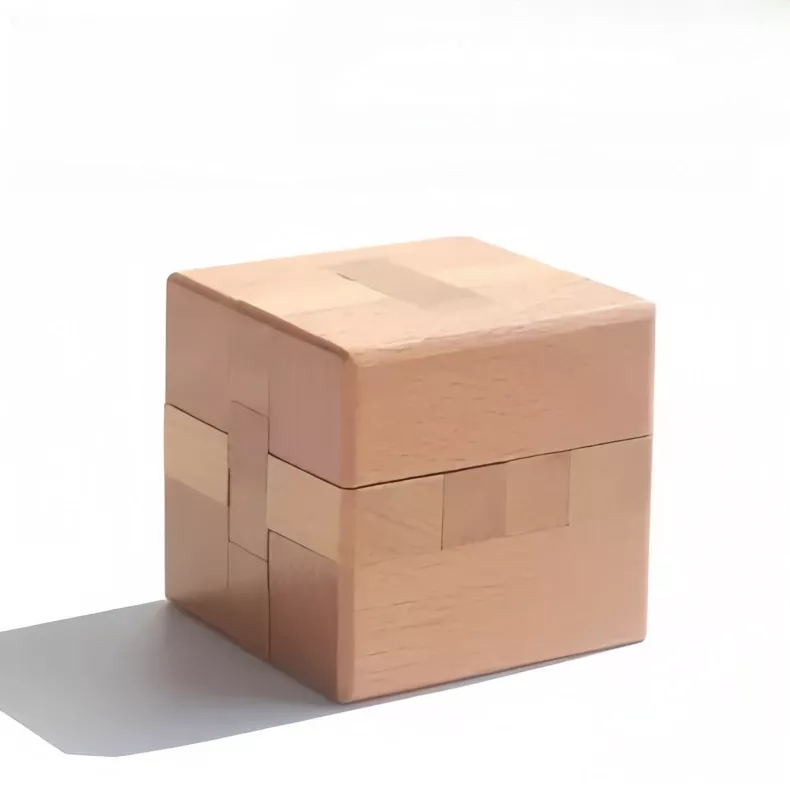
The square lock is the safe runner-up, and the format most people picture when they hear “Lu Ban lock.” It tends to be a flatter, more architectural object, which makes it a better desk reference piece than a hands-on toy. If your recipient is a hobbyist woodworker, the square format rewards a second look because the geometry is more legible. Some square variants use dovetail joinery rather than mortise-and-tenon, which is a different but equally valid traditional Chinese woodworking technique worth noting on the listing.
Fish and ox shapes are the collector lane. They are often more decorative than mechanical, and the listings for them are less consistent — some disassemble into a genuine burr puzzle, others are carved ornaments with no moving parts. If a listing does not show the puzzle taken apart into its individual pieces, treat it as a display object rather than a brain teaser. The ox in particular tends to run large and is built to sit on a shelf rather than a desk, which is a packaging and shipping concern as much as a gift-giving one.
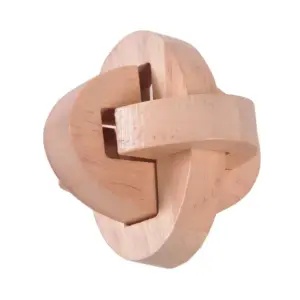
For an adult gift, the sphere puzzle offers a different kind of trade-off worth flagging. It moves the challenge from disassembly to spatial reorientation, and the rounded form makes it a tactile desk object that survives being handled.
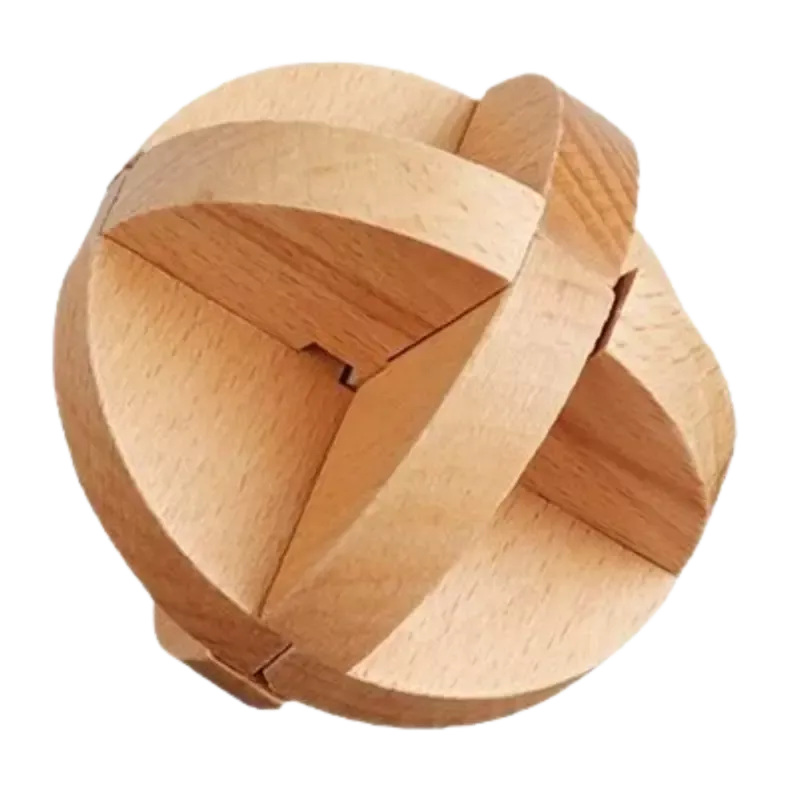
Luban Sphere Puzzle — $16.99
The decision rule: pick the barrel for a present, pick the fish or ox for a personal collection add-on, and pick the square when the recipient is a woodworker who will appreciate the geometry. The barrel survives the gift moment even if the recipient never touches it — and that is the test every other shape has to pass before you add it to the cart.
04. Price and Where to Buy Without Overpaying
Once you’ve matched the shape to the recipient, the next filter is what a fair price looks like for a barrel Lu Ban lock gift — and that comes down to two observable signals on the listing, not the platform’s reputation. The barrel variant lists at $19.77 at Tea-Sip, but you’ll see similar puzzles across Amazon, Temu, DHgate, and Etsy for less or more, and the difference is almost always explained by material and joinery — not brand prestige.
That framework — material plus joinery — is the only price test that holds across marketplaces. A listing that names a specific hardwood (beech, rosewood, walnut) and a named joint (mortise-and-tenon or dovetail) is paying for craft. A listing that only says “wooden puzzle” or “traditional Chinese style” with no joint detail is paying for shipping in a generic box. For a gift, that distinction matters because the recipient will notice the joinery the moment they pick it up.
What “hardwood” actually means on a listing varies. Tea-Sip’s barrel lock page describes “premium hardwood with precision mortise-and-tenon joinery.” Wooobe’s product page goes further, noting “dovetail joints and three different lengths of blocks for assembly” — that level of mechanical detail is what justifies a higher price tier. Amazon and Temu listings often say “wooden” without specifying the species; some are beech, some are painted softwood, and you can’t tell from the photo alone. The verification step is to look for a dimensions line and a material line, not just a title.
Etsy is the most variable marketplace for this keyword. Some results are barrel-shaped Lu Ban puzzles; others are rectangular padlocks marketed as “love locks” or couple gifts with a key. If the title mentions a key, a hasp, or a Valentine’s framing, it’s a different product family entirely — skip those even if the price looks low.
For a gift specifically, favor the listing that shows the barrel from three angles and names the wood species. A page with a single stock photo and vague copy will arrive in a plain bag, and the unboxing is half the present. The Tea-Sip barrel page lists at $19.77 and includes the joinery details; check that page for the current price and the current photo set before you commit. If the page you land on doesn’t show the joint close-up, the gift presentation won’t either.
One practical next action: read the material line first, read the joint line second, and only then look at the price. A barrel Lu Ban lock under $10 with no wood species named is almost certainly a painted softwood that won’t survive a desk display. A barrel in the $18–$30 range with hardwood and mortise-and-tenon named in the copy is the gift-grade tier. Anything above $30 in this category is paying for a bundle or a luxury box — worth it only if the recipient is a collector, in which case a multi-piece set like the 9-Piece Luban Lock Set makes the comparison worth running.
05. Gifting Questions: Repeat Play, Difficulty, Secret Santa, and the Card
The price check you just ran matters because it predicts what happens after the gift is opened. The barrel Lu Ban lock is a burr-style assembly puzzle, which means the recipient can take it apart and put it back together many times rather than solving it once and shelving it. Burr puzzles are defined as interlocking piece assemblies, and the Lu Ban lock is a traditional Chinese variant of that family — so the gift keeps giving well past the first solution.
Can the recipient play it more than once?
Yes. A burr puzzle is, by construction, a repeatable disassembly and reassembly. The barrel form does not change that property. What changes with quality is how satisfying the replay feels: a hardwood barrel with tight mortise-and-tenon joints rewards repeated handling for years, while a loose-tolerance painted version may loosen further with use. If you want a present that still gets touched in month three, hardwood and precision joinery matter more than the count of internal pieces.
What does “age 8+” actually mean for an adult recipient?
The age rating states the lower bound of who can solve it, not the ceiling. A 30-year-old will not find the barrel Lu Ban lock intellectually difficult on the first attempt — the real value at adult skill level is the tactile calm of moving the pieces and the visual interest of watching the joint sequence release. Treat “8+” as “approachable,” not “trivial.” An adult who enjoys hands-on challenges gets a relaxing, screen-free focus object, not a brain-burner. The product page also notes it supports logic, spatial reasoning, and fine motor skills, which is the right way to frame the adult benefit.
How hard is the barrel compared to other Chinese wooden puzzles?
The barrel sits in the moderate band. Larger multi-piece sets like the 12 Piece Crystal Luban Lock Set or the Luban Lock Set 9 Piece introduce more internal rods and more step dependencies, so they demand longer patience. A single-shape barrel is faster to the “aha” moment. For a first-time Lu Ban solver, barrel is the right starting gift; for someone who already owns one, a different shape is a better “next” present. Readers weighing the multi-piece format can compare across multi-piece sets in a separate product review.
Why barrel instead of square or fish?
Barrel is the shape that photographs and displays best on a desk. The rounded silhouette reads as a small wooden artifact rather than a geometric block, which makes the gift feel curated instead of toy-like. For a present where unboxing matters, that presentation difference carries real weight. For a private solver who cares only about mechanism, shape is mostly aesthetic.
Is the Tea-Sip barrel meaningfully different from a budget listing?
The price gap reflects wood species, joint tolerance, and finishing. A page that names hardwood and mortise-and-tenon joinery, and shows the joint close-up, is a different grade than a listing with a single stock photo and no wood named. For a gift, the unboxing and the first-hand impression carry the moment, so the higher-grade page is doing real work. For a casual desk toy to leave in a break room, a budget version is acceptable.
Is it a good gift for an adult who doesn’t usually do puzzles?
Conditional yes. The barrel Lu Ban lock works when the recipient already likes hands-on objects, small artifacts, or screen-free rituals. It underwhelms a person who reaches for a phone the moment something stops being instantly rewarding. The age-8+ rating is a useful proxy here: a puzzle rated for an eight-year-old’s patience is a low-commitment entry point, not a high-difficulty challenge.
Is it suitable as a Secret Santa or coworker gift?
Yes, with one small condition. The barrel form is compact enough for a wrapped package and requires no setup, instructions, or batteries. It is also neutral on religion, politics, and personal taste in a way that a mug or candle is not. The one check: make sure the recipient does not have a severe reaction to unfinished hardwood dust — rare, but worth flagging in a shared office.
What should the gift card say?
Short, concrete, and about the recipient rather than the object. Lines like “For your desk — a puzzle that doesn’t need a charger” or “Something to fidget with between meetings” land better than a generic “Enjoy your gift!” The barrel’s defining trait is its mix of craftsmanship and quiet interactivity, so the card should point to one of those two qualities, not both at once.
Where to compare next
For readers weighing the barrel against other lock-puzzle gift options, the Tea-Sip guide on lock puzzles for gifting brain training covers the broader family in one place.
One practical next action: confirm the recipient, confirm the listing shows the wood species and the joint detail, and then place the order. The barrel Lu Ban lock product page is the gift-grade version — if the copy still names hardwood and mortise-and-tenon joinery, the decision is already made.
Where to Start
If the recipient and occasion checks above match, start with The Barrel Luban Lock. Check the current product page for the specifications that matter to your choice.
Still comparing options? Browse the Tea-Sip puzzle listings to compare the same decision criteria, rather than restarting the search from scratch.
Sources and verification
- Product details and current specifications: Tea-Sip product page
Last updated: August 13, 2026