Quick Answer
For a college student who is new to puzzles, choose a compact 3D brain-teaser set with a storage box when portability and a one-sitting challenge matter most; choose a 200–500-piece jigsaw with an interesting image when the goal is relaxed, screen-free downtime. Four checks resolve almost every gifting question: skill level, space, time commitment, and purpose (stress relief vs. social vs. solo challenge). Run the four before clicking buy.
| Puzzle type | Best for | Skill check | Space check | Time check | Verify before buying |
|---|---|---|---|---|---|
| 3D brain-teaser set | Solo study-break focus, travel, one-sitting wins | 12–20 pieces = entry-level challenge level | Fits a 12×12 inch shelf | 15–60 min per puzzle | Instructions + storage box included |
| Mid-count jigsaw (200–500 pcs) | Screen-free downtime, social dorm activity | Image interest matters more than piece count | Needs a flat table | 2–6 hours across sittings | Piece thickness, reference poster included |
| Wooden interlocking kit | Display piece, decorative purpose | Assembly time on box is a fair difficulty proxy | Finished object fits desk or shelf | 1–3 hours | Glue required? Tools included? |
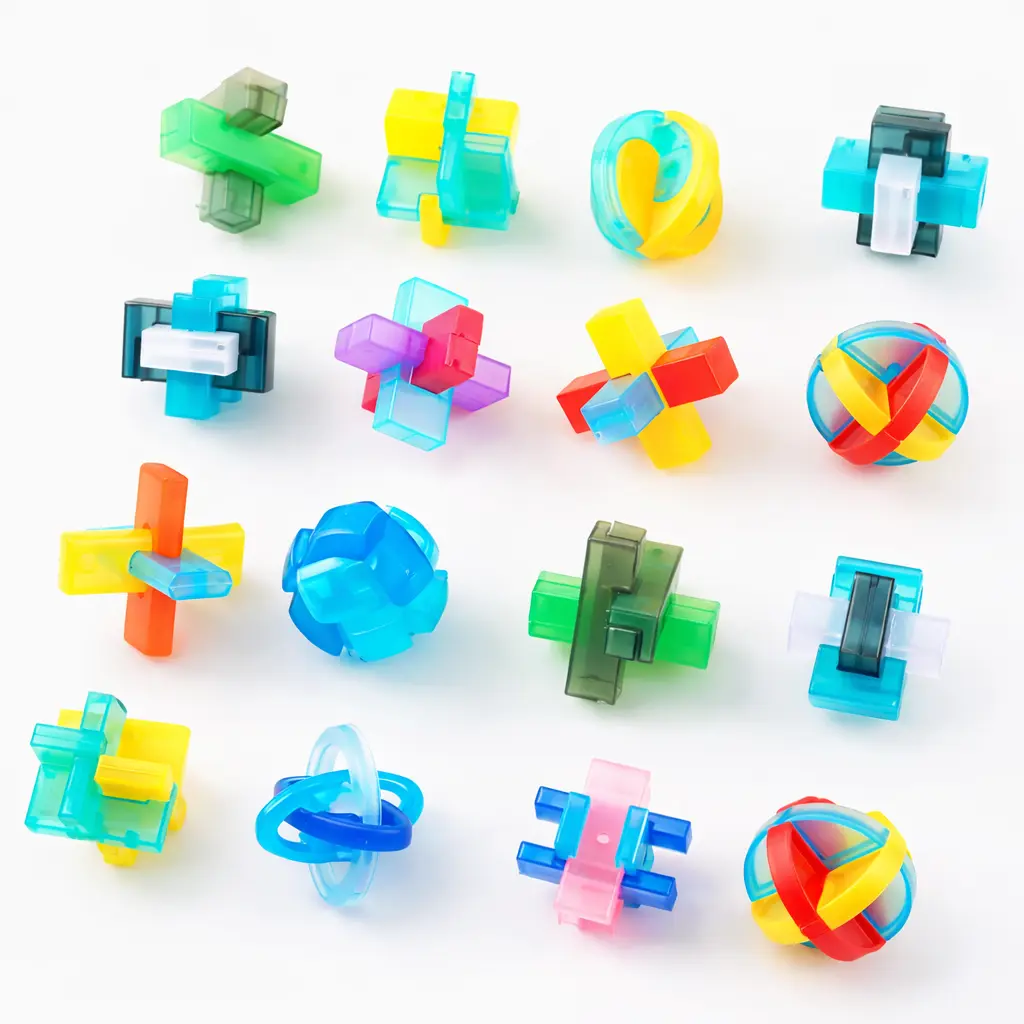
The 3D category works because most products labeled “beginner puzzle” target ages 6–10, which is the single biggest mismatch in this market. A 12-piece mechanical set matches an 18–22-year-old’s frustration threshold without taking over the dorm desk. For a closer look at the top pick in that range, see the hands-on guide to the 12-piece crystal Luban lock set.
01. What ‘Beginner’ Actually Means at the College Level
A college beginner is a stress-aware, time-constrained adult whose hands are used to typing, not toddler-sized pieces, and most products labeled “beginner puzzle” on retail sites are designed for ages 6 to 10, which is the single biggest mismatch in this market. The four checks from the quick answer (skill level, space, time, purpose) start here, because the word “beginner” alone tells you almost nothing.
That mismatch is where bad gifts come from. A puzzle that says “beginner” on the box is often bright, oversized, cartoon-themed, and solvable in under ten minutes by a child. For an 18- to 22-year-old, that experience reads as condescending, not challenging. The wrapper says “entry-level,” but the experience delivers a yawn.
Redefine the term. At the college level, “beginner” means an adult who has never done puzzles as a hobby, not a child learning shapes and colors. The skill range covers a wide spectrum: from a student who wants a calming, screen-free study break, to one who enjoys a quick mental warm-up between classes, to a first-time buyer of a brain teaser who wants a real “aha” moment. Each of those is a beginner. None of them want a preschool-tier product.
Three observable traits expose the mismatch before a gift is even opened.
Piece size and weight. Children’s puzzles are sized for small fingers and printed on thick cardboard. Adult-beginner puzzles use wood, metal, or denser plastic, sized for grown-up hands. A Luban lock set with chunky, weighted pieces feels satisfying to manipulate; a foam-backed cardboard puzzle can feel flimsy. The recipient’s hand will register the difference in the first thirty seconds.
Assembly time and session length. A child-set puzzle is designed to finish in one sitting of under fifteen minutes, fine for a kid, but for a college student that translates to “I solved it, now what?” An adult beginner typically wants 30 to 90 minutes of focused engagement per session, with a clear sense of progress. Sets marketed to adult-beginner audiences, like the Ajuny 4-in-1 wooden set tagged for “Adults Teens Logic Play Travel Birthdays and Puzzle Gifts,” are built around that time window. That audience tag is the filter worth reading.
Frustration threshold and tone. Adult beginners don’t want cartoon mascots, bright primary colors, or instructions written in a singsong voice. They want a puzzle that respects their intelligence: clear diagrams, clean typography, packaging that signals “this is for you.” The visual and verbal tone of the box is part of the gift experience. A product that markets itself to adults sends a small but real signal of respect.
This is why skill level comes first in the four checks. The “beginner” label is not enough; the age band and audience tag printed on the box or product page are the real filter. A product that names “teens,” “adults,” or “young adults” is far more likely to match than one that says “ages 6 and up.” For a closer look at how age labels actually map to adult skill, see how puzzle age labels actually map to adult skill.
For the gift-giver, the practical next action is simple: skip the toy aisle and browse the adult-tagged puzzle category instead. Read the audience tag before you read the piece count. The product is not a beginner puzzle because it is easy; it is a beginner puzzle because it is designed for a first-time adult solver. Get that right, and the rest of the four checks fall into place.
02. Three Puzzle Categories That Fit a College Student
Match the puzzle type to the student’s actual downtime, not the product’s age label. Three categories cover nearly every college beginner: a compact 3D brain-teaser set for solo stress relief between classes, a 200–500-piece jigsaw for relaxed screen-free downtime, and a wooden interlocking kit for a social activity with dorm-mates. Each maps to a different student personality, and each is verifiable from the product page alone.
Category 1: Compact 3D Brain-Teaser Set — Best for Solo Stress Relief
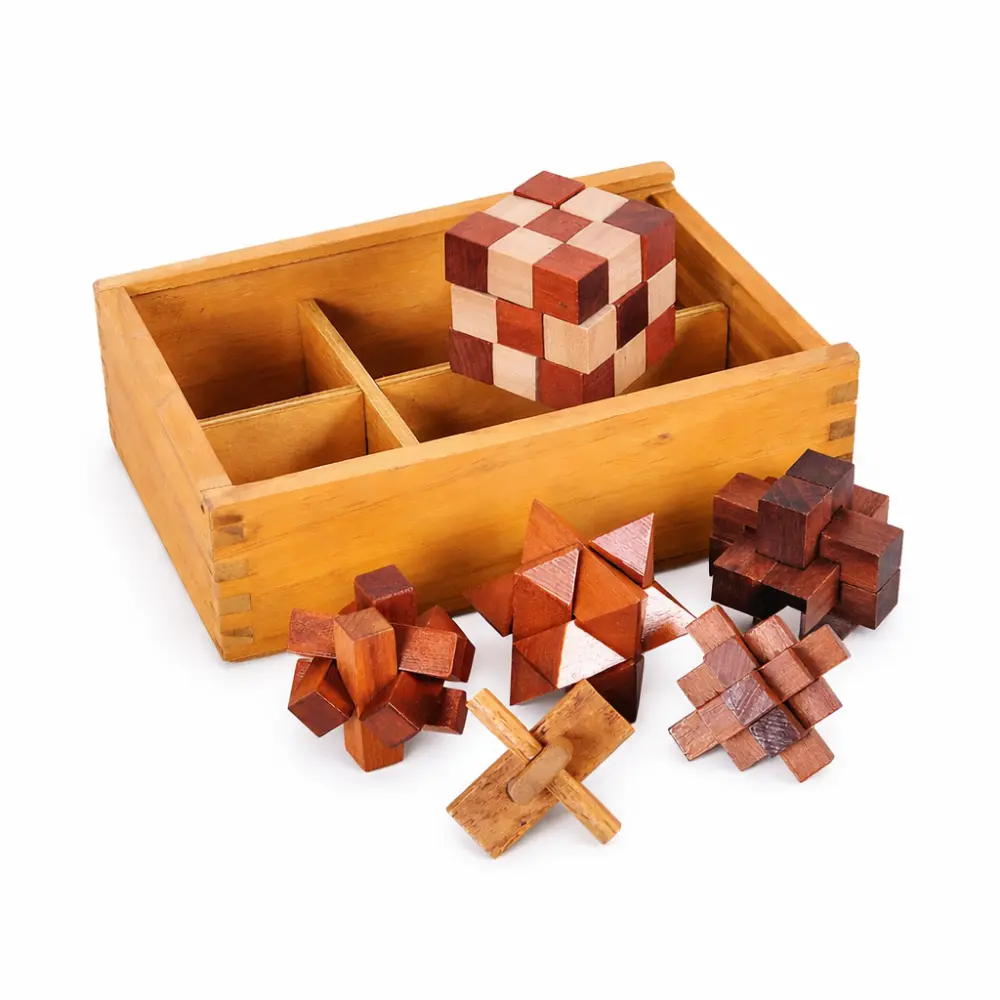
Pick this if the student is a quiet, solo type who wants a one-sitting challenge they can pick up and put down without a flat table. The reference example is the Ajuny 4-in-1 set: four named puzzles (Diagonal Burr, Soma Cube, Snake Cube, Interlocking Blocks), a storage box, and an audience tag of “Adults Teens Logic Play Travel Birthdays and Puzzle Gifts.” That combination — adult audience, multi-puzzle variety, included storage — is exactly what a college beginner needs.
Observable traits to verify on the product page:
– Box dimensions (should fit in a 12×12 inch shelf or a backpack)
– Number of puzzles included (one is too few; three or more gives variety)
– Whether a storage box or tray is included
– Whether instructions are printed, not just diagrammed
– Whether the material is wood or plastic (wood feels more like a “real” object; plastic is lighter for travel)
For a college student who wants a tactile challenge that doesn’t require a table, the next action is simple: look for a multi-puzzle set with an adult audience tag, a storage box, and printed instructions. Skip anything labeled “ages 6 and up,” even if the price is right.
Category 2: 200–500-Piece Jigsaw — Best for Relaxed, Screen-Free Downtime
Pick this if the student wants a slow, visual project for a Sunday afternoon or a study-break reset. A jigsaw is the lowest-pressure option: there is no “wrong” way to do it, and the image carries the interest. The college version is not a 1,000-piece landscape; it is a 200–500-piece puzzle with an image the student would actually want to look at for two hours.
Observable traits to verify:
– Piece count (200–500 for a beginner at the college level)
– Finished dimensions (small enough to leave set up on a desk overnight)
– Image type (avoid generic scenery; look for something specific to the student’s interest — art, architecture, a map, a vintage ad)
– Box sturdiness (a flimsy box means lost pieces)
– Whether a reference poster is included
The next action: before ordering, screenshot the puzzle image and ask whether the student would hang it on their wall if it were a poster. If the answer is no, pick a different image.
Category 3: Wooden Interlocking Kit — Best for a Social Dorm Activity
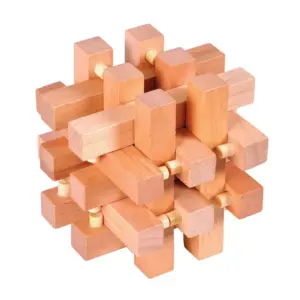
Pick this if the student lives with roommates and wants something they can pass around on a Friday night. A wooden interlocking kit — the kind where pieces slot together into a shape or mechanism — works as a shared challenge because it can be reset and re-attempted. The 54‑T Cube Puzzle is a recognizable example: a wooden cube made of interlocking pieces that can be taken apart and reassembled. For first-hand solve notes on the 54-T cube, see first-hand solve notes on the 54-T cube.
Observable traits to verify:
– Number of pieces (10–60 is the sweet spot for a shared challenge; more than 100 becomes a solo project)
– Material (wood reads as “nice object”; plastic reads as “toy”)
– Whether the finished form is a recognizable object (cube, sphere, animal, geometric shape) or abstract
– Whether the puzzle can be reset without breaking it
– Whether instructions are in clear, diagrammed English
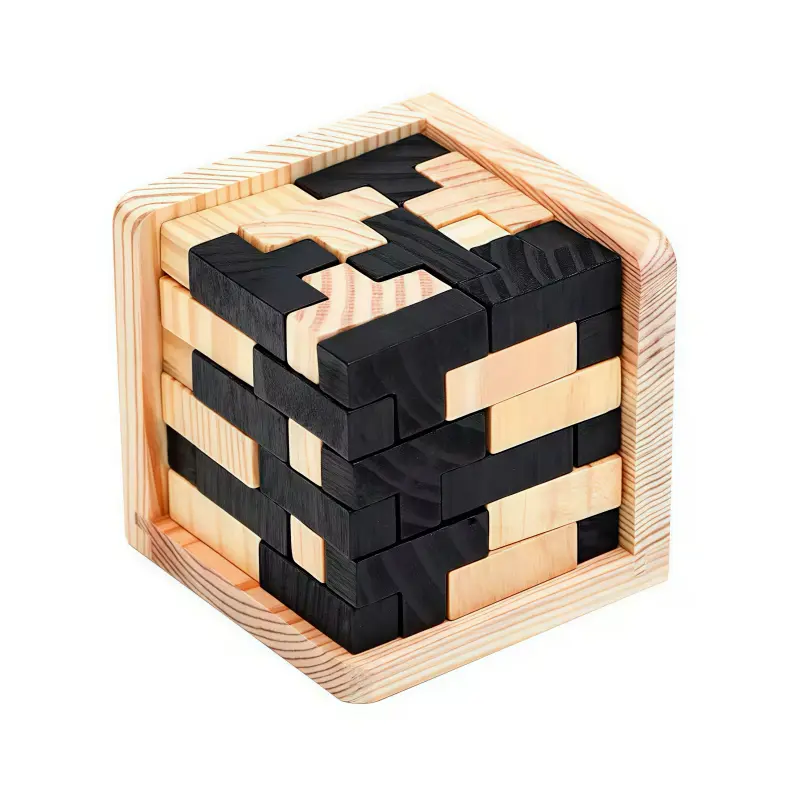
54‑T Cube Puzzle — $18.99
For a dorm social activity, the next action is to check the solve-time estimate and the piece count. If the puzzle takes longer than 90 minutes or has more than 60 pieces, it stops being social and becomes a solo project.
The One Parallel Check
All three categories share one filter: the product page must name “adults,” “teens,” or “young adults” in the audience tag. Anything labeled “kids” or “ages 6+” — no matter how clever the design — is the wrong gift for a college beginner. The audience tag is the single fastest way to filter the category pages before you read a single other detail. Respect that line, and the rest of the four checks become confirmation, not filtering.
03. The College Student Checklist: What to Check Before You Order
Once the audience tag confirms the puzzle is for adults or teens, run five more checks before adding to cart. These five checks turn a vague “beginner” label into a concrete fit for a dorm, a study-break window, and a gift budget under $30. Skip any one, and the puzzle risks living in a drawer instead of getting solved.
Check 1: It fits inside a 12×12 inch shelf space
Pick this if the assembled puzzle measures 12×12 inches or less when finished. Dorm shelves, closet organizers, and the space between a stack of textbooks and a desk lamp rarely accommodate anything larger. A 3D object taller than 6 inches or wider than 12 inches will crowd the nightstand or get pushed behind the monitor, where it gets forgotten. Measure mentally against a sheet of paper before you buy.
Check 2: It costs under $30
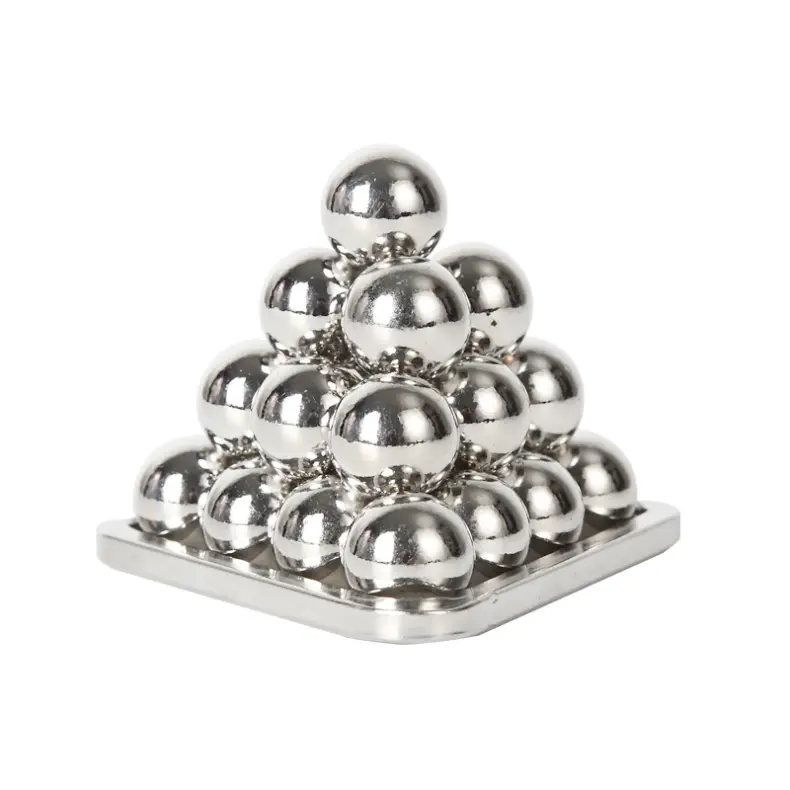
Pick this if the listed price stays under the $30 ceiling. A college student living on a meal plan can absorb a $15–$20 surprise much more easily than a $50 splurge that feels like it should have been something “bigger.” Under $30 also keeps the gift in the “fun impulse” zone rather than the “practical necessity” zone — exactly where a hobby gift should sit. The 6 Piece Steel Ball Pyramid Puzzle at $11.98 lands in this range.
Check 3: It solves in 30–90 minutes
Pick this if the product page states a solve time between 30 and 90 minutes, or a piece count that maps to that window. A 3D brain-teaser set with more than 20 pieces or a jigsaw above 500 pieces quietly shifts from “study break” to “weekend project,” and weekend projects get abandoned mid-semester. A one-sitting solve fits between classes, after dinner, or during a single Netflix episode — which is when a college beginner actually engages with a puzzle.
Check 4: It works without a flat dedicated table
Pick this if the puzzle can be solved on a lap, a bed, or a small section of a shared desk. Mechanical brain teasers and 3D objects satisfy this check because they hold their own shape mid-solve. A jigsaw without a dedicated surface, or a puzzle box that needs a 24-inch flat area, will sit unopened in a room where the dining table is shared with three roommates. A metal disentanglement puzzle solves in hand — no table required.
Check 5: It stores neatly when not in use
Pick this if the puzzle either fits back in its own box, stacks flat, or doubles as a displayed object. RA room inspections, surprise visits from parents, and end-of-semester move-out all punish loose pieces. A puzzle with a storage box, a wooden kit that assembles into a finished sculpture, or a compact metal puzzle that lives in a desk drawer all clear this filter. A loose-piece jigsaw without a sorted tray does not.
The Reject Signal
Move on if the product listing does not show the assembled size or the piece count. A listing without those two numbers is hiding the information a gift-giver needs to match a dorm reality. The “beginner” label alone tells you nothing about space, time, or storage — three constraints that determine whether a puzzle becomes a habit or a regret. Scroll past any listing that requires you to email the seller for basic specs.
04. How to Verify Difficulty Before You Click Buy
The “beginner” label alone tells you nothing about difficulty — but three numbers on a product page will. Check piece count for jigsaws, listed move count for brain teasers, and whether a solution sheet ships with wooden kits. These proxies tell you in 30 seconds whether a puzzle sits at the entry-level or skews expert. Difficulty is a numbers game, and most product pages publish the numbers if you know where to look.
The category itself offers a starting clue. A mechanical puzzle is one whose pieces can be manipulated physically — how a puzzle moves, not just how it looks, drives the solve. Once you know that, the right proxy for difficulty shifts by category.
Jigsaws: read the piece count.
A 200–500 piece jigsaw is the adult-beginner band: substantial enough to feel like a project, short enough to finish in a one-sitting challenge or across a few study-break sessions. Under 100 pieces reads as toy-grade and may feel trivial to an 18–22-year-old. Over 1,000 pieces is an expert signal and a real time commitment — not the relaxed, screen-free break most students want between classes. Look for the piece count in the product title, specs, or box dimensions. If the listing only says “beginner” without a number, treat that as a warning.
3D brain teasers: count the moves, confirm instructions.
A 3D brain teaser should list a solve-step count or difficulty rating on the page. Anything described as “dozens of moves” or “expert-level” is a mismatch for a first-time solver. Equally important: confirm the set ships with printed instructions or a solution key. A stuck beginner with no fallback is a wasted gift — and the frustration often travels back to the gift-giver. For a closer look at how these ratings get assigned, see how puzzle difficulty is rated in practice.
Wooden interlocking kits: verify the reference material.
Wooden assembly kits, especially 3D builds, should include a printed solution sheet, step-by-step diagrams, or a reference image of the finished model. Without one, a misstep at step 3 of 40 can derail the entire project. Look for phrases like “instruction included,” “step-by-step guide,” or “exploded view diagram” in the listing. If none appear, assume the kit ships bare and choose a different option.
One Final Check
If a product page hides all three of these signals, the seller is not making comparison easy — and that is itself a signal. Pick a listing that publishes the numbers. Difficulty is observable, and a gift that respects the recipient’s time starts with a page that respects the buyer’s.
05. When the Recipient Doesn’t Think They Like Puzzles
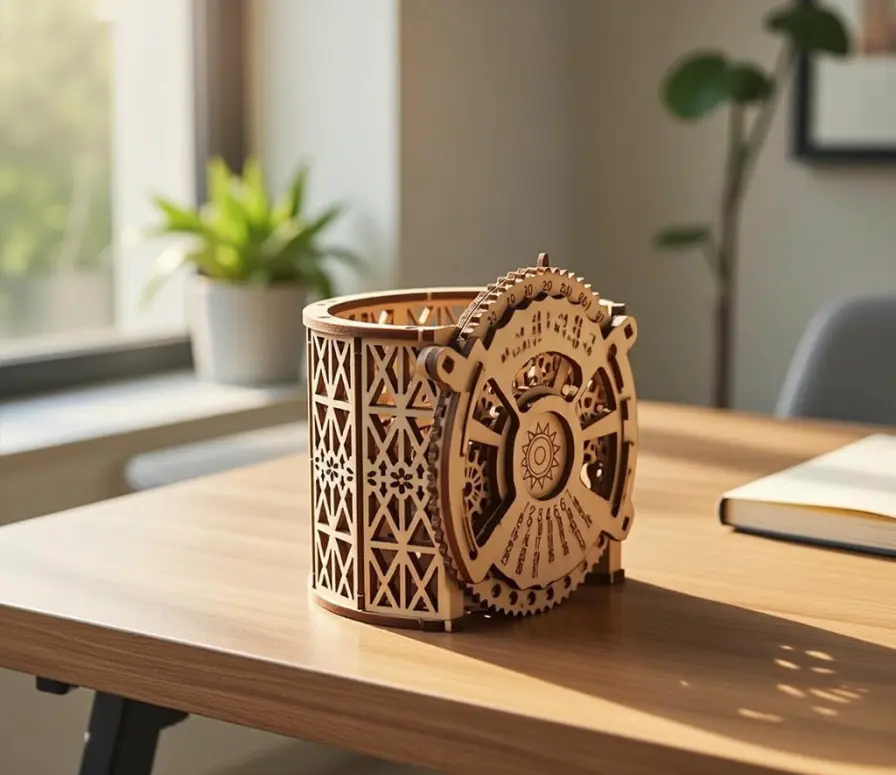
The difficulty checks from the last section assume the recipient plans to sit down and solve. If the college student in your life has already said “puzzles aren’t my thing” — or has never mentioned them at all — change the gift logic. Pick a puzzle whose solved form doubles as a functional object: a desk organizer, a bookend, a calendar, or a fidget-style desk piece. The recipient gets a use even if the puzzle is never touched again. That is the safer move when enthusiasm is uncertain.
Why dual-purpose wins for uncertain recipients.
A pure challenge — a snake cube, a metal disentanglement puzzle, a 300-piece jigsaw — has one job: be solved. If the recipient never opens it, the gift has no second life. A dual-purpose puzzle has two jobs: be solved, and then sit on a shelf or desk as a working object. The shift in framing is small. The safety margin is real. The student who never solves it still keeps a pen holder, a clock, a treasure box, or a calendar. The student who does solve it gets both a screen-free focus ritual and a piece of room décor. Two outcomes, one purchase.
For a deeper look at why a wooden desk organizer is the safest dual-purpose gift, see the related breakdown.
Where the stress-relief framing fits in.
Hand-held puzzles also work as tactile desk objects between classes. The general category is broadly described as fidget toys — “objects used to help focus or relieve stress through tactile engagement.” Keep the framing general: a calming, screen-free pause during a study break. Not a treatment. Not a clinical tool. Just a compact object the student can pick up between problem sets and put down again without losing progress. The stress-relief value lives in the solved form, not the challenge.
The safest picks when you are guessing.
Match the finished object to a dorm-room function. A desk organizer or pen holder suits a student who studies at a small desk. A perpetual calendar suits a student who likes minimal décor. A small storage box holds jewelry, earbuds, or loose clutter. A 3D mechanical model — pistol, clock, music box — fits a student who already enjoys building things. Skip pure brain-teasers labeled “expert” or “hard.” Skip sets with no solved form — no box, no holder, no display value. If the listing describes a piece that “looks great on a desk” or “doubles as storage,” that is the dual-purpose signal worth trusting.
One sentence to act on.
Choose a set whose solved form sits on a dorm desk and earns its space — not one that hides in a drawer because the challenge was never finished.
Frequently Asked Questions
A beginner puzzle that earns its space in a dorm doubles as something the student will actually use or display — a desk organizer, a pen holder, a small storage box, or a finished 3D model. The FAQ below answers the questions gift-givers actually send before they order.
What kind of puzzle is good for a college student who has never done puzzles?
Pick a compact 3D brain-teaser set or a 200–500-piece jigsaw with a clear image. Both match an entry-level challenge level and finish in one sitting. Skip anything marketed for ages 6–10, since those products are designed for fine-motor skills a college student will outgrow in minutes.
Are wooden puzzle sets actually beginner-friendly?
Wooden sets are beginner-friendly when the pieces fit with light pressure and the instructions are printed, not app-only. Check the listing for “suitable for beginners” or a step-by-step manual. If the listing only shows a finished object and no instructions, assume intermediate difficulty.
How much should I spend on a puzzle gift for a college student?
Plan $15–$30 for a single beginner set, or $25–$40 for a multi-puzzle bundle. A 6-in-1 set typically lands in that upper range. Spending more doesn’t reduce frustration for a first-timer — it just adds pieces or complexity the student may not finish.
What puzzles help with stress during finals week?
Short, repeatable hand puzzles work as a study break. The calming value sits in the tactile engagement, not the challenge. Choose a compact disentanglement or lock set the student can pick up for five minutes and put down without losing progress. Verify the solve time on the product page before ordering.
Is a 3D puzzle too hard for someone who has never tried one?
No, if the piece count is low and instructions are included. A 12-piece crystal lock set or a simple mechanical model counts as entry-level. Skip 3D models with 100+ parts or laser-cut sheets with no numbered sequence.
Will a puzzle fit in a small dorm room?
Most beginner sets ship in a box under 12×12 inches. Check the package dimensions on the product page before ordering. A set that includes its own storage box solves the dorm-space problem by giving the pieces a permanent home.
What is a good puzzle for someone who doesn’t think they like puzzles?
A puzzle whose solved form has a function: a pen holder, a jewelry box, a perpetual calendar, a desk clock. The recipient engages with the object daily even if they never “solve” a second puzzle.
Should I get a jigsaw or a brain teaser as a gift?
Jigsaw when the student has a flat table, an hour of free time, and enjoys visual imagery. Brain teaser when the student wants a one-sitting challenge, a portable desk toy, or a finished object that earns shelf space. Match the format to the student’s downtime, not your own taste.
Where to Start
If the recipient and occasion checks above match, start with 12 Piece Crystal Luban Lock Set. Check the current product page for the specifications that matter to your choice.
Still comparing options? Use the matching Tea-Sip collection to compare the same decision criteria, rather than restarting the search from scratch.
Sources and verification
- Product details and current specifications: Tea-Sip product page
Last updated: August 26, 2026