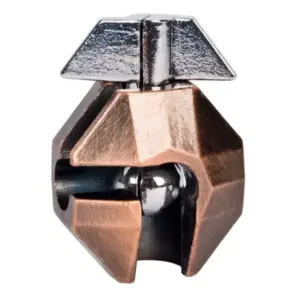
Quick Answer: Brass Cube Maze Puzzle Keychain Gift: How to Choose for Adults
For most adult gift-givers, choose a brass cube maze puzzle when you want a small, tactile brain teaser with a classic metallic look; choose a different mechanism if the recipient already owns disentanglement puzzles or prefers silent fidget tools. The decision hinges on three checks: mechanism type, material and finish, and keychain-grade hardware.
A “brass cube maze puzzle keychain” is not one product. Listings collapse three distinct mechanisms into the same search term: an interior ball-bearing maze (tilt to roll a small ball through channels), a wire-path disentanglement puzzle (slide a shaped piece along a twisted wire), and a sliding-panel sequential puzzle (push internal panels in the right order). Each feels different in the hand and each teaches a different skill. Before you order, confirm which mechanism the listing describes, because the photos often look interchangeable.
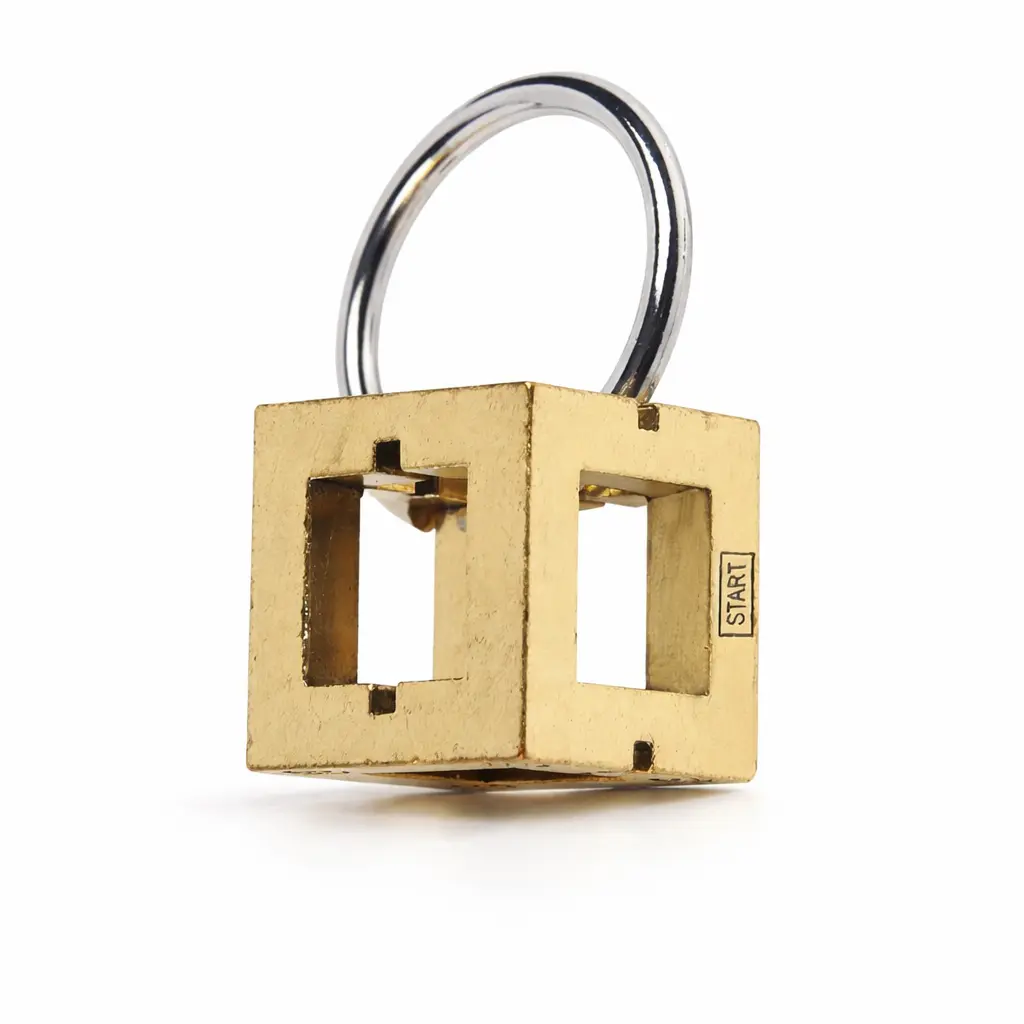
Mechanism comparison at a glance
| Mechanism type | How it solves | Skill it trains | What to check before buying |
|---|---|---|---|
| Interior ball-bearing maze | Tilt the cube to roll a small ball through hidden channels | Steady hand, spatial memory | Confirm a visible ball, sealed channels, and stated dimensions in the listing |
| Wire-path disentanglement | Slide a shaped metal piece along a twisted wire without touching it | Patience, fine motor control | Verify wire gauge, piece shape, and whether the loop detaches for keychain carry |
| Sliding-panel sequential | Push internal panels in a coded order to open or align | Logic, sequence recall | Look for stated move count and whether panels reset automatically |
For a pocket-sized gift that reads as a real mechanical puzzle rather than a toy, a ball-bearing maze in solid brass is the most common and most giftable configuration. Confirm the listing names the mechanism in the description, states the cube’s dimensions, and specifies a split ring or lobster clasp rather than a decorative cord. For a closer look at how the mechanism, channel geometry, and hand feel come together in the Brass Cube Maze Puzzle Keychain, see Tea Sip’s complete hands-on guide.
01. What a Brass Cube Maze Puzzle Keychain Actually Is and How It Works
A brass cube maze puzzle keychain is a pocket-sized mechanical puzzle that uses a solid metal cube body to house one of three distinct solving mechanisms. Because “cube maze” gets applied to all three on retail listings, the reader’s first job is to decode which mechanism is actually inside before judging difficulty, weight, or gift fit.
The three mechanisms behave very differently once they leave the box, and each suits a different kind of adult recipient. Getting this right is the difference between a keychain the recipient solves once and forgets, and one that lives on a desk for years.
Interior ball-bearing maze. A small steel or brass ball is sealed inside the cube and must be tilted through a network of internal channels until it reaches a target hole, recess, or finish line. The puzzle relies on fine motor control, steady breathing, and spatial memory — the same skill set used to solve a tabletop labyrinth, but compressed into a one-inch block. Wikipedia defines a maze as “a complex network of paths and passages designed as a puzzle,” and the ball-bearing version is the most literal expression of that definition in keychain form. The Brass Cube Maze Puzzle Keychain in the Tea Sip catalog is built around exactly this mechanism, which is why it reads as a classic pocket maze rather than a modern fidget gadget. For more on how the ball’s weight and channel geometry drive the experience, Tea Sip’s own write-up on the 31mm lesson in patience and spatial logic walks through the same problem in detail.
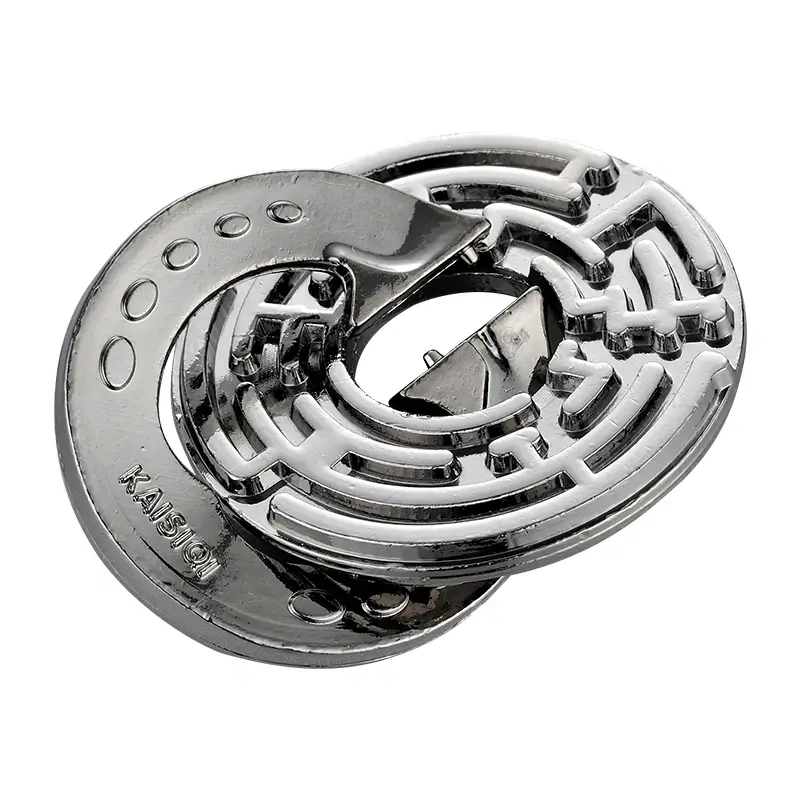
Wire-path disentanglement puzzle. Here the cube is split into two halves connected by a bent brass wire or rod, and the solve consists of sliding the free piece along the wire without letting it touch the body. These are sometimes sold as “brass disentanglement puzzles” and are governed by the broader category of mechanical puzzles — physically manipulated objects with no hidden information, per Wikipedia’s definition. For a recipient who already owns the classic nail-and-ring disentanglement, the cube form adds novelty, but the challenge is largely about patience and steady hands rather than deductive logic. A dual-sided maze lock, like the Maze Lock Dual-Sided Maze Puzzle, leans into this same hands-on category from a slightly different angle and gives the recipient a second, harder track to clear once the first is solved.
Sliding-panel or sequential-move cube. This version looks like a small Rubik’s-style object: faces or panels slide along internal tracks in a coded sequence, and the solve is reached by reproducing the right move order. Wikipedia’s entry on the Rubik’s Cube places this family firmly inside 3-D combination puzzles, and the tactile feel is closer to a handheld combination lock than to a tilt maze. The Sphere Morphs Into Cube sits in the same transformation-based category — geometry must be reshaped rather than navigated — and is a natural alternative for a recipient who prefers pure manipulation over ball control.
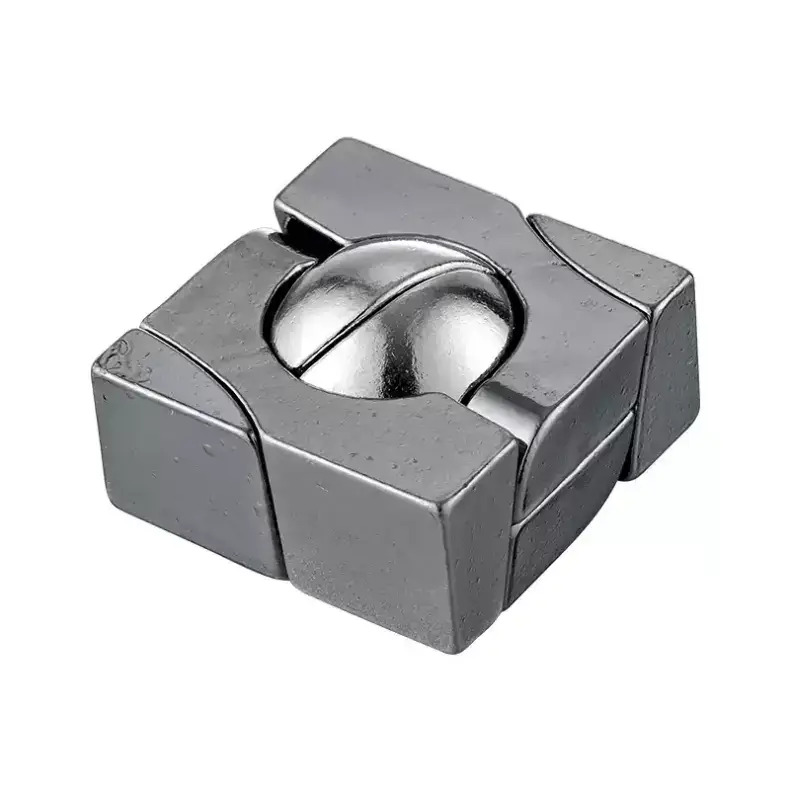
Sphere Morphs Into Cube — $12.00
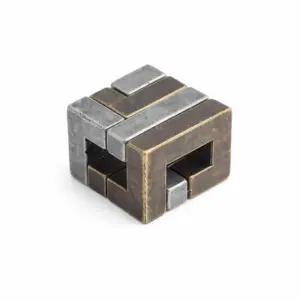
The one-check test before you buy. Look at the listing photo and answer one question: can you see a hole, a visible ball, or an interior track? If yes, the product is a ball-bearing maze and will reward patience and a steady hand. Can you see two halves joined by a brass wire, with a separate free piece? If yes, it is a disentanglement puzzle and will reward careful motion planning. Are the faces smooth, with sliding panels and no exposed interior at all? If yes, it is a sequential cube and will reward pattern recall. That single visual check separates a genuine adult mechanical puzzle from a decorative charm, and it is the only test that matters before the recipient ever picks it up.
One photo. One check. No guesswork.
For most adult gift-givers shopping this category, the ball-bearing maze in solid brass remains the default — the one that most clearly earns the word “puzzle” on the box and the word “brass” in the listing, and the one most likely to survive being dropped, pocketed, and solved more than once.
02. Solid Brass vs Brass-Plated: How to Verify the Finish Before You Buy
If a listing says only “brass” with no qualifier, assume plated and verify before checkout — solid brass and brass-plated zinc or aluminum behave very differently over months of pocket carry, and the wrong call shows up as flaking finish or a green ring on the recipient’s keys. The next ten minutes of reading are about turning that assumption into a confident check.
The reason this matters more for a keychain-bound puzzle than for a desk piece is friction. A cube sitting on a shelf rarely touches skin, rarely meets keys or coins, and rarely gets dropped. A cube on a keyring does all three daily. Brass plating is typically a thin surface layer over a cheaper base metal — zinc, aluminum, or steel — chosen to keep cost and weight down. Solid brass costs more per gram and weighs more per cubic centimeter, so when a seller wants the “brass look” at a lower price point, plating is the standard shortcut. The shortcut is fine for a decorative item. It is less fine for something that will sit in a pocket for years.
Check 1 — The magnet test. Solid brass is non-magnetic. A strong neodymium magnet held to the body of the cube should slide off with no pull. If the magnet grabs, snaps, or even hitches noticeably, the core is ferrous — most likely steel with a brass finish. Steel cores are common in budget keychain puzzles and they are not necessarily bad, but they are not solid brass, and the listing should say so. A faint stick is acceptable (some solid brass alloys contain trace iron); a hard pull is not.
Check 2 — Weight in hand. A solid brass cube of the same dimensions as a zinc or aluminum cube will feel noticeably heavier — roughly 2.5 to 3 times the mass for a given size, since brass sits around 8.5 g/cm³ versus aluminum’s 2.7 g/cm³ and zinc’s 7.1 g/cm³. A buyer who can compare two keychain cubes side by side will feel the difference immediately. A buyer shopping online has to read the listed weight, and that is where the next check matters.
Check 3 — Listing language. Specific phrases are a reliable signal. “Solid brass,” “brass alloy body,” “CNC-milled brass,” and “brass construction” all point to a solid piece. “Brass finish,” “brass tone,” “antique brass plating,” and “brass-coated” all point to a surface treatment. If the description is silent on the base material, that silence is itself information — assume plating.
The patina question, answered directly. Solid brass develops a patina — a slow, even darkening that many owners consider part of the appeal. It does not turn skin or fabric green the way copper-rich alloys can, because the green staining associated with cheap jewelry comes from copper reacting with sweat, and brass is mostly copper but the patina layer actually slows that reaction. Plated brass wears through at edges and high-contact points, and when it does, the exposed base metal can behave unpredictably — zinc can pit, aluminum can oxidize white, steel can rust. A buyer who wants a keychain that ages evenly should want solid brass. A buyer who wants a keychain that looks the same in year five as it does on day one may actually prefer plating, and that is a legitimate choice to make knowingly.
A useful cross-reference for the metal comparison above lives in Tea Sip’s guide to 6 metals compared for weight, feel, and durability, which lays out the same weight ratios in a side-by-side format for buyers who want to see the numbers in one place.
The one practical next action. Before adding any brass cube maze puzzle keychain to a cart, open the listing and copy the exact finish description into a note. If the words “solid,” “alloy,” or “CNC-milled” appear, the listing has earned the higher price. If only “brass” appears alone, assume plating and decide whether that is acceptable at the listed price. That single sentence of due diligence is the difference between a keychain that ages into a keepsake and one that peels into a problem.
03. Keychain Hardware That Survives Daily Pocket Carry
The hardware that connects a brass cube maze puzzle to a keyring decides whether the puzzle survives a year of pocket carry, because the mechanism gets the credit but the fitting takes the abuse. A solid brass body attached to a flimsy split ring will still fail at the ring, not the cube. For adult buyers, the attachment hardware deserves the same scrutiny as the material itself, and most product photos do not show it clearly enough to judge.
Split ring. The standard circular wire ring is what most listings ship with, and it remains the default because it is cheap, secure when closed properly, and the easiest hardware to find replacements for. The trade-off is friction: adding or removing keys takes patience and a thumbnail, which means most owners never actually detach the puzzle from the ring after the first day. That is fine for a permanent keychain, but inconvenient for someone who wants to bring the puzzle to a desk, solve it there, and return it to the ring afterward.
Lobster clasp. A spring-loaded gate lets the user clip on and off in under a second, which makes it the right answer for a recipient who solves puzzles at work or in meetings, where the keychain stays on a belt loop but the puzzle comes off to be held. The failure point is the spring: cheap stamped-steel springs lose tension after a few hundred open-close cycles, and a clasp that pops open in a pocket is a lost puzzle. Buyers who want this style should look for cast or machined clasps with a visible spring, not the thin wire loops found on promotional keychains, and should test the gate tension against a finger before trusting it to a keyring.
Integrated loop. A solid tab, eyelet, or hole cast or milled directly into the cube body removes the separate fitting entirely. There is no ring to bend, no spring to weaken, and nothing to lose in an airport security tray. The trade-off is permanence: the puzzle is harder to detach for a quick solve session, and a keyring passes through a narrower channel that can wear the loop edges over time. Integrated loops also limit which keyrings fit, so a bulky carabiner-style ring may not pass through at all.
The phone-screen and laptop-chassis check. Whichever hardware the listing uses, it must sit flush with the cube body. A protruding split ring or a tall clasp adds a hard edge that sits against whatever else lives in the same pocket, and modern phone screens and aluminum laptop chassis do not forgive repeated contact with a metal nub. A buyer should look at the product photos from the side, not just the front, and confirm that the highest point of the hardware is no taller than the cube itself. If only front-facing images are available, that is a reason to ask the seller for a side profile before paying.
The one practical next action. Before ordering, message the seller and ask which hardware ships with the unit. If the answer is a split ring, ask whether a heavier-gauge upgrade is available or whether the ring is even included. If the answer is vague or reads as “standard keychain,” treat that as a signal to check the return policy before paying, because hidden hardware details are often the first place corners get cut on a budget puzzle. A two-line message can prevent a keychain that lasts one season instead of several.
04. Difficulty, Size, and Gift Presentation for an Adult Recipient
A brass cube maze puzzle is a fitting adult gift when difficulty lands in the “noticeable but not punishing” range, the cube fits a closed fist without dominating it, and the packaging signals a mechanical object rather than a toy. Once the hardware question from the previous section is settled, the next three filters decide whether the recipient will actually carry it or quietly leave it in a drawer.
Gauging difficulty without a solve-time claim. Most listings for cube keychains do not publish a difficulty score, so the buyer has to read the mechanism description. Interior ball mazes with multiple dead ends read harder than a single straight channel, because the solver has to backtrack and the path is not obvious. Disentanglement puzzles with multiple bends read harder than a simple U-shape, because each curve adds a decision point. Sliding-panel cubes with more than four moving faces read harder than a two-panel toggle, because the solver must hold several moves in working memory at once. A reasonable adult range is “five to fifteen minutes of real thinking for someone who has never seen it” — long enough to feel earned, short enough to finish during a coffee break.
Size and pocket reality. Most cube puzzle keychains sit in the 25–40 mm range, and that band is where the gift works as a daily-carry object. Anything under 25 mm becomes fiddly for adult hands, and the keyring loop ends up bigger than the puzzle itself. Anything over 40 mm stops feeling like a keychain and starts feeling like a desk object that the recipient will never actually attach to keys. If only one measurement is given in a listing, confirm the edge length, not the diagonal, before ordering.
Presentation as a signal. Packaging tells the recipient what category they are holding. A velvet pouch, a small kraft box, or a printed sleeve reads as adult-gift intent. A blister pack with cartoon graphics or a header card that says “fun for all ages” reads as a children’s product, and a coworker or a client will register that immediately. For stocking-stuffer or host-gift contexts, ask the seller whether a gift box is included or available as an add-on before placing the order.
For a keychain that is meant to be carried and solved in short bursts, the Brass Cube Maze Puzzle Keychain fits the size band and the difficulty window described above, and the listing should be checked for the hardware and packaging details that match the recipient.
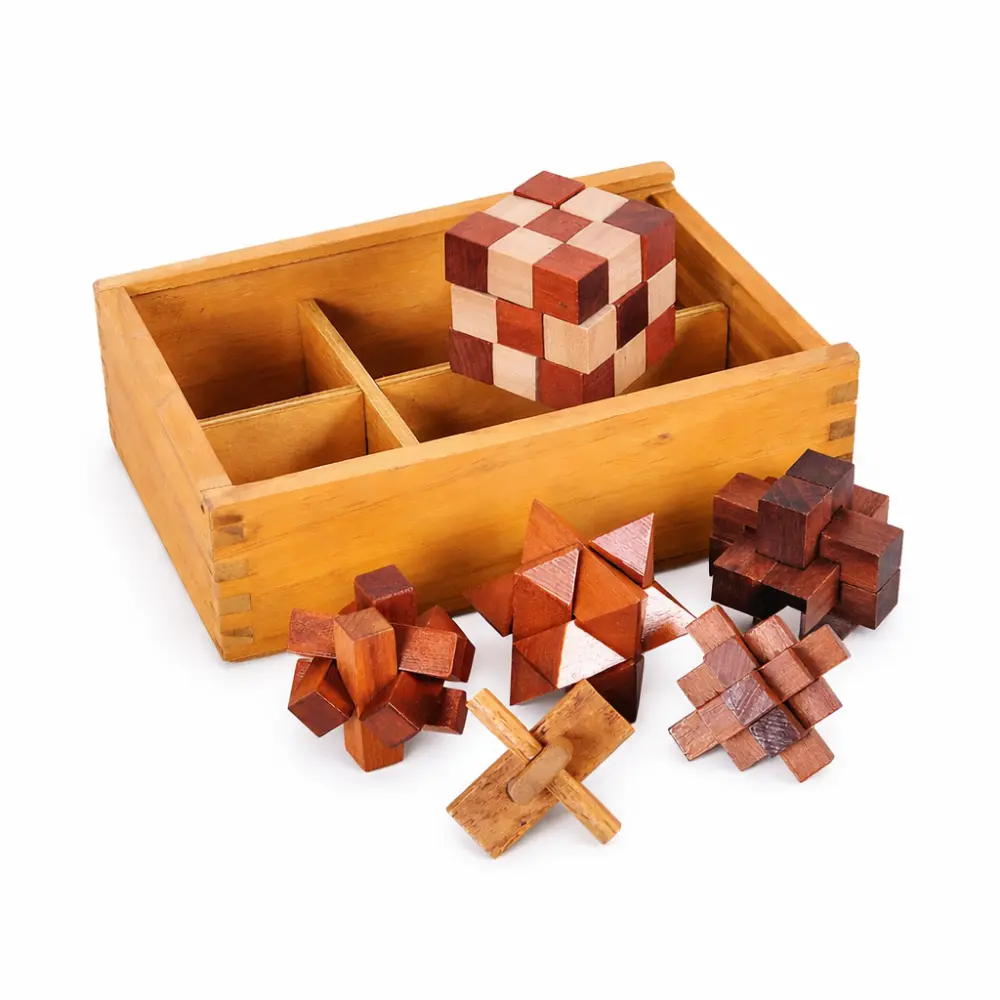
For a coworker or a host who will not carry keys into a meeting, a 7 Color Soma Cube Puzzle offers the same “noticeable but not punishing” difficulty in a desktop form factor, and a 6-in-1 Wooden Brain Teaser Set gives multiple difficulty levels in a single gift box, which suits a recipient whose taste is unknown.
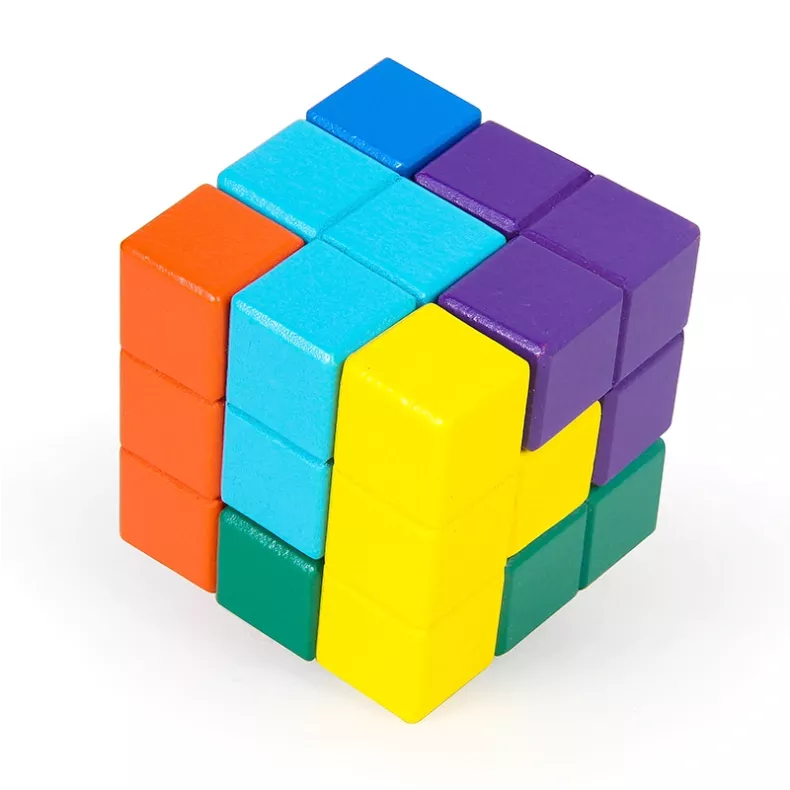
7 Color Soma Cube Puzzle — $21.88
The one practical next action. Before ordering, confirm three things on the product page: the edge length in millimetres, the hardware type, and whether gift packaging is included. If any of those three is missing, message the seller. A two-line message separates a brass cube that gets carried for years from one that ends up in a drawer after a week. For a wider sweep of options that hold up to repeated use, see 12 puzzle gifts under 25 that actually get reused.
05. Matching Mechanism Type to Recipient: Decision Table
Once the three physical checks (edge length, hardware type, and gift packaging) are sorted on the product page, the remaining decision is which mechanism type fits the recipient’s puzzle habits. The table below is a fast-matching tool, not a ranking: three distinct products are sold under the name “brass cube maze puzzle keychain,” and the right match depends on the kind of solve the adult on your list actually enjoys.
| Mechanism | Best For | Why | What to Check |
|---|---|---|---|
| Interior ball-bearing maze (gravity-driven ball through internal channels) | Adults who want a silent, one-handed, repeatable pocket solve | Tilt and roll; the challenge is route-finding inside the cube, not disassembly | Confirm solid brass vs brass-plated, edge length in mm, ball audibility in quiet rooms, keyring hardware type |
| Wire-path disentanglement (a separate metal piece threaded along a fixed wire) | Adults who already own maze puzzles and want a new geometry | Two-handed solve; the moving piece and the path are both visible | Wire thickness and joint welds in product photos, total weight on the keyring, whether the loop is integrated or split-ring |
| Sliding-panel sequential (panels move in a fixed order to release) | Gift-givers who want a clearer “aha” moment at reveal | Solve feels like cracking a small safe; panels click into place | Slide travel distance and panel tolerances, finish wear at high-friction edges, whether packaging includes a gift box |
The first row is the mechanism behind the Brass Cube Maze Puzzle Keychain: a small brass cube with an interior maze channel and a weighted ball that the user tilts toward a finish point. It is the most pocket-friendly of the three because it solves one-handed, runs silent, and clips to a standard keyring without the bulk of a wire frame or a multi-panel body.
If the recipient already owns disentanglement puzzles, however, a wire-path version may be wasted money. They will solve it once and shelve it. A sliding-panel sequential puzzle fits the same “already owns one” profile differently: it rewards the recipient who enjoys the visible step-by-step release of a small safe rather than a silent one-handed tilt.
For an adult who has never owned a keychain puzzle but likes the format, a different mechanism entirely may suit them better. The 54‑T Cube Puzzle is a spatial-assembly brain teaser in the same product family: fifty-four pieces form a cube through shape-matching rather than maze-solving, which gives a more visible “building” experience than an interior channel.
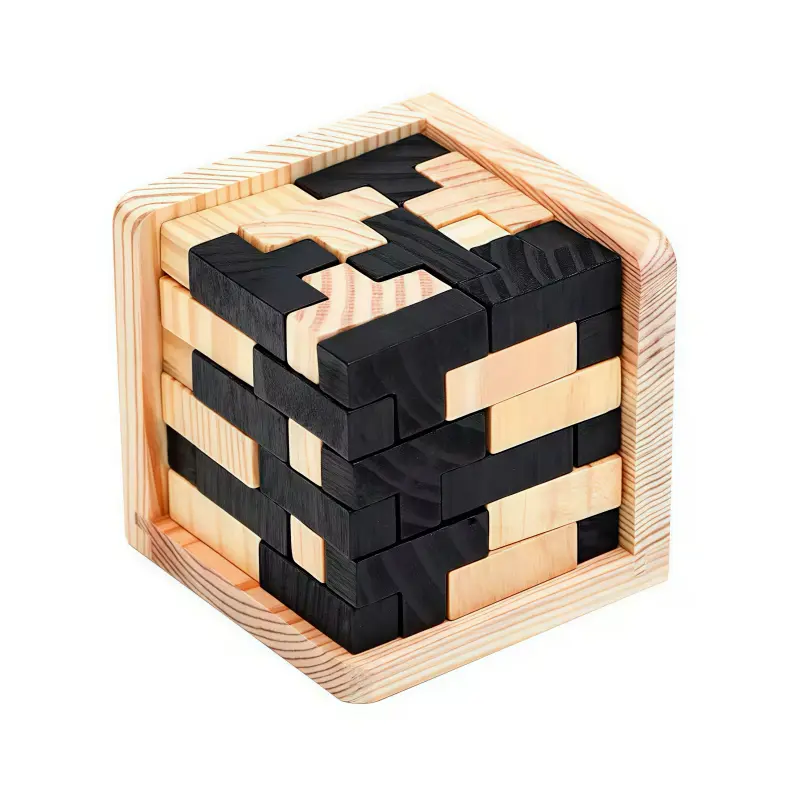
54‑T Cube Puzzle — $18.99
The summary in one line. For most adult recipients who want a small, tactile, silent, one-handed brain teaser on their keyring, the interior ball-bearing brass cube is the right mechanism, and the rest of the decision is material, hardware, and packaging. For a step-by-step method on the disassembly-and-reassembly variant, see how to solve metal cube puzzles in 6 steps.
Frequently Asked Questions
A brass cube maze puzzle keychain is a compact mechanical puzzle worn on a keyring, and the questions below cover the practical checks most adult buyers run through right before clicking order. The mechanism has been decided; the remaining concerns are durability, pocket behavior, and gift fit.
What is a brass cube maze puzzle keychain and how does it work?
It is a small cube (typically pocket-sized) containing an internal maze channel and a weighted ball that the user tilts through the path from start to finish. The puzzle is solved by gravity and steady hand control, not by twisting faces or aligning tiles. The mechanism is a gravity-based navigational puzzle, a sub-type of mechanical puzzle that requires physical manipulation of a discrete object with no hidden information.
Is a brass cube maze puzzle hard enough for an adult?
For a casual adult recipient, yes. Interior ball-bearing mazes fall into the “first-time-solvable in a few minutes” range, which makes them satisfying without being frustrating. A recipient who already solves Hanayama-level disentanglements will find it too easy; for that person, a sequential puzzle box or interlocking wire puzzle is a better fit. Ask the retailer or check the listing for a stated difficulty rating before assuming.
Will brass tarnish or turn my keys green?
Solid brass develops a patina over time, which most buyers describe as a warm, darker tone rather than green corrosion. Green discoloration on skin or keys usually signals brass-plated base metal reacting with sweat, not solid brass. Wiping the cube occasionally and keeping it dry slows both effects.
Is it solid brass or just plated — how can I tell?
Check the listing for explicit words like “solid brass” or “brass-plated.” A magnet test is a fast check: solid brass is non-magnetic, while many plated zinc or steel cores will attract a magnet. Weight is another clue; plated zinc feels noticeably lighter than solid brass in the same cube size.
How big is it, and will it scratch my phone?
Most brass cube maze keychains sit in the 3–4 cm range, roughly the footprint of a large die. Edges are usually rounded, but brass is harder than phone glass, so a loose pocket mix with a bare phone is a risk. A small fabric pouch or a separate key pocket eliminates the concern.
Are these allowed on planes in carry-on luggage?
Metal mechanical puzzles are generally permitted in carry-on; they are not prohibited items under standard airline security rules. For absolute certainty, the relevant aviation authority’s published prohibited-items list is the source to verify before flying.
What is the difference between a maze puzzle and a disentanglement puzzle?
A maze puzzle uses gravity and tilt to guide a ball through a fixed path. A disentanglement puzzle uses two interlocked pieces (often wire or metal rings) that must be separated through a specific sequence of moves. Both count as mechanical puzzles, but the solving skill is different: spatial navigation versus move planning.
Is it a good gift for someone who already likes puzzles?
Yes, when the recipient appreciates small desk or pocket objects and likes the brass aesthetic. For a serious collector, pair the cube with a second mechanism type, such as the Maze Lock Dual-Sided Maze Puzzle or the 7 Color Soma Cube Puzzle, to give the gift more range.
Next step. Confirm mechanism type, material claim, and hardware style on the product page, then order from tea-sip.com/product/brass-cube-maze-puzzle-keychain for the listed price of $16.99.
Where to Start
If the recipient and occasion checks above match, start with Brass Cube Maze Puzzle Keychain. Check the current product page for the specifications that matter to your choice.
Still comparing options? Use the matching Tea-Sip collection to compare the same decision criteria, rather than restarting the search from scratch.
Sources and verification
- Product details and current specifications: Tea-Sip product page
Last updated: August 27, 2026