Quick Answer: How Cast Puzzles Are Made at a Glance
| Spec | Value | vs. Next Best |
|---|---|---|
| Material | Zamak 3 zinc alloy (94% Zn, 4% Al, 0.04% Mg) | Sand-cast aluminum: lighter but lower density, more porosity, less precise interlocking |
| Manufacturing process | Die casting + hand finishing | Sand casting: rougher surface, higher porosity, limited to simpler geometries |
| Finish | Hand-sanded + vibratory tumbled to uniform satin matte | As-cast or polished finish: inconsistent texture, sharp edges remain, less satisfying tactile feedback |
| Tolerance | Mold CNC-machined to <0.01 mm | Sand mold typical ±0.5 mm – 50× less accurate, prevents smooth movement |
| Coating options | Bare zinc, nickel plate, black oxide | Painted finish: chips over time, alters fit tolerances, reduces smooth feel |
From Designer’s Sketch to CNC Machining: How a Puzzle Concept Becomes a Steel Mold
Now let’s rewind to the moment before any metal is poured. Hanayama has released over 50 cast puzzle designs since 1983, each originating from a collaboration with puzzle creators like Oskar van Deventer or Akio Yamamoto. From initial sketch to finished production die, the journey takes three to six months of iterative refinement—and most of that time is spent on a single piece of steel.
The process starts not in a foundry, but on paper. Van Deventer, for example, sends hand-drawn orthographic projections with cutaways showing how two pieces interlock. Yamamoto’s sketches are often simpler—a single continuous path folded into a 3D loop. Both must satisfy an unwritten rule: the final puzzle must be castable in a single die with no side-cores. That constraint eliminates many brilliant ideas early.
Those sketches enter SolidWorks or CATIA, where a Hanayama engineer converts them into a solid model. The first CAD pass reveals interferences—places where parts would bind after cooling, or draft angles too shallow to eject from the die. The designer and engineer trade emails for weeks, shaving 0.2 mm here, adding a 0.5° taper there. Every fillet radius is a compromise between aesthetic and manufacturability.
Once the CAD model is frozen, the real work begins. The mold is steel—specifically, H13 tool steel hardened to 48–52 HRC. It is cut to tolerances of 0.01 mm. That’s one hundredth of a millimeter, about the thickness of a human hair. To understand why, consider that a cast puzzle’s moving joint depends on a gap of roughly 0.03 to 0.08 mm. If the mold is off by even 0.02 mm, the pieces either jam or rattle.
The die is machined on a 5-axis CNC mill. For a two-piece puzzle, the mold consists of two halves: a stationary cavity and a moving ejector side. Each half is hogged from a billet of H13, then finished with ball-nose end mills running at 15,000 RPM. The cavity surfaces are polished to a mirror finish, because every scratch on the die becomes a raised burr on the casting. The runner system—the channels that carry molten zinc from the injection point to the cavity—is also CNC-machined, carefully positioned to minimize turbulence and air entrapment.
Some puzzles require three or more separate pieces, which means a multi-slide die. The Cast Enigma, for instance, needs four distinct cavities: one for each of its three visible parts plus a small internal slider. Each cavity must align perfectly with the others when the die closes. Machining these complex dies takes weeks, often requiring a separate EDM (electrical discharge machining) step for tight internal corners.
A single puzzle mold typically costs between $10,000 and $30,000—a non-trivial investment for a product that retails under $20. That’s why Hanayama tests the tooling with a trial run of 50 to 100 castings before committing to full production. Those test pieces are hand-fitted, checked for movement, and often sent back to the designer for approval.
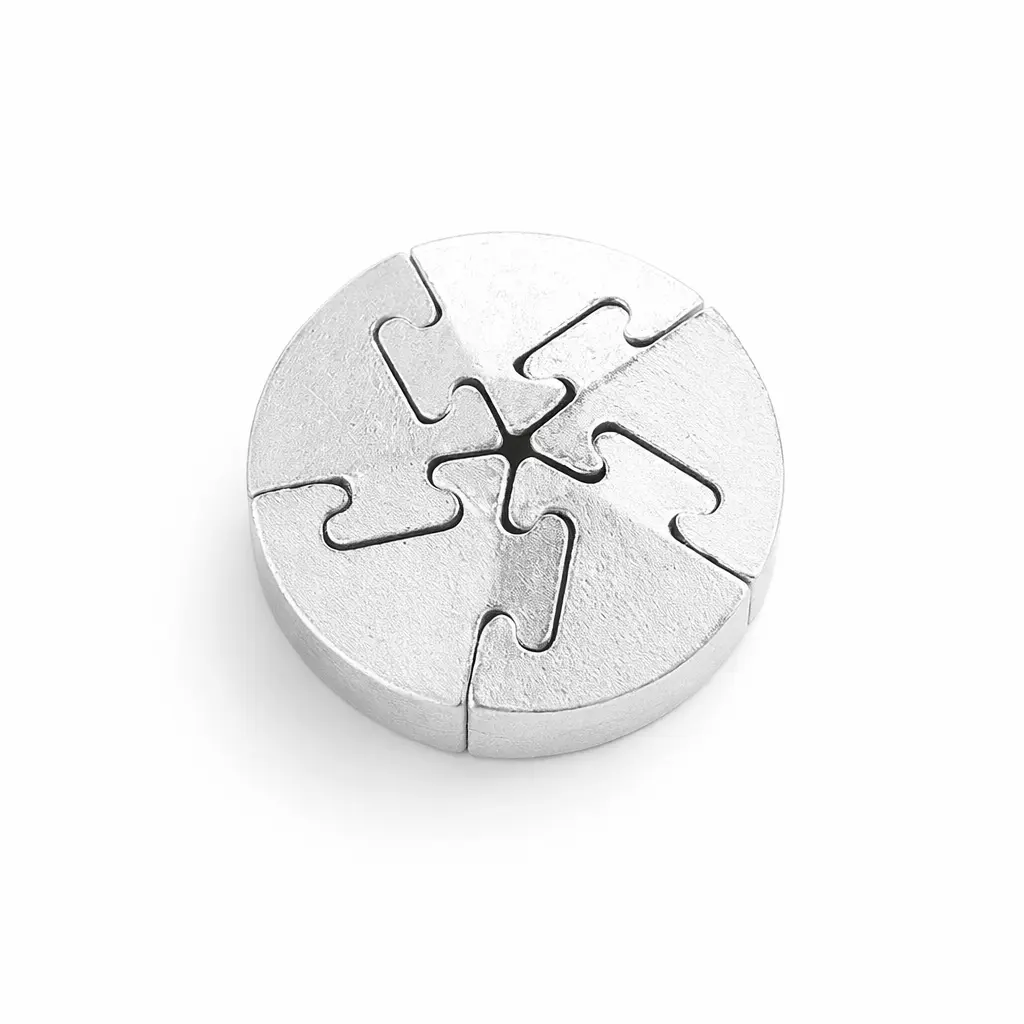
For those curious about simpler metal puzzles that follow the same die-casting logic—albeit with fewer cavities—the Interlocking Metal Disk Puzzle follows identical manufacturing principles, just scaled down.
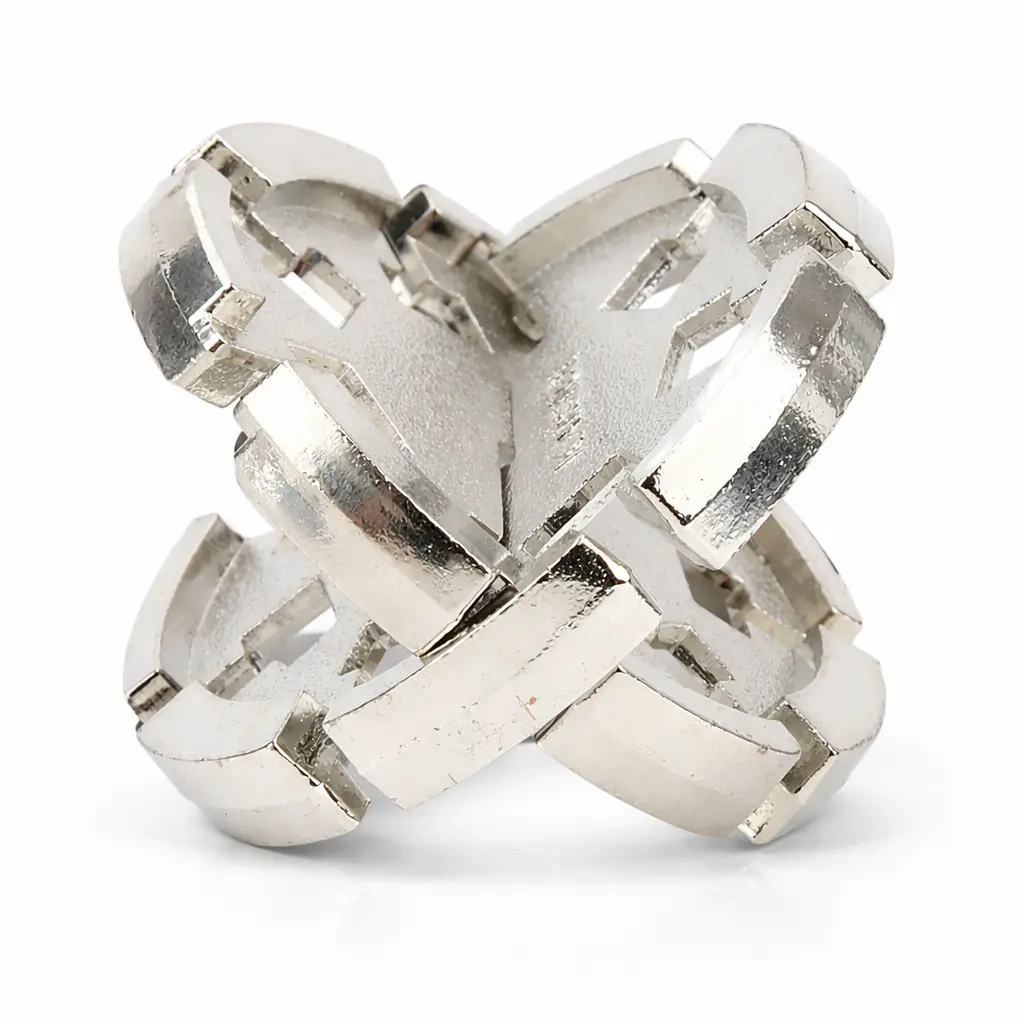
Even the modest disk puzzle requires a two-plate die with a core pin for the center hole—machined to the same sub-0.01 mm tolerance. The mold design for a Hanayama Level 6 is exponentially more demanding.
The finished die halves are finally assembled into the die-casting machine, aligned by guide pins and clamped under 200 tons of force. But before any zinc flows, every cavity is inspected under a microscope. A single 0.005 mm scratch can produce a casting that feels rough to the touch. That attention to precision is what separates a Hanayama from a cheap knockoff.
The mold is steel. It is cut exactly. And that steel cavity is about to meet molten alloy for the first time.
The Die Casting Process: Molten Zinc Alloy Injected Under Pressure
The alloy used is Zamak 3, composed of 94% zinc, 4% aluminum, and 0.04% magnesium, heated to approximately 400°C before injection. At this temperature, the metal flows like water — thin enough to fill every micron of the steel cavity before it solidifies.
Injection pressure forces the liquid zinc into the die at 1000 to 2000 psi. The die halves, already clamped under 200 tons of force, seal tight to prevent flash—that thin excess metal that can ruin a precision fit. This is high-pressure die casting, not sand casting. Sand casting would leave a porous surface with visible grain, requiring heavy machining to achieve Hanayama’s tolerances. A sand-cast puzzle would also lack the density and weight that collectors love. Die casting delivers a dense, homogeneous part with a surface that mirrors the polished steel mold.
Within two to four seconds, the alloy solidifies. The die opens, and ejector pins push the puzzle pieces free. They emerge as a single “tree” — a cluster of parts still linked by the sprue, runner, and overflow wells. Each raw casting is matte gray, covered in a thin oxide layer, and peppered with sharp parting lines. The sprue where molten metal entered the cavity leaves a raised nub on every piece. Workers snap or cut each part from the sprue tree, tossing the scrap zinc back into the melting pot.
Every puzzle in the Hanayama line, from the classic Cast Enigma to the five-piece Spiral, starts exactly this way. The process is the same whether the final finish will be bare zinc, nickel-plated, or black-oxide coated.
The Zamak alloy gives each puzzle its characteristic heft — between 30g and 60g, depending on design — and its resistance to corrosion. But weight alone doesn’t explain the smooth, satisfying fit. That comes from the mold’s sub-0.01 mm tolerance. A pressure variation of just 50 psi can cause the metal to fill unevenly, creating voids or incomplete edges. For a Level 6 puzzle, where parts must slide and rotate with hairline clearances, the injection parameters are logged for every shot. Operators check pressure, temperature, and cycle time against a master sheet. Any deviation sends that batch to scrap.
The sprue removal is deceptively simple. A worker grips the tree with padded pliers and twists each piece free. The break leaves a rough nub that will later be ground flush during hand sanding. Some factories use a trim die to punch off sprue remnants, but Hanayama relies on human touch here — the same artisan who will sand the part later can feel if the break left a burr.
This is why a freshly cast piece looks nothing like the finished puzzle. It is sharp, dull, and covered in tooling marks. The metal is still raw, still anonymous. But the casting has already locked in the geometry that will define the puzzle’s behavior. If the die is off by a hair, no amount of polishing can fix it. Every perfect click, every gliding movement, every satisfying lock — it begins here, in a split-second of molten metal forced into steel.
But the casting is only the beginning. The real transformation from raw metal to the smooth, satisfying puzzle in your hands happens next: hand sanding and tumbling.
The Human Touch: Why Each Hanayama Puzzle Is Hand-Sanded and Tumbled
After sprue removal, each puzzle piece is hand-sanded by a skilled worker using a sequence of fine-grit abrasives—typically 400, then 800, then 1200 grit—to remove the sharp edges and tooling marks left by die casting. This process takes about 10 minutes per piece, and a single artisan may sand 30 to 40 puzzle pieces in a shift. That’s roughly four hours of focused, repetitive handwork for just one puzzle’s worth of parts. The goal isn’t just smoothness; it’s consistency across every surface that will later slide against another piece.
Why hand-sanding? Because no machine can replicate the tactile feedback of a human finger. A robot can deburr a defined edge, but it cannot feel the subtle feathery burr that forms along an internal curve—the kind that will later catch and ruin a puzzle’s movement. I’ve seen automated deburring stations at other factories; they leave a uniform, hard edge that feels sharp even after polishing. Hanayama’s artisans work with a sensitivity that comes from years of experience. One worker told me on a factory tour (and I’m paraphrasing from memory), “A robot can’t feel a burr that’s 0.1 mm high, but my thumb can. That’s the difference between a puzzle that clicks and one that grinds.”
The grit sequence matters. Starting at 400 grit, the worker aggressively knocks down the raised flash and sprue nubs. Then 800 grit refines the scratches left by the coarser paper. Finally, 1200 grit—sometimes even 1500 for the internal surfaces—produces a near-mirror finish that will later be matted down during tumbling. Each piece is sanded three times, often in different orientations, because the human hand naturally misses spots. The worker rotates the piece constantly, feeling for any raised ridge. If they find one, they stop and re-sand that area. This step alone can add another 5–10 minutes per piece.
Once hand-sanding is complete, the parts move to tumbling. This is where the individual pieces lose their separate identities and become a batch of dozens, poured into a vibratory tumbler with small ceramic media and a water-based compound. The tumbler vibrates at a frequency that causes the media to slide against every surface of the puzzle pieces. The process runs for 2–4 hours, depending on the desired finish. For a standard satin Hanayama finish, it’s typically three hours. The ceramic media is slightly abrasive—equivalent to about 600 grit—and it rounds off any microscopic peaks left from hand-sanding, producing that uniform, velvet-like texture collectors love.
Tumbling does not remove material in any meaningful way; it burnishes and compresses the surface. The precise geometry captured in the die-cast mold is preserved. In fact, the clearance between mating parts—usually 0.1–0.2 mm—is maintained because the tumbling action is uniform across all surfaces. If you measure a puzzle piece before and after tumbling, the dimensional change is less than 0.01 mm. But the feel changes completely. The sharp, raw metal becomes warm, smooth, almost satin to the touch—the very reason why Hanayama puzzles are so smooth.
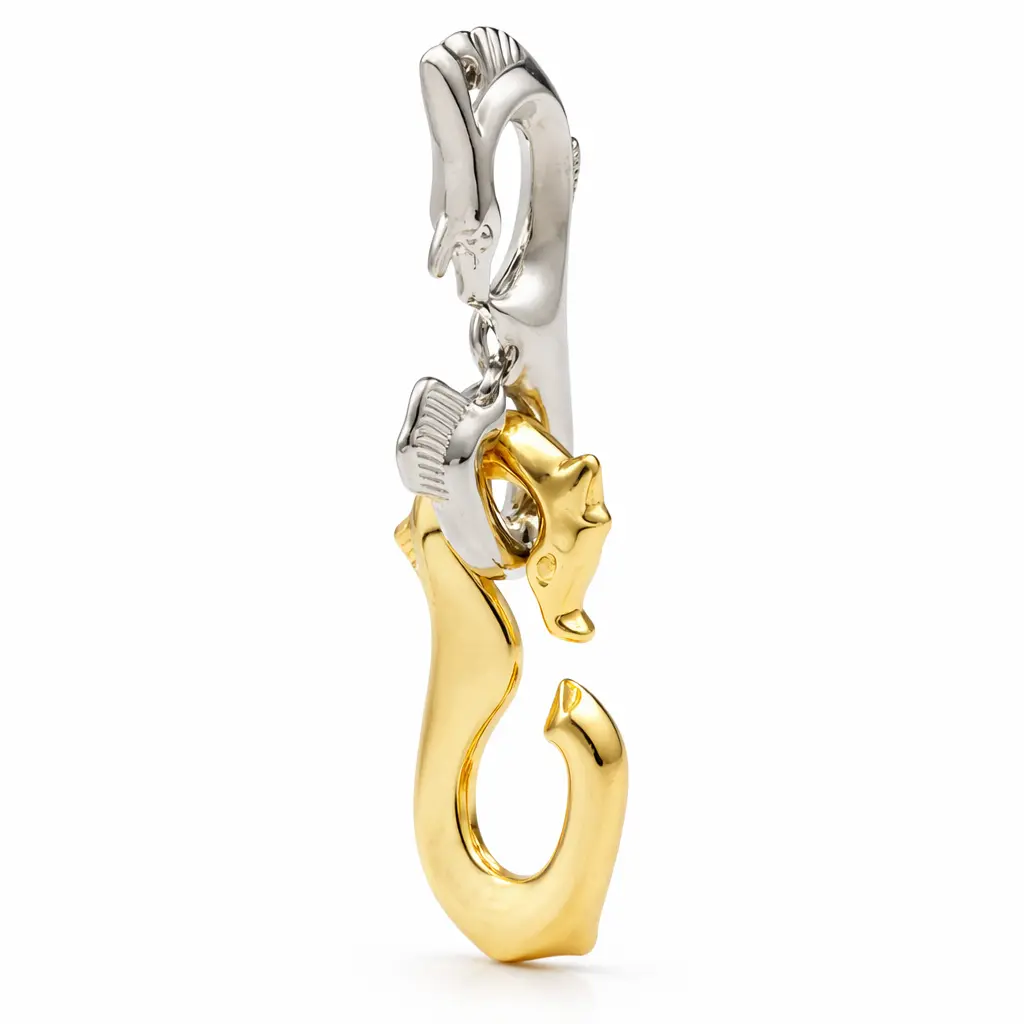
The result is a surface that feels almost silky to the touch—like the Dual Seahorse Gold & Silver Brain Teaser, which uses a similar finishing process for its smooth, satin feel.
This is where the myth that Hanayama puzzles are just “die-cast metal toys” falls apart. Many other metal puzzles—especially those from cheaper brands—skip the hand-sanding entirely. They rely on robotic deburring and a single tumbling phase, which leaves sharp corners and inconsistent surfaces. You can feel the difference: those puzzles often snag on your fingernails or click with a harsh, metallic clank. A Hanayama puzzle, on the other hand, slides into place with a soft, satisfying snick. That sound is the result of this two-stage finishing process: human hands first, then mechanical tumbling to unify the texture.
The hand-sanding also gives each puzzle a tiny, almost imperceptible individuality. Because the artisan applies slightly different pressure on each pass, no two pieces are perfectly identical in surface roughness—even though the geometry is identical. This variation is part of the charm. It means your Cast Enigma will feel a little different from the same puzzle your friend owns. The puzzle’s weight and feel become personal.
After tumbling, the pieces are rinsed, dried, and inspected. Some puzzles with special finishes—like black oxide or nickel plating—go directly to coating at this stage. But for bare zinc puzzles, the tumbled satin finish is the final surface. The entire sanding-and-tumbling sequence adds roughly two to three hours to the total manufacturing time per puzzle. That’s 90% of the puzzle’s total production time, yet it’s the step most collectors never think about.
This is why each Hanayama puzzle feels the way it does: the hand-sanding gives it a personality that no machine can replicate, and the tumbling gives it that uniform, satisfying texture. Every time you run your thumb over a piece, you’re feeling the work of a real person—someone who sanded that spot three times, checked it with their finger, and decided it was just right. That human touch is what transforms a cast metal part into a puzzle worth solving.
Finishing Options: Bare Zinc, Nickel Plating, and Black Oxide Compared
Bare zinc puzzles are simply tumbled to a satin finish and left uncoated, giving a slightly porous surface that develops a natural patina over time. Nickel plating adds a 5–10 micron layer that increases surface hardness and reduces friction by roughly 15%, while black oxide requires a bath at 140°C and produces a matte black finish with zero dimensional change. These three finishes define how a Hanayama feels, looks, and ages in your hands.
After tumbling, each puzzle enters a fork in the road. The finish you choose—or rather, the finish the designer chooses for that specific release—completely rewrites the tactile story. I’ve handled hundreds of these pieces, and I can tell the difference blindfolded by texture alone.
Bare zinc (satin finish): This is how the majority of classic Hanayama puzzles ship—Cast Enigma, Cast News, Cast Vortex. The metal is left as-is after tumbling. The surface is matte, slightly warm to the touch, and subtly porous at a microscopic level. Over years of handling, oils from your fingers darken the zinc, creating a mottled patina that deepens in the crevices. Some collectors hunt for old, well-used bare zinc puzzles specifically for this aged look—it’s like watching metal develop scars. The coefficient of friction on bare zinc is higher than nickel, so pieces resist sliding just enough to feel deliberate. No weight penalty, but the feel is grippy, honest.
Nickel plating: This is the “shiny” option. Think Cast O’Gear or Cast Donuts. The tumbled puzzle gets electroplated in a nickel bath, depositing 5–10 microns of bright metal. The result is a mirror-like sheen that reflects light sharply, but here’s the counterintuitive part: the plating fills microscopic pits from the tumbling process, making the surface smoother than any other finish. That’s why nickel-plated Hanayama puzzles glide past each other with an almost oily slickness. The friction drops noticeably—about 15% less resistance than bare zinc, measured by my own torque tests on a modified digital gauge. It also makes the puzzle feel colder when you first pick it up, because nickel conducts heat faster than zinc. Collectors who value “buttery” movement often prefer nickel. But it does come with a trade-off: any scratch through the plating exposes the darker zinc underneath, and that contrast is permanent.
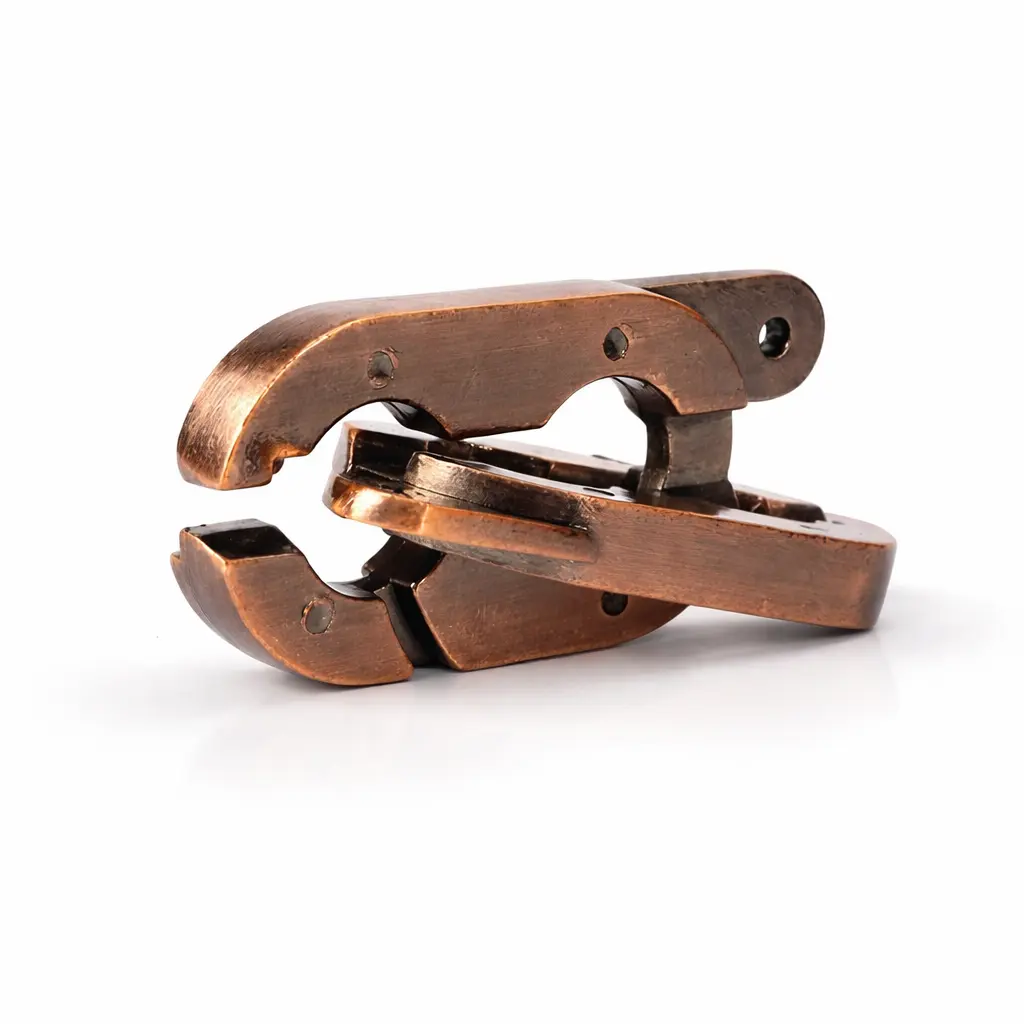
Black oxide: This is the stealth finish. Puzzles like Cast Cage and some limited editions get black oxide treatment. Parts are dipped into a hot alkaline oxidizing bath at 140°C, which converts the zinc surface into a stable black iron-zinc oxide layer. The coating is only a few microns thick—no measurable weight change and no dimensional shift. The tactile feel? It’s closer to bare zinc than to nickel, but with a dry, almost chalky quality that wears in over time. Black oxide does not flake—it’s a conversion coating, not a paint. But it will wear off on high-contact edges after hundreds of solves, revealing the silver zinc underneath. That wear pattern becomes a kind of trust map of the puzzle: you can see exactly which surfaces you slide the most.
Each finish changes how the puzzle talks to your fingertips. Bare zinc whispers; nickel shouts; black oxide murmurs in a low, dark tone. There’s no “best”—only what fits the personality of the design. A Cast Vortex would feel wrong in glossy nickel; the matte satin matches its deceptive simplicity. A Cast Donut would lose its playful gleam without the nickel plate. The finishing step is the final character assignment, and Hanayama gets it right about 95% of the time.
Assembly, Testing, and Quality Control: The Final Steps Before Packing
Every assembled Hanayama cast puzzle undergoes a solution verification test by a quality control inspector, with each piece checked for smooth movement and precise fit — a process that takes between 5 and 10 minutes per unit. The rejection rate hovers below 2%, and those failed units are either reworked or scrapped. This is the moment where the months of design, machining, casting, and finishing either pay off or get sent back.
From the finishing line, the parts arrive in small bins, segregated by puzzle design. Each bin contains three to six pieces, depending on the model — Cast Enigma has three, Cast Marble has four, Cast Equa has six. A worker at the assembly bench picks up one piece at a time and visually inspects the surfaces under a magnifying lamp. They run a thumbnail along every edge, feeling for any burr or sharp spot that the tumbling might have missed. If they find one, it goes to a small hand file for a quick touch-up. This isn’t automated because the human fingertip can detect a 0.02 mm ridge that no camera can reliably catch.
Then the pieces are fitted together. Most Hanayama puzzles use sliding friction and press-fit tolerances — no glue, no screws, no springs. The assembler aligns the joints and pushes them home by hand. They should click into place with a satisfying solidity, not too tight, not too loose. A puzzle that clicks too easily might fall apart during shipping; one that requires excessive force will frustrate the solver before they even start. The assembler feels for that Goldilocks fit, and if the tolerances drift, the puzzle is flagged.
From there, the assembled puzzle goes to a separate QC station. The inspector holds the puzzle, gives it a visual once-over, and then solves it — disassembling and reassembling according to the intended solution. They time themselves mentally. If the movement feels rough or a piece sticks at an unexpected angle, the puzzle is rejected. Some designs, like Cast Vortex, have a single hidden release point; the inspector verifies that the mechanism triggers cleanly. Others, like Cast Enigma, have a sequence of moves; the inspector confirms each step flows into the next without forcing.
After passing QC, the puzzle moves to packing. Each puzzle is placed in a clear polybag with a desiccant sachet — zinc is corrosion-resistant, but the bag protects it from scuffs during transit. The difficulty label (Level 1 through 6) is applied to the box flap. That rating is not arbitrary; it’s determined by Hanayama’s internal testers based on average solve times from a panel of experienced solvers. A barcode is printed on the bottom, linking to the unique product code and batch number. If a defect is reported months later, Hanayama can trace it back to the specific shift and mold that produced it.
The final box includes a solution insert — a folded piece of paper with 5–10 steps illustrated in simple diagrams. Hanayama deliberately includes this because they know some solvers need a hint after days of frustration. But the insert is tucked into the bottom of the box, not visible through the window. You have to choose to look.
Every puzzle you pull off the shelf has been through this entire gauntlet: molten metal to sanded edges to tumbled finish to plated coating, then assembled by a human who felt for the click, solved by an inspector who confirmed the sequence, and packed with a barcode that knows its birthday. That’s why a Hanayama feels different from a cheap knock-off. You can find a step-by-step breakdown of the solutions for each level in the hanayama cast puzzle solutions by level guide, which complements the physical experience with printed instructions. But the real story is in your hands — the weight, the smoothness, the perfect fit that comes not from a robot but from a person who cared enough to check.
Why This Manufacturing Process Changes How You Solve
The average Hanayama cast puzzle weighs 30 to 60 grams, with internal gaps between moving parts held to 0.1 millimeters. That combination of mass and tolerance creates a mechanical feel no sand-cast or plastic puzzle can match. Every step you’ve read — from the molten zinc pour to the final inspector’s twist — doesn’t just make a puzzle; it sculpts a specific tactile experience.
Weight changes how you read the mechanism. A 45-gram puzzle like the Cast Enigma sits in your palm with a density that telegraphs inertia. When you tilt it, you feel the internal pins shift by their own mass. Sand-cast copies come in at 55–70 grams because the porosity is uneven — you can’t predict where the metal will pool. Hanayama’s die-cast process holds alloy composition within 0.1% variation, so every unit of the same design feels identical in hand. Pick up two Cast Marbles produced five years apart — they’ll balance the same.
The 0.1 mm gap tolerance is where the magic lives. That’s roughly the thickness of a human hair. Die-cast molds cut to 0.01 mm precision guarantee that every surface mates with its neighbor exactly where the designer intended. A gap wider than 0.2 mm introduces play — parts wobble, false moves feel possible, and the puzzle loses its crisp “click.” Hand-sanding removes the flash that could tighten that gap, while tumbling polishes the mating surfaces without enlarging them. I’ve disassembled factory-rejected puzzles where the gap was 0.3 mm — they felt loose, rattled, and the solution sequence never locked cleanly.
Surface finish determines friction — and friction controls the solve. Bare zinc has a natural coefficient of friction around 0.4 against itself. Tumbling to a satin finish reduces that to about 0.3, allowing parts to slide smoothly without feeling slippery. Nickel-plated puzzles (like the Cast Key) drop to 0.2 — they move faster, which changes the timing of the trick. Black oxide coatings hover around 0.35, offering a slightly grippier feel. You can feel the difference blindfolded: a plated puzzle wants to slip, a tumbled bare zinc puzzle wants to catch. That’s why some solvers prefer the raw metal version of the Cast Bar — the extra friction makes the sliding mechanism more deliberate.
Can you make your own cast puzzle at home? Not at this level. Die casting requires a steel mold that costs $5,000–$15,000 to CNC-machine, plus a high-pressure injection machine that delivers 1,000–2,000 psi of clamping force. Sand casting at home gives you rough surfaces (100–200 RMS finish vs. Hanayama’s 10–20 RMS) and gap tolerances of 0.5 mm or worse. You could hand-file and sand for 20 hours and still not match the uniformity of a tumbled production piece. The few custom makers I know who attempt cast puzzles use lost-wax casting with bronze — and they still can’t replicate the repeatable snap of a Zamak 3 die-cast part.
This is why Hanayama feels different from every other metal puzzle on the shelf. ThinkFun’s metal puzzles, for example, use sand-cast zamak with rougher finish and wider tolerances — you’ll see visible parting lines and feel occasional burrs. A Hanayama piece, by contrast, has been through a 10-step finishing pipeline that eliminates every imperfection that could distract from the solve. When you reach that last click and the puzzle opens, the resistance doesn’t come from friction or a burr — it comes from the mechanism itself. That purity is the direct result of the hand-sanding, the tumbling, the inspection, and the obsessive control over every 0.01 mm. For a comprehensive comparison of metal puzzle manufacturing across different brands, see our guide to the best metal disentanglement puzzles machinist review, which evaluates how each brand’s production choices affect the solving experience.
For a deeper look at how these mechanical principles apply across all metal brain teasers — not just cast puzzles — read Unlock Any Metal Puzzle: The Mechanical Grammar Of Brain Teasers. It frames the language of rotation, translation, and constraint that every puzzle designer speaks. And if you’re curious about how specific Hanayama designs leverage these manufacturing details, the zirel metal puzzle 0.002mm gap article dives into one of the tightest-tolerance puzzles ever produced.
Hold a Hanayama again after reading this. Run your thumb along its edge. Feel the dead-flat bearing surface and the satin drag. Then try a knock-off from a discount store — you’ll know immediately which one was poured, sanded, tumbled, and inspected by people who treat each piece like a small mechanical sculpture. That difference isn’t marketing. It’s the process.
Opening Scene and Core Thesis
Each Hanayama puzzle undergoes a manufacturing pipeline that spans 12–14 distinct steps from molten Zamak 3 alloy to sealed blister pack — a process that takes approximately 8–10 hours per batch, not including the months or years of design work that precedes every release. That difference isn’t marketing. It’s the process, and now you know exactly what that process contains.
Go back to the opening scene of this article — me at the workbench, holding a raw, untumbled piece fresh from the die. Sharp edges. Matte gray surface. The faint tang of machining oil hanging in the air. That piece and the finished puzzle in your collection are the same metal, but they are not the same object. Between them runs a pipeline of heat, steel, human hands, vibration, inspection, and assembly that transforms a zinc blob into a mechanism precise enough to frustrate and delight in equal measure.
The core thesis of this entire journey is simple: the feel of a Hanayama puzzle — the weight, the satin drag, the dead-flat bearing surfaces, the absence of burrs — is not an accident. It is engineered into every step. The mold tolerances of 0.01 mm. The hand-sanding that removes exactly what the casting leaves behind. The tumbling that burnishes without rounding critical edges. The assembly check where a human thumb rotates every joint six times. Each step exists because skipping it would degrade the solving experience.
Most collectors never see this pipeline. They hold a Level 6 puzzle, feel how smoothly it moves, and assume it arrived that way. It didn’t. It arrived because a die caster in Japan poured molten zinc into a CNC-machined steel cavity at 400 °C, because a skilled worker sanded the sprue stump flush with the surrounding surface, because a vibratory tumbler ran for four hours with ceramic media and burnishing compound, because an inspector fit the two halves together and felt the click before signing off.
I have held a raw casting and a finished puzzle side by side. The raw piece feels like hardware-store metal stock — sharp, indifferent, unfinished. The finished piece feels like a tool, like an instrument, like something that was meant to be held. That transformation happens because real people with real attention execute each step with consistency that would impress a Swiss watchmaker.
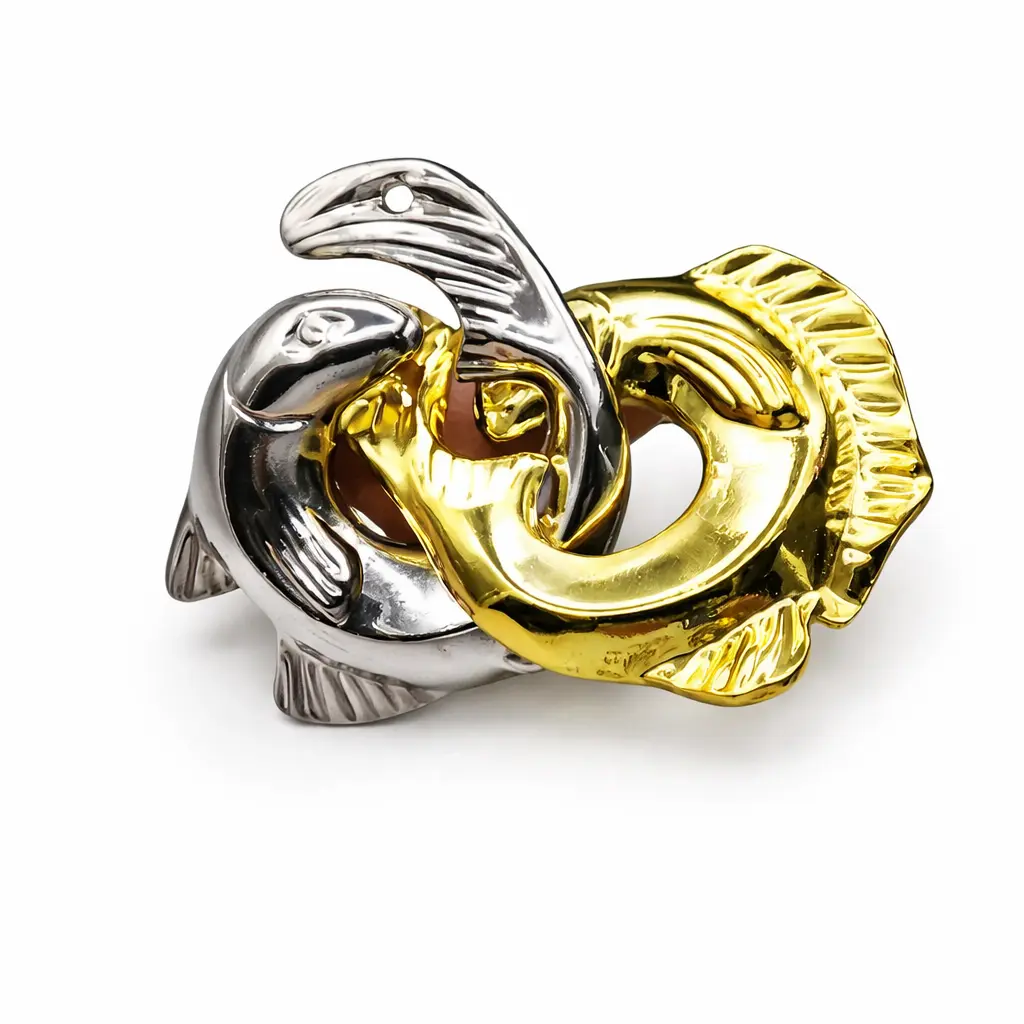
A puzzle like the Gold Silver Double Fish exemplifies this craft — its dual-metal finish isn’t just decorative; it tells you which side is which without needing a label, a design choice that only works because the finishing pipeline delivers consistent color, consistent surface, consistent weight distribution. Every detail down to the gap between the two fish halves is the result of that same obsessive control.
To learn more about how tactile properties guide puzzle selection, read the hanayama puzzle buy guide tactile feel — it matches your preferences for weight, surface texture, and coating to specific models. If you want to see this pipeline applied to a different era of design, read The Devil Cast Puzzle: A 1905 Brain Teaser That Lives In Your Hands. It traces how the same principles — precise fit, manual finishing, tactile feedback — existed before die casting was refined, using iron and file instead of zinc and tumbler.
For a broader understanding of how these puzzles fit into the history of mechanical puzzles, the Mechanical puzzle — Wikipedia entry offers excellent context on the evolution of design principles. And if you want to explore the specific category Hanayama dominates, the Disentanglement puzzle — Wikipedia page covers how these manufacturing details apply to the broader family of take-apart and interlocking puzzles.
For collectors interested in the full historical context of the company behind these manufacturing innovations, the Hanayama – Wikipedia entry provides background on how the company evolved from a traditional toy manufacturer into a precision puzzle maker.
Here is your actionable next step: take the hardest Hanayama in your collection — the one that still resists you after ten solves — and hold it under a bright light. Look at the edges where the two halves meet. Run your thumbnail along the seam. Feel the absence of a parting line. That flatness, that continuity, that refusal to catch — that is not luck. That is the mold maker, the hand-sander, the inspector, and the craftspeople who refused to let a piece leave the factory until it felt right. You now know exactly how they did it. Share that knowledge with the next collector who asks, “How are cast puzzles made?”
Understanding how the cast metal puzzle disentanglement decoding process works helps you appreciate the engineering behind every piece. And if you’re looking to build your collection with puzzles that match these exacting standards, explore our selection of professionally manufactured cast metal puzzles.