The Heft in Your Palm: Unboxing the ‘Mind-Boggler’
The Hanayama Cast Chain puzzle first announces itself not by sight, but by weight. You lift it, and a cool, dense mass of metal settles into your palm—it feels substantial, like a precision-machined component from a vintage timepiece, not a trinket. Measuring 7.6 x 3.9 x 3.9 cm, this compact trio of gold and copper-plated links possesses a deceptive, collector’s-grade heft, thanks to its cast zinc alloy construction. This is your first clue that you’re not holding a toy, but a serious mechanical puzzle in the classic tradition of the disentanglement puzzle.
This is Oskar van Deventer’s Hanayama Cast Chain, an immediate recipient of an Honourable Mention at the IPP 22 and universally rated at the apex of difficulty: a 6/6 on Hanayama’s scale and a perfect 10/10 “Mind Boggling” from Puzzle Master. Its reputation precedes it. You’ve heard the whispers from collectors: That one’s the mind-boggler. Now, it’s in your hand.
Visually, it presents a facade of elegant simplicity. Three links are interlocked in a seemingly standard chain configuration. Your fingers naturally probe for movement, expecting a rattle or a slide. There is none. The pieces are locked in a perfect, silent deadlock. You turn the assembly over, seeking a seam, a gap, a weakness. The flawless galvanized gold copper finish offers no hints. You apply gentle pressure, testing a rotation. It doesn’t wiggle. It pivots, a fraction, before meeting an immovable internal wall. This is the first, crucial moment of ‘stuckness.’
The initial intrigue—the beautiful, heavy feel—collides with the awe of its pedigree, instantly giving way to a profound confusion. How can something that looks so logically derived from a common chain be so impossibly fixed? This is the deliberate design feint. The disentanglement puzzle before you only mimics a chain; its core logic is something far more clever and rigid. You place it on your desk, a tiny, gleaming monument to a problem yet unsolved. The Huzzle Cast series has thrown down its greatest gauntlet, and the silent challenge is absolute. Where do you even begin?
Oskar van Deventer’s Design Philosophy: Minimalist Torture
That first moment of profound stuckness is not a flaw in your approach, but the signature of its creator. Oskar van Deventer, the Dutch puzzle designer behind over 300 mechanical enigmas, operates on a principle he terms “minimalist torture.” His goal is to distill a complex, logic-driven challenge into the fewest possible components, creating an object that is geometrically pure and maddeningly inscrutable. The Cast Chain, which received an Honourable Mention at the IPP 22 (International Puzzle Party), is a pinnacle of this ethos—three simple links that contain a universe of constraint.
As a puzzle archivist, I categorize designers by their tells. Some rely on hidden compartments or sequential discoveries. Oskar’s hallmark is a brutal, elegant clarity. His puzzles present their entire mechanism in plain sight. There are no secret panels, no springs, no magnets. Just precision machining and immutable geometric law. You see all the pieces, yet their permitted paths of movement are so perfectly restricted that the solution feels hidden in a blind spot of your own perception. This is why his puzzles, especially the Hanayama Cast Chain, transcend mere dexterity toys. They are spatial logic theorems you hold in your hand, a pure form of the mechanical puzzle.
His background as a scientist and instrument maker is palpable. Each design functions like a precision lock, where the key is a specific series of rotations and alignments along a hidden rotational axis. The “torture” isn’t about tricky moves or weak fingers; it’s the mental friction of confronting a perfectly balanced system that yields only to perfect understanding. Why does a puzzle that looks so simple become a weeks-long companion on your desk? Because Oskar removes all avenues for guesswork. Every failed twist teaches you something about the invisible internal channels.
This philosophy explains the Cast Chain’s revered—and feared—status within the metal puzzle collection community. Compared to other level 6 difficulty Hanayama puzzles, which might involve more obvious piece manipulation or sequential symmetry-breaking, the Chain offers a purer form of Oskar’s craft. It’s a disentanglement puzzle that initially denies the very possibility of disentanglement. The three links are a deliberate feint, a familiar form that sets up expectations only to subvert them with a far more rigid and clever interlocking mechanism. The award from the IPP, a gathering of the world’s most obsessive puzzle designers and collectors, is a testament to its success as a minimalist masterpiece. It’s not just a hard puzzle; it’s a beautifully confined logic engine.
Anatomy of a Feint: Why This Isn’t a Normal Chain
The Hanayama Cast Chain is a 3-link chain in form only—a deliberate design feint. While its silhouette measures a compact 7.6 cm and its three links suggest fluid, chainlike behavior, the reality is a rigid interlocking system where each “link” is fixed in a single, immutable orientation. This fundamental constraint is what transforms a familiar object into a true disentanglement puzzle. The chainlike behavior you expect—loose, swinging articulation—is the first and greatest illusion Oskar van Deventer uses to misdirect you.
Pick it up. The links don’t swing freely. They are three independent, C-shaped pieces of cast zinc alloy plated in gold and copper, but they are not connected by pins or hinges. Instead, each curved arm slots through a precisely machined window in its neighbor. It’s a closed loop of three identical pieces, each holding and being held. This creates an immediate cognitive dissonance: your eye sees a chain, but your fingers feel a single, perplexing knot of metal. The puzzle’s objective—to separate and reassemble the trio—seems to defy its own welded-together appearance. Why call it a chain? Because the 3-link chain concept is the perfect Trojan horse, inviting assumptions that are systematically dismantled by the actual mechanical puzzle logic inside.
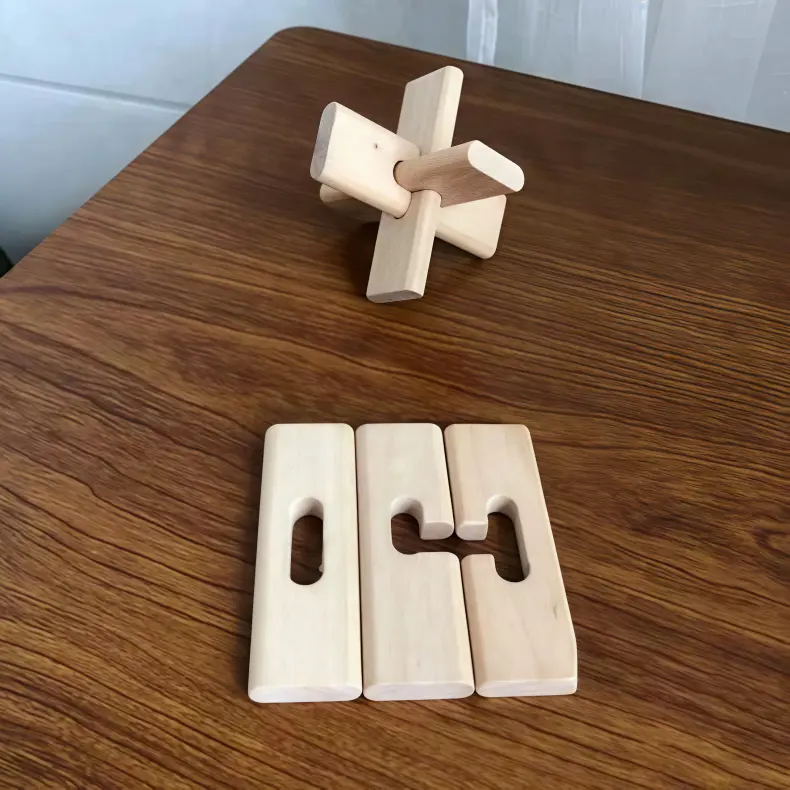
Examine the craftsmanship. The precision machining is flawless; the seams where the pieces interlock are tight, granting only a few tenths of a millimeter of play. This isn’t slop—it’s calculated tolerance. Each piece has a specific topography: curved outer surfaces, flat inner faces, and those critical rectangular windows. The galvanized gold copper plating isn’t just for looks; it provides a smooth, consistent surface that emphasizes tactile feedback. You feel every minute shift, every glancing contact between internal walls. When you try to move one link, the entire assembly moves as one. It doesn’t wiggle. It pivots.
This is the core of the feint. A normal chain link can rotate freely on two axes relative to its neighbors. Here, each piece is locked in a three-dimensional embrace, only able to move along one specific rotational axis relative to another. The puzzle’s infamous level 6 difficulty stems from this radical limitation. The solution doesn’t involve manipulating a flexible chain, but rather navigating these three rigid bodies through a sequenced dance where their windows and arms must align in exact, non-intuitive ways. Understanding this is the first step out of confusion: you are not untangling links, you are operating a minimalist machine with one hidden key. To appreciate the broader logic behind such designs, delve into our article on the mechanical grammar of brain teasers.
The Single Axis of Enlightenment: The Core Mechanical Principle
The single mechanical secret governing the Hanayama Cast Chain is a precise, internal rotational axis and alignment channel that permits movement only when the rectangular windows of two specific links are perfectly co-planar. This constraint transforms the puzzle from a tangle of metal into a solvable, three-state logic problem, where success depends on recognizing this alignment rather than applying force. It is the definitive reason for its mind boggling level 10/10 rating.
Recall that pivotal feeling from the last section: the entire assembly moves as one rigid body. It pivots. That pivot point is the key. Inside each of the three seemingly identical links, there is a hidden geometry—a specific channel formed by the flat inner arm and the curved outer wall. This channel is not a wide groove; it’s a precise path that only accepts the rectangular “window” of another link when that window is rotated to an exact orientation.
Think of it not as a chain, but as a series of three interlocking cams. Each piece can only rotate relative to another around one fixed axis, and only when their keyways—those rectangular windows—are aligned face-to-face, like a lock’s shear line. This is the core mechanical trick. Oskar van Deventer didn’t create a flexible tangle; he engineered a miniature, sequential locking mechanism. Your goal is to find the one link pair whose internal channels are momentarily aligned, initiate the 90-degree rotation that this allows, and then discover how that single move reconfigures the entire puzzle’s relational geometry, revealing the next permissible axis.
This is why random fidgeting leads to a softlocked puzzle. You’re not just moving pieces; you’re navigating a three-dimensional state machine. If you rotate a link even five degrees off the true axis, or try to move a pair whose windows aren’t perfectly co-planar, the internal walls bind. The smooth tactile feedback turns into a jarring dead stop. This isn’t a flaw—it’s the puzzle speaking its language. It’s telling you, “That is not the correct path.”
How do you find the correct axis? This is where observation supersedes brute force. Under good light, peer into the puzzle’s center. You’ll see the edges of those rectangular windows overlapping. Your task is to manipulate the trio gently, feeling for the point where two windows slide against each other to become a single, uninterrupted plane. It’s a visual and tactile alignment check. When you find it, the movement is unmistakable: a clean, singular pivot with no wobble. This principle of chainlike behavior through rigid rotation is what enables all three solutions. The “first” link you free is simply the one whose alignment channel you discover first; each choice branches into a distinct, but equally valid, solution tree.
This unifying principle is what separates the Cast Chain from other level 6 difficulty monsters. While puzzles like Cast Equa demand you discover hidden voids, the Chain is brutally pure in its logic. It presents its rule upfront—rotation on one axis—and then obscures how to achieve the necessary alignment. Mastering this principle is your emancipation from confusion. It shifts the internal monologue from “What can I force?” to “Which two pieces are ready to turn?” and finally, to the enlightened realization: “Ah, this is the machine’s current state, and that is the key it will accept.” This is the mechanical puzzle as high art—a disentanglement puzzle where the true entanglement is in your perception, not in the metal.
Diagnosing the Deadlock: How to Escape the Infamous Softlock
The path from confusion to enlightenment with the Hanayama Cast Chain is rarely linear. More often, it’s a sudden, jarring halt. You’ve been exploring its chainlike behavior, applying the principle of the single rotational axis, and then—click. Everything seizes up. The pieces jam. Hard. This is the infamous “softlock,” a state of perfect misalignment that feels irrevocable and is the single most common point of frustration documented in Reddit threads and forum posts. Escaping it requires no force, only a diagnostic reset, reinforcing that this mechanical puzzle respects logic, not muscle.
If your Cast Chain now looks like three links mashed together in a tense, immovable clump where the elegant gaps have vanished, you’ve found the deadlock. This isn’t a design flaw; it’s Oskar’s deliberate lesson in spatial awareness. The jam occurs when you’ve partially applied the core principle—aligning channels on two pieces—but have rotated the third piece into a position that blocks the very axis you need. The internal channels are now cross-threaded, so to speak. The immediate, panic-driven instinct is to pull. Don’t. This is a fidget-resistant object. The solution is to mentally rewind.
Start your diagnostic by asking the solver’s key question: “Which two pieces are most aligned?” Even in a jam, one pair will have a sliver of a visible channel or a less-resistant wobble. Your goal isn’t to solve it from here, but to methodically backtrack to a known “open” state. Isolate that pair and focus only on getting them to pivot on their shared axis. You may need to coax the third, offending piece along for the ride, gently persuading it to rotate out of the obstructive plane. This is not random wiggling. It is a deliberate search for the one degree of freedom that remains, using the tactile feedback from the metal to find the path of least resistance.
The telltale sign of progress is the reappearance of a gap. Remember, the precision machining means that in any valid position, you will see clear, geometric negative space between the cast zinc alloy pieces. If everything is flush and tight, you’re in a softlock. Your mission is to restore a gap, any gap, by reversing the last few moves. Think of it like easing tension on a precise, old lock where the tumblers have been over-rotated. Slow, tiny adjustments in opposite directions on each piece will eventually pop the system free, often with a satisfying, subtle click.
This moment of un-jamming is, paradoxically, a profound part of the disentanglement puzzle experience with this Oskar van Deventer masterpiece. It teaches you to read the puzzle’s state before acting. Mastering the softlock transforms your relationship with the Cast Chain from one of frustration to one of respectful dialogue. You learn that every dead end has a logical, non-destructive exit, reinforcing that the true mind boggling level challenge was never just the three solutions—it was learning to listen to the machine. If you find yourself frequently in such jams, our guide on metal puzzles that don’t break offers foundational principles for safe, logical manipulation.
Three Paths, One Principle: Conceptualizing the Solutions
The three distinct solutions to the Hanayama Cast Chain are not mirrored variations, but three fundamentally different disassembly sequences, each dictated by which of the three interlocked pieces you choose to free first. For a first-time solver who has internalized the core principle, discovering each unique path typically takes between 20 to 40 minutes of deliberate, principle-led exploration.
So, if they are not mirrors, what makes them different? The answer lies in the starting configuration and the consequent choreography of moves required by the single mechanical secret—the aligned rotational axis and internal channel. Think of the principle as a universal key, but each solution is a different lock it must open. The initial choice of which link to target changes the entire dance of pivots and clearances for the remaining two pieces. One path feels like a slow, deliberate unwinding. Another requires a surprising mid-sequence reversal that feels counterintuitive. The third might hinge on a precise alignment you’d only find by trusting the tactile feedback of the cast zinc alloy gliding through its channel.
This is where the disentanglement puzzle transcends random fidgeting. Can you actually see the solution paths? Not in a literal sense, but you can feel them. Once you understand that every valid move is a rotation around that fixed axis within the defined channel, you stop pushing and start navigating. The path to freeing the center link first, for instance, feels like solving a elegant, symmetrical knot. The sequence for an end link, however, often involves creating a temporary, seemingly more complex entanglement—a clever feint—before everything simplifies and falls apart. Each route has its own rhythm, its own series of “aha” moments that confirm you’re applying the precision machining logic as intended. For structured help on other high-level challenges, our index of Hanayama cast puzzle solutions by level provides a helpful framework.
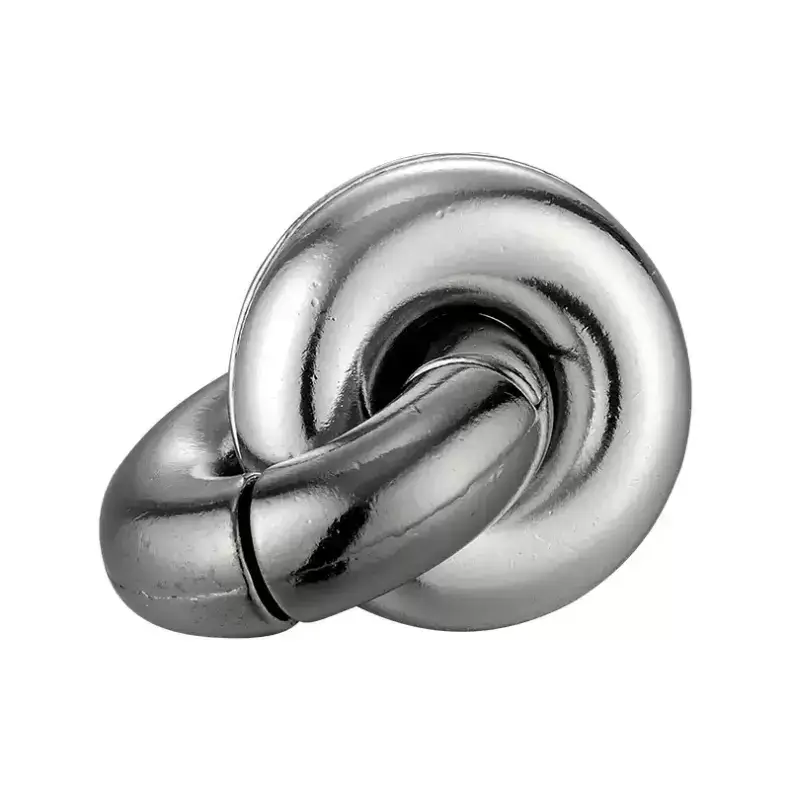
This puzzle, like the Interlocking Double-Ring Lian, emphasizes symmetrical, logic-based disassemble and assemble challenges rather than dexterity. The satisfaction of mastering the Cast Chain’s three ways comes from this variety. Solving it once is a triumph. Mapping the second path proves your understanding wasn’t a fluke. Conquering the third is total mastery, a confirmation that you are no longer manipulating metal, but thinking in Oskar van Deventer‘s geometric language. The Hanayama Cast Chain doesn’t just have three solutions; it has three distinct personalities, each testing a different facet of your spatial reasoning within the same ironclad rule set.
Comparing the “feel” to other top-tier Hanayama puzzles is instructive. A puzzle like Cast News (also a level 6 difficulty) is about discovering hidden seams and slides. The Chain is different. Its movement is always overt, but its permissions are hidden. The challenge isn’t finding how to move, but learning which of the possible movements leads forward. It’s less about discovery and more about deduction. You turn a piece. It moves. But is that the right move for this path? The answer is a resounding yes only if it creates a new, viable alignment for the next step. This constant, real-time analysis is what earns its Puzzle Master rating of Mind Boggling.
The final beauty of this Oskar’s masterpiece is the puzzle reassembly. It is not merely the reverse. Knowing the principle allows you to rebuild the puzzle from its separated state into any of the three interlocked configurations. This is the ultimate test of your archival knowledge. Can you mentally run the sequence backward? Can you guide the galvanized gold copper links along their prescribed channels and feel the exact moment they lock into place, solid and flush, a collector’s grade trophy restored? That is the true completion of the Huzzle Cast Chain experience—a cycle of separate and reassemble that transforms confusion into enlightened, repeatable skill.
The Solve Experience: How It Compares to Other Legendary Hanayamas
The Hanayama Cast Chain is categorically more demanding than many of its level 6 peers, not because its movements are more concealed, but because its logical deduction is continuous. Where a puzzle like Cast Heart offers a single, elegant “aha” moment, the Chain requires you to correctly interpret a sequence of eight to ten deliberate, non-reversible moves. Your first full solve will likely take hours, not minutes, solidifying its unique position as a fidget-resistant mental marathon.
This distinction becomes clear when you hold other Oskar van Deventer designs. Take the Cast Heart. Its solution is a sublime piece of geometric misdirection, a beautiful trick that, once seen, can be executed in seconds. It’s a wonderful puzzle, but its replay value lies in re-experiencing the elegance, not re-solving the complexity. The Chain offers no such shortcut. Its disentanglement process is a sustained logic problem. You cannot simply memorize a single twist; you must internalize the governing principle of its rotational axis and apply it dynamically at each step. This is why a collector who breezed through Cast News might find themselves utterly stalled by the Chain.
The comparison to Cast Equa, another top-tier Hanayama, is especially telling. Both are rated 6/6. Both are mechanical puzzles of exceptional craft. But their challenges are orthogonal. Cast Equa is a spatial visualization test; it’s about understanding how asymmetrical pieces occupy a shared space. You turn them over in your hands, studying shapes. The Chain, however, is a lesson in constrained kinematics. The pieces are deceptively similar. The challenge isn’t seeing if they fit, but deducing how they are allowed to move relative to one another at any given moment. It’s the difference between solving a 3D jigsaw and debugging a locked gear train. For a survey of other supreme challenges, see our guide to ruthless cast puzzles for connoisseurs.
This is what defines the Cast Chain puzzle difficulty as uniquely “adult.” It is not a desk toy challenge you idly manipulate while thinking. It demands your full, undivided attention. Unlike the Cast Vortex (which encourages rhythmic, almost meditative spinning) or the Cast Labyrinth (which has a clear exploratory phase), the Chain punishes mindless fidgeting. Each move has consequence. This makes it a poor choice for someone seeking a casual kinetic distraction, but a masterpiece for the solver who finds deep satisfaction in systematic, procedural deduction.
So, is it harder? For the pure, unadulterated slog of persistent logical reasoning, yes. It lacks the intermittent rewards of other puzzles. There is no satisfying mid-point “click” or partially separated state. You are either in the deadlock, or you have achieved total separation. This binary outcome—total failure or total success—is what separates it from even its most revered siblings in the Huzzle Cast series. It’s not just a puzzle to solve; it’s a system to comprehend, a true Oskar’s masterpiece that rewards the archivist’s patience with a deeper, more profound sense of mechanical enlightenment.
For those curating a metal puzzle collection, this makes the Chain a essential, if singular, pillar. It fills the niche of pure, relentless logic. You might display your Cast Heart for its beauty and your Cast News for its cleverness, but you’ll display the Cast Chain as a trophy of your perseverance—a mind boggling level challenge conquered not by chance, but by understanding.
The Right Hands: A Collector’s Gift Guide (And Warnings)
The ideal owner for the Hanayama Cast Chain is a patient, observant solver who views understanding a system as the victory, not merely achieving separation. This is defined by the average first solve time—a deliberate 60 to 90 minutes of methodical deduction, not frantic fidgeting. If the journey of unlocking a single, elegant mechanical secret excites you, this is your grail.
It is not for everyone. This disentanglement puzzle will frustrate two types of people. First, the seeker of quick wins or satisfying desk toys; the Chain is notoriously fidget-resistant, offering no kinetic payoff until the final, triumphant release. Second, those who excel at pure dexterity challenges but balk at persistent logical reasoning. The solution isn’t found in nimble fingers, but in visualizing rotations along the hidden rotational axis.
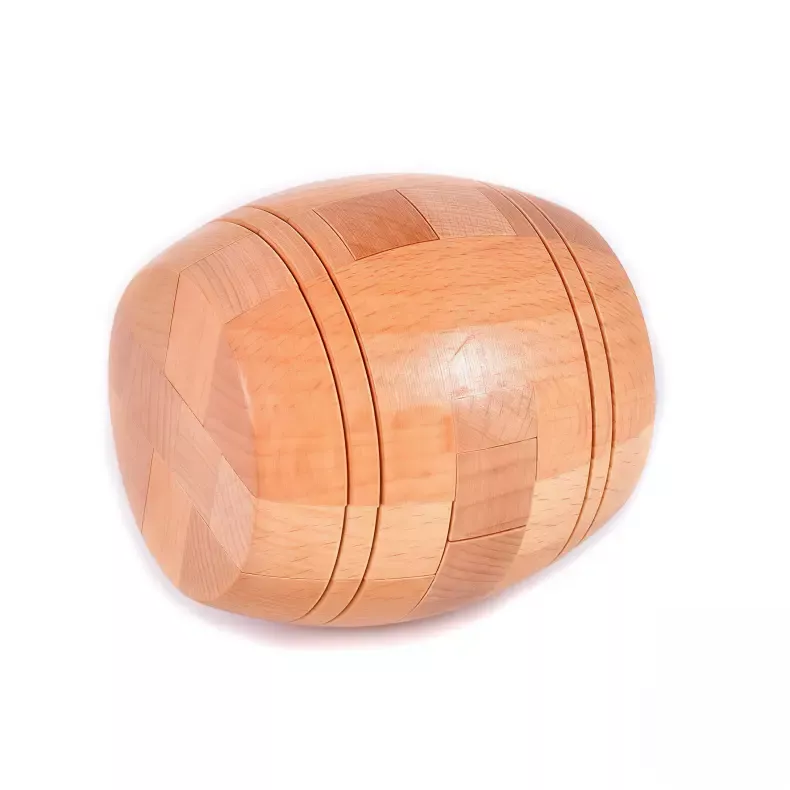
The Barrel Luban Lock — $19.77
As a gift, it is superb for the logic puzzle enthusiast who appreciates tangible objects—the kind who relishes a Sunday morning with a complex puzzle box or a nonogram. It’s a terrible gift for someone who casually wants “a cool brain teaser.” For the former, it’s a profound gesture that says, “I know you enjoy this specific type of intellectual grind.” Its collector’s grade heft and finish make it a display piece long after solving, a certified Oskar’s masterpiece for the shelf. For broader guidance on selecting puzzles by personality, our guide to choosing the right Hanayama puzzle is an excellent resource.
Where should you buy it? Seek reputable puzzle retailers or the official Hanayama channels to guarantee authentic precision machining. The galvanized gold copper plating is durable, but like any plated object, aggressive handling over years may wear the high points to the underlying cast zinc alloy—a dignified patina of use for a true metal puzzle collection.
In the end, the Cast Chain transcends being a mere puzzle. It is a benchmark. It asks not just “can you solve this?” but “do you have the temperament to learn its language?” For the right person, receiving it is an invitation to a unique and satisfying dialogue with one of Oskar van Deventer‘s most minimalist, brilliant minds. For a curated look at other sophisticated challenges, explore our guide to the best metal puzzles for adults.
Archivist’s Notes: Care, Display, and Long-Term Satisfaction
The final stage of ownership for a puzzle like the Hanayama Cast Chain is curatorial. Proper care preserves its galvanized gold copper finish, while thoughtful display turns a solved enigma into a trophy of patience, solidifying its place in a metal puzzle collection. With minimal maintenance, this Oskar van Deventer design will remain a conversation piece for decades.
Your primary concern is the plating. The cast tin material (a zinc alloy) is robust, but the gorgeous finish on the high-contact edges of the links can wear with aggressive, repeated solving. The solution is in your grip. Handle it with dry, clean hands. Avoid the constant, mindless fidgeting that defines lesser puzzles—this one demands respect. If you need to reset it from a softlocked puzzle state, apply the diagnostic logic, not force. A soft microfiber cloth is sufficient for occasional dusting.
Display is where the story of your solve is told. The three separated links, laid out in order of their liberation, narrate a journey. The reassembled 3-link chain, resting solved, is a quiet boast. For a dedicated shelf, consider a small, clear acrylic display stand or a felt-lined tray. It pairs beautifully with other Huzzle Cast series icons, creating a landscape of mechanical puzzle history.
The lasting satisfaction is unique. Unlike a solved riddle that loses its mystery, the Cast Chain offers solve three ways. Mastery of one path doesn’t diminish the challenge of the next. Months later, picking it up to find the second solution feels like a fresh dialogue with the same brilliant mind. It becomes a benchmark in your collection, its level 6 difficulty a permanent testament to your perseverance. For those who enjoy the intricate reassembly process, the methodology shares DNA with our Luban Sphere disassembly guide.
For those looking to build a narrative on their shelf, a thematic pairing can be compelling. A puzzle about connection, like a heart, makes a poignant counterpoint to the Chain’s austere logic.

Your next step as an archivist? Document your progress. Note the date of your first solve, and the time it took to find the second path. This turns a static object into a living record of intellectual pursuit. For deeper dives into the philosophy and care of such objects, our archives on decoding the 4000-year-old fidget await. Then, return the Chain to its place. Let its cold, precise weight in your palm be the full stop to the experience—a satisfying closure that is always ready to begin again.