The Fingertip Test: Your First Clue to a Puzzle’s Soul
The first clue to a cast puzzle’s quality isn’t in its design or difficulty rating—it’s in its weight. A high-quality zinc alloy puzzle will have a specific, substantial heft, typically between 150-250 grams for a palm-sized object. In your hand, it feels deliberate, not an afterthought.
Close your eyes. I place two seemingly identical metal puzzles in your palms. The first is light, almost hollow. Its edges feel slightly gritty, and it shifts with a tinny, loose rattle. The second is a dense, compact weight. Its surface is cool and silky-smooth, and when you move it, it rotates with a quiet, solid authority. You feel the difference before you see it. This isn’t just about design; it’s in the zinc.
That satisfying mass is the direct result of material density. Zinc alloys are about 40% denser than aluminum, the metal often used in cheaper castings. This density provides the psychological and physical anchor we perceive as quality. A heavier puzzle communicates durability, precision, and cost—it feels like an object, not a trinket. (This is why “cast metal puzzle weight” is the first spec I check; a number far below 100 grams for a multi-piece set is a warning flag.)
Next, run your fingernail gently across the surface. This is the ‘Fingernail Test.’ On a poor casting, you’ll feel microscopic grit, a sandpaper-like texture from porous metal or inadequate finishing. On a quality piece, your nail glides. The surface is uniform, often with a subtle, consistent grain from the mold—a machined finish, not a rough cast. A sharp, raised seam line along the parting edge? That often signals a faster, cheaper casting cycle and minimal post-processing.
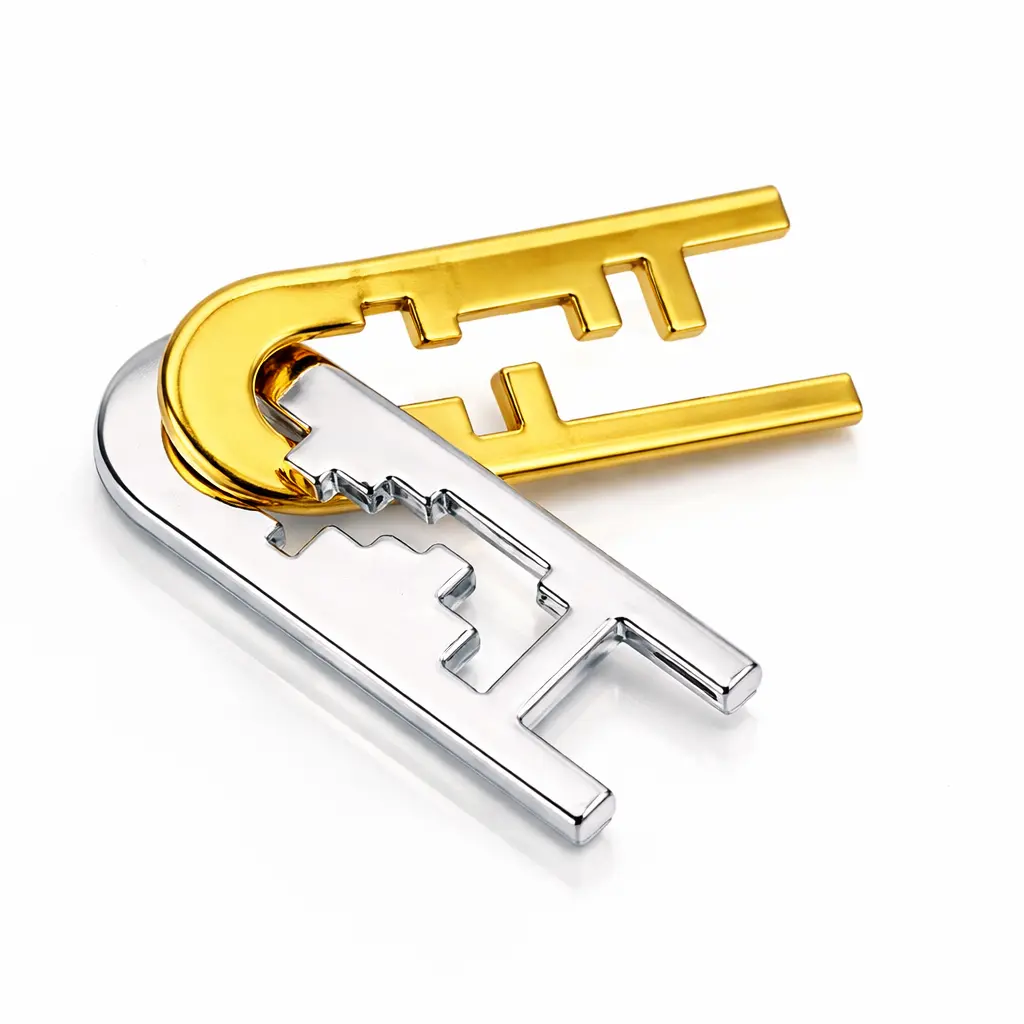
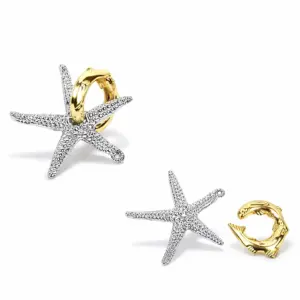
Cast Keyhole Gold & Silver — $13.99
Finally, listen. Shake the puzzle gently. A cheap cast will chatter, its components rattling loosely in oversized channels. A well-made one moves with a constrained, muffled sound—the sound of tight tolerances. This is the core of why cast puzzles feel so solid: precise engineering executed in a material capable of holding that precision, from the factory floor to your desk. The heft tells your hand it’s substantial. The finish tells your skin it’s refined. The silence tells your ear it’s exact. This tactile symphony begins with the choice of metal. It’s what we mean when we talk about decoding the cool heavy knot in your hand.
Why Zinc, Not Steel or Aluminum? The Metallurgist’s Choice
That satisfying heft and intricate detail don’t happen by accident. Zinc alloy, specifically the Zamak family, is the dominant material for high-end cast puzzles because it offers the optimal balance of density, castability, and strength. With a density of 6.6 g/cm³—substantially heavier than aluminum (2.7 g/cm³) but lighter than steel (7.8 g/cm³)—it delivers a premium feel without the prohibitive cost or manufacturing compromises of other metals.
So why not solid steel for the ultimate weight? It’s a question of physics and finance. Steel is famously difficult to die-cast with the fluidic precision required for complex, interlocking parts. Its high melting point demands more energy and far more expensive molds. While a machined steel puzzle would be indestructible and incredibly dense, the cost would be astronomical, and you’d likely lose the fine surface detail. The process would be overkill, like using a CNC mill to carve a toothpick. You might find a few artisan stainless steel puzzles, but they are outliers, not the standard.
Aluminum, on the other hand, is the lightweight contender. It’s easy to cast and can capture detail, which is why it’s used in many cheaper puzzles. But herein lies the trade-off. That lightness you feel isn’t just a lack of heft; it’s a material that’s inherently softer. Aluminum puzzles can feel insubstantial, almost toy-like, and are more prone to nicks, dings, and wear at the friction points critical to a puzzle’s mechanism. Over many solves, an aluminum piece can deform just enough to subtly change the fit—the enemy of the tight tolerance that defines a quality experience.
Zinc flows like thick honey. This high fluidity at relatively low temperatures is its superpower. It races into a mold, filling every microscopic crevice to capture the designer’s intended geometry with near-perfect fidelity. This is how you get the sharp, machined finish on a complex piece like Hanayama’s Cast Vortex or the impossibly fine threads on a dial puzzle. Once set, zinc alloys have excellent dimensional stability; they resist warping over time and with temperature changes, so the fit between pieces that was perfect on day one remains perfect on day one hundred.
The specific formulation matters. When you see Zamak 3 vs Zamak 5 puzzles on a spec sheet (if you’re lucky enough to see one), here’s what it means for you. Zamak 3, the most common, is the casting champion, offering the best fluidity and surface finish. Zamak 5 trades a sliver of that flawless castability for increased tensile strength and hardness via a small copper addition. For most puzzles, Zamak 3 is more than sufficient. But for designs with exceptionally thin, delicate protrusions or that will see… let’s say, forceful solving attempts, Zamak 5 provides a margin of safety against breaks.
You can learn more about the specifics in our deep dive, Puzzle Design Through The Lens Of Material Science.
This brings us to the best material for metal puzzles for the mass market. Zinc alloy is the Goldilocks solution: dense enough for a premium heft, fluid enough for breathtaking detail, strong enough for a lifetime of solves, and cost-effective enough to be accessible. It provides the foundational “canvas” for the metal puzzle finishing process—readily accepting electroplates and coatings that would not adhere as well or wear as evenly on porous aluminum. The next time you pick up a puzzle and feel that instant, subconscious judgment of quality, you’re likely feeling the result of this calculated metallurgical choice. It’s not that steel or aluminum can’t be used; it’s that for the symphony of weight, precision, durability, and finish, zinc alloy conducts the orchestra.
Zinc Flows Like Honey: How Fluidity Creates Impossible Shapes
Zinc alloy, specifically the Zamak grades used in puzzles, melts at a relatively low 386°C (about 727°F), but its superpower is what happens next: it flows with a thick, honey-like viscosity that perfectly fills microscopic mold details. This fluidic precision is the first and most critical reason how are Hanayama puzzles made with such consistent, intricate complexity—it allows liquid metal to capture every designed curve, undercut, and interlocking channel that defines a puzzle’s soul.
Think of the mold for a precision die casting puzzle not as a crude container, but as a negative sculpture of the final piece. For a puzzle mechanism to work—where pieces slide, rotate, and lock with hair-splitting tolerance—the metal must replicate the mold’s interior with near-perfect fidelity. Aluminum, by comparison, is more viscous and prone to solidifying before it fills the finest features, leading to rounded edges and lost detail. Zinc’s exceptional castability means it can produce the sharp, definitive edges and smooth, complex curves that make a high-end puzzle feel machined, not molded. It’s the difference between a crisp photographic print and a slightly blurry photocopy. This capability is what allows for designs like the interlocking spirals of the Hanayama Cast Coil or the labyrinthine channels of the Cast Vortex, shapes that would be fraught with flaws or impossible to mass-produce in another material.
My own journey to appreciating this began with a knock-off. Years ago, I bought a cheap copy of a popular cast puzzle. Visually, it was a match. But in the hand, it felt wrong—the surfaces were slightly gritty, the corners soft. When I finally pried it apart (it was poorly cast and jammed), the interior surfaces revealed the truth: a porous, grainy texture, like stale cornbread. This is the hallmark of a poor casting process, often where the metal wasn’t fluid enough or the injection pressure was too low, trapping air and creating voids. The ‘Fingernail Test’ is brutal for such pieces: run your thumbnail across a surface that should be silky. On a quality casting, your nail glides. On a poor one, you’ll feel the microscopic peaks and valleys of that grainy texture. A sharp, raised seam line is another telltale sign of a faster, cheaper casting cycle where mold halves weren’t aligned with painstaking care.
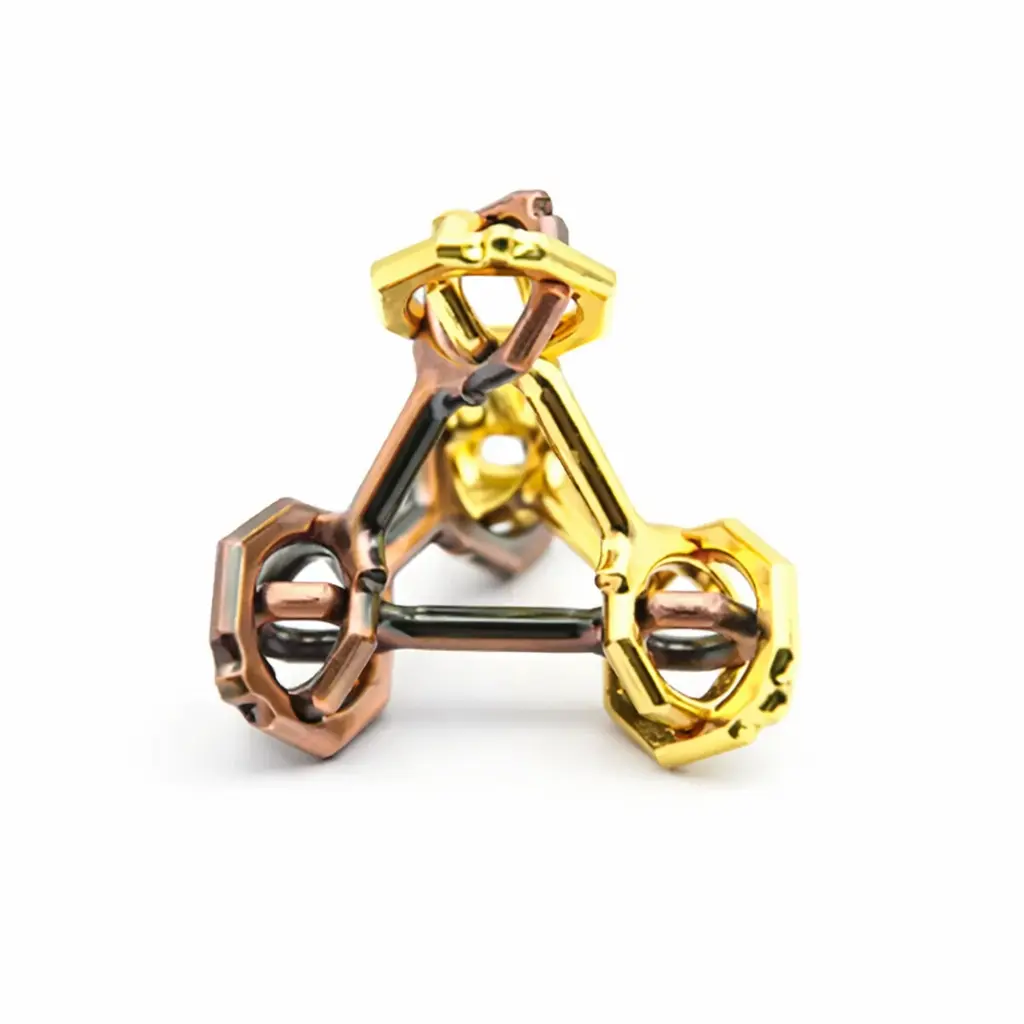
This fluidity is why zinc alloy is the undisputed champion for high-end mechanical puzzles. The metal literally flows into the artistry. When you examine a piece like the Cast Coil Triangle, the precision of the winding path is not achieved by later machining—it’s born in that single, perfect moment of injection. This foundational accuracy is what enables the legendary tight tolerances that brands are known for, where the movement between pieces is measured in thousandths of an inch. That satisfying, precise slide you feel on a first-rate puzzle is the direct descendant of zinc’s obedient flow into a meticulously crafted mold. It’s a process where metallurgy meets micro-engineering, creating the impossible shapes that define the craft.
For more on the agonizing precision of these tolerances, the journey documented in Zirel Metal Puzzle: The 0.002mm Gap Between Art and Agony is a fascinating read.
Decoding Zamak: What the Alloy Number Means for Your Puzzle
If zinc’s fluidic precision is the superpower, the specific Zamak alloy is the source code. That code is usually a single digit. For most high-end cast puzzles, including the majority of Hanayama’s lineup, the alloy of choice is Zamak 3, a precise cocktail of ~96% zinc, ~4% aluminum, and a trace (~0.04%) of magnesium. That 4% aluminum is the critical agent—it’s the element that gives the alloy its legendary flow, allowing it to fill those impossibly thin mold walls and capture filigree details. Magnesium’s tiny presence acts as a grain refiner, strengthening the metal’s microscopic structure.
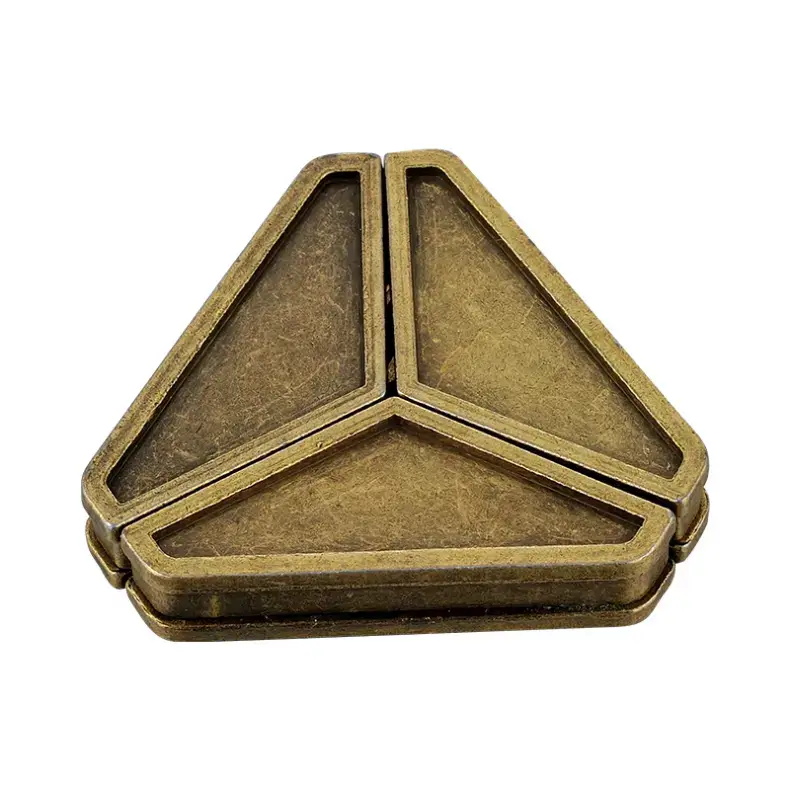
This brings us to the zamak 3 vs zamak 5 puzzles question. Zamak 5 swaps the formula: it contains about 1% copper in addition to the aluminum. Copper is a potent hardener. This boosts tensile strength by roughly 15-20% and improves hardness, but it comes at a subtle cost to that magical fluidity. So, is Zamak 5 “better”? It’s a designer’s trade-off. If a puzzle has an extremely delicate, lace-like protrusion or an internal channel thinner than a pencil lead, Zamak 3’s superior castability is non-negotiable. Its pristine fill means fewer microscopic pores and a more consistently solid feel.
However, if the design involves slender, lever-like components under repeated stress, or a mechanism with a hair-trigger tolerance that must resist deformation over thousands of solves, a designer might specify Zamak 5. That extra zinc alloy die cast puzzle durability can be the difference between a piece that lasts a decade and one that develops a hairline crack after a hard drop. (This is also why you sometimes see Zamak 5 in complex locking mechanisms or in puzzles designed for competitive “speed solving,” where they’re subjected to more aggressive handling.)
Here’s where the engineer’s quirk comes in: I can sometimes diagnose the alloy by sound. A Zamak 3 piece, when gently tapped on glass, has a slightly purer, higher-pitched ring. A Zamak 5 piece offers a marginally duller thud—the acoustic signature of copper damping the vibrations. It’s a subtle clue to the puzzle’s intended character.
Ultimately, the alloy number is a blueprint for behavior, not a quality grade. A well-designed puzzle in Zamak 3 will far outclass a poorly engineered one in Zamak 5. The choice is about matching material properties to design intent. And this careful selection directly answers a key user question: it’s one of the tangible differences between a generic $10 cast and a $30 Hanayama. The premium puzzle doesn’t just use “zinc alloy”—it uses the right zinc alloy, specified to ensure the mechanism works as intended for a lifetime of satisfying heavy clicks.
The Anatomy of a Quality Cast: Tolerances, Seams, and the Machined Finish
The physical evidence of a high-quality zinc alloy cast puzzle lies in tolerances tighter than 0.1mm, invisible seam lines, and a surface that’s been machined or tumbled to a silky matte. These features guarantee that pieces interact with fluidic precision without wearing down, directly stemming from zinc’s dimensional stability and meticulous post-processing.
That dimensional stability we just covered—zinc’s resistance to warping—is what allows for those tight tolerances in the first place. A quality puzzle isn’t just precise when new; it’s precise a decade from now. The gaps between moving parts are engineered to be minimal, creating that signature snick of engagement without any slop. If pieces feel loose or wobbly, it’s often a sign of a rushed casting process or an alloy blend with poor stability.
Where the alloy meets the mold, however, tells another story. This is where you perform the ‘Fingernail Test’: run your thumbnail gently across the puzzle’s surface, especially along edges and curves. On a cheap cast, you’ll feel a gritty texture or catch on sharp, raised lines—this is casting flash, the excess metal that seeped between mold halves. A sharp seam line here often means a faster, cheaper casting cycle where the molds weren’t perfectly aligned or finished. On a high-quality piece, your nail should glide smoothly. The seams are either absent or so finely blended they’re detectable only by a subtle change in light reflection, not touch.
The surface finish itself is the next tell. An ‘as-cast’ surface straight from the mold has a distinct, slightly granular texture. It’s functional but lacks refinement. Post-processing is where quality manufacturers invest time. This is the metal puzzle finishing process that transforms a rough casting into a tactile delight. High-end pieces are often tumbled in a vibratory bowl with abrasive media for hours, which deburrs edges and imparts a consistent, satin-soft matte finish. Some undergo light machining or polishing on critical contact surfaces to ensure buttery-smooth movement.
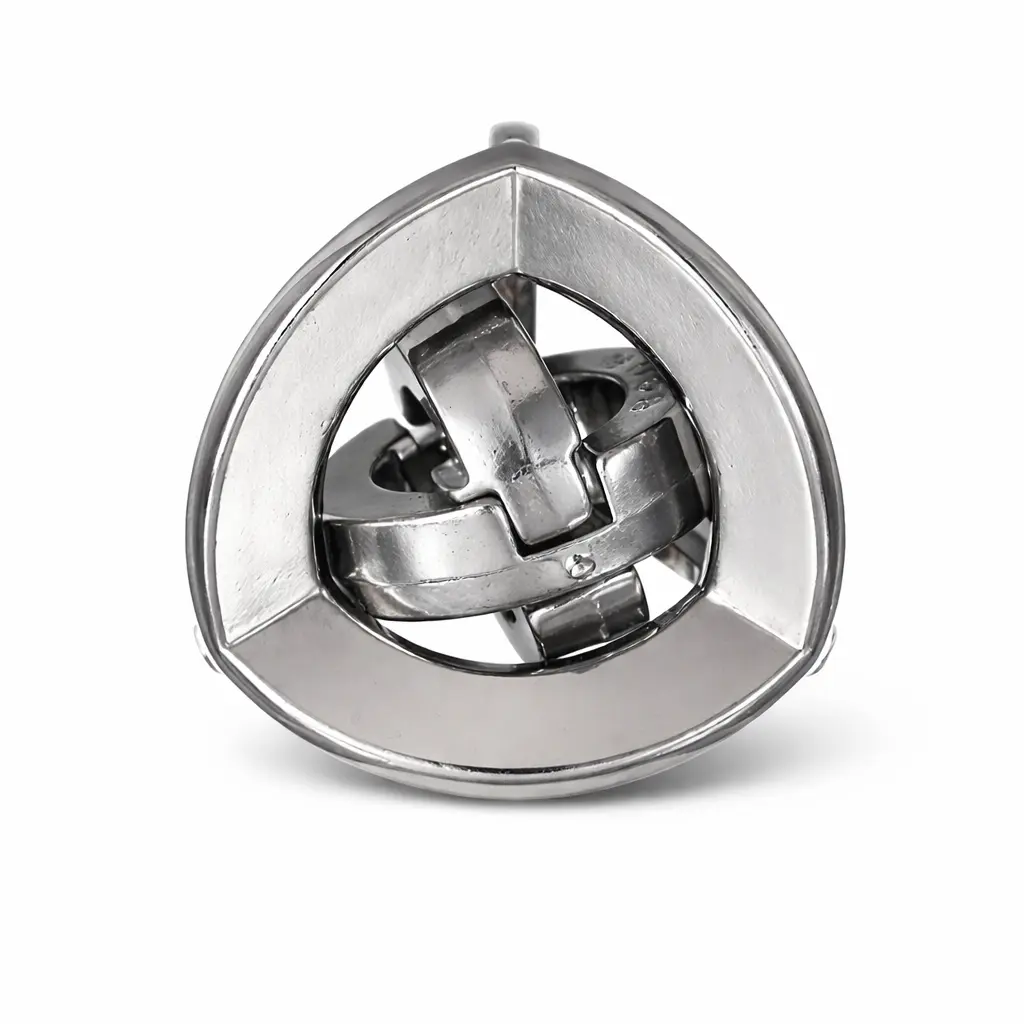
Consider a puzzle like the Metal Orbit Ring. At its price point, a thorough cast puzzle quality check is essential. It may exhibit slight seam lines, but a good tumbling process can still deliver a pleasant, consistent hand-feel. The heft should be solid, not hollow, and all parts should move without grating—a sign that interior surfaces received attention too.
For more on evaluating durability, see our guide to Metal Puzzles That Don’t Break.
The ultimate goal of all this finishing is to eliminate variables. You want the puzzle’s challenge to come from its geometry, not from friction, burrs, or misalignment. A machined finish on bearing surfaces reduces wear, preventing the dreaded “galling” where zinc pieces fuse under pressure. That silky feel isn’t just luxury; it’s functional, ensuring the mechanism ages gracefully through hundreds of solutions. When you pick up a puzzle and it feels impeccably smooth and precise in your hand, you’re feeling the direct result of an alloy chosen for stability and a manufacturer willing to invest in the details that transcend the mold.
The Weight in Your Hand: How Density Creates the ‘Substantial’ Feeling
The silky, precise finish we just explored means nothing if the piece feels hollow or insubstantial when you pick it up. The answer to whether a heavier puzzle is always better is a confident no—but density is the non-negotiable foundation of that premium feel. Zinc alloy’s density, approximately 6.6 g/cm³, is what provides the initial, satisfying heft that aluminum (2.7 g/cm³) simply cannot match. This physical property is the first signal to your brain that you’re handling an object of consequence.
That weight is psychological currency. In a world of lightweight plastic and feathery phone apps, a dense, cool mass in your palm commands focus. It implies durability, investment, and tactile seriousness. This is the intrigue—the initial “wow” that makes you want to solve it. But weight alone is just a paperweight. I’ve held cheap, heavy castings that felt like lugging a poorly machined doorstop. The magic happens when that inherent density is married to the precision tolerances and machined finishes we’ve discussed. The heft must be informed.
Think of it as the difference between a solid “thock” and a hollow “clack” when two pieces connect. A high-quality zinc alloy puzzle uses its mass deliberately. The weight is evenly distributed, and moving parts balance heft with fluid motion. You feel the mass participating in the solve, providing inertial feedback as you shift components. A poorly made heavy puzzle, however, uses its weight to mask flaws—the pieces grate, the seams catch, and the solve becomes a battle against the object itself.
(This is where the “Fingernail Test” extends beyond surface finish. Run your nail along an edge on a cheap, heavy casting. You might not feel a burr, but the piece will feel dead and unresponsive in motion, its weight working against you rather than with the mechanism.)
So, is a heavier puzzle better? Not inherently. But for a cast metal puzzle weight to translate into perceived quality, the density must be a feature of the design, not an accident of the material. Zinc provides the perfect base density—substantial enough to feel luxurious, yet not so heavy as to be fatiguing during a long solve. When you find that sweet spot—where every gram feels intentional and every movement feels crisp—that’s when you’ve moved from mere heft to engineered substance. The weight in your hand becomes the first clue to the precision in the mechanism.
Beyond Silver and Gold: The Science and Art of Plating
After appreciating the substantial heft of a zinc alloy puzzle, your attention naturally shifts to its surface—where the metal puzzle finishing process transforms raw castings into visually captivating objects. Zinc alloy’s dense, non-porous structure makes it an ideal canvas for electroplating, allowing for microns-thin layers of metals like nickel or gold to bond securely. A well-applied plating can withstand years of handling, with high-quality finishes losing less than 5% of their thickness after 50,000 friction cycles in standardized tests.
Why is zinc so accommodating? Recall its fluidic precision during casting. That same property yields a surface free of the microscopic pores and voids that plague cheaper alloys. A smooth substrate means plating adheres uniformly, without weak spots where corrosion or wear can start. (This is why a zinc die-cast can hold a flawless mirror finish, while a grainy aluminum casting often looks speckled under plating.) The dimensional stability of Zamak alloys also prevents subtle flexing that could crack a brittle coating over time.
The common finishes form a functional hierarchy. Nickel is the workhorse—hard, corrosion-resistant, and often used as a base layer for other platings or left as a bright, silvery final coat. It’s the most durable option for frequent handling. Brass plating offers a warm, gold-like appearance but will naturally oxidize to a darker patina with touch, which many collectors appreciate. Gold plating, typically a thin flash over nickel, provides luxury but is primarily decorative; it can wear through to the nickel layer on high-contact edges after extensive solving. Then there are intentional antiqued finishes, like black oxide or smoked coatings, which are often chemically applied and designed to highlight puzzle details through contrast—these wear in a way that enhances, rather than degrades, the aesthetic.
So, will the shiny finish rub off? With a quality piece, not in the way you fear. Superior plating is a post-processing marvel, measured in microns and bonded electrochemically. It doesn’t “paint on.” However, all platings experience wear. A sharp edge on a constantly rotating piece will eventually show a bright sliver of underlying zinc—a testament to the puzzle’s use, not a defect. Cheap puzzles use a thinner, poorly bonded deposit that can flake or rub off in patches, revealing a dull gray beneath. The difference is in the preparation: a proper machined finish and cleaning before plating versus a rushed, oily surface.
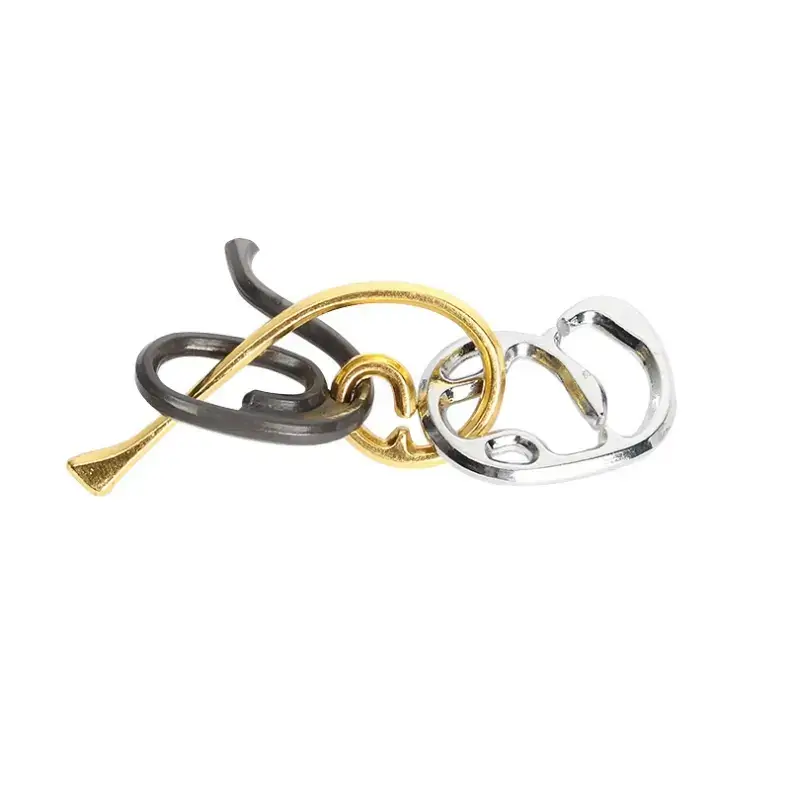
Puzzles like the one above showcase the art possible with zinc alloy plating wear in mind. Multiple colors aren’t just sprayed on; they are selectively plated, often with masking techniques, to create visual cues for the solver. The longevity of such a finish depends on the plating sequence—a gold accent over a nickel base will last far longer than direct plating on zinc.
When evaluating, don’t just look for shine. Run your thumb over a plated seam. A quality piece will feel seamless; a rough transition hints at post-casting buffing to hide flaws, which can thin the plating prematurely. And remember, a developing patina on brass or antique finishes isn’t failure—it’s the puzzle gaining character. The true mark of high-end mechanical puzzles is plating that serves the design, enduring where it must and aging gracefully where it can. This fusion of metallurgy and artistry is what turns a functional object into a lasting tactile pleasure.
The Stuck-Piece Scenario: When Friction Wins, and the Safe Fix
That beautiful, enduring finish on your puzzle isn’t just for looks—it’s a barrier. When it’s compromised through forceful friction, you encounter a notorious quirk of zinc alloy puzzles: the permanently stuck piece. This isn’t a design flaw but a direct consequence of the metal’s properties. Under extreme, localized pressure, the zinc alloy surfaces can cold-weld, or “gall,” a phenomenon frequently noted by Reddit users who learn the hard way that force is not the answer.
Gallin g occurs when two similar, non-hardened metals—like the Zamak 3 in your puzzle—are pressed together with enough force to break through surface oxides and platings. The clean metal beneath adheres at a microscopic level, creating a tiny, solid bond. In a high-tolerance cast puzzle, a wrong twist with too much enthusiasm is all it takes. You’ll feel it as a sudden, gritty resistance, followed by the chilling realization that the pieces are now one.
The cardinal rule is simple: never force it. Applying more torque or pulling harder will only increase the surface area of the gall, welding the pieces together for good. Instead, the goal is to break the seizure by relieving pressure and reversing the motion that caused it.
First, try a sharp, light tap with a wooden or plastic handle directly on the seam of the bond. The goal is to create a tiny shockwave to dislodge the welded points, not to deform the metal. If that fails, use temperature to your advantage. Place the entire puzzle in a sealed plastic bag and into the freezer for 20-30 minutes. Metals contract when cold, and the zinc alloy will shrink slightly more than any steel pin inside it, potentially loosening the grip. Upon removal, try a gentle, reversing wiggling motion.
For a persistent bond, a penetrating oil designed for metals (like a lightweight sewing machine oil) can be a last resort. Apply a single, tiny drop at the seam and let it wick in for an hour. This can lubricate and break down the microscopic weld. Wipe any excess off thoroughly to protect the puzzle’s finish and your hands. (This is a key part of long-term care for zinc alloy puzzles—knowing when and how to intervene chemically.)
If you succeed, inspect the formerly stuck surfaces. You’ll likely see dull, scored patches where the plating is gone and the base metal is exposed. This is the scar of galling—a tactile reminder of the puzzle’s material reality. You can prevent a recurrence by applying the lightest graphite powder to the mating surfaces, a trick borrowed from lockpicking, which reduces friction without attracting grime like oil does.
Understanding this scenario transforms how you handle any cast metal puzzle. It’s not about delicate fear, but informed respect for the mechanics at play. It connects directly to the earlier lessons on tolerance and finishing: a perfectly machined finish isn’t just for feel, it’s a low-friction coating that, when intact, prevents this very issue. When a puzzle is truly, irreversibly stuck, it’s often a lesson written in metal—a story about the fine line between a satisfyingly tight fit and a friction-locked union.
For more on the principles behind these mechanisms, our guide to the mechanical grammar of brain teasers can provide deeper insight. And if you’re dealing with a specific, stubborn puzzle like the Cast Hook, a detailed tutorial might offer the precise maneuvering sequence to avoid galling in the first place.
Your Buyer’s Lens: Translating Product Page Claims into Real Quality
Armed with the science of alloys and the realities of finishing, you can now decode any product listing. The core difference between a $10 impulse-buy puzzle and a $30 Hanayama isn’t just branding; it’s a quantifiable gap in material specification, weight, and post-processing labor. Quality is now something you can see in the specs before it ever lands in your hand.
Forget the subjective claims of “high-quality” or “precision cast.” Your new checklist looks for concrete evidence.
First, demand material transparency. A listing that specifies “Zamak 3” or “Zamak 5” has already passed a major filter. It tells you the publisher knows their alloy and chose it for a reason—typically Zamak 3 for superior fluidity and crisp detail. Vague terms like “metal alloy” or “zinc alloy” without a standard designation are red flags for uncontrolled, potentially porous castings. (This is where decoding alloy numbers pays off: Zamak 3 is the puzzle industry’s sweet spot for detail.)
Second, judge by the gram. Weight is the easiest metric to verify. A substantial, palm-sized high-end mechanical puzzle should typically fall between 70 and 150 grams. If a listing provides no weight, be skeptical. A puzzle that looks large but is described as “lightweight” is almost certainly a thin-walled, brittle aluminum casting, not the dense zinc you’re seeking for that solid feel. Compare: a classic Hanayama Cast Hexagon weighs about 100g; a cheap, similarly sized knock-off might be 40g and feel like a tin can.
Third, scrutinize the finish in the photos. Look for mentions of “tumbled,” “machined,” or “hand-polished.” These indicate post-processing to remove casting seams and smooth surfaces. Zoom in. Can you see the seam line? A faint, uniform ridge is normal; a sharp, jagged flash of excess metal is a sign of worn molds or rushed de-gating. Perform the ‘Fingernail Test’ mentally: imagine running your nail across that seam. If it looks like it would catch, it will.
Fourth, understand plating claims. “Antique silver” or “gunmetal” finishes are often durable coatings or chemical patinas. “Gold” or “nickel” are electroplates. A good listing will note if the plating is over a nickel undercoat for durability. The shinier the plate, the more it may show wear over time—this isn’t a flaw, but a characteristic.
Here is your actionable cast puzzle quality check for any product page:
* ☐ Alloy Named: Zamak 3/5 specified.
* ☐ Weight Listed: Grams provided, suggesting purposeful heft.
* ☐ Finishing Described: Words like tumbled, deburred, or machined.
* ☐ Seams Visible: Product photos show clean, minimal seam lines.
* ☐ Tolerance Hinted: Description mentions “smooth movement” or “precise fit.”
The $10 puzzle typically fails most checks, offering only a shape. The $30 puzzle passes them, charging for the material science and labor that creates the heavy click. Your final step? Apply this lens. Go look at a puzzle you own or one you’re considering—our guide on The Best Metal Puzzles For Adults applies this very framework. Place it on your scale. Find the seam. You’re not just buying a puzzle anymore; you’re evaluating a piece of precision-cast art. For a focused look at a specific brand that exemplifies many of these principles, you might consult your Hanayama puzzle buy guide.
A Final Note on the Craft
At its core, a high-quality zinc alloy cast puzzle is a specific type of mechanical puzzle, a category defined by objects that must be manipulated to reach a solution. More specifically, most cast puzzles are a form of disentanglement puzzle, where the goal is to separate linked pieces. The magic of zinc alloy is that it allows this ancient form of cerebral play to be executed with a level of precision, heft, and durability that feels utterly modern. It transforms abstract geometry into a tangible, weighty conversation between your hands and your mind. The heavy click you hear isn’t just metal meeting metal; it’s the sound of a perfectly realized idea.