The First Click: What Happens When You Turn the Handle
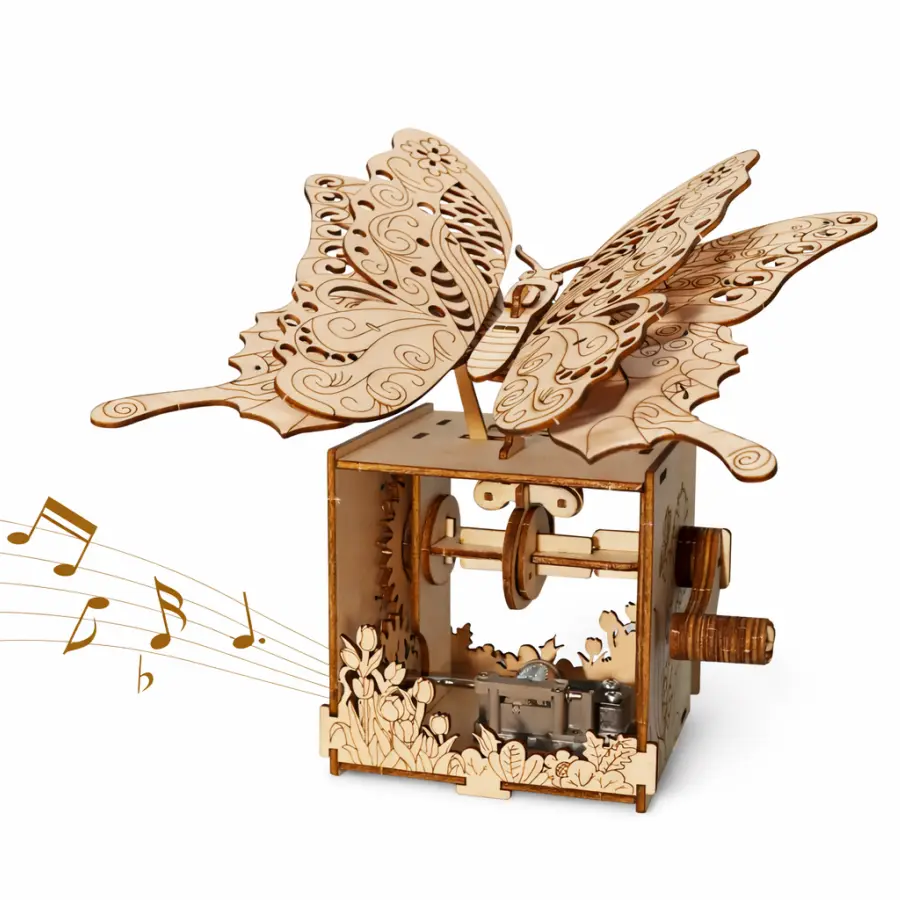
You lift the assembled box, feeling the solid weight of its laser-cut birch plywood. The layered butterfly, poised at the center, is motionless. Your thumb finds the small, knurled metal handle on the side. The first turn is stiff, requiring deliberate pressure—this isn’t a flimsy wind-up toy. As you rotate it clockwise, a cascade of mechanical events begins.
A soft click-whirr emanates from inside as the mainspring tightens. Through the transparent acrylic panel, you see the central gear engage. It transfers motion to a smaller pinion, which begins to rotate the pinned brass cylinder. This is the heart of the music movement. The cylinder’s precisely placed pins start to pluck the tuned teeth of the steel comb, producing the first clear, bright notes of the melody—a classic, uplifting tune that feels both nostalgic and crisp.
Simultaneously, a separate gear train activates. A clever series of linked cams and levers, now visible in motion, translates the rotary force into a gentle, vertical oscillation. The butterfly’s layered wings, until now perfectly still, begin a slow, fluttering dance, rising and falling in time with the music. It’s this synchronization—the audible mechanics and the visual poetry—that defines the experience. You’re not just playing a recording; you are the power source, directly animating a miniature world. It’s a locking puzzle box not because it has a literal lock, but because the reward—this charming mechanical ballet—is locked behind the deliberate, hands-on process of building it first.
Unboxing the Butterfly: A Closer Look at the Build and Design
Lift the box and the first surprise is the weight—or lack of it. At just under a pound, the unassembled kit feels substantial but not dense, a promise of the layered plywood inside. Opening the lid reveals not a jumble of parts, but a series of laser-cut wood sheets, each piece nestled in its frame like a model-maker’s blueprint. The wood is a light, unfinished birch plywood with a fine grain and a faint, pleasant scent of laser-cut timber. Edges are clean, with minimal charring, and each piece pops out with a satisfying, low-resistance snap. No splintering. This initial tactile experience matters; a frustrating unboxing with stuck pieces or rough edges immediately sours a build. Here, it feels considered.
The components separate into clear functional groups. The largest pieces form the box’s outer shell and the iconic, layered wings. A smaller bag contains the mechanical heart: a real 18-note music movement with a brass cylinder and steel comb, a clear acrylic panel for the gearbox window, a metal crank handle, and all necessary screws, axles, and tiny wooden dowels. The instructions are purely visual, a series of exploded diagrams without a single word. This universal language is a double-edged sword. It eliminates translation barriers but demands careful, sequential observation—your first puzzle before the puzzle.
Physically, the assembled piece stands about 5.5 inches tall, 4.5 inches wide, and 3 inches deep. It’s a desktop sculpture, not a pocket trinket. The design’s cleverness is in its “layered” construction. The butterfly and floral motifs aren’t painted on; they are created by stacking and offsetting multiple laser-cut sheets, creating a subtle 3D depth that catches the light. The final finish is raw wood, which some may find too plain, but it presents a perfect canvas for personalization—a light stain, a touch of paint, or simply letting it age with handling.
Where this product diverges from a standard model kit is in its integrated puzzle-box logic. You’re not just following steps A-to-Z to create a static ornament. The build is the first stage of the sequential discovery. For instance, assembling the gear train isn’t just about placing gears; you must deduce the correct orientation and engagement so that the crank’s rotation smoothly transfers power to both the music cylinder and the wing mechanism. Get a cam slightly off-phase, and the wings will stutter. It’s a functional test you perform yourself. This is a stark contrast to a purely decorative 3D puzzle or a disassembly challenge like the $14.99 Two Bull Head lock Puzzle, which is a self-contained object of pure deconstruction. The Butterfly Box asks you to construct the very mechanism that will later delight you.
My honest first impression? The raw materials feel good, not premium. This isn’t heirloom walnut or brass. It’s a well-executed kit at its price point. The potential fragility of some thin wooden linkages gave me pause during assembly. However, this material choice is strategic: it makes the mechanics visible. You see every interaction, every cause and effect. The slight flex in a wooden lever teaches you more about mechanical principles than a hidden, indestructible metal gear ever could. The negative, if you can call it that, is that it demands a builder’s patience, not a brute-force solver’s strength. If your preference leans towards the hefty, tactile clink of metal puzzles, you might find the $11.98 Metal Grenade Lock Puzzle more immediately satisfying. But that puzzle offers a different kind of reward—a quick, clever “aha” upon opening. The Butterfly Box trades that instant gratification for a longer, more involved journey from flat pack to functioning wonder.
The Assembly Puzzle: Where Most People Get Stuck (And How to Avoid It)
This is the pivot point. The moment you move from admiring the pieces to actually building the box is where the real “locking puzzle” begins. You’re not just following instructions; you’re reverse-engineering a functional lock from its components. The manual provides a sequence, but it doesn’t explain why the sequence works. That’s the hidden challenge. Most people get stuck in one of three predictable places, turning a 2-hour project into a 4-hour frustration spiral. I’ll walk you through each, because avoiding them transforms the experience from daunting to delightful.
The First Sticking Point: The Gear Train Orientation. Around the 20-minute mark, you’ll assemble the music movement and the primary drive gear onto the back panel. The manual shows a picture. You’ll think, “Got it.” This is the trap. The critical detail is the engagement depth of the drive gear with the music box’s worm gear. If it’s too deep, the mechanism will bind under pressure. If it’s too shallow, it will slip and make a grinding sound without turning the cylinder. My first attempt resulted in a pathetic crunch-click when I turned the handle. The fix isn’t in the manual: you need to test the gear mesh before finalizing the panel placement. Gently hold the pieces together and turn the side handle. You should feel smooth, consistent resistance. If you feel a “bumpy” catch or see the gear teeth visibly jump, reposition the drive gear post slightly. This isn’t a manufacturing flaw; it’s the inherent tolerance of a wooden kit. Mastering this micro-adjustment is your first real puzzle solve.
The Second Sticking Point: The Butterfly Linkage Geometry. The butterfly’s wings flap via a brilliant but finicky system of levers and pins. The pieces are tiny, and the connection points are shallow. The common mistake is to glue or press these linkages into place too early, before understanding their full range of motion. I did this. I attached the vertical lift arm to the butterfly assembly, only to find later that it limited the wing movement to a sad, 5-degree twitch. The “aha” moment came from understanding the sequence of constraints. You must install the butterfly assembly onto the front panel loosely, then connect it to the driving cam on the gearbox, and only then finalize the pivot points. This allows the system to find its natural alignment under motion. The puzzle logic here is pure sequential discovery—you cannot know step C until you’ve temporarily completed steps A and B. For more on this fascinating puzzle philosophy, our guide on the principles of sequential discovery in trick boxes offers deeper context.
The Third Sticking Point: The Final Closure and Alignment. After about 90 minutes, you’ll have a working gearbox on the back panel and a decorated front panel with the butterfly. Putting them together seems trivial. It is not. The four corner posts must align perfectly with the holes in the front panel while the central drive shaft simultaneously slots into the cam on the butterfly linkage. Apply pressure unevenly, and you’ll hear a sickening crack from a stressed joint. This is where patience pays. Don’t press straight down. Lower the front panel at a slight angle, engage one pair of posts, then gently rock the panel to walk the other posts into place. Listen for a soft snick as the drive shaft engages. If you meet resistance, stop. Backtrack. The puzzle is teaching you finesse. This final assembly is the true “lock”—a three-dimensional alignment problem where force is the enemy.
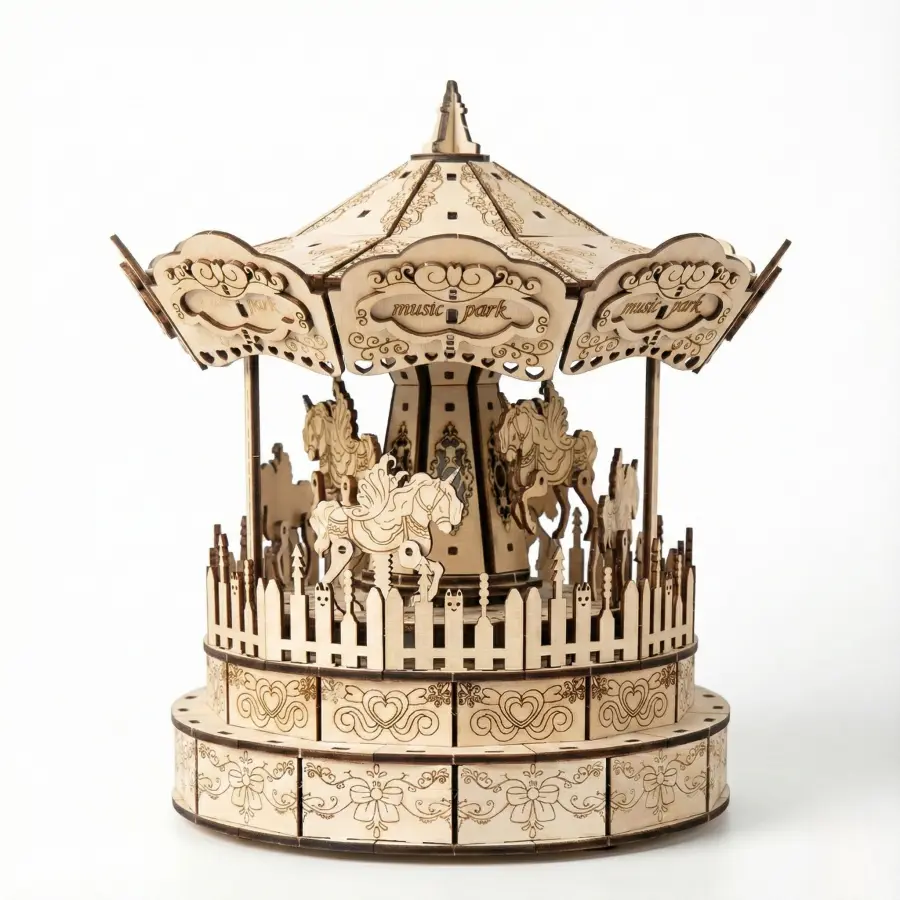
If this kind of structured, multi-stage build captivates you, the logical next step is the 3D Wooden Carousel Music Box for $43.99. It applies similar principles of gear assembly and kinematic linkage on a grander, more decorative scale. The Carousel is less about a single “lock” and more about orchestrating multiple moving parts into harmonious motion—a perfect progression in complexity.
So, how do you avoid the frustration altogether? Follow this non-obvious order: 1) Dry-fit the major mechanical groups without glue. 2) Perform a “motion check” at every sub-assembly stage. 3. Use the glue sparingly as a final locker, not a construction crutch. The goal isn’t just to build a music box; it’s to understand the clockwork logic that makes it a locking puzzle in disguise. When you finally turn the handle and see the butterfly dance, that triumph isn’t just about solving a puzzle. It’s about having successfully engineered the solution yourself, piece by deliberate piece.
The Locking Mechanism Revealed: How the Music Box Actually Works
The moment of truth arrives when you turn the side handle for the first time. You’ve assembled the gears, aligned the butterfly, and secured the frame. But will it work? The handle turns with a slight, satisfying resistance. A soft click echoes from the gear train, and then the magic begins: the central axle rotates, the layered butterfly wings begin their fluttering ascent and descent, and a bright, clear melody—often “You Are My Sunshine” or a similar classic—fills the room. This isn’t just a toy; it’s a miniature, hand-powered automaton. The “lock” you’ve been solving isn’t a padlock or a combination; it’s the precise mechanical alignment required to transform rotational force into coordinated visual and auditory performance.
At its heart, this is a classic music box movement, a type of mechanical puzzle lock whose history dates back centuries. As defined by authoritative sources on mechanical puzzles, the core principle involves a pinned cylinder or disc that plucks the tuned teeth of a steel comb. In the Layered Butterfly, this comb-and-cylinder unit is pre-assembled, but its integration is the final, critical step. The “puzzle” lies in correctly mating this movement to the custom gear train you’ve built. The drive gear on the movement must mesh perfectly with the final gear in your wooden transmission. A misalignment of even a millimeter will result in a jarring grind, a skipped tune, or a stalled butterfly. When it works, you’ve successfully “unlocked” the device’s intended function.
This experience connects directly to the broader category of puzzle boxes, where the goal is to discover a hidden compartment or mechanism through manipulation. Here, the compartment is open—the gears are visible—but access to the function is locked behind correct assembly. It’s a “sequential discovery” puzzle in build form: you must complete step A (frame) to enable step B (primary gears), which then allows for the final step C (movement integration). Fail any step, and the final output remains inaccessible. This creates a profound “aha” moment that’s more rewarding than simply finding a hidden hinge; you’ve built the key itself.
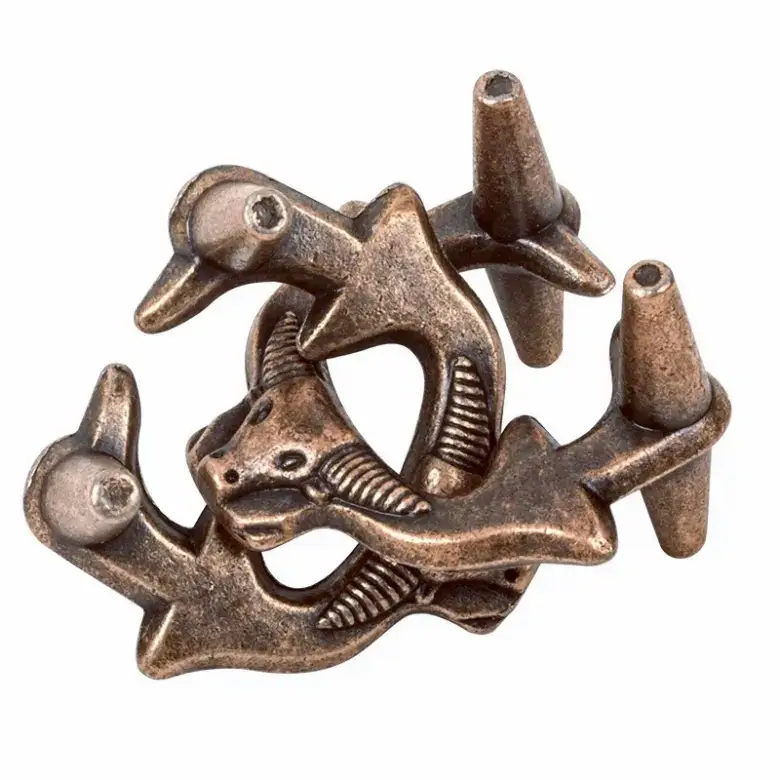
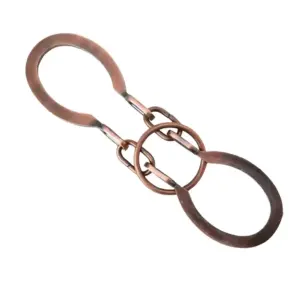
Two Bull Head lock Puzzle — $14.99
The tactile feedback is where this puzzle shines. A cheap mechanism feels gritty and sounds tinny. This one provides clean, distinct auditory and tactile cues. The handle turn is smooth, not wobbly. The gear clicks are precise, not mushy. The music comb produces clear, resonant notes because the cylinder pins are accurately placed to pluck the teeth at the exact right moment. This quality is what separates a satisfying brain teaser from a frustrating trinket. If you appreciate this nuanced feedback in a pure solving challenge, you’d likely enjoy the tactile precision of the Two Bull Head Lock Puzzle for $14.99, where the “click” of a disengaging internal lock is the only signal you’re on the right path.
So, what’s really happening inside? Let’s trace the kinetic chain:
1. Input: You turn the side handle, rotating a primary drive shaft.
2. Transmission: This shaft turns a small pinion gear, which engages a larger intermediate gear, multiplying torque and reducing speed. This larger gear is linked to the vertical axle for the butterfly.
3. Visual Output: The vertical axle has a cam or offset pin. As it rotates, this cam pushes against the underside of the butterfly platform, causing it to rise and fall in a fluttering motion. The layered wings amplify this effect.
4. Auditory Output: Simultaneously, the primary drive shaft (via another gear) turns the pinned cylinder of the music movement. Each pin on the cylinder is a note in the melody. As the cylinder rotates, these pins pluck the corresponding tines on the steel comb, which vibrate to produce specific musical pitches.
5. The Lock: All these actions must happen in synchronized harmony. If the gears are misaligned, the timing between the butterfly’s flutter and the music’s tempo breaks. The puzzle is solved only when every element in this kinetic chain is perfectly linked.
This mechanism teaches a fundamental principle of puzzle locks: the solution is often a specific sequence of correct alignments, not brute force. You can’t force the gears to mesh; you must adjust the entire assembly until they find their natural engagement. It’s a lesson in patience and systematic observation. For more on the nuanced thinking these puzzles require, our deep dive into the hidden language and logic of puzzle box solutions explores this cognitive process in detail.
Ultimately, the Layered Butterfly Music Box demystifies a beautiful piece of engineering. It takes a mechanism that’s usually hidden inside a sealed box and lays it bare, making you an active participant in its creation. The “lock” is the state of dysfunction; the “key” is your understanding and correct application of mechanical principles. When you finally turn the handle and it works, you’re not just playing a tune—you’re conducting a symphony of cause and effect that you built from the ground up.
Who Should Build This Box (And Who Should Walk Away)
The Layered Butterfly Music Box isn’t for everyone, and that’s its strength. After building it, I can pinpoint exactly who will cherish this experience and who will find it a frustrating mismatch. Your $28.99 and, more importantly, your time, are best spent when aligned with the right project.
Build this box if:
- You want a “first build” with a spectacular payoff. This sits perfectly between a simple snap-together model and an intimidating, 500-piece engineering kit. The 2-3 hour commitment is substantial but manageable, and the reward—a functional, beautiful music box you built yourself—is immediate and deeply satisfying. It’s the ideal gateway into the world of mechanical assembly.
- You crave a tactile, screen-free ritual. If you find yourself doom-scrolling for a mental break, this box offers a profound alternative. The process of sorting laser-cut birch pieces, fitting them together, and focusing on a single, tangible outcome is a form of active meditation. It’s the antithesis of digital distraction.
- You’re a gift-giver who values meaning over mass. For a milestone birthday, graduation, or holiday, this isn’t just a present; it’s an experience you’re giving. The recipient gets the joy of building and a lasting decorative heirloom. It’s a far more memorable gesture than a generic gift card, especially for the creatively inclined teen or adult in your life.
- You appreciate visible mechanics. Unlike a sealed puzzle box where the magic is hidden, this kit celebrates its inner workings. If you’re the type who wonders how things work, you’ll love watching the gear train you assembled translate your hand-crank into fluttering wings and melody.
Walk away and choose something else if:
- You want a pure, quick-solving brain teaser. This is a buildable music box with puzzle-like assembly steps. If your primary goal is the “Aha!” of solving a disassembly/reassembly challenge in under an hour, you’ll be disappointed by the required construction time. For that quick-hit logical deduction, a dedicated metal puzzle is a better fit.
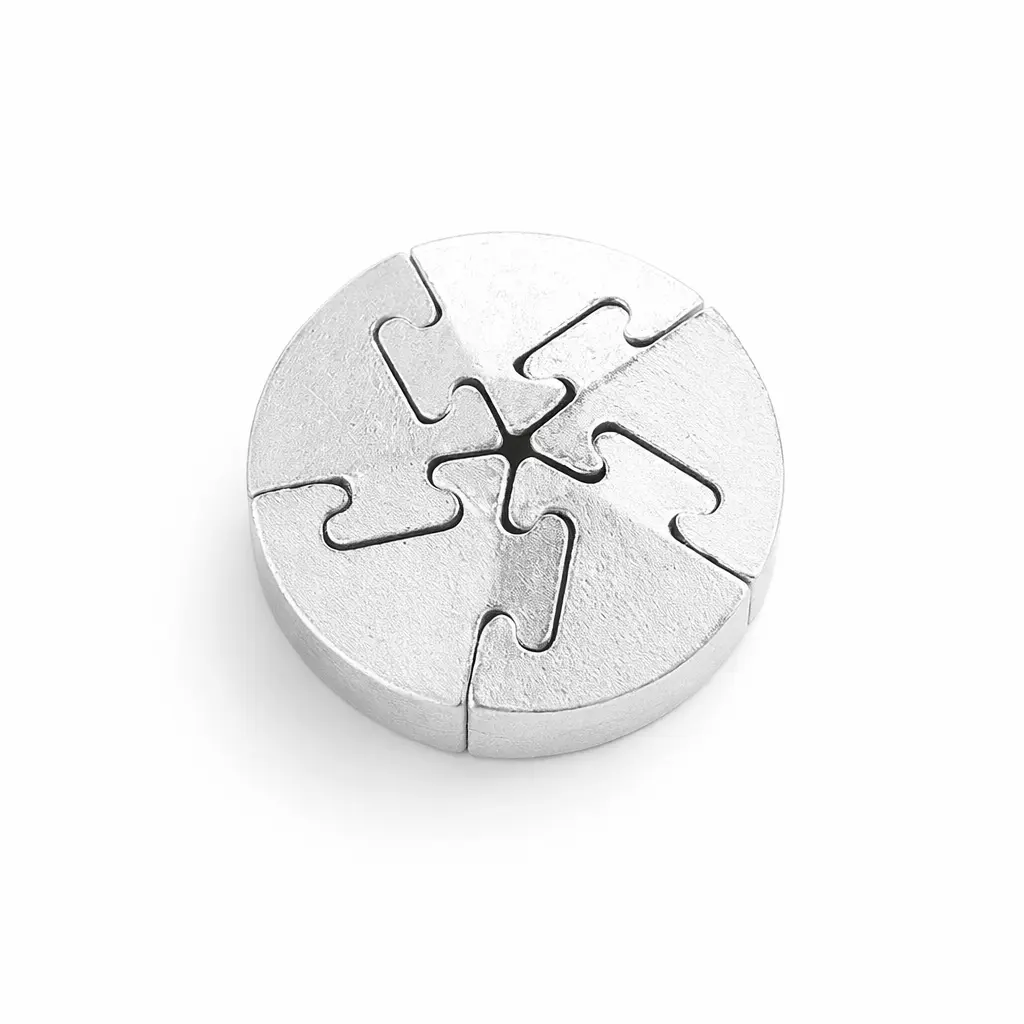
Consider the 5 Piece Cast Spiral Metal Puzzle. It delivers that satisfying, minutes-long solve-and-resolve cycle in a pocket-sized package, perfect for a focused mental break without a multi-hour commitment.
- You dislike following instructions or lack fine motor patience. The instructions are pictorial and generally clear, but they require careful, step-by-step attention. If you prefer to intuit a solution through trial and error, or if working with small, sometimes snug wooden pieces will test your temper, this build will feel like a chore, not a joy.
- You need a sturdy, child-ready toy for unsupervised play. While suitable for ages 14+, this is a delicate display piece once built. The layered wings and music mechanism are not designed for rough handling. For a durable, kid-friendly puzzling challenge meant to be solved and re-solved endlessly, look to solid metal constructions.
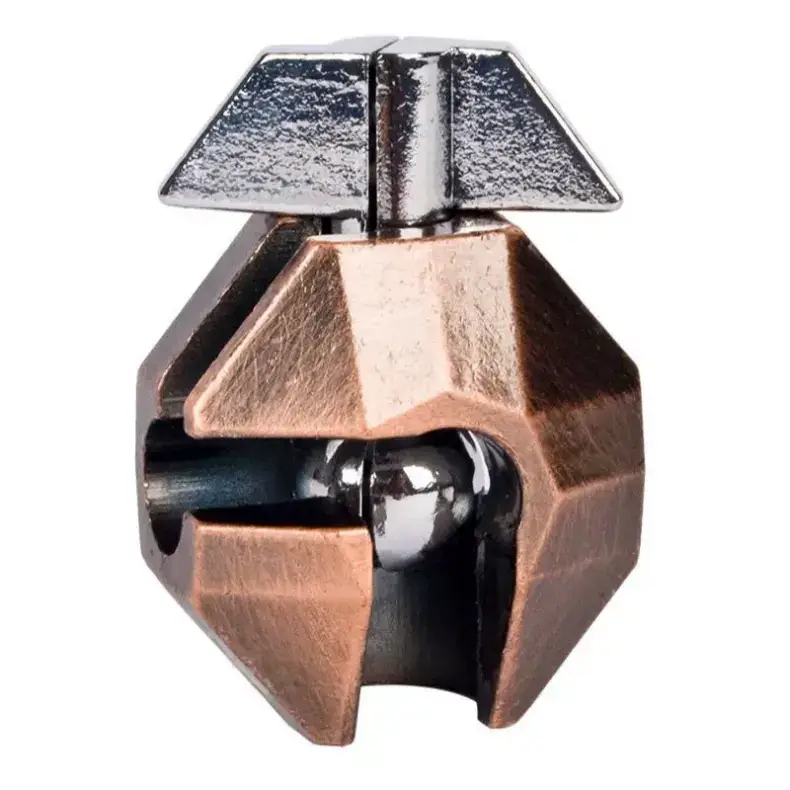
Metal Grenade Lock Puzzle — $11.98
The Metal Grenade Lock Puzzle ($11.98), for instance, is a cast-metal brain teaser built to withstand countless solving attempts by determined hands, making it a great option for family puzzle fun.
- Your goal is purely decorative. If you just want a pretty music box on your shelf, you can buy one pre-assembled for similar cost. The entire value proposition here is the act of building it. Without that, you’re paying for a kit you’ll need to complete yourself.
The Price-to-Value Verdict:
At $28.99, the value is exceptional for the right person. You’re not just buying a music box; you’re buying a premium, glue-free wooden kit, a quality music movement, and 2-3 hours of deeply engaging, rewarding activity. Compare that to the cost of a movie ticket and snacks for a two-hour passive experience, or a typical plastic model kit. For the builder, the hobbyist, or the meaningful gift-giver, the return on investment—in satisfaction, pride, and a unique finished object—is high. For someone seeking an instant-gratification puzzle or a ready-made decor item, that same $30 is better spent elsewhere.
5 Things I Wish I Knew Before Starting My Build
Hindsight is 20/20, especially with a mechanical puzzle kit. While the instructions are clear, there are nuances you only learn by doing. Here are the five insights that would have smoothed my path from confused pile of pieces to fluttering butterfly.
1. The “Music Movement” Isn’t a Puzzle—It’s Pre-Assembled Precision.
My biggest initial confusion was the small, rectangular metal component labeled “music movement.” I spent ten minutes trying to figure out how to take it apart or where its gears went. Don’t. This is the pre-made, tuned heart of the music box. Your job isn’t to build it, but to integrate it. The real mechanical puzzle is the wooden gear train you construct that connects the side handle to this unit’s drive shaft. Understanding this division of labor—you build the transmission, not the engine—immediately clarifies the project’s scope. For more on the fascinating mechanics inside these units, the Wikipedia entry on mechanical puzzles offers great historical context.
2. Dry-Fit Everything Before You Commit Pressure.
The pieces are precision laser-cut and fit together without glue via a combination of friction, slots, and dowels. The temptation is to push each connection home firmly as you go. Resist. For complex layers, especially the gearbox housing and the butterfly platform, perform a complete “dry fit.” Slot all pieces together just enough to see how they align, then disassemble. This two-minute step reveals the correct orientation of asymmetrical parts and prevents the heart-sinking moment of realizing a critical gear is trapped behind a wall you’ve already sealed. This principle is a cornerstone of quality wooden puzzle assembly.
3. The Side Handle is Your First Functional Test.
About halfway through the build, you’ll attach the large, layered gear to the side handle’s axle. The moment you insert this assembly into the main frame, test it. Turn the handle. If it rotates smoothly, you’ve aligned the axle holes perfectly—proceed with confidence. If it binds or grinds, stop. A piece is likely misaligned by a fraction of a millimeter. Fixing it now takes seconds; fixing it after you’ve added the next three layers on top becomes a major headache. This handle is your diagnostic tool.
4. Patience with the Butterfly Linkage is Non-Negotiable.
The most delicate part of the build is connecting the butterfly’s wings to the cam mechanism. The provided thin, wiry connectors must be looped through tiny holes. This is a test of fine motor skills, not puzzle-solving. Have good lighting, use tweezers if you have them, and accept that it might take a few tries. If you rush or force it, the wire can bend in a way that inhibits the fluttering motion. The payoff for this patience is immense—seeing those wings dance for the first time makes the fiddling worthwhile.
5. The Final “Lock” is a Satisfying Click, Not a Hidden Trick.
Given this is a guide on a locking puzzle box, you might expect a secret sequence to finally close it. The “lock” here is more of a final, satisfying mechanical integration. When you place the last decorative top layer onto the fully assembled gearbox, it clicks into place with a definitive, solid sound. This isn’t a puzzle to solve but the final seal of a job well done—the assurance that everything you’ve built is aligned, seated, and ready. It’s the period at the end of the sentence. If you crave a more traditional, purely logical locking challenge after this, a compact metal option like the 5 Piece Cast Spiral Metal Puzzle offers a pure, portable disentanglement challenge.
If You Enjoyed This, Try These 3 Related Challenges Next
The Layered Butterfly Music Box sits at a wonderful intersection—it’s a build, a puzzle, and a kinetic sculpture. If one of those elements particularly captivated you, your next perfect challenge is waiting. Here are three curated next steps, each extending a different thread from this experience.
If the act of building a complex, beautiful mechanism was your highlight, your logical progression is the 3D Wooden Carousel Music Box ($43.99). This isn’t just a step up; it’s a leap into a more intricate world of mechanical engineering. With 281 laser-cut pieces, it transforms the satisfying click of the butterfly’s final layer into a multi-hour journey of constructing a fully realized, wind-up carousel. You’ll engineer a central gear train that rotates multiple tiers of horses, all crowned by a classic music movement. It’s the ultimate project for when you want to disappear into a weekend of focused, hands-on creation, resulting in a stunning decorative heirloom. For more on the deep satisfaction of complex assembly, explore our guide on the hidden language and intricate mechanics of advanced puzzle boxes.
Perhaps you found the most joy in the “Aha!” moment of solving the locking gearbox—the pure puzzle at the heart of the build. For that logical, tactile satisfaction in a pure, portable form, shift from wood to metal. The Two Bull Head lock Puzzle ($14.99) distills that “find the trick” essence into a solid, palm-sized alloy conundrum. There’s no assembly, just you, two interlocked bull heads, and the need to discover the precise manipulation that frees them. Its weight and precision machining offer a deeply satisfying tactile feedback when you finally unlock the secret. It’s the ideal pocket companion for a quick mental reset, proving that a great locking puzzle doesn’t need hundreds of pieces, just one perfectly conceived mechanism.
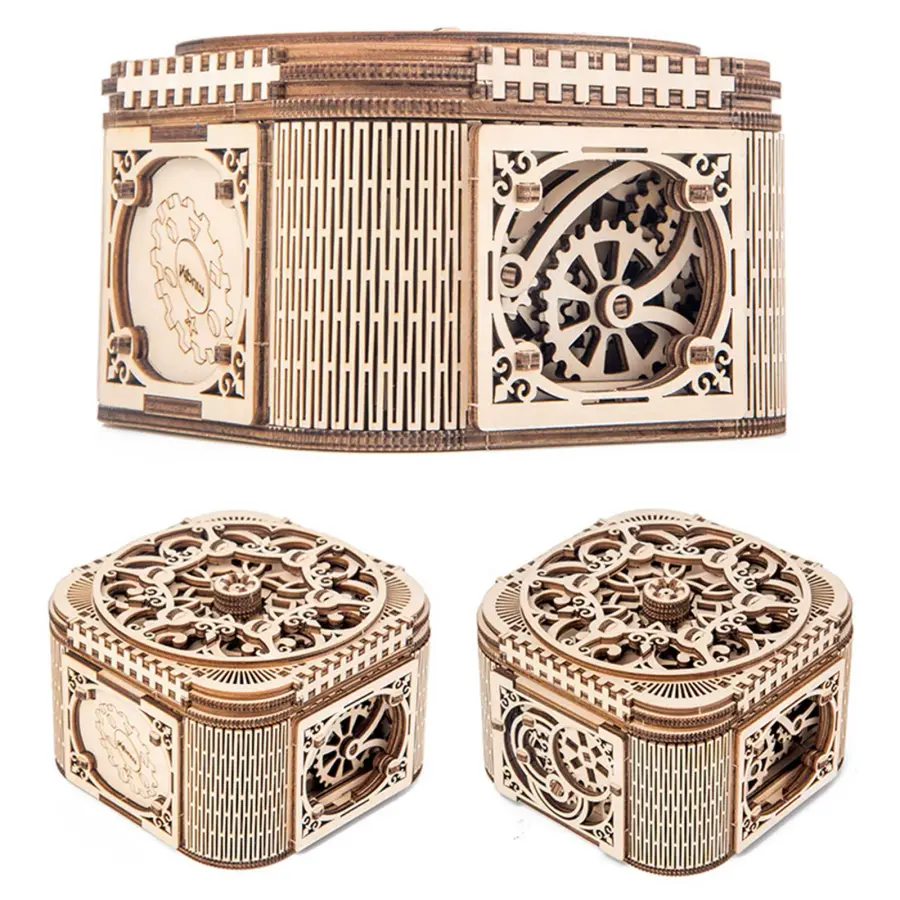
Finally, if you loved the dual purpose—the thrill of solving something that then becomes a functional secret keeper—your destination is clear. The 3D Wooden Puzzle Treasure Box ($29.99) takes the concept of a locking container and makes it the entire point. You assemble a beautiful wooden box with a fully visible, mesmerizing gear mechanism on its side. Once built, solving that mechanism is how you unlock it to reveal a hidden compartment, perfect for jewelry or small valuables. It transforms the puzzle from a one-time build into an ongoing ritual of access and secrecy, making it a profoundly thoughtful gift. For more inspiration on puzzles that cleverly conceal gifts, our analysis of why the best gift wraps punish impatience delves into the psychology behind these perfect presents.
Your Locking Puzzle Box Questions, Answered
This section tackles the most common questions I’ve received about the Layered Butterfly Music Box and locking puzzles in general. The answers are based on hands-on experience, community insights, and a bit of mechanical history to give you the clarity you need before you click “add to cart.”
How long does it take to assemble and solve the Layered Butterfly Music Box?
Plan for a dedicated 2 to 3 hours from unboxing to the first melody. This isn’t a race. The first hour is typically spent on the satisfying, methodical assembly of the layered wooden body and gearbox—a process that feels more like fine model-building than puzzling. The “lock” portion, which is figuring out the correct sequence to engage the music mechanism, usually unfolds in the final 30-60 minutes. It’s the perfect length for a single, immersive weekend afternoon project. If you rush, you risk forcing pieces and missing the subtle tactile feedback that guides you to the solution.
Is it too difficult for a beginner?
Not at all, but it depends on your definition of “beginner.” If you’re completely new to 3D assembly and mechanical concepts, there’s a learning curve, but the instructions are visual and logical. The puzzle-solving aspect is more about observation and patience than complex deduction. It’s significantly more accessible than a pure sequential discovery puzzle box where the mechanism is completely hidden. Think of it as a perfect intermediate step: you build the lock yourself, so you understand its parts, which then gives you the insight to solve it. For a true beginner’s first locking challenge, a self-contained item like the Metal Grenade Lock Puzzle ($11.98) might be a gentler, quicker start.
Do I need glue, tools, or batteries?
No, and this is a key feature. Everything you need is in the box: pre-cut wooden sheets, the music movement, gears, and a small tool for popping pieces out. The assembly is entirely glue-free, relying on precise interlocking joints—a hallmark of quality laser-cut kits. The music box is powered by your own hand turning the crank; there are no batteries. You will need a clean, flat workspace and good lighting. A pair of fine-grit sandpaper (200+ grit) can be helpful to smooth the occasional stubborn tab, but it’s not strictly necessary.
Can it be re-solved after the first time, or is it a one-time build?
Absolutely, it can be re-solved. This is a crucial distinction. Once assembled, the box is a permanent, functional object. The “puzzle” is the specific procedure to unlock the music mechanism. After you solve it and play the tune, you can reset the lock and challenge yourself (or a friend) to solve it again. The build is a one-time event, but the solving experience is repeatable. It becomes a decorative conversation piece that doubles as a hands-on brain teaser for guests.
How sturdy is it once built? Is it just a display model?
It’s surprisingly robust. The layered birch plywood construction, when fully assembled, feels solid and substantial in your hands, not toy-like. You can confidently turn the crank and operate it regularly. However, it is a precision mechanical object, not a child’s toy. It should be handled with care, kept away from excessive moisture, and not subjected to forceful manipulation. As a display piece, it’s beautiful; as a functional music box, it’s entirely legitimate. For a locking puzzle built purely for relentless, pocketable durability, you’d look at all-metal designs like the classic Two Bull Head lock Puzzle.
What’s the difference between a “puzzle box” and a “locking puzzle”?
This is a fundamental taxonomy question. A locking puzzle is any device where the primary challenge is to open a container or disengage a lock. The mechanism might be external, like disentangling a metal loop from a bull head. A puzzle box (or secret box) is a specific subtype where the locking mechanism is integrated and hidden within the box itself, often requiring a non-obvious sequence of moves—slides, presses, twists—to discover the latch. The Layered Butterfly is a hybrid: you build a box with an exposed but enigmatic internal lock (the gear train). For a deep dive into boxes with truly hidden mechanisms, our guide on the intricate world of puzzle trick boxes explores their fascinating secrets.
Are these kinds of puzzles good for your brain?
While I can’t make medical claims, the cognitive benefits of spatial reasoning, problem-solving, and focused attention are well-documented in contexts like puzzle design. Engaging with a mechanical puzzle forces you into a state of “productive struggle.” You form a hypothesis (“if I turn this gear, the lever will move”), test it, and learn from the feedback. This process, as explored in research on learning theory by figures like Edward Thorndike, strengthens procedural understanding and patience. It’s a focused mental workout that pulls you away from passive screen consumption. For a different style of logical workout, our magic square puzzles offer a pure numbers-based challenge.
I’m stuck! Is there a solution guide?
The kit does not include a printed solution for the locking sequence, which preserves the “aha!” moment. However, if you’re truly at an impasse, the most common point of failure is not following the gear assembly instructions to the letter. Double-check that every gear meshes perfectly and rotates freely before closing up the layers. The solution always lies in observing the cause-and-effect relationship between the external crank and the internal cam that triggers the music. If you need to, walk away for an hour. Fresh eyes and hands often spot the missed connection instantly. For community-inspired tips and tricks, our collection of puzzle box solve techniques can offer new perspectives.
Why are some puzzle boxes so expensive?
Cost scales with complexity, materials, and craftsmanship. A simple mass-produced cast metal puzzle might cost $15. A intricate, hand-finished wooden sequential discovery box from a master craftsman can cost hundreds. You’re paying for R&D (designing a novel, fair mechanism), precision manufacturing (often laser-cut or hand-toleranced), and material quality. The Layered Butterfly sits at a compelling mid-point: it offers the hands-on build of a high-end kit and a genuine mechanical puzzle at an accessible price. You’re not just buying an object; you’re buying the engineered experience of building and solving it.
What is “sequential discovery” in puzzles?
This is the holy grail for many enthusiasts. A sequential discovery (SD) puzzle requires you to find and use tools concealed within the puzzle itself to progress through a series of steps toward the goal (usually opening a container). You might find a pin that unlocks a panel, revealing a key that turns a hidden screw, and so on. It’s a story told through mechanics. The Layered Butterfly is not a full SD puzzle—you are given all parts upfront—but the process of using the gears you built to unlock the music gives you a delightful taste of the genre. To explore true SD puzzles, starting with reputable makers is key, as discussed in enthusiast forums on the best puzzle boxes and locks.
Can I put a gift inside?
Yes, but with a caveat. Once solved and unlocked, the small interior cavity of the music box can hold a very lightweight, flat item like a folded note, a small piece of jewelry, or a paper gift card. It is not a large storage container. The act of solving the puzzle becomes the gift unwrapping. If your primary goal is to hide a gift of significant size, you should choose a product designed specifically for that purpose, like the 3D Wooden Treasure Box, which features a dedicated, roomier secret compartment. The psychology of making a recipient work for their gift is fascinating, and we explore it in our article on why the best gifts punish impatience.
How do I maintain a wooden puzzle box?
Keep it in a stable environment away from direct sunlight, extreme heat, or dampness. Dust it gently with a soft, dry cloth. The wooden pieces may develop a richer patina with handling over time, which adds character. For the metal music movement and gears, avoid forcing them. If the mechanism ever feels gritty or stiff, a tiny, precise drop of lightweight clock oil (not WD-40) on the gear axles can restore smooth operation. The goal is to preserve the precise friction fit of the joints and the smooth action of the mechanics you worked so carefully to create.
The Verdict: Is This $28.99 Puzzle Box Worth Your Time?
The value of a puzzle isn’t in its price tag, but in the experience it provides. The Layered Butterfly Wooden Music Box delivers a rare trifecta: the tactile satisfaction of assembly, the intellectual reward of a locking mechanism, and the emotional payoff of a beautiful, functional result. For $28.99, you’re not buying a disposable trinket; you’re investing in 2-4 hours of deeply focused, screen-free engagement that culminates in a kinetic sculpture you can revisit. It’s a complete workshop-in-a-box that teaches basic mechanical principles through your own hands. If you crave a project that blends craft, puzzle, and art, this box is unequivocally worth it.
However, its value plummets if your goal is a quick, pure brain teaser to solve and shelve. For that, a dedicated locking puzzle like the Two Bull Head is a more efficient challenge. But if the idea of building the lock and the treasure it guards appeals to you, this is a standout. My final click wasn’t just the lid closing—it was the realization that I’d created a small, perfect machine. Ready to begin your build? Start with the Layered Butterfly Wooden Music Box here for $28.99. When you’re ready to explore the wider world of hidden mechanisms, our guide to puzzle trick boxes is the perfect