Quick Answer: Where to Buy a Wooden Cube Puzzle at a Glance
| Retailer Tier | Best For | Typical Price | Skip If |
|---|---|---|---|
| Mass-market (Amazon, Walmart, Target) | First-time buyers wanting a brain teaser in two days | $8–15 | You want real hardwood — most listings under $10 are rubberwood or MDF |
| Specialty puzzle shops | Hobbyists hunting solid beech or walnut Soma and Kongming puzzles | $20–50 | You need it tomorrow — international warehouses often take 7–14 days |
| Direct-from-artisan workshops | Collectors buying numbered rosewood or ebony with hand-rubbed finishes | $40–95 | You want a quick gift — artisan lead times run weeks |
| Educational suppliers | Classrooms stocking color-matching cubes and STEM kits for 20+ students | $20–45 | You want a single heirloom — these SKUs prioritize volume |
| DIY/3D-print hubs and local makerspaces | Tinkerers who want to laser-cut or sand their own wooden cube puzzle | $5–30 plus a printer | You want a finished object on your desk today |
Mass-market listings under $8 are almost always rubberwood or MDF, and the specialty row from $20 to $50 tends to use solid beech or walnut with tighter tolerances than a typical Amazon listing. Anything below $6 is plywood, fiberboard, or a wood-grain sticker over chipboard — that price floor exists because real hardwood costs more than freight alone. Curated specialty shops like tea-sip.com sit one tier below the artisan labels: Luban locks and Soma sets in the $16–$44 range, with domestic shipping that does not require a six-week wait.
The 4 Main Wooden Cube Puzzle Types and How to Tell Them Apart
A classic Soma cube uses exactly 7 pieces to form a 3×3×3 cube and has been in continuous production for decades. The four types below cover roughly 90% of what you’ll encounter under the search term “wooden cube puzzle,” and once you can name them, every Amazon listing and artisan page suddenly starts to make sense. As mechanical puzzles go, these four belong to the interlocking-disassembly family — a category distinct from the twisty puzzles typified by the Rubik’s Cube and the modern speed cube, where the goal is permutation rather than disassembly.
The Soma cube. Seven pieces, all made of smaller unit cubes glued into non-uniform shapes. Three of the pieces are identical L-shaped tetracubes; the other four are each unique. Solid-wood versions sell from a few dollars in rubberwood up to $50+ in Thai hardwoods, and the pieces weigh enough to anchor a desk. Some collectors still call the Soma a “magic cube,” a leftover nickname from the period when the design was briefly marketed alongside twisty puzzles.
For under $25, the color-coded wooden Soma is the better gift buy — the dyed surfaces make the 240 non-trivial solutions easier to track for a first-time solver, and the 3D wooden puzzle format doubles as a color-matching puzzle for the visual learner.
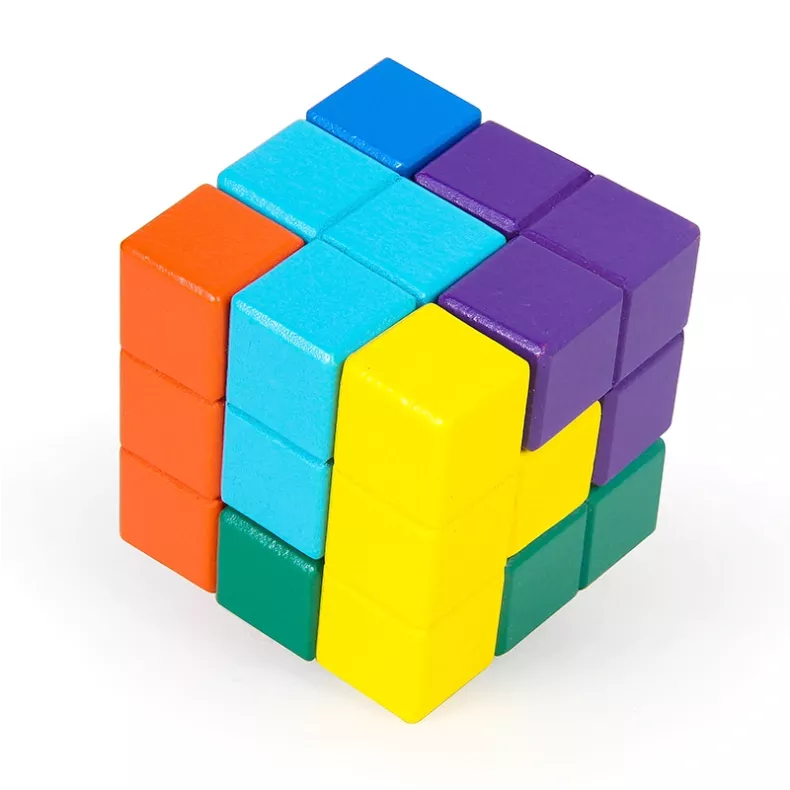
7 Color Soma Cube Puzzle — $21.88
The Kongming / Luban lock. This is the wooden brain teaser most people picture when they type “Chinese wooden puzzle” into a search bar. The form is a 3×3×3 cube that disassembles into 6 to 9 interlocking pieces, depending on the designer’s license. A budget rubberwood version ships for $8–$12 from China; artisan rosewood and padauk versions from tea-sip.com run $20–$45 with numbered editions climbing higher. Collectors sometimes call any non-trivial disassembly an “impossible puzzle,” a name that stuck once the burr family crossed into mainstream hobby catalogs.
The Luban lock is also the puzzle most commonly mislabeled as a “Chinese puzzle box,” which it isn’t — the puzzle box has drawers and a hidden release, while the Luban is a pure interlocking mechanical puzzle with no fasteners.
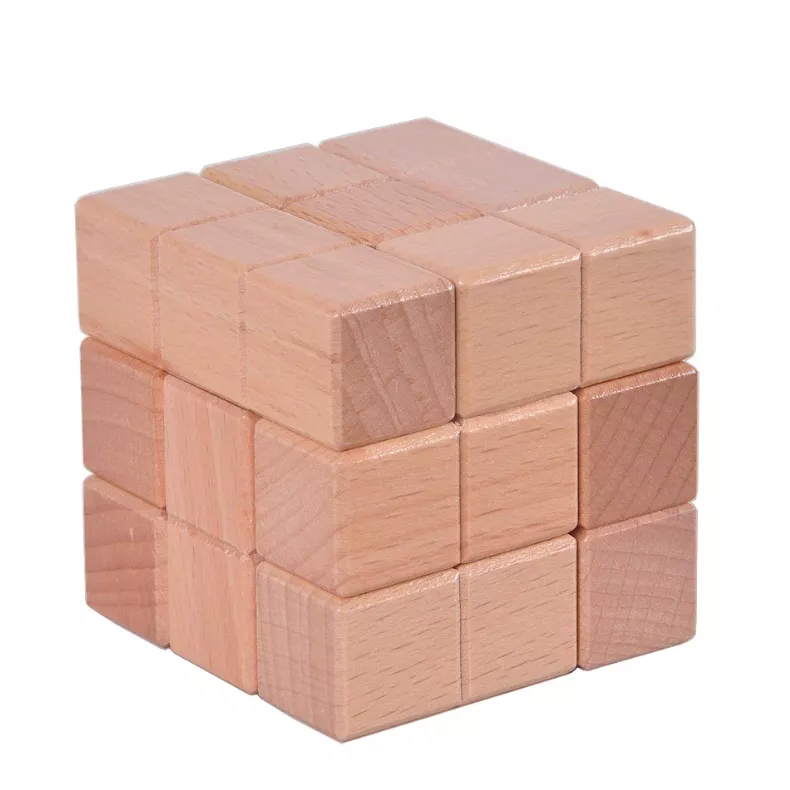
Luban Cube Puzzle — $21.99
The snake cube. A chain of 17 to 64 hinged wooden triangles or small cubes that folds back into a 3×3×3 block. Cheap plastic versions have been around for decades; the wooden versions, especially beech with brass pin hinges, feel like a well-made pen. Prices cluster between $10 and $30, with the upper end reserved for rosewood chain links and hand-rubbed finishes. The wooden snake puzzle doesn’t disassemble, so it’s safe around a six-year-old’s hands but endlessly frustrating for the adult who picks it up expecting it to “click” into place.
The matching / mosaic cube. This is the one r/boardgames users keep trying to identify. Smart Games’ Cube Puzzler uses 7 transparent colored tiles in a frame, but the wooden version most shoppers actually want has 16 to 26 solid colored squares packed into a wooden tray — closer to a stack of wooden puzzle blocks than a transparent plastic window. Smart Games’ plastic version runs $20–$30; the all-wooden knockoff from educational suppliers sits in the same window. If your mystery puzzle has color squares and no disassembly, this is your type.
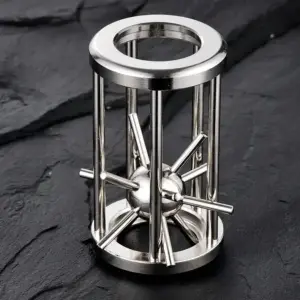
The Indiana Jones puzzle that isn’t one. The prop in Raiders of the Lost Ark is technically a “serpent cube” or “idiot’s delight” — a ball trapped inside a cubic cage, not a wooden cube puzzle in the interlocking sense. Replica prop kits and standalone serpent cubes both exist on specialty sites; do not buy a Luban lock expecting that look. Match the prop, then match the seller.
For the dozen-plus variants this section doesn’t cover — burr families, sequential unlock chains, trick boxes — the full wooden cube puzzle identification guide maps every shape from the artisan catalogs. Name the type first; pick the retailer second.
Wood Species Decoder: What Beech, Walnut, Rosewood, and MDF Actually Feel Like
Now that you can name the type of puzzle sitting in your cart, here is the harder question the listing won’t answer: what kind of wood is it actually made of? A solid-hardwood Soma cube feels substantial in the palm; the same cube in MDF feels heavy in a dead, lifeless way and smells like a wardrobe. The species on the label is the single biggest predictor of how long the puzzle will last — and how much you should pay for it.
Beech is the workhorse. A pale, fine-grained hardwood from European forestry, beech is what most specialty retailers reach for when they want a “real wood” puzzle at a non-artisan price. Expect pieces in the $8–$20 range, a clean slightly sweet smell when you first open the box, and a weight that feels substantial without being heavy. Beech sands to a smooth finish; the lacquer sits evenly; tolerances are usually within a few thousandths of an inch. The downside is that beech dents if you drop it on tile, and the lightest-colored pieces show coffee-ring stains within a season. For a handcrafted puzzle that gets solved weekly rather than daily, beech is the right call.
Rubberwood is the mass-market default. Grown on plantations in Southeast Asia, often marketed as “eco-friendly” because it uses trees that already produced latex, rubberwood is what most $8–$15 Amazon and Walmart listings are actually selling you under the word “wooden.” It is a real hardwood — not a fake — but it is dense, pale, and almost completely featureless in grain. The smell is neutral to faintly sour. Tolerances are inconsistent: the third piece of the Kongming lock may seat with a faint thwock; the fourth may need a firm palm-slap. Splintering complaints on Amazon reviews cluster overwhelmingly on rubberwood listings under $10.
Pine is the softwood budget tier. It is cheap, it dents the first time you look at it sideways, and it is the wood most likely to appear in a “kids’ wooden cube puzzle” priced under $12 at Target. Pine smells wonderful — that sharp, resinous cut-trees-in-December smell — but it is too soft to hold tight tolerances. Pieces warp if the box sits in a humid car overnight. For a child who will lose a piece within six months anyway, pine is fine. For an adult who plans to keep a 3D wooden puzzle on a shelf, skip it.
Walnut is the mid-premium sweet spot. Dark chocolate brown, faintly sweet on the nose, dense enough that a walnut cube feels heavy for its size. Walnut dominates the $30–$60 tier from specialty vendors. The grain is visible without being loud; the lacquer finish tends to be hand-rubbed rather than sprayed. A walnut Kongming lock outlasts a rubberwood one by years, simply because the pins don’t wear out of the softer wood. If you want a solid wood puzzle that will still solve cleanly in a decade, walnut is the floor.
Rosewood is the artisan tier. Genuine rosewood — sheesham, dalbergia, or the Brazilian variety now restricted under CITES — is heavy, dark, often purple-tinged, and aromatic in a way that fills a room when you open the box. Pieces in this species run $60–$120+, frequently from small studios that hand-cut and number each edition. The lacquer finish on artisan rosewood is usually hand-rubbed tung oil rather than polyurethane. This is the tier where the same 3D wooden puzzle costs five times the rubberwood version for reasons your hands can feel in five seconds.
MDF is the red flag. Medium-density fiberboard is sawdust and resin pressed into sheets, then wrapped in a thin laminate printed to look like wood grain. The weight is misleading — heavy for the size, but in a dead, lifeless way. There is no grain to run your thumbnail across; the corners chip instead of denting; and the smell, especially when warm, is the unmistakable furniture-board odor of urea-formaldehyde.
The beech set thunks; the walnut whispers; the rosewood rings. Trust the rosewood; suspect the MDF.
3 Red Flags That Predict a Bad Wooden Cube Puzzle Before You Order
Wooden cube puzzle listings under $8 that use the word “wooden” but name no wood species show a missing-piece or splinter complaint pattern in the 1-star reviews disproportionate to mid-tier listings — a buyer who counts 1-star reviews mentioning “missing,” “short,” or “splinter” will find the budget listings blowing past a personal cut-off that experienced puzzle buyers treat as a reason to walk away.
Red flag #1: MDF core. The tell is in the product photos, not the description. Solid hardwood shows continuous grain and color from face to face, with the through-cut edge revealing the same tone you see on the outside. MDF shows a uniform tan core sandwiched between two printed faces, and the through-cut edge looks like compressed cardboard. The confirmation in text is the Q&A: if a buyer asks “is this real wood?” and the seller answers “engineered wood with wood-grain finish,” that is MDF in plain language. Close the tab.
Red flag #2: vague “wooden” labeling with no species named. A serious seller knows what they cut. A listing that says “wooden cube puzzle” and stops there — no beech, no rubberwood, no walnut, no rosewood — is a soft confession that the manufacturer would rather you not ask. Species should appear in the product title or in bullet one; if you have to scroll past three paragraphs of marketing copy to find the material, the seller is hiding the answer. A serious retailer’s product page names the species in the description, not buried three paragraphs deep.
Red flag #3: a high missing-piece complaint ratio in reviews. Open the reviews tab. Sort by 1-star. Skim the first fifty. Count every review that mentions “missing piece,” “short piece,” “only 11 instead of 12,” or “had to request a replacement.” Divide by the total review count. If that number is consistently elevated across the listing, walk away. Wooden puzzles ship in small batches from small workshops, and a piece slipping into a sawdust bin is not unusual — but a shop that loses one in every batch has a quality-control problem the discount will not compensate for.
A 54-T Cube Puzzle from a specialist retailer comes from a shop that has to sign its name to what it sends, where the product page goes deeper than a mass-market listing, and the complaint ratio does not register on a casual scroll. The difference is not magic; the difference is a shop that has to sign its name to what it sends.
Skip the MDF.
The 5 Retailer Tiers, From $8 Amazon Beech to $95 Handmade Rosewood
Most “wooden cube puzzle” search results on Amazon, Walmart, and Target lead with rubberwood or engineered board — the buyer has to do the species detective work. The five tiers below are how to sort that chaos when a reader asks where to start, and the answer is almost never “Amazon first.”
Tier 1: Mass-market (Amazon, Walmart, Target). The default aisle. Most of what shows up here is rubberwood or engineered beech, finished in a light lacquer, and priced between $7 and $20. Tier 1 is fine for a child’s first brain teaser or a stocking stuffer; it is not where a serious collection lives.
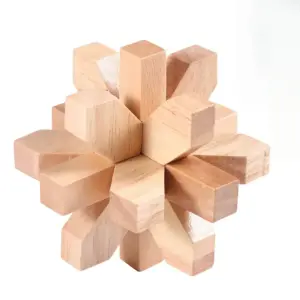
Tier 2: Specialty puzzle shops. The middle ground. These vendors stock Soma, Kongming, and snake cube puzzles in named wood species, with EU or US warehouses that typically ship in one to two weeks. Catalog depth is greater than any single mass-market retailer. If you want a known-good Soma, a Luban lock, or a snake cube from a vendor who answers email, this is the tier. The 54-T Cube Puzzle at $18.99 from a curated specialist fits here, with a focused product page that goes deeper than a mass-market listing.
Tier 3: Direct-from-artisan workshops. Where tolerances get tight. Independent makers handcraft from rosewood and walnut and ship between $40 and $95 per puzzle, with hand-rubbed finishes and numbered editions for collectors. Tier 3 pieces seat with a faint thwock rather than a clack. For buyers comparing the hand-rubbed rosewood and padauk options, the side-by-side testing of 6 premium wooden puzzle brands walks through the rosewood, ebony, and padauk tolerances in detail. Plan ahead for shipping: artisan pieces often take two to three weeks to reach a US doorstep from overseas.
Tier 4: Educational suppliers. Bulk-buy territory. Classroom-friendly wooden brain teaser sets in lots of 6 to 24, usually rubberwood or birch plywood, priced $15 to $30 per unit with quantity breaks at the cart. The trade-off is uniformity; you get a consistent product that survives a third-grade backpack, not a one-of-a-kind object. Tier 4 is where a teacher or a homeschool co-op should shop, and where a 6-in-1 Wooden Brain Teaser Set at $38.88 makes sense as a single SKU for an entire reading group.
Tier 5: DIY and 3D-print hubs and local makerspaces. The rabbit hole. Online repositories host free design files for printable Soma cubes, burr puzzles, and labyrinth-style interlocking puzzles, all designed for desktop FDM printers in PLA or PETG. A 12-piece Soma prints in a few hours on a desktop FDM printer in wood-filled PLA and finishes with a light sanding. The result is not heirloom; the wood filament smears if you over-sand. But for a buyer who already owns a printer, Tier 5 is the cheapest way to prototype a mechanical puzzle before committing $40 to a handcrafted version.
One neutral note on third-party retailers. The market for wooden cube puzzles includes a handful of independent makers and small studios in the US, Israel, the UK, the Netherlands, and Thailand. Names like Kubiya Games, MasterCubeStore, Creative Crafthouse, Wood-Expressions, SiamMandalay on Amazon, Pandolfini Casa, Jean-Claude Constantin, the Puzzle Parlour, Lakeshore, MindWare, and Thingiverse are all searchable for buyers who want to compare artisan and educational options directly. Pricing and shipping policies vary by seller, so verify before purchase.
A reader who just closed the red-flag checklist wants one thing: a vendor who names the wood. The tiers above are ordered by how often that simple courtesy shows up. Tier 1 rarely. Tier 5, always — you printed it.
Match-the-Buyer Matrix: Which Retailer Fits Your Situation
If you’d rather match by complexity, audience, or material first and then by retailer, the definitive buyer’s framework for wooden puzzle sets inverts this map. Same category, opposite buyers. Here is how to match your situation to the right tier.
1. Gift for a 6- to 10-year-old
Larger pieces. Rounded corners. A finish that survives a water-bottle spill. This is where mass-market rubberwood earns its keep — the tolerances are loose, which is exactly what a child needs, because forgiving assembly beats precision for small hands. Look for a cube under 3 inches with pieces that cannot be swallowed. Avoid anything with decorative dowels under a centimeter.
The 54‑T Cube Puzzle is my top pick in this scenario. It runs $18.99 and the pieces seat with a soft thwock that a child can hear but cannot pinch fingers on. It is the cube to send to friends with kids, and a wooden puzzle toy that survives a backpack with the corner ding or two.
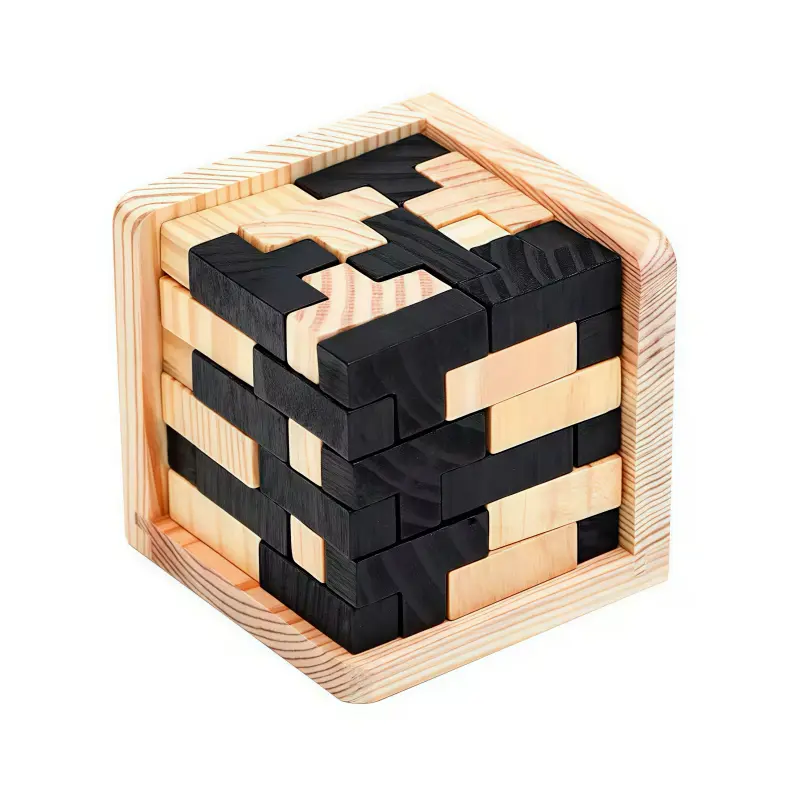
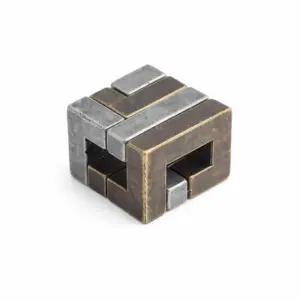
For a second option at similar price, the Luban Cube Puzzle at $21.99 ships in slightly tighter tolerances — better for an 8-to-10-year-old who has already beaten the easier Soma clones at school. Both fit the wooden puzzle toy category without the MDF warning of a $6 Amazon listing.
2. Gift for a puzzle-loving adult
Skip the under-$25 tier entirely. An adult solver registers loose tolerances as cheap, and a child-safe lacquer as plasticky. This is the tier for walnut, rosewood, and any puzzle with a numbered edition. Pieces should seat with a faint click, not a clack; the wood should smell like wood when you open the box. Think of it less as a purchase and more as a handcrafted puzzle that lives on a shelf between solves.
The 6-in-1 Wooden Brain Teaser Set is my recommendation when you do not know which type of brain teaser your giftee prefers. At $38.88 it bundles multiple distinct mechanisms, so the recipient gets range instead of a single bet.
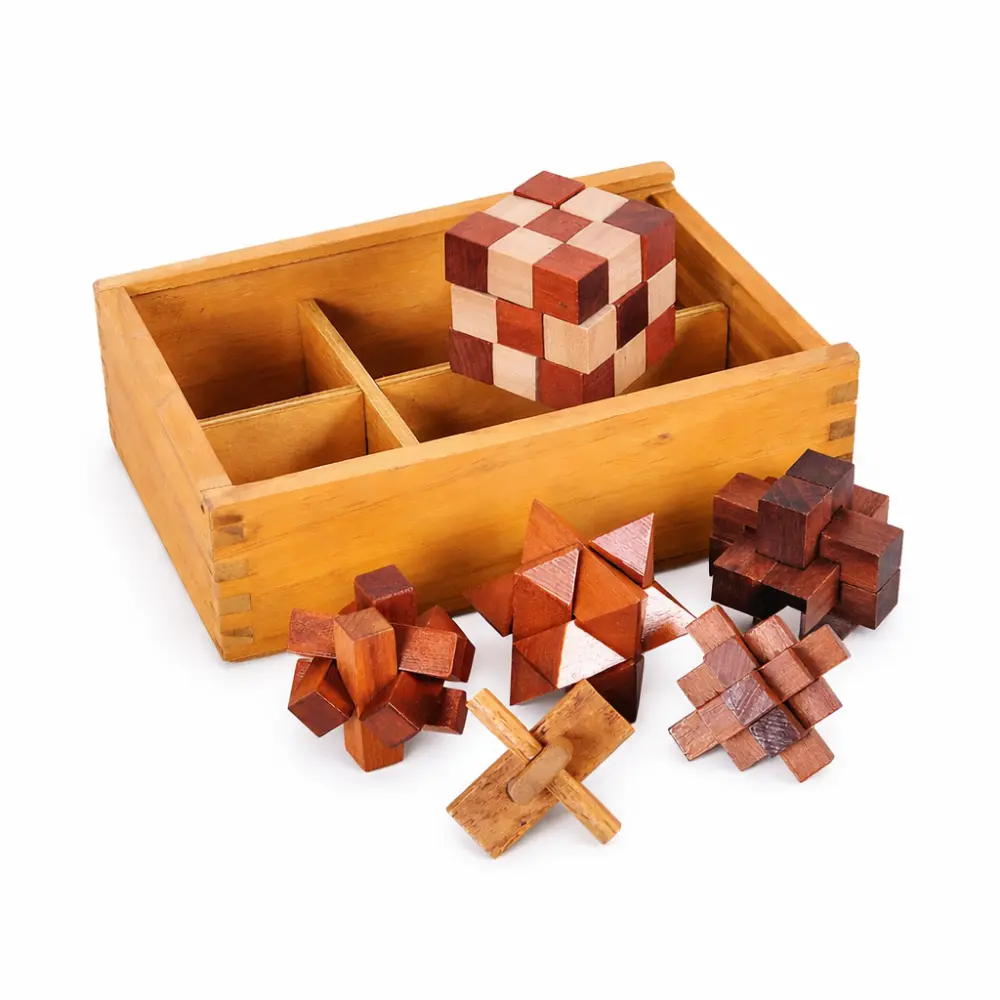
If you know they already own a Soma or two, step up to a sequential-difficulty set in solid hardwood — a Luban variant with visible internal geometry that adult collectors photograph from every angle.
3. Desk fidget
Quiet operation matters more than species here. A puzzle that thunks when you drop it will annoy your coworkers; one that whispers is a keeper. Look for a smooth lacquer finish, no protruding dowels, and a single solved state you can return to in under a few minutes. This is also the slot where the line between a wooden brain teaser puzzle and a sensory fidget toy blurs — a smooth-edged Soma works as both.
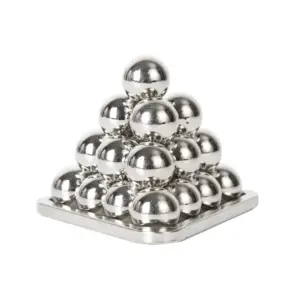
The 7 Color Soma Cube Puzzle at $21.88 fits a standing-desk fidgeter — the colored faces let you solve by pattern without staring, and the pieces reset to a cube once you have practiced the path. The Blockade Puzzle, when you want something with a little more tension and a more demanding solve path, also works as a desk object between meetings.
4. Classroom set of 12 or more
Per-unit cost and consistency matter. A classroom of mixed-ability solvers will stress a cheap Soma within a term; a beech or walnut burr with tight tolerances will survive five years of after-school club. Bulk pricing usually starts at the 12-unit mark, and an educational toy in this volume has to clear classroom-safety standards before it clears your cart.
The Luban Cube Puzzle at $21.99 per unit is the classroom workhorse in this roster — simple enough for a 7-year-old to attempt, hard enough that a teacher will not solve it in front of the class on day one. For mixed-grade reading groups, treat each station as a tiny wooden board game: a single Luban lock plus a printed solution sheet is more absorbing than a deck of cards.
5. Collector’s add
Numbered. Signed. Limited to 50 or fewer. The collector market is small but specific — and it is the one tier where a six-week shipping wait becomes a feature, because the wait signals scarcity. Among readily available options, the Blockade Puzzle is the most display-worthy single piece in the Tea Sip roster when you want an object that earns its shelf space.
6. Replacement-piece need
Never email an Amazon third-party seller for a missing piece. The path is direct-from-artisan: open the product page, find the maker’s contact, attach a photo of the missing piece and the original box. Response times run 2 to 5 business days; shipping is usually covered for verified defects. The same logic applies whether the missing piece is from a $15 mass-market Soma or a $90 handcrafted burr. If you cannot find a maker contact on the listing, that itself is a red flag — note it for your next purchase.
Mystery-cube identification (the Reddit fix)
The r/boardgames thread that pushed the writing of this section asked about a 16-tile cube-matching puzzle in clear plastic with colored squares on each face. That is the Smart Games Cube Puzzler or a direct clone, usually sold as a standalone brain teaser rather than a solid wood puzzle — most “wooden” versions of that mechanism are beech trays with printed stickers. If you want a wooden version of that mechanism, the 6-in-1 Wooden Brain Teaser Set at $38.88 includes a similar color-matching component in actual solid wood with a longer service life. The other common mystery is a wooden snake puzzle — 27 connected cubes on a string that fold into a 3x3x3. The same set covers that too.
Match the buyer, not the puzzle.
Why Anything Under $6 Is Almost Certainly MDF: Price Floors Explained
The arithmetic behind the $6 price floor is straightforward: kiln-dried beech plus food-safe lacquer plus laser-cut labor already costs more than $6 before packaging, retailer margin, or international shipping — which is why any wooden cube puzzle listing under $6 ships at a loss if it is genuinely solid wood.
Below that floor, you are not buying wood. You are buying compressed sawdust and glue with a paper veneer that mimics grain. The $6 threshold tracks the global commodity price of beech plus the minimum labor cost to sand six faces without splinters. Amazon listings at $4.99 to $5.99 cluster around two material categories: thin plywood with a printed beech photo on the outside, or medium-density fiberboard sealed with a single polyurethane coat. Both fail the same way within a season. MDF swells when a humid basement breathes on it; the printed plywood delaminates at the corner joints, exposing the ply layers like a peeled onion. The Reddit complaints about “wooden puzzles that smell like furniture” trace directly to this tier — that smell is the formaldehyde off-gassing from the MDF core.
At roughly $25, the math finally allows for kiln-dried beech or rubberwood, laser-cut tolerances that are tight enough for a faint thwock rather than a clack, and a hand-applied finish that does not off-gas. This is the sweet spot for the 54-T Cube Puzzle at $18.99, an interlocking brain teaser that punches above its price tier because the maker skipped retail packaging and ships direct. The 7 Color Soma Cube Puzzle at $21.88 covers the classic Soma mechanism with color-coded pieces and a tighter fit than the mass-market default.
At $25, expect beech or rubberwood, tight tolerances, a satin lacquer or beeswax finish, and packaging that survives a transcontinental shipment without corner dents.
Above $50, the beech and rubberwood give way to walnut, rosewood, and Thai hardwoods — denser grains, natural oils that resist humidity, and the kind of finish that improves with handling rather than degrading. The trade-off at this tier is shipping wait time, often two to three weeks from international artisan shops, and the understanding that you are buying an object, not just a mechanical puzzle.
Cheap versus expensive is not really a quality conversation. It is a material conversation. A budget beech Soma is a perfectly fine brain teaser that will survive a child’s backpack and a year of Sunday solves. A premium walnut Soma is a desk object you will hand to a grandchild twenty years from now. Both are legitimate purchases for different buyers — but neither is MDF, and that is the floor that matters.
Pay $25, not $6, and skip the MDF forever.
Frequently Asked Questions About Buying Wooden Cube Puzzles
Here are the eight questions most often fielded about wooden cube puzzles — answered with the same numbers a hobbyist would use over coffee.
What is the wooden cube puzzle from Raiders of the Lost Ark, and where do I buy the real one?
The 1981 Chachapoyan Fertility Idol has been recreated as a ball-in-cage wooden puzzle by artisan shops, with signed editions typically listing at premium collector prices direct from the maker. The mechanism is a true burr-style cage; the wood is typically olive or walnut; and the production run is usually limited. Replicas surface at specialty retailers in Europe, the UK, and through artisan shops across a handful of countries — but skip any “Indiana Jones idol” listed under $40. At that price the body is resin, not wood.
How can I tell if a wooden cube puzzle is real wood or cheap MDF before I click Buy?
Three field tests work in your kitchen in under sixty seconds. First, read the species: if the listing says “wooden” without naming beech, walnut, rubberwood, or rosewood, assume MDF. Second, check the weight — a 2.25-inch solid beech Soma weighs noticeably more than the same size in MDF, which feels heavy in a dead, lifeless way. Third, look at the edge grain in the photo — MDF shows a uniform flat edge with no pores; solid wood shows growth rings or open grain.
Which wooden cube puzzle fits a 6-year-old, and which fits an adult?
A 6-year-old solves by feel and color, so pick a chunky rubberwood set with no sharp edges and a short solve that ends in a satisfying shape change. An adult wants a 54-piece T-cube or a 24-piece Soma; the 54-T Cube Puzzle ($18.99) and the Luban Cube Puzzle ($21.99) both ship from Tea Sip with tolerances tight enough to seat the final piece with a faint thwock; the budget beech set thunks; the walnut whispers. Skip the under-$8 options for any child under 8; the splinter rate on budget rubberwood is the most common 1-star complaint.
Where can I buy a real-wood Soma cube, not plastic?
Solid-wood Soma cubes are available from a handful of artisan shops and curated specialty retailers. The 7 Color Soma Cube Puzzle ($21.88) is the most accessible entry point for buyers who want seven pigmented hardwoods in one box and a sub-$25 price. A simple Amazon search for “Soma cube wooden” surfaces several solid-wood options, mostly in the $20-50 range.
Do the $8-12 Kongming locks sold on Amazon hold up, or do they fall apart?
Expect a year or two of daily pocket carry before the first splinter, based on common buyer-review patterns on budget Luban-lock listings. The wood in that price band is rubberwood with a thin spray lacquer; the joint tolerances are loose enough that pieces wiggle when assembled, and the lacquer chips at the corners within a year. Step up to a multi-piece set from a known maker, and the same mechanism survives years of use. Step up from rubberwood.
Can I get a replacement piece if a wooden cube puzzle arrives missing one?
Direct-from-artisan shops almost always ship a replacement at no charge, because the maker keeps stock of every cut they make. Third-party marketplace sellers rarely respond, and the refund path is faster than the replacement path. For puzzles you bought years ago, a furniture restorer can hand-cut a replacement from a matching species for a modest fee — and if you’d rather try the repair yourself, the 8-step walkthrough on how to repair a broken wooden puzzle piece in 8 steps covers beeswax fills, dowel splices, and grain matching.
What is the difference between a wooden brain teaser and a fidget cube?
A brain teaser has a single intended solve path; the Luban lock and the Soma cube each open one way, then close, and the satisfaction is the solve itself. A fidget cube has multiple independent mechanisms (clicker, rocker, spinner, switch) designed to be touched repeatedly without resolution. The walnut Soma in your hand produces one satisfying thwock per solve; a fidget cube produces many clicks per minute with no end state. Buy the wooden brain teaser if you want a screen-free focus ritual; buy the fidget toy if you want a tactile distraction during a long meeting. Two different tools, two different jobs.
Where do collectors buy numbered or limited edition wooden puzzles?
Four sources feed the collector market. Independent makers run numbered drops and sell direct. Small studios issue numbered runs of burr and Soma lines, often in small batches. Artisan shops on Etsy in the EU and Japan list small-batch handmade puzzles from cherry, ebony, and padauk. UK shops curate and authenticate vintage and out-of-print artisan pieces. Expect collector pricing to vary widely with the species, the maker, and the edition size; the prices hold because the runs are tiny. Tiny runs. Lasting prices.
Pick the puzzle that fits the table you actually have — not the one a five-star review told you to want. Start with the 54-T Cube Puzzle at $18.99, set it on a desk where you’ll see it every morning, and let the next click come to you.