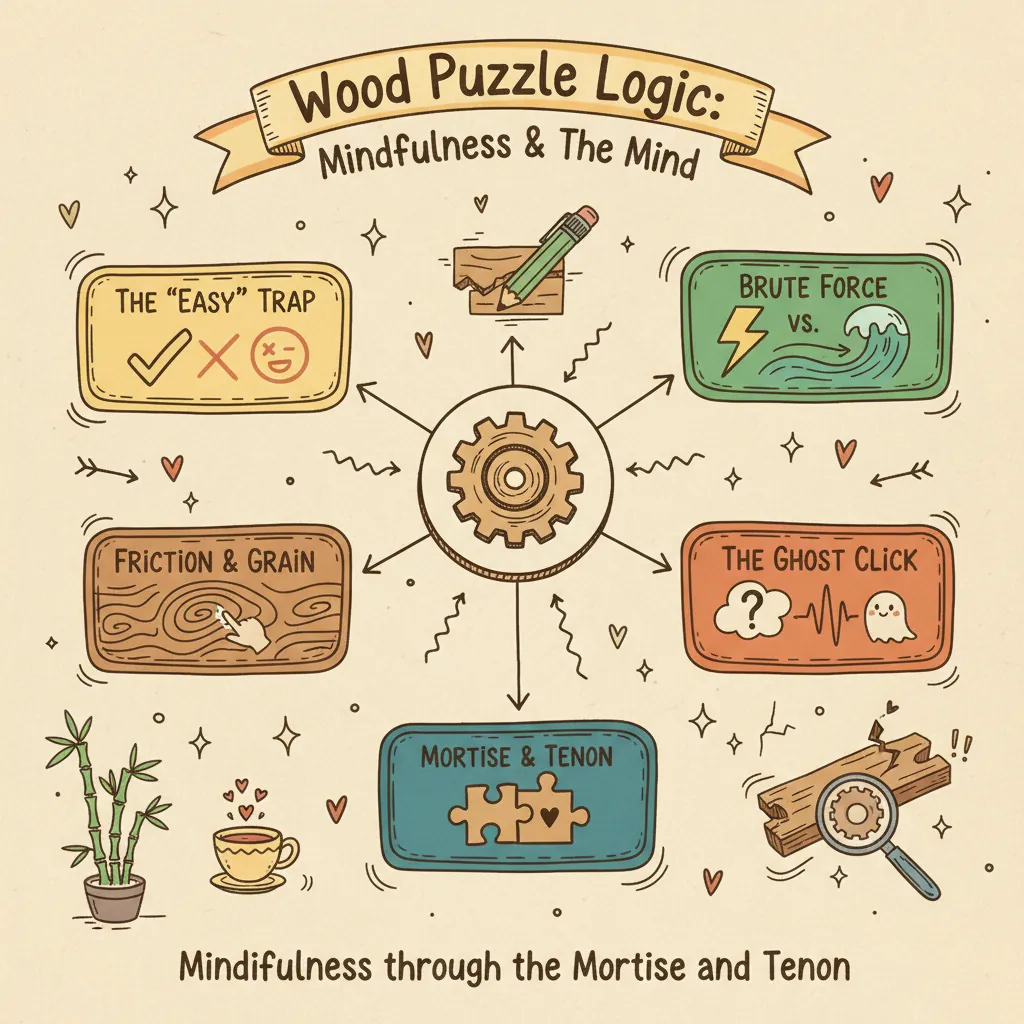
The third time the 24th piece of the cage puzzle fell onto my hardwood floor with a sharp clack, I realized I was fighting the material, not the logic. I had been trying to force a tolerance that didn’t want to be moved, treating the wood like it was a stubborn bolt on a car engine. I set the pieces down, made a fresh cup of jasmine tea, and just looked at them. The grain on the bamboo was tight, almost shimmering under my desk lamp, and it occurred to me that I wasn’t just solving a geometric riddle. I was participating in a conversation with a material that has been used to challenge the human mind for over two millennia.
My thesis after testing over 200 of these objects is simple: wood is the superior medium for mindfulness because it is imperfect. Unlike the cold, clinical precision of a machined aluminum puzzle, a wood puzzle brain teaser has a soul. It expands with humidity, it wears down where you touch it most, and it demands a level of “listening” that metal simply doesn’t require. If you try to brute-force a wooden joint, it will snap. It forces you to be gentle, to be observant, and to eventually realize that the solution isn’t something you impose—it’s something you allow to happen.
In this deep dive, I’m going to walk you through the mechanics of why these timber enigmas work, how to spot a quality build from a cheap knock-off, and which specific models from my current rotation are worth your desk space.
The Lie of the “Easy” Wood Puzzle
Most people see a six-piece wooden cross at a gift shop and think, “I’ll have that sorted by the time the appetizers arrive.” They are usually wrong. There is a specific kind of deceptive simplicity in wooden joinery that preys on our assumptions about how objects fit together. We are used to nails, screws, and glue. When you encounter a collection of tactile timber challenges that rely entirely on the friction of the wood itself, your brain has to reboot its understanding of structural integrity.
The classic Six-Piece Burr ($17.99) is the perfect example of this.
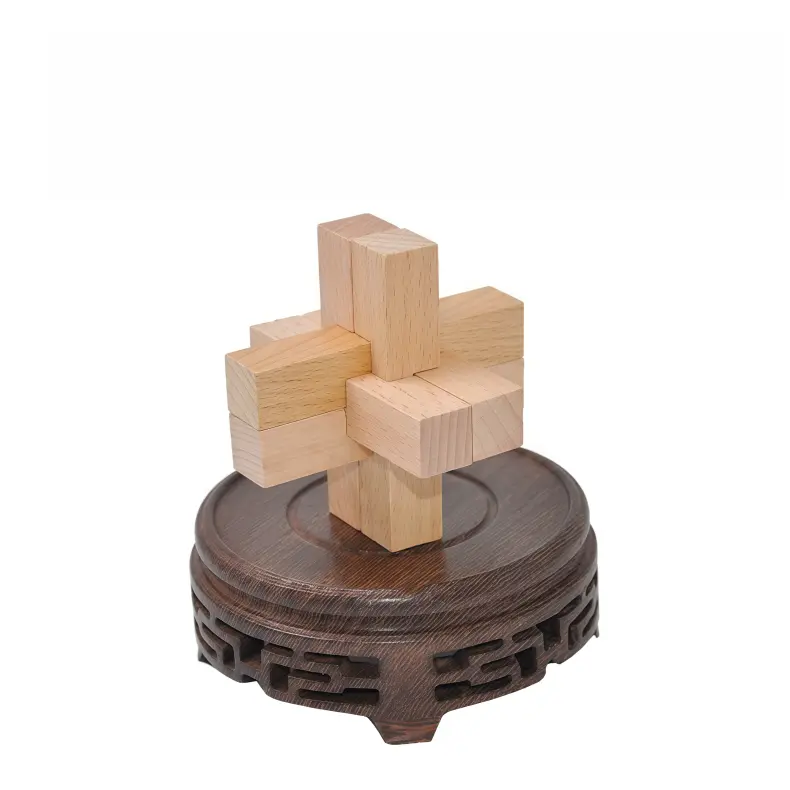
Six-Piece Burr — $17.99
I’ve had this specific burr on my shelf for months, and I still find myself reaching for it when I need to reset my focus. It’s based on the traditional Altekruse design, where every piece is identical. Most people assume there’s a “key” piece—one that slides out easily to start the chain reaction. But with a well-made burr, the stability comes from the collective pressure of all six pieces. It’s a physical manifestation of the idea that true strength doesn’t require external fasteners; it requires internal alignment. At seventeen dollars and change, the finish on this one is surprisingly smooth, though I did notice the internal notches had a few tiny splinters that I had to buff out with a fingernail. It’s a “level 3” challenge that feels like a “level 5” if you’ve never handled an interlocking puzzle before.
Friction as a Feature: Why Wood Beats Metal for Beginners
I often get asked why I recommend wood over metal for people just getting into the hobby. Metal puzzles, specifically the cast ones, are fantastic, but they can be discouragingly opaque. You often can’t see the internal mechanism, so you’re just “fishing” for the solution. Wood is different. You can see the notches. You can see how the grain aligns. The feedback is immediate.
When you slide two pieces of hardwood together, there is a specific vibration—a “drag”—that tells you if you’re on the right track. If the pieces bind, you’re misaligned. If they glide, you’ve found the path. This tactile feedback is essential for developing spatial reasoning. It’s why something like the 6 Piece Wooden Puzzle Key ($12.99) is such a great entry point.
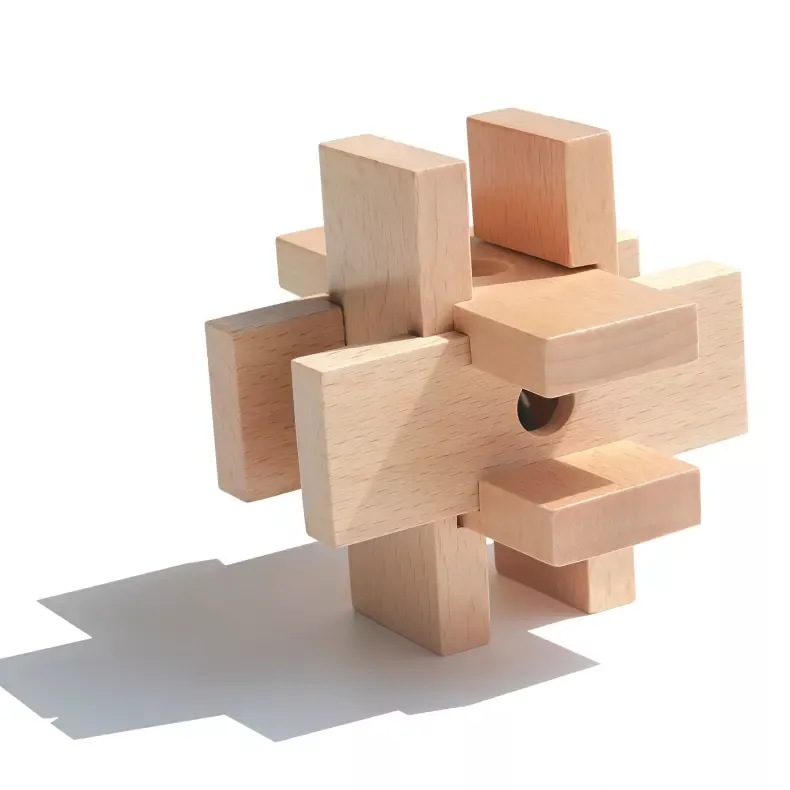
6 Piece Wooden Puzzle Key — $12.99
The “Key” puzzle is what I call a “fidget solver.” It’s small enough to hold in one hand while you’re on a Zoom call, and the solve is more about muscle memory than high-level mathematics. It teaches you the art of “Wu Wei” or effortless action. If you try to pull it apart, it resists. If you let your fingers find the natural gaps, it practically falls into your palm. For under thirteen dollars, it’s the cheapest therapy session you’ll ever buy. The hardwood used here is dense and has a satisfying weight, though the “key” shape is more of a stylistic choice than a functional one. It’s a great gift for someone who claims they “aren’t a puzzle person” because the tactile satisfaction of the wood is enough to keep them fiddling until they accidentally solve it.
The Ancient Logic of Mortise and Tenon
To understand why these puzzles feel so “right,” you have to look back at the history of Chinese architecture. For centuries, Chinese builders didn’t use nails. They used mortise and tenon joints—interlocking tabs and slots that allowed buildings to sway during earthquakes without collapsing. The history of the puzzle is deeply intertwined with these functional engineering feats.
The most famous of these is the Luban Lock, named after Lu Ban, the legendary carpenter of the Zhou Dynasty. These aren’t just toys; they are miniature architectural models. When you solve a Luban Cube Puzzle ($21.99), you are essentially assembling a tiny, earthquake-proof structure.
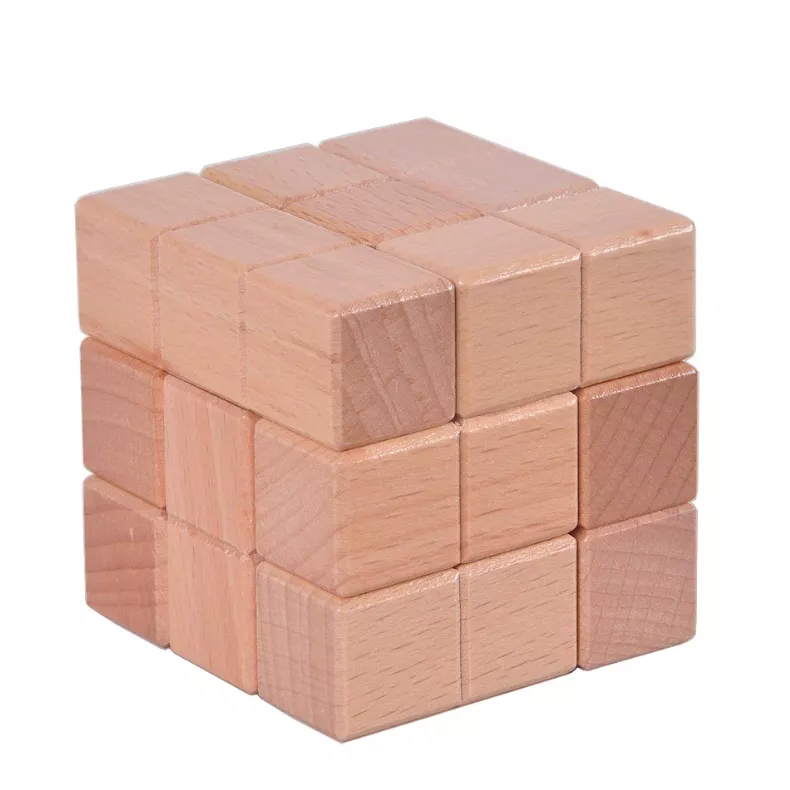
Luban Cube Puzzle — $21.99
The 3x3x3 Luban Cube is a beast compared to the simple burr. It uses 6 or 7 notched blocks that must be oriented perfectly in three dimensions. I spent about forty minutes on my first attempt, mostly because I kept getting the “internal” pieces mixed up. The beauty of this specific version is that there is only one exact spot for every piece. It’s a “hidden magic” challenge where the cube looks like a solid block of wood until you find the one sliding piece that initiates the disassembly. At nearly twenty-two dollars, it’s on the higher end for a simple cube, but the precision of the notches justifies the price. If the tolerances were off by even half a millimeter, the whole thing would either rattle or jam.
The “Ghost Click” – When Logic Becomes Intuition
There is a moment in every puzzle solve that I call the “Peak Moment.” It’s not when the puzzle is finished. It’s the moment about 60% of the way through when your brain stops thinking in 2D and starts “seeing” the internal void space.
I recently demonstrated this to a friend who is a mechanical engineer. I gave him a complex interlocking cage, and for fifteen minutes, he tried to calculate the angles. Then, I gave the same puzzle to his ten-year-old daughter. She didn’t calculate anything; she just felt for the loose piece. Within three minutes, she had it open. She wasn’t smarter than the engineer; she was just more attuned to the “ghost click”—that subtle shift in weight when a piece moves into a previously occupied space.
This is the core appeal of the Double Cross Cage Puzzle ($18.88).
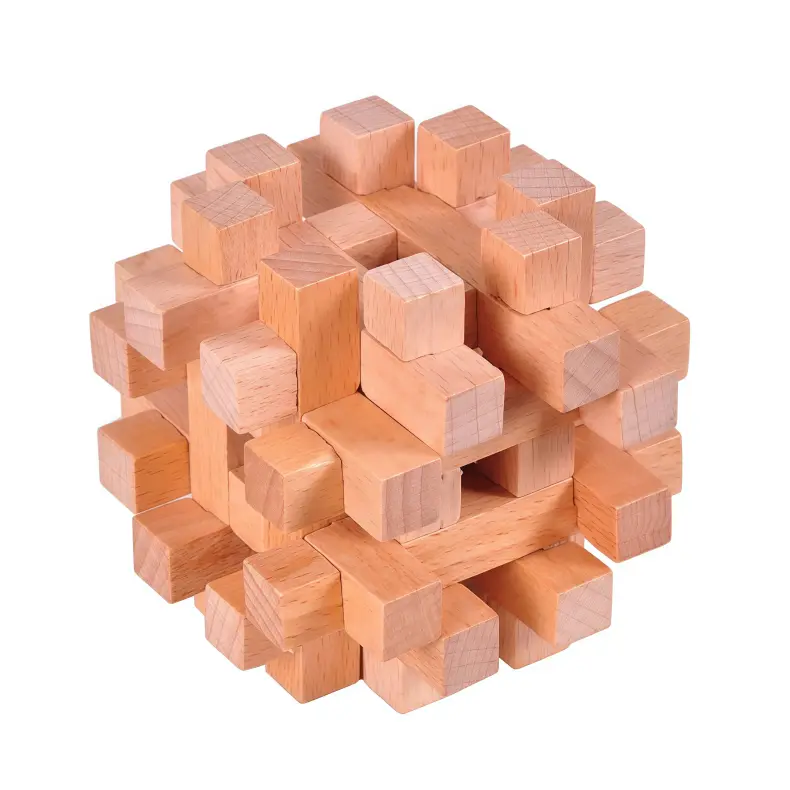
Double Cross Cage Puzzle
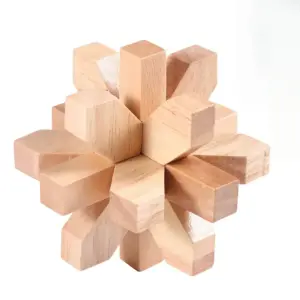
The Double Cross Cage is a meditation on patience. It consists of twenty-four identical pieces that create a structure of seemingly impossible strength. When you hold it, it feels like a solid orb of wood. There is no obvious starting point. The “peak” for me was realizing that the strength doesn’t come from any one piece being “locked,” but from the geometric balance of the whole. You have to find the one piece that has a fraction of a millimeter more play than the others.
Once you get the first piece out, the rest of the solve is a lesson in gravity. If you aren’t careful, the remaining 23 pieces will explode across your desk. Reassembling it is the real challenge—it’s like trying to build a house of cards where the cards are made of slippery bamboo. For $18.88, this is arguably the best “bang for your buck” if you want a puzzle that will keep you occupied for an entire afternoon. It’s a tactile fable about how knowing when to yield is the ultimate power.
Why Your First Solve Will Be an Accident
If you are new to the world of mechanical locks that require sequential logic, don’t be discouraged if your first “win” feels like a fluke. Many wooden brain teasers are designed to be “discovered” through play rather than “solved” through deduction. This is especially true of the more philosophical designs that integrate ancient teachings.
Take the Wood Knot Puzzle ($16.99), for instance.
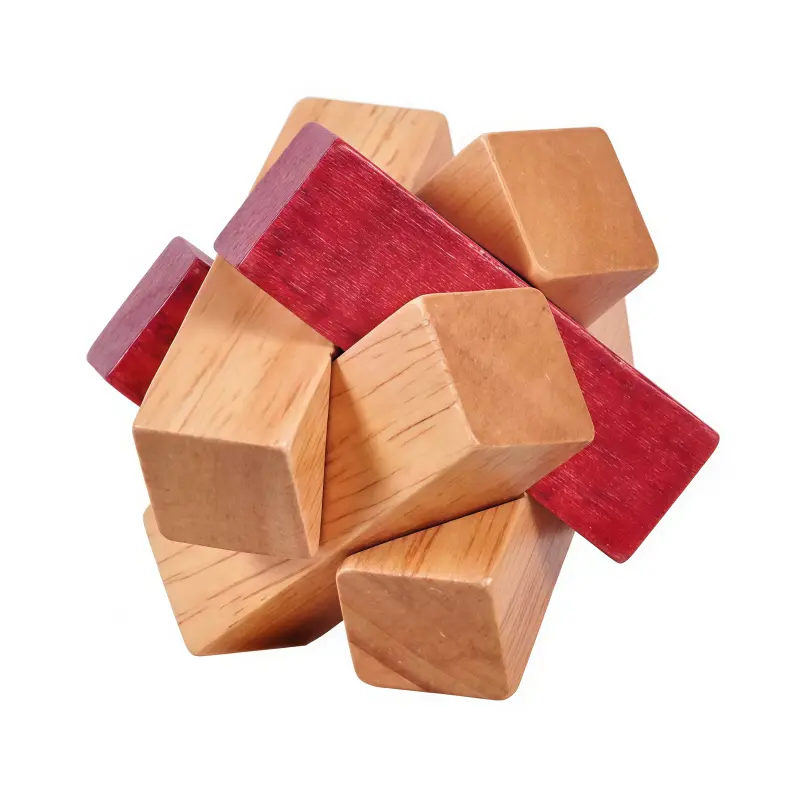
Wood Knot Puzzle
This is the puzzle I keep on my coffee table for guests. It’s based on Taoist teachings like “great sound is barely heard.” It looks like a tangled mess of six hardwood bars, but it’s actually a masterpiece of geometric harmony. There are no screws, no glue, and no shortcuts.
When I first picked this up, I spent ten minutes trying to pull it apart. Then, while I was distracted by a conversation, my hands just… found the rhythm. The pieces slid apart with a sound that I can only describe as a “wooden whisper.” It’s a level 2 difficulty, meaning it’s accessible, but the “re-assembly” is where the philosophical contemplation really kicks in. You have to remember the exact order of the “foundations” to rebuild the knot. It’s a perfect example of how a wood puzzle brain teaser can be a mindful practice rather than just a game. For under seventeen dollars, it’s a beautiful object that doubles as a conversation starter.
Crossing the Border: When Wood Meets Metal
While I’m a wood purist at heart, I’d be remiss if I didn’t mention the “hybrid” experience. Sometimes, the logic of a wooden puzzle is better expressed in metal, or a metal puzzle borrows the “interlocking” logic of a Luban lock.
For example, if you find the wooden puzzles too “soft” or you’re worried about humidity affecting the solve, you might look at something like the Silver Heart Lock Puzzle ($18.89).
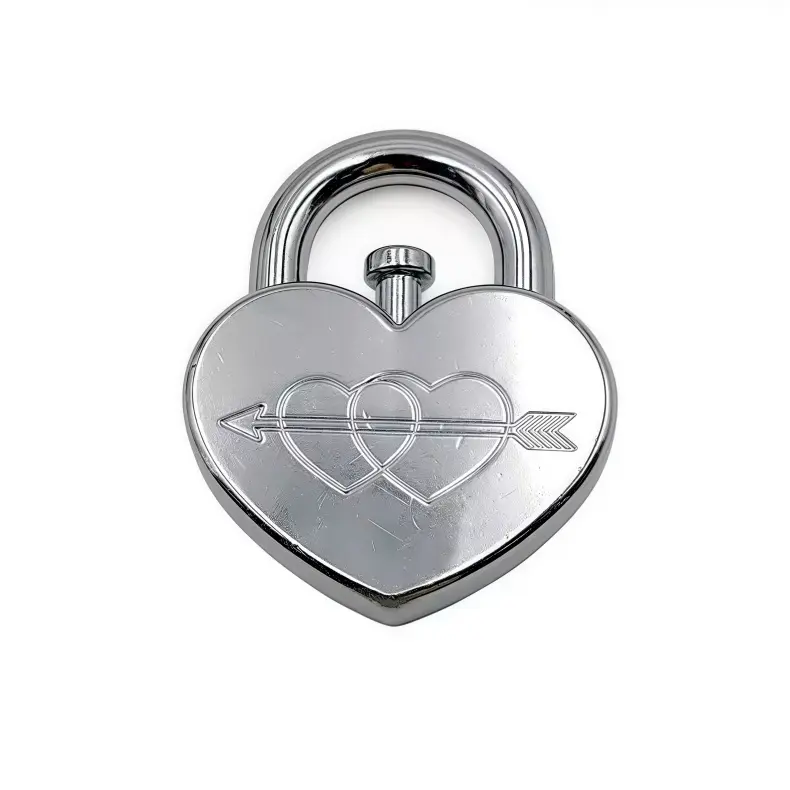
Silver Heart Lock Puzzle — $18.89
The Silver Heart Lock is technically a metal puzzle, but it uses the exact same interlocking mechanism you’d find in a traditional wooden “heart lock.” It’s silver-plated and feels significantly heavier in the hand than the bamboo versions. I like this for travel because it’s durable, but it lacks that “organic” friction I love. If you’re a fan of the Cast series, you’ll appreciate the tolerances here. Similarly, the Metal Grenade Lock Puzzle ($11.98) offers a more “industrial” take on the disassembly challenge.
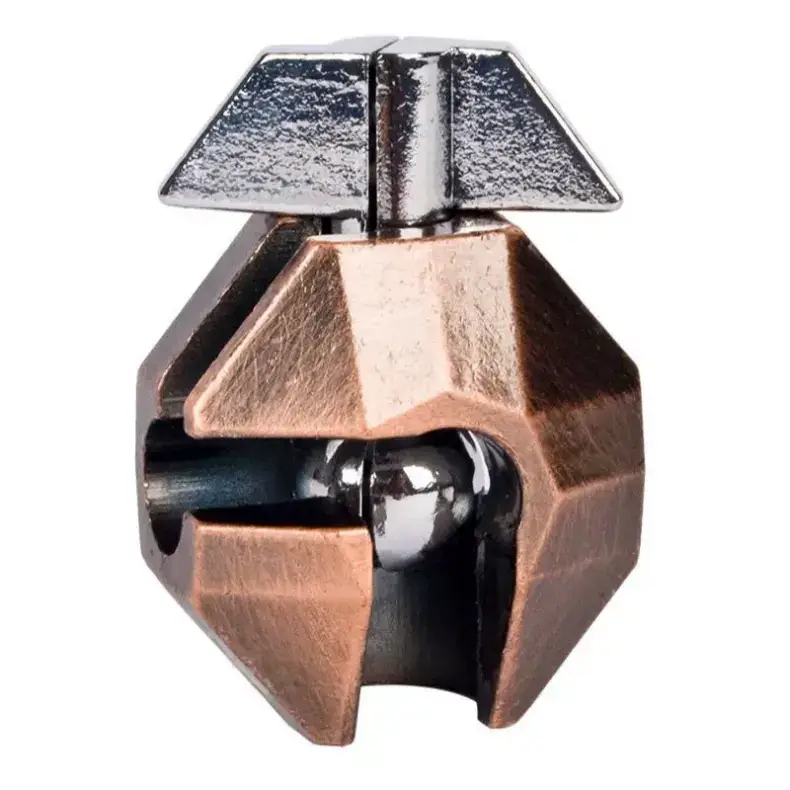
Metal Grenade Lock Puzzle — $11.98
The Grenade Lock is a great “desk toy” for someone who likes a bit of weight. It requires observation and precise manipulation, much like a wooden burr, but the stakes feel higher because the “grenade” design implies a certain mechanical urgency. It’s a level 3 difficulty and, for just under twelve dollars, it’s an easy add-on to a collection. However, if you want the true “ancient legend” feel, you have to go back to the source.
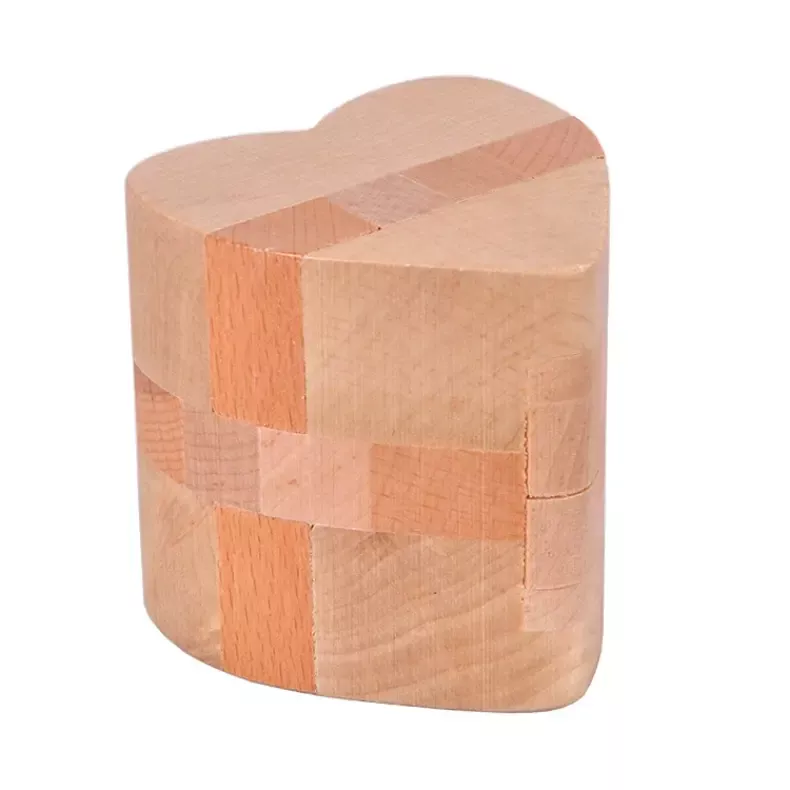
King Wen of Zhou heart-lock puzzle
This is the “storyteller” of my collection. The King Wen of Zhou heart-lock puzzle ($17.99) is based on the love story of King Wen and Tai Si. It’s a tactile fable. The grooves and notches aren’t just for show; they represent the “reversing of chaos into order,” a core Daoist principle.
What I love about this one is the narrative weight. When you’re struggling to slide the final piece into place, you aren’t just fighting a block of wood; you’re navigating a legendary loyalty. The wood is finished with a slight sheen that highlights the “whispers of history” in the grain. It’s a medium-difficulty puzzle that rewards patience over speed. If you’re the type of person who likes to solve while listening to a podcast or reflecting on your day, this is the one for you. It’s a “mindful reflection” tool disguised as a $17.99 game.
The Expert’s Choice: The Luban Square Lock
If you’ve graduated from the 6-piece burrs and the simple keys, you’re ready for the “final boss” of traditional wooden puzzles. The Luban Square Lock ($21.99) is the purest expression of the craft.
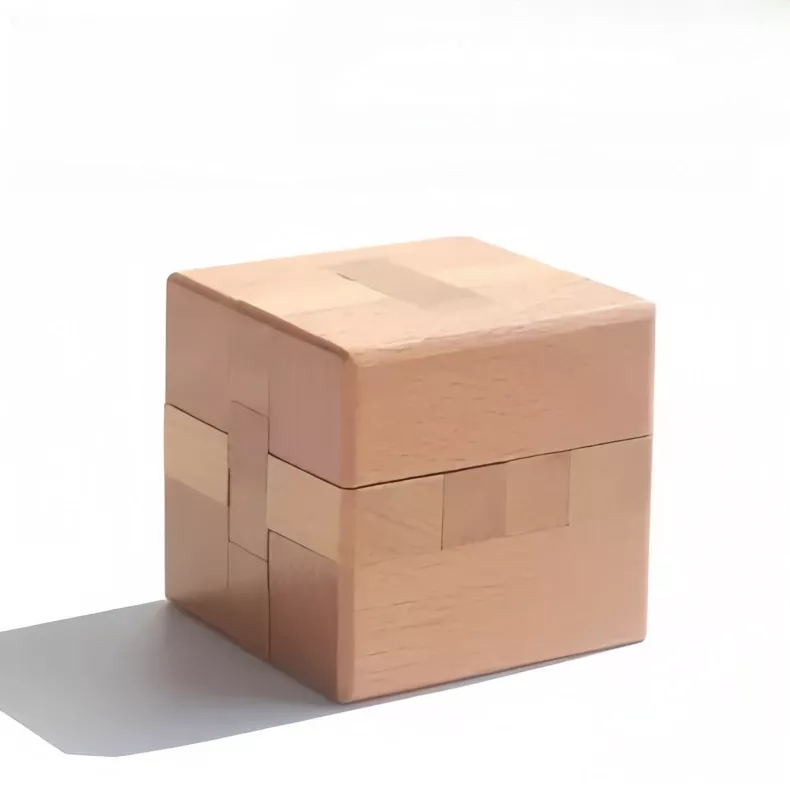
Luban Square Lock
This is a solid hardwood puzzle with a natural finish. There are no nails, no glue—just pure mortise and tenon joinery. It typically consists of 6 to 12 precision-notched bars that interlock into a perfect cube.
Why is this the expert’s choice? Because the tolerances are tight. In cheaper versions, you can cheat by wiggling the pieces. In this version, you have to be exact. It trains your fine motor skills and spatial reasoning in a way that few other puzzles can. I’ve had my Luban Square for three weeks, and I still find the assembly process challenging. It’s a great stress-relief tool because it requires 100% of your attention. You can’t “half-solve” a Luban Square. You’re either in harmony with the wood, or you’re staring at a pile of sticks. For $21.99, it’s the most authentic “old world” experience you can get.
For those who want to keep the challenge going but need a break from the physical, I often suggest switching to logic-based grid games like Kurodoko to reset your brain’s spatial processing.
Quick-Reference Comparison Table
FAQ: Everything You’re Afraid to Ask About Wood Puzzles
How do I solve a wooden brain teaser if I’m totally stuck?
Most people try to solve wooden puzzles by pulling. Don’t do that. Instead, apply light pressure to each piece individually to see which one has “play.” Wooden puzzles almost always have a “key” piece that must move first. If you’re really stuck, you can try to search for specific project plans or solution guides, but I recommend a “blind” approach first. Try rotating the puzzle in your hands; sometimes gravity is the missing ingredient.
Are wooden puzzles durable enough for kids?
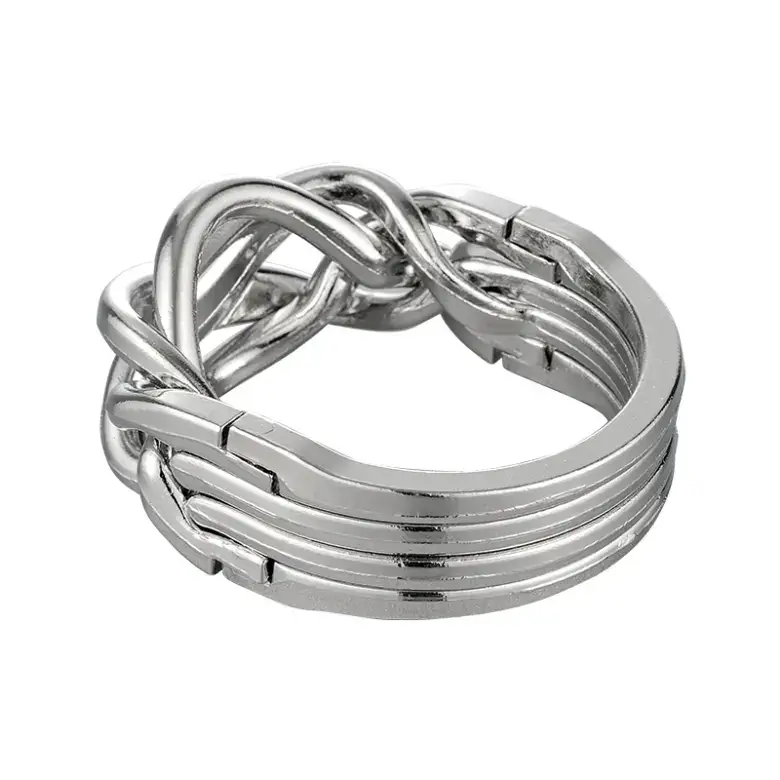
Yes and no. While wood is sturdy, the thin “tenons” (the tabs) can snap if a child tries to force a piece that isn’t meant to move. I generally recommend wooden puzzles for ages 12 and up. For younger kids, stick to something like the 4 Band Puzzle Ring ($11.99) which is metal and can survive being dropped or stepped on.
My puzzle is stuck and won’t move at all. Is it broken?
Likely not. Wood is a natural material that reacts to humidity. If you live in a very humid environment, the wood can swell, making the tolerances extremely tight. Try putting the puzzle in a dry room or near a dehumidifier for 24 hours. Conversely, if it’s too loose, a bit of humidity can actually “tighten” the joints. This is part of the charm—and frustration—of the medium.
Is it “cheating” to look at the solution?
I respectfully disagree with the purists who say you should never look at the solution. Sometimes, seeing the internal logic of one puzzle helps you solve ten others. If you’ve spent three days on a Luban lock and you’re ready to throw it out the window, look at the guide. The goal is to learn the patterns, not to suffer needlessly.
Why do some wooden puzzles smell like chemicals?
Cheap, mass-produced puzzles often use low-quality lacquers. A high-quality wood puzzle brain teaser should smell like wood—cedar, bamboo, or walnut. If you get one that smells like a nail salon, let it air out for a week. The models I’ve linked here, like the Luban series, generally use natural finishes that are much friendlier to the nose.
Can I use a script or AI to solve these?
Some Reddit users have written scripts to “brute force” the logic of 25-piece puzzles, but honestly, that defeats the purpose. The value of a physical puzzle is the tactile connection. If you want to solve things with a computer, try digital number sliding games instead. Wood puzzles are about the slow, analog “aha!” moment.
How do I maintain my wooden puzzles?
Don’t use furniture polish. A tiny bit of mineral oil on a rag once a year is enough to keep the wood from drying out. If a joint is too “sticky,” you can rub a little bit of beeswax or a graphite pencil on the friction points. I’ve had some of my puzzles for five years, and they actually move better now than the day I bought them because they’ve been “broken in” by my hands.
What’s the difference between a “burr” and a “Luban lock”?
Technically, a burr is a type of Luban lock. The term “burr” usually refers to the 6-piece interlocking cross shape (resembling a seed burr). “Luban lock” is a broader term for any traditional Chinese interlocking puzzle using mortise and tenon joints. They all share the same DNA: stability through geometry.
Are these good for seniors with arthritis?
It depends on the puzzle. Interlocking cubes like the Luban Square require some fine motor precision. However, larger puzzles like the Double Cross Cage can actually be great for keeping hands active. Just avoid the tiny “pocket” versions which can be fiddly.
Why are some wood puzzles $10 and others are $100?
It comes down to wood type and tolerances. Exotic hardwoods like ebony or purpleheart are expensive. But more importantly, the “fit” is harder to achieve in wood than in metal. A master craftsman has to account for the grain direction so the pieces don’t warp over time. For a casual collector, the $15-$25 range is the “sweet spot” for quality without overpaying for a name brand.
The One Puzzle That Teaches You How All the Others Work
If you’ve read this far, you’re probably looking for a place to start. If I had to pick just one—the “Rosetta Stone” of my collection—it would be the Wood Knot Puzzle ($16.99).
It isn’t the hardest. It isn’t the most expensive. But it is the most honest. It teaches you that if you stop forcing the solution and let the patterns emerge naturally, the complexity dissolves. It’s the puzzle that taught me to stop fighting the wood and start listening to it. That “wooden whisper” I mentioned earlier? You won’t find that in a metal puzzle, and you certainly won’t find it in a plastic one.
Whether you’re looking to kill twenty minutes at your desk or you’re starting a lifelong obsession, remember that the goal isn’t just to get the pieces apart. The goal is to understand why they were together in the first place.
If this tactile challenge clicked for you, you might find that advanced solvers often graduate to sequential discovery boxes that hide tools inside themselves, adding a whole new layer to the mystery. Start with the Knot, feel the grain, and let your curiosity do the rest.
The “click” is waiting. You just have to stop pulling so hard.