Quick Answer: Wooden Desk Organizer Perpetual Calendar Puzzle Pen: Which to Buy
Buy the Tea-Sip Wooden Desk Organizer with Perpetual Calendar | Puzzle Pen Holder at $19.99 — a ready-made ring-rotation puzzle that works the moment it arrives. Choose a DIY 3D puzzle kit only if the build is the reason; skip any “perpetual calendar” that can’t explain month-length or leap-year handling.
Three checks decide which version fits:
| If you want… | Pick this archetype | The one thing to verify on the listing |
|---|---|---|
| A passive desk fidget + working date display + pen holder, ready to use | Ready-made ring-rotation organizer (e.g., Tea-Sip $19.99 organizer) | The rings actually rotate freely and the gold print is etched or laser-burned, not surface-stamped |
| A weekend build project that ends in a calendar you assembled yourself | DIY 3D mechanical puzzle kit (Gear Elevation–style) | A stated or typical assembly time, and whether the moving parts arrive pre-cut or need sanding |
| A minimalist block-style date display with no moving parts | Reusable pine-block perpetual calendar (EXQUIDECA-style) | The wood is named (e.g., natural pine) and the number/letter blocks are reusable year over year |
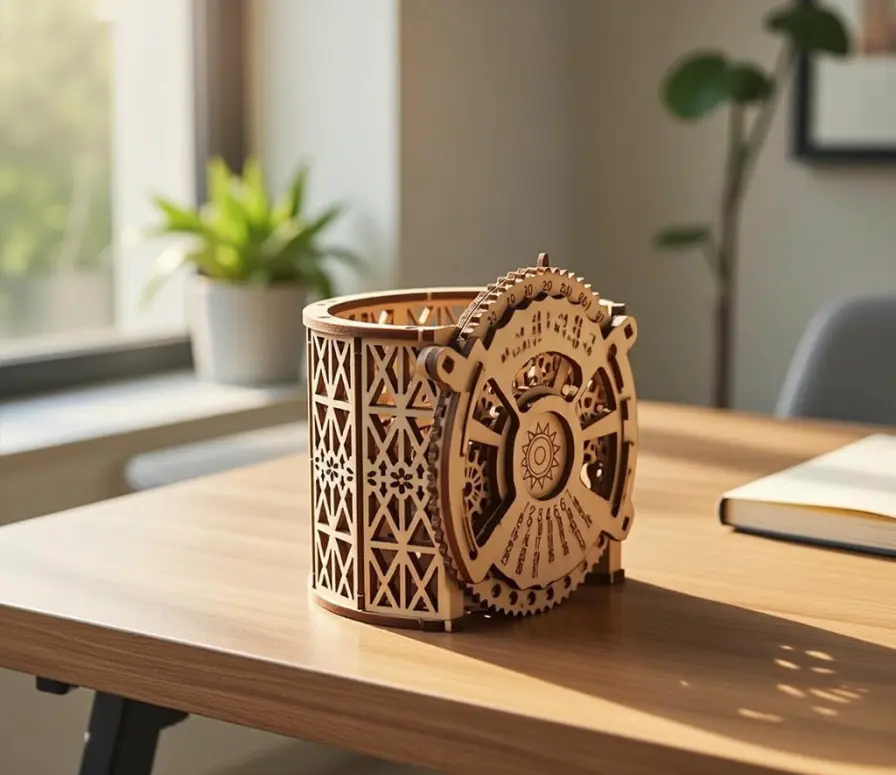
The “puzzle” on a mass-produced ring-rotation organizer is a small, passive interaction — you line up three rings and you’re done — and that is exactly why a buyer who already owns a wooden pen holder and wants a fidget that also displays the date tends to land here. The check: before you buy, confirm the product page names the wood type and shows the rings in a close-up photo, because cheaper versions on third-party marketplaces are the ones that buyers report for fading gold lettering.
01. What the ‘puzzle’ actually is on a wooden perpetual calendar
Three different mechanisms are sold under the same “wooden perpetual calendar puzzle” label, and the one you get changes what the product actually does on a desk. Ring-rotation organizers are passive fidget-plus-date tools. 3D mechanical kits make the calendar the build itself. Sliding block calendars turn date-setting into a small daily arrangement. The check: name the mechanism in the listing before you buy.
The first archetype — ring-rotation — is what most buyers land on when they search this keyword. The calendar lives on a small set of concentric wooden or plastic rings mounted to the side or top of a pre-assembled organizer; you spin the outer ring to a month, the inner ring to a day, and a window or pointer reveals the current date. There is no challenge and no sequence to learn — the “puzzle” is the brief moment of alignment, repeated every morning. The same mechanism appears on multi-function organizers that also hold a pen cup, a card slot, a mobile stand, and sometimes an analog clock face, which is why a single listing can advertise five or six features and still belong to this same passive category. For an adult who already likes wooden desk objects and wants a small tactile ritual at the start of the day, the ready-made version on the Tea-Sip product page lists at $19.99.
The second archetype is the 3D mechanical kit, and this is where the word “puzzle” starts to mean something closer to its original sense. Kits like the 3D Wooden Perpetual Calendar Puzzle ship as flat laser-cut wooden sheets that you press out and assemble into a finished object. The puzzle has two stages: the build itself, where gears, axles, and a calendar drum fit together in a specific order, and the perpetual-calendar mechanism, where manually rotated components inside the finished model line up the date and continue to do so year after year. Once assembled, the daily interaction is closer to the ring-rotation type — turn a dial, read a number — but the cognitive effort that produced the object is real, and the listing page makes that explicit. For a clearer picture of how 3D wooden puzzles actually work before committing to a multi-hour build, that walkthrough is worth a read.
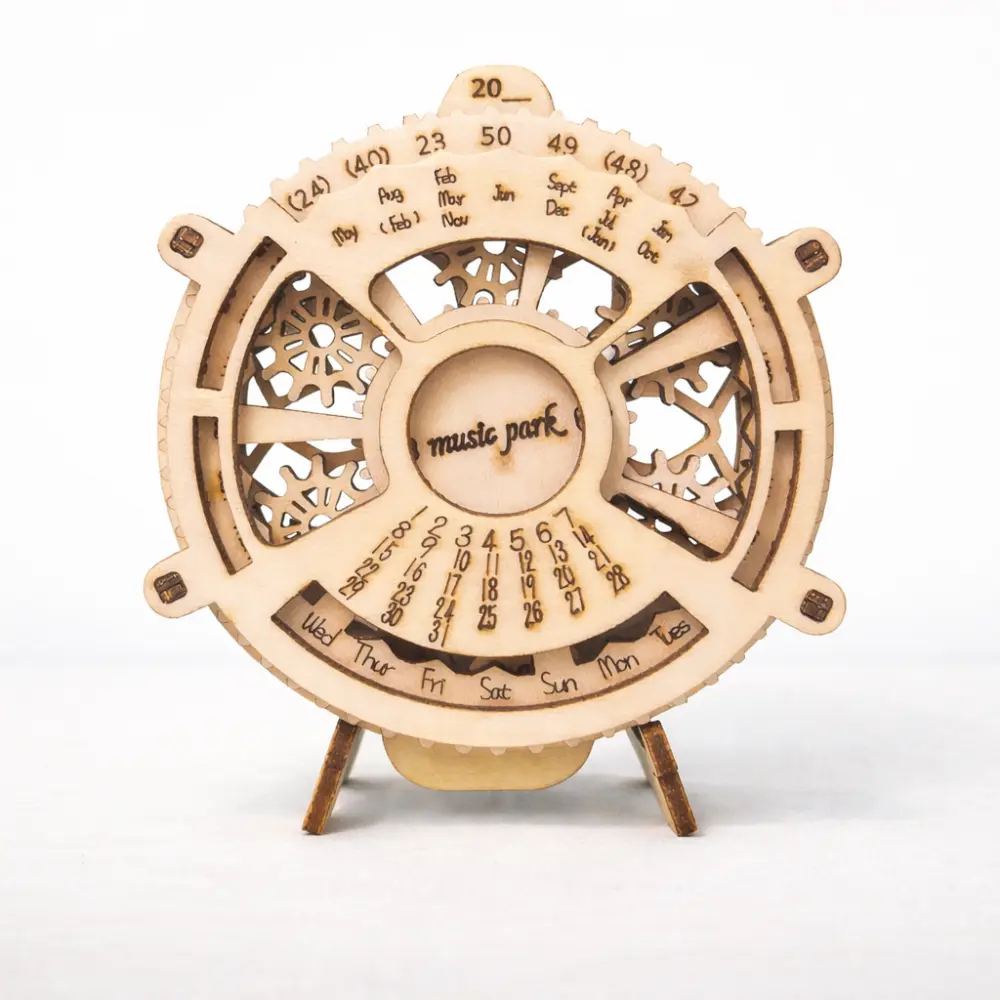
The third archetype is the sliding block calendar, sold in listings like the EXQUIDECA wooden block perpetual calendar. Instead of a fixed mechanism, you get a set of individual wooden cubes or tiles — one per number, weekday, and month — that you arrange on a tray or in a frame to spell out the current date. The “puzzle” here is rearrangement rather than mechanical solving: every morning you rebuild the date from pieces, and at the end of the month the blocks rotate back to position one. It is the most meditative of the three because there is no dial to spin and no object to assemble — just pieces to place. Pine is the dominant material in this category, and the wood tone is usually the most visible selling point.
A fair objection runs through all three. A r/IndustrialDesign comment on a perpetual desk calendar concept put it bluntly: a product cannot honestly use the word “perpetual” unless it automatically accounts for changing month lengths and leap years. None of the three archetypes above solves that — every ring-rotation organizer, every 3D mechanical kit, and every sliding block set still requires the user to remember that February ends on the 28th or 29th. The “perpetual” in the name refers to reusability across years, not to automatic date computation, and a buyer who cares about the distinction should treat the word as marketing shorthand.
The listing-page check, then, is this: read the product description and decide which of the three mechanisms — ring, gear, or block — the listing is actually describing, and whether that mechanism matches the kind of interaction the buyer wants from a “puzzle.”
02. DIY kit, multi-function organizer, or block calendar: how the three differ
The listing-page check from the previous section only works if the reader knows what the three mechanisms actually look like on a product page. A DIY kit, a multi-function organizer, and a block calendar all claim the perpetual calendar label, but they differ in wood, assembly time, and mechanism depth — and matching the mechanism to the kind of interaction the buyer wants is the rest of the decision.
The three archetypes side by side
A DIY kit, marketed as a “mechanical construction 3D model kit” by sellers like Gear Elevation, ships as flat wooden sheets and gear components that the buyer assembles into a working object. The Tea-Sip 3D Wooden Perpetual Calendar Puzzle at $39.99 sits squarely in this category. The wood is usually a light plywood or basswood chosen for laser-cut precision rather than grain beauty, and the moving parts — gears, dials, sliders — are the central feature, not the date. Once built, the mechanism is manually adjusted to create a perpetual calendar that works year after year. This archetype suits a buyer who treats the project as the gift — someone who wants the build, not just the finished object — and who can absorb a multi-hour assembly session without skipping steps. Skip this archetype if the recipient is impatient, or if the desk needs to be functional the day it arrives.
A multi-function organizer, exemplified by Joytree’s 6-in-1 combination of a perpetual calendar, clock, card holder, and pen stand, arrives fully assembled and is built around function stacking. The wood is the visible material — usually a stained or veneered hardwood chosen to match office furniture — and the perpetual calendar is one feature among many, not the central mechanism. The Tea-Sip Wooden Desk Organizer with Perpetual Calendar | Puzzle Pen Holder at $19.99 fits this profile most closely among the roster, with a ring-rotation mechanism the buyer aligns each morning. Buyers in this category want a tidy desk first and a date display second; the “puzzle” is the ring alignment at the start of the day, not a build process. Pick this archetype if the recipient is busy, wants storage, and only needs a few seconds of morning interaction.
A block calendar — the EXQUIDECA natural pine version on Amazon, or any sliding-block perpetual — drops the mechanism entirely. The user rotates wooden cubes or slides blocks to display the date, week, and month, then at the end of the month the pieces rotate back to position one. Natural pine is the dominant material here, and the wood tone is usually the most visible selling point. Assembly is zero, function count is the lowest of the three, and the experience is the most meditative. This archetype is the cheapest path to a “perpetual” label and the most likely to survive on a small desk — but it does the least to organize pens, cards, or a phone.
Decision rules
Pick the DIY kit if assembly is the point. Pick the multi-function organizer if the buyer wants a tidy desk with the calendar as one feature among several. Pick the block calendar if wood tone and a calm, low-fi date check matter more than storage. For a wider view of how the multi-function organizer sits alongside other desk-sized wooden puzzles, the wooden puzzle sets buyer’s framework lays out the decision space in more detail.
The check before buying any of them: read the listing’s mechanism description, not its marketing headline. If the description names rings, gears, or blocks specifically, the listing is being honest about what the user will actually do each morning. If it only says “perpetual calendar puzzle” without naming the mechanism, the buyer should ask which of the three it is.
03. Which version fits which buyer (and who should skip all of them)
Pick the version that matches how much assembly the buyer actually wants to do — not the version with the longest feature list. The right perpetual calendar wooden organizer is the one whose daily interaction matches the buyer’s tolerance for fiddling, building, or waiting.
That single decision rule separates the three archetypes. Everything below maps it to a specific buyer type, with a concrete check the reader can run on the listing page.
The ready-made multi-function organizer: for adults who want a tidy desk now
The Wooden Desk Organizer with Perpetual Calendar | Puzzle Pen Holder at $19.99 fits the buyer who already owns wooden desk objects and wants one piece that does several jobs at once. The user rotates the calendar rings each morning to land on the date — a five-second fidget-plus-date-check with no prior assembly, no learning curve, and no extra desk real estate. It’s the right answer for someone setting up a home office in an afternoon, not a hobbyist. The check: the listing should describe the rings by name and show the pen, card, and clock sections on the product page. If the listing hides the mechanism behind a stock photo, the rings may be decorative rather than functional.
Skip this version if the buyer wants a “real” mechanical puzzle — ring alignment is a fidget-plus-date-check, not a challenge with a solution to discover. The r/IndustrialDesign objection applies here: rotating rings to display the date is not the same as a calendar that automatically accounts for month-length and leap-year variation.
The DIY kit: for teens and adults who want the build to be the point
A DIY Wooden Perpetual Calendar Pen Holder Puzzle is the right fit for a buyer who treats assembly as the gift. The Gear Elevation product page explicitly names teens and adults as the target audience — someone who enjoys a weekend build, likes seeing gears, and wants a constructed object with visible joinery. The mechanism here is a genuine mechanical puzzle: rotating calendar components that the builder assembles into a working perpetual mechanism. Skip it if the buyer wants desk organization today — the build takes hours, and the finished object usually prioritizes the calendar and pen slots over broader desk storage. For a deeper read on what to expect during a DIY build, the phase-by-phase assembly guide walks through the steps in detail.
The block calendar: for the minimalist who wants wood and a calm date check
A natural pine block calendar with reusable date, week, and month pieces — EXQUIDECA-style — suits the buyer who cares about wood tone and a slow morning ritual more than storage. Assembly is zero. Skip it if the buyer needs to corral pens, cards, or a phone. The Etsy-cited quality concern applies here too: cheaper gold-lettered versions show poorly, and printed words may fade over time, so a buyer in this archetype should ask the seller for a close-up of the lettering before committing.
Who should skip all three
Anyone who actually needs a perpetual calendar that handles leap years and month-length changes automatically should skip all three. The r/IndustrialDesign comment is direct: unless the mechanism accounts for those variations on its own, “perpetual calendar” is marketing, not mechanics. If that’s a hard requirement, the buyer is looking at a different product category entirely — a true mechanical or quartz calendar with a built-in month-length and leap-year table, not a rotating-ring or block-format wooden desk object.
Practical next step
The check before clicking buy on any of the three: read the listing’s mechanism description, not the marketing headline. If the description names rings, gears, or sliding blocks specifically, the listing is being honest about what the user will actually do each morning. A buyer who wants a compact, reusable hand puzzle to keep on the same desk as their organizer can pair it with the Luban Cube Puzzle below as a screen-free companion.
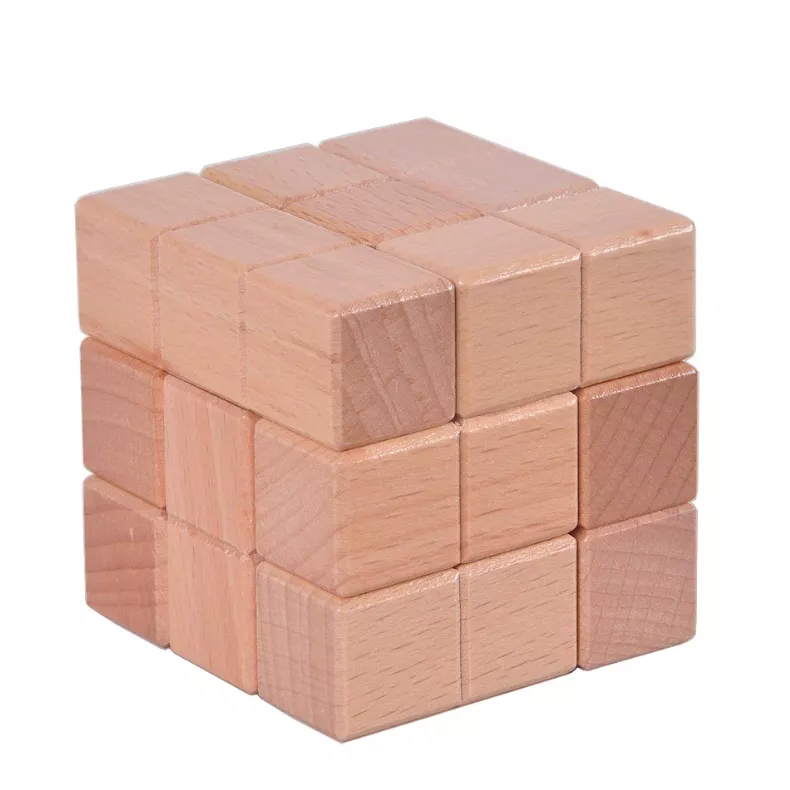
Luban Cube Puzzle — $21.99
04. Decision table: five listing-page checks to run before you buy
Run five observable checks on the listing before you commit — these are the filters that tell you which of the three archetypes (passive ring, DIY mechanical kit, sliding block) a seller is actually shipping, and whether the finish and the mechanism will hold up past the first month. A shopper who knows the framework above can now apply it: scroll past the marketing photos, read the specs, and match what you see against the table below.
| Check | Why it matters | What to verify |
|---|---|---|
| Gold-lettering durability | Cheaper prints show poorly out of the box and printed words can fade within weeks of desk use — a real complaint in verified buyer feedback. | Zoom into the listing photos and read the user-review section for mentions of fading or low contrast. If reviewers note that printed words were already fading on arrival, treat the listing as a short-life decorative object rather than a daily driver. |
| Wood material (named species) | “Wood” and “natural pine” are not interchangeable — a named species tells you the grain, weight, and finishing behavior. | Search the spec list and the description for a specific species. The EXQUIDECA block calendar, for example, lists natural pine; if a listing never names the wood, ask the seller directly before buying. |
| Mechanism type | The “puzzle” means three very different things: passive ring-rotation, active 3D mechanical movement, or sliding-block hybrid. | Read the mechanism description, not the title. Phrases like “manually rotate the rings” point to passive, “mechanical construction kit” points to active DIY, and “slide the wooden pieces” points to the block hybrid. Match to the archetype you actually want. |
| Assembly requirement | A pre-built organizer and a ROKR-style 3D mechanical kit sit at opposite ends of the same shelf — confusing them leads to a 4-hour build the buyer did not sign up for. | Open “what’s in the box” and look for a part count, an age rating, and whether tools are included. Listings aimed at teens and adults typically flag the build time and a recommended age; a missing age rating usually means pre-assembled. |
| Leap-year / month-length handling | A strict reading of “perpetual calendar” requires automatic month-length and leap-year handling; most desk versions sidestep that by asking you to rotate the rings yourself. | Search the description for “leap year,” “28 days,” or “automatically adjusts.” If the listing is silent on those terms, the user is the one keeping the calendar correct — which is fine, but it is the buyer’s job to know. |
The check after the table: if a listing passes all five — named wood, durable print, clear mechanism language, age-appropriate assembly note, and an honest answer on leap-year handling — you have enough information to buy without surprise.
Frequently Asked Questions
The five checks just covered the listing-page signals. The remaining questions usually come down to whether the puzzle is mechanical or decorative, whether the calendar survives years of use, and whether the build matches the recipient. Here are the direct answers, tied to what product pages and verified listings actually show.
Is the ‘puzzle’ on a wooden perpetual calendar organizer real, or just spinning rings?
It depends on the archetype you pick. On pre-built organizers like the $19.99 Wooden Desk Organizer with Perpetual Calendar on Tea-Sip, the puzzle is passive — you rotate the calendar rings to align today’s date, a fidget-plus-date-check rather than a real challenge. On a wooden 3D puzzle kit, the moving parts are genuine: gears, cams, and detents you build yourself. Sliding block hybrids sit between the two. The check: look for words like “mechanical,” “gears,” or “construction kit” in the listing description.
Does the wooden perpetual calendar actually work year after year?
The mechanism does — perpetual calendar rings have no teeth to wear down. What fades is the surface print, not the function. One Etsy UK review notes that “the gold lettering doesn’t show up very well, and some of the printed words were already fading” — a print-finish issue rather than a mechanism issue. The check: look for laser-etched or varnish-sealed numbers in the listing photos, since those don’t degrade the way low-temperature foil does.
How long does it take to assemble a DIY wooden calendar puzzle kit?
Build time depends on part count, not brand. Gear Elevation markets its perpetual calendar pen holder as a “mechanical construction 3D model kit for teens and adults” without a published hour count. The check: open the “what’s in the box” — a part count above 80 pieces and a 14+ age rating usually signals a multi-hour build, while sub-50-piece kits often finish in under an hour. Pre-assembled organizers sidestep the question entirely.
Why do some wooden perpetual calendars have fading lettering?
One Etsy UK buyer observed a cheaper listing where “the gold lettering doesn’t show up very well, and some of the printed words were already fading” — a print-quality complaint from verified user feedback. Print longevity varies by listing, and the listing photos are the most reliable signal: numbers that look crisp at close range tend to last longer than gold-foil lettering that sits on top of the wood grain. The check: zoom into the listing photos and look for ink sitting on top of the wood grain versus numbers that look burned into the surface.
What is the difference between a perpetual calendar pen holder and a regular desk calendar?
A regular desk calendar is a tear-off pad you replace each January. A perpetual calendar uses reusable blocks or rotating rings you adjust to show today’s date — you never throw the calendar away. The catch — as one r/IndustrialDesign commenter pointed out — is that most desk versions don’t automatically handle leap years or 28-day Februaries, so the user is the one keeping the date alignment correct. The check: search the description for “leap year” or “28 days” before assuming full automation.
Is the wood quality good on cheaper perpetual calendar pen holders?
It varies, and the listing photos are the only honest test. The EXQUIDECA Amazon listing calls out natural pine; Joytree’s multi-function organizer claims “premium wood” without specifying species. The check: zoom the listing photos to 100% and look at the end grain, the joint lines, and whether the print is crisp at the edges. Soft pine with clean laser-etched numbers will outlast hard-looking wood with flaking foil.
Next step
If the five listing-page checks pass and the archetype matches your situation, the $19.99 Wooden Desk Organizer with Perpetual Calendar on Tea-Sip is the right pick for adults who want a low-effort date fidget plus a desktop organizer. For the buyer who treats the DIY assembly as the whole point, the $39.99 3D Wooden Perpetual Calendar Puzzle from the same roster adds real mechanical movement at roughly double the price — same wood family, same calendar ring mechanism, real moving parts.
Where to Start
If the difficulty, mechanism, and use-case checks above match, start with Wooden Desk Organizer with Perpetual Calendar | Puzzle Pen Holder. Check the current product page for the specifications that matter to your choice.
Still comparing options? Use the matching Tea-Sip collection to compare the same decision criteria, rather than restarting the search from scratch.
Sources and verification
- Product details and current specifications: Tea-Sip product page
Last updated: August 2, 2026