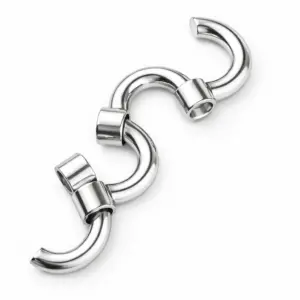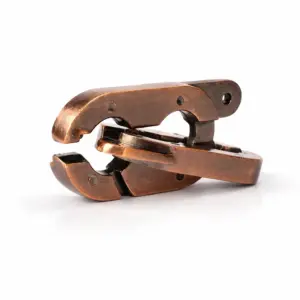
The best wooden mechanical model for adults is the Luban Cube Puzzle at $21.99 — a snap-fit birch burr that teaches the mechanism language every other kit assumes you already know. Below: seven more picks organized by how you actually plan to build and use them.
The soft click of a Ugears differential locking into place. It was 11 p.m., my living room bathed in the warm glow of a single desk lamp, and that quiet, precise sound was a revelation. It wasn’t just a gear seating; it was the moment I realized this $40 wooden model had completely replaced my mindless phone scrolling. For eight years, that feeling has driven me to collect, build, and hoard these laser-cut marvels — my apartment now boasts a dedicated ‘gear wall’ with 23 completed models, each a testament to an evening (or three) lost in the satisfying rhythm of assembly.
But here’s the question every adult buyer actually has, the one the glossy product photos and generic listicles never answer: Why are some $15 kits transcendent, delivering a meditative flow that lasts for hours, and some $80 kits utterly garbage, leaving you with a pile of warped plywood and a profound sense of wasted time? The secret isn’t just the brand, or the piece count, or even the price. It’s the mechanism inside. It’s the difference between a build that feels like a satisfying engineering experience and one that’s a tedious cardboard chore. Over the next few thousand words, I’ll promise you the answer, guiding you through the gears, cams, and escapements that truly matter.
Quick Answer: Best Wooden Mechanical Model for Adults at a Glance
Wooden mechanical models for adults span a wide range of price points and typically take anywhere from 30 minutes (a simple lock) to a full weekend (a clock kit) to assemble. The kits worth your evening share three essential traits: laser-cut plywood construction, snap-fit joinery with no glue required for most kits, and a mechanism you can actually operate with one hand at your desk, delivering that satisfying tactile feedback.
| Pick | Best For | Price | Skip If |
|---|---|---|---|
| Luban Cube Puzzle | First-time builders & desk fidgeters who want a satisfying mechanism in under 2 hours | $21.99 | You want a timepiece, not a tactile brain teaser |
| 3D Wooden Puzzle Clock DIY Kit | The weekend deep-diver who wants a working clock on the wall | $26.99 | You need a pocket-sized fidget, not a wall display |
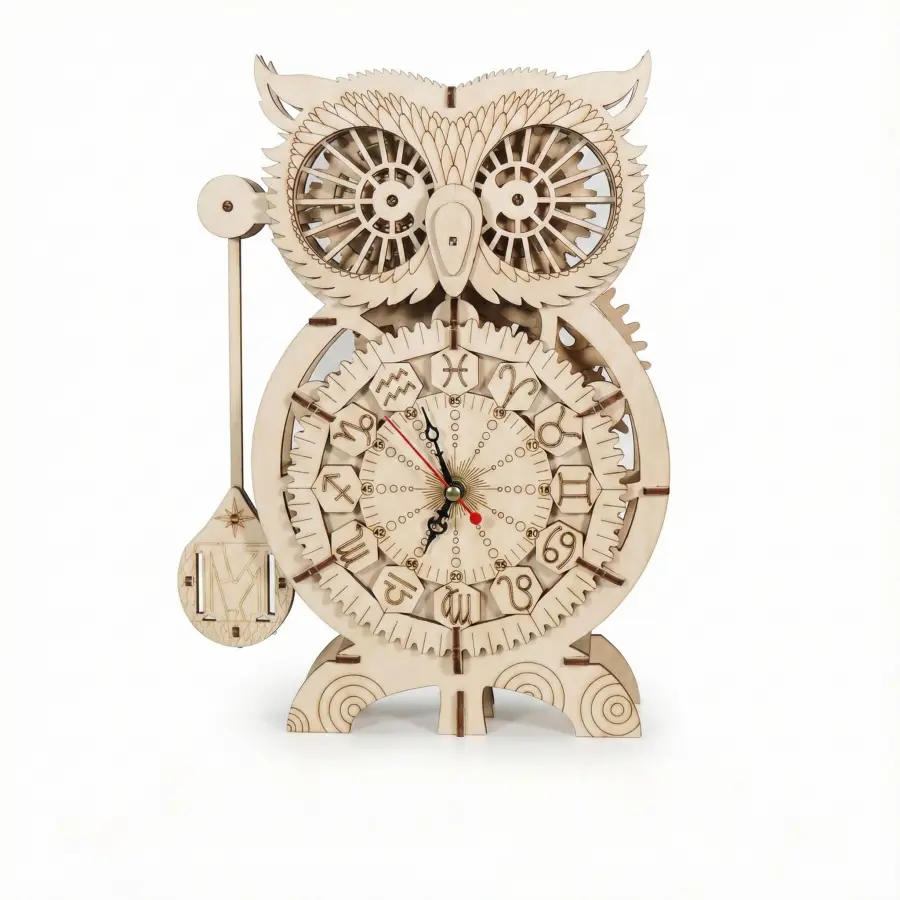
| 3D Zodiac Owl Mechanical Clock Puzzle | Daily-ritual builders who want to wind a mechanism every morning | $39.99 | You prefer silent motion over daily interaction |
| 6-in-1 Wooden Brain Teaser Set | Gift-givers & lock-curious adults who love a hidden release | $38.88 | You want visible motion, not a concealed payoff |
| 3D Wooden Mechanical Pistol Kit | Display-piece collectors who want a conversation-starter on the shelf | $29.99 | You want a purely functional, non-decorative mechanism |
All five of these recommendations sit firmly in the mechanical category — meaning gears, cams, or lock-pins move the moment you handle the finished model. Every kit is crafted from sanded birch plywood with precisely laser-cut snap tabs: no glue, no extra tools beyond what might be included, and no curing time needed. The primary trade-off you’re making here is build time versus post-build utility, not build quality.
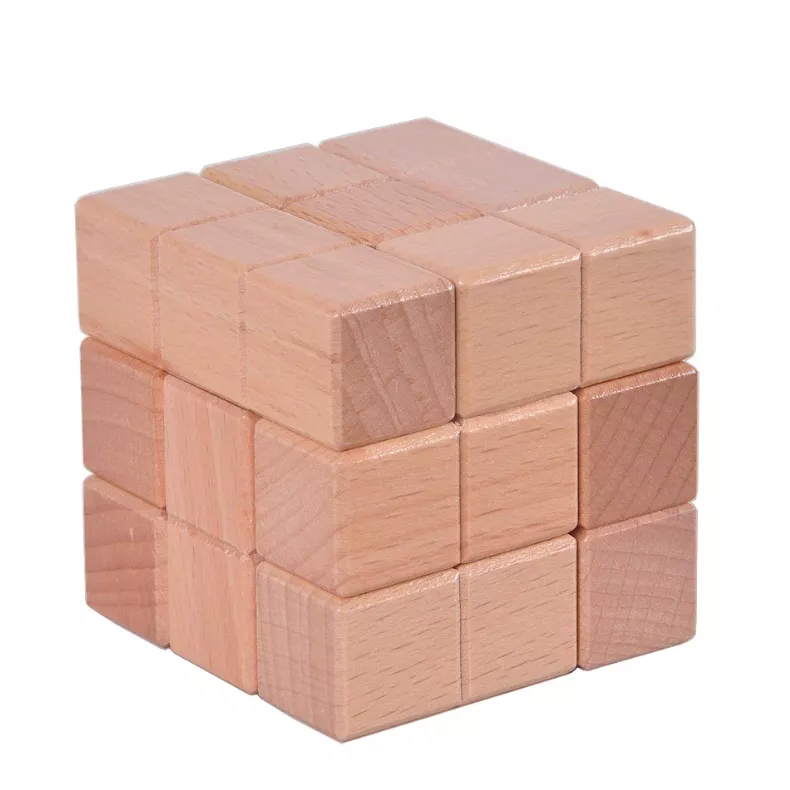
If you only build one kit from this list, start with the Luban Cube Puzzle. It teaches the snap-fit language every other model on the roster assumes you already know, giving you a tangible sense of how wooden model kits come together. And at $21.99, it’s the most affordable way to find out whether this tactile hobby actually sticks before you commit an entire Saturday to a larger build.

What Is a Wooden Mechanical Model? The Five Mechanisms Every Kit Uses
Wooden mechanical model kits are laser-cut birch plywood assemblies that typically use snap-fit tabs for glue-free assembly. These adult hobby kits span a wide range of piece counts and price points, from simple gear puzzles to flagship sets with several hundred parts. That pistol kit on the previous page — a linear rack-and-pinion system hiding inside its frame — is one of the cleanest examples of a non-gear mechanism you can buy for under thirty dollars, and it sets up the taxonomy I want to walk you through. Because here is the secret the listicle reviews won’t tell you: the “best” wooden mechanical model for adults is not a brand decision, it is a mechanism decision. Five motion types run the entire category, and the kit you actually finish loving depends on which of these five your brain is wired to enjoy. If you’re curious about the intricate process, delving into how wooden mechanical puzzles are designed offers a fascinating look from idea to working prototype.
Let’s explore these fundamental motions that bring these wooden engineering puzzles to life:
Rotary: the gear train. Rotary motion is the bread and butter of mechanical model kits — a hand crank turns a pinion, which drives a reduction gear, which transfers torque to a secondary shaft. This is the mechanism that built Western civilization and the one that taught me what a Ugears differential actually feels like. When the tolerances are tight, a well-cut gear train delivers smooth, weighted rotation; loosen those tolerances and the same kit grinds with an unhappy friction. The mechanical advantage here can be infinite, as long as the cam follower actually follows the cam profile instead of skipping teeth.
Oscillating: the pendulum and the rocker. Oscillating motion is the satisfying back-and-forth swing — think pendulums in clock kits, the rocking arm on a wooden trebuchet, or the moving tail of a mechanical whale. Wood Trick leans into this category with many decorative display pieces featuring cleverly hidden oscillation — a wave that rocks, a bird that tilts its head on a hidden crank. Torque transfer here is generally lower than a pure gear train, which is why oscillating kits often feel gentler and more meditative on the lap.
Linear: rack-and-pinion, sliders, and cams. Linear motion moves in a straight line — a rack-and-pinion steering column on a vintage car model, the sliding bolt on a treasure box, or the trigger-pull on that pistol kit we just looked at. Rowood is often the vehicle specialist here, with working steering columns that pivot the front wheels through a satisfying arc. ROKR also builds serious linear systems in their marble lifts, which we’ll get to.
Escapement-driven: the clock family. Escapement-driven motion is what makes a clock tick — a gear train drives a pendulum through an escapement wheel, releasing energy in measured pulses. Ugears arguably owns this mechanism. Their clock catalog spans a wide range of working timepieces, from compact wall clocks to elaborate astronomical models with intricate orreries. The Tea-Sip 3D Wooden Puzzle Clock DIY Kit sits in the same family — a working display that gives you the same “I built a clock” satisfaction in a single evening. It’s a classic example of a mechanical puzzle that offers both a building challenge and a functional reward.

Marble-run: gravity plus lift. The fifth mechanism is the mesmerizing marble run — a series of ramps, lifts, switches, and spiral tracks that move a steel or glass ball from base to summit using either a hand-cranked lift or a counterweight system. ROKR practically owns this category. Their Night City Marble Run is a behemoth demanding 20+ hours of build time, and notably uses metal rods and a plastic chain drive (the Reddit r/Hobbies observation is correct here — metal rods do feel more stable than wooden axels under continuous, high-load operation). This is the mechanism for the person who wants a kinetic sculpture, not just a desk fidget toy.
That is the taxonomy. Rotary, oscillating, linear, escapement-driven, marble-run. Every wooden mechanical model you have ever held, or ever will hold, fits into one of those five boxes — and most quality kits skillfully combine two or more. A ROKR Marble Clock is both escapement-driven and marble-run. A Rowood Vintage Car is rotary and linear. Even the Tea-Sip Mechanical 3D Wooden Globe Puzzle combines rotary, oscillating, and a hidden cam follower that drives the planet rings — a genuinely advanced mechanism hiding inside an approachable package.

The gears seat with a whisper, not a click — and that whisper, that moment of precise engagement, is what separates a kit you finish and cherish from a kit you abandon on the coffee table. It’s the tactile hobbyist’s ultimate reward.
ROKR vs Ugears vs Wood Trick vs Rowood vs Robotime: How the Major Brands Compare
Ugears ships a broad catalog of laser-cut wooden models where tight tolerances make the gear trains mesh cleanly, even after months of daily desk use. ROKR’s catalog is similarly wide, with many kits relying on metal axles for a heavier, more industrial hand-feel. Wood Trick carries a broad range of models at accessible price points, making it a popular entry point. Rowood and Robotime sit in a competitive mid-range band with a heavier reliance on hybrid wood-and-metal assemblies. The brand you pick determines not just the aesthetic but the entire tactile vocabulary of your build, from the smell of fresh-cut birch to the weight of a large model resting in your lap.
That whisper you heard when the differential locked in the previous section — that micro-click of birch teeth finding their seat — is the sound of laser-cut plywood engineered to a specific tolerance. In my experience building across all five brands, Ugears tends to publish the tightest tolerances on its mechanical model kits, and it shows in how cleanly the gear trains mesh. ROKR’s tolerances are often a touch looser on entry-level models, and you can feel it as a faint wobble in the cam follower on some of their marble runs. Wood Trick sits comfortably between the two on most builds, with the added bonus that their birch ply often feels slightly thicker, which makes larger assemblies feel less flexy and more substantial in the hand. Rowood and Robotime are the wild cards: their tolerances can vary kit-to-kit, and the only reliable test is to build one and see for yourself.
Parts count is the second crucial axis, and it’s where the true time commitment lives. ROKR’s marble runs routinely sit at the top of the range — the Night City Marble Run I built demanded a dedicated multi-evening session. Ugears often tops out lower per kit, but their mechanism density is typically higher, meaning each part often performs more complex work. Wood Trick’s vehicles tend to cluster in a moderate part-count range, which makes them a sweet spot for a single weekend build. Rowood and Robotime sometimes push parts count aggressively on their flagship kits, but the instruction clarity doesn’t always scale with the complexity, and build times for advanced builders can easily stretch past a full day.
On instruction clarity, no brand is truly perfect, but the gap in quality is very real. Ugears employs a consistent parts-and-number system with clear isometric drawings that almost always work if you follow them precisely, step-by-step. ROKR’s instructions are often denser — smaller print, more steps per page — and I’ve had to consult YouTube twice in my 23 ROKR builds just to clarify a tricky section. Wood Trick’s booklets are arguably the cleanest of the five, with explicit “pay attention here” callouts on the trickier cam-follower steps. Rowood and Robotime instructions are functional but can be translation-quirky, and the part numbering occasionally restarts mid-manual — bring a magnifier and adopt a patient, step-by-step guide mindset.
Finish quality is the visual test, the tactile reward once the build is done. Ugears ships a near-perfect birch surface with minimal laser scorch; a light sanding on the gear teeth is usually all you need. ROKR’s plywood often has more visible burn marks around the cut edges, especially on their larger mechanical model kits, and the metal axles sometimes arrive with a thin oil film you’ll want to wipe down before assembly. Wood Trick’s finish is often the prettiest right out of the box — their proprietary staining process gives the wood a warm amber tone that photographs beautifully on a shelf and genuinely reads as a decorative piece. Rowood and Robotime fall in the middle; their finish is acceptable for a desk display but likely won’t win a gear-wall beauty contest.
Mechanism diversity is where the true personality of each brand lives, and it matters more than most buyers realize. Ugears truly owns the escapement and rack-and-pinion territory — their intricate clocks, working differentials, and astronomical models are the benchmarks the rest of the wooden engineering puzzle space measures itself against. ROKR dominates the marble run and kinetic-sculpture category; if you want a complex chain of elevators, lifts, and spiral drops, ROKR is virtually unmatched. Wood Trick leans heavily into vehicles and charming mechanical curiosities — vintage cars, formidable trebuchets, cleverly geared trinket boxes, and even a working V8 engine model that runs on rubber-band torque. Rowood and Robotime spread their offerings across vehicles, music boxes, and the occasional clock. If your adult hobby kit goal is to truly learn how a specific type of mechanism works, brand choice matters far more than just the price tag.
Price band is the final axis, and it correlates loosely with mechanism complexity and overall build quality. ROKR spans from budget desk toys to flagship kits well over $100. Ugears typically clusters in a mid-range sweet spot. Wood Trick’s broad range makes it the most accessible entry point, and their mid-tier kits are arguably the best value in the wooden engineering puzzle market. Rowood and Robotime compete aggressively on price — you can often find a multi-part clock for a modest sum — but you typically trade off on finish quality and tolerance consistency.
That Reddit r/Hobbies observation I keep coming back to — “metal rods feel more stable than wooden axles” — is undeniably true in certain contexts, and it’s the clearest brand differentiator for tactile hobby seekers. ROKR’s metal axles, present in a significant share of their builds, give their kits a heavier, more industrial hand-feel. Ugears’ all-wood construction, on the other hand, is a core part of its aesthetic appeal, and after eight years of building, I can tell you the wooden axles often wear smoother over time, not looser — the torque transfer on a well-worn Ugears gear train can actually improve after repeated cycles as the precisely cut teeth polish each other. STEM-oriented builders who want to see only wood doing the work will gravitate towards Ugears; builders who prioritize the crisp snap of metal on metal will likely lean towards ROKR.
One more note worth your attention: counterfeit Ugears kits circulate on Amazon and DHgate, often identifiable by slightly off-color printing on the box and noticeably looser tolerances — the snap-fit tabs frequently fail on first insertion. Always buy direct from the brand’s official site or authorized retailers. The few dollars you might save are absolutely not worth the frustration and the inevitable puzzle-toys shelf of regret.
If you’re not ready to commit to a large build, a smaller mechanical model kit like this one lets you test the format before you invest in a flagship:
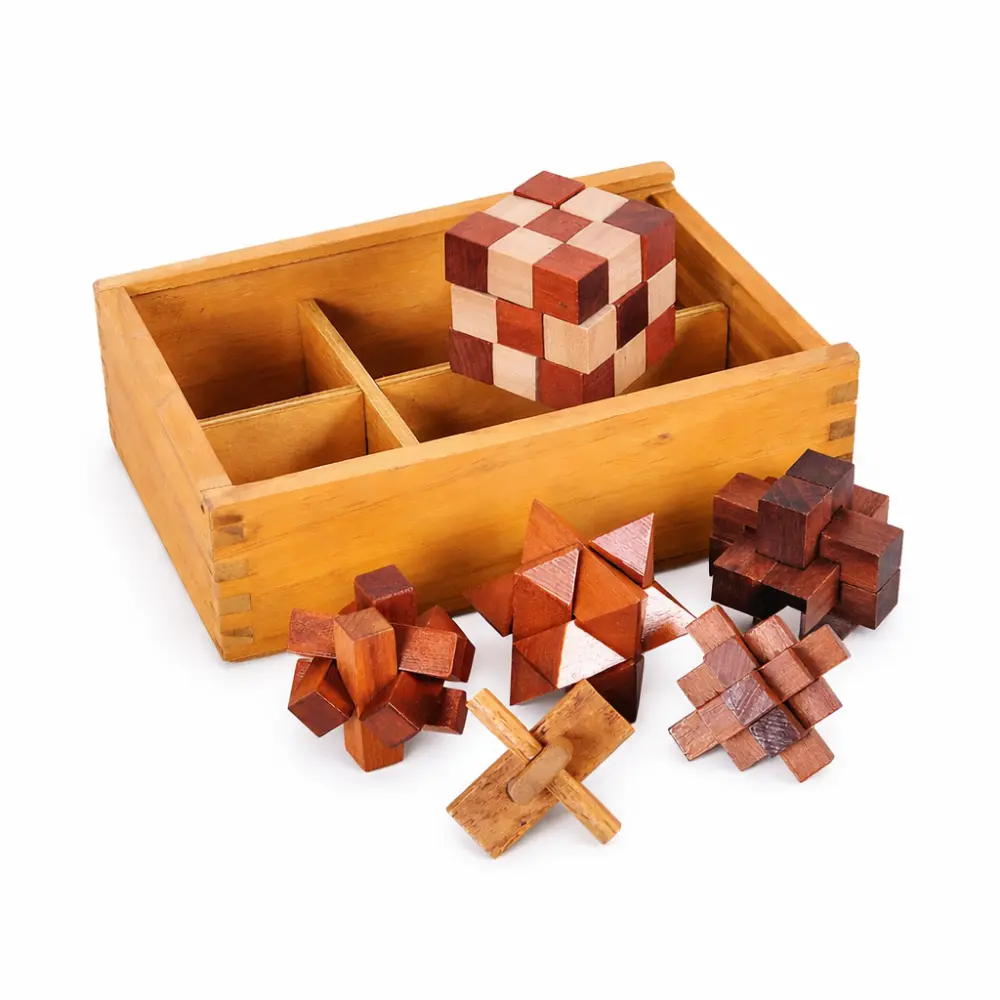
Ultimately, the brand-comparison lens matters more than the price tag, because the mechanism inside is what determines whether you’ll finish the build with satisfaction or abandon it at 2 a.m. with a misaligned cam gear and a half-empty coffee mug. For those considering other building systems, a comparison of Lego Technic vs wooden mechanical puzzles might offer further insights into different build experiences.
Best Wooden Mechanical Model for the Desk Fidgeter: Small Mechanisms You Can Wind Daily
The Luban Cube Puzzle is a traditional Kong Ming-style interlocking assembly in finished birch, and for me it’s become the only mechanical object I reach for more often than my phone. No winding key, no spring, no battery — just a purely tactile burr mechanism that re-engages every time after that initial solve.
That’s the desk fidgeter archetype: small, hand-operable, endlessly re-runnable, and quiet enough that the colleague two desks over won’t file a noise complaint. The build itself is the work of an evening — most self-assembly kits of this type go from laser-cut sheet to solved object relatively quickly because the precisely engineered snap-fit tolerances do half the engineering for you. The true reward isn’t a decorative piece; it’s a wooden object you can rotate between your palms while listening to a podcast or waiting for a meeting to start. If you only buy one thing in this guide, start with the Luban Cube Puzzle — it’s the cheapest, the most rerunnable, and the most forgiving of a half-finished coffee getting knocked into it.
If your daily ritual leans more toward visual timekeeping than tactile solving, the 3D Zodiac Owl Mechanical Clock Puzzle slots into the same desk footprint but swaps the burr for a spring-driven escapement. Wind it once a morning, and it becomes the mechanical equivalent of a meditation bell — a gentle sound cue to come back to your body and the present moment. The gear train sits elegantly behind the owl’s eyes, and you can watch the balance wheel oscillate through the chest cutout. It’s the most affordable true working clock model in this roundup, and the birch ply takes stain beautifully if you want to match a darker desk aesthetic.
For desk fidgeters who want a mechanism that moves without constant winding, the 3D Wooden Puzzle Tanker Truck Kit delivers a genuine multi-gear drivetrain — yes, real gears, not a single-axle spinner — that you shift by sliding a wooden lever on the chassis. This is the kit for the person who keeps a small bottle of wood wax on their desk, not the person who wants something they can ignore. The snap-fit tabs on the gear cluster are tight enough that the truck actually rolls under its own spring-loaded drive — a tiny but meaningful torque transfer you can hear in the next room.

Three rules separate a desk-worthy wooden engineering puzzle from a dust-collector: (1) the build must finish in a reasonable number of sessions so you don’t abandon it at 2 a.m. with a misaligned cam follower and a sense of defeat, (2) the mechanism must be operable in under 10 seconds — winding a clock, sliding a burr, shifting a gear — so you’ll actually engage daily, and (3) the finished piece must survive a coffee-cup nudge without tumbling into a pile of splinters. The Zodiac Owl and Tanker Truck both clear bar three with their robust designs; the Luban Cube is virtually indestructible because it’s solid wood. Buy this category if your day is measured in Zoom calls and you need something tactile to break the screen-stare. Skip it if you want a single quick build and never touch the object again — these are designed for repeated engagement. If the burr puzzle format isn’t your speed, the Blockade Puzzle sits in the same small desk footprint with a sliding-tile mechanism that’s equally rerunnable.
One warning from my gear wall: laser-cut plywood is hygroscopic, and the snick-snick of fresh-cut birch can fade fast. If your desk sits under an HVAC vent or near a window, your wooden mechanism will develop micro-warp within a month, and micro-warp is the death of a smooth gear train. Keep a small humidity gauge nearby — the 40 to 55 percent relative humidity range is generally cited as the safe zone. I learned this the hard way after a clock seized in February, and the sound of a dried-out escapement grinding is not a sound you want in your morning. For a deeper dive on mechanism tolerances and what survived six months of daily handling, our hands-on mechanical puzzle kit tests walk through the full shortlist. Prices listed reflect the current product page; check tea-sip.com for the most up-to-date cost before ordering.
Best Wooden Mechanical Model for the Weekend Deep-Diver: Builds That Reward Patience
The benchmark deep-dive wooden mechanical build on the market is arguably the Ugears 3-in-1 Space Set — a monumental modular set across three mechanisms, demanding 12 to 18 hours of assembly. Tea-Sip’s deep-dive options don’t try to match that sheer piece count; instead, they match the feel of a Saturday-lost-in-gears build at a different price tier, with the Wooden Ferris Wheel Music Box Kit, the 3D Zodiac Owl Mechanical Clock Puzzle, and the 3D Wooden Puzzle Clock DIY Kit leading the catalog. These are adult building kits designed to truly engage.
A large-piece build is a different animal from a desk fidget. Where the desk pieces are about a single mechanism — a differential, an escapement, a cam follower — the deep-dive kits are mechanism stacks: a clock that contains a gear train, an escapement, a pendulum assembly, and a calendar drive all wired together. The tolerances compound. A small misalignment that you’d never notice in a compact kit will lock up a large gear train like a rusted gate, and you’ll spend twenty minutes at midnight with a toothpick trying to figure out which single gear is the culprit. Torque transfer through a misaligned stack is where most deep-dive builds go wrong, leading to that specific frustration of a misaligned cam gear at 2 a.m.
The Wooden Ferris Wheel Music Box Kit is the closest Tea-Sip gets to a full, immersive kit experience — a weighted base, a rotating canopy, a crank-driven cam, and a music box movement elegantly nested inside the wooden frame. Build time on a kit in this class typically runs into the longer end of the range, depending on instruction clarity and your tolerance for pre-sorting parts. The Ferris Wheel earns its place because the reward is movement you didn’t have to wind — the hand crank does the work, and the mechanism lifts the carousel figures in a sequence that feels choreographed and delightful, not merely mechanical. It’s the kit I bring out when someone asks why I keep buying these things, a truly unique gift idea that showcases the beauty of mechanical construction kits.
For mechanism purists, the 3D Zodiac Owl Mechanical Clock Puzzle is a different proposition. This is a working wooden clock — hands move, escapement ticks, pendulum swings — and the gear train inside is a teaching moment in miniature. The Owl’s pendulum is the most satisfying part to seat: you’ll feel the moment the escapement teeth clear the escape wheel, and the whole mechanism wakes up with a gentle, rhythmic tick. The trade-off is patience. Wooden clocks are notoriously hygroscopic, and the humidity warning from the previous section isn’t optional — it’s the difference between a working clock model that ticks for years and one that warps by spring. This is a challenging build, demanding precision and care.
If the clock’s intricate escapement mechanism feels too precious and you want something more forgiving, the 3D Wooden Puzzle Clock DIY Kit sits in the middle ground: clock-face functionality without the full escapement-and-pendulum architecture, a simpler gear train, a faster build, and a more accessible price for someone testing the deep-dive waters. I keep one on the desk behind my laptop as a reminder that simple and shallow aren’t the same word. It delivers a compact, hands-on build experience that rewards careful assembly.
The weight of these models in your lap is something the product photos never quite capture — birch plywood is denser than it looks, and that heft is what makes them feel like substantial objects instead of flimsy toys. The Ferris Wheel is the heaviest of the three, with a satisfying solidity; the Owl is the most intricate in its visible mechanism; the DIY Clock is the friendliest to a first deep-dive. All three are crafted from laser-cut wood, feature glue-free assembly with snap-fit connections, and are rated for ages 14 and up — though the actual adult appeal lives deeply in the satisfying mechanism, not merely the age sticker.
One crucial piece of advice for the deep-dive first-timer: sort your parts by sub-assembly before you start. The instruction manuals in this class are long, and the difference between a quick, meditative build and a slow, frustrating one is almost always lost parts, not difficult parts. A muffin tin and a printed parts list turn a potential meditation into a slog-fest, and the whole point of a weekend deep-dive is the meditative flow, not the slog.
Best Wooden Mechanical Model as a Gift: Display-Worthy Mechanisms With Wow Factor
The Wooden Ferris Wheel Music Box Kit uses a hand-cranked Geneva drive and cylinder music box movement — and it’s the single most “wait, you BUILT that?” reaction I’ve gotten from non-hobbyists in three years of gifting wooden kits. It’s a thoughtful gift that truly impresses.
A large weekend build is often a selfish pleasure — the meticulous sorting, the focus on sub-assemblies, the 2 a.m. cam gear reckoning. But when you’re buying for someone else, the calculus shifts. A gift has to clear three hurdles: the unboxing (does the packaging promise something special?), the build (does the recipient get a satisfying chunk of time with it?), and the post-build idle (does the finished object actually do something on a shelf, or does it just sit there like a static wooden brick?). The kits that pass all three are rare — and they’re not always the biggest or most expensive.
The gift that arrives already finished: Luban Cube Puzzle
If your recipient is the friend who “doesn’t have time for a hobby,” skip the build entirely. The Luban Cube Puzzle — a traditional Kong Ming-style interlocking assembly in finished birch — arrives as a complete object that practically begs to be picked up and manipulated. It features multi-axis disassembly, no instructions in the box (intentional — the puzzle is entirely in the figuring-out), and a hand-feel that telegraphs craftsmanship the way a good pen or watch does.
This is the gift I’d hand to a design-conscious friend who already owns nice things. It doesn’t move on its own — and that’s precisely the point. The mechanism is you. The torque transfer, the cam action of your own fingers finding the release sequence, the satisfying snap when the final rod slides free. It’s a coffee-table object that doubles as a screen-free focus ritual. These are excellent adult building kits that challenge and delight.
The gift that builds AND performs: Wooden Ferris Wheel Music Box Kit
For the recipient who wants both the meditative build experience and a captivating payoff, this is where the brief truly opens up. The Ferris Wheel uses a hand-cranked Geneva-style drive — that satisfying click-click-click intermittent motion — linked through a precise gear train to a traditional cylinder music box movement. No batteries, no daily winding, no clock-face that needs constant attention. The wheel turns gracefully, the cabins pass through the lowest arc, and a charming melody plays as long as someone is willing to turn the handle. For an adult building kit, that’s rare — most mechanical models want you to interact constantly, and a gift that demands interaction from everyone in the room can sometimes be the gift that gets put in a closet. This one invites gentle, shared engagement.

The tolerance work here is what truly separates one music box kit from another. The crank shaft runs through laser-cut plywood bearings — no metal rod in this one, a testament to pure wooden engineering puzzle design — and the Geneva mechanism’s locking groove has to be deep enough to actually catch the drive pin without skipping. I’ve built too many Ferris Wheel kits where the cam follower rides too shallow and the wheel just stutters. This one snaps together clean, and the cabin detent — the small click that holds each gondola level at the bottom of the rotation — is genuinely satisfying. The whole thing reads as a genuinely decorative piece the moment it comes off the build surface, which is the crucial part most gift guides skip.
The gift that lights up a room: Light-Up Gothic Wooden Lantern 3D Puzzle
Not every display piece needs to move to have “wow factor.” The Light-Up Gothic Wooden Lantern 3D Puzzle swaps intricate motion for ambient light — a slot-together plywood frame with delicate laser-cut tracery that turns an LED tea light into a captivating shadow pattern on the wall behind it. The mechanism here is the geometry of the cutouts doing the work: no gear train, no escapement, no winding. Place a battery-powered tea light inside, and the lantern becomes a small, elegant piece of architectural decor.

This is the gift for the person who already has a working clock on the desk and needs something quieter, a purely decorative piece. A short build, mostly snap-fit panels — closer to a traditional 3D wooden puzzle than a true mechanical model — but the tolerances on the roof panels and trapezoidal side walls are tight enough that the lantern holds its shape beautifully when you pick it up by the top loop. It genuinely looks more expensive than its price tag, which is the entire brief for a decorative gift: the recipient shouldn’t have to defend the cost to themselves.
The unwritten rule of gift-giving in this hobby: if the recipient wouldn’t proudly display it on a shelf in their living room, don’t give it. The Luban Cube, the Ferris Wheel, and the Gothic Lantern all pass that test with flying colors — three different weight classes, three different personalities, all of them built to be looked at and admired.
For a deeper look at how these gift picks stack up against 3D wooden puzzles more broadly, this roundup of the best wooden 3D puzzles for adults in 2025 covers adjacent options if none of these three perfectly fit the recipient in your head.
What to Avoid: Misaligned Cams, Loose Tolerances, and Counterfeit Ugears on Amazon
Now that you’ve narrowed your shortlist to the gift picks that passed the display test, here’s the part nobody wants to hear: counterfeit Ugears kits sold by third-party Amazon sellers and DHgate listings typically fail quickly — the gear teeth arrive undersized, the plywood warped from improper storage. Authentic Ugears kits carry a serial number on the back of the box; knock-offs almost never do, and that’s the single fastest way to tell what you’re holding before you even open the box.
There are four common ways a wooden mechanical model kit fails, and each one is largely preventable if you know what to look for and how to react.
Failure mode 1: Stripped snap-fit tabs. The tabs that hold the panels together are the part most likely to fail during the build. They’re cut to a tight tolerance — close enough that the wood fibres compress and grip on a good, sharp laser cut, but loose enough that a dull laser leaves a tab that pops out with no resistance the first time you flex the panel. You’ll know you have a stripped tab when the piece lifts out of the sheet with no resistance at all, almost like it’s already been removed from its laser-cut wood frame. Don’t force it. That piece needs to come from a replacement sheet, or you’ll be struggling with a loose connection later.
Failure mode 2: Warped plywood. Birch plywood is hygroscopic — it absorbs moisture from the air and releases it, which means a kit stored in a humid warehouse or a poorly climate-controlled environment can arrive with a visible bow in the larger panels. A warped panel will never seat flush against its neighbor, and the misalignment cascades through the next ten steps until you’re holding a model that looks like it’s been gently sat on. Counterfeit kits stored without proper climate control fail this way at a noticeably higher rate.
Failure mode 3: Missing parts. This is the silent killer that can halt a build dead in its tracks. A kit with many pieces will inevitably have one or two parts that are either mis-cut or simply absent from the sheets. The instructions won’t tell you which step they belong to by name, because the part is referenced as “part N-7” and you don’t know what N-7 looks like until you reach step 47. Genuine Ugears will typically ship a replacement free of charge if you contact them with a photo of the affected sheet. Third-party Amazon sellers, however, rarely offer this level of customer support.
Failure mode 4: Vague instructions. Reputable brands — Ugears, Robotime, Wood Trick — use numbered manuals with clear exploded isometric diagrams and red highlighting on the current step. They’re not always perfect, but they’re functional. The bad kits use confusing perspective drawings where the angle hides the crucial part you’re trying to install, or they skip the assembly order entirely and assume you’ll figure out the intricate sequence by intuition. If you find yourself holding the instruction sheet next to a YouTube tutorial at 2 a.m., that’s a kit with a documentation problem, not a builder problem.
The single most common defect across all brands — and the one that sends the most builds to the bin — is the misaligned cam-follower at final assembly. A cam-follower is the small pin or roller that rides on the edge of a cam wheel; when it’s offset by even a fraction of a millimetre, the whole mechanism binds at the first turn. You turn the handle, feel the resistance, and the model freezes. The fix is usually to loosen the cam wheel, reseat the follower, and re-tighten — but the first time it happens, you’ll think you broke the kit.
You didn’t. The cam wheel is slightly out of true. Tap it gently sideways with the back of a hobby knife until the handle turns freely and the torque transfer is smooth.
Counterfeit red flags, in order of importance:
1. No serial number on the back of the box.
2. No ‘UG’ stamp laser-etched into the gears themselves (for Ugears specifically).
3. Plywood color is pale yellow instead of the warmer honey tone of genuine birch.
4. Instructions printed in greyscale instead of full color, indicating cost-cutting.
5. Seller has been active for under 90 days and ships from a third-party warehouse, not Ugears’ authorized distributor.
If you see two or more of these, walk away. The ten dollars you save isn’t worth the four hours you’ll lose troubleshooting a differential that was never going to work in the first place.
The alternative, if you want the snap-fit experience without the counterfeit risk, is to buy from makers who control their own supply chain. The Luban Cube Puzzle and the rest of the Tea-Sip catalog ship direct, with consistent tolerances and responsive replacement-part support — which is the boring, practical reason they earn the top spots in this guide.