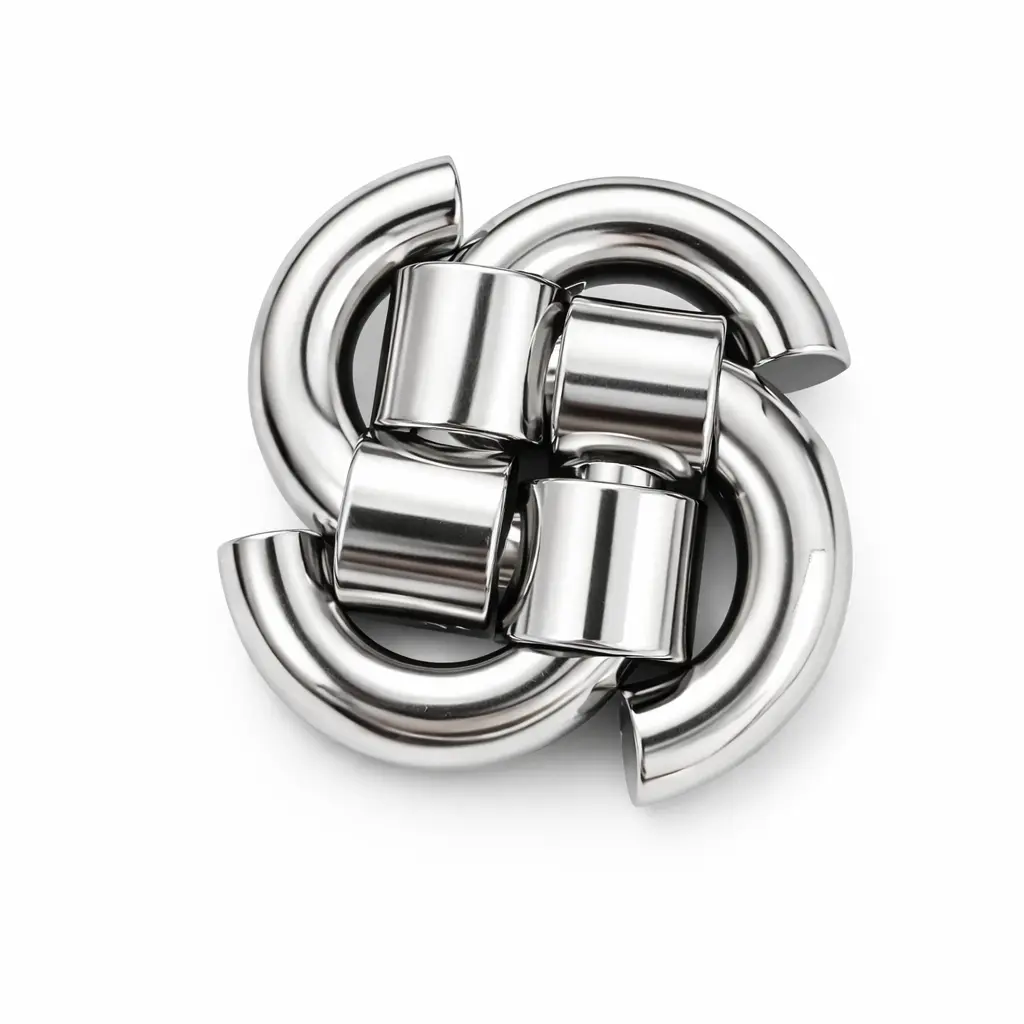
I spent 45 minutes on my first attempt to reassemble this puzzle. Not because the mechanism is complicated — four identical cast metal pieces, each shaped like a C-curve with cylindrical ends — but because every instinct I had about how interlocking puzzles work turned out to be wrong.
The Cast Galaxy is a spatial reasoning puzzle disguised as a simple assembly challenge. Four identical silver-toned metal arcs that, when correctly interlocked, form a compact knot shape reminiscent of a four-leaf clover crossed with a Celtic design. Taking it apart takes seconds. Putting it back together can take anywhere from five minutes to five days, depending entirely on whether you can override a very specific mental habit.
That habit — linking pieces sequentially, one after another like chain links — is exactly what this puzzle punishes. And that’s what makes it worth every one of the 88 seconds you’ll spend watching a solution video in confused disbelief afterward.
What You’re Actually Holding
Each of the four pieces is identical. That alone sets this puzzle apart from most cast metal brain teasers, where different components play different roles. Here, every piece is a mirror of the others: a curved metal arc roughly the shape of a letter C, with a short cylindrical post at each end. The cylinders are cut at an angle — a diagonal slice that creates a flat mating surface when two posts are pressed together correctly.
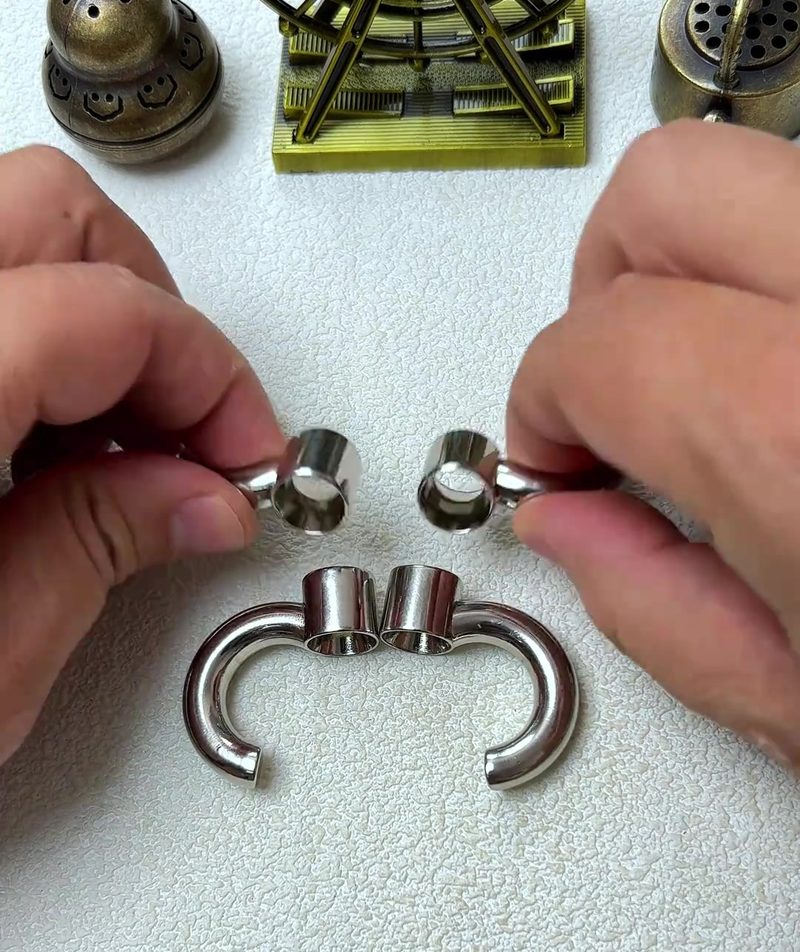
The metal has real weight to it. Not heavy enough to feel like a paperweight, but dense enough that you register it as a precision-machined object rather than a toy. The chrome-like silver finish is smooth without being slippery, and the “Galaxy” brand name is stamped into the barrel of each piece — small enough to be unobtrusive, but visible enough to confirm that yes, all four pieces really are the same.
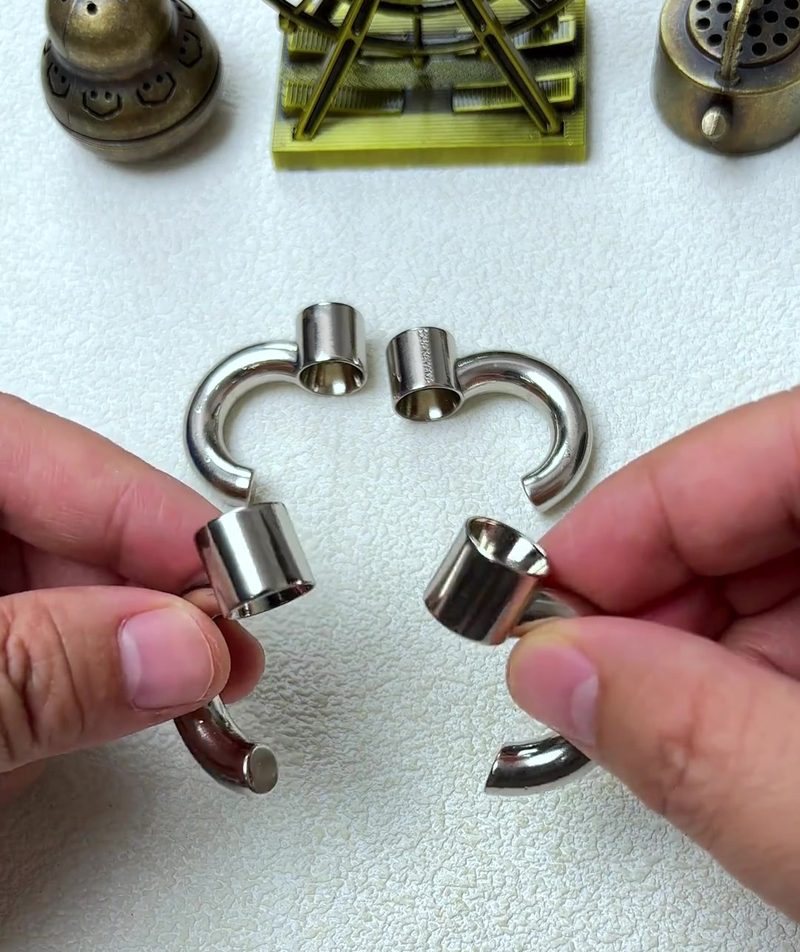
If you’ve spent time exploring cast metal brain teasers of various types, you’ll recognize the weight distribution immediately. There’s a satisfying centripetal quality when you hold two pieces together and rotate them — the mass shifts in your hand like a gyroscope finding its axis.
The Trap Everyone Falls Into
Here’s what happens to almost every person who picks up this puzzle for the first time. They see four C-shaped pieces. They notice the cylinders at the ends. They think: connect one piece to the next, and the next to the next, forming a chain or ring.
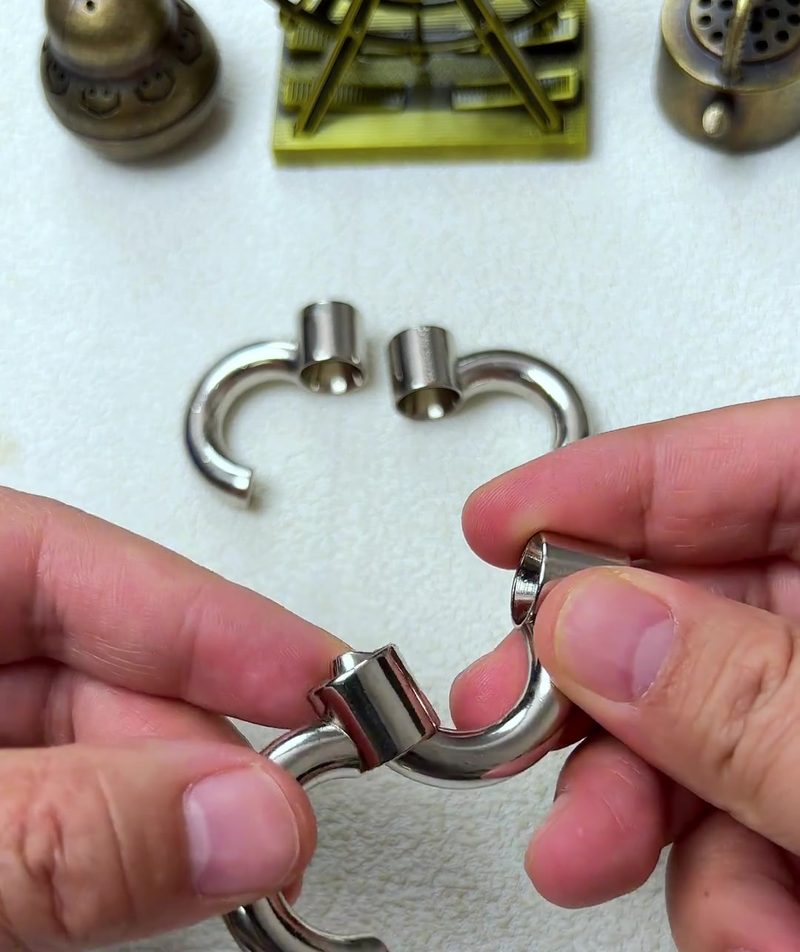
This sequential linking strategy feels completely logical. You take Piece A, hook Piece B through it, thread Piece C through B, and then try to close the loop with Piece D. Three pieces go together without much resistance. The curve of each arc slides into the neighboring arc’s gap. You can see the pattern forming. It looks like it’s going to work.
Then you try to fit the fourth piece, and you discover the fundamental problem.
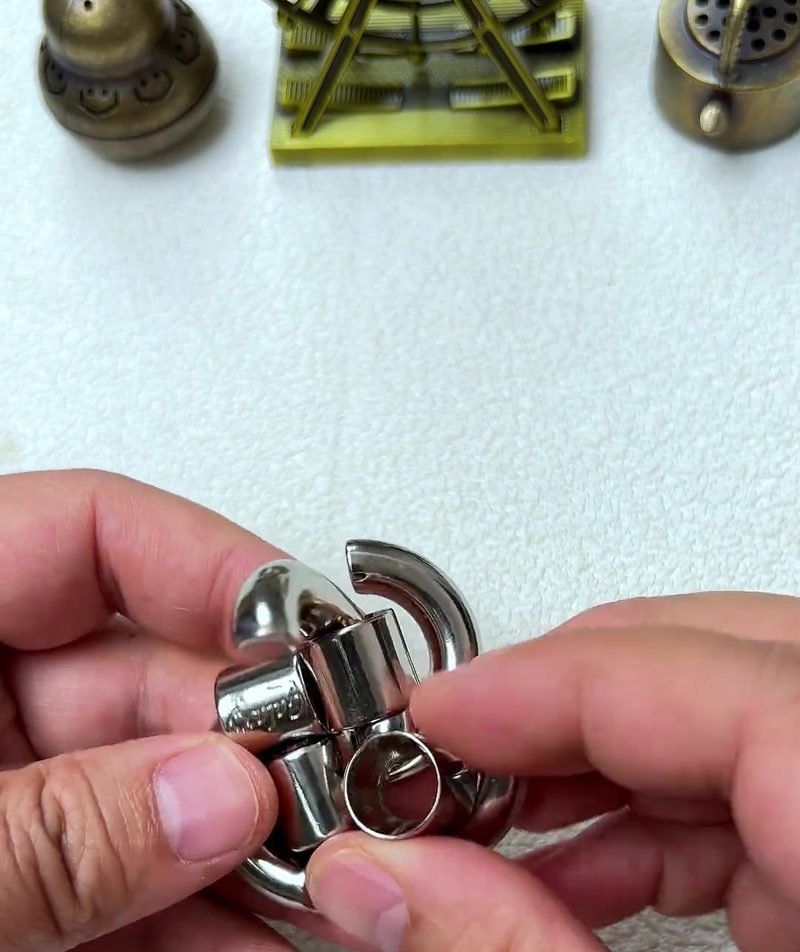
The last semicircular arc simply cannot close the loop. There’s no angle, no rotation, no amount of gentle pressure that makes it work. The geometry won’t allow it. You’ve built what amounts to a three-piece open chain, and closing it into the four-fold symmetrical knot requires an approach that sequential thinking cannot reach.
This is the moment where most people either give up or, more commonly, try the same approach five or six more times with increasing frustration. I know because I watched myself do exactly that. The puzzle demands spatial imagination — specifically, the ability to think about interlocking not as a sequence but as a simultaneous, symmetrical operation.
The Real Method: Think in Pairs, Not Chains
The insight that unlocks this puzzle is disarmingly simple once you hear it, and nearly impossible to discover on your own unless you abandon sequential logic entirely.
Instead of linking pieces one after another, you start by making two separate pairs. Two pieces, interlocked as a unit. Then two more pieces, interlocked identically. Then you merge the two pairs.
Pair One: Link Two Pieces Together
Take two pieces and connect them at the cylinders, creating a figure that looks like two interlocking horseshoes. The diagonal cuts on the cylinder faces should mate naturally — you’ll feel a slight click when the angle is right.
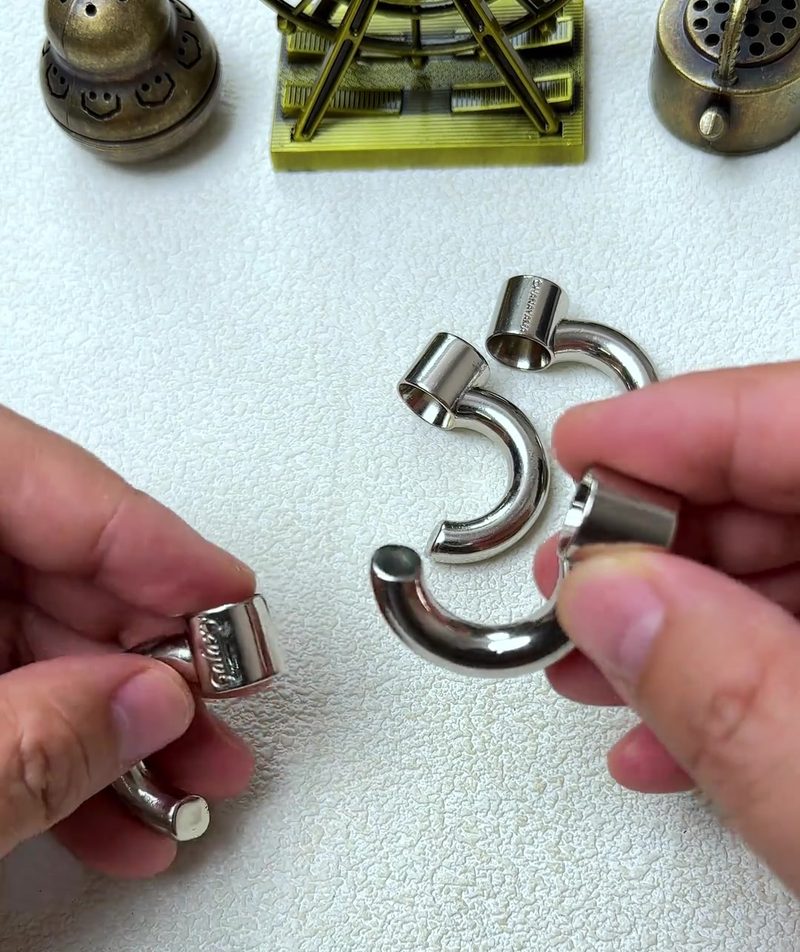
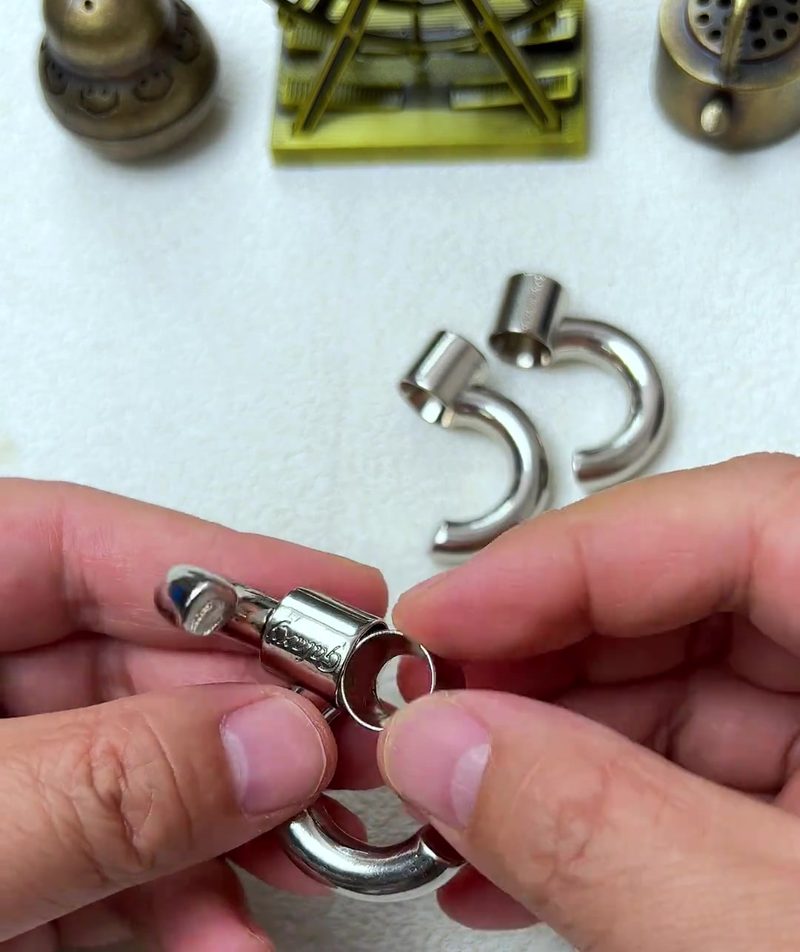
This step is straightforward. Two C-arcs meeting at their posts, curved sections sweeping away from each other. If you’re familiar with the kind of spatial sequencing explored in the Yin Yang balance puzzle, you’ll recognize the symmetry principle at work here.
Pair Two: Repeat With the Remaining Pieces
Take the remaining two pieces and assemble them exactly the same way. You now have two identical two-piece subassemblies.
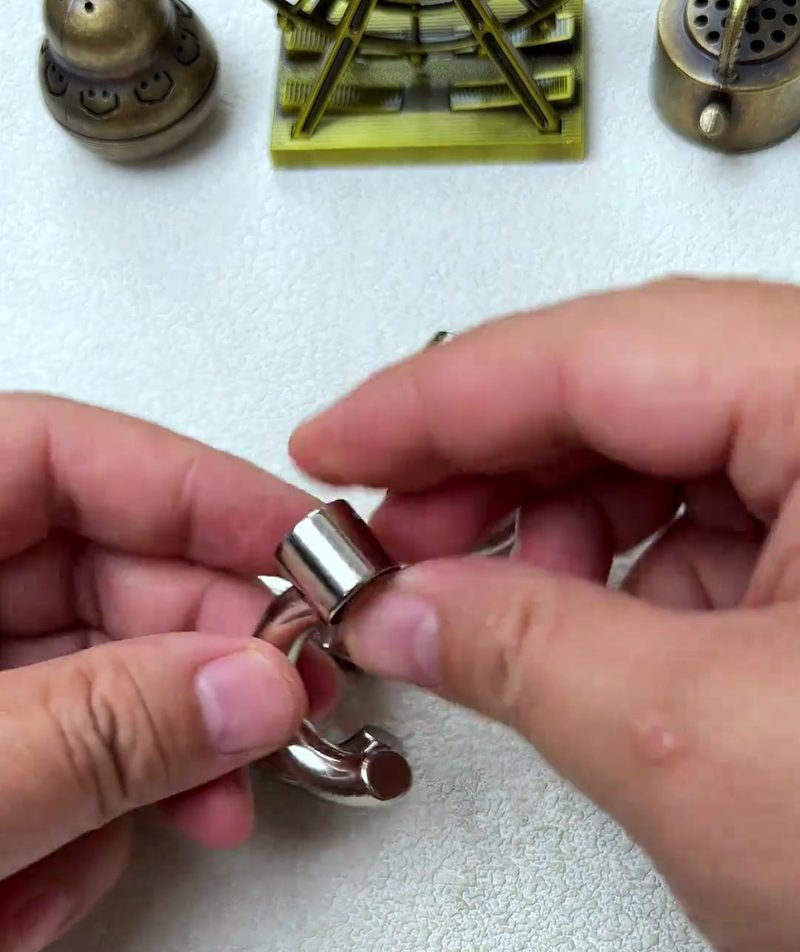
Merge: The Critical Move
Hold one pair in each hand. This is where spatial reasoning earns its reputation. You need to interleave the two pairs — threading the right pair’s cylinder through the left pair’s arc opening, and simultaneously threading the left pair’s cylinder through the right pair’s arc opening.
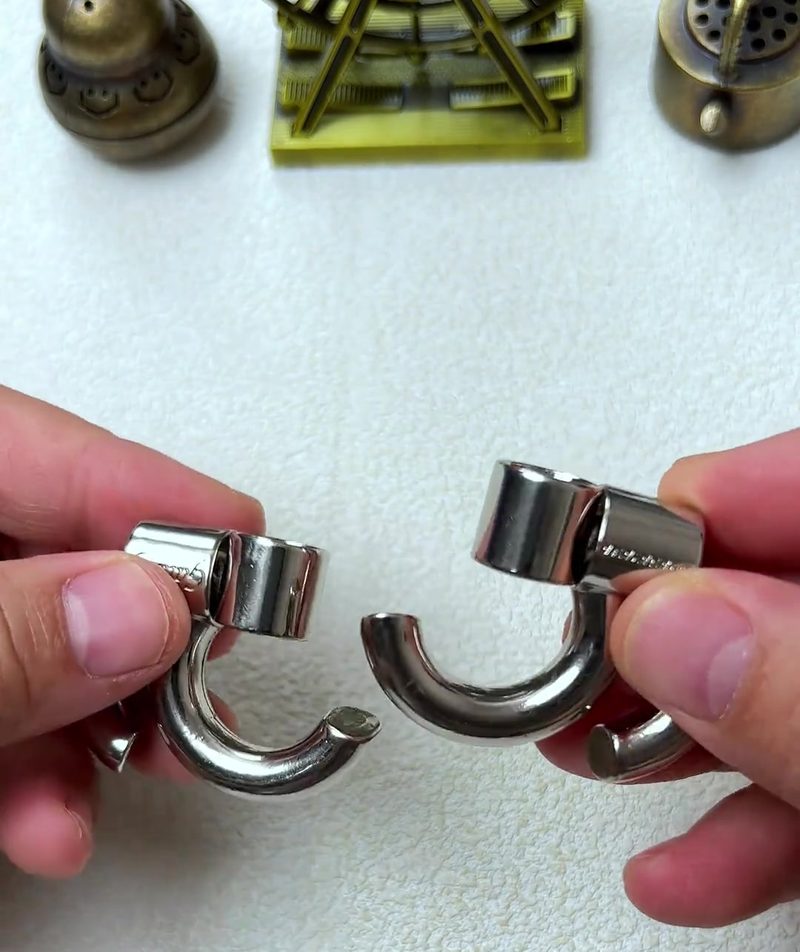
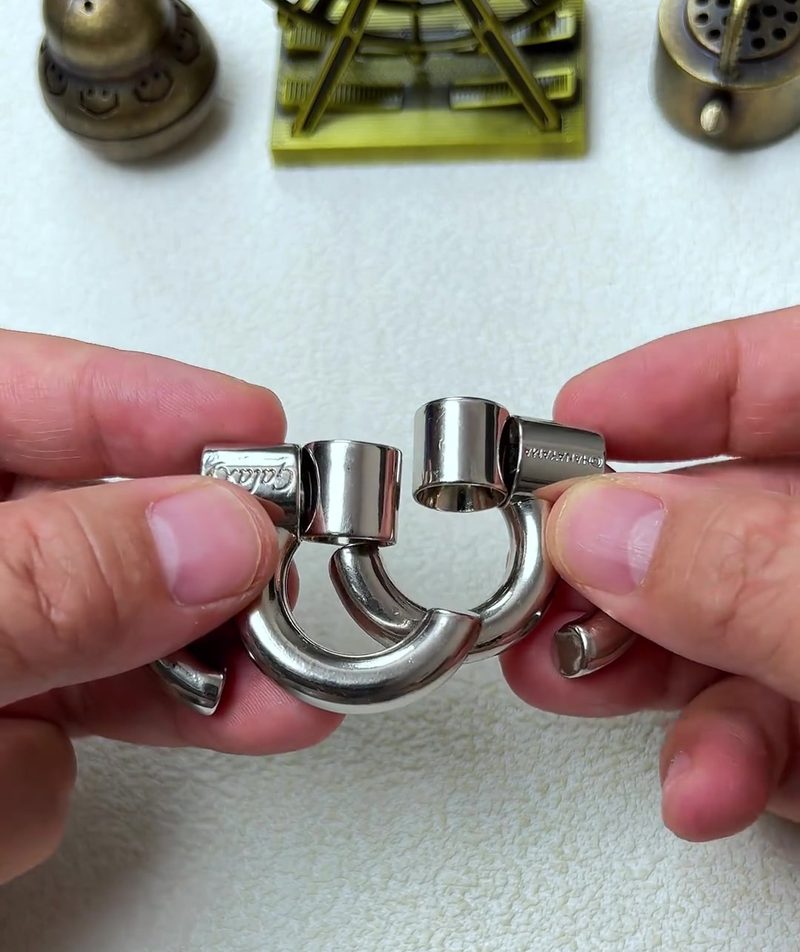
The motion feels counterintuitive because you’re moving both hands toward each other and slightly rotating. The cylinders of one pair pass through the arc gaps of the other pair, and vice versa. It’s a mutual threading operation, not a one-sided insertion.
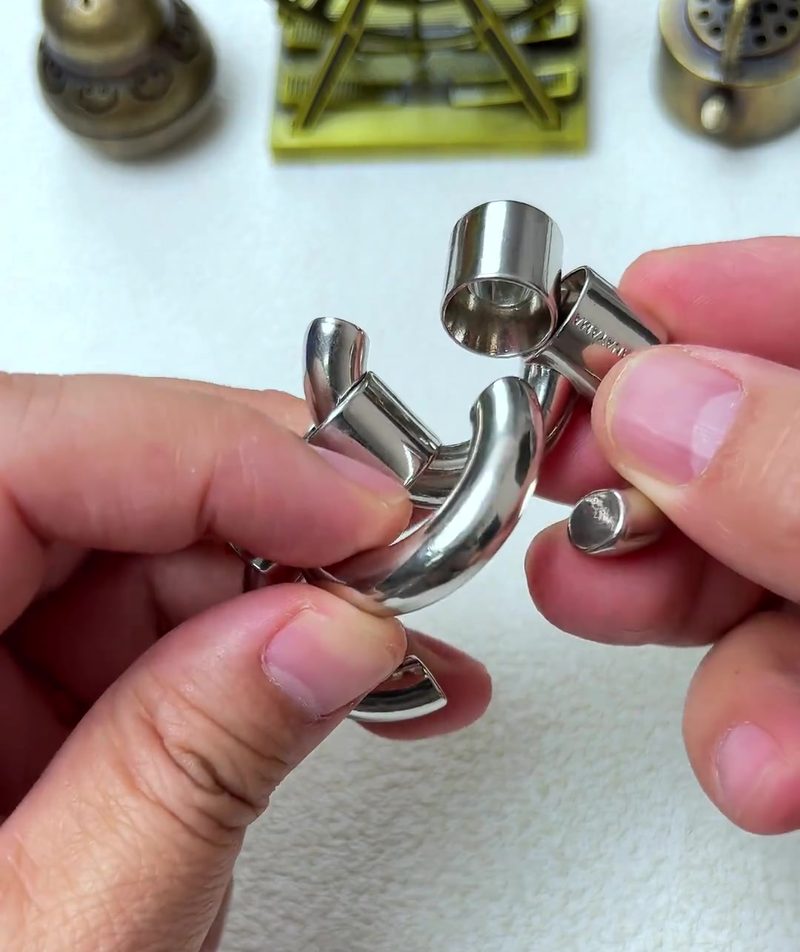
Align and Lock
Once both pairs are threaded through each other, you need to rotate the assembly so that the diagonal-cut cylinder faces meet flush. This is the tactile reward moment — the surfaces align, the pieces nestle into their final positions, and the puzzle compresses into the tight, symmetrical galaxy form.
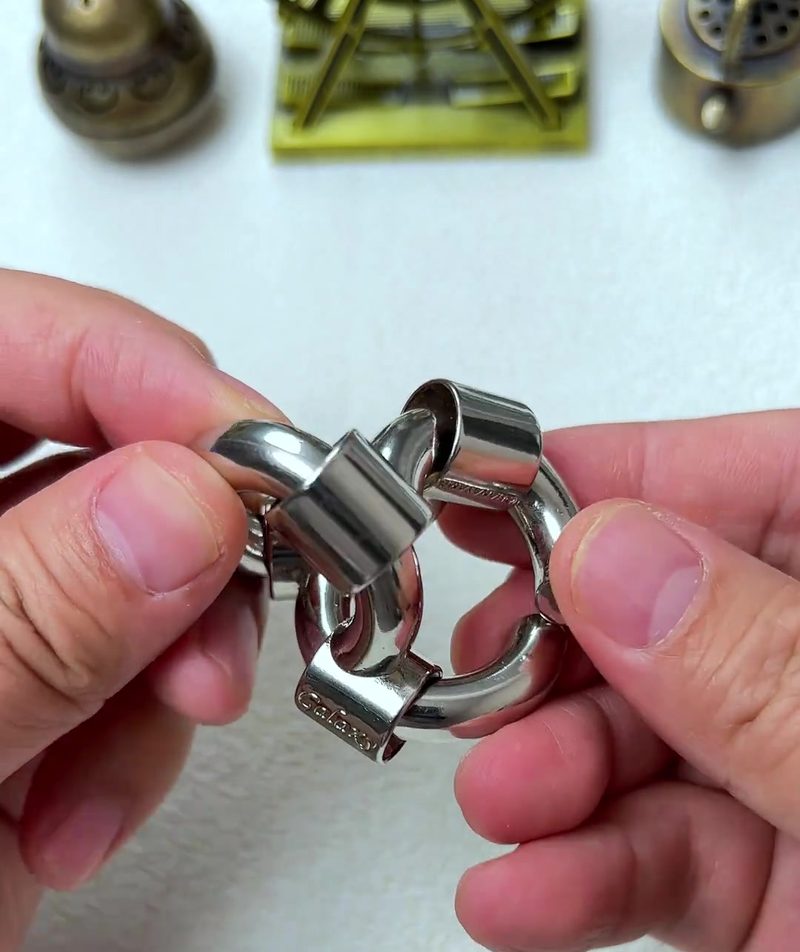
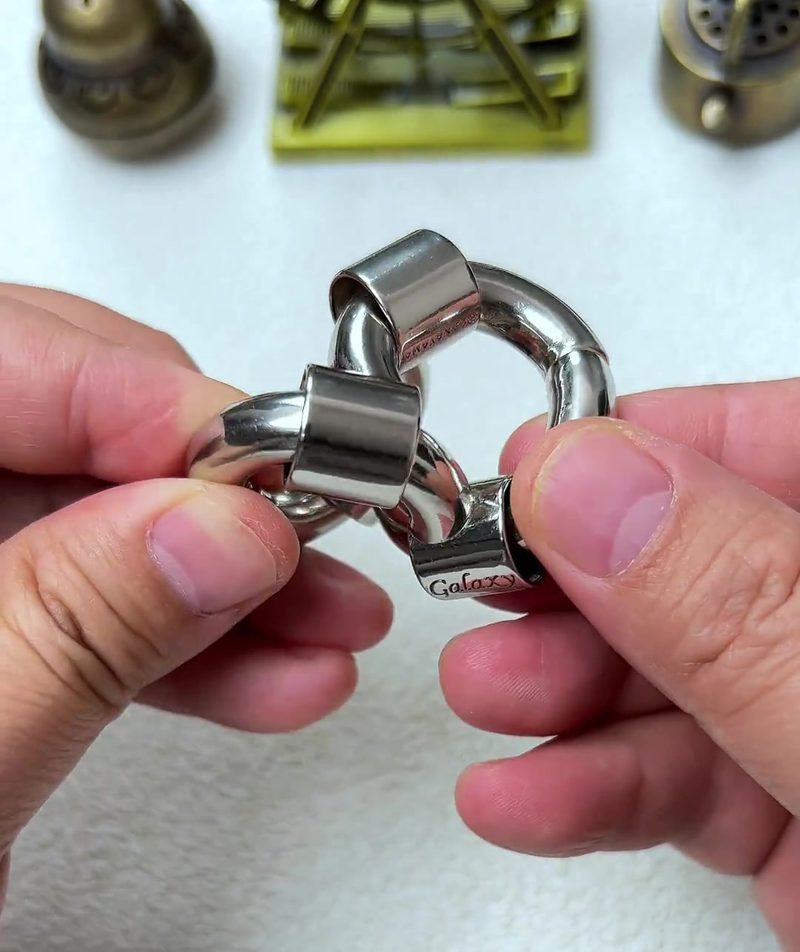
Hold the assembly with both hands and apply a gentle twist — one hand rotating slightly forward, the other slightly back. The pieces settle into place with a satisfying precision that you can feel through the metal.
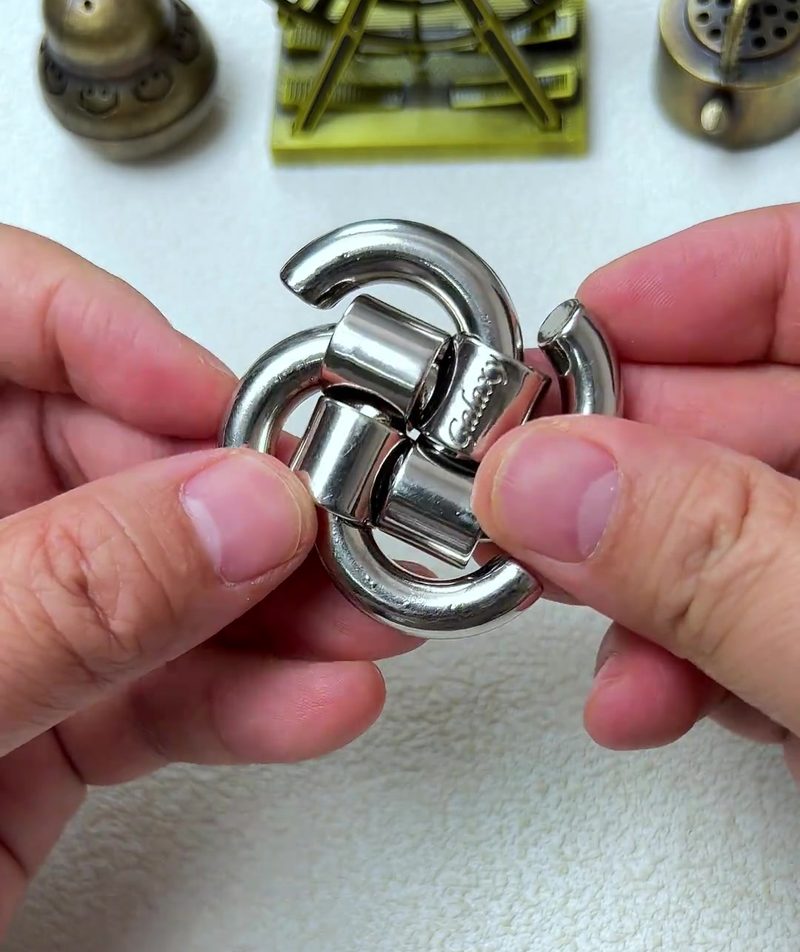
The finished form is compact, tight, and visually elegant. Four arcs weaving through each other in a pattern that bears a genuine resemblance to a spiral galaxy when viewed from above. And this is where you realize why reassembly is so satisfying: the completed puzzle looks like something that couldn’t possibly come apart, which makes the fact that it does — and that you now know how — quietly thrilling.
Why Your Brain Gets This Wrong
The reason nearly everyone defaults to the sequential-chain approach isn’t a failure of intelligence. It’s a feature of how human spatial cognition works. We’re wired to think about construction as an additive, sequential process: stack one brick, add another, and another. This mental model works for most physical assembly tasks — furniture, LEGOs, even most puzzles.
The Cast Galaxy specifically exploits this default by making the sequential approach feel right for the first three pieces. You get positive feedback: pieces fit, the pattern takes shape, you feel momentum. Then the fourth piece refuses, and you’re stuck in a cognitive trap. You’ve committed to a mental framework that worked three-fourths of the way, and abandoning it feels like giving up.
Cognitive scientists call this “functional fixedness” — the tendency to see objects and processes in terms of their conventional use. If you enjoy testing the boundaries of your spatial reasoning, you might appreciate how logic puzzles challenge these mental defaults across different puzzle types.
The pairs-first approach requires what psychologists call “parallel processing” — holding two independent operations in your mind simultaneously and then merging them. It’s the same cognitive skill that separates strong chess players from beginners, and it’s the same skill that makes the Cast Galaxy genuinely educational rather than merely frustrating.
The Disassembly Experience
Taking the puzzle apart is almost comically easy once you understand the assembly logic. Hold the assembled puzzle in both hands, apply a counter-rotating twist (reverse of the final assembly move), and the two pairs separate cleanly. Then each pair splits into its two constituent pieces with a simple pull.
Total disassembly time: about four seconds. Total reassembly time after you’ve learned the method: about thirty seconds. The contrast is enormous, and it’s the main source of the puzzle’s show-off potential. Hand it to someone in assembled form, let them take it apart, then watch them struggle to put it back together. The puzzle essentially resets itself as a challenge every time it’s disassembled.
Who This Puzzle Is For (And Who Should Skip It)
The Cast Galaxy sits in a sweet spot that makes it one of the more versatile cast metal puzzles I’ve handled. The working mechanics of interlocking cast metal puzzles range from trivially simple to obscenely complex, and this one lands squarely in the medium-difficulty zone — hard enough to stump you, easy enough to solve in one sitting.
You’ll enjoy this if you:
Like spatial reasoning challenges that reward insight over trial-and-error. Prefer puzzles with a single elegant solution rather than brute-force complexity. Want something pocket-sized that you can hand to friends and watch them struggle. Appreciate metal objects with precision machining and satisfying weight.
Skip this if you:
Need progressive difficulty — once you solve it, the mechanical challenge is over. Get frustrated by puzzles where the trick is conceptual rather than sequential. Want a puzzle that takes days or weeks to solve. Prefer wooden puzzles with more organic textures — in which case something from the wooden brain teaser collection might suit you better. Are looking for a multi-step sequential puzzle experience — the screen-free puzzle gift guide covers options with longer solve arcs.
The Metal and the Making
The four pieces are cast from zinc alloy with a chrome-silver finish — standard for this category of pocket puzzle. The casting is clean with no visible seam lines or burrs, and the chrome coating is uniform without the streaky finish you sometimes see on lower-quality metal puzzles. The diagonal cuts on the cylinder faces are machined to tight tolerances; the pieces fit together with minimal play but no binding.
Weight is roughly 100 grams for the assembled puzzle — enough to feel substantial in your palm without being heavy enough to be uncomfortable in a pocket. The puzzle measures approximately 4.5 centimeters across when assembled, making it genuinely pocket-portable rather than just theoretically so.
One detail worth noting: the pieces make a distinctive metallic click when the cylinder faces mate correctly during assembly. This audio feedback is genuinely useful — it tells you when you’ve hit the right alignment angle without needing to look. I found myself relying on it heavily during the threading step, where visual verification is difficult because your fingers are blocking the view.
If you appreciate how material properties affect the solving experience, the way cast metal puzzles use their own weight and surface finish as haptic feedback is one of the more underappreciated aspects of the category. The spiral metal brain teaser uses similar zinc alloy construction and demonstrates how the same material behaves in a completely different interlocking geometry.
What the Solution Teaches About Problem-Solving
I keep coming back to the Cast Galaxy not because the mechanical puzzle itself has lasting replay value — it doesn’t, at least not for the solver — but because the cognitive experience of solving it the first time is a genuinely useful lesson in breaking assumptions.
The sequential-linking trap isn’t just a puzzle gimmick. It’s a direct analogue to how we approach many real-world problems: we assume the solution must follow the same logic as our initial approach, and when it doesn’t work, we try harder rather than rethinking the framework entirely. The Cast Galaxy punishes persistence and rewards restructuring. That makes it a better teaching tool than puzzles that are simply hard.
For puzzlers who enjoy the relationship between mechanical design and cognitive psychology, the cast equa orbital ring puzzle guide explores another design where physical form creates specific cognitive traps.
Living With It
After the initial solve, the Cast Galaxy transitions from challenge to desk companion. It’s a fidget object — the assembled form is pleasant to rotate in your fingers, and the disassembly-reassembly cycle has a meditative quality once you know the method. I find myself taking it apart and putting it back together during phone calls, the same way someone might click a pen.
The metal-on-metal contact does produce quiet sounds during manipulation. In a silent office, this could draw attention. In a normal working environment, it’s unnoticeable. The chrome finish has held up well over weeks of daily handling without visible wear, though I expect the high-contact areas on the cylinder cuts will develop a slight patina over months.
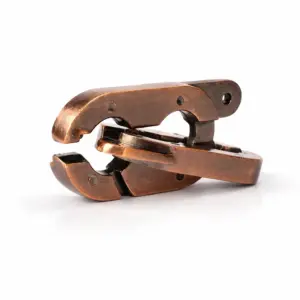
As a gift, this puzzle works exceptionally well because the presentation value is high — the assembled form looks intricate and impressive — and the difficulty is accessible enough that most recipients will solve it within a session rather than shelving it. It pairs naturally with other cast metal puzzles like the interlocking metal disk puzzle or the antique bronze keyring puzzle for a curated brain teaser set.
Assembly Quick Reference
For solvers who want the steps without the narrative:
Step 1: Separate all four pieces. Confirm they’re identical.
Step 2: Connect two pieces by mating their cylinder ends. This creates Pair A.
Step 3: Connect the remaining two pieces identically. This creates Pair B.
Step 4: Hold Pair A in your left hand, Pair B in your right. Thread each pair’s cylinder ends through the other pair’s arc openings simultaneously.
Step 5: Once both pairs are interleaved, twist gently — left hand forward, right hand back — until the diagonal cylinder faces meet flush.
Step 6: The puzzle compresses into its compact galaxy form. Done.
The critical insight: this is a simultaneous merge, not a sequential chain. Two pairs interlocking at once, not four pieces linked one after another.
Frequently Asked Questions
How long does the Cast Galaxy puzzle take to solve without hints?
First-time solvers typically spend 15-60 minutes before either finding the solution or looking it up. The difficulty is conceptual rather than mechanical — once you understand the pairs-first approach, execution takes under a minute. The challenge is abandoning the sequential-linking instinct, which can happen quickly or take considerable time depending on your cognitive flexibility. The memory match pattern game exercises a similar spatial recall skill that helps with this type of puzzle.
Is the Cast Galaxy puzzle suitable for children?
The pieces are small enough to present a choking hazard for very young children. For older kids (roughly ages 10 and up), the puzzle is excellent — it’s genuinely educational for spatial reasoning development, and the difficulty is achievable without being trivially easy. Younger children may find it frustrating without guidance.
Can the pieces get stuck during assembly or disassembly?
No. The pieces never bind or lock in a way that requires force. If you’re pushing hard, you’re on the wrong path. Every correct move in this puzzle feels smooth and natural. If a piece resists, rotate or reposition rather than applying pressure. The zinc alloy is durable but the chrome finish can scratch under excessive force.
How does the Cast Galaxy compare to other 4-piece interlocking puzzles?
The identical-piece design makes it unique in the cast metal category. Most multi-piece puzzles use different components with different roles. Having four identical pieces creates a specific type of difficulty — you can’t reason by role differentiation, only by spatial orientation. This makes it simultaneously simpler (fewer variables) and harder (no visual cues about which piece goes where).
Does the puzzle lose its challenge after you solve it once?
Mechanically, yes — once you know the method, assembly takes seconds. But the puzzle retains value as a social challenge (handing it to others), as a fidget object, and as an occasional exercise to keep the solution fresh in muscle memory. Many solvers report that they forget the exact technique after a few weeks and enjoy the re-solving experience.
What material is the Cast Galaxy puzzle made from?
The pieces are cast zinc alloy with a chrome-silver electroplated finish. This is the standard material for precision-cast pocket puzzles — durable enough for daily handling, heavy enough to feel substantial, and smooth enough for the pieces to slide without friction. At $14.88, the material quality is consistent with what you’d expect in this price range.
Is the Cast Galaxy good as a gift for puzzle enthusiasts?
For someone who already solves cast metal puzzles regularly, it might be too easy — they’ll likely recognize the pairs approach within minutes. For a general audience or someone newer to brain teaser puzzles, it’s an excellent choice because the difficulty is perfectly calibrated: hard enough to feel like a genuine challenge, easy enough to solve in one session. The puzzle box gift guide covers more options if you’re building a gift set.
Can I use the Cast Galaxy as an everyday carry (EDC) fidget?
In assembled form, absolutely. It’s pocket-sized, durable, and the rotating manipulation is quiet enough for most environments. In disassembled form, carrying four loose metal pieces is impractical. I’d recommend keeping it assembled and treating disassembly as an at-desk activity.
What if I lose a piece?
Because all four pieces are identical, a lost piece can’t be replaced with a different component — you need an exact match. The pieces are not sold individually. This is worth considering if you plan to keep the puzzle disassembled for travel; a small pouch or tin helps prevent pieces from separating.
How does this puzzle compare to wire disentanglement puzzles?
Completely different cognitive skill. Wire puzzles require finding a specific movement path through space. The Cast Galaxy requires reconceptualizing the assembly paradigm itself. Wire puzzles test patience and manual dexterity. The Cast Galaxy tests cognitive flexibility and spatial imagination. Both are cast metal, but the challenge types barely overlap. For the wire disentanglement experience, the metal starfish puzzle ring is a good comparison point.