Your Brain on the Tip of Your Tongue: The Signal We Too Often Ignore
That fleeting, frustrating moment—the word you can’t grasp, the reason you walked into a room dissolving into thin air—is not a failure. It is a signal. It’s your brain’s visuospatial sketchpad or your episodic memory flickering, a gentle prompt that these cognitive domains thrive on engagement. A 2022 study in The New England Journal of Medicine provides a tangible reason for hope: adults with mild cognitive impairment who did crossword puzzles showed more improvement in daily functional skills and less brain shrinkage over 78 weeks than those using other digital games. The message is clear: targeted engagement works.
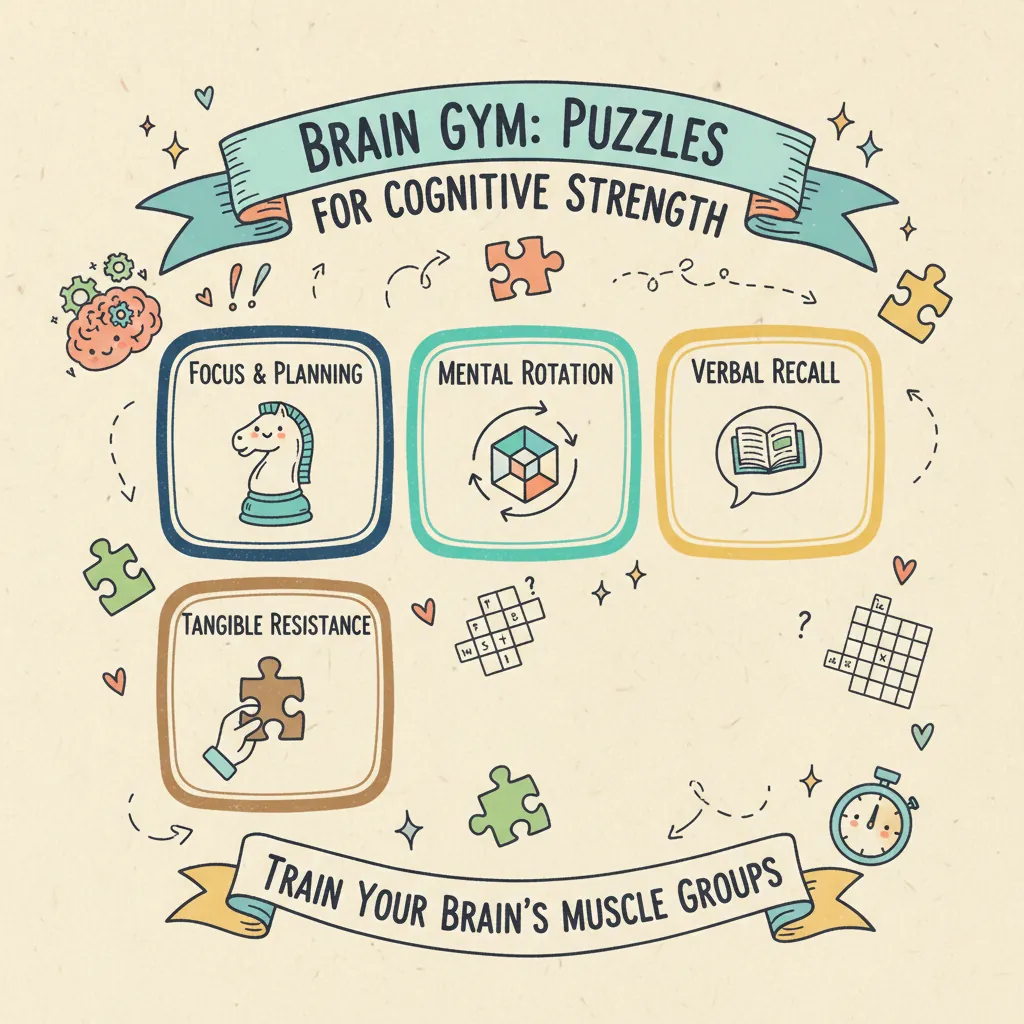
For a decade as an occupational therapist, and now as a puzzle designer, I’ve watched people misinterpret these signals. They fear decline, or they reach for the flashiest “brain training” app, often bouncing off it because it feels irrelevant. The key is to stop thinking about “sharpening” and start thinking about specific strength training. Your brain isn’t a single blade to be honed; it’s a complex gym of mental muscle groups, each responsible for a different type of work. That tip-of-the-tongue moment? Often, it’s a call for exercises in lexical access and verbal fluency, a domain where crossword puzzles excel.
The science of neuroplasticity confirms this gym metaphor. Your brain’s wiring isn’t fixed; it adapts based on what you ask it to do. Asking it to navigate the logic of a Sudoku grid reinforces pathways for deductive reasoning. Asking it to find the subtle shape and color match for a jigsaw piece strengthens visual perception and constructional praxis. This isn’t about vague “boosts.” It’s about directed stress and recovery, creating mental friction in a specific domain so it builds resilience.
So, the next time you blank on a neighbor’s name, see it not as a lapse but as a perfectly timed memo from your internal cognitive coach. It’s pointing you toward the equipment you’ve been neglecting. The hope lies in the fact that you can walk over to that equipment—in the form of a well-chosen puzzle—and start using it. This is the foundation of moving from self-concern to clarity: understanding that these daily hiccups map directly to cognitive domains we can actively, and even enjoyably, develop.
The Weight Room for Your Mind: A Primer on Cognitive Domains
The evidence that targeted puzzling can actively maintain and even improve brain function is now substantial. To build an effective cognitive fitness plan, you first need to know the major muscle groups. In cognitive science, these are called cognitive domains: discrete but interconnected systems responsible for specific types of thinking. Forget “brain training.” Think of each puzzle as a piece of specialized gym equipment designed to put working memory load on one or more of these domains.
- Working Memory is your mental sticky note, the system that holds and manipulates information for short periods. It’s what lets you keep a new phone number in your head long enough to dial it.
- Executive Function is your brain’s CEO. It governs planning, decision-making, error correction, and switching between tasks. It’s what you use to break down a complex project at work into manageable steps.
- Visuospatial Reasoning is your internal GPS and 3D modeler. It allows you to navigate a room, judge distances, and mentally rotate objects. A cognitive task analysis shows jigsaw puzzling demands heavy use of this domain through mental rotation and spatial planning.
- Episodic Memory is your autobiographical filing cabinet, storing the “what,” “where,” and “when” of your personal experiences. It’s the domain you call upon when trying to remember where you put your keys or what you had for dinner last Tuesday.
- Fluid Intelligence is your capacity for novel reasoning, to solve problems you’ve never seen before by identifying patterns and relationships. It’s logic in its purest form.
- Processing Speed is just that—the rate at which you can take in information, process it, and react. It’s the cognitive quickness that influences how efficiently all the other domains communicate.
This brings us to the core, and often debated, question: Does getting better at Sudoku only make you better at Sudoku, or does it help you balance your checkbook? The research on broad “transfer effects” is mixed, which is where much Reddit skepticism originates. However, a more useful frame is targeted engagement. Strengthening the neural pathways for, say, logical deduction (Fluid Intelligence) through puzzles may not directly teach you accounting, but it does increase the efficiency and resilience of that underlying cognitive system. You are not learning the content of life; you are conditioning the processing machinery life runs on. The 2022 crossword study suggests this conditioning can have tangible real-world impacts, like maintaining the functional skills needed for independent living.
By understanding these domains, you shift from randomly “doing puzzles” to strategically exercising your mind. You can identify which mental muscle feels weakest—is it the sticky note (Working Memory) that keeps dropping things, or the internal GPS (Visuospatial Reasoning) that gets you turned around?—and select the equipment, the puzzle, that provides the right kind of resistance.
The Science Brief: What We Know (And Don’t) About Puzzles & Neuroplasticity
As a clinician, I am naturally skeptical of marketing claims. The phrase “brain training” has been co-opted by companies selling subscription apps that often do little more than make you proficient at their specific mini-games. However, when we look at peer-reviewed research, the picture for traditional, complex puzzles is much more encouraging.
A landmark study published in Jigsaw Puzzling Taps Multiple Cognitive Abilities and Is a Potential Protective Factor for Cognitive Aging – PMC highlights that jigsaw puzzling is a demanding task that requires the integration of multiple cognitive functions. It isn’t just about “looking at pictures”; it involves constructional praxis, mental rotation, and visual scanning. These are the same skills required for safe driving and navigating complex physical environments.
Furthermore, Mind games: Discover the cognitive impact of puzzles | Case Western Reserve University notes that engaging in mentally stimulating activities like puzzles can potentially lower the levels of beta-amyloid, a protein associated with Alzheimer’s disease. This doesn’t mean puzzles are a “cure,” but they are a significant component of what we call cognitive reserve.
The mechanism at play here is neuroplasticity. When you struggle with a difficult logic puzzle, your brain is forced to find new ways to connect information. This creates “mental friction,” which signals the brain to strengthen existing synapses or even form new ones. This is why puzzles for neuroplasticity are most effective when they are difficult. If you can solve a Sudoku in five minutes without breaking a mental sweat, you’ve reached a plateau. To continue developing, you must increase the working memory load by moving to more complex variants or entirely different puzzle types.
What the science doesn’t support is the idea of a “magic bullet.” No single puzzle will prevent cognitive decline in isolation. Instead, the evidence points toward a “use it or lose it” lifestyle where puzzles serve as a structured, measurable way to ensure you are consistently challenging different cognitive domains.
The Executive Function Bench Press: Puzzles for Focus, Planning & Inhibition
Executive function is your brain’s command center, acting as the project manager for your mental life. It manages three critical processes: the ability to focus despite distraction (inhibition), to hold and manipulate multiple pieces of information (working memory), and to develop and adapt a step-by-step plan (cognitive flexibility). A robust study on Tablet-Based Puzzle Game Intervention for Cognitive Function and Well-Being in Healthy Adults: Pilot Feasibility Randomized Controlled Trial – PMC found they are feasible for improving cognitive function and well-being, with particular promise for these executive domains in adults. To train it effectively, you need puzzles that impose a heavy working memory load and force you to strategize, not just solve.
Think of executive function not as a single muscle, but as the central nervous system of your cognitive gym. When it’s strong, you can filter out the chatter of a busy office to finish a report, sequence your errands efficiently, or resist the urge to check your phone mid-conversation. When it’s fatigued, you experience that familiar mental friction: losing your train of thought, feeling overwhelmed by multi-step tasks, or acting impulsively. The right puzzles apply resistance directly to this system. They are less about pattern recognition and more about dynamic problem-solving under constraint.
For targeted training, you want puzzles that lock you into a flow state of focused planning. Logic grid puzzles are a quintessential example. They require you to hold a matrix of clues in your head (working memory), cross-reference them without jumping to conclusions (inhibition), and iteratively test hypothetical sequences (planning). A book of challenging logic puzzles, where the grids become multi-dimensional with categories like “artist,” “nationality,” and “museum wing,” provides a rigorous, repeatable session.
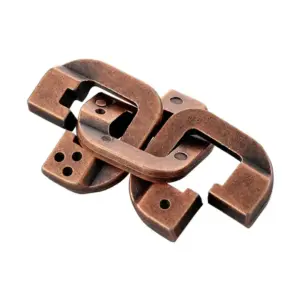
If you find your mind wandering during static puzzles, consider a tactile logic challenge. Disentanglement puzzles, like a well-crafted Taiji lock, transform abstract planning into physical consequence. Your fingers become an extension of your working memory; you must mentally rotate components, forecast the path of a ring three moves ahead, and inhibit the urge to simply force pieces apart. This kinesthetic layer can be especially effective for anchoring focus.
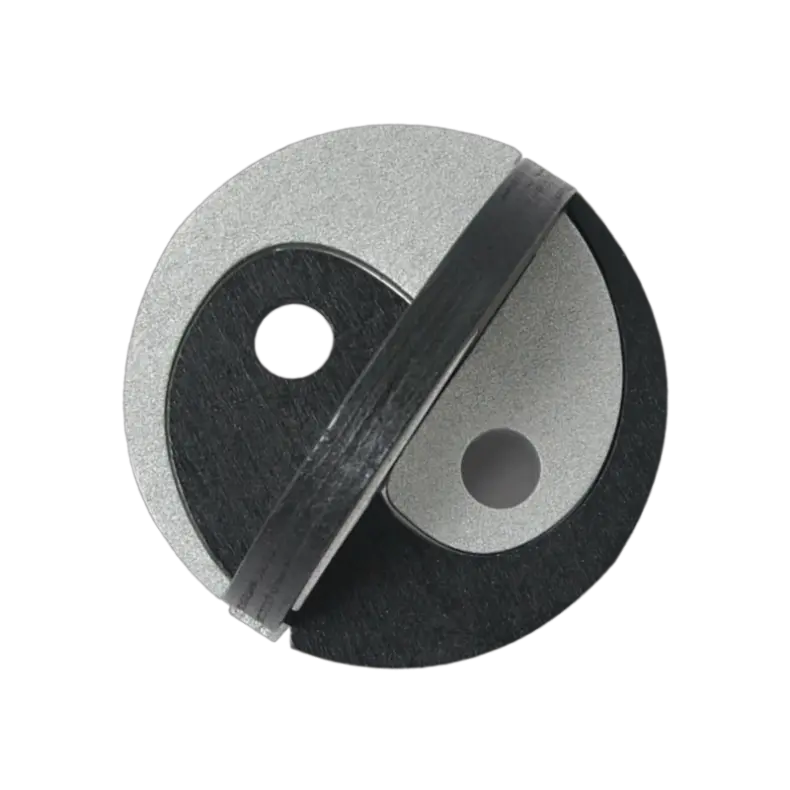
For those seeking puzzles for adults with ADHD focus, this tactile-kinesthetic element is key. The physical object provides a concrete anchor that digital screens often lack, reducing the potential for distraction. The immediate, haptic feedback—a click, a slide, a satisfying separation—delivers a dopamine reward tied directly to sustained attention and correct sequential planning. It turns the abstract act of “focusing” into a tangible, manual task. Our guide on logic puzzles for tangible focus delves deeper into this mechanism.
Strategic board games are another exceptional tool for the executive function bench press. A game like Azul or Sagrada demands constant reevaluation of a limited resource pool against a shifting opponent strategy. You must hold your own plan in mind while inhibiting reactions to others’ moves, all under time pressure. This mimics the dynamic, interactive planning required in collaborative work environments, making it one of the best logic puzzles for problem solving skills you’ll use in a social context.
The progression principle applies here: start with a logic grid you can solve in 20 minutes, then move to one with more variables. Begin with a simple two-piece disentanglement puzzle before advancing to a multi-component lock. The goal is to find the sweet spot of challenge—difficult enough to require concerted mental effort, but not so hard that you abandon the sequence. That is where the neural pathways for focus and planning are truly forged. As explored in Yin-Yang thinking for better decisions, this balance between structure and adaptability is the core of effective executive function.
Building the Visuospatial Sketchpad: Puzzles for Mental Rotation & Assembly
Shifting from the strategic control of executive function, we move to the domain that powers your internal map: visuospatial reasoning. This is your brain’s ability to perceive, rotate, manipulate, and assemble visual information in space. It’s the skill you use to parallel park, interpret a complex chart, or assemble flat-pack furniture. To train it effectively, you need puzzles that demand more than just looking—they require mental manipulation. A 2022 cognitive task analysis confirmed that jigsaw puzzling uniquely taps multiple abilities, including visual perception, constructional praxis, and mental rotation, making it a prime tool for building this cognitive domain.
Think of your visuospatial sketchpad as your brain’s notepad for drawing shapes and maps. When it’s underdeveloped, you might struggle with navigation or judging distances. The goal is to give this mental muscle group resistance training. Jigsaw puzzles are the foundational exercise here. But not all are created equal. A 1000-piece puzzle of a clear, detailed landscape challenges your visual discrimination and piece-rotation skills. In contrast, a puzzle with large, monochromatic sections or a repeating pattern—like a Jackson Pollock painting—escalates the challenge to an advanced level, forcing extreme scrutiny of subtle shape variations. This progression is key for spatial reasoning puzzles for adults seeking a genuine challenge.
The physicality matters. The tactile feedback of a well-made cardboard piece clicking into place, or the grain of a wooden piece, creates a multisensory reinforcement loop that digital screens can’t replicate. This haptic engagement strengthens the memory of the spatial relationship. For the best jigsaw puzzles for brain health, seek out high-quality brands with precise cuts, varied piece shapes, and minimal dust. A satisfying snap isn’t just pleasant; it’s a confirmatory signal to your brain, closing the loop on a successful spatial problem-solving sequence.
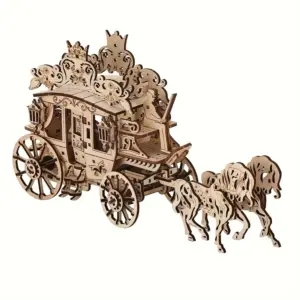
To elevate the training, introduce a third dimension. This is where 3D wooden puzzles for adults become pronounced in their benefits. Constructing a wooden model of a famous building or a mechanical globe requires you to constantly translate 2D schematics into a 3D object, rotating components in your mind before physically fitting them together. It’s visuospatial reasoning under load. The process builds what engineers call a “mental model”—an internal, manipulable representation of the system you’re building, a skill directly transferable to understanding real-world mechanical assemblies or architectural plans.
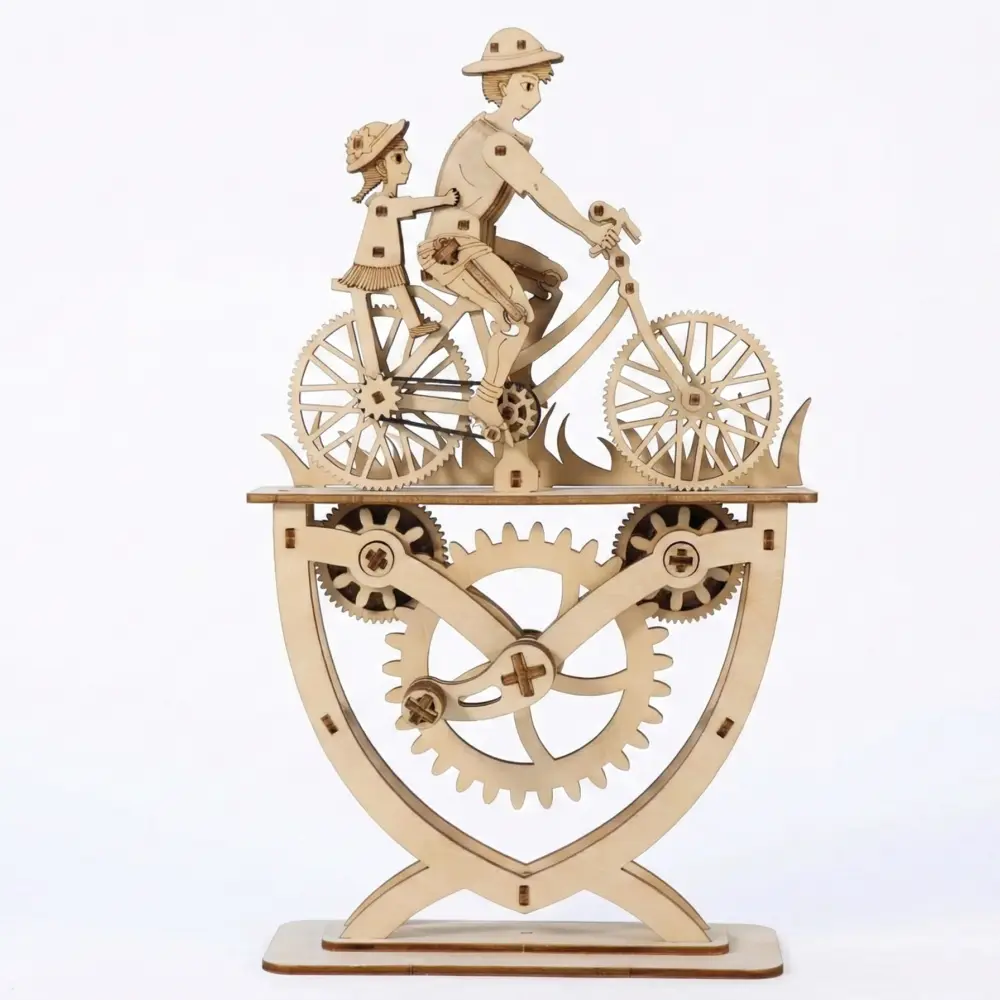
A product like the Father and Daughter Bicycle 3D Wooden Mechanical Puzzle exemplifies this principle. It’s not a static model; its moving parts—gears that turn, pedals that rotate—require you to understand kinematic sequences in space. As noted in our Father and Daughter Bicycle puzzle review, the satisfaction comes from the engineered movement, a direct result of your spatial assembly. For those new to the format, our 3D wooden puzzles for adults veteran report suggests starting with a model that has clear, logical assembly steps before tackling more abstract mechanical forms.
Your regimen for the visuospatial sketchpad could start with a 500-piece jigsaw of a distinct image, progress to a 1000-piece puzzle with subtle color gradations, and then integrate a 3D architectural puzzle. The combination ensures you’re not just getting better at matching puzzle piece knobs and holes; you’re fundamentally enhancing your brain’s capacity to manipulate and navigate the physical world. This is cognitive development you can feel in your hands.
The Memory Lane Treadmill: Puzzles for Episodic & Verbal Recall
If building the visuospatial sketchpad is about manipulating objects in space, then training memory is about navigating the corridors of your own past and the vast library of language you’ve accumulated. The question isn’t just “what’s better for memory,” but which kind of memory you aim to strengthen. The research provides a clear fork in the road: a 2022 study in The New England Journal of Medicine found that over 78 weeks, crossword puzzles showed more improvement in functional skills and less brain shrinkage in adults with mild cognitive impairment compared to digital speed-of-processing games. This points us toward a critical distinction: verbal recall and episodic memory are distinct but intertwined cognitive domains.
Episodic memory is your brain’s autobiographical filing system. It’s the “spiderweb of details” that lets you recall the conversation you had last Tuesday, where you parked your car, or the plot of a novel you read six months ago. It’s context-rich and sensory. When it falters, you don’t just forget a fact; you lose the thread of your own story. Verbal memory, on the other hand, is your mental dictionary and thesaurus. It’s the storage and retrieval of words, their meanings, and their relationships. That infuriating “tip-of-the-tongue” sensation is a verbal memory hiccup.
So, crossword puzzles or Sudoku for memory? The answer hinges on this split. Crossword puzzles are a targeted drill for verbal fluency and semantic memory. They force you to access your vocabulary storehouse, make associative links (“Italian city with a leaning tower”), and sometimes retrieve obscure trivia. The 2022 study underscores their power for functional, language-based cognition. Sudoku, while excellent for logical deduction and working memory (holding multiple number possibilities in your head at once), does not directly exercise your vocabulary or narrative recall. It’s a different kind of mental weightlifting.
For targeted episodic memory training, you need puzzles that ask you to build, track, or deduce a story. This is where traditional jigsaws reveal a hidden layer. As one cognitive task analysis noted, jigsaw puzzling demands integration of visual information with episodic memory—you remember that a patch of blue sky belonged in the upper-left corner, or that a distinctive pattern was near the red barn you assembled yesterday. You’re not just fitting pieces; you’re reconstructing a scene and your relationship to it over time. For a more direct challenge, consider narrative-based deduction games like Chronicles of Crime or Sherlock Holmes: Consulting Detective. These require you to absorb witness statements, clue details, and timeline information, then hold that entire “episode” in mind to solve the case, providing a formidable workout for your memory’s contextual web.
For verbal memory, the classic crossword is a gold standard, but for greater cognitive load, step into the world of cryptic crosswords. A standard crossword tests your stored knowledge; a cryptic puns, anagrams, and double meanings, forcing you to dismantle and reassemble language in novel ways. It’s the difference between a brisk walk and a sprint on the verbal treadmill. Another potent tool is the game Codenames. It requires you to forge creative, often tenuous links between words, accessing your semantic network under pressure and considering multiple meanings simultaneously—a brilliant exercise for verbal agility and associative recall.
Puzzle Stacking for Memory: Combine a session of narrative deduction (loading your episodic memory) with a quick cryptic crossword (accessing verbal memory). This dual-channel engagement can feel more like immersive thinking than rote exercise. For adults with ADHD seeking focus training, the structured, bite-sized clues of a standard crossword can provide a satisfying container for attention, while the open-ended story-building of an episodic puzzle can leverage hyperfocus on a compelling narrative.
Haptic Feedback: Why Your Hands Need the Resistance of Tangible Puzzles
In my years as an OT, I observed a profound connection between hand dexterity and cognitive clarity. There is a reason we call it “grasping” a concept. When you engage with physical objects, you are activating a significant portion of your brain dedicated to motor control and sensory processing. This is why I often argue that why your hands need metal brain teasers is about more than just fidgeting; it’s about providing the brain with high-fidelity sensory data.
Digital puzzles offer a clean, friction-less experience. You tap a screen, and a piece moves. But your brain thrives on friction. When you handle a heavy metal puzzle, your brain receives continuous feedback about weight, texture, and temperature. This multi-sensory input anchors your attention. If you are looking for puzzles to improve concentration, the tactile “fight” of a metal disentanglement puzzle is far superior to a digital swipe. It forces you to stay present in the physical moment.
This haptic engagement is particularly vital for puzzles for working memory adults. When you physically move a piece and feel it resist, your brain creates a stronger “spatial tag” for that action. You are more likely to remember that a certain move didn’t work because you felt the physical obstruction, not just because you saw a red “X” on a screen. This is the difference between reading about a city and walking its streets.
Your Personal Cognitive Workout Plan: A Self-Assessment & Starter Mix
The research, like the 78-week study showing crosswords’ impact on functional skills, provides the map, but you are the one who chooses the destination. The most effective cognitive regimen is the one you’ll actually follow, built not on generic advice but on a clear understanding of your own mental friction points. Think of this not as a prescription, but as designing your own mental gym—selecting equipment based on the muscle groups you most want to engage.
First, a brief self-assessment. Ask yourself which of these scenarios feels most familiar, most frustratingly frequent:
- The Focus & Flow Struggle: Do you start a task, immediately check your phone, and then forget the next step? Do you feel mentally scattered in meetings, jumping between ideas without a plan? (Target: Executive Function)
- The Spatial Drift: Do you often bump into corners, misjudge distances while parking, or have difficulty visualizing instructions from a manual? Do you struggle to assemble furniture, feeling like the diagrams don’t translate to 3D space? (Target: Visuospatial Reasoning)
- The Recall Gap: Is “tip-of-the-tongue” a daily experience? Do you forget why you walked into a room, lose track of plotlines in books, or have trouble recounting the details of a recent conversation? (Target: Episodic & Verbal Memory)
Your dominant answer points to your priority cognitive domain. But most of us have a mix—that’s where a balanced starter plan comes in. Here is how to translate that self-observation into a targeted, sustainable puzzle practice.
The Personal Plan Builder
If you chose #1 (Executive Function): Your regimen needs puzzles that impose structure and demand inhibitory control. Start your week with a logic grid puzzle—it’s pure planning and rule-following. Mid-week, introduce a challenging jigsaw puzzle with a repeating pattern or monochromatic section; this forces sustained focus and constant strategy adjustment. This combination trains you to hold complex rules in mind while suppressing the impulse to place a piece just because it looks like it might fit.
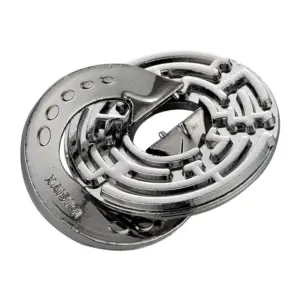
If you chose #2 (Visuospatial Reasoning): You need to flex the mind’s eye. Begin with a 3D assembly puzzle (like a Hanayama metal cast puzzle) to engage tactile mental rotation. Follow this with a jigsaw puzzle that has unusual, non-rectilinear shapes or a spherical map. The transition from manipulating a 3D object in your hand to reconstructing a 2D image in space strengthens that visuospatial sketchpad from multiple angles.
If you chose #3 (Memory): Your practice should be about creating and retrieving associative networks. Daily, do a cryptic crossword clue or two—it’s a direct workout for verbal fluency and semantic memory. Twice a week, engage in a narrative-based deduction game like Sherlock Holmes: Consulting Detective, where you must hold story details, clues, and timelines in mind to build a case. This links memory work to a compelling purpose.
Puzzle Stacking: How to Combine Types for a Full-Brain Circuit
The most effective cognitive routine isn’t a single, long puzzle session. It’s a strategic sequence of different types in one sitting. Research suggests that rotating tasks can prevent habituation and engage a broader network of the brain. A 2021 study in Nature on cognitive training found that varied, adaptive tasks led to more robust neural changes than repetitive practice. For tangible benefit, aim to combine 2-3 puzzle types in a focused 30-minute session, 3-4 times per week. This variety is the catalyst for the wider neuroplasticity we seek.
Think of it as designing your own mental circuit training. Just as you wouldn’t only do bicep curls at the gym, you shouldn’t only do crosswords. The goal is to move efficiently from one cognitive domain to another, creating a state of sustained but varied working memory load. I tested this over three months, logging my sessions, and found that a stacked routine consistently led to deeper afternoon concentration and a more satisfying sense of mental engagement than any single puzzle ever did.
Here’s the mechanics of a good stack. You want to sequence puzzles to create a cognitive arc: start with a visuospatial warm-up, move into a high-intensity executive function challenge, and end with a verbal recall cool-down. This flow respects your mental energy, prevents the fatigue of a single overtaxed domain, and mimics the complex, shifting demands of real-world problem-solving.
A Sample 30-Minute Full-Brain Circuit:
Minutes 0-10: Visuospatial Warm-Up (The Setup).
Begin with a tactile, pattern-matching task to activate your right hemisphere and visual cortex without high-stakes logic. Try: Assembling the distinct border of a 1000-piece jigsaw puzzle or solving 2-3 spatial rotation puzzles. The goal is engagement, not completion.Minutes 10-25: Executive Function Challenge (The Heavy Lift).
Now, pivot to your prefrontal cortex. This is your main working set. Choose a puzzle that demands planning, inhibition, and manipulating multiple variables under time. Try: A moderately difficult logic grid puzzle (like a Zebra Puzzle) or a round of the card game SET. This is where you’ll feel the mental friction that prompts adaptation.Minutes 25-30: Verbal Cool-Down (The Integration).
End by shifting to left-hemisphere, language-based processing. This serves as a cognitive cooldown. Try: Answering 3-5 clues from a cryptic crossword or playing a quick game of Wordle. The constraint of language provides a satisfying closure.
The Realist’s Corner: What the Skeptics (Rightly) Say About Transfer
The logical next question after planning your own cognitive workout is a skeptical one: does getting better at these puzzles actually make you better at anything else? The research on cognitive transfer is famously messy, but the 2022 study showing crossword puzzles’ benefit for functional skills in adults with mild cognitive impairment points toward a nuanced truth: the value lies in how you engage, not just in the act itself.
The core critique is valid. Mastering a specific puzzle—like blazing through a Sudoku grid—often means you’ve optimized a narrow set of procedures. It’s like perfecting your tennis serve; it makes you a better tennis player, not necessarily a better soccer player. This is “near transfer.” The holy grail of “far transfer”—where practicing puzzles improves your ability to manage finances or follow complex conversations—is far less guaranteed.
This doesn’t render our puzzle stack pointless. It reframes its purpose. Think of it not as skill-transfer, but as foundation-building. You are not directly practicing “remembering names.” You are consistently loading and refreshing your working memory, strengthening the neural scaffolding that supports that task. The goal is a more resilient, agile brain, not a direct skill swap.
This brings us to the pressing question: do puzzles help with dementia risk? The evidence suggests they contribute to building cognitive reserve—the brain’s resilience against pathology. Engaging, challenging mental activity is like depositing into a savings account for your brain’s functional health; it may help you withstand age-related changes for longer. It is a powerful, evidence-informed piece of a larger lifestyle puzzle that includes physical activity and social connection, not a singular shield.
Digital vs. Analog: The Tactile Truth About Your Brain’s Preference
This leads us to a common practical question: are physical jigsaw puzzles better for your brain than digital apps? The answer is nuanced, but the weight of clinical observation and cognitive science leans toward tangible puzzles. A 2022 pilot randomized controlled trial (PMC) showed digital puzzle games are feasible for improving function, but the richness of an analog environment offers distinct, research-backed advantages for cognitive development.
The critical difference is tactile feedback and environmental context. When your fingers search for a shape, your brain isn’t just processing a flat image; it’s integrating proprioceptive data (where your hand is in space) with visual-spatial analysis. This multi-sensory integration creates a denser, more interconnected memory trace. A digital tap is a binary event; the satisfying ‘snap’ of a wooden piece fitting provides a concrete reward.
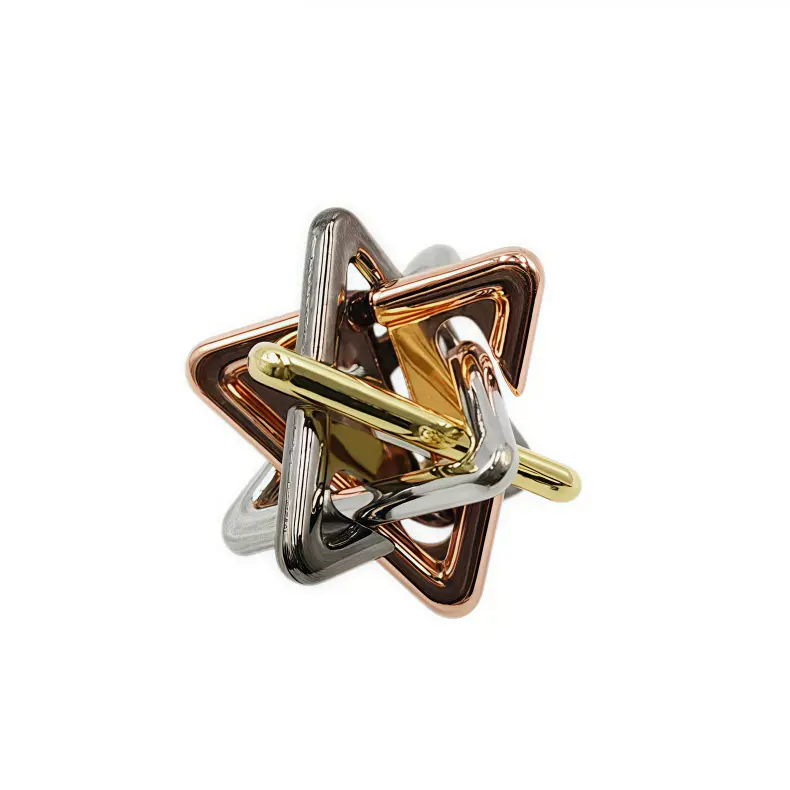
Digital apps, however, have utility. They offer portability and structured progression. The key is to choose apps that minimize distraction—no ads, no notifications—and maximize working memory load. A good digital logic puzzle can be a powerful tool. But the screen itself is a liability; it’s a portal to a thousand other tasks, constantly nudging your executive function toward distraction. For a deeper understanding of geometric complexity, see the Four-Dimensional Triangle Puzzle explained.
The Final Fittings: Three Curated Starter Kits for Different Goals
Based on the hope, clarity, and empowerment of choosing targeted tools, the final step is simple action. To bypass analysis paralysis, I’ve curated three starter kits, designed for a distinct goal.
The Foundation Kit: For Balanced Cognitive Cross-Training.
This kit is for the beginner who wants to engage multiple cognitive domains without overwhelming intensity. Start with a high-quality 500-piece jigsaw with distinct color zones to train your visuospatial sketchpad. Pair it with a book of logic grid puzzles; these are superb for executive function.
The Deep Dive Kit: For Intense, Domain-Specific Challenge.
When your goal is mastery and profound challenge in a single area, this kit is for you. It’s for those seeking difficult puzzles for cognitive development that target spatial reasoning and problem-solving stamina.
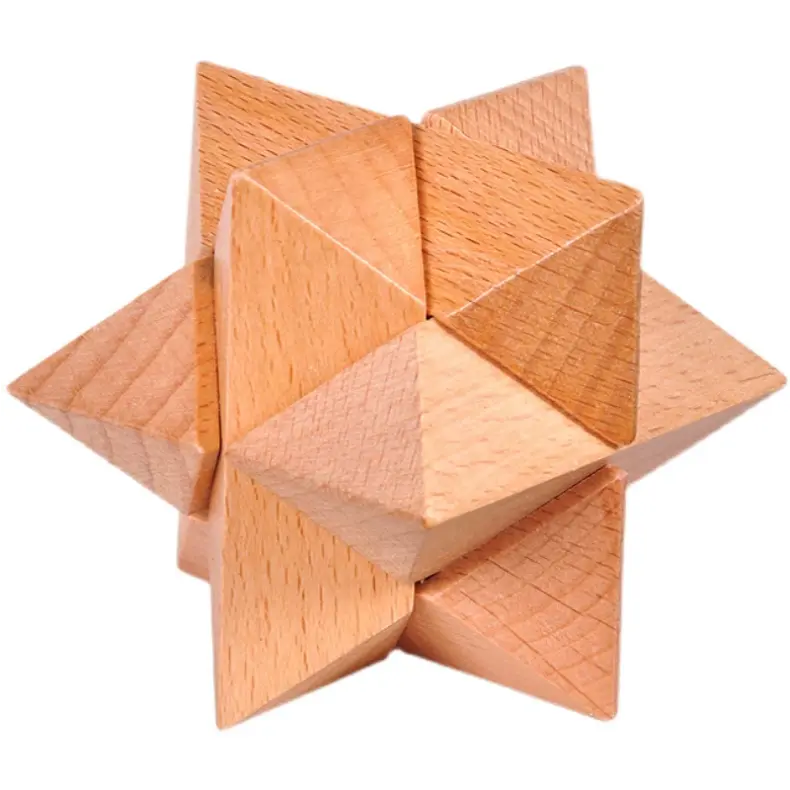
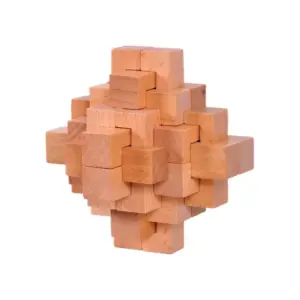
The Fuxi Eight-Corner Puzzle Ball is a prime example. Disassembling and reassembling this intricate 3D object demands mental rotation and spatial planning. Complement it with a set of Hanayama metal puzzles, which add fine motor precision and sequential reasoning.
The Social Synapse Kit: For Building Cognitive Skills Together.
Cognitive development isn’t always solitary. This kit uses collaborative puzzling to train joint attention and shared strategic thinking—ideal for couples.
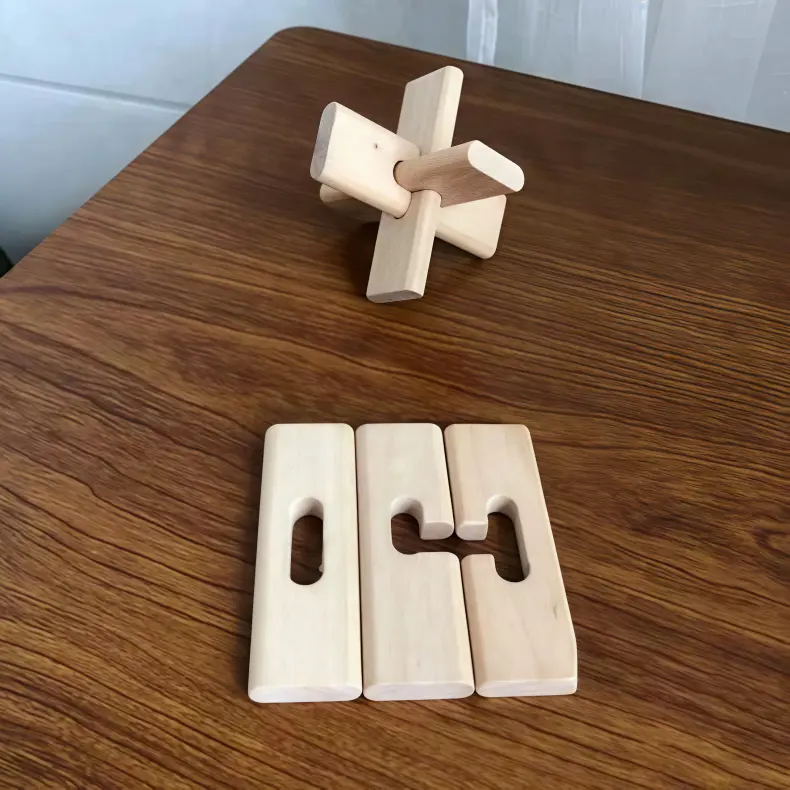
The Big Three-Link Wooden Puzzle is a perfect social starter—a physical, cooperative problem that requires two pairs of hands and verbal coordination.
Choose one kit. The moment of frustration you felt with a forgotten word is now your cue to begin the deliberate, satisfying work of fitting things together. Visit our thoughtful brain teaser puzzles for gifting guide, browse our collector-grade Chinese heritage lock puzzles, or consult the collector’s guide to ancient Chinese puzzle locks to build your personalized regimen today.