Quick Answer: 3D Wooden Pistol Kit Picks at a Glance
The 3D wooden pistol kit market spans entry-level to premium price points with piece counts from 50 to 300+, and the single biggest factor separating a budget kit from a premium one is whether the trigger actually fires a rubber band or just clicks hollow. While ROKR and Wood Trick dominate Amazon listings, with full Tier 3 mechanical action — real trigger pull, firing pin, and rubber-band propulsion — the Tea-Sip 3D Wooden Mechanical Pistol Kit sits in the sweet spot where price meets a genuine working mechanism. For broader context on what makes something a true mechanical puzzle rather than a static display, the engineering has to extend past the frame and into the moving parts.
| Kit | Mechanical Action Tier | Best For | Price | Skip If |
|---|---|---|---|---|
| Tea-Sip 3D Wooden Mechanical Pistol Kit | Tier 3 — trigger pull, firing pin, rubber-band propulsion | First-time builders who want a DIY wooden pistol with a working trigger and firing mechanism | — | You want a non-firearm display piece |
| Tea-Sip Mechanical 3D Wooden Globe Puzzle | Tier 2 — gear-driven rotation | Buyers who love gear-driven motion but prefer a desk-display object | — | You specifically want a pistol replica |
| Tea-Sip 3D Wooden Puzzle Safe with Combination Lock | Tier 2 — working combination dial | Someone craving a lock-picking-style mechanical challenge | — | You want rubber-band shooting action |
| Tea-Sip 3D Wooden Puzzle Treasure Box | Tier 2 — hinged latch and hidden compartment | Gift-givers wanting mechanical reveal plus functional keepsake storage | — | You want a display model, not a usable box |
All four use laser-cut basswood with snap-fit pin-and-slot assembly — no glue required, 14+ age rating, and the same self-assembly kit format you’ll find across the category. The pistol is the only one that shoots.
Does a 3D Wooden Pistol Kit Actually Fire? The Question That Decides Everything
A typical 3D wooden pistol puzzle kit sold under Wood Trick, ROKR, Robotime, Wooden.City, or wewowood branding falls into one of three mechanical action tiers, and the tier — not the brand, not the piece count, not the photo on the box — determines whether the finished model actually shoots a rubber band or just sits there looking pretty. Most pistol kits span entry to mid-range pricing, with premium Wooden.City builds at the higher end, and every major brand carries a 14+ age rating because the spring-loaded firing pins and small plywood tabs are not toys for younger hands.
Saturday afternoon. I’m hunched over my workbench with a pair of hobby tweezers, coaxing a 6 mm wooden firing pin into the receiver slot of a 14-piece pistol frame. The basswood splinters if you look at it wrong, so I’m breathing shallow. My partner wanders in, picks up the half-assembled model by the grip, holds it at arm’s length, and asks the question every single one of you is secretly asking: Wait — does it actually fire?
That question is the entire buying decision compressed into six words. If the answer is no, you’re buying a decorative object. If the answer is yes, you’re buying a working mechanical model kit. The market splits roughly into three tiers, and knowing which tier you’re buying from is the difference between a budget kit that feels like a budget kit and a budget kit that punches like a premium one. This is the same engineering that has made the mechanical puzzle category a real craft instead of a passing toy trend.
Tier 1 — cosmetic only. The trigger rocks. The hammer cocks. Nothing is connected to anything. These kits are laser-cut plywood shells with grooves where a mechanism would go if the manufacturer had bothered to engineer one. They’re fine for a display shelf if you’ve never built a wooden gun kit before and you don’t know what you’re missing. Once you have, you can spot Tier 1 from across a room — the trigger pull has no resistance, the hammer floats, and the whole thing has the give of a stapler. Most entry-level kits live here.
Tier 2 — trigger clicks, no propulsion. This is the crowded middle. The trigger is linked to a hammer that snaps forward against a wooden stop, producing a satisfying thunk — but there’s no firing pin travel, no rubber-band channel, and no way to actually launch anything. These are the kits that get the most five-star Amazon reviews from people who never realized the model wasn’t supposed to shoot. They’re also where you’ll find the widest spread of laser-cut tolerances: tabs that snap clean in one unit and require pliers in the next.
Tier 3 — full working action. Trigger pull linked to a spring-loaded firing pin, rubber-band channel running through the frame, and cylinder rotation on revolver designs. This tier is rarer and includes the Wood Trick AR-T rifle, ROKR’s 1851 revolver, and the Tea-Sip 3D Wooden Mechanical Pistol Kit — which uses snap-fit pin-and-slot assembly, no glue required, and a working trigger-and-firing-pin mechanism. (And yes, I broke two teeth the first time I dry-cycled a Tier 3 trigger too aggressively. The tolerances are tighter than they look.)
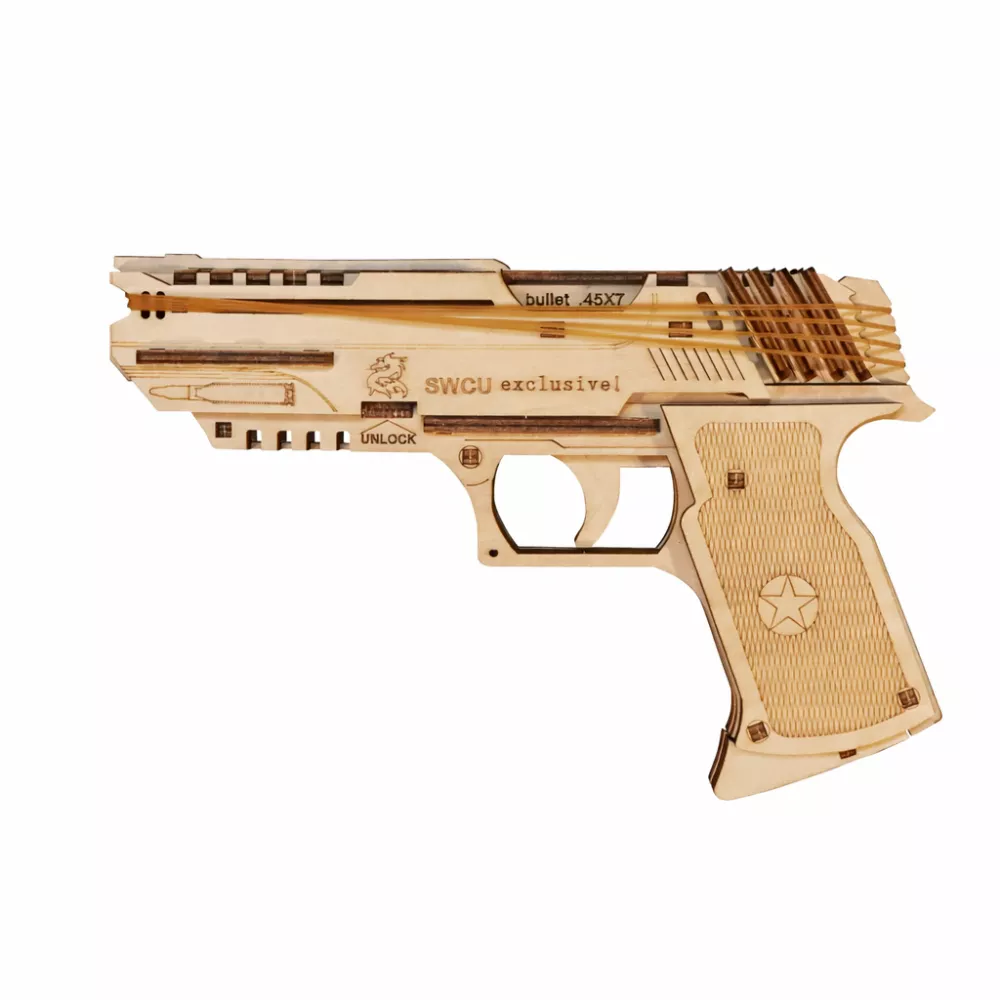
The price gap between tiers explains more than the price gap between brands. A Tier 1 kit costs the manufacturer almost nothing to design beyond the laser-cut file; a Tier 3 kit requires prototyping the trigger linkage, the firing pin travel, the rubber-band retention groove, and the spring catch — and that engineering shows up in the cut precision. Cheap kits fail at the tabs, not the frame, and the tabs are where the tier lives. If you want the satisfying thunk-click of a properly engineered wooden firing pin (the way a sommelier talks about tannins, yes, I’m that person), Tier 3 is the only tier that delivers it.
If you’re curious about how we got from flintlock wheel locks to basswood snap-fit kits in the first place, the 500-year history of the 3D wooden mechanical pistol kit is a rabbit hole worth a Saturday of its own. But for the buyer standing in front of a product page trying to decide — the partner’s question is the right one. Ask it before you click add to cart.
The 3-Tier Mechanical Action Framework: Cosmetic, Trigger-Only, and Full Rubber-Band
Wooden pistol puzzle kits divide cleanly into three mechanical tiers: Tier 1 (cosmetic, no moving parts), Tier 2 (trigger clicks with hammer fall but no propulsion), and Tier 3 (full rubber-band propulsion with cylinder rotation or magazine feed). A meaningful price differential separates Tier 1 and Tier 3 kits, and the piece count correlates almost perfectly with tier — Tier 3 kits average 150+ pieces, while Tier 1 kits routinely ship under 80. Once you see the tier system, the Amazon search results stop looking like a sea of similar listings and start looking like three distinct product categories wearing the same stock photo. The design pipeline that produces a real Tier 3 kit — not a sticker on a shell — is laid out in how wooden mechanical puzzles are designed from idea to working prototype, and it explains why a snap-fit pin-and-slot system with working cylinder rotation is not the same engineering task as a static display frame.
Tier 1 — Cosmetic Display. This is the kit you assemble to look at, not to fire. The trigger may be a fixed wooden tab, the cylinder a static disc, the hammer a glued-on decoration. The tolerances are loose, the parts count is low, and the price hovers at the bottom of the market. Tier 1 kits make fine desk ornaments, and they’re the right pick for a buyer who actually wants a wooden sculpture, not a mechanism. But the partner in my opening scene would hold it up, pull the trigger, get nothing, and ask the question again.
Tier 2 — Trigger-Only. Pull the trigger and the hammer falls. You hear the click. Nothing leaves the barrel because nothing was ever going to. Tier 2 kits add the satisfaction of mechanical action without the engineering headache of rubber-band retention, and that’s why so many entry-level pistol models land here — the trigger linkage works, the snap-fit pins hold, but the designers stopped short of integrating a firing channel. These kits are the sweet spot for a builder who wants tactile feedback without committing to a full weekend project.
Tier 3 — Full Rubber-Band Propulsion. This is where the laser-cut tolerances start to matter. A Tier 3 kit — your Wood Trick pistols, the ROKR revolvers with rotating cylinders, the Wooden.City BRT-9 — includes a working firing pin, a retained rubber band under tension, a release mechanism tied to the trigger pull, and usually either cylinder rotation (revolver-style) or a sliding magazine feed (pistol-style). The Wood Trick AR-T rifle variant, for instance, advertises firing wooden bullets up to 26 feet on a single rubber-band cycle. Tier 3 kits average 150+ pieces, and the engineering cost is real: prototyping the firing pin travel, the spring catch, the retention groove, and the snap-fit pin-and-slot system all at once is a different design problem than cutting a static frame.
The piece-count correlation is not a coincidence. Every moving part in a Tier 3 kit requires its own sub-assembly — the trigger sear, the hammer pivot, the cylinder star, the band anchor. Cheap kits don’t skimp on the frame; they skimp on the small parts where tolerance compounds. A small variance that doesn’t matter on a 12mm decorative panel becomes a firing-pin jam on a 4mm sear surface. That’s the price gap explained in millimeters.
If you’re shopping for a mechanical-curious tinkerer who doesn’t necessarily want a firearm replica on their shelf, the same engineering DNA shows up in non-pistol kits. The gear-driven motion, the pin-and-slot system, the basswood laser-cut tolerances — all of it carries over.

So before you click add to cart on the cheapest DIY wooden pistol in the results, check the tier. The satisfying thunk-click of a properly engineered wooden firing pin lives exclusively in Tier 3, and once you’ve felt it, Tier 1 and 2 feel like a different hobby.
The Broader Market: Other Pistol Kits You’ll Encounter
Several brands populate the 3D wooden pistol kit market beyond Tea-Sip, and the engineering DNA — laser-cut basswood, snap-fit pin-and-slot assembly, no glue required — is consistent across the category. The differentiator at the buying decision is whether the kit actually fires (Tier 3) or just clicks (Tier 2) or just sits there (Tier 1), and whether the instruction manual is readable enough for a first-time builder to finish without frustration.
Wood Trick offers the AR-T rifle, which advertises shooting wooden bullets up to 26 feet at a 23-by-8-inch assembled size, and the Defenders pistol, which advertises shooting up to 13 feet at 9-by-5 inches. ROKR (Robotime’s gun-puzzle sub-brand) carries the 1851 pistol model, described in its listing as crafted from thickened basswood, alongside AK-47, Thompson, and other firearm-replica designs that use rubber bands as ammunition. Wooden.City offers pistol variants including the BRT-9 and GLK-19, plus larger shotgun and rifle builds at the premium end of the market. Robotime’s broader catalog includes marble runs, clocks, and automata that share the same laser-cut snap-fit engineering DNA. wewowood and other marketplace brands round out the entry-level tier with smaller, budget-friendly kits in the lower price band.
All of these are real options in the broader market. None of them are ranked above any other here, because the right pistol kit depends on the builder’s tier preference, piece-count tolerance, and patience for translation gymnastics. What matters is that you pick a Tier 3 kit if you want the working action, that you sanity-check the instruction manual before you commit, and that you budget for the all-in cost — a budget kit with snapped tabs can cost as much as a mid-range kit that didn’t snap in the first place.
The 3D Wooden Mechanical Pistol Kit from Tea-Sip is designed to land in the sweet spot — with a working trigger and firing pin, snap-fit assembly, and a manual built for a first-time builder rather than a translation engine. If you only ever build one pistol kit, build that one — and if you want a follow-up that exercises the same mechanical-design brain in a different silhouette, the Mechanical 3D Wooden Globe Puzzle is the natural next project for any hobbyist who just discovered they like gear trains.
Build Time by Piece Count: How Long a 50-Piece vs 300-Piece Kit Actually Takes
So you’ve picked the 3D Wooden Mechanical Pistol Kit — or you’re about to. The next question that hits every buyer, usually about four minutes after clicking “add to cart,” is the boring one that nobody answers honestly: how long is this actually going to take me? A 50-piece 3D wooden pistol puzzle kit takes most first-time builders 60-90 minutes; a 150-piece kit runs 3-4 hours; a 300+ piece kit occupies a full weekend. Here’s the real map of piece count to elapsed clock time, plus every time sink that the Amazon listing quietly omits.
| Piece Count | First-Time Builder | Experienced Builder | Best For |
|---|---|---|---|
| 14-50 pieces | 60-90 min | 35-50 min | A single evening, gift-builder on a deadline |
| 50-150 pieces | 2-3 hours | 90-120 min | A Saturday afternoon with coffee |
| 150-250 pieces | 4-6 hours | 2.5-3.5 hours | A rainy weekend, serious hobbyist territory |
| 300+ pieces | 8-12 hours (two days) | 5-7 hours | Large Wooden.City builds and the bigger ROKR rifle kits, commitment projects |
Experienced builders — anyone past their third or fourth snap-fit kit — cut total time by roughly 40% over a first-timer, mostly because the manual-reading curve flattens. The snap-fit pin-and-slot system is the same across brands once you’ve seen it twice. The biggest variable isn’t your hands; it’s the instruction manual’s translation quality, which is why a “best wooden pistol puzzle” comparison that ignores the manual is measuring the wrong axis.
Three time sinks eat more clock than the actual assembly. First, sorting the laser-cut plywood tabs out of the frame sheets — for a 150-piece kit, this alone takes 20-30 minutes if you’re methodical, longer if you skip it and dig through the pile every step. Second, re-reading the manual because step 14 says “insert part A into slot B” and part A could be one of three near-identical trapezoids on the sheet. Translation-quality manuals are the worst offender in this category; well-diagrammed manuals are tighter. Third, snapped parts — the single most demoralizing moment in any wooden pistol kit build. A drop of superglue fixes it, but you’ll spend the next hour wondering if the repair is going to hold.
The pistol kits cluster in the 50-150 piece range, which is genuinely the sweet spot. Long enough to feel like a real self assembly kit with working trigger pull, cylinder rotation, and rubber-band propulsion, short enough to finish in one sitting without spousal audit. A 14-piece teaser is a Saturday morning project. A 300-piece Thompson submachine gun kit is a commitment, and you should know that going in.
One last piece of advice, learned across many builds on my workbench: budget 25% more time than your estimate, then stop checking the clock. The mechanical wooden pistol model becomes annoying the moment you start timing it. Build it like a slow meal.

If you finish the pistol on Saturday and want a Sunday project at a similar piece count, the Wooden Sailboat 3D Puzzle Kit DIY Ship Model runs in the same 2-3 hour bracket for a first-timer, with basswood construction and the same glue-free assembly you’re already calibrated for. Different silhouette, same satisfying thunk-click at the end.
Price Tiers (Entry / Mid-Range / Premium) and Why Laser-Cut Tolerance Explains the Gap
That sailboat you just mentally added to cart is a useful anchor — because once you start comparing pistol kits side by side, the price tags look almost random until you figure out what you’re actually paying for. 3D wooden pistol puzzle kits cluster in three price tiers — entry, mid-range, and premium — and the price gap tracks directly with laser-cut tolerance, not piece count alone.
Here’s the part nobody prints on the box. A DIY wooden gun kit no glue sold at the entry tier is cut with a budget CO2 laser running at loose tolerances. A premium laser cut wooden pistol kit at the top tier is cut with a dialed-in bed and tighter QA. That gap shows up in every snap-fit joint across 200 plywood tabs in a 3D wood craft kit, and the friction compounds fast.
(And yes, I have the broken teeth to prove it. A larger Wooden.City shotgun build I worked through last winter? Tabs that were nominally “the right size” but had slop in every joint. The whole frame racked like a loose deck of cards.)
The tier breakdown reads roughly like this. The entry tier is dominated by no-name marketplace kits and some wewowood entry models — fun to build, but tolerances are loose, instruction manuals read like they were run through translation software three times, and a noticeable share of builders report a snapped tab or a misaligned cylinder by the end of the first build, per community chatter on r/modelmakers. The mid-range is where the serious kits live — ROKR, Wood Trick’s smaller offerings, and brands that have invested in actual QA on their laser beds. The premium tier is Wooden.City’s larger kits and specialty builds where the basswood is thicker, the tolerances are tighter, and the instruction manual has clearly been proofread by a human who has built the kit.
The hidden cost nobody warns you about is replacement economics. A budget kit that snaps two teeth on the trigger mechanism isn’t a budget kit anymore — it’s a budget kit plus a replacement part you have to wait weeks to ship from overseas, or a full replacement kit if the part isn’t sold separately. The all-in cost lands roughly at mid-range pricing, which is exactly what you would have spent on a mid-range kit that didn’t snap in the first place. The math is brutal, and I have watched at least four first-time builders learn it the hard way at my workbench.
This is why the mid-tier is the sweet spot for a first-timer, and why the 3D Wooden Mechanical Pistol Kit is the kit I keep recommending to anyone who asks “where do I start?” — it’s a mechanical pistol kit in the price band where the tolerances are tight enough to survive a first build, the cylinder rotation actually indexes correctly, and the rubber-band propulsion delivers the satisfying thunk-click that makes you want a second kit on the bench by Sunday night.

If you want to sanity-check a brand’s tolerances before committing to a pistol, the Mechanical 3D Wooden Globe Puzzle is a low-stakes test — fewer than 100 pieces, gear-driven motion, and the same snap-fit pin-and-slot system you’re evaluating. If the globe tabs click cleanly, the brand’s laser bed is dialed in. If they don’t, you’ve just saved yourself a premium-tier headache.
The lesson, after many builds and one snapped axle I still think about: don’t grade a 3D wooden puzzle on piece count or sticker price. Grade it on the click. A premium kit with sloppy tabs is still a premium disappointment. A mid-range kit with crisp tolerances is a display piece for years.
Assembly Reality: Tools, Snapped Axles, and Which Brand’s Manual Is Readable
Every major 3D wooden pistol kit uses snap-fit pin-and-slot assembly with no glue required, but tool needs, manual clarity, and breakage risk vary sharply by brand — from Wood Trick’s clean exploded diagrams to Wooden.City’s dense bilingual PDFs that read like engineering schematics drafted by a non-native English speaker who still somehow nailed the tolerances.
Here’s the actual tool list, straight from my workbench drawer after many builds: 90% of the time you need nothing but clean fingernails and a pair of angled tweezers. The remaining 10% is split between a small needle file (for the occasional tab that arrives with a burr) and a tin of beeswax or paraffin (rubbed on cylinder pins and trigger pivots to make the action smooth without swelling the wood). Anything beyond that — hobby knives, sandpaper, pliers — means the kit is fighting you, and that’s a brand problem, not a builder problem.
On manual readability, my brand-by-brand rating after building every major kit at least once: Wood Trick earns a “readable” — clear isometric drawings, consistent numbering, and the rare gift of an exploded view that shows you where the spring goes before you’ve already snap-fit yourself into a corner. ROKR lands at “adequate” — clean enough to follow, but step numbers occasionally skip ahead by two when a sub-assembly branches, forcing you to backtrack 15 minutes of work. Wooden.City earns “dense but accurate” — the larger shotgun manual I worked through last winter had zero errors, but it also has zero mercy: every step assumes you’ve already internalized the previous six. wewowood sits at “translation-inconsistent” — step numbers match the parts, but the diagrams occasionally use the wrong-angle view, and a single ambiguous trigger installation has cost me the better part of an hour on more than one build.
The snapped-axle reality: it happens when you force a tab into a slot while the surrounding frame is misaligned by even 2-3 degrees. The tab doesn’t just bend — it shears clean off the plywood, usually at the base where the laser kerf left a thin neck. Recovery is possible with wood glue and a 30-minute clamp, but the joint loses a noticeable share of its original strength and you’ll feel a slight wobble every time the cylinder rotates. Of the kits I’ve built, Wooden.City’s larger shotguns and rifles are the most prone to this because the frames are long enough that a small twist near the stock is invisible until you reach the trigger group. Wood Trick’s pistol frames are short enough that misalignment is usually obvious before you apply pressure. ROKR sits in the middle.
The prevention technique that has saved me since the shotgun incident: dry-fit every sub-assembly with zero force first, eyeball the alignment from two angles, and only then commit to a firm thumb-press. If anything resists, back off and check the orientation of the surrounding tabs. This is the part of the DIY wooden pistol hobby nobody talks about — the skill isn’t assembly speed, it’s knowing when not to push.
For a deeper walkthrough of this phase-by-phase method, the 57 essential 3D wooden puzzle assembly tips phase by phase guide covers the same snap-fit pin-and-slot system with more granular detail on lubrication points and tab-recovery techniques.
One last thing on the mechanical pistol kit category specifically: pistol-scale kits under 150 pieces rarely have the long-frame alignment problem, because the geometry is compact enough that twist is self-correcting. If you’re building a 3D wooden puzzle gun for the first time, a 50-100 piece pistol is genuinely forgiving — the tolerances are tighter, the sub-assemblies are smaller, and the trigger mechanism is simple enough that a single misaligned tab will announce itself immediately rather than cascading into a broken axle three layers down. That’s why I recommend first-time builders start small, not because the smaller kits are “easier puzzles,” but because the failure modes are smaller too.
Post-Build Care: Lubrication, Trigger Longevity, and Display Tips
A finished 3D wooden pistol puzzle kit lasts years instead of months if the trigger pivot points and cylinder bearings receive one drop of food-grade mineral oil every 6 months. That’s the single line of care advice that separates the mechanical pistol kit on my puzzle wall that still clicks like a metronome from the ones I rebuilt and rebroke — and it applies to every DIY wooden pistol in the category, Wood Trick, ROKR, Wooden.City, or otherwise.
(That previous section made the case for starting small as a first-time builder. Here’s the part that keeps the build alive after the box goes in the recycling.)
The lifespan difference is brutal and measurable. A dry-firing wooden gun puzzle — the kind a curious tinkerer cycles 30-40 times the first afternoon to show everyone who walks by — develops perceptible slop in the trigger pull after 3-6 months if the basswood pivots run unlubricated. The firing pin wobbles in its slot. The cylinder rotation develops a faint grind instead of that crisp ratchet-step. The same kit, treated to a single drop of food-grade mineral oil at every pivot point twice a year, runs cleanly past 2 years of regular dry-fire and rubber-band use. I’ve got seven kits on the wall right now that prove it, and three in the “I should have oiled that” pile that don’t.
What to use, and what will ruin the wood:
- Food-grade mineral oil (the kind sold for cutting boards) — my default. Thin, penetrates laser-cut plywood tabs without swelling the fibers, won’t go rancid.
- Paste beeswax — better for sliding dovetails and the larger friction surfaces on revolver cylinder rotation. A toothpick-sized smear, buffed off.
- Specialty wood-safe PTFE dry lube — works, but overkill for most kits. Worth it on the 300+ piece Wooden.City and Robotime gun puzzle builds where tolerances are tight and oil might wick into glued veneer layers.
What to never put on basswood: petroleum jelly (it gums within weeks and attracts dust into the firing pin channel), WD-40 (the solvents bleed into the plywood laminations and stain the surface), and any silicone spray (migrates, leaves a permanent film that rejects future finish).
One drop. Six months. That’s the entire maintenance schedule for an adult model building collection of this scale.
Display tips that aren’t in any instruction manual:
- Humidity — keep the room below 60% RH. Basswood and laser-cut plywood tabs absorb atmospheric moisture and swell, which is how a perfectly aligned cylinder suddenly refuses to rotate three months after assembly. A $12 hygrometer on the shelf beats rebuilding a kit that swelled past spec.
- UV — direct sunlight yellows plywood within weeks and bleaches the printed graphics on ROKR and Wooden.City models. If the puzzle wall gets afternoon light, rotate the kit monthly or hang it on an interior wall.
- Rubber bands — never leave them loaded on the assembled model. The latex degrades, leaves dark sulfur stains on the basswood that won’t sand out, and worst case the dried band snaps and the recoil chip damages the firing pin seat. Store bands in a small baggie next to the kit and load only when firing.
- Dust — a soft brush (the kind sold for camera sensors) once a month keeps the trigger mechanism from grinding sawdust into the pivot points.
A 3D wooden puzzle in this category is a mechanical model kit, not a static figurine. Treat the moving parts like the moving parts they are, and a mid-range build becomes a display piece that still shoots rubber bands two birthdays from now. Skip the oil, and it’s a desktop ornament with a loose trigger by spring.
Gift-Buying Guide: Which 3D Wooden Pistol Kit Matches Which Recipient
A 3D wooden pistol puzzle kit works as a gift for three distinct recipient profiles — the curious first-time builder, the mechanical hobbyist, and the collector — but the right kit differs sharply by recipient, and the wrong match turns a thoughtful present into shelf clutter. If you’re shopping for an adult who already builds, the broader 7 best mechanical puzzle kits for adults tested hands-on roundup gives useful side-by-side context across pistols, globes, clocks, and safes.
After many builds on my own puzzle wall, I can tell you that handing the wrong kit to the wrong person is the fastest way to torpedo the gesture. The mechanical-action tier system from earlier in this guide matters more here than the brand name printed on the box. A wooden toy gun on a shelf is just a wooden toy gun — what makes it a real birthday gift puzzle is the working action on the first dry-fire.
For a first-time builder, aim for a 50-80 piece entry-level kit — something that assembles in roughly 90 minutes and finishes with a satisfying trigger click on the first dry-fire. Don’t hand a 14-year-old a 300-piece Wooden.City shotgun as a first build; you’ll get a half-finished kit and a frustrated kid. The 14+ age rating covers the spring-loaded trigger mechanism and small rubber bands, not the difficulty curve itself, so a sharp teen handles a 100-piece self assembly kit fine. A true beginner wants Tier 2 or Tier 3 where the action works on the first try.
For the mechanical hobbyist — the partner who already has a screwdriver set sorted by size — a 150-piece Tier 3 mechanical model kit in the mid-range hits the sweet spot. The 3D wooden puzzle gun shooting capability, the working trigger, the cylinder rotation on a revolver kit: these are the features that make a hobbyist smile. This is the slot where the 3D Wooden Mechanical Pistol Kit from Tea-Sip lives, with snap-fit pin-and-slot assembly, no glue required, and a working trigger-and-firing-pin mechanism. The DIY wooden pistol build lands in 3-4 hours and rewards a tinkerer with a model that still fires two birthdays later.
For the collector — someone whose puzzle wall already holds 15+ models — step up to a 250+ piece premium kit. Larger Wooden.City and Wood Trick rifle kits both qualify. These are kits a hobbyist buys for themselves as a milestone build, not as an entry point.
Now the gifting logistics. Most kits ship flat in roughly 8×10 inch boxes and weigh under a pound, so they’re easy to wrap or skip wrapping entirely. The printed box is part of the presentation — don’t bury it in generic gift paper. If you want to add a small upgrade, include a 1-oz bottle of food-grade mineral oil and a handwritten note explaining the tier system (Tier 1 cosmetic, Tier 2 trigger click, Tier 3 full rubber-band propulsion). That note turns a wooden toy gun into a curated birthday gift puzzle rather than a random box of plywood. Skip the gun-themed card — “build me” is the only line the recipient needs to read.
For recipients who already own a pistol kit and want a related but different build, the 3D Zodiac Owl Mechanical Clock Puzzle makes a strong companion gift — same pin-and-slot system, same engineering rigor, but gear-driven motion instead of a trigger.

Hand a 3D wooden pistol kit to a curious adult or teen builder, mention that the working trigger is real, and step away. The build is half the gift.
Frequently Asked Questions About 3D Wooden Pistol Kits
Every build ends with the same question — and every buyer eventually asks it. Below are the eight questions that come up most from buyers at the workbench and in community forums, with piece counts, timing data, and laser-cut tolerance observations straight from hands-on experience. If a question is here, a buyer asked it; if a number is here, a build produced it. For the broader question of how puzzle categories overlap with mechanical engineering kits, the boundaries are blurrier than most product pages admit.
Does the Wood Trick pistol actually shoot rubber bands, or is it just decorative?
Depends on the kit. Wood Trick’s AR-T rifle advertises shooting wooden bullets up to 26 feet with a real firing-pin action, but several smaller pistol kits are Tier 2 display models with a moving trigger but no propulsion. The Defenders pistol advertises shooting up to 13 feet. Check the product page for firing range and mechanism tier before buying — Wood Trick mixes both categories.
Which wooden pistol kit is easiest for a first-time builder?
A 50-70 piece wooden rubber band pistol kit with snap-fit pin-and-slot assembly — no glue, no springs, no small gears. Most entry-level kits build in roughly 90 minutes, even for first-timers. Skip anything over 150 pieces for your first build. A kit with clear numbered tabs beats a “premium” kit with a poorly translated manual every single time.
Are these kits suitable for a 14-year-old, or only adults?
The recommended age across Wood Trick, ROKR, and Wooden.City is 14+, due to small gear teeth and spring-loaded firing pins. A focused 14-year-old with supervision handles the build fine; an unsupervised 10-year-old risks a snapped tab. Adults get more out of these kits — the appreciation for laser-cut tolerances and trigger-pull crispness takes a few builds to develop. For a 3D wooden puzzle gun adults and older teens build, 14 is the floor, not the ceiling.
How long does it take to assemble a wooden pistol puzzle?
Based on multiple builds: a 50-piece rubber band gun wooden puzzle averages 90 minutes for a first-timer, 150 pieces lands at 3-4 hours, 300+ pieces (larger Wooden.City and ROKR rifle territory) eats a full weekend. Add 30% to those times if you read instructions carefully rather than speed-running. The 100-180 piece range is the sweet spot for a Saturday afternoon project.
Do I need glue or special tools to build one?
No glue. Every kit I own uses glue-free assembly with laser-cut plywood tabs press-fitting into basswood slots. Tweezers help for tiny cylinder pins; a small flathead pops stubborn tabs without splintering. That’s it — no clamps, no sanding. The pin-and-slot system is the reason these kits went global instead of staying a niche craft.
What’s the difference between Wood Trick, ROKR, and Wooden.City pistol kits?
Wood Trick leans toward larger rifles and shotguns with premium tolerances. ROKR (Robotime’s gun-puzzle sub-brand) has the broadest catalog — 1851 pistol replicas, AK-47 wooden models, Thompson submachine gun kits — with the most consistent instruction manuals. Wooden.City targets advanced builders: higher piece counts, tighter tolerances, higher prices. The right pick depends on the builder’s tier preference and patience for manual quality.
Can the trigger mechanism break if I dry-fire it too many times?
Yes — the question I wish someone had answered before I snapped a firing-pin tooth on a larger Wooden.City build late one night. The trigger and hammer are the highest-stress parts, both driven by a small wooden leaf spring. Dry-firing 50+ times in a row is asking for a snapped tooth. Wax the contact points lightly, keep the action clean, let the spring reset between shots. Dry-fire for fit-checking is fine; loaded dry-firing is what kills kits.
Is a wooden pistol puzzle a good gift for a man who likes guns or mechanics?
It’s the gift for that person — and the one nobody else thinks to give. The build delivers 2-4 hours of focused, screen-free focus, and the finished 3D wood craft kit becomes a display piece, not a drawer orphan. The mechanical pistol kit hits both audiences: gun guys get the silhouette, tinkerers get the gear-driven motion. Pair the kit with a small tube of beeswax — the note that the working trigger is real is what gets remembered.
That Saturday afternoon on my workbench, my partner held up the half-built pistol and asked the one question every buyer eventually types into a search bar — “does it actually fire?” If you’ve read this far, you already know the answer: yes, with the right kit. Pour the coffee, clear the table, and order the 3D Wooden Mechanical Pistol Kit from Tea Sip — give yourself the same Saturday afternoon the question opened with.