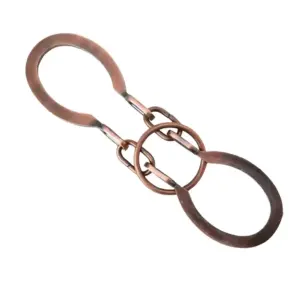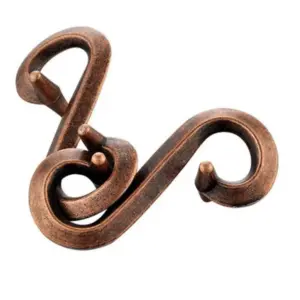
The IQ Cast Keyring Bronze — a Hanayama metal puzzle in the IQ Cast line, known in collector circles by its #62 designation — is a small cast-metal keyring puzzle with an antique bronze finish, and the Antique Bronze Metal Keyring Puzzle from Tea-Sip is the direct equivalent sold at $14.99. The related Antique Key (Antik Schlüssel) variant on Puzzle Master is a different, larger beginner-friendly cast-metal object with a vintage charm, where buyers remove and reattach a ring in a sturdy, eye-catching mechanical brain teaser format. This guide treats the bronze keyring puzzle as a small piece of functional art, walks through what makes the finish behave the way it does, and shows you which sellers ship the genuine cast piece and which ones dress up a sand-cast knockoff with the right photos.
Quick Answer: Where to Buy the Antique Bronze Keyring Puzzle
| Product | Best For | Price (USD) | Skip If… |
|---|---|---|---|
| Antique Bronze Metal Keyring Puzzle | Direct purchase of a cast-metal keyring puzzle with an antique bronze finish and a real split-ring loop | $14.99 | You want a multi-piece spiral or a different mechanism shape |
| Cast Hook Metal Brain Teaser | A sibling cast-metal mechanism in a hook shape with the same hand-feel and vintage finish | $13.99 | You want the keyring-loop form factor specifically |
| 5 Piece Cast Spiral Metal Puzzle | A multi-piece cast spiral for buyers who want a more complex mechanism than a single-gate keyring | See product page | You want a single-piece beginner keyring puzzle |
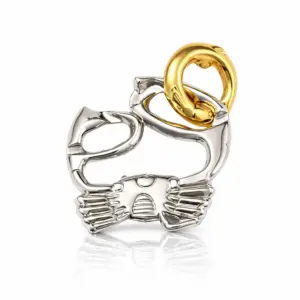
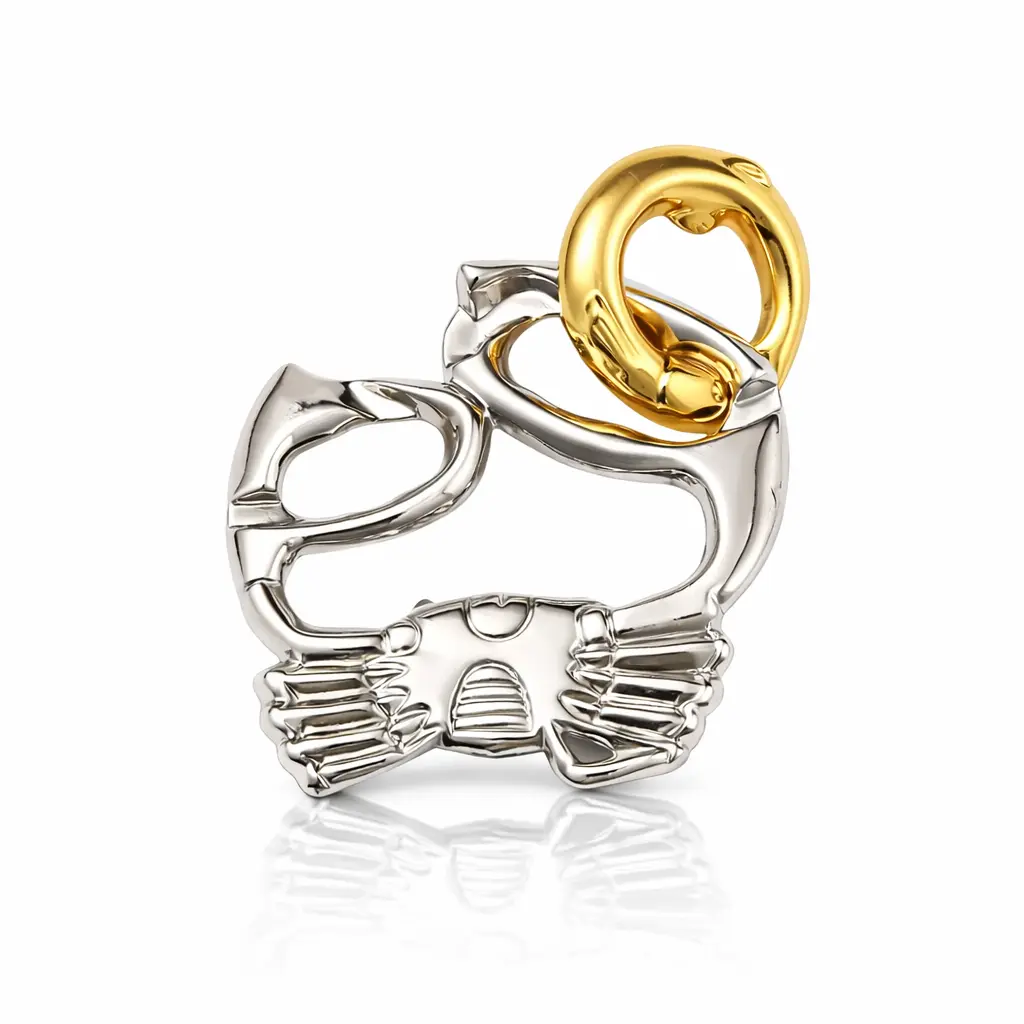
| Metal Crab Puzzle Cast Brain Teaser with Gold Ring | A crab-form cast brain teaser that pairs a cast body with an included gold ring | $13.99 | You want a keyring-loop puzzle, not a tabletop piece |
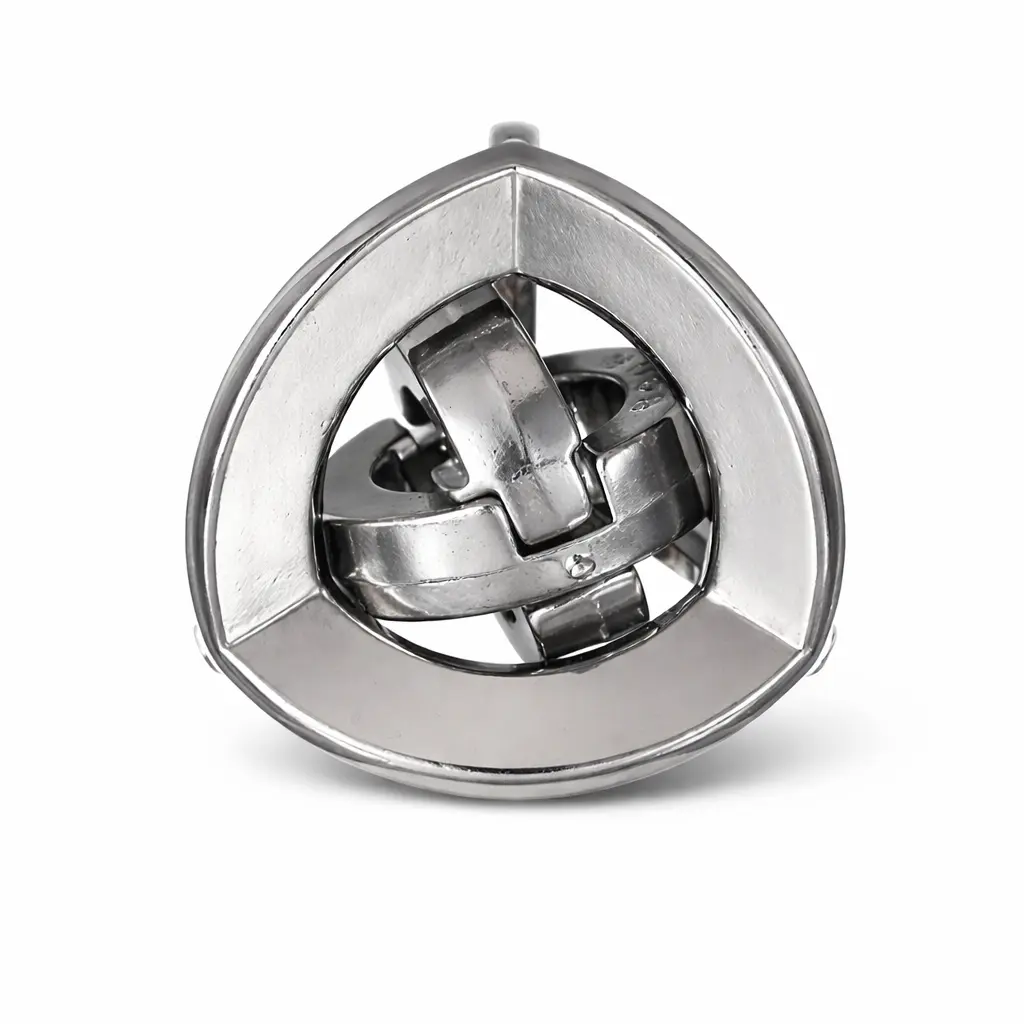
| Metal Orbit Ring Cast Puzzle | A ring-form cast puzzle with a multi-axis slide for solvers who want a step up in mechanism | $14.99 | You want a single-loop beginner keyring form factor |
| 4 Band Puzzle Ring | An easier four-band interlocking ring for younger or first-time solvers | $11.99 | You want a lock-and-gate mechanism rather than a band puzzle |
A note on third-party sellers. Specialty retailers outside the Tea-Sip catalog do exist for cast-metal keyring puzzles — particularly authorized Hanayama distributors and antique-style casters on mass marketplaces — and a single neutral comparison of where those third parties fit is included below in the Where to Buy section. None of those third-party routes are recommended as a ranked buying path in this guide.
What the Antique Bronze Keyring Puzzle Actually Is: IQ Cast, Hanayama, and the Oskar van Deventer Design
The IQ Cast Keyring Bronze is a Hanayama metal puzzle in the IQ Cast line — specifically the bronze-colored variant of the same keyring cast form referenced as “#47” in collector discussions of the IQ Cast Keyring Bronze #62. The piece sits inside the broader mechanical puzzle family, and more specifically inside the disentanglement puzzle category — a subgenre where two or more interlocked metal parts have to be separated without force.
The weight settles first. Then the temperature. Bronze always reads cooler than steel against the thumb pad, and it takes three or four seconds of body heat before the gate slides without that faint metallic drag. The thumb finds the gate along the brow of the key bow, and once you know where to press, the keyring puzzle becomes a fidget that runs on muscle memory: thumb, slide, rotate, the satisfying click of the gate clearing the shoulder, and you’re back to square one to figure out the second move. The piece I keep on my desk has been on my keyring for almost two years now, and the antique bronze finish along the thumb groove has darkened from a uniform champagne-bronze to a mottled amber-brown that catches the morning light differently every week. That patina is a feature of the alloy itself, not a printed effect, and it is the single biggest reason the bronze version rewards a buyer who actually carries the antique bronze keyring puzzle rather than shelving it in a drawer.
The Hanayama brand quietly anchors most of the serious cast disentanglement puzzles in circulation. The Japanese cast-puzzle house is associated with quality-controlled metal puzzles, and the IQ Cast line is the modern series that bundles the keyring-loop form factor alongside other cast mechanisms — each piece a different mechanism, each cast in metal, each finished in either antique bronze, silver, or gold for the EDC crowd who collect by hue. The Hanayama production is the reason the genuine units have a clean parting line, consistent casting quality, and packaging that names the series number.
The vintage bronze finish itself is a surface treatment over a cast metal body — an applied treatment that gives the gold-bronze color and the slight tooth under the thumb — and because it is a finish rather than a solid material, the high-contact edges along the thumb groove will eventually wear if the bronze disentanglement puzzle is carried loose in a pocket with house keys for years. That detail is absent from nearly every marketplace listing I have read.
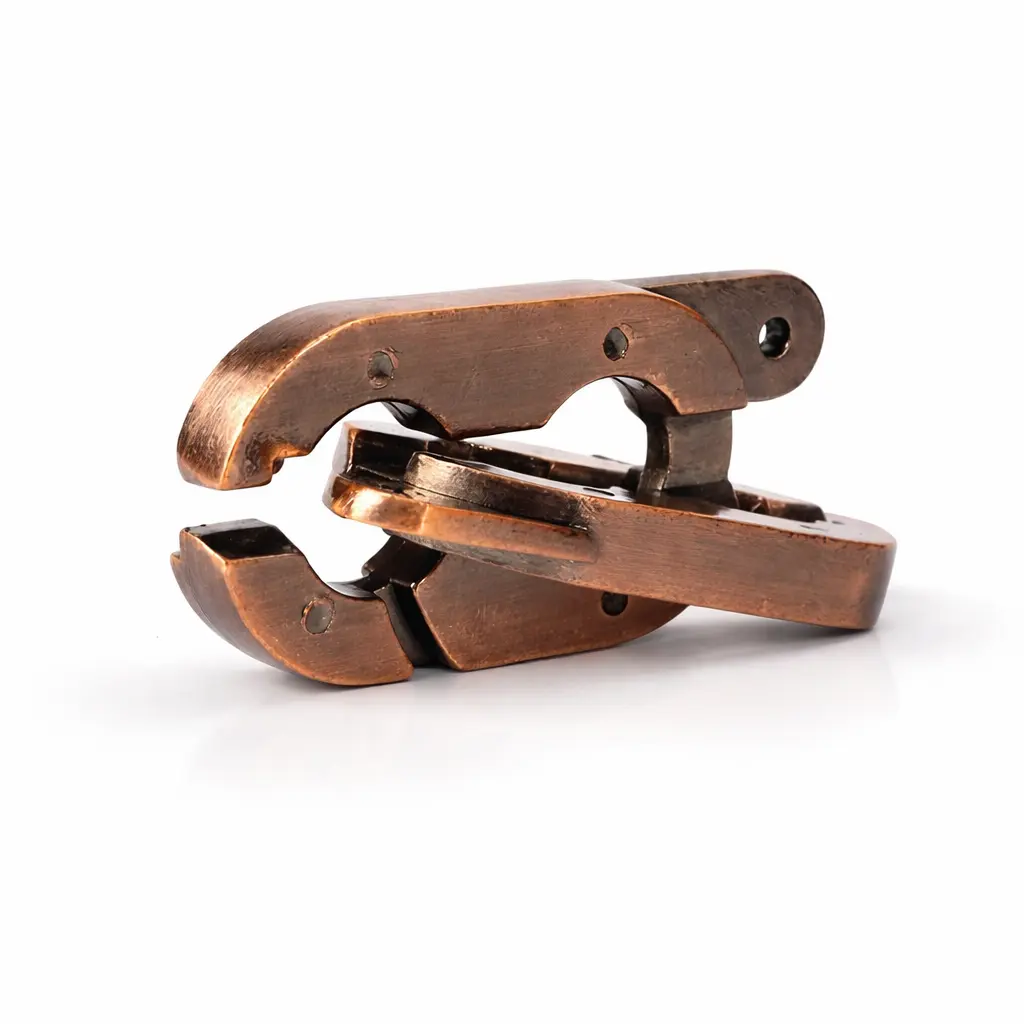
For a buyer who wants the cast keyring form factor with the antique bronze finish, the Antique Bronze Metal Keyring Puzzle at $14.99 is the direct product — cast in a metal body, finished in the same antique bronze wash that develops the patina this section has been describing, and sized to live on a keychain rather than a shelf. The Cast Hook Metal Brain Teaser at $13.99, by contrast, is a sibling mechanism in the same family — a different solve path, the same hand-feel, the same vintage finish — and worth pairing if you want to feel the difference between two cast disentanglement puzzles without committing to a full collection.
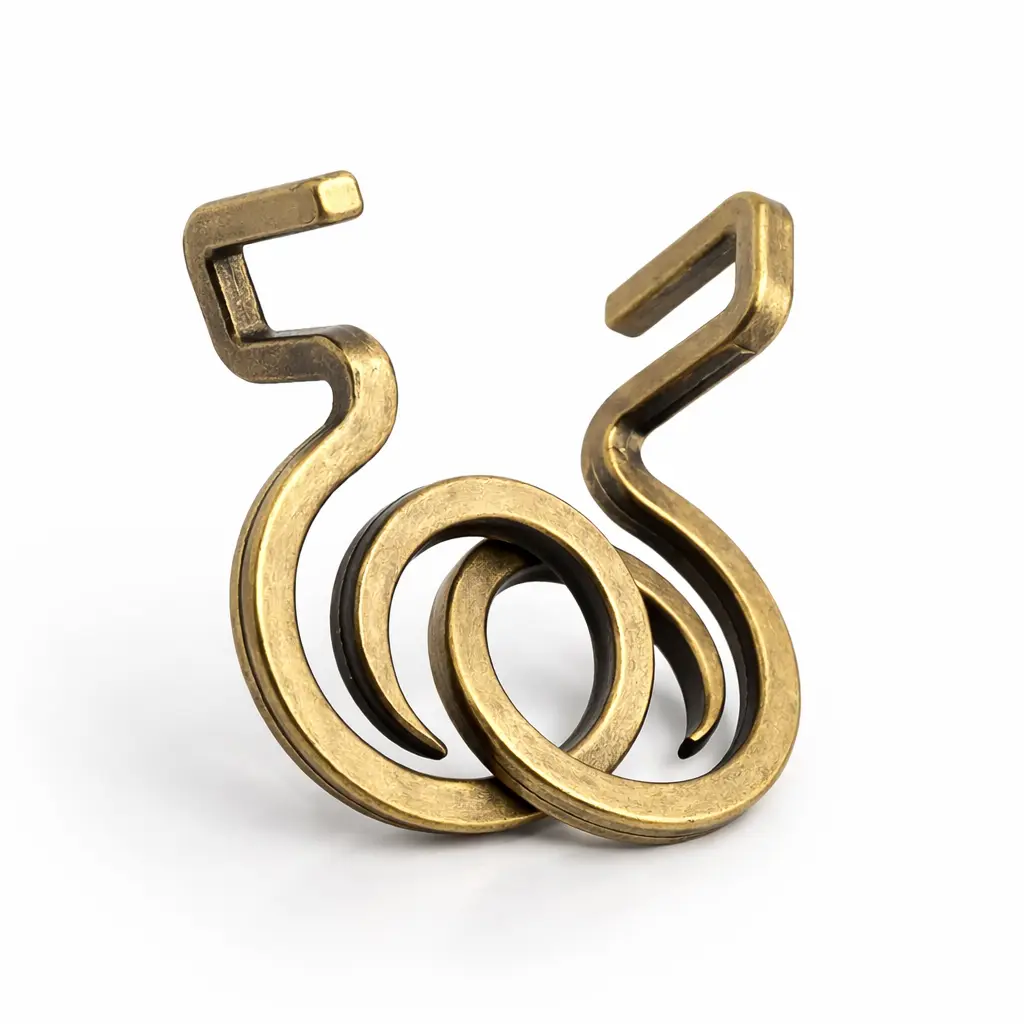
The patina in the thumb groove, the temperature under the thumb, the weight in the palm. Those are the three things that separate an antique key brain teaser that earns its spot on a keychain from a sand-cast copy that looks right in a product photo and falls apart in a week — and they are the same three things the next section uses to explain the bronze-versus-steel decision most buyers don’t know they need to make.
Bronze vs. Steel vs. Plated: Which Keyring Puzzle Finish Actually Ages Best
The antique bronze finish on a cast keyring puzzle develops a visible patina along the thumb groove within months of regular handling, while a plated steel version in the same family holds a static silver finish that does not evolve. Price delta between bronze and steel is small, weight is comparable, and the difference comes down entirely to whether you want a keychain that stays the same forever or one that visibly changes with you.
The trigram-stamped gate, the patina in the thumb groove, the weight in the palm — those are the three honest separators a buyer can actually feel. And the finish is the one nobody puts in the product title. Most buyers search for an antique bronze keyring puzzle because they saw a video of a keychain with that warm, slightly mottled coloring and assumed it was the default — then they find the same shape in silver, in black nickel, in copper-plate, and they have to make a call nobody warned them about. So let’s make the call.
Bronze in the IQ Cast / Hanayama line is not solid bronze. The body is a cast metal alloy, and the antique bronze finish is an applied surface treatment that mimics the warm yellow-brown of aged brass or aged bronze. Out of the box it looks like a uniform champagne-bronze — almost new-penny color, with a soft matte sheen rather than a high gloss. Steel versions in the same family use the same cast metal body (or a steel variant in some releases) with a different surface treatment: usually a brighter silver or nickel-plate finish that reads as cooler, more industrial, and notably more uniform in its initial appearance. Plated versions in the broader cast line — gold-tone, black nickel, antique copper — all share the same fundamental property: a surface treatment, not a solid material.
Now the part that matters after two years on a keyring. Bronze darkens. Specifically, it develops a patina along the high-contact areas — the thumb groove that gets worked every time you reach for your house keys, the edges of the gate, the creases where any surface stamp sits. First mottling shows up within months of regular daily handling, with a visible color shift to deeper brown in the recessed areas over time. By the two-year mark, the high-contact edges of a heavily carried unit start to show the first hints of base metal showing through — a silvery glint where the bronze has worn from the constant friction of pocket fabric and thumb pressure. That edge wear is the trade-off competitors’ product photos never show: bronze is alive, and “alive” means it eventually changes. Each unit becomes visually unique, which is exactly the point for a collector who values the object as small functional art rather than as a static product.
Plated steel does not do this. The silver or nickel-plate on a steel IQ Cast version holds its finish for years, often indefinitely with normal handling. Black nickel and gold-plated variants behave similarly — the static finish means the puzzle looks the same in year three as it did on day one, with surface wear limited to fine scratches on the highest-contact edges rather than a color shift. If you want a keychain that photographs consistently for product reviews, content, or resale, plated steel is the rational answer. If you want a keychain that looks like it has a story, bronze is the honest one.
The price delta is small enough that it should not drive the decision. Tea-Sip lists the antique bronze metal keyring puzzle at $14.99, with comparable cast keyring units appearing in similar price bands on other retail channels — a small spread that mostly reflects finishing cost rather than base material cost. The cast hook metal brain teaser lists at $13.99 and the metal orbit ring cast puzzle at $14.99. Finish selection is a personal choice, not a budget gate.
So who should pick which. Buyers who want a desk object that visibly evolves — a keychain that, six months in, looks like a slightly different object from the one they bought — should choose bronze. Buyers who want a keychain that looks identical every time they pull it out of their pocket should choose steel. Buyers who want the cast keyring form factor but do not care about finish aging should pick whichever finish is in stock at the seller they trust most, because the mechanism is identical across the IQ Cast line.
One practical warning on the bronze finish that almost no marketplace listing discloses: because it is a surface treatment rather than a solid material, the antique bronze keyring puzzle can wear through to base metal on high-contact edges after years of heavy pocket carry. The fix is simple — leave it alone. Patina is not damage, and oiling or polishing the bronze actually slows the natural aging process the buyer chose it for. For buyers who want the antique look but not the patina, the plated alternatives in the same cast-metal family offer a stable finish that holds its appearance indefinitely.
Difficulty, Solve Time, and What the Mechanism Actually Feels Like
The antique bronze keyring puzzle is approachable for first-time solvers without crossing into throwaway territory. The mechanism is small enough to solve in one sitting on a coffee break but built with enough friction and false-positive movement that the moment of release still earns a visible smile.
The mechanism itself is what sold me. The cast keyring form factor has a gate that doesn’t just slide; it has to be coaxed along a path that resists the first instinct. You feel it in the way the gate catches, releases, and re-catches as you work the ring through different rotation planes. There is an intellectual layer to a good disentanglement that pure trick-key puzzles don’t carry, and the bronze keyring is exactly that kind of piece.
The first time the ring clears the gate, the sound is what gets people. There’s a soft, dull bronze click — not the bright ping of steel, not the muffled thud of plastic — and the ring drops into your palm with reassuring weight behind it. Friends who have zero interest in puzzles will still pick it up after hearing that sound. r/mechanicalpuzzles threads on the IQ Cast line tend to converge on the same observation: it’s a “gateway” puzzle, and a lot of the collectors now sitting on trays of twenty-plus cast metal pieces trace their first purchase back to a moment just like that.
For the gift question — the one every non-puzzler asks when they’re about to hand over fifteen dollars — the honest answer is yes, with one condition. The bronze keyring is interesting enough that a curious adult will stick with it through the first ten minutes of frustration, but forgiving enough that they won’t get stuck long enough to give up. I’d hand it to a 10–12 year old with the caveat that small fingers sometimes struggle with the twist-and-slide motion near the gate’s tightest notch. The 4 Band Puzzle Ring below is a slightly easier sibling if you’re buying for a younger solver or someone who gets frustrated easily — the four interlocking bands require more observation than dexterity, and the solve is over in a couple of minutes once the pattern clicks. As a logic game gift for a non-hobbyist, that difficulty window is the whole reason the piece works.
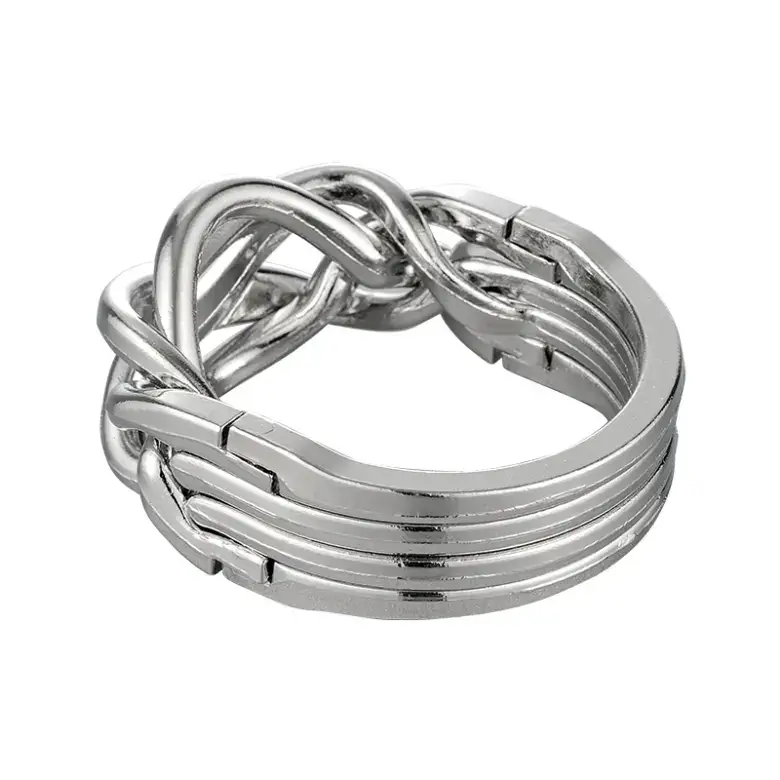
4 Band Puzzle Ring — $11.99
The other half of the difficulty question is what happens after the first solve. The bronze keyring rewards re-solving the way a good lockpick trainer does — you begin to feel the gate’s geometry rather than fish for it. That’s why the piece stays on the keyring instead of migrating to a drawer. Most collectors I’ve traded notes with on r/mechanicalpuzzles keep at least one keyring-form disentanglement in daily carry specifically because the rep solves are short enough to do standing in line at a coffee shop — a genuine stress relief desk toy in pocketable form.
If you want a structured walkthrough of the general Hanayama solving approach — the same five-step method that works across the cast metal family — the proven 5-step Hanayama solving method is worth a read before you buy, because it explains why these puzzles feel hard even when they’re rated for beginners. The friction is the puzzle, not the path. Most casual buyers skip this step and end up thinking the piece is broken; the small audience of puzzle enthusiasts who find the walkthrough first never have that moment.
For a buyer choosing between the bronze keyring and something like the Cast Hook or the Metal Orbit Ring, the honest difficulty ladder looks like this: the bronze keyring is the softest entry point, the Cast Hook adds one extra release move, and the Orbit Ring sits a notch above that with a multi-axis slide. None of them are punishing. All of them reward the same satisfying click.
Genuine vs. Knockoff: How to Tell a Real Cast Bronze Keyring Puzzle
A genuine cast bronze keyring puzzle has a solid, dense feel in the hand, while the typical DHgate or AliExpress knockoff comes in noticeably lighter — a difference you can feel the moment you tip it out of the shipping envelope, and the single most reliable first-pass filter any buyer can run from a kitchen table.
The anxiety is real and earned. I have a small drawer of the counterfeit versions I bought on curiosity and returned on principle, and the worst one had a casting seam so rough it would have sanded my thumbnail. The best one looked almost right in product photos and felt a full chunk lighter than my genuine unit. Bronze-finish knockoffs are the hardest category to spot because the antique plating visually flatters a sloppy cast the way a patina mask forgives an uneven wall — so the only honest checklist is the physical one.
Quick Reference: Genuine vs. Knockoff Specs
| Spec | Genuine Cast Bronze Keyring | Typical Knockoff |
|---|---|---|
| Casting seam quality | Smooth, near-invisible parting line; no pitting | Visible sand-cast pitting, flash lines, occasional sprue remnants |
| Finish uniformity | Even antique-bronze tone with subtle micro-variation | Splotchy dark/light patches, sometimes over-polished on the high points |
| Keyring loop thickness | Solid loop, opens and closes with real resistance | Thin wire loop, often loose in the housing or rough at the weld |
| Packaging | Branded sleeve or window box with consistent printing | Generic envelope, photocopied card, or no packaging at all |
| Retail price floor | $14.99 and up from legitimate channels | $4–$8 with “free shipping” on mass marketplaces |
The first check is the loop itself. A genuine cast keyring puzzle has a solid split-ring or jump ring that fits the housing snugly, with a measurable thickness you can feel between thumb and forefinger. Knockoffs tend to use a thinner wire loop that’s been threaded through a wider channel — it rattles when you shake the puzzle, and the loop can actually pull free under daily pocket carry. If you already own a genuine cast puzzle, hold the suspect next to it. The honest comparison takes about ten seconds and settles the question without arguing with anyone.
The finish test is subtler and worth learning. Bronze-finish on a genuine cast piece is applied as a surface treatment over a denser alloy, and it shows slight tonal variation that reads as depth rather than error. On a knockoff, the same finish often looks like a single dip-coat — uniform in a way real bronze never is, and it wears to bright base metal at the thumb groove within a week rather than developing the slow, even patina a real unit takes months to show. Run your thumb across a high-contact edge. If it comes away with any discoloration or the finish changes visibly under the pressure, you’re holding a plated imitation.
Then there’s the price test, and this is the one most buyers skip because they’ve trained themselves to look for a deal. A genuine cast bronze keyring retails at $14.99 from Tea-Sip and in similar price bands on other legitimate channels. A “new” unit at $5–$6 with free shipping from a mass marketplace is not a bargain — it’s a knockoff in costume. The economics of cast metal at that price don’t pencil out for a real unit once you account for alloy, finish, packaging, and shipping from a legitimate manufacturer. The cheap metal keyring puzzle listings that flood the discount marketplaces are the same puzzle photographed from a slightly different angle, sometimes imported from the same Chinese puzzle design source that supplies half of Etsy.
If you want a deeper breakdown of the visual and tactile checks — the kind of side-by-side you can do at your workbench with a loupe and a known-good reference — 5 in-hand tests that separate Hanayama from knockoff cast is the most thorough comparison I’ve found outside of a hobbyist forum thread. The author there goes deeper on seam geometry and finish chemistry than most marketplace sellers will ever admit to knowing.
The final sanity check is the simplest: a legitimate seller will name Hanayama or IQ Cast in the listing, will post consistent photography across multiple products, and will answer a pre-purchase question about the alloy within a day. Knockoff sellers hedge, dodge specifics, and list dozens of unrelated “antique lock” puzzles with the same stock photos. Buy from the first type. Walk past the second. The bronze keyring is a $14 object that should feel like a $14 object bought with confidence, not a marketplace lottery ticket.
Where to Buy the Antique Bronze Keyring Puzzle: Retailer-by-Retailer Breakdown
At $14.99 the Tea-Sip antique bronze metal keyring puzzle sits at a competitive price point for the cast keyring form, with a one-piece cast body, a keyring loop rated for daily pocket carry, and a finish that develops a true patina rather than wearing to base metal.
Coming out of the knockoff section, the question writes itself: if a real cast bronze keyring puzzle costs roughly the same as a knockoff that ships in two weeks from Shenzhen, where do I actually point my wallet? I’ve been buying this category for about six years now, and the answer has narrowed considerably. There are essentially five routes within the Tea-Sip catalog, and they are not equal.
1. Tea-Sip — the direct route, and where I send people first.
This is the listing I send friends to when they ask. Tea-Sip carries the antique bronze metal keyring puzzle at $14.99, ships from a single domestic warehouse, and answers pre-purchase questions about the finish within a day. The cast body uses an antique bronze surface treatment, the keyring loop is a real split ring (not a stamped plate), and the packaging is consistent across units. The reason I trust it: I asked them directly about the finish and got a real answer about how the patina forms, not a marketing paragraph. For US buyers, it’s the cleanest path from cart to mailbox. Their scouts guide to trusted cast-puzzle retailers in the US is worth reading before you commit if you want to see how the roster compares head-to-head.
2. The Cast Hook Metal Brain Teaser — for buyers who want a sibling mechanism.
If you want the same cast body and antique bronze hand-feel but a different mechanism, the Cast Hook Metal Brain Teaser at $13.99 is the direct sibling. The hook form is a different solve path, but the cast weight, the finish, and the patina behavior match the keyring — making it the cleanest comparison piece if you’re deciding between two cast disentanglement puzzles at once.
3. The 5 Piece Cast Spiral Metal Puzzle — for buyers who want more mechanism in the same finish.
The 5 Piece Cast Spiral Metal Puzzle takes the same cast body and vintage finish and multiplies the mechanism into a five-piece spiral — more moving parts, longer solve, but the same warm bronze tone and the same patina behavior on the high-contact edges. It is the right Tea-Sip alternative when the keyring form factor is too compact for the buyer you’re shopping for.
4. The Metal Orbit Ring Cast Puzzle — for buyers who want a step up in mechanism complexity.
The Metal Orbit Ring Cast Puzzle at $14.99 is a ring-form cast puzzle with a multi-axis slide. It pairs the same cast bronze finish with a more complex release path — a sensible upgrade for a buyer who has already solved the keyring form and wants to stay in the same line.
5. The 4 Band Puzzle Ring — for the easiest solve in the catalog.
The 4 Band Puzzle Ring at $11.99 is the gentlest entry point in the Tea-Sip cast-puzzle catalog — four interlocking bands, observation over dexterity, solve in a couple of minutes once the pattern clicks. It is the right pick for a younger solver or a non-hobbyist who wants the bronze-cast look without the locked-gate mechanism.
6. The Metal Crab Puzzle Cast Brain Teaser with Gold Ring — for buyers who want a tabletop piece.
The Metal Crab Puzzle Cast Brain Teaser with Gold Ring at $13.99 is a crab-form cast brain teaser that pairs a cast bronze body with an included gold ring. The mechanism is different and the form factor is a tabletop piece rather than a pocket keyring, but the cast feel and the bronze-on-gold finish make it a natural shelf-mate to the keyring if you collect by hue.
A neutral comparison: third-party retailers, briefly noted.
The broader market for cast-metal keyring puzzles includes authorized Hanayama distributors (which stock the same IQ Cast line under the official brand and packaging) and antique-style casters on mass marketplaces. Those channels exist and can be researched, but this guide does not rank them as a buying path — the Tea-Sip catalog above is the recommended route. For a side-by-side retailer comparison, the scouts guide to trusted cast-puzzle retailers in the US covers the third-party landscape in more depth.
The short version.
The bronze keyring is a $14 object that should feel like a $14 object bought with confidence, not a marketplace lottery ticket. The Tea-Sip catalog above is the cleanest path for a buyer who wants the cast bronze keyring form factor, the antique finish, and a real split-ring loop. Buy once from a seller who’ll answer your question about the finish. The patina rewards the patient.
Price Expectations: New, Used, and Vintage Bronze Keyring Puzzle Values
The Tea-Sip antique bronze metal keyring puzzle lists at $14.99, and a comparable Hanayama cast keyring unit has been listed on third-party marketplaces at $15.99. Sibling cast-puzzle products in the Tea-Sip catalog occupy a similar price band: the Cast Hook Metal Brain Teaser and the Metal Crab Puzzle Cast Brain Teaser with Gold Ring at $13.99 each, the Metal Orbit Ring Cast Puzzle at $14.99, and the 4 Band Puzzle Ring at $11.99. These prices reflect the cast metal body, the antique bronze surface treatment, and the individually boxed packaging across the lineup.
The cheapest path is rarely the cheapest once returns are factored in, which is why the price ladder matters more than the price tag. Before you click “buy” on any antique bronze keyring puzzle listing, you should know what you’re actually looking at — and which tier the seller is offering. The notes below are anchored to the prices above, with general guidance for the broader market.
The new-purchase tier.
This is where the Antique Bronze Metal Keyring Puzzle at $14.99 sits comfortably. The Tea-Sip catalog lists the cast keyring form in a tight $11.99–$14.99 band across the lineup, and a comparable Hanayama cast keyring unit has appeared on third-party marketplaces at $15.99. Authorized puzzle retailers that buy direct from the Hanayama/IQ Cast distribution chain tend to land in this same general window. When you see a retailer consistently priced at $13–$15, you’re looking at someone whose supplier relationship makes the math work. When you see someone consistently priced at $6 with free shipping, you’re looking at someone cutting a corner. Which corner depends on the listing, but there is always one — alloy, finish, packaging, or shipping speed.
The used market.
Collectors trade amongst themselves through forum sales threads, niche puzzle marketplaces, and a handful of enthusiast groups. A used cast bronze keyring in good condition — finish has developed patina but the mechanism still moves freely, original box present — typically clears at a discount to the new retail price. Without the box, expect the lower end. With original packaging and a documented purchase date, sometimes the higher end. The puzzle holds its value reasonably well because the line is still in production, which means collectors know exactly what they’re getting when they buy a used unit. They know the mechanism, the finish, the tolerance. Buyers shopping this tier should ask for photos of the actual unit, a description of the mechanism action, and any original packaging before committing.
The vintage tier.
Brass and bronze keyring puzzles from earlier decades do appear in collector channels — estate sales, antique auctions, and specialty dealers — and a vintage unit with a documented maker and an intact mechanism commands a higher price than a new cast piece. Provenance — a maker’s mark, original packaging, or auction documentation — moves the value of any vintage puzzle ring more than condition alone. Buyers exploring this tier should ask the seller for maker’s marks, weight in grams, and any provenance paperwork before purchasing; a generic “antique style” listing without those details is not the same product as a documented mid-century piece.
Walk-away prices.
Under $8 for a “new” antique bronze keyring puzzle is the clearest red flag in the market. The alloy cost alone makes a sub-$8 genuine unit implausible for an authorized seller. Under $20 for a “vintage” piece should make you ask for maker’s marks, weight, and any provenance the seller can provide. If they can only show a stock photo and call it “antique style,” you’re looking at new merchandise dressed up with a vintage label — a different product, sold at a vintage price.
The cheapest path is rarely the cheapest once you factor in the time spent on a return. Buy once from a seller who’ll answer a question about the finish. The patina rewards the patient, and so does the price when you know what tier you’re actually shopping in.
Patina Care, EDC Durability, and Gifting: Practical Buyer Questions
The cast metal body of an antique bronze keyring puzzle is durable enough for daily pocket carry, but the bronze surface treatment is a finish — not a solid material — and will wear on high-contact edges after years of heavy handling. That’s the single fact most marketplace listings bury, and it’s the one that decides whether you’re buying a piece that ages with you or a piece that disappoints in year three.
The price talk behind us now turns into ownership talk. Once the antique bronze metal keyring puzzle lands on your desk, the question shifts from “which seller” to “what do I do with this thing for the next decade.”
On the patina itself.
The mottled, finger-worn look that develops along the thumb groove and crease lines is the entire point for most collectors. It typically begins showing visible character within months of regular handling, with the deepest tone settling into the seams by the end of year one. The patina is what separates a genuine vintage finish from a stock photo — it only happens with time and touch.
For the buyer who wants this evolution, the answer is essentially: leave it alone. Bare hands, the natural oils on your thumb, the slow oxidation of the bronze-plated cast body — these are the patina’s ingredients, and they need nothing added. As a sturdy cast metal object meant to be held, not displayed, the bronze version earns its living in the pocket.
For the buyer who would rather slow that process, a thin wipe of light mineral oil once a month buys you a few extra months of uniform color before the mottling begins. It does not stop oxidation; nothing short of a clear lacquer will, and lacquer is a different aesthetic conversation entirely. If the buyer actively wants to restore a worn or older piece toward its original champagne-bronze look, a gentle brass polish applied with a soft cloth, then buffed dry, will lift surface oxidation without attacking the underlying finish. Avoid anything abrasive — the antique bronze surface treatment is microns thick, and a scratchy polish cuts straight through to base metal.
EDC durability, honestly assessed.
The loop, the gate, the keyring itself — these are the parts that take mechanical stress, and on a genuine cast unit they hold up. I’ve carried mine on a house-key ring for nearly two years through backpack zips, jacket pockets, and the bottom of a messenger bag, and the gate still swings with the same confident click it had on day one. The cast body has not cracked. The bronze surface, however, has polished bright along the thumb groove where my finger rests — a visible wear pattern that no amount of careful handling has prevented. That’s normal. That’s the patina doing its job. The mechanism stays sound; the finish tells the story of how much you’ve used it.
A genuine cast antique bronze finish behaves differently from a plated steel version because the bronze tone is integrated into the cast surface rather than electroplated over a different base. It will never peel the way a chrome-plated keyring puzzle can, and for a sturdy cast metal object you actually carry, that’s a real structural advantage. As a metal mind challenge that also functions as a keychain, the bronze is the most forgiving finish in the lineup.
Gifting, with the honest caveat.
For an adult beginner or a puzzle-curious non-hobbyist, the antique bronze keyring puzzle is a strong gift — visible, tactile, conversation-starting, and solvable in a sitting with a hint. As a disentanglement, it sits at the approachable end of the IQ Cast lineage, which makes it the rare collector-grade object that also works as a one-evening introduction to the genre.
For a 10–12 year old, it’s suitable with adult guidance: small parts mean it’s not for under-10s, and the mild frustration tolerance needed for the solve rewards a kid who’s already comfortable with a screen-free logic challenge. It is the kind of object that lives on a desk for a decade, gets handed to a friend, gets handed back, and quietly accumulates stories in the metal. The bronze remembers who held it.
Frequently Asked Questions About the Antique Bronze Keyring Puzzle
Buyers most commonly ask whether the IQ Cast Keyring Bronze is the same puzzle as the Antique Key on Puzzle Master, how to verify authenticity, and whether the antique bronze finish wears off with regular handling — and the short answer to all three is no, not really, and yes, but gracefully.
Is the IQ Cast Keyring Bronze #62 the same puzzle as the Antique Key on Puzzle Master?
No. The IQ Cast Keyring Bronze is a small keyring-form disentanglement in the Hanayama cast metal family, while the Antique Key (Antik Schlüssel) on Puzzle Master is a larger beginner-friendly lock-and-key cast metal puzzle where you remove and reattach the ring — described by Puzzle Master as a “sturdy, eye-catching mechanical brain teaser” with a different scale, weight, and difficulty tier. The IQ Cast is the everyday-carry object; the Antique Key is the desk piece.
Where can I buy a genuine bronze keyring puzzle without getting a knockoff?
The most reliable path is a specialty retailer that lists a current price, weight, and brand on a dedicated product page — the Tea-Sip antique bronze metal keyring puzzle at $14.99 is one such listing. Cross-check the photos: a genuine cast piece shows clean parting lines, consistent alloy color, and a smooth split-ring loop, while sand-cast knockoffs usually have pitted surfaces and a noticeably lighter feel in the hand.
How does the bronze version compare to steel or plated alternatives?
The bronze cast puzzle from Tea-Sip lists at $14.99, and the difference shows up in how the surface ages. Bronze darkens along the thumb groove into a real patina; plated steel tends to chip at high-contact edges within a year of pocket carry. For a piece you handle daily, the patina is the upgrade.
Does the antique bronze finish wear off with handling?
The bronze is a surface treatment over a cast metal body, so heavy abrasion on sharp edges can reveal base metal over years of use, but it does not peel or flake the way chrome plating can. Most owners see the finish deepen into a richer tone within the first months of carry rather than wear through.
Is the difficulty right for a non-puzzle person?
Yes. First-time solves are long enough to feel earned and short enough to finish in a single sitting with a hint. That window is the sweet spot for a beginner-friendly gift recipient who is curious but not yet a hobbyist.
Can it actually function as a keyring through daily pocket carry?
Yes, with one caveat. The cast metal body and split-ring loop are sturdy enough for everyday use, but the moving gate tolerates pocket lint, not pocket abuse. If you sit on it, you risk bending the gate rather than cracking the loop. Hang it on the outside of a key bunch, and it survives indefinitely. As an antique metal keyring in continuous rotation, it is among the more resilient options in the cast-puzzle category.
What is a fair price for a used one, and are mid-century vintage brass puzzles worth more?
A clean used cast bronze keyring from the same lineage typically sells for less than a new unit. Genuine mid-twentieth-century cast brass and bronze keyring puzzles with documented makers and intact mechanisms can command higher prices to the right collector — but they are a different object, not a better version of this one.
Is it suitable for a 10–12 year old?
Yes, with adult guidance for the first solve. The mechanism is small-parts fiddly but not sharp, and the solve window is well-matched to a preteen attention span once the frustration threshold is past the first few minutes.
The bronze remembers who held it — and the next holder can be you. Visit the Tea-Sip antique bronze metal keyring puzzle product page to confirm the current $14.99 price and add one to your keyring this week.