Quick Answer: How to Choose a 3D Wooden Puzzle Gift for Minimalists
Choose a 3D wooden puzzle for a minimalist by filtering on four observable traits: natural-wood finish, low color saturation, small desk footprint, and quiet mechanism. If the recipient enjoys quiet tinkering, a mechanical interlocking set reads as warm and intentional. If the gift must function as pure decor, an architectural silhouette wins. This filter rejects most of the catalog — and that is the point.
Three archetypes pass:
- Mechanical-natural — interlocking or gear-driven pieces in unfinished or clear-finish wood. Best for a desk that already holds small tactile objects.
- Architectural silhouette — cathedral, gramophone, or geometric form with no moving parts. Best for a shelf styled as a gallery.
- Tabletop marble run — small and slow. Only for a recipient who already keeps interactive objects in plain sight.
Four checks for any product page:
- Wood finish — natural grain, not a painted surface.
- Color saturation — no bright red, blue, or yellow accents.
- Footprint — fits a small shelf zone, not a tabletop centerpiece.
- Packaging — the box itself should be something a minimalist would keep out.
| Archetype | Motion | Best for | What to check |
|---|---|---|---|
| Mechanical-natural (interlocking locks) | Quiet hand interaction | A desk that already holds small objects | Finish is natural or clear, not painted |
| Architectural silhouette | None | A shelf styled as a gallery | Dimensions fit the intended display spot |
| Tabletop marble run | Visible, slow | A desk that invites play | Sound level is low; footprint is small |
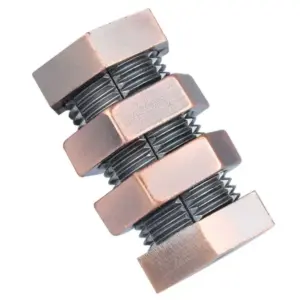
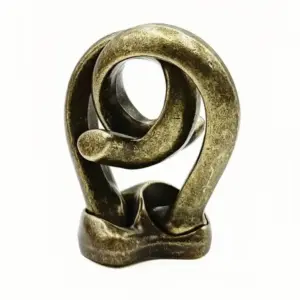
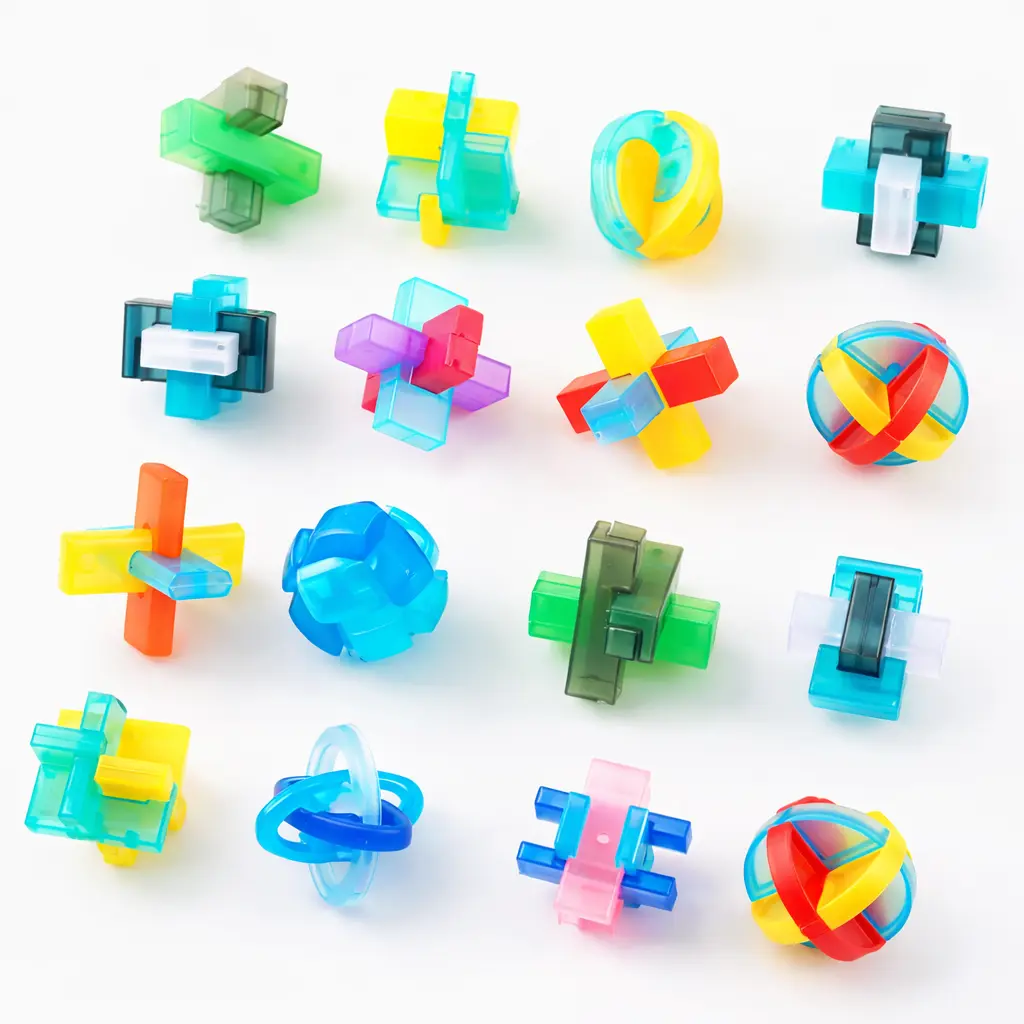
A good minimalist gift starts with the 12 Piece Crystal Luban Lock Set. Confirm the current product page for finish, dimensions, and packaging before purchasing — the four checks above will tell you whether to keep it or move to a different archetype.
01. What ‘Minimalist-Compatible’ Actually Means in a 3D Wooden Puzzle
A minimalist 3D wooden puzzle is defined by what it omits, not by what it adds. The first filter is absence: no paint, no glossy varnish, no battery module, no oversized base. When those elements are missing, the object can earn its place on a curated shelf.
The decision table in the Quick Answer introduced four checks. Each one is observable on a product page or in a single unboxing photo, which means the buyer can run the test without building anything first. This section expands each check into something the eye can verify in under a minute.
Check one: wood finish. The surface should read as natural plywood, birch ply, or unfinished wood. Warm grain visible. A clear matte sealant is acceptable. A high-gloss lacquer is not. The reason is simple: a minimalist room treats wood as a material, and glossy varnish turns that material into a plastic substitute. Look for product photos that show the wood tone under daylight, not under a flash.
Check two: color saturation. No paint, no stained accents, no printed decals. A single dyed element — a red knob, a blue cog, a printed logo — can break the visual line of an otherwise quiet object. Reading the product as one quiet object rather than a collection of parts is what the minimalist eye is checking for.
Check three: desk footprint. The finished puzzle should read as one object on a shelf, not as a diorama. Compare the listed dimensions against the intended display spot before you buy. A model that occupies half a desk will always feel like a project, never like a display piece. Negative space around an object is what makes a curated shelf feel curated at all.
Check four: motion. Either a quiet mechanism — a hand-cranked gear, a slow-turning music box — or no mechanism at all. Loud, spring-loaded, or battery-driven motion introduces sound and visual attention that a minimalist room is designed to exclude. A puzzle that moves only when touched stays neutral the rest of the day.
Translate the four checks into a 30-second filter. Open the product page. Look at the first image. Is the wood natural? Are the accents the same color as the wood, or close to it? Is the object small enough to sit beside a book? Does it move, and if so, does it move quietly? If any answer is no, move on. The filter takes longer to read than to apply.
This article evaluates each model against these four observable criteria, not against personal assembly experience. Where a specification — exact dimensions, sound level, finish type — is not listed, the article tells the reader what to look for on the page rather than guessing.
A wooden brain teaser set that includes multiple pieces can also pass the minimalist filter, provided each piece follows the same four rules. The same filter applied specifically to wooden brain teasers is explored further in mindful minimalism meets wooden brain teasers, which covers a wider set of brain-teaser archetypes in the same design-aware register.
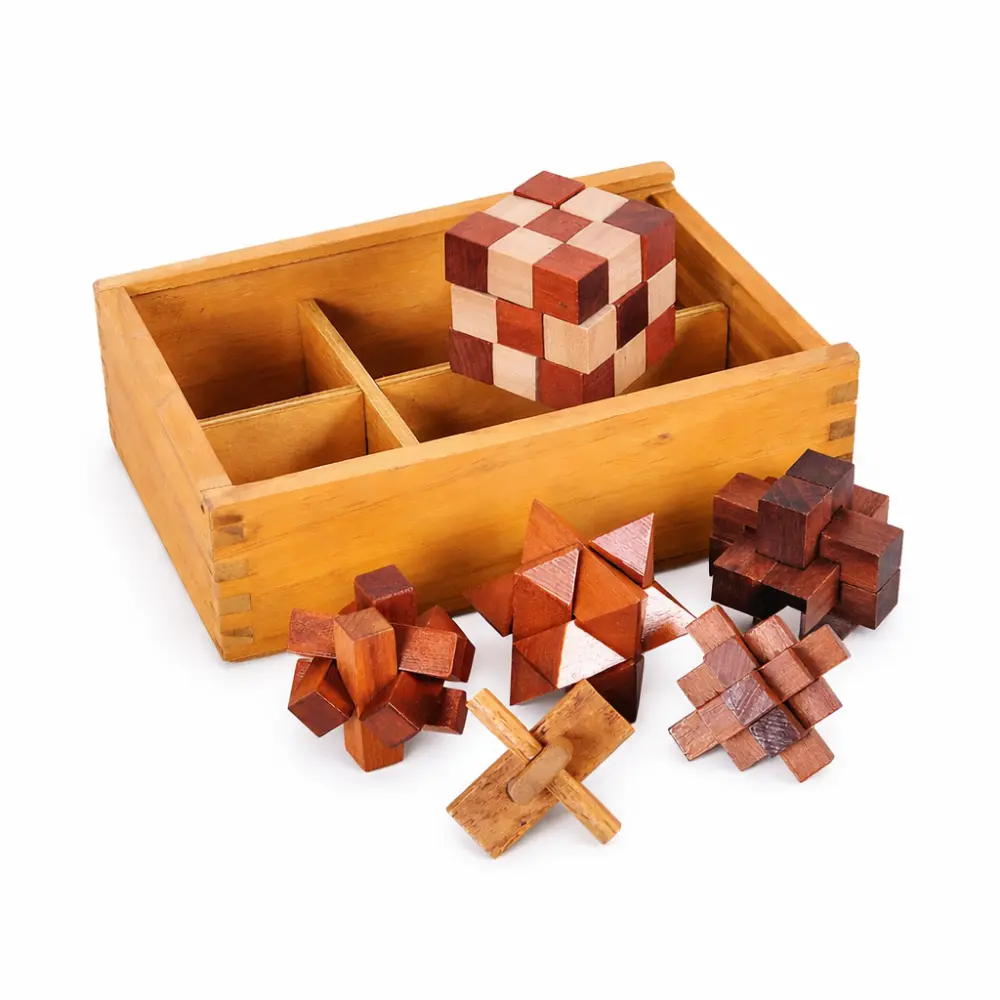
The 6-in-1 Wooden Brain Teaser Set follows the same logic: six small puzzles in one box, each finished in the same natural wood, no bright accents, each small enough to sit on a corner of a desk. The variety is a feature, not a problem, because the buyer can keep two or three out and store the rest in a drawer. A set with several objects is the right answer when the recipient enjoys rotating what is on display.
Once the four checks become reflex, the buying decision is no longer about which puzzle is “best.” It is about which one passes.
02. The Three Puzzle Archetypes That Pass the Minimalist Filter
Only three puzzle archetypes consistently clear the minimalist test, and each one fits a different kind of recipient. Match the archetype to the recipient’s relationship with objects, not to the puzzle’s piece count, difficulty, or price. The wrong archetype, however elegant, will end up in a drawer within a month, and the gift will read as a mismatch instead of a kindness.
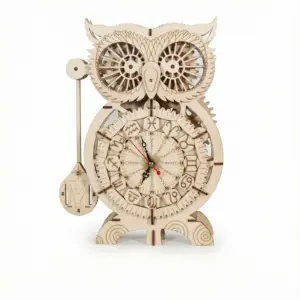
Archetype A is the mechanical-natural model: a gear assembly, a music box, a clockwork. It is built from unfinished wood with a warm grain, and its motion is the point. The recipient turns a small handle, the mechanism turns with it, and nothing else happens. No LED, no digital sound module, no bright accent. This archetype is right for the recipient who keeps a watch-winding tray on the dresser, who reaches for a kinetic object on a slow Sunday morning. The mechanism earns the desk footprint by being used, not by being looked at. A music box in natural plywood is the cleanest version of this archetype because it adds an audible payoff without breaking the material language.
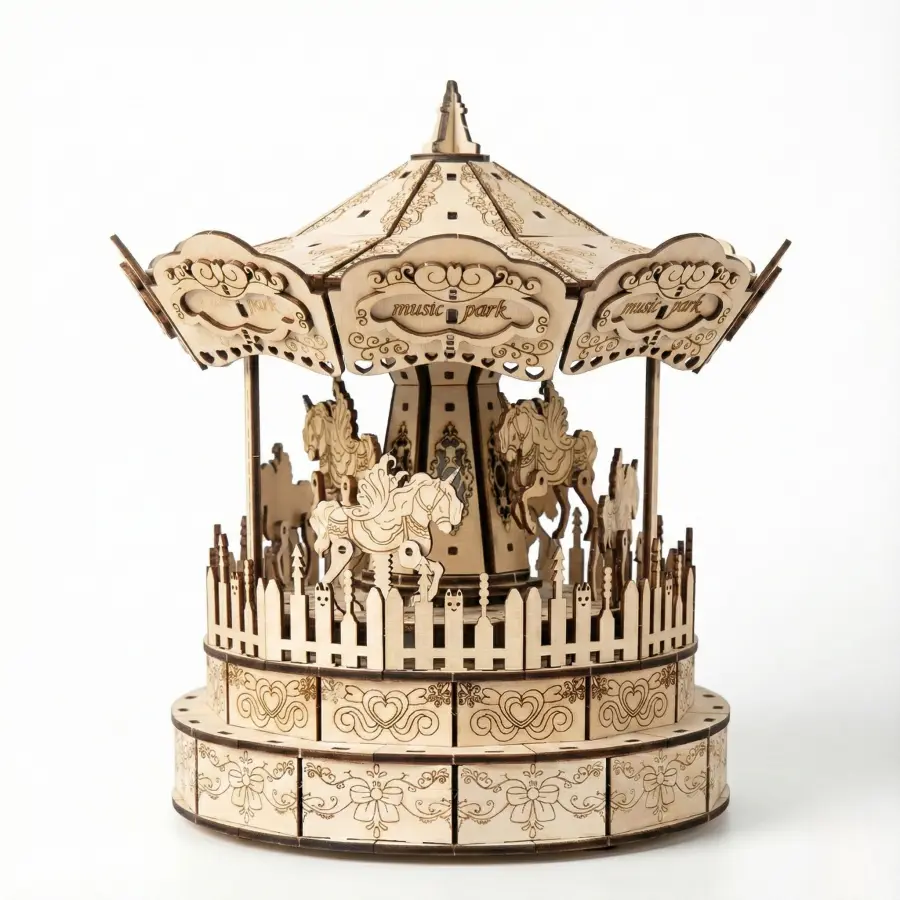
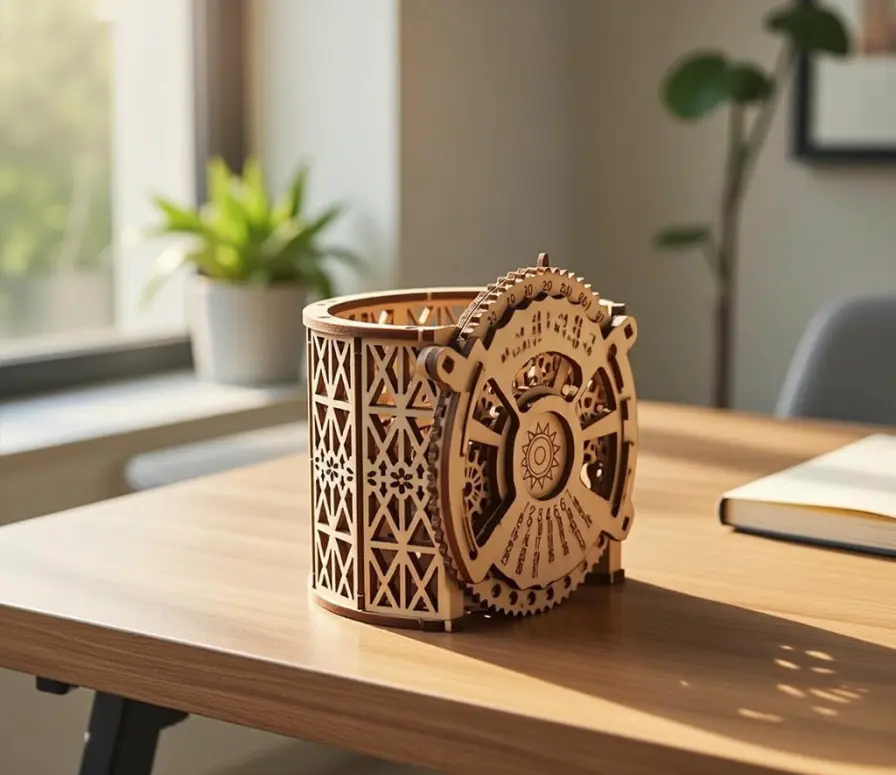
Archetype B is the non-mechanical architectural silhouette. A cathedral profile, a lighthouse outline, a gramophone curve. The object is a small sculpture finished in the same natural plywood, and it does nothing when no one is looking. This archetype is right for the recipient who treats the shelf as a curated composition, where each object earns its negative space. The absence of moving parts is the feature, not a limitation. A functional object in the same material and proportions, like a pen holder or a perpetual calendar, can sit in this category when its form is architectural and its mechanism is silent.
Archetype C is the small tabletop marble run. The piece sits flat, the marble drops, the path resets. This archetype is right only if the recipient already keeps interactive objects on the desk, a paperweight, a spinning top, a coin on a tray. If the recipient’s surface is curated to a single object and a lamp, the marble run will read as clutter. If the desk already holds two or three tactile pieces, the marble run becomes the fourth, and the running motion stops feeling like noise. The test is whether the recipient already accepts objects that exist to be touched.
| Archetype | Footprint | Motion | Best for |
|---|---|---|---|
| Mechanical-natural (gears, music box) | Small to medium; central placement | Quiet handle-driven mechanism | Recipients who tinker and will use the object weekly |
| Architectural silhouette (cathedral, lighthouse, organizer) | Small to medium; shelf or side table | None, or a single silent calendar flip | Recipients who want pure decor with no visible mechanism |
| Tabletop marble run | Flat and wide; needs clear space around it | Continuous reset with visible moving parts | Recipients who already keep interactive objects on the desk |
When each archetype fails the test:
A music box fails the moment the recipient treats winding as maintenance rather than ritual. A cathedral silhouette fails on a working desk if the recipient needs clear surface area; a tall plywood tower is a paperweight no one asked for. A marble run fails in a curated living room where every object earns its silence. None of the archetypes is universally right.
Practical check for any listing: before choosing an archetype, confirm the assembled dimensions against the recipient’s intended surface, look for the word “natural” or “unfinished” in the material description, and count the moving parts in the product photos. A single visible gear is a mechanism. A spinning figure with painted accents is a decoration. The archetype is defined by what the object does on the shelf, not by what the box calls it.
The right archetype is not a style choice. It is a forecast of whether the object will be touched, watched, or simply held in the gaze. Pick the forecast that matches the recipient, not the one that flatters the gift.
03. Color and Material Red Flags That Break a Minimalist Room
Most 3D wooden puzzle listings pass the archetype test and still fail the minimalist test. The reason is almost always material, not mechanism. Choose a model only after confirming the listing contains no painted, plastic, illuminated, lacquered, or printed-base elements — any one introduces a non-wood material, raises color saturation, or forces the object to compete for attention on a curated shelf.
The buyer is left to spot these qualifiers while scrolling. The five details below are the terms and visual cues to scan for on any product page before checkout.
Painted accent pieces. A single painted gear, a dyed-roof cathedral, or a colored marble track moves the object from natural ply to multi-tone décor. In a minimalist room, one painted component reads as the loudest object on the surface. Listing language to flag: “hand-painted details,” “colorful accents,” “vibrant finish.” What to check instead: the product photos on a neutral background, with no color other than wood visible.
Plastic gears and rubber bands. Mechanical puzzles occasionally substitute molded plastic cogs for laser-cut wood to reduce friction. The substitution is invisible in thumbnail photos and obvious in person — a beige plastic gear next to warm birch ply is a material mismatch the eye registers before the mind does. Listing language to flag: “pre-lubricated gears,” “durable plastic components,” “snap-fit assembly.” What to check instead: zoom on the gear area in the product images. If any component is a uniform molded color rather than layered ply, the model is not all-wood.
LED or battery modules. Light-up models introduce a power source, a switch, and a glow that draws the eye even when switched off. A minimalist room treats light as a designed-in feature, not a battery outcome. Listing language to flag: “LED light kit included,” “battery-operated,” “illuminated base,” “warm glow.” Skip these entirely. They fail the quiet-object test.
Glossy lacquer or varnish. A high-sheen finish on natural ply brightens the wood grain but also flattens it under reflection. On a curated shelf, a varnished object competes with the room’s light instead of absorbing it. Listing language to flag: “glossy finish,” “polished surface,” “lacquered for protection.” What to check instead: look for “unfinished,” “natural matte,” or a description that names no finish at all. Raw ply reads as warm. A clear coat reads as plastic-adjacent.
Oversized printed bases. Architectural silhouettes sometimes ship on a thick printed platform that names the model, the brand, or a decorative scene. The base becomes a billboard inside the recipient’s space — exactly the visual noise minimalism rejects. Listing language to flag: “decorative base,” “display platform with printed scene,” “branded stand.” What to check instead: photos of the finished model from below, or a description that says the object stands freely without a base.
A model can pass four of these checks and still fail the room. The fastest filter is a single question, asked before purchase: would this still earn its place on the shelf if the gift tag were removed? If the answer requires the tag, the puzzle is not minimalist-compatible. Move on.
04. Three Ways to Present a 3D Wooden Puzzle as a Gift
Match the gift format to the recipient’s relationship with objects, not to your convenience. The way puzzle gifting is changing is away from difficulty-and-piece-count and toward whether the finished object fits a curated space. A sealed box suits someone who enjoys building. A partially built model suits someone who wants the experience but not the hours. A fully assembled display piece suits someone who would never touch a kit — but who will still keep a quiet, natural-plywood object on the desk.
Once a model passes the red-flag checks from the previous section, the next decision is format. The same puzzle can be given in three ways, and each way changes how the object enters the recipient’s life.
A. The sealed box, for the builder.
A minimalist who already keeps a small workspace and a flat tray for sorting parts will welcome a kit. The gift becomes an evening’s project, and the recipient opens the punch-out sheets themselves — which is half the experience. The sealed box also protects the wood grain from handling marks before assembly.
But the box itself counts as part of the object. A glossy, full-color printed sleeve covered in product photography is exactly the visual noise a minimalist will reject on sight, even if the model inside is plain birch ply. The packaging must clear the same four checks as the model — wood tone, color saturation, footprint, and motion.
What to verify on the listing: whether the outer box is plain brown kraft, recycled matte cardboard, or a printed sleeve in one neutral tone. If the listing photo shows a shiny retail-style box with multiple brand colors, the model is not gift-ready as-is.
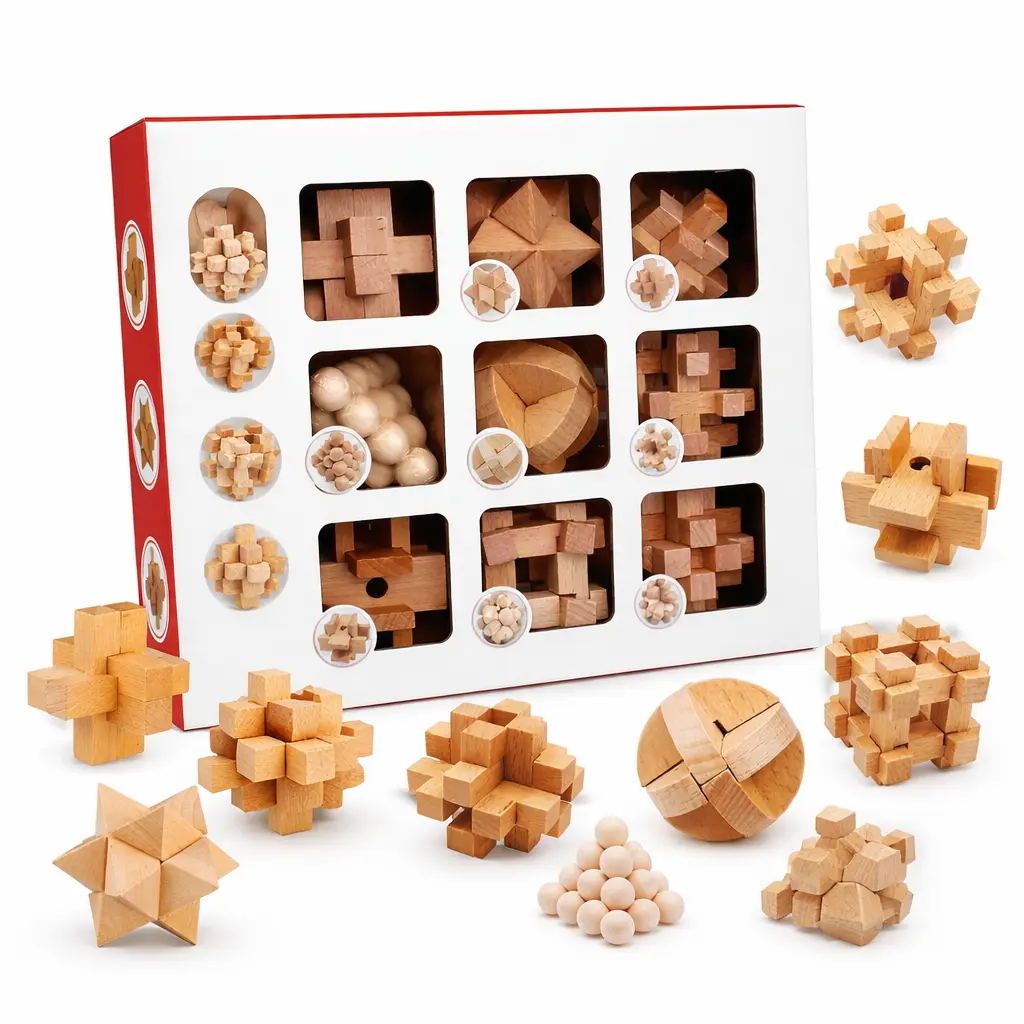
Luban Lock Set 9 Piece — $39.99
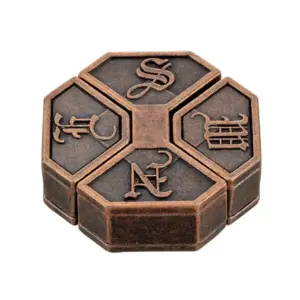
A contained interlocking set like the Luban Lock Set 9 Piece fits this format well. Check the current product page to confirm packaging style and piece count before purchase.
B. Partially pre-assembled, for the time-pressed.
Some recipients want the experience of completing a model but not the hours of starting from flat sheets. Building the base, the internal frame, or the least photogenic steps — and leaving the final, most visible panels undone — preserves the reveal moment while removing the bottleneck. The recipient finishes in an hour instead of a weekend.
What to verify before wrapping: whether partial disassembly is feasible without snapping tabs, and whether the instructions are clear enough to resume from a middle step. Test-fit a pre-built section on your own table first.
C. Fully built, for the non-builder.
A recipient who would never assemble a kit themselves can still want a quiet wooden object on the desk. The gift is the finished piece — a display object, not a project. The wrapping reveals something already complete, and the recipient places it directly on a shelf.
What to verify: whether the assembled model is structurally stable enough to transport in a gift box, and whether any moving parts (gears, music box, marble tracks) still work after the move. Re-test the mechanism right before wrapping.
No varnish. No paint. No plastic sleeve. A finished, stable object that earns its place the day it is unwrapped.
05. Decision Table: Choosing Between Mechanical, Architectural, and Marble-Run Archetypes
Use this table to make the final call after the four checks have already been run. The first sentence of every row answers whether the archetype fits the recipient’s relationship with objects. A mechanical puzzle rewards hands-on patience; an architectural silhouette rewards visual restraint; a marble run rewards ambient interaction.
| Archetype | Footprint | Motion | Wood Finish | Gift Format | Recipient Signal | What to Check |
|---|---|---|---|---|---|---|
| Mechanical (gears, music box) | Compact to medium | Continuous when wound | Natural ply or birch | Partially pre-assembled | Owns a mechanical keyboard or watch. Values tinkering. | “No glue required.” Hand-cranked mechanism. |
| Architectural silhouette | Small to medium | None | Unfinished wood preferred | Fully built | Curates a shelf as a composition. | “Unfinished” or “natural wood.” No painted tiles or decals. |
| Tabletop marble run | Flat and wide | Ambient cycle | Light-toned ply | Fully built and tested | Already keeps a kinetic desk object. | Finished-footprint measurement. Gravity-driven, not battery. |
Run the table once. Then run the four checks a second time. If the archetype still passes both rounds, the gift will earn its place on the shelf.
The single next action: open two product pages side by side and apply the four checks — wood finish, color, footprint, motion — before reading the price. A minimalist gift fails or succeeds on the first two screens of the listing. If both passes still look the part, buy the one whose mechanism or silhouette you could describe in one sentence to a stranger. That sentence is the gift.
Frequently Asked Questions
After the four checks pass on two product pages, the practical questions remain. How large is the finished object? Can it ship pre-assembled? The answers below are verifications.
Are there 3D wooden puzzles without paint or bright colors?
Yes. Some interlocking puzzles rely on the material’s own tone rather than added color. Look for “natural,” “unfinished,” or “birch ply” in the materials description, and confirm what the specific listing shows. Saturated reds, blues, or yellows in the photos signal dye and will break a neutral palette.
How big are 3D wooden puzzles when finished?
Footprint ranges from palm-sized to shelf-spanning. Check the dimensions spec on the product page, not the photos. For a desk, anything under roughly 8 inches in its longest dimension usually leaves room for a lamp.
Can you give a 3D wooden puzzle already assembled as a gift?
Yes, and for a minimalist it is often the better choice. A pre-built model arrives as a finished object — no spare parts, no instruction booklet, no packaging to discard. For recipients who would rather build the model themselves, how to solve 3D wooden puzzles outlines a universal six-step method that works across archetypes.
What is the difference between a mechanical and a non-mechanical puzzle for display?
A mechanical puzzle moves — gears turn, a music box plays, marbles cycle. A non-mechanical puzzle is static and reads as pure form. The minimalist filter prefers the latter unless the recipient already keeps a kinetic object on the desk.
Do 3D wooden puzzles come in gift-ready packaging?
Rarely. Most ship in printed boxes covered in product photography and marketing text. Check for a photo of the actual packaging. Many gift buyers move the contents into a plain kraft box or fabric pouch before presenting.
Are 3D wooden puzzles too busy for a minimalist home?
Some are. The deciding factor is the visual weight of the finished piece, not the part count. A small natural-plywood model with no paint reads quieter than a large painted model with fifty pieces. Run the four checks — wood finish, color, footprint, motion — and the category sorts itself.
The right puzzle disappears into a curated shelf and rewards a second look. If both rounds of checks pass and the finished object can be described in one sentence, view the 12 Piece Crystal Luban Lock Set to confirm dimensions, materials, and current price.
Where to Start
If the recipient and occasion checks above match, start with 12 Piece Crystal Luban Lock Set. Check the current product page for the specifications that matter to your choice.
Still comparing options? Use the matching Tea-Sip collection to compare the same decision criteria, rather than restarting the search from scratch.
Sources and verification
- Product details and current specifications: Tea-Sip product page
Last updated: August 20, 2026