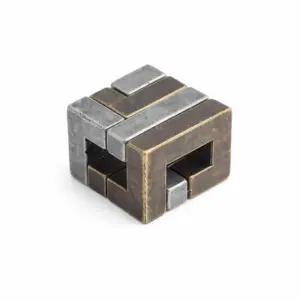
Quick Answer: How to Pick a Cast Metal Puzzle Gift for Your Father-in-Law
Pick a cast metal puzzle when the mechanism is visually self-evident, the solve time lands between 20 minutes and 2 hours, and the piece looks intentional on a desk — not toy-like. The three checks that determine whether a cast metal puzzle reads as a thoughtful gift versus a generic desk trinket: mechanism type, difficulty calibration, and visual maturity. Skip high-difficulty burrs. Skip religious, political, or overly decorative themes.
Cast metal, brass, and zinc alloy puzzles carry visual weight. A compact disentanglement or interlocking piece sits on a work desk without looking like a toy or a fidget spinner. The mechanism is the impression: a clean disentanglement reads as intellectual, an ornate lock reads as decorative, a 12-piece burr reads as a flex that may never get solved.
The three checks before you buy
- Mechanism — does the puzzle look like a problem to solve, not a trinket to admire?
- Difficulty — can a first-time solver finish in 20 minutes to 2 hours, with a hint available if they stall?
- Visual maturity — does the piece match a professional desk? No cartoon characters, no political or religious iconography.
| Mechanism type | Reads as | Tea-Sip pick (verify current price on the product page) | Choose when |
|---|---|---|---|
| Disentanglement (hook) | Intellectual, clean, compact | Cast Hook Metal Brain Teaser — $13.99 | The default pick: visible mechanism, single solve, fits a pocket or desk. |
| Sequential cast (animal form) | Curiosity object, giftable | Metal Crab Puzzle Cast Brain Teaser with Gold Ring — $13.99 | The recipient likes mechanical objects but you can’t confirm puzzle experience. |
| Spiral / multi-piece cast | Sculptural, tactile | 5 Piece Cast Spiral Metal Puzzle — $16.99 | You want a piece that doubles as desk decor once solved. |
| Coil pocket / triangle | More involved, collector | Cast Coil Pocket Puzzle — $18.99 | You suspect he has solved simple metal puzzles and wants a step up. |
The top pick for the dominant buyer situation — a son- or daughter-in-law who knows little about the recipient’s puzzle history — is the Cast Hook Metal Brain Teaser. Single-object solve, brass-toned cast metal, priced low enough that the gift does not read as over-reaching. Sections 01–03 below walk through mechanism choice, difficulty matching, and how to present it.
01. Which Cast Metal Puzzle Mechanism Type Best Fits a Father-in-Law Gift
Pick a disentanglement or interlocking cast metal puzzle when the gift must read as thoughtful and intellectually respectable without requiring you to know the recipient’s hobby history. The Cast Hook is the default for that situation — a compact, visible, single-solve object in cast metal. But mechanism choice is the variable that determines whether the gift reads as thoughtful, fidgety, or decorative, and the four cast metal families each create a different impression when set on a desk in front of a man you may not know deeply.
The four mechanisms, in plain terms
Within the cast metal category, the puzzle splits into four mechanism families, and each one carries a different signal in a father-in-law context.
Disentanglement puzzles are, in cast metal form, usually a hook, ring, or linked bar set coaxed apart by hand — two or more parts linked together and manipulated to separate. The solve is short, the mechanism is visible, and the object looks intentional even before it is solved. For a father-in-law, this is the safe default: a classic hand challenge, not a toy, and it costs nothing in terms of guessing wrong about his experience.
Interlocking puzzles are pieces taken apart or assembled, often based on burr-style geometry. In cast metal, these are heavier, more sculptural, and more obviously “engineered.” They signal respect for the recipient’s patience and spatial reasoning. The risk: upper-difficulty burrs can require hours of focused work, and an unsolved puzzle on a desk becomes a guilt object. Choose this family only with a defensible reason to believe the recipient enjoys spatial assembly.
Sequential-discovery and puzzle boxes unlock an interior, reveal a compartment, or free a key through a chain of moves. In cast metal, the form is usually a lock, a locket-style object, or a creature-shaped container. These read as premium and gift-reveal-oriented, which is their strength. The weakness in a father-in-law context is the patience profile: a recipient who expects a five-minute fidget will not enjoy a twenty-step reveal, and a recipient who enjoys one may not want to perform it in front of family. Pick this family when the gift is given in a private setting and the recipient likes the reveal-as-ritual format.
Brain-teaser shapes — rotating cubes, ten-sided forms, brass-toned geometric assemblies — are polished, ornamental, and visually self-contained. They score high on desk presence: the object looks deliberate next to a pen tray. The risk is reading as a toy or desk trinket, especially at small scale or in bright colorways. The mitigation is material and footprint — a heavier brass-toned cast form on a larger base reads as a designed object, not a keychain.
Mechanism-to-impression map for a father-in-law
| Mechanism | What it signals | What to watch for |
|---|---|---|
| Disentanglement (hook, ring) | “Classic, intellectually framed.” | Too-small scale — reads as a keychain, not a gift. |
| Interlocking (burr-style cast) | “Engineering respect.” | High difficulty that goes unsolved and gets shelved. |
| Sequential / puzzle box | “There is a reveal — this took thought.” | Long solves in front of a group; multi-step frustration. |
| Brain-teaser shape (rotating forms) | “Desk-worthy, visually clean.” | Bright colors, plastic-feeling finishes, tiny scale. |
This is the map that justifies why a compact disentanglement is the default. It is the only mechanism that looks right whether the recipient solves it in five minutes or two hours, and whether he sets it on a desk or drops it in a drawer.
Where the Cast Hook fits, and where it does not
The Cast Hook Metal Brain Teaser sits in the disentanglement family — linked cast metal parts, single visible mechanism, single solve. For most father-in-law situations, that is the right answer: it reads as a hand challenge rather than a toy, costs $13.99, and is small enough to present without ceremony but substantial enough to not look like an afterthought.
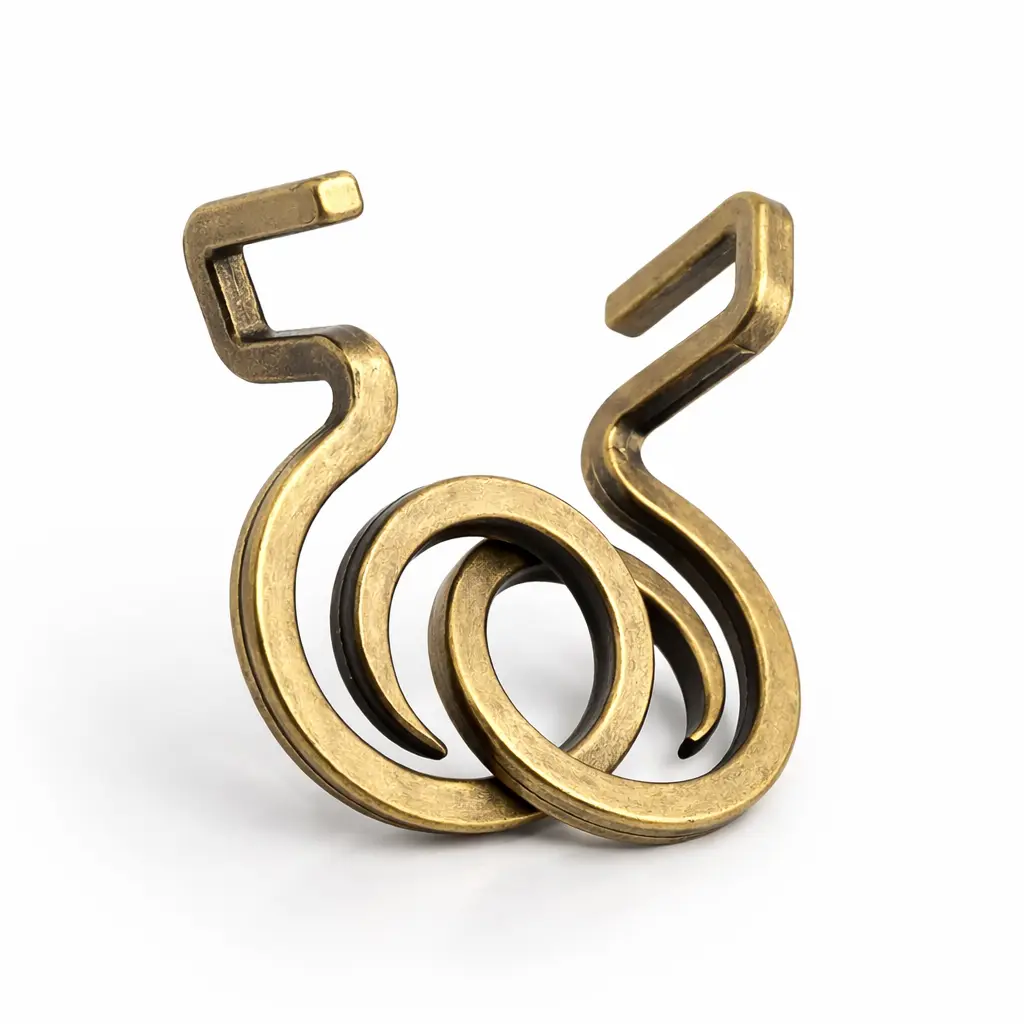
Where it does not fit: when the recipient is already an experienced mechanical-puzzle solver, the Cast Hook reads as an entry-level object and the gift underwhelms. In that case, step up to a multi-piece cast spiral or a coil-style puzzle that visibly signals more parts and a longer solve — same material family, higher visual commitment.
Choose when / skip when, filtered for a father-in-law
- Disentanglement (Cast Hook and similar): Choose when you have no reliable read on his puzzle history and the gift must work in any setting. Skip when you know he is already deep into the hobby.
- Interlocking / burr-style cast: Choose when the recipient has a visible track record with mechanical objects and a reputation for patience. Skip when you are guessing.
- Sequential / puzzle box: Choose when the gift is given in a private moment and he can take twenty minutes uninterrupted. Skip when the unwrapping is a group event and the solve is long.
- Brain-teaser shape (rotating forms, brass-toned geometric objects): Choose when desk display value is the priority and the form stays visible after the solve. Skip when it is small, bright, or plastic-feeling — that combination signals “toy” in a father-in-law context.
The one check that filters everything
Before committing to any mechanism, apply this single test: imagine the object on his desk six months from now. If it still looks like a deliberate, machined cast-metal object, the mechanism is right. If it looks like a forgotten desk trinket, switch families. Not a toy. Not a flex.
For a fuller taxonomy, the Tea Sip guide on the six main types of metal puzzles and what to buy first extends the framework without changing the father-in-law filter.
02. How to Choose Puzzle Difficulty When You Don’t Know His Experience Level
When the recipient’s puzzle history is unknown, target the “safe difficulty band”: cast metal puzzles rated approachable to moderate by the seller, with stated solve times between 20 minutes and 2 hours. This range respects his time, signals the gift is solvable, and prevents the “it sits unsolved in a drawer” outcome that quietly undoes a thoughtful present.
The previous check — the six-month desk test — filters mechanism and appearance. Difficulty is a separate axis, and the buyer cannot solve the puzzle first to gauge it. What they can do is read four observable signals before paying.
One: treat the seller’s difficulty rating as a floor, not a ceiling. Seller ratings skew optimistic, especially on lower-priced cast metal puzzles where the marketing incentive is to keep the barrier low. A “moderate” label from a generalist seller is more reliable than a “moderate” label from a puzzle-collector brand that calibrates harder puzzles upward. The stated solve time is the more honest metric when both are available, because hours are harder to fudge than stars.
Two: require a visible goal. The objective should be readable from the object itself — separate the pieces, free the ring, slide the bar out, untangle the hooks. This single condition prevents the “I don’t even know what I’m supposed to do” dead end that turns a thoughtful gift into an abandoned one. A puzzle whose goal only emerges after reading instructions is a worse gift for an unknown recipient.
Three: prefer a single solution path over open-ended assembly. Sequential-discovery and disentanglement puzzles have one correct endpoint. Burr and assembly puzzles can have multiple valid configurations and an ambiguous “finished” state. For a gift given across a table or a holiday meal, the single-endpoint design wins — he knows when he is done.
Four: skip “expert” and “collector” labels unless you have direct evidence he is a puzzler. The word “expert” on a cast metal puzzle page usually means a solve time that stretches past a weekend and a frustration curve that ends with the solution guide being read. Neither is what a father-in-law gift should deliver.
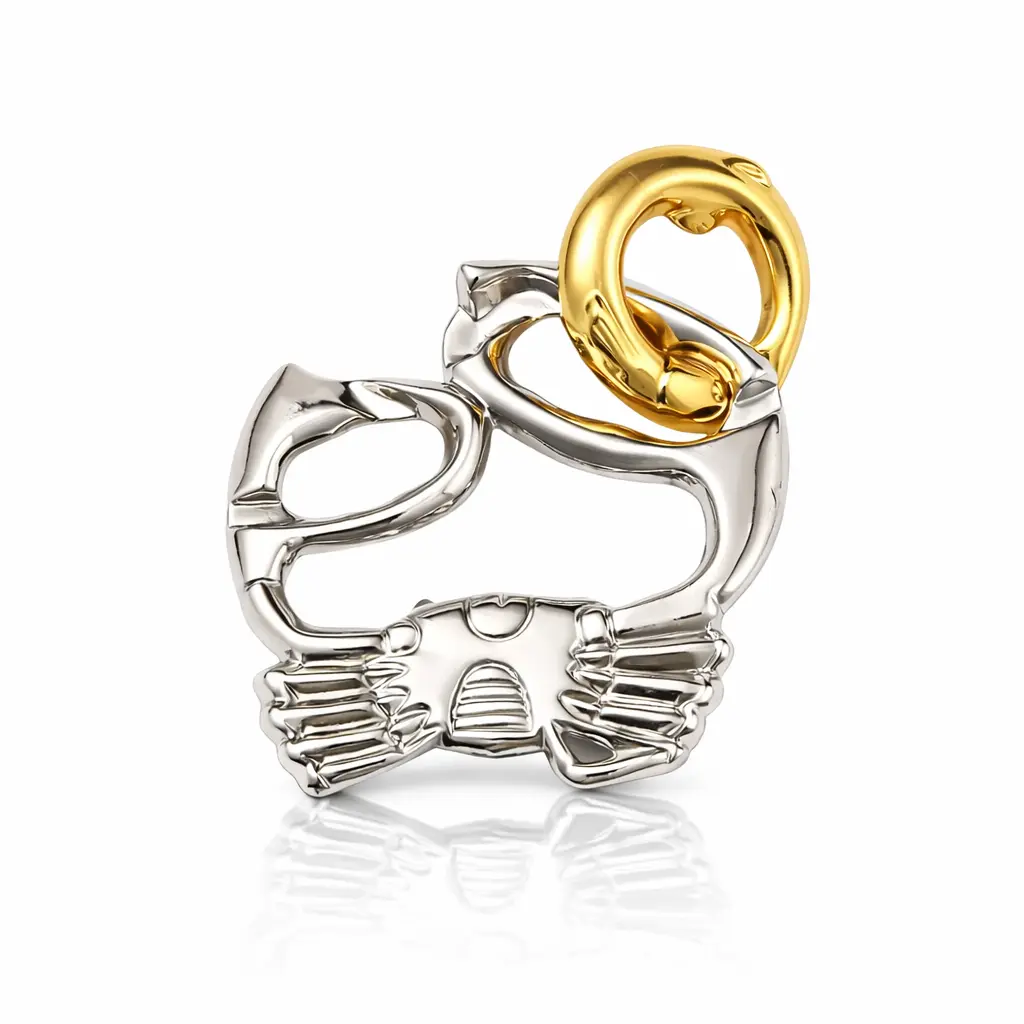
The Metal Crab Puzzle Cast Brain Teaser with Gold Ring fits the band: a clearly visible goal (free the gold ring from the crab), a single endpoint, and a form that reads as deliberate cast metal rather than toy plastic. At the $13.99 listed price, it is also a low-risk first cast metal puzzle if the recipient turns out to enjoy the category — a second, harder piece is an easy follow-up gift if he does.
Verify before you buy — a four-point checklist:
- Difficulty rating on the product page (treat the label as the floor, not the ceiling)
- Stated solve time in minutes or hours (20 minutes to 2 hours is the safe band)
- Visible goal readable from the product photo (separating, freeing, sliding, untangling)
- Solution guide or return policy available (one of the two is non-negotiable for a gift given across a relationship line)
The single practical next action: if a puzzle meets all four checks, it belongs on the shortlist. If it fails on goal-visibility or stated solve time, skip it regardless of how striking the product photo looks. Mechanism and appearance can still be debated; difficulty and goal cannot be fudged after the gift is opened.
For a deeper breakdown of why difficulty ratings vary so widely between sellers — and why a “level 5” at one shop can mean three minutes and at another three days — the guide on why a level 5 can mean 3 minutes or 3 days walks through the rating problem in more detail.
03. Which Puzzle Themes, Materials, and Presentation Choices to Avoid or Choose
A shortlist of well-mechanized puzzles is not yet a gift. The next filter is whether the object reads as a deliberate choice or a random trinket, and for a father-in-law, the cost of guessing wrong on theme, branding, or material is higher than most gifts because the piece will sit on his desk in plain view for years.
The decision rule: avoid religious iconography, overt political symbolism, juvenile cartoon branding, and puzzles that look like corporate promotional merchandise. Each creates a context you cannot control once the box is open, and each can quietly turn a thoughtful gift into a conversation he has to manage.
Materials — what reads as premium versus what reads as toy-like. Solid cast brass, zinc alloy, and stainless steel in neutral finishes read as intentional objects with weight behind them. A piece that feels substantial in the hand signals “this was chosen,” not “this was grabbed.” Plated or painted metal can read as cheap the first time a corner chips or a coating wears. For a deeper look at how the six common cast metals compare for weight, feel, and durability, the linked breakdown walks through the trade-offs.
Themes — abstract and engineering forms, not figurative ones. Abstract geometric forms, classical disentanglement shapes (linked rings, linked bars, classic burr silhouettes), and engineering-inspired forms read as intellectual. Figurative animal puzzles can work when the form is restrained — a crab holding a ring, a fish threaded with coral — because the figure becomes the mechanism rather than a decoration. What fails is any theme that demands the recipient share an enthusiasm you are guessing at: zodiac signs, fandom branding, sports team motifs, cultural symbols specific to a region or subculture.
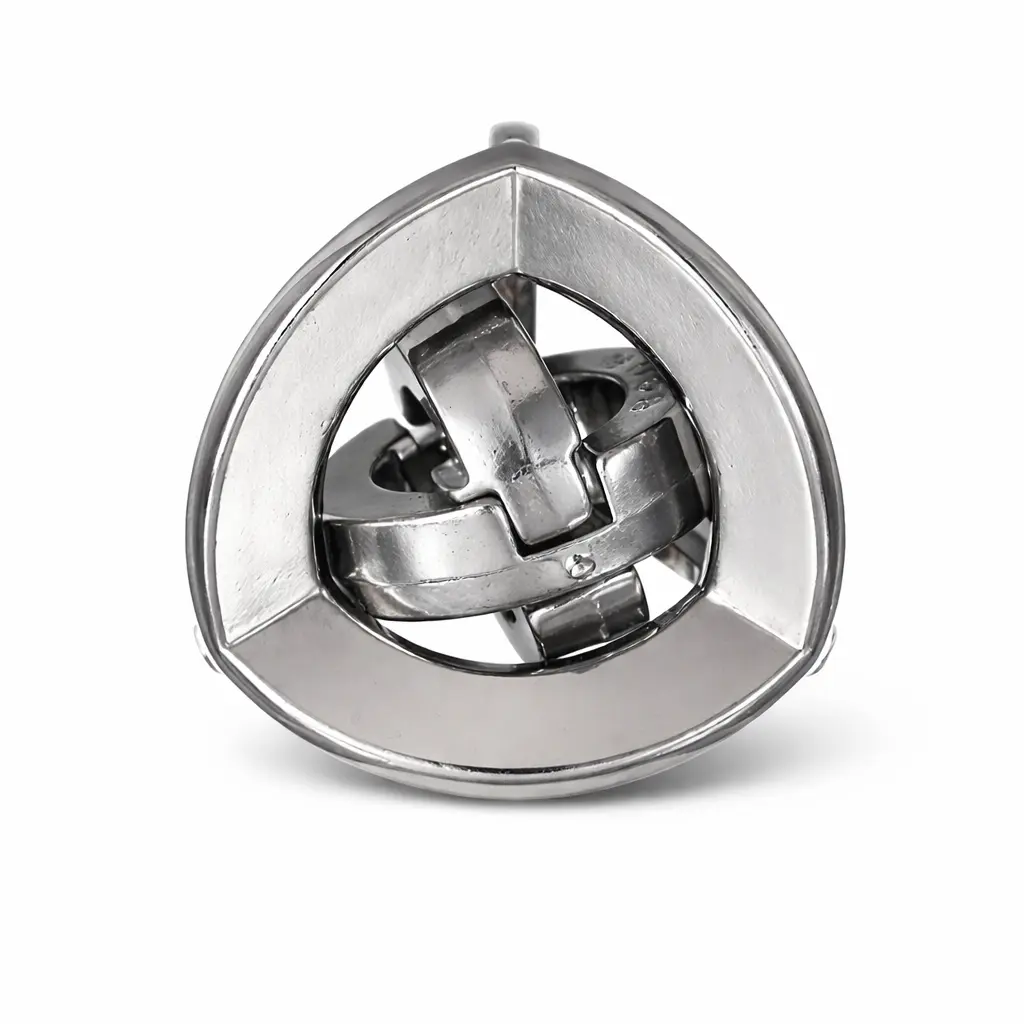
The orbit ring above is a good template: abstract linked-form geometry, no branding on the visible faces, weight that lands in the hand rather than the pocket.
Branding — less on the surface, more on the back. Minimal or absent branding on the faces he will see daily reads as confidence in the object. A logo-heavy surface reads as promotional. If branding exists, it should sit on the base or the inside of a piece, not the top.
Size and weight — the hand test. Pieces under roughly 80 grams or smaller than a walnut read as keychain trinkets, not desk objects. A cast metal puzzle that earns desk space needs heft. Before buying, check the product page for a stated weight in grams or ounces — if weight is not listed, that is itself a signal to verify or pass.
Presentation — the part competitors skip. Three moves turn a cast metal puzzle from a present into a moment:
- Include a back-up reference, but don’t hand it over up front. A solution card tucked inside the box, a QR code to a video solve, or a short offer to send a hint if he stalls — any of these removes the awkwardness of the giver being the only point of contact. A printed solution guide placed on the table is what reads as distrust; a quietly available back-up is what reads as thoughtfulness.
- Frame the gift in a short note that leaves the door open. A line like “Hope this earns a spot on your desk — would love to hear how long it takes you” acknowledges a future interaction without demanding one.
- Let the mechanism be visible. Avoid wrapping that hides the form. A clear sleeve, an open-top box, or a cloth pouch that unfolds flat lets the object sell itself before he touches it.
The single practical next action: filter the shortlist by weight, branding, and theme first, then choose the presentation format. A well-mechanized puzzle in the wrong theme or wrapped in opaque paper still arrives as the wrong gift.
04. Cast Metal Puzzle Categories Matched to Father-in-Law Gift Scenarios
Match the puzzle category to the gift scenario first, not to a “best overall” pick. A disentanglement puzzle suits a milestone birthday when the form will sit on his desk. An interlocking set suits a builder or engineer. A rotating geometric form suits a thank-you to a non-puzzler. A sequential-discovery box suits a reveal-driven moment. Choose by context, then by mechanism.
Once presentation is handled, the next decision is the category itself. Two father-in-laws can both deserve cast metal puzzles but need completely different mechanisms: the man who solves a Rubik’s cube in his head is not the man who keeps a brass crab on his desk because it looks like sculpture. Below is a category-to-scenario map that turns the prior filters — weight, theme, branding, solve time — into four actual gift decisions.
| Category | Best For Scenario | What Signals the Right Choice | What to Check Before Buying |
|---|---|---|---|
| Classic disentanglement (linked rings or bars, hook-and-loop forms) | Milestone birthday or holiday when the recipient may display the puzzle on a desk, shelf, or credenza. Works when the solve is a shared moment rather than a private challenge. | Compact footprint, visible mechanical connection, weight that prevents the piece from being pocketed and forgotten. | Difficulty rating, stated solve time, whether a solution card or QR reference ships with the box, return policy if it stays unsolved. |
| Interlocking burr-style cast metal (multi-piece, geometric assembly) | Father-in-law who is an engineer, builder, or hands-on hobbyist. Verify by other objects in his space (calipers, model kits, mechanical watches), not by asking. | Multiple distinct cast pieces rather than a single form, a stated piece count visible on the package, brass or zinc alloy weight in hand. | Piece count, material spec on the product page, puzzle dimensions, whether a solution diagram is included or must be sourced online. |
| Rotating geometric form (cube-style, multi-axis, banded ring) | Holiday or thank-you when the recipient is not known to be a puzzler but appreciates desk objects. Lower intellectual threshold, higher visual return. | Clean geometric silhouette, no narrative or themed branding, finishes that read as brass or polished metal rather than painted plastic. | Stated mechanism type, whether the puzzle is marketed as a brain teaser or as a fidget object, and a weight that supports “desk presence” rather than “keychain.” |
| Sequential-discovery cast metal box (locks, keyed mechanisms, latch systems) | Milestone gift where the reveal is part of the moment and the recipient has patience for a slower solve. Read this as a longer arc puzzle. | Visible lock or latch component, multi-step mechanism implied by the design, weight consistent with internal moving parts. | Difficulty band, number of steps if listed, presence of a key or solution reference, and whether the box can be re-locked after the solve for repeat display. |
Two products that span the first two rows of this map are worth a closer look before committing to a scenario. A disentanglement form such as the Cast Hook Metal Brain Teaser fits the first row when the gift is a milestone and the mechanism needs to read at a glance.
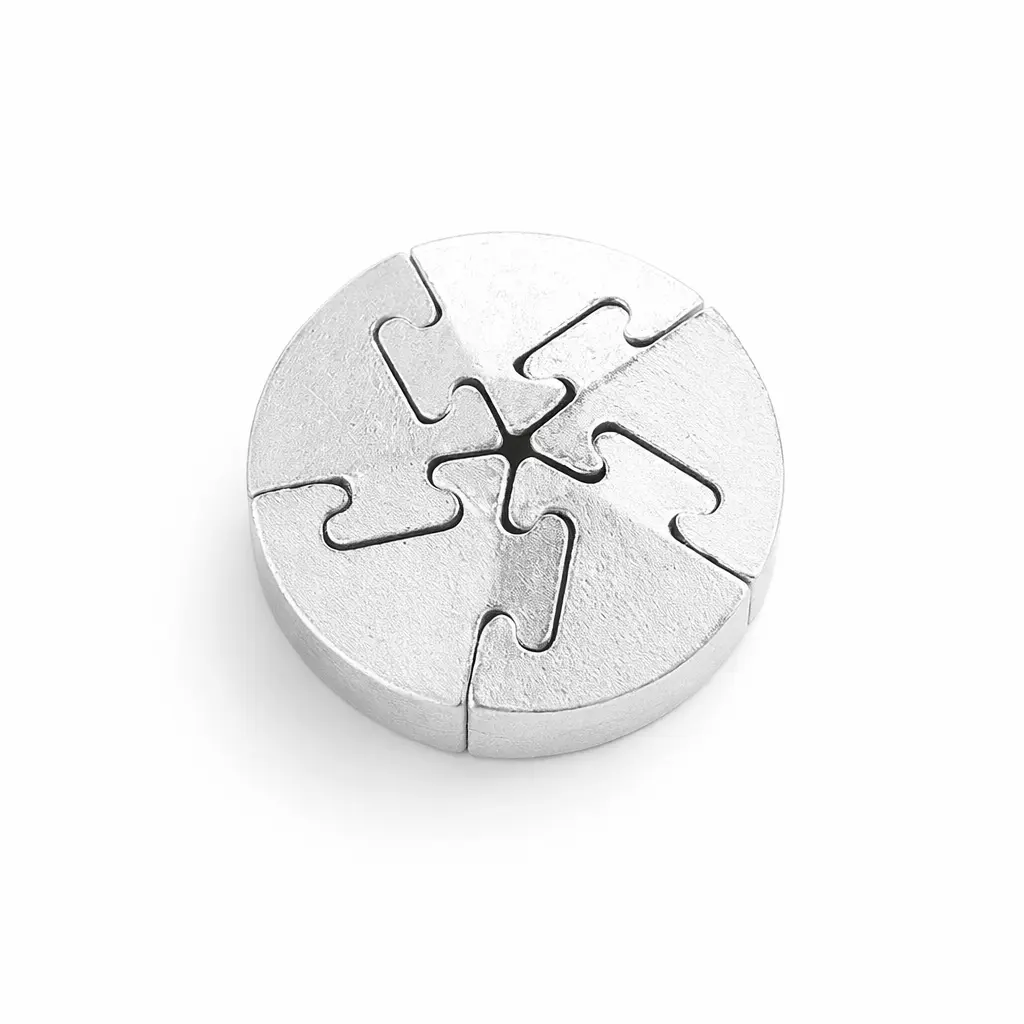
A multi-piece cast set fits the interlocking burr-style row — useful when the recipient is hands-on and the solve should feel like assembly rather than magic.
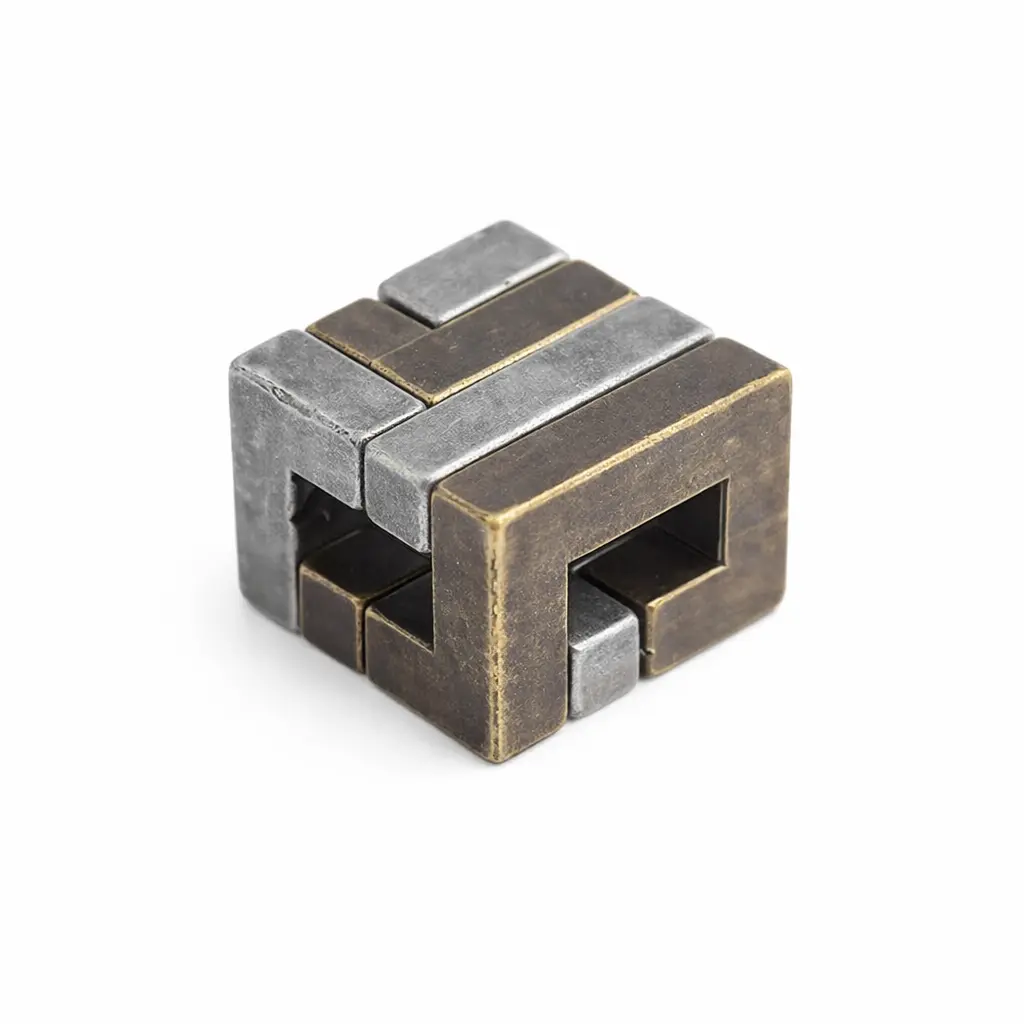
Cast Coil Pocket Puzzle — $18.99
A coil form fits the disentanglement row — compact, visible mechanism, and a shape that holds up on a shelf without reading as a keychain. For more on how personality type maps to the right puzzle, see seven puzzle gifts for dad matched to his personality type.
The single practical next action: pick the row that matches your scenario first, then verify the “What to Check” column against the product page before you buy. A correct scenario match with an unverified difficulty band still arrives as the wrong gift.
Frequently Asked Questions
A scenario match narrows the field, but most gift buyers still have practical questions before they commit to a cast metal puzzle for a father-in-law. The seven below cover price, solve time, themes, and presentation — answered with checks you can verify, not speculation.
Is a cast metal puzzle a good gift for a father-in-law, or does it seem random?
It reads as thoughtful when the mechanism is self-evident, the piece looks intentional on a desk, and difficulty lands in the 20-minute to 2-hour band. A cast brain teaser that solves cleanly and reads as an object — not a toy — signals respect. Gifts read as random when the giver skips the mechanism check.
What difficulty should I buy when I don’t know his experience?
Target puzzles that take 20 minutes to 2 hours for a first-time solver, with a visible mechanism and a single clear goal. Skip multi-hour burrs and “extreme” pieces unless you have direct evidence of his puzzle history. The three checks — visible mechanism, safe solve time, desk presence — are the filter.
How long do cast metal puzzles typically take to solve?
Disentanglement and sequential discovery pieces in Tea Sip’s cast metal range are built for single-session solving — a few minutes for simpler designs, longer for involved interlocking forms. The 20-minute to 2-hour band fits one evening. For piece-specific difficulty, verify on the product page.
Are there themes or designs I should avoid?
Skip religious iconography, political symbols, juvenile characters, overtly romantic motifs, and anything that looks like branded corporate swag. Neutral geometric and animal forms — hooks, coils, orbits, keys, fish — read as intellectual. When the theme could be misread, the piece fails the father-in-law test.
Should I include a hint card or solution guide?
Skip a printed solution guide handed across the table — it can read as distrust. A back-up reference (a tucked-away hint card, a QR code to a video solve) is fine if the recipient chooses to use it. The right difficulty does most of the work; a short handwritten note does the rest.
What is a reasonable price range?
Tea Sip’s cast metal puzzles sit in an accessible gift range — the Cast Hook Metal Brain Teaser at $13.99 is a typical entry point for a first-time father-in-law gift, and other pieces in the line run modestly above and below that. Verify current pricing on each product page before ordering.
Will it read as thoughtful or as a last-minute grab?
It reads as thoughtful when wrapped, paired with a short note explaining the mechanism choice, and presented with a small cue. It reads as last-minute when it arrives in a shipping envelope with no framing. The puzzle is half the gift; presentation is the other half.
Final move: pick one row from the scenario table, verify the “What to Check” column against the product page — for the Cast Hook, start here — and write the note tonight, not on the way to the event.
Where to Start
If the recipient and occasion checks above match, start with Cast Hook Metal Brain Teaser. Check the current product page for the specifications that matter to your choice.
Sources and verification
- Product details and current specifications: Tea-Sip product page
Last updated: August 23, 2026