Quick Answer
For a software developer gift, choose a cast metal disentanglement or sequential-move puzzle when the recipient likes desk objects with hidden logic; choose a heavy cast puzzle with a display base when the gift is meant to live permanently on the desk. Use three checks — mechanism type, weight, and solve time band — to narrow the shortlist before price or brand matters.
The mechanism is the primary decision, not the brand or the finish. Software developers are trained in pattern matching, and a cast metal puzzle that rewards the same skill in a different medium reads as a respectful object, not a novelty. Mechanism-to-personality alignment matters more than aesthetic branding because the puzzle becomes part of the desk environment.
Three checks before checkout
- Mechanism type — disentanglement, sequential removal, interlocking burr, or take-apart. Each asks for a different cognitive mode.
- Weight and material — declared in grams. A 200-gram brass piece reads as a permanent desk object; a 40-gram zinc piece reads as a pocket companion.
- Solve time band — the product page should state a difficulty rating or estimated solve range, not just “challenging.”
Quick decision table
| Recipient signal | Mechanism match | What to check on the product page |
|---|---|---|
| Lives at a clean, minimal desk | Heavy cast disentanglement or burr | Material declared, weight in grams, whether a display base is included |
| Constantly picks up and sets down objects | Pocket-sized sequential-move | Size for one-handed handling, no loose parts |
| Collects mechanical objects | Interlocking or take-apart with packaging | Edition numbering, finish quality |
| First cast metal puzzle in their hands | Disentanglement, moderate difficulty | Solve time band under one hour, re-assembly required |
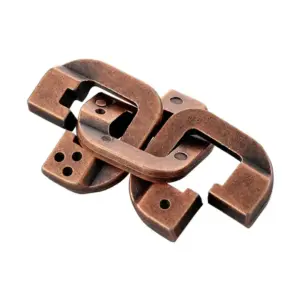
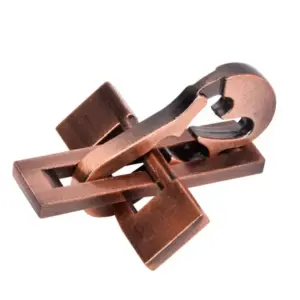
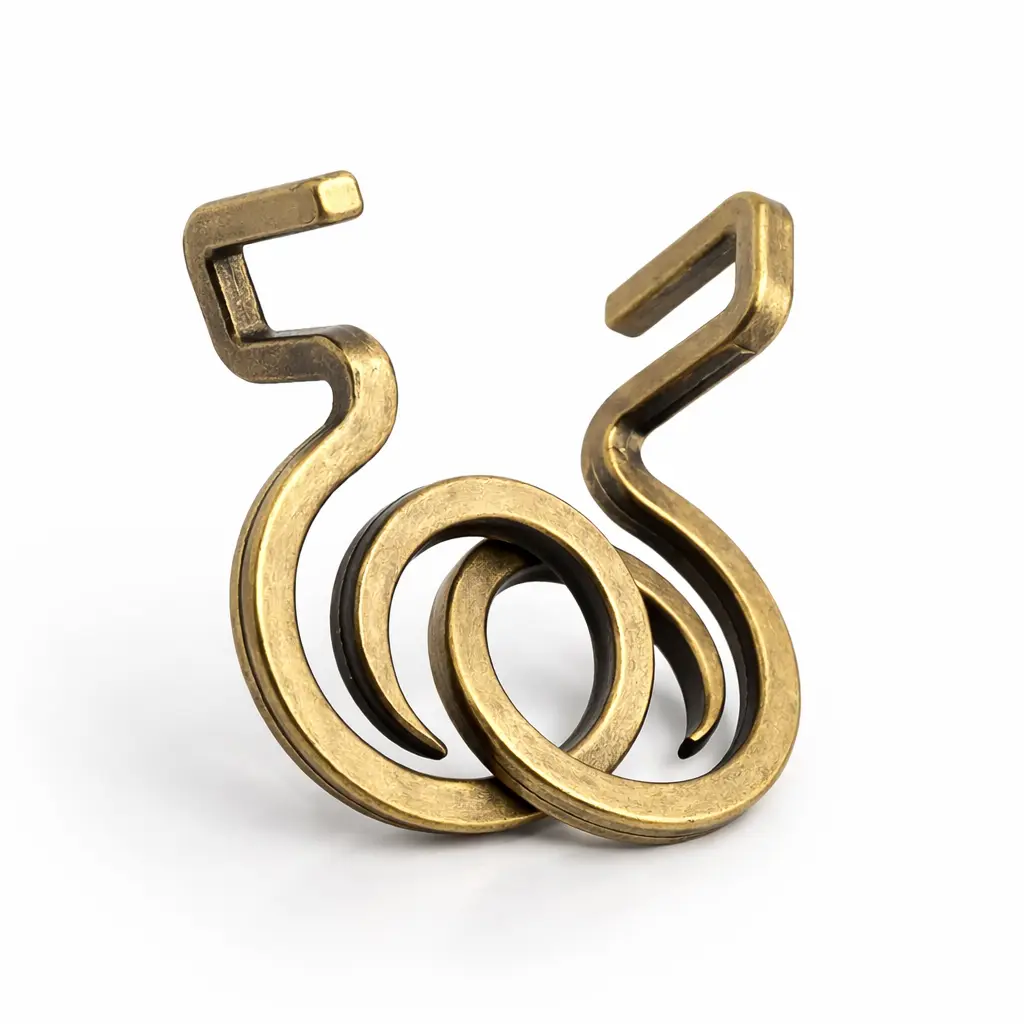
The Cast Hook Metal Brain Teaser fits the disentanglement class at a weight suited to permanent desk display.
01. Which Cast Metal Puzzle Mechanism Class Should You Buy?
The Quick Answer already named a hero pick in the disentanglement class. The next decision — and the one that determines whether the recipient will still be using the puzzle six months from now — is the mechanism class itself, because the class, not the price and not the finish, controls how the object gets used. A mechanical puzzle is defined as a puzzle solved entirely through physical manipulation, and that definition is what separates this gift category from screen games, apps, or paper-and-pencil challenges. A disentanglement puzzle rewards repeatable hand challenges between meetings; a sequential-removal puzzle rewards a longer ordered solve. The four classes below define what the solver actually has to do with their hands.
Disentanglement puzzles ask the solver to free one trapped piece from a structure. The mechanism usually looks like the piece cannot possibly pass — a hook caught on a bar, a ring trapped inside a frame — and the solve is finding the path that bypasses the apparent barrier. Wikipedia’s Disentanglement puzzle entry defines the class by that “free the trapped piece” goal. Solve time is short once the path is found, which is why this class lives happily on a desk as a repeatable ritual. Form factor is compact, weight typically lands in the 50–150 g band, and the feel is “I can put this down and pick it up between meetings.”
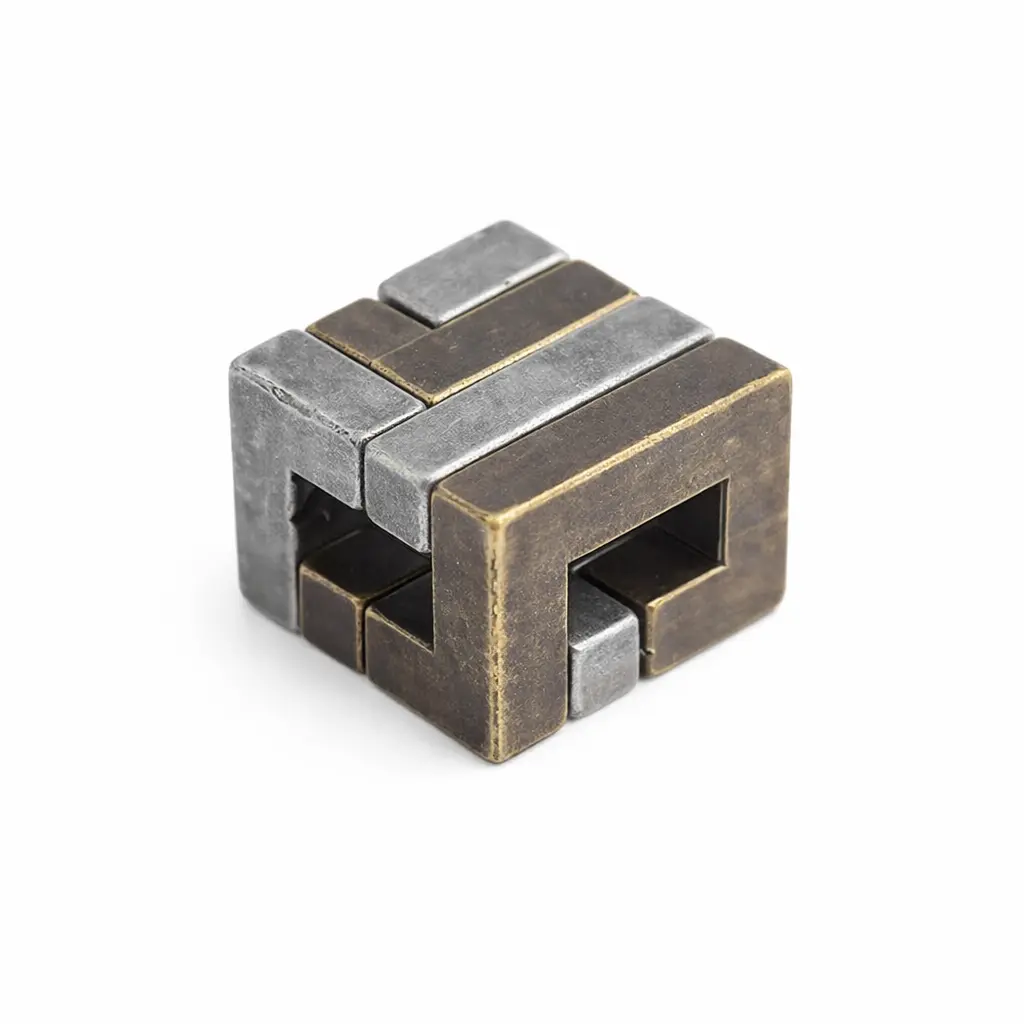
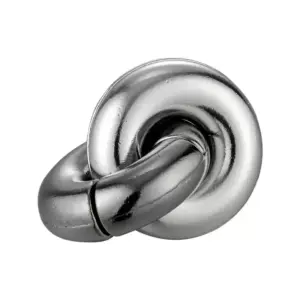
Cast Coil Pocket Puzzle — $18.99
Sequential-removal puzzles ask the solver to execute moves in a specific order — the sequential move is the contract: step 2 only works after step 1 has been completed. The Curio Puzzles product page describes their brass Jack Puzzle as designed for sequential disassembly and reassembly, which is the defining behaviour of this class. The reward is a longer solve, often 10–30 minutes for a typical cast-metal sequential, and a final “click” that feels earned. Weight tends to be heavier than a disentanglement piece because the mechanism has more mass to manipulate. Form factor is usually a closed shape that hides the order until the solver has cracked it. Feel: “I had to think about this in layers.”
Burr and interlocking puzzles ask the solver to separate pieces that are physically locked together. The pieces fit with notches, slots, or internal geometries that no single move can undo, and the visual reveal as each piece slides free is part of the reward. Weight is the heaviest in this lineup because the interlocking geometry uses more material. Form factor tends to be a chunky, displayable shape that justifies the mass. Feel: “I can see why this goes together — I just have to find the path.”
Take-apart puzzles ask the solver to disassemble an object without tools. The disguise is part of the gift: a take-apart puzzle hides its puzzle nature inside something that looks like a familiar desk object. Weight and finish dominate the impression; heavier brass develops a patina over months of handling, which most developers read as a feature, not wear. Form factor is the giveaway — a take-apart puzzle often reads as a key, a lock, a ring, or a small instrument. Feel: “Wait, that opened?”
The next action: before adding a listing to cart, read the product page and name the mechanism class out loud. If the description uses “disentangle,” “sequential,” “burr,” or “take apart,” you have a definable class and a predictable solve-time band. If it uses only “brain teaser” with no mechanism named, treat the listing as a reject and move on. A broader classification of these four families alongside adjacent ones is laid out in a collector’s taxonomy of six types of metal brain teaser puzzles, which goes deeper than this guide needs to.
02. Why Does a Software Developer’s Profile Change the Recommendation?
The four mechanism classes are defined, and the question is now which one fits a specific developer. A developer who solves logic problems professionally does not need more logic; the gift works because the activity is different from the work, and the recipient’s profile determines whether the object earns a permanent spot on the desk or gets solved once and shelved. Match the profile first, then verify the mechanism on the product page.
Professional problem-solvers are not the audience puzzles are aimed at, yet the cast metal form works anyway. A developer’s daily work is screen-mediated, where problems are text on a flat surface. A cast metal object returns the problem to the hands, to weight, to three-dimensional geometry, to a feedback loop a monitor cannot deliver. The Wikipedia entry on fidget toys frames them as tools for sensory stimulation and attention regulation; a cast metal puzzle operates in that same register, a screen-free focus object that uses tactile manipulation to redirect attention rather than demand more of it. The gift earns its place because the work changes the medium, not because the brain needs another problem.
Four developer profiles map to the four mechanism classes. The mapping is not about skill but about what the recipient already values at the desk: novelty, craft, constraint, or quiet signal. A misread here is the difference between a puzzle solved once and shelved and one that lives on the desk for years.
A junior engineer who likes novelty responds to a disentanglement puzzle. The solve is repeatable, the moves forgiving, the challenge resets in seconds, which suits an early-career developer who treats the desk as a fidget space between tickets. A piece like the Metal Orbit Ring Cast Puzzle uses the orbit-and-remove pattern: two cast rings coaxed apart, satisfying enough to pick up during a code review.
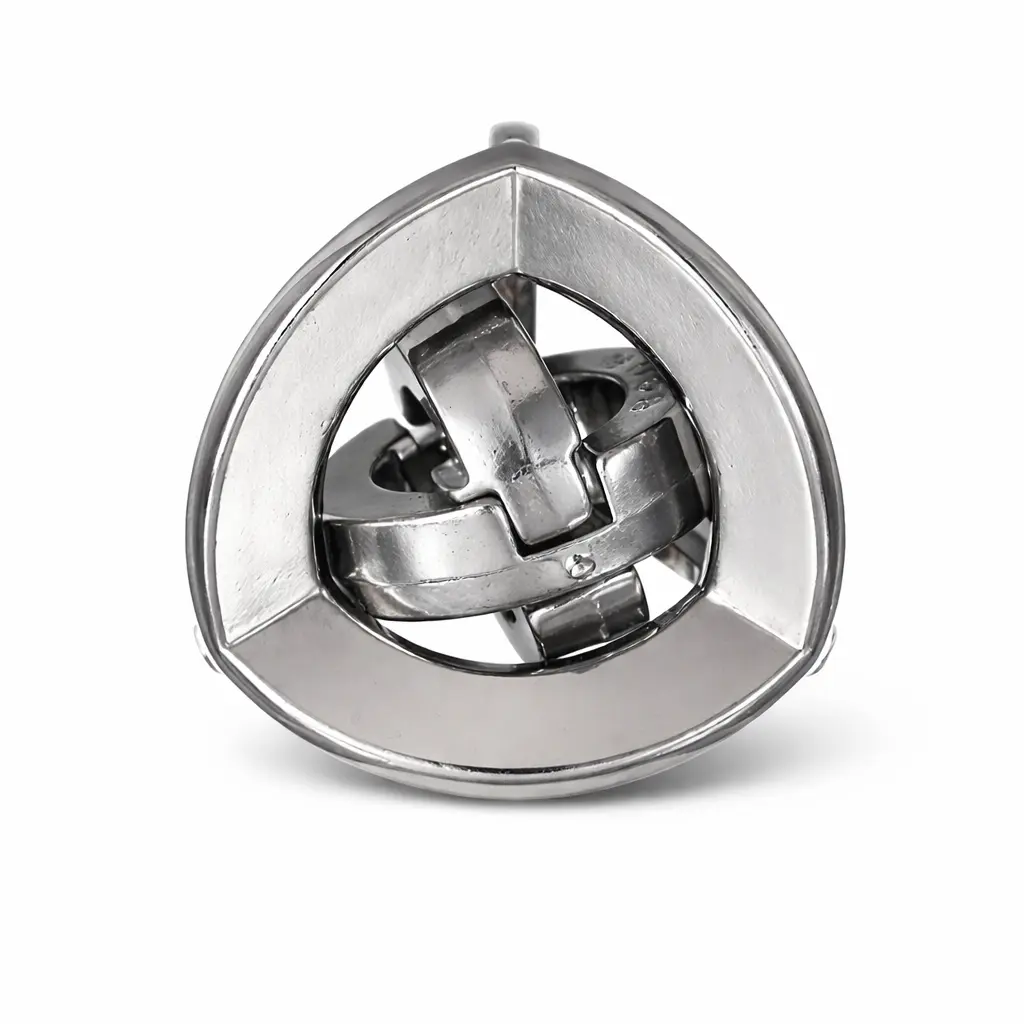
A senior engineer who values craft responds to a burr or interlocking puzzle. A heavier assembly reads as serious desk hardware rather than desk toy, and the slow reveal of each piece is the part this profile enjoys. Brass and zinc-alloy castings develop a patina with handling, and a senior engineer reads that patina as earned character, not wear. The Cast Coil Triangle Puzzle is a close example of a displayable, weight-forward shape whose interlocking geometry rewards methodical exploration.
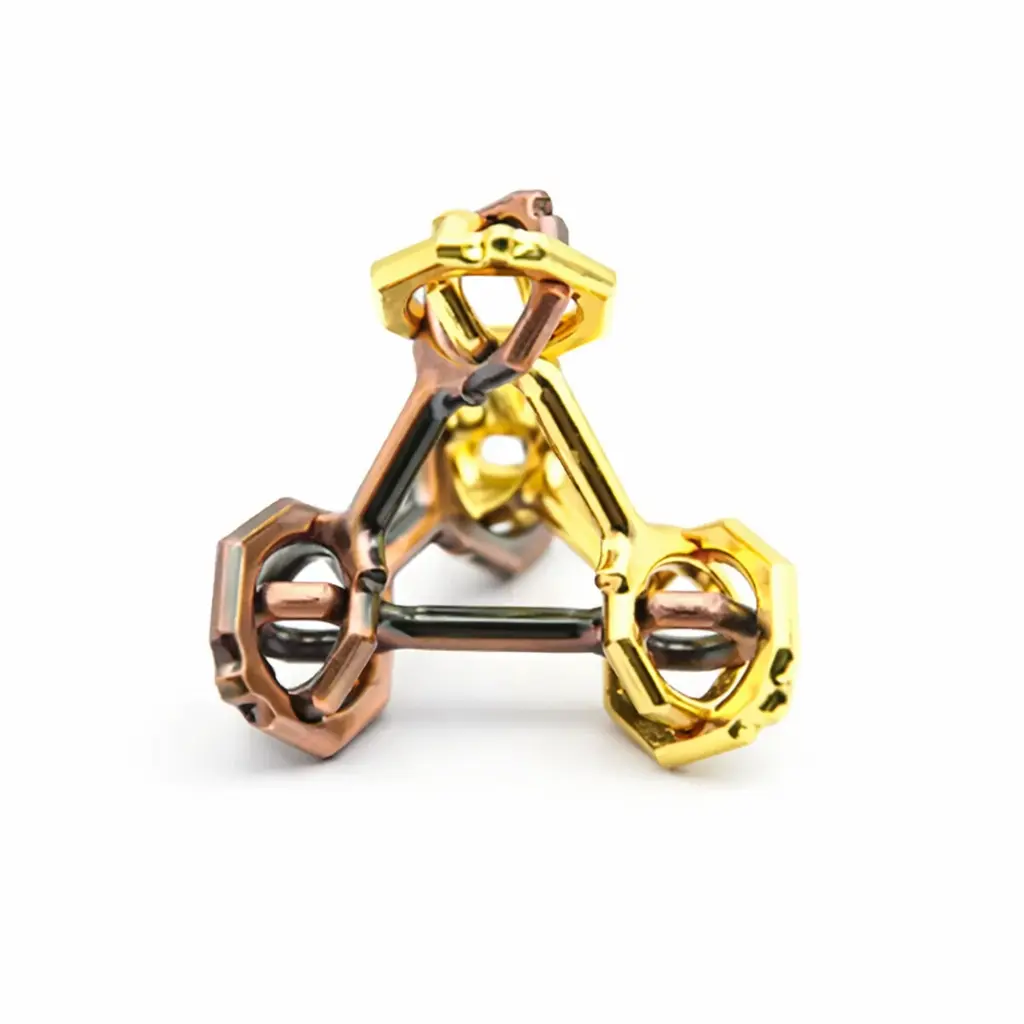
A systems programmer who enjoys tight constraints responds to a sequential-move puzzle, where the order of operations is the puzzle. This profile thinks in state machines and preconditions; they enjoy puzzles that punish the wrong first move and reward reading the geometry before acting. A take-apart puzzle that hides its moves under a familiar disguise — a key, a ring, a lock-like object — tends to land well because the constraint is the point.
An engineering manager who wants a quiet desk signal responds to a take-apart puzzle that reads as something else first. A brass object on a shelf that turns out to be a puzzle is the detail a manager who curates taste will appreciate; it signals craft and discretion. Form factor matters more than mechanism here: a key, a small lock, or a ring-style object on a coaster, handled occasionally, is the right register.
The desk is where the recipient’s identity gets broadcast, and material changes that read. A zinc-alloy piece in a bright finish reads as promotional swag; a brass or heavier alloy with a matte or antique finish reads as curated object. Patina is the long-term signal: a metal puzzle handled daily will darken at contact points, which most developers read as a feature, not wear. The verification step is to check the material declaration on the product page and to look for a weight in grams rather than a vague “heavy-duty” claim. The form-factor split between monitor-shelf display and pocket carry is tested in Tea Sip’s roundup of desk puzzles for software developers evaluated for mental breaks, where each pick is judged on how it sits on a desk rather than how it fits in a pocket.
The next action: before adding a listing to cart, write down which of the four profiles the recipient matches and which mechanism class that profile maps to. Then verify the product page names the mechanism, lists the material, and gives a weight. A listing that says only “brain teaser” without naming a class is a reject, not because the puzzle is bad, but because it cannot be checked against this map.
03. What Should You Check on a Cast Metal Puzzle Product Page?
Reject any cast metal puzzle listing that does not name the mechanism, declare the material in grams, and state a solve difficulty band or time. A product page that skips these three details cannot be checked against a buyer decision, which is the entire reason the rest of this guide exists.
Five checks separate a buyable listing from a gamble. Run them in order, and reject the listing the moment one fails.
Check 1 — Material declared in grams, not adjectives. The product page should state the metal (brass, zinc alloy, stainless steel) and a weight figure. “High-quality metal alloy” with no gram count is a vague listing, because the buyer cannot compare it to a known reference. Brass and zinc behave differently in the hand, and the difference shows up in the first ten seconds of holding. For a deeper comparison of how the common metals feel and hold up, the Tea Sip guide to metals used in metal puzzles compared by weight and durability is a usable cross-check against any listing’s weight claim.
Check 2 — Mechanism named in plain language. The listing should say disentanglement, sequential removal, interlocking burr, or take-apart. The Curio Puzzles product page for its brass Jack Puzzle is a useful model: it names the piece as a sequential-disassembly and reassembly puzzle, which tells the buyer exactly what the solver is being asked to do. A listing that says only “brain teaser” or “puzzle gift” leaves the mechanism undefined, and mechanism is the variable the buyer just spent two sections mapping to a recipient profile.
Check 3 — Solve difficulty band or stated time. The page should give a difficulty rating (often 1–6) or a time range (“5 to 15 minutes”). A solve time that exceeds 45 minutes changes the gift calculus, because the recipient is now committing to a project, not a fidget. If the listing gives neither, the buyer is guessing.
Check 4 — Display form versus pocket form. A cast metal puzzle meant to live on the desk needs a base, a finish that holds up to handling, and proportions that read at arm’s length. A pocket form is built to be carried and used briefly. The product photo should make this obvious; if the puzzle is shown floating against white with no base and no context, the buyer is looking at pocket form regardless of how the description frames it.
Check 5 — Return policy on a used-handled item. Some sellers will not accept a returned puzzle once the seal is broken, which is reasonable, but the policy must be stated. If the page is silent, the buyer cannot resolve a recipient-doesn’t-like-it outcome cleanly.
The practical next action: open the listing, run the five checks in order, and reject the page if any one fails. The product page is the verification tool. When it cooperates, the mechanism-to-profile map from sections 01 and 02 becomes a buying decision.
04. How Do You Match a Mechanism to a Developer Profile?
Once the five checks pass, the remaining decision is mechanism to profile. Match the recipient’s desk and habits, not the brand. A disentanglement puzzle like the Cast Hook Metal Brain Teaser suits a developer who wants a fast, repeatable hand challenge; a sequential take-apart suits one who values visible progress; an interlocking burr suits engineering-purity minds; a coil or spiral form suits one who wants a sculptural desk signal. The map below turns desk observations into a shortlist.
| Mechanism | Recipient profile | Why it fits | What to check on the page |
|---|---|---|---|
| Disentanglement (e.g., Cast Hook Metal Brain Teaser) | Junior or mid-level developer who enjoys quick resets and visible “aha” moments | The mechanism is a loop-and-hook challenge that solves in minutes and resets without wear; it pairs with the way a screen-switching developer works in short bursts between commits | Material weight in grams, loop diameter, whether the puzzle sits flat on a desk or requires two hands |
| Sequential removal / take-apart | Senior engineer or staff-level developer who values craft and deliberate progress | Disassembly honors patience; each step reveals order, mirroring the way experienced engineers read systems layer by layer | Piece count, stated time range, finish that won’t show fingerprint oils at the first handling |
| Interlocking burr | Systems programmer who enjoys constraints, minimalism, and the satisfaction of a closed geometric proof | A burr puzzle rewards the same mind that reads kernel code or formal specifications; it has no narrative surface to skim, only a mechanism to master | Number of pieces, burr class (6-piece vs. 12-piece), whether the solution path is symmetric or asymmetric |
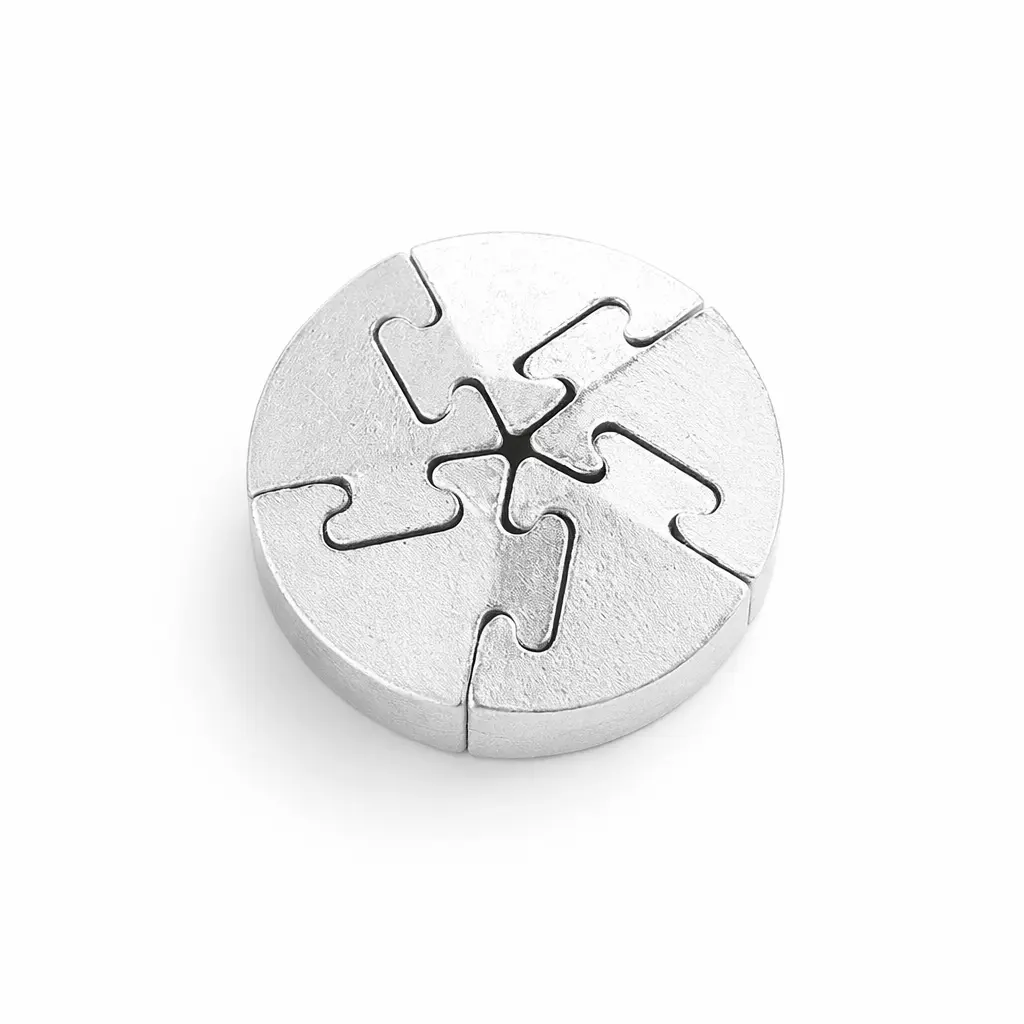
| Coil or spiral form (e.g., 5 Piece Cast Spiral Metal Puzzle, Cast Coil Pocket Puzzle, Cast Coil Triangle Puzzle) | Engineering manager or tech lead who wants a desk object that signals taste without being loud | Sculptural castings read as serious craft rather than desk clutter; the mechanism hides inside the form so the gift is a display object as much as a puzzle | Whether a base is included, the patina behavior of the metal, proportions readable at arm’s length |
How to use the table: start with the recipient’s desk and habits, not the brand or the price. If the developer’s workspace is sparse and the monitor dominates, a sculptural coil form lands as a counterweight. If the desk is already crowded with figurines, swag, and peripherals, a compact disentanglement puzzle disappears into a pocket and gets used. If the recipient has talked about the satisfaction of debugging a state machine or unspooling a gnarly regex, a sequential-removal puzzle is a more honest match than a generic brain teaser. If their shelf already holds a few well-made objects — a watch, a brass paperweight, a hardcover monograph — an interlocking burr signals shared taste more credibly than another novelty. The desk tells you which row applies. For corporate gifting, the coil or spiral class also scales best because the form reads as a gift without requiring the recipient to engage with a mechanism in front of a team. That compactness-over-raw-difficulty logic is the organizing principle behind Tea Sip’s metal brain teaser puzzles for adults sorted by use case, which applies the same desk-footprint filter across its picks.
The practical next action: pick one row from the table, then run the five checks from section 03 against the product page. The mechanism-to-profile match narrows the field; the product page confirms whether the listing is honest about the piece. When both line up, the buying decision is no longer a guess.
05. Do Cast Metal Puzzles Work as Corporate or Team Gifts?
Cast metal puzzles scale well for corporate gifting when every recipient gets their own desk to keep the piece on; they fail as corporate gifts in hot-desking environments where the puzzle has to travel home each night in a shared drawer. For software teams specifically, a mechanism that reads as craft — rather than as a toy — holds up in client meetings and on shared Slack photos.
A compact disentanglement or sequential-removal mechanism handles the team-gifting use case better than a complex interlocking burr. The reasoning: a developer can solve it in a meeting, set it back on the desk, and pick it up a week later without losing progress. An interlocking burr that requires a full teardown to reset creates a problem — the team member either keeps it in a solved state forever (and it stops being a puzzle) or has to remember the reassembly sequence from memory. The compact cast form factor fits this brief well because it sits flat, doesn’t dominate the desk, and carries a sculptural read that doesn’t require the recipient to explain it to a visitor.
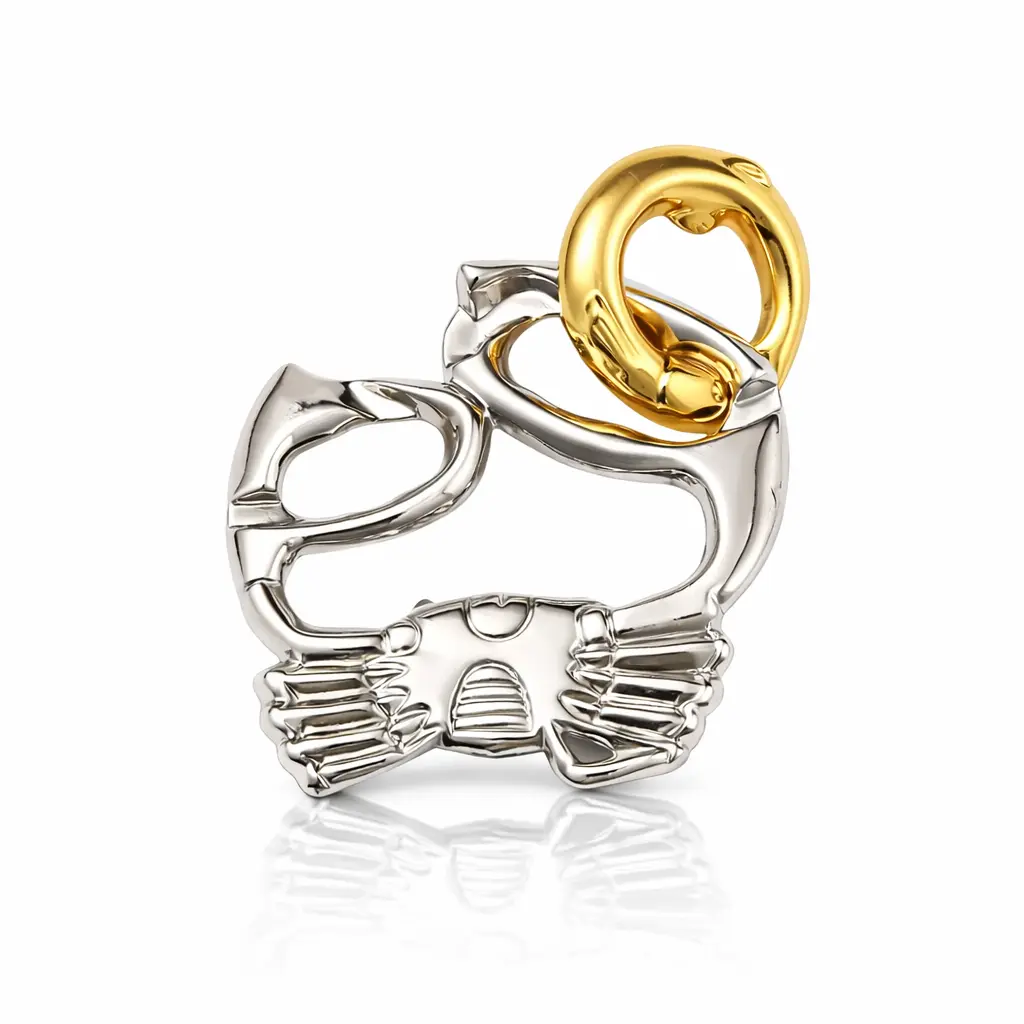
For client-facing gifting — the piece that goes to a customer’s engineering lead, not an internal team — the finish floor rises. The buyer should check for: a smooth, consistent cast surface without visible pitting, a mechanism that moves without grinding, and packaging that doesn’t require the recipient to open a baggie with scissors. What to check if the listing doesn’t show the finish: ask the supplier for a photo of three units from the same production batch, not a single hero shot. A cast piece that looks good in a render can arrive with flash lines or rough sprue marks that read as cheap on a client desk.
The procurement brief should name three things: the mechanism class, the per-unit weight, and whether the pieces ship individually boxed or bulk-packed. A bulk shipment saves cost but forces the gifting team to wrap each piece; an individually boxed order arrives gift-ready. For software teams of 10–50, the mechanism class should stay consistent — a uniform reading on the desk looks intentional, while a mixed box of a coil, a burr, and a lock reads as a clearance bundle.
The use case where a cast metal puzzle is the wrong corporate gift: any environment where the desk is shared, the recipient rotates locations, or the office enforces a strict “no personal objects” policy. A puzzle that can’t stay on the desk becomes a puzzle that goes in a drawer and gets forgotten. In those cases, a consumable — snack box, coffee subscription — outperforms a durable object.
The practical next action: confirm the recipient has a personal desk, decide between an internal team gift and a client-facing gift (which raises the finish threshold), and brief procurement with the three specifications above. For volume logistics and packaging tiers, metal puzzle corporate gift ideas that actually get used covers what this section leaves out.
Frequently Asked Questions
Before you click checkout, a few questions almost always surface — the ones the decision table above cannot settle. These are the practical calls: mechanism difficulty, how long the recipient will actually spend with the object, how the material holds up to desk life, and whether the gift fits a team or a single developer.
What kind of cast metal puzzle suits a software developer?
Match the mechanism to the recipient’s working style. A disentanglement puzzle suits a developer who wants a repeatable hand challenge between commits. A sequential take-apart suits someone who likes finishing what they start. A burr or interlocking puzzle suits a collector who values mechanism density. The primary recommendation, the Cast Hook Metal Brain Teaser, is a disentanglement form in a compact cast body — verify the mechanism name and a stated difficulty on the product page before you commit.
Are cast metal puzzles hard to solve, and how long does solving take?
Difficulty varies by mechanism, not by material. A simple disentanglement can fall in minutes; a complex sequential take-apart can take hours. Reputable listings state a solve-time band or a difficulty rating — if neither is shown, treat that as a red flag and ask the seller before buying.
What is the difference between a disentanglement puzzle and a burr puzzle?
A disentanglement puzzle asks you to free one or more pieces from a trapping structure without forcing them. A burr puzzle asks you to take apart — and later reassemble — interlocking pieces whose moves depend on a specific sequence. The first rewards spatial imagination; the second rewards procedural logic.
Do cast metal puzzles tarnish or show wear from handling?
Brass develops a patina over months of skin contact; stainless and zinc alloys hold their finish longer. Both outcomes are normal and reversible with a polish cloth. Verify the metal declared on the product page before checkout.
Can a metal puzzle live on a desk long-term without damage?
A solid cast piece heavier than 100 grams sits stably and tolerates daily handling. A sub-50-gram piece can scratch a soft desk surface or get knocked into a laptop tray. Check the gram weight on the listing.
Is a cast metal puzzle appropriate as a corporate or team gift?
Yes, when the recipient has a personal desk and the mechanism class stays consistent across the batch. For a single recipient, the Cast Hook Metal Brain Teaser is the natural pick from the recommendation above — same mechanism, same desk read.
Where to Start
If the recipient and occasion checks above match, start with Cast Hook Metal Brain Teaser. Check the current product page for the specifications that matter to your choice.
Sources and verification
- Product details and current specifications: Tea-Sip product page
Last updated: August 26, 2026