Quick Answer: Beginner Puzzle Set Gift for Remote Workers: Which Set Wins?
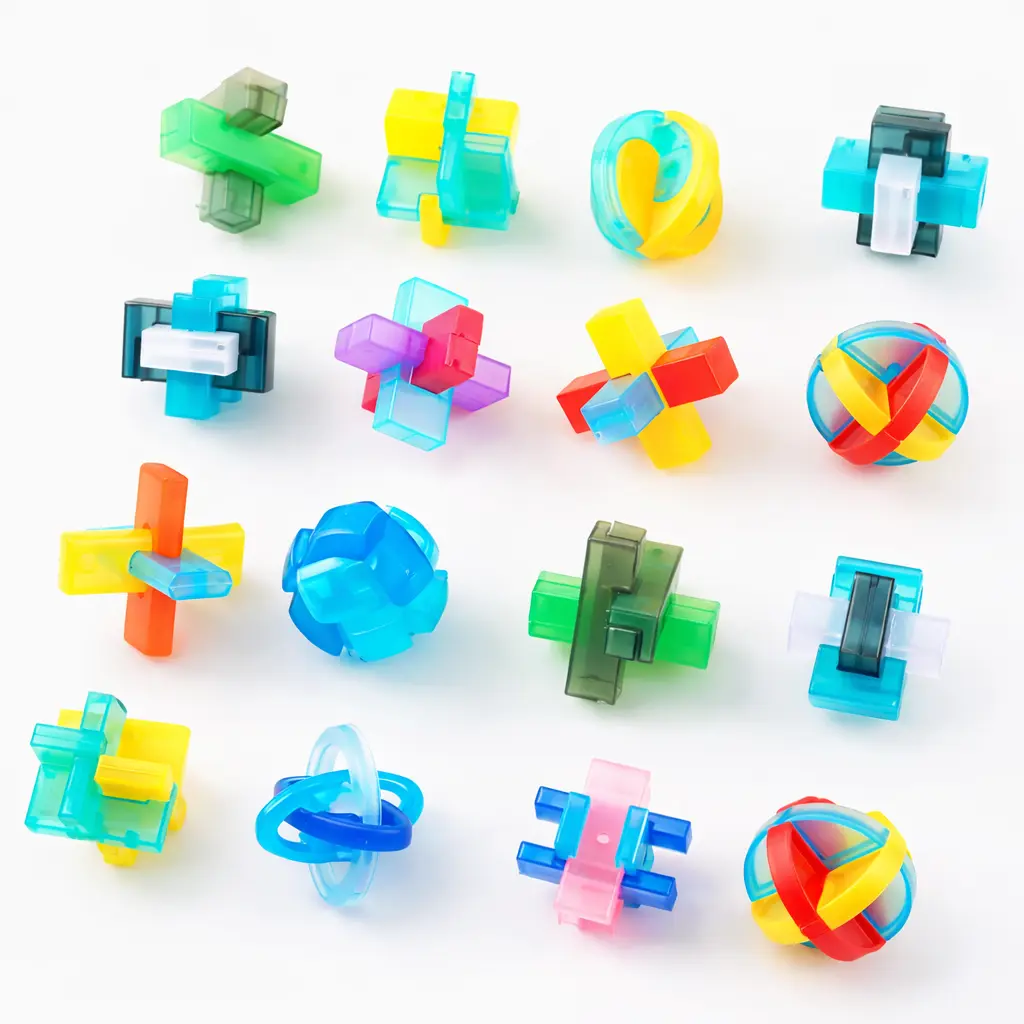
For a beginner remote worker, the 12 Piece Crystal Luban Lock Set is the safest top pick: a 12-piece multi-pack that fits a work bag, stays quiet on calls, and offers a learnable first challenge without expert-level frustration. Choose a wooden brain-teaser set when shelf-display value matters more; choose a metal disentanglement puzzle when the recipient prefers pocketable, tactile work. Three conditions shift the pick: frustration tolerance, desk space, and solo versus shared use.
Set archetypes at a glance
| Set archetype | Best for | Beginner risk | What to check on the product page |
|---|---|---|---|
| Multi-pack brain-teaser (e.g., 12 Piece Crystal Luban Lock Set) | True novices wanting variety in one box | Low — short, repeatable solves | Piece count, material, stated difficulty |
| Wooden brain-teaser set (e.g., 6-in-1 multi-pack) | Recipients who want a shelf-display object | Low to medium | Wood type, finish, ready-to-solve vs. assembly |
| Metal disentanglement (e.g., 4 Band Puzzle Ring, 6 Piece Steel Ball Pyramid) | Tactile, fidget-friendly recipients | Medium — some pieces resist obvious moves | Metal type, pocketability, desk scratch risk |
| 3D-assembly set (e.g., pistol kit, treasure box) | Long-form project solvers | Higher — hours of focus required | Build time, tools needed, finished size |
Three checks that shift the pick
- Frustration tolerance. A novice with low tolerance starts with the lightest piece in a multi-pack, not the hardest. A 12-piece set lets them skip blockers.
- Desk space. A contained multi-pack beats a sprawling wooden kit on a desk already holding two monitors and a laptop.
- Solo or shared. On camera, a visually clear, contained set reads as “interesting hobby,” not “kid’s toy.”
Before you checkout
Confirm the piece count matches the product name. Check the listed material — transparent plastic reads differently on a video call than metal. Read the difficulty range on the product page; a beginner set should not list “expert.” Compare the current listed price against the product page before ordering.
01. What ‘Beginner’ and ‘Set’ Actually Mean in Puzzle Gifting
The pre-checkout notes from the Quick Answer are not arbitrary. They map directly to how a beginner-safe puzzle set is actually defined, and three observable signals separate the gift that gets solved from the one that collects dust: a piece count of four or more, no “expert” or “advanced” tag in the listing, and packaging that calls itself a “set” or “multi-pack” rather than a single collectible.
What “beginner” actually means. The word “beginner” does more work in a product listing than most buyers realize. On a puzzle page, it should signal a low learning curve: the first piece can be opened, separated, or assembled within minutes, without a tutorial, and without the frustration that makes a novice abandon a hobby on day one. If a listing uses phrases like “collector edition,” “advanced,” or “for experienced solvers,” that is a quiet way of saying the recipient will struggle. A true beginner set holds at least one piece easy enough to finish between meetings — because the early win is what hooks a remote worker who only has fifteen minutes between calls and no patience for a one-hour dead end.
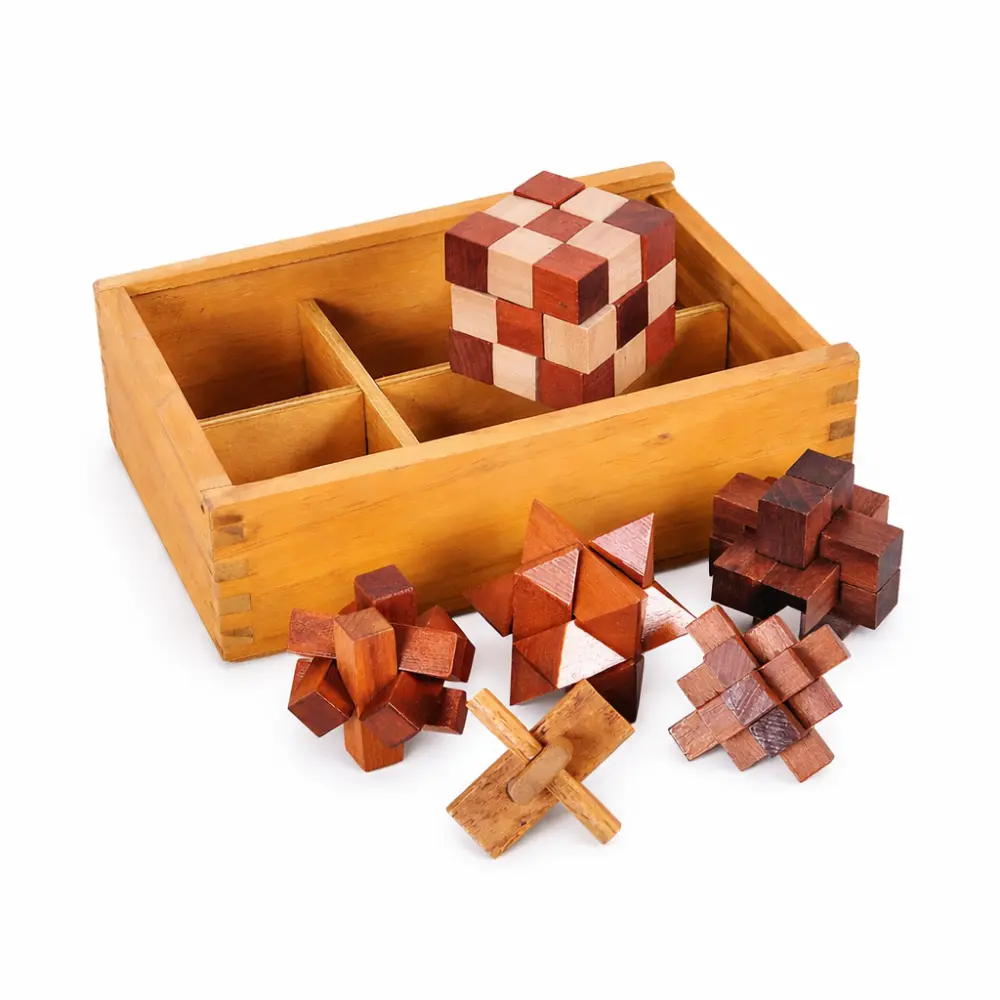
What “set” actually means — and why it matters for gifting. A “set” is a multi-pack of varied pieces, not one single puzzle. That distinction matters more for a gift than for a personal buy. A single expert-level puzzle is a collector’s item, not a beginner gift. For someone shopping for a remote coworker, the set format offers three things a single puzzle cannot: a built-in learning curve (easy pieces first, harder ones later), a longer gift lifespan (one piece per week rather than one solve per lifetime), and a lower per-piece cost that fits a practical gift budget. A wooden brain-teaser set packaged as a 6-in-1 multi-pack is the clearest example of this format — one box, six distinct challenges, each with its own difficulty step. HitMyNeed’s wooden brain-teaser set, for instance, is described the same way on its product page, which is the structural promise a buyer should look for in any set listing.
The 6-in-1 Wooden Brain Teaser Set fits that beginner-friendly multi-pack model and reads cleanly on a home-office shelf.
Why expert picks often fail beginners. Many roundups of “puzzle gifts for adults” lead with names like the BonBon, the 2-Piece Pyramid, or the Four Fit — all flagged as expert-to-medium difficulty in their own product framing. Those are great gifts for a hobbyist who already solves, but a novice will hit the first piece, fail twice, and shelve the set. The mismatch is rarely the buyer’s fault: the listing rarely says “expert” in the headline, and the design looks approachable until the solve attempt starts. That is why the three beginner-safety signals at the top of this section exist — they are what the product page does not volunteer on its own, and they exist because most general-audience roundups do not apply a remote-work filter to difficulty.
Reading the product page like a buyer. Before adding a set to cart, scan the listing for four items: the exact piece count, the listed materials, the difficulty language (look for “beginner,” “easy,” or “level 1” rather than “advanced”), and whether the title itself uses the word “set” or “multi-pack.” A mechanical puzzle, in the standard framing used on Wikipedia, is a puzzle that requires ingenuity to disassemble, separate, or reassemble — but that definition does not signal difficulty on its own. The difficulty signal must come from the product page itself, not the category header. If the page does not list a difficulty range, that is a verification gap to flag before checkout, not a green light. A buyer who skips this step is essentially buying a hobby blind.
The next action. Pick one set archetype from the Quick Answer, then run those four checks on the product page. The set that passes all four — piece count, materials, difficulty language, and the word “set” or “multi-pack” in the title — is the one that will survive a remote workday rather than collect dust next to a keyboard. Move to the next section to see how the same checks change once the desk, the camera, and the call schedule enter the picture.
02. The Four Remote-Work Fit Criteria for a Desk Puzzle
A puzzle set only earns its place on a remote worker’s desk if it passes four observable fit tests — desk footprint, call-friendly noise, video-call shareability, and screen-free break value — that most gift guides skip entirely. Run these before checkout and the set either survives the workday or it does not.
The previous section covered how to read a product page for piece count, materials, difficulty language, and the word “set” or “multi-pack” in the title. Those checks protect the buyer from picking the wrong hobby. The four checks below protect the buyer from picking a hobby that cannot survive the actual environment it has to live in: a home-office shelf with a second monitor, a webcam, a microphone, and a calendar full of calls.
Criterion 1: Desk footprint.
Measure the available surface area before falling in love with a product photo. A puzzle set that ships in a 12-inch box may not survive contact with a dual-monitor setup, a laptop stand, and a coffee mug. Compact brain-teaser sets in the 4-to-9-piece range generally fit in the negative space beside a keyboard without crowding the webcam’s line of sight. Oversized 3D-assembly kits often double as display objects — and that is the point — but they need shelf real estate, not desk real estate. The failure mode here is simple: a box too big to leave out gets shoved in a drawer and never reopened. Verify the listed dimensions on the product page before checkout.
Criterion 2: Call-friendly noise level.
This is the criterion most gift guides ignore. A metal disentanglement puzzle that clicks, clinks, or scrapes against a desk surface is a liability on an open-mic call. Wooden brain-teaser sets and plastic interlocking sets are quieter by default — they absorb sound rather than reflect it. A buyer cannot measure this from a photo, so the practical check is to read the product page for material language (“wood,” “plastic,” “ABS”) and to scan reviews for any mention of noise. If the page is silent on both, treat the set as unverified for call use rather than assuming it is fine.
Criterion 3: Video-call shareability.
A puzzle on a desk is a background. Coworkers, clients, and managers will see it. The question is whether the puzzle signals “fun professional” or “kid’s toy.” Geometric wooden brain teasers and abstract metal disentanglement puzzles tend to read as tasteful desk objects. Puzzle sets shaped like cartoon characters, brightly colored plastic pieces, or novelty kits tend to undercut a professional backdrop. The failure mode is a background that sparks an unwanted question in the middle of a quarterly review. If the recipient’s calls include clients or external stakeholders, lean toward minimalist materials and muted color palettes.
Criterion 4: Screen-free break value.
A desk puzzle that takes an hour to solve is not a micro-break — it is a project. A desk puzzle that solves in two minutes is a reset button between tasks, not a hobby. The criterion here is repeatability: can the recipient solve, reset, and solve again without losing the fun. Brain-teaser sets and disentanglement sets are built for this loop; 3D-assembly kits are one-and-done unless the recipient enjoys rebuilding. Match the loop to the recipient’s break pattern. A 10-minute screen break calls for a different puzzle than a 30-minute lunch break, and the wrong match is how a gift becomes desk clutter.
The next action. Take one set from the previous section’s archetype list and run the four checks above on its product page. A set that clears all four — compact footprint, quiet materials, professional background, repeatable loop — is the one that will still be on the desk in six months. For a deeper look at desk-toy options that survive video calls, see remote-work desk toys that survive video calls. Move to the next section to see how these four filters turn into a concrete set-by-set comparison.
03. Four Beginner Set Archetypes Compared by Mechanism and Use
Match the recipient to one of four beginner-friendly set families — wooden brain-teaser, metal disentanglement, 3D assembly, or jigsaw-adjacent — and the gift survives a real workday instead of joining the desk clutter pile. The archetype you pick determines repeatability, desk footprint, and how the recipient actually uses the set between meetings, which is why the choice is about fit, not difficulty alone.
The previous section ended with a repeatability filter, and that filter is the hinge between archetype and recipient. A set that resets in seconds invites a five-minute reset between tasks; a set that builds once invites display, not play. Each archetype below maps to a different repeatability rhythm, desk footprint, and beginner risk profile. The match is what makes a gift a daily habit or a one-week curiosity.
Wooden brain-teaser set (the safe default)
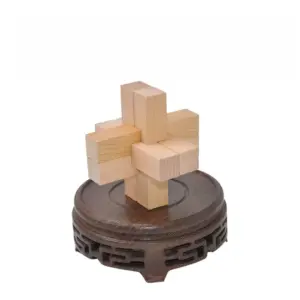
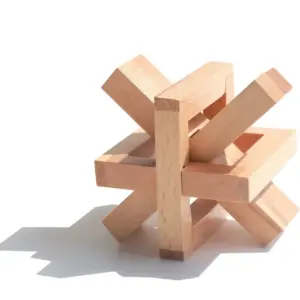
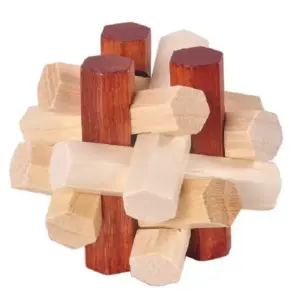
Mechanism: interlocked pieces that come apart in a specific sequence — often wooden, crystal, or chain-linked. Desk-fit: small footprint, low profile, doubles as a display object once solved. Beginner-safety: look for a set that mixes difficulty levels or includes a solution guide. A 12-piece multi-pack of varied lock mechanisms lets a true novice start easy and progress, which is why the 12 Piece Crystal Luban Lock Set is the clearest beginner-friendly choice in this family — the variety softens the frustration-tolerance risk in a single purchase. The 6-in-1 Wooden Brain Teaser Set is the wood-grain alternative when the recipient prefers warmer material on a wood-tone desk. Either earns its home-office shelf space.
Metal disentanglement set (the tactile loop)
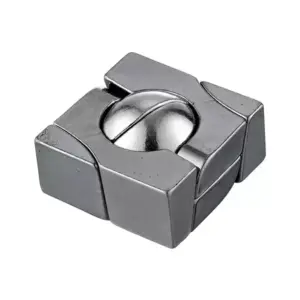
Mechanism: metal wires, rings, or balls separated and reconnected along a specific path. Desk-fit: the smallest footprint of the four archetypes, often pocketable, fits in a work bag for a screen-free break between meetings. Beginner-safety: metal sets can feel mechanical rather than puzzling when they jam, so check for a solution guide and visible mechanism. The 4 Band Puzzle Ring is the entry-level metal option because the bands are visible and the solve is short, keeping frustration low. These sets also overlap with what Wikipedia describes as fidget toys — objects used for sensory stimulation or focus — which is why a metal set often doubles as a quiet reset tool on a busy day. Step-up options include the 6 Piece Steel Ball Pyramid Puzzle, which adds multi-pack variety in metal.
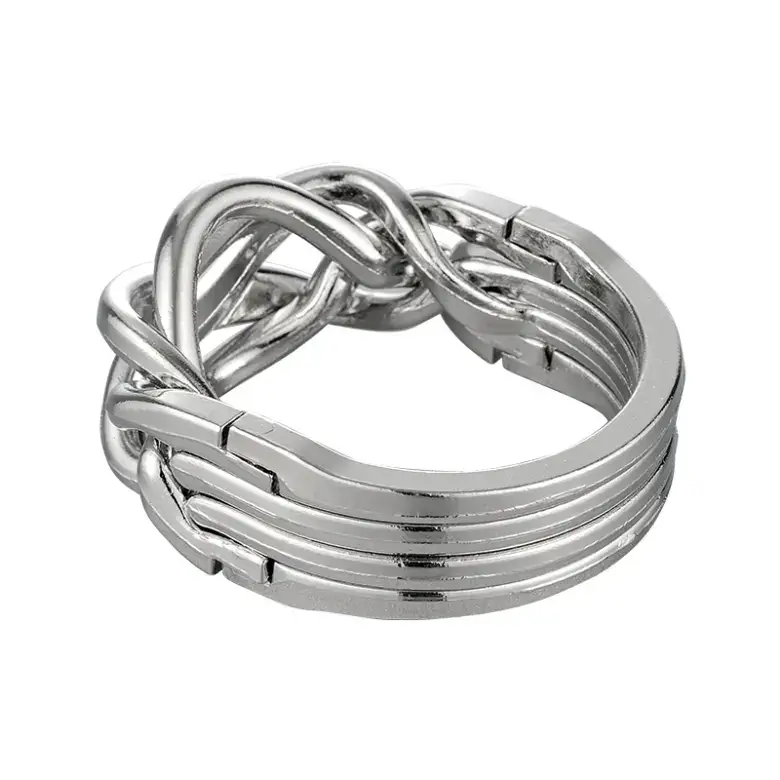
4 Band Puzzle Ring — $11.99
3D assembly set (the build-once reveal)
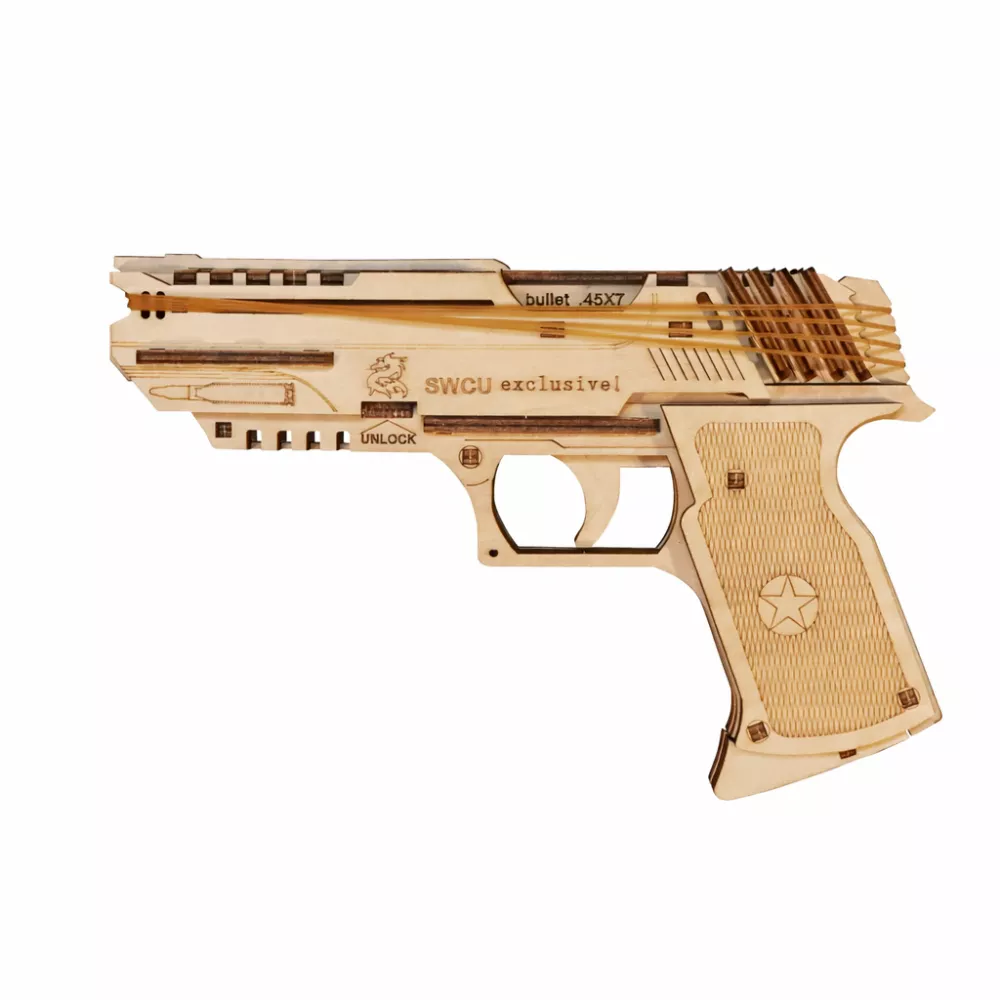
Mechanism: flat wooden or metal sheets that snap or screw together into a 3D model — often a clock, vehicle, or mechanical object. Desk-fit: large footprint during assembly, permanent display object afterward, and the result is what the recipient sees on video calls. Beginner-safety: assembly time can stretch to several hours, and a missing piece stops the build cold, so verify piece count, recommended skill level, and whether tools are included on the product page. The 3D Wooden Mechanical Pistol Kit is a compact build with a display payoff at the lower end of the 3D-assembly price range. Larger builds like the 3D Wooden Puzzle Clock DIY Kit or the 3D Wooden Puzzle Safe with Combination Lock turn the gift into a longer project and a more substantial desk object.
Jigsaw-adjacent mini-set (the shared break)
Mechanism: small geometric assemblies — Soma cubes, T-shaped cube puzzles, or layered wooden shapes — rebuilt after a quick scramble. Desk-fit: medium footprint, stable on a desk, easy to pause mid-solve. Beginner-safety: the low difficulty ceiling is a feature for a true beginner but a limit for an experienced puzzler, so pair this archetype with someone who prefers a calm five-minute reset over a hard challenge. The 54-T Cube Puzzle is the most approachable because the pieces are chunky and the solve fits a coffee break. The 7 Color Soma Cube Puzzle sits beside it for a slightly higher learning curve. Both invite a shared puzzle moment on a video call — two people can compare solves in real time without either one looking unprofessional on camera.
The trade-off in one line
Wooden brain-teaser sets win on display value and variety in a single purchase; metal sets win on tactile repetition and pocket portability; 3D assemblies win on the build-and-display reveal; jigsaw-adjacent sets win on collaborative break time. The next move is to pick one archetype that matches the recipient’s break pattern from Section 02, then open the product page and run the four remote-work checks from earlier in this guide. A set that clears compact footprint, quiet materials, professional background, and a repeatable loop is the one still earning its place on the desk six months later.
04. Frustration-Tolerance Check and the Decision Table
A beginner puzzle set should be matched to the recipient’s frustration tolerance before it reaches the desk, not after. The 12 Piece Crystal Luban Lock Set sits at the safest end of the curve because each lock is a self-contained solve that fits between meetings, while wooden brain-teaser sets and metal disentanglements scale up in difficulty inside the same box. Pick the wrong tolerance and the gift ends up in a drawer by Wednesday.
Run this pre-purchase check
A frustration-tolerance check is the one filter three of five competitor listicles skip, which is why their beginner recommendations tend to frustrate true novices. Before you click buy, scan which sentence below sounds most like the recipient:
- Low tolerance — “I want something I can solve in five minutes or put down without guilt.” → The 12 Piece Crystal Luban Lock Set delivers twelve short solves, each one a self-contained reward. The 6 Piece Steel Ball Pyramid Puzzle is the second-safest pick: fewer pieces, a single objective, no assembly required.
- Medium tolerance — “I like a small challenge but I don’t want to give up my lunch break.” → The 6-in-1 Wooden Brain Teaser Set walks difficulty up across six varied puzzles, so a beginner starts easy and progresses inside the same box. The 54-T Cube Puzzle sits in the same range.
- High tolerance — “Give me something I can chew on for a week.” → The 3D Wooden Mechanical Pistol Kit is a multi-session build that doubles as a display object. Pair it with a shorter daily-pick set (the 12 Piece Crystal Luban Lock Set) so the recipient has a quick win alongside the long project.
Decision table
| Set Archetype | Best For | Why It Works | What to Check on the Product Page |
|---|---|---|---|
| 12 Piece Crystal Luban Lock Set ($28.88) | True beginners, video-call desks, multi-sit break pattern | Twelve independent short solves, no assembly, fits a coffee break, low commitment per puzzle | Piece count (12), per-piece difficulty range, material description |
| 6-in-1 Wooden Brain Teaser Set ($38.88) | Beginners who want a learning curve inside one box | Six varied wooden puzzles spanning easy-to-medium, scales the recipient up gradually | Total piece count across all six puzzles, wood type, recommended skill label |
| 6 Piece Steel Ball Pyramid Puzzle ($11.98) | Tactile learners, pocket portability, low-noise desks | Metal feel, six-piece structure, single-objective solve, travels in a work bag | Steel finish, exact dimensions, whether solution hints are included |
| 54-T Cube Puzzle ($18.99) | Logical thinkers, shared video-call solves, display-friendly wood finish | Chunky wooden pieces, moderate solve, doubles as a desk object when assembled | Wood type, assembled size, beginner vs. advanced labeling |
| 3D Wooden Mechanical Pistol Kit ($29.99) | High-tolerance builders, display-led gifts, solo weekend projects | Build-and-reveal payoff, finished piece sits on a home-office shelf, longer engagement | Total parts count, assembly time estimate, whether tools are included |
| 4 Band Puzzle Ring ($11.99) | Pocket-portable fidget-style gift, stocking-stuffer budget | Wearable, near-zero desk footprint, tactile repetition without screen time | Band material, sizing, whether the ring ships with a solution hint |
The one decision rule
If the recipient has never solved a mechanical puzzle, the 12 Piece Crystal Luban Lock Set is the recommended pick: it costs less than a takeout lunch, occupies a corner of the desk, and turns the learning curve into twelve separate wins rather than one long gamble. If the recipient is the person who finishes every crossword, step up to the 6-in-1 Wooden Brain Teaser Set, or pair the 12 Piece Crystal Luban Lock Set with a 3D Wooden Mechanical Pistol Kit so they get a short daily solve and a long weekend project side by side.
What to verify before you buy
Three claims are worth a 30-second product-page check before checkout, because the roster page does not list them all and a wrong assumption sends the gift back:
- Per-piece difficulty range — beginner sets can hide one or two harder pieces inside a “beginner” box; scan the listing for any piece labeled medium or hard.
- Material and finish — wood, metal, and crystal-style plastic each signal a different desk aesthetic; confirm the recipient’s home-office tone before checkout.
- Total piece count across the set — “6-in-1” and “12 Piece” mean different things; the former is six puzzle types, the latter is twelve individual locks. Verify the count matches the recipient’s appetite for variety.
This verification step replaces the assumed facts most competitor listicles leave out, and it is the one habit that separates a gift that gets solved from a gift that gets shelved.
05. Beginner Puzzle Set Questions for Remote Workers, Answered
The questions below are the ones buyers actually ask at checkout for a remote coworker — and each one ends with the verification step that closes the loop. Match the gift to the recipient’s tolerance for frustration, their available desk space, and whether the puzzle is meant for solo breaks or shared video-call moments.
Are wooden brain-teaser sets hard for beginners?
Most wooden brain-teaser sets are designed for first-time solvers and lean on shape recognition rather than abstract logic. The 6-in-1 Wooden Brain Teaser Set sits at the entry end of the difficulty spectrum, so it is the right assumption for a true novice. For a first-time solver, pick a set where the listing names the difficulty level per piece — don’t trust the word “beginner” alone.
What puzzles can you do on a video call without looking unprofessional?
Skip anything noisy or that demands a flat-laid table. Compact metal disentanglements, a single Luban lock, or a wooden cube sit cleanly in-frame, signal “hobby” rather than “kid’s toy,” and rarely produce sound that picks up a microphone. Avoid jigsaws mid-call — they crowd the desk and signal distraction.
Is a puzzle set a good gift for someone who works from home all day?
Yes, when the gift is framed as a screen-free break rather than a productivity tool. The 12 Piece Crystal Luban Lock Set works here because each lock is a short, completable break that clears a few minutes of mental load. A larger project, like the 3D Wooden Mechanical Pistol Kit, works better as a weekend project than a daily break.
How much should I spend on a beginner puzzle gift?
For a first-time solver, a $15–$40 set is the right range: high enough to feel gift-worthy, low enough to avoid the pressure of an “expensive” thing the recipient feels guilty not solving. Confirm the current price on the product page before you commit.
What is the difference between a brain-teaser set and a regular puzzle?
A brain-teaser set ships multiple puzzle types in one box, which is why it suits a beginner whose taste is unknown. A regular puzzle is a single item — one cube, one disentanglement, one jigsaw — and it asks the buyer to guess a single difficulty level and mechanism.
A beginner puzzle set for a remote worker works because it offers variety in a small footprint, not because it promises transformation. The verification habit from the previous section — checking piece count, material, and difficulty labels — is the one practice that separates a generic listicle from a confident buy. For a deeper look at the gifting mechanics behind a puzzle that actually gets used, the real way to gift a puzzle that actually gets solved covers the unwrapping ritual and the “solve-it-on-day-one” habit in more depth.
06. Before You Buy: Five Things to Verify on the Product Page
Treat the product page like a checklist — five verifiable facts turn the habit of checking specs into a confident buy. Confirm specifics on the listing, because none of the remote-work fit arguments above hold if the puzzle arrives as the wrong size, wrong material, or wrong difficulty for a beginner.
1. Listed piece count. A “set” ships multiple puzzles or challenge variations, not a single item. The page should state the number clearly. If the count is buried in a photo caption or absent, ask before checkout.
2. Material and finish. Solid wood reads differently from composite or MDF, and a metal disentanglement should name the alloy. Photos mislead; the written spec is the source of truth.
3. Stated difficulty rating. A genuine beginner-friendly set labels difficulty — star count, number scale, or a “beginner / intermediate / expert” tag. If the page says only “challenging,” assume it skews harder than a novice’s frustration tolerance can carry.
4. Box dimensions against the recipient’s desk. Measure the intended spot before ordering. A 3D-assembly kit that doubles as display needs shelf room, not just a keyboard footprint.
5. Return policy if the puzzle is too hard. A gift that frustrates a beginner is worse than no gift. Confirm the seller accepts returns on unopened boxes, so the recipient can swap a piece they find genuinely punishing.
The single next action: read the product page’s listed piece count and difficulty label first. If either is missing or vague, scroll past the photos to the written spec block — or pick a different set.
Where to Start
If the recipient and occasion checks above match, start with 12 Piece Crystal Luban Lock Set. Check the current product page for the specifications that matter to your choice.
Sources and verification
- Product details and current specifications: Tea-Sip product page
Last updated: August 26, 2026