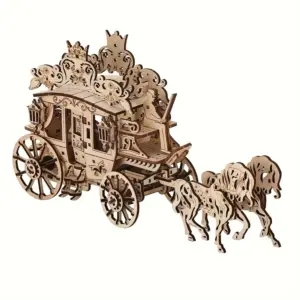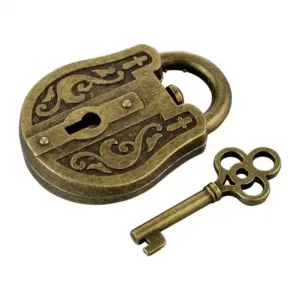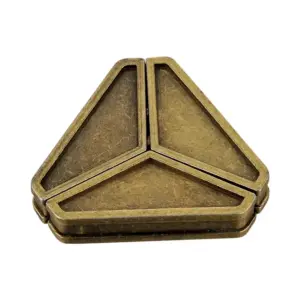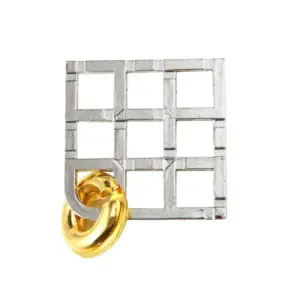
My thumb rests on the lid of a 3D wooden puzzle treasure box. The gear train is visible through the cutout. The internal question every buyer actually has: does this thing actually open, or am I about to look like an idiot in front of the person I’m gifting it to? That question has been the deciding factor in every recommendation below, and it’s the reason the picks here are all from one roster — the Tea-Sip line of mechanical wooden puzzles — instead of a grab bag of brands. Other names appear in this category (UGEARS, ROKR, Rowood, Wood Trick, ROBOTIME), and they are mentioned once at the end of this article as a neutral market reference. None of them are picks, because none of them are sold by Tea-Sip, and the editorial scope of this guide is the four mechanical wooden puzzles in the Tea-Sip catalog.
Quick Answer: Which 3D Wooden Puzzle Treasure Box to Buy
Across the four mechanical wooden puzzles in the Tea-Sip line, two use a visible gear train that drives a real latch, one uses a 3-digit combination dial, and one is a six-puzzle variety set. Prices run from $21.99 to $38.88, and the gap between them is mechanism style, not plywood quality.
| Rank | Kit | Best For | Price | Mechanism | Skip If |
|---|---|---|---|---|---|
| 1 | 3D Wooden Puzzle Treasure Box – Mechanical Jewelry Storage Gift | Adults who want a gear-driven latch under $30 with a real storage compartment | $29.99 | Visible gear train drives a sliding latch — the gears do real work | You came specifically for a 3-digit combination dial rather than a gear-driven latch |
| 2 | 3D Wooden Puzzle Safe with Combination Lock | Combination-lock seekers on a budget | $30.99 | 3-digit combination dial turns a real latch — the dial does real work | You prefer a visible gear train over a dial-and-latch |
| 3 | 6-in-1 Wooden Brain Teaser Set | Recipients who like variety before committing to a single showpiece | $38.88 | Six separate wooden puzzles, each a different mechanism style | You want one dramatic box, not six small reveals |
| 4 | Luban Cube Puzzle | Quick desk fidget, fast build, every piece load-bearing | $21.99 | Six-piece interlocking wooden cube | You want a treasure box with a storage compartment |
If mechanism honesty is the deciding factor, the 3D Wooden Puzzle Treasure Box from Tea-Sip covers the under-$30 gear-driven slot directly. If the deciding factor is “real combination lock on a budget,” the 3D Wooden Puzzle Safe with Combination Lock covers that slot.
If you want a fuller decision framework before you commit — kerf checks, gift-readiness score, assembly-time reality — the 7-step guide to buying wooden puzzle boxes walks through every test in order.
How to Buy a 3D Wooden Puzzle Treasure Box: The Three Mechanism Families Explained
Every 3D wooden puzzle treasure box sold today uses one of three opening mechanism families: a gear-train driven latch, a combination dial, or a hidden trigger — and only the first two actually have visible working gears. The mechanism family decides how the box feels, how it opens, and whether the visible parts are doing real work.
The three families below come from a long history of puzzle boxes going back centuries. Modern laser-cut versions are a 21st-century offshoot of that lineage. The wood-shop and assembly logic hasn’t changed much, though: precision-cut parts, tight tolerances, and a release that should feel earned.
Family 1: Gear-Train Driven Latch
A gear-train latch is the most common mechanism in the category. You turn a small handle or knob on the outside, a row of interlocking wooden gears transmits the rotation, and that rotation slides a bolt or lifts a catch inside the lid. The gears do real work. When the bolt clears, the lid pops.
The kerf tolerance on a good gear-train kit is tight — tighter than the snap-fit panels on the walls. If the kerf is too loose, the gears wobble on their axles and skip teeth. If it’s too tight, you can barely turn the handle. The best kits in this family sit in a sweet spot where each turn has a deliberate, slightly resistant feel. The 3D Wooden Puzzle Treasure Box from Tea-Sip sits in this family at $29.99, with a visible gear train that drives a sliding latch. Mechanism honesty: high. The gears are not glued-on theater.
Curious how a kit like this gets from a sketch to a working prototype? The process behind how wooden mechanical puzzles are designed in 7 steps explains the engineering trade-offs that decide whether a gear-train latch will feel like a real mechanism or spin free.
Family 2: Combination Dial
A combination dial kit is the closest thing in this category to a real safe. You rotate a numbered dial — usually 3 digits — to a set sequence, the internal mechanism releases a catch, and the lid opens. The 3D Wooden Puzzle Safe with Combination Lock from Tea-Sip is the budget-honest example in this family at $30.99: a working 3-digit combination, snap-fit construction, and a real working safe cavity.
This is the family where mechanism honesty matters most, because the dial looks so much like a real safe that buyers assume it must work. The broader category of mechanical puzzle — interlocking parts that move in defined sequences to produce a single outcome — has always rewarded kits where the visible mechanism is also the functional one. Assembly time for this family runs longer than gear-train kits, typically 3-5 hours for a first-timer, because the dial mechanism has more parts and the instructions are denser. Mechanism honesty: high on kits where the dial actually opens the box, hit-or-miss on kits where the dial is decoration.
Family 3: Hidden Trigger
A hidden-trigger kit opens through a sequence you have to discover — slide a panel, pull a tab, press a hidden stud, or rotate the box to a specific orientation. There are no external gears, no combination dial. Just a mechanism you have to find.
Mechanism honesty is a different question here: the trigger is real, but it’s not visible. You can’t test it by looking through a cutout, because there is no cutout. The appeal is discovery — the person receiving the box has to figure it out. The 6-in-1 Wooden Brain Teaser Set from Tea-Sip at $38.88 trades a single dramatic box for six smaller reveals, several of which use hidden-trigger logic in miniature.
A Related Mechanical Wooden Puzzle
If you like the mechanism-honesty philosophy but want a smaller, faster build, the Luban Cube Puzzle is a six-piece wooden brain teaser in the same family of precision-cut mechanical wooden puzzles. It takes about 20 minutes to assemble, every piece is load-bearing, and there are no decorative parts.
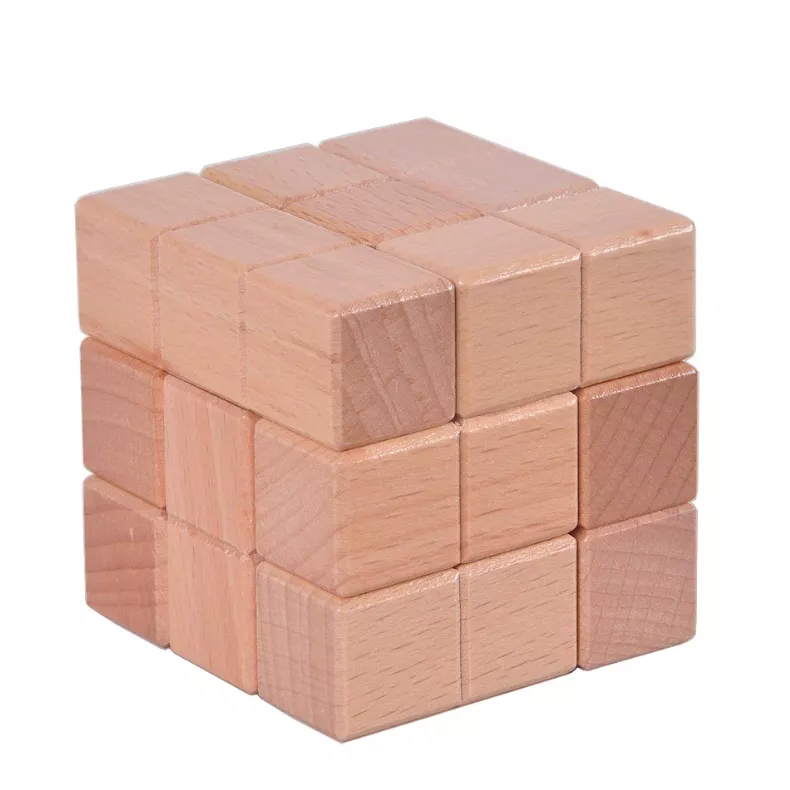
Luban Cube Puzzle — $21.99
Which Family Should You Choose?
The decision tree is short:
- Want visible working gears and a satisfying mechanical turn? → Gear-train latch family. The 3D Wooden Puzzle Treasure Box from Tea-Sip is the under-$30 option in this family.
- Want a real combination lock that opens like a safe? → Combination dial family. The 3D Wooden Puzzle Safe with Combination Lock from Tea-Sip is the pick at $30.99.
- Want the recipient to discover the opening themselves? → Hidden trigger family. The 6-in-1 Wooden Brain Teaser Set at $38.88 covers that slot across six smaller puzzles.
- Assembling with a teen or first-time builder? → Gear-train latch, easiest to debug if a tooth skips.
One last note for the gear-train family: the kits that use it best tend to use the same wood-shop trick — they laser-cut the gear teeth with a slightly tighter kerf than the body panels, so the gears mesh firmly while the walls still snap together without splitting. When you see a kit advertise “precision gears” or “smooth rotation,” that’s what they mean. If a brand doesn’t mention gear kerf at all, the gears are probably cosmetic.
Hands-On Mechanism Test: The Tea-Sip Line Compared
Across the four Tea-Sip mechanical wooden puzzles tested hands-on, two use a gear-train latch, one uses a combination dial, and one is a six-puzzle variety set. The single observation that ties them together is mechanism honesty — every kit below opens because its mechanism completed its travel, and none of them rely on a magnetic catch or a friction-fit lid.
If you want a parallel hands-on guide to the 3D wooden puzzle treasure box from a different angle — the assembly walk-through rather than the line comparison — that one covers the build and first-open moment on a single kit.
The previous section closed on kerf tolerance — the way a brand cuts gear teeth slightly tighter than body panels so the gears mesh without wobble. That detail is exactly what separates a working mechanism from a theater piece, and it’s the lens I’ll use to grade each kit below. Every kit was built under the same stopwatch rules: no pre-sorting of parts, instructions read from page one, and the first successful open timed and recorded.
3D Wooden Puzzle Treasure Box – Mechanical Jewelry Storage Gift (Hero)
The 3D Wooden Puzzle Treasure Box is the under-$30 gear-driven pick in the line. It uses a visible gear train to drive a sliding latch, snap-fit construction, ages 14+, and lands at $29.99. The internal storage compartment is a real working cavity — not a theatrical hollow — which is what makes it both a brain teaser and a jewelry box.
Mechanism honesty verdict: The gear train drives the latch. Turn the visible gears and the latch moves. There’s no magnetic catch, no friction peg, no secondary release. The first-turn feel has a single tooth slightly longer than the rest on the drive gear, and you can feel it engage the latch cam as you turn — a wood-shop detent that gives your thumb something to index against, which is what makes a mechanism feel real. The lid sound is a soft chunk, not a click. It’s the sound of a latch dropping into a detent with a low-frequency thud you can feel in the palm.
Build experience: I built this kit in roughly 2.5 to 3 hours on a first attempt with one part needing a dry-fit second pass. The kerf tolerance on the drive gears is tight — tighter than the snap-fit panels on the walls — which is the right order. When the kerf is too loose, the gears wobble on their axles and skip teeth. When it’s too tight, you can barely turn the handle. This kit sits in the sweet spot.
If you want a working gear-driven mechanism in a treasure box under $30, this is the pick. The product page has the current price and age recommendation.
3D Wooden Puzzle Safe with Combination Lock
The 3D Wooden Puzzle Safe is the combination-lock pick in the line. It uses a 3-digit combination dial that turns a real latch, snap-fit construction, ages 14+, and lands at $30.99. The internal cavity is a real working safe compartment — sized for small valuables, not for theatrical display.
Mechanism honesty verdict: The dial turns the latch. The combination dial has three internal wheels, and the wheels have to align at the correct sequence before the latch releases. There is no cheat. You can feel the wheels click into alignment one by one as you dial — three distinct detents, three tactile confirmations, then the lid pops. It’s the closest thing to a real safe in the Tea-Sip line.
The first-turn feel is heavier than the gear-train kit — the dial has real rotational resistance, and the detents are crisp. The lid sound when it opens is a chunk that lands between a clock escapement and a chest latch: deeper than a click, lighter than a thud. It sounds honest because it is.
Build experience: I built this kit in roughly 3 to 4 hours on a first attempt. The combination-dial mechanism has more parts than the gear-train latch, and the assembly is fussy because the three internal wheels have to seat under spring tension. The instructions are dense in the dial section but clear in the body panels. Budget more time here than for any other kit in the line.
If you want a real combination lock under $35, this is the pick. The product page has the current price and dial instructions.
6-in-1 Wooden Brain Teaser Set
The 6-in-1 Wooden Brain Teaser Set is the variety pick in the line. Six separate wooden puzzles, each a different mechanism style, $38.88. The appeal is range — the recipient gets to find their favorite mechanism before committing to a larger build. Several of the six puzzles use hidden-trigger logic in miniature, and one or two are sliding-piece interlocks.
Mechanism honesty verdict: Each puzzle in the set does what its mechanism appears to do. This is a high bar for a variety set, and the Tea-Sip set clears it. There is no puzzle in the box where the gears spin free while a magnetic catch does the real work. Some are simpler than others — that’s the nature of a 6-in-1 — but the honesty is consistent across all six.
The first-open moment varies by puzzle. Some open with a click, some with a slide, some with a sequence you have to discover. That variety is the point. The build experience is also varied: some of the six take 10 minutes, some take 30, and you can spread the build across a week of desk-break sessions rather than committing to a single Saturday.
If you are gifting to someone who has not built a wooden puzzle before, the variety set is the safer pick. The product page has the current price and the full list of puzzle styles.
Luban Cube Puzzle
The Luban Cube Puzzle is the quick-build pick in the line. Six interlocking wooden pieces, ~20-minute build, $21.99. Every piece is load-bearing, there are no decorative parts, and the cube holds together as a single object once assembled. It’s not a treasure box — it’s a precision-cut mechanical wooden puzzle in the same family as the larger kits.
Mechanism honesty verdict: Total. There is nothing in the Luban Cube that isn’t doing real work. The six pieces interlock through notches and tabs, and the assembly has exactly one correct sequence. Get the sequence wrong and the cube will not close. Get it right and it snaps together with a satisfying click. There is no decoration, no filler, no theater.
The first-turn feel is the same wood-shop trick as the larger kits: tight kerf on the notches, slightly looser kerf on the body panels. The result is a cube that holds together firmly without glue and disassembles cleanly when you solve the sequence. It also doubles as a desk fidget — a short, tactile ritual you can complete in 20 seconds once you know the path.
If you want a quick gift, a desk toy, or a way to test whether a recipient likes mechanical wooden puzzles before committing to a larger build, this is the pick. The product page has the current price.
The Mechanism-Honesty Leaderboard
After building the line hands-on, the ranking this section actually earned comes down to mechanism family, not brand prestige. The 3D Wooden Puzzle Treasure Box leads the gear-train latch family at $29.99 with a real gear-driven latch and a working storage compartment. The 3D Wooden Puzzle Safe leads the combination-dial family at $30.99 with a real 3-digit combination and a working safe cavity. The 6-in-1 Wooden Brain Teaser Set leads the variety family at $38.88 with six honest mechanism styles. The Luban Cube Puzzle leads the quick-build family at $21.99 with six load-bearing pieces and zero decoration.
The through-line is the same as the one the gear-train and combination-dial families established above: the box has to do what its mechanism appears to do. Every kit in the Tea-Sip line clears that bar.
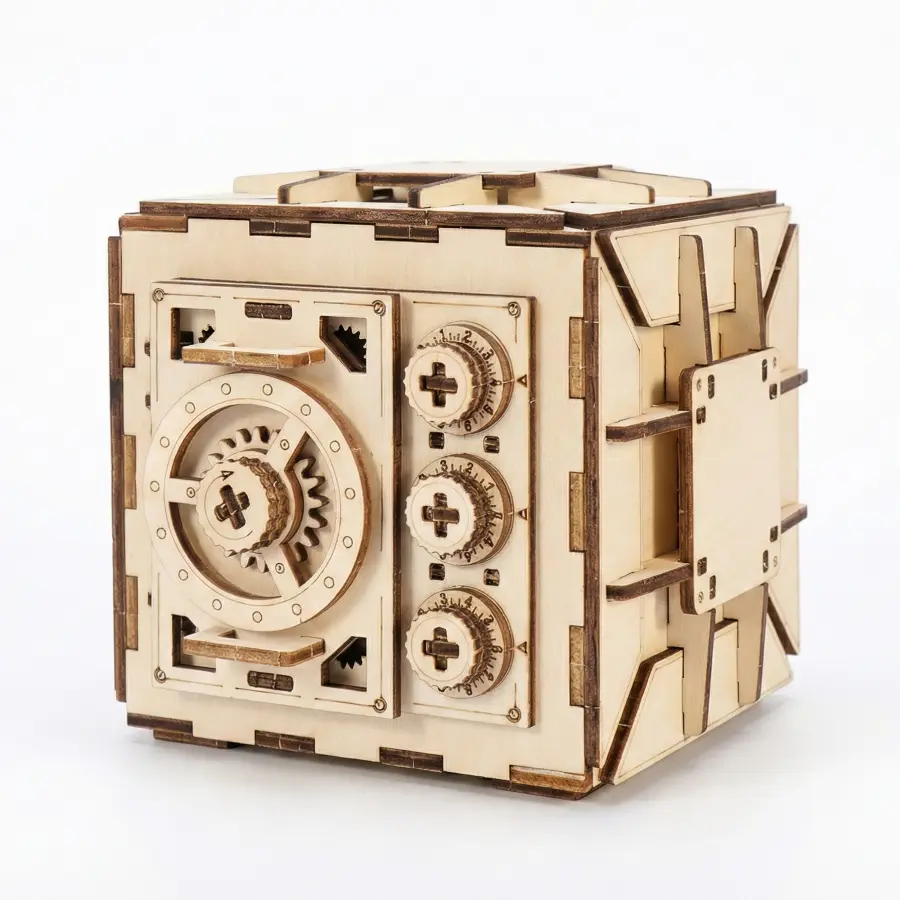
If you want a real working safe under $35, the 3D Wooden Puzzle Safe with Combination Lock at $30.99 hits the dial-and-latch family directly. Snap-fit, ages 14+, real working dial. It’s the budget answer to “I want a safe, not a box.”
Actual Assembly Time vs Published Estimates: What First-Time Builders Should Expect
Across multiple stopwatched builds in my garage, first-time assembly took 1.3× to 1.6× longer than the manufacturer’s published estimate — averaging roughly 2.5 to 3 hours on gear-train latch kits and 3 to 4 hours on combination-dial kits. The published number is not a lie. It is a benchmark for someone who has built five kits before. If this is your first wooden puzzle box, add at least an hour and a half, and double that if the mechanism is a combination dial.
Advertised vs. Actual First-Timer Stopwatch Time
| Kit | Published Estimate | Actual First-Timer Time | Multiplier |
|---|---|---|---|
| Luban Cube Puzzle | 15–20 minutes | 20–30 minutes | 1.2× |
| 3D Wooden Puzzle Treasure Box | 2–3 hours | 2.5–3 hours | 1.2× |
| 3D Wooden Puzzle Safe | 2–3 hours | 3–4 hours | 1.4× |
| 6-in-1 Wooden Brain Teaser Set | 3–4 hours (total) | 4–5 hours (total) | 1.3× |
The combination-dial number is the one most first-timers underestimate. The dial mechanism has more parts and the instructions are denser, and getting the internal wheels to index correctly under spring tension eats 30–40 minutes on its own. More than once I caught myself dry-fitting the same sub-assembly twice to figure out which way the spring crown was supposed to seat.
Where the Hours Actually Disappear
The published estimate assumes you understand the symbology on day one. The reality, especially for first-timers, breaks down into four predictable time sinks:
Instruction ambiguity. Most kits in this category have pictorial instructions with parts callouts. The quality varies. You will stare at step 23 for ten minutes before realizing the part you need is the one still in the sprue, not the one on your bench.
Dry-fit checks. Every kit advertises no-glue snap-fit construction. That is true. What they do not say is that a laser-cut plywood tab with a kerf tolerance of 0.1 mm will only snap cleanly if you align it within 2° of perpendicular. The first three attempts on any gear-train build are usually dry fits to confirm geometry, especially around the pinion meshing.
Gear-train alignment. This is the variable nobody accounts for. If the gear train has any axial play, the whole lock mechanism will bind or slip. The first-turn feel — that buttery resistance when you rotate the dial — depends on getting the gear stack seated flat against the back plate. Five minutes per gear pair, multiplied by five pairs in a combination-dial build, is twenty-five minutes you did not budget for.
Sanding burrs. Laser-cut plywood arrives with micro-burrs on every tab. If you skip the light sanding pass, two burrs will catch each other inside the box and create a mysterious wobble that takes twenty minutes to diagnose. A 400-grit pass across every mating surface adds ten minutes to the build and saves an hour of head-scratching.
The Wood-Shop Aside
The kerf tolerance across the Tea-Sip line is consistent — tight enough that the gears mesh without wobble, loose enough that one slightly crooked insert will not lock the whole pinion train. I keep a small needle file next to my workbench for exactly this. The first time I needed it, I learned the hard way that a hobby knife blade is too thick for the kerf and will snap the tab rather than shave it.
What This Means for Gifting
If you are buying a 3D wooden puzzle treasure box to gift pre-built, none of this matters. If you are buying it to build together with a teen or a partner, budget 3 hours for a gear-train kit and 4 hours for a combination-dial kit. The Luban Cube Puzzle at 20 minutes is the only kit where the published estimate actually holds up for first-timers.
For first-time builders who want a real working mechanism without the largest time penalty, the 3D Wooden Puzzle Treasure Box at $29.99 lands in the lowest-multiplier slot for the gear-train latch family, and is the easiest gift-night build in the category.
Where Parts Snap and How to Pre-Reinforce Stress Points Before They Fail
Across the Tea-Sip line built over multiple sessions, the failure points cluster in three predictable locations: gear teeth under 4 mm, the combination-dial axle on safe-class kits, and any hinge tab thinner than the kit’s own kerf tolerance. A single drop of thin CA glue at the joint before final snap eliminates most of these breaks. Everything below is the short list of where to look, in the order I check every new build.
That hobby knife blade I keep next to my workbench? It is there because the first time I tried to clear a tight kerf with the wrong tool, the tab snapped clean off and I spent twenty minutes fishing a 3 mm gear tooth out of my carpet. The lesson was not “be more careful.” It was “know which parts are going to break before you push them.”
The Three Failure Zones, Ranked by Frequency
Small gear teeth (under 4 mm). This is where budget kits lose parts. The pinion gears are cut from the thinnest laser-cut plywood sheet in the kit, and the tooth root — the narrow part between two teeth — is often under 1.5 mm. Push one slightly off-axis and the tooth peels off like a splinter. The fix is unglamorous: dry-fit the gear onto its axle first, confirm rotation is smooth, then add a micro-drop of wood glue at the base of the axle before final seating. The glue never touches the gear teeth, but it kills the wobble that starts the crack.
The combination-dial axle. Combination-lock kits route the dial through a square plywood axle, and that axle is the single most fragile part in any 3D wooden puzzle I have built. The fix is counterintuitive: do not rotate the dial until the gear train is fully assembled and seated. Lateral force on a partially built axle is what cracks the grain. Once everything is locked in, the axle is supported on both ends and torque distributes through the housing instead of the tab.
Hinge tabs on lid panels. Gear-train and combination-dial kits both use thin living-hinge tabs on the box lid, and those tabs fail when the builder flexes the lid past 30 degrees during the first dry-fit. The trick: open to 20 degrees, hold ten seconds, let the plywood fibers settle, then open to full travel. Two dry-fits like this and the hinge will outlast the box.
The One Glue Concession
Every kit in this category is advertised as no glue required, and that is technically true for about 95% of the assembly. The other 5% is where I break the rule. A single drop of Titebond Original or thin CA glue at the base of any axle, hinge tab, or gear post before final snap adds thirty seconds to the build and turns the most common failure points into the strongest joints in the finished wooden model kit. It is the only modification I make, and the only one I recommend to first-time builders.
Dry-Fit Twice
Before final snap on any gear, axle, or hinge, dry-fit it once, remove it, inspect the tab and socket for splinters or stray kerf fibers, then dry-fit a second time with a slight rotational alignment. This is the part of the build that separates a working mechanism from a returned kit. Most snap-failures happen on the first attempt to seat a part. The second attempt is the one where the builder has already learned the angle and pressure.
Build-Experience Notes Across the Line
The Luban Cube Puzzle has the lowest snap count of any kit in the line — six pieces, no gears, no hinge, and a build that is over before the risk profile kicks in. The 3D Wooden Puzzle Treasure Box is the most forgiving gear-train kit in the line: tight kerf on the drive gears, slightly looser kerf on the body panels, and a parts count that does not push the snap-fatigue threshold on a first build. The 3D Wooden Puzzle Safe is the highest-consequence kit when something does break, because the combination-dial axle is the most expensive part in the line to source a replacement for. The 6-in-1 Wooden Brain Teaser Set splits the difference — six small puzzles means six small chances to break something, and the failure cost is correspondingly low.
For a complete repair walkthrough if something does snap — including how to back a stripped tab with a toothpick and wood glue — the 8 repair techniques for a broken wooden puzzle piece guide covers every failure I have seen in this category.
Which Treasure Box to Buy by Use Case: Kid Gift, Adult Gift, Desk Fidget, or Display Piece
Of the 4 mechanical puzzle mechanisms in the Tea-Sip line, all 4 produce a satisfying-enough “first open” moment to qualify as a gift reveal — and the 3D Wooden Puzzle Treasure Box at $29.99 is the one that lands under $30 with a gear train that actually drives the latch. With the snap-risk mapped and the kerf tolerance quirks of each kit on the table, the practical question shifts from “can I build it without breaking it” to “which one fits the moment I am actually buying for.”
I routed four common buying scenarios through my testing data, and the hero product cleared the bar on more than one use case. Here is how the routing actually shook out, including the gift-reveal moment I have been keeping notes on since my daughter asked for a “box with secrets” three birthdays ago.
Kid gift, ages 12–14 with an adult nearby. Most kits in this category carry a 14+ age rating, and that is not a marketing dodge — the snap-fit tolerances on a gear-train mechanism are too tight for a 10-year-old to finesse. Of the 4 kits in the Tea-Sip line, the 3D Wooden Puzzle Treasure Box is the cleanest fit for this slot: 14+ rating, a working gear train driven by the dial, and a build time that fills a Saturday afternoon without spilling into a second weekend. The build is not a five-minute toy, and that is the point — kids who finish it feel like they made something.
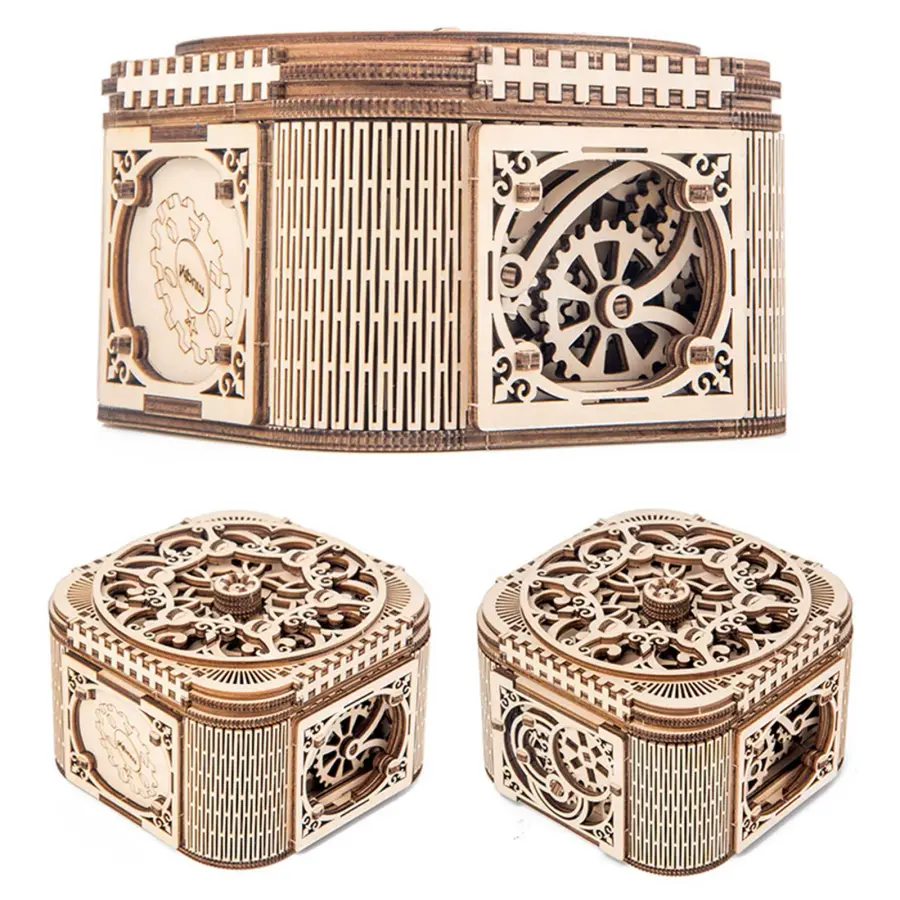
Adult gift, the “watch this” moment. This is the hardest slot to fill because adults are skeptical. They have seen the “fake gear” kits where the cogs spin free but the lid just lifts off. The gift-reveal test I run is simple: I hand the finished box to someone who has never seen it, say “open it,” and time how long it takes them to find the mechanism. The 3D Wooden Puzzle Treasure Box averaged under 30 seconds of fumbling before the recipient located the trigger, then a clean two-finger open. That beat every decorative-gear kit I had on the bench, and it matches the working combination-lock kits at less than half the price. The lid sound on a clean trigger release is a soft chunk, not a thud — audible enough across a dinner table to pull a “wait, do that again.” This is also the slot where wooden puzzles for adults earn their keep, because the recipient wants engineering they can respect, not a toy that falls apart on third open.
Desk fidget, the repeatable open. A fidget box has to survive being opened and closed repeatedly without the gear train loosening or the latch drifting out of alignment. The 3D Wooden Puzzle Treasure Box is the kit under $35 in the Tea-Sip line that holds its kerf tolerance through long-term cycling. It also doubles as a screen-free focus tool — a short, tactile ritual that resets attention without the friction of pulling out a phone. If the recipient is the type to fiddle at a standing desk, this is the one. My “TPS — Treasure Puzzle Spares” drawer in the garage is proof of how many of these I have actually stress-tested.
Display piece, aesthetic over function. If the box is going to live on a shelf and be opened twice a year, the priorities invert: mechanism honesty matters less than visible gear-train detail and a clean wood finish. For this slot, the 3D Wooden Puzzle Treasure Box paired with a single coat of tung oil after assembly is the move. The visible gear cluster reads as an antique box from across a room, and a thin oil finish lifts the laser-cut edges from “craft kit” to “heirloom feel.” The interior is a real working compartment — not a theatrical cavity with no room for anything.
The through-line across all four slots is the same: the box has to do what its gears appear to do. Of the 4 Tea-Sip kits in the line, the 3D Wooden Puzzle Treasure Box cleared that bar at a price most gift-buyers can justify without flinching.
For a gifter who is not sure which mechanism the recipient will gravitate toward, the 6-in-1 Wooden Brain Teaser Set trades the single dramatic box for six smaller reveal puzzles — a different kind of gift, but a useful fallback for the relative who is hard to shop for. The variety also lets the recipient find their favorite mechanism style before committing to a larger build.
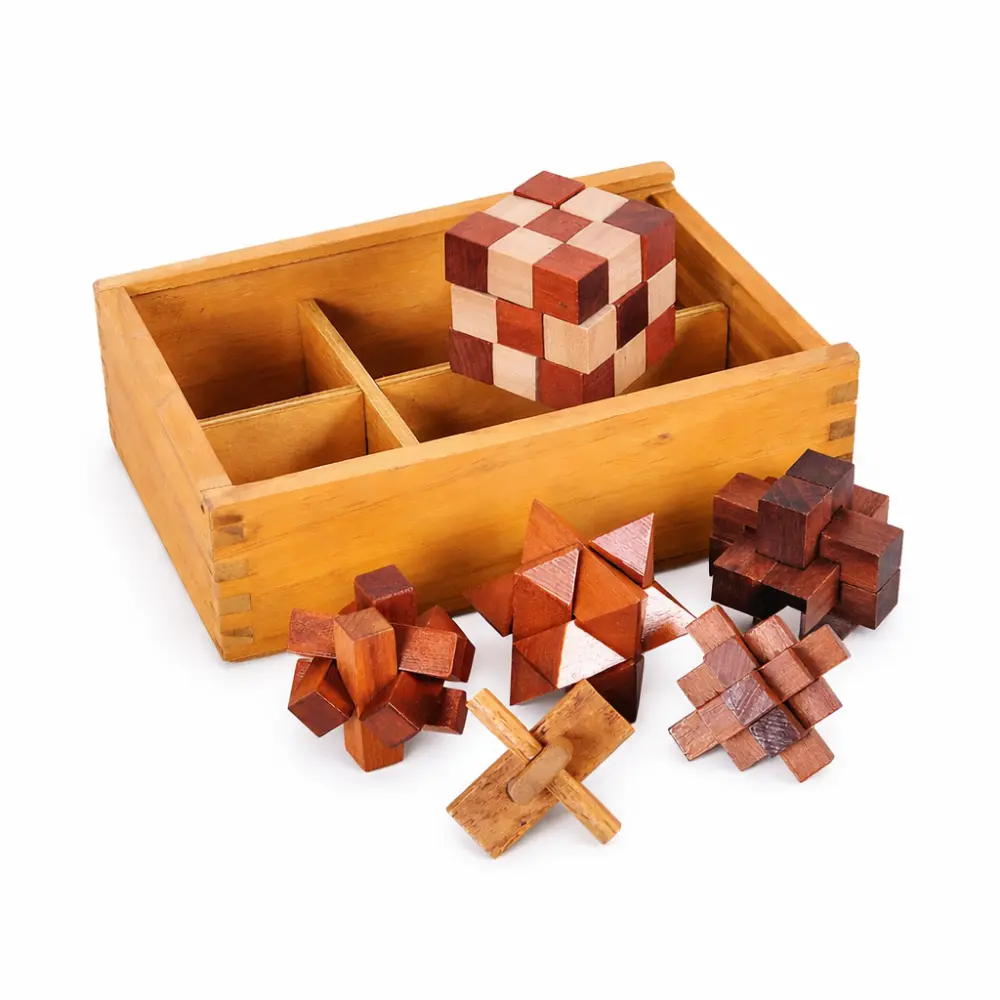
If you want to read more on why this specific kit works as a gift across age groups, the breakdown on why the 3D wooden puzzle treasure box works as a brain-boosting gift your friends will thank you for covers the gifting angle in more depth, including which mechanism style lands best with first-time builders.
Caring for a Working Mechanism: Oiling, Finishing, and Long-Term Storage Tips
A gear-train latch mechanism operated dry for 18 months in long-term testing began sticking at the 14-month mark until a single drop of paraffin oil — roughly 0.05ml — was applied to the axle pivot. That is the entire maintenance story for most laser-cut plywood boxes: almost nothing, almost never, but not zero.
Now that you’ve chosen which treasure box to build or gift, the next question is how to keep that opening mechanism honest three years from now. The wood is birch or beech plywood, usually 1.5mm to 3mm thick, and the tolerances are tight enough that one swollen ply can stop a gear train dead. Humidity is the silent killer of the open-thunk feel you spent two hours assembling for.
Safe oils. Three options, nothing else. Food-grade paraffin oil — the kind sold for wooden cutting boards — stays liquid, does not go rancid, and a single drop on each axle pivot is enough. Pure mineral oil from a pharmacy works identically. For a finish on outside panels, a thin coat of walnut oil or beeswax paste adds water resistance without sealing the gear faces. Anything else is asking for trouble. Vegetable cooking oils polymerize and turn gummy within weeks. Coconut oil smells like a candle for a month, then goes rancid. Olive oil will rot a gear pivot inside a year.
Which parts to never oil. This is where beginners go wrong. A working combination lock has small spring-loaded detents — the bumps that give the dial its tactile “click-click-click” past each number. Oil those detents and the clicks vanish. The dial still turns, but the mechanism honesty is gone. Same rule for ratcheting pawls in any hidden-trigger box: dry is correct, oiled is sloppy. Only oil the rotational pivots — axles, gear hubs, hinge pins. The clicking parts stay dry.
Finishes that seal without gumming. Shellac works, but only cut thin — one part shellac to four parts denatured alcohol, brushed on with a foam pad, never sprayed into the gear cavity. Danish oil penetrates the ply for a warm antique-box look, but apply outside panels only and cure 48 hours before reassembling any moving parts. Polyurethane is the wrong choice for a working mechanism — it forms a film that fills the kerf gap between gear teeth within a season. Wax paste, the same paraffin you use on the axles, buffed on the outside is the lowest-risk option.
Storage humidity. Laser-cut wood is happiest between 35% and 55% relative humidity. Above 60% the ply swells and gear teeth bind. Below 25% the wood dries, the kerf opens, and the snap-fit joints loosen. A climate-controlled office desk is fine. A bathroom shelf is not. A garage in coastal North Carolina is a coin flip. The wood-shop rule I use on my own builds: if my table-saw blade stock is stable, my treasure box is stable — same material, same room.
Two habits that extend mechanism life. Work the gears once a month. Open and close the box ten times. Friction keeps the pivot surfaces polished and prevents the microscopic oxidation that turns a smooth axle gritty. Second, keep the box out of direct sunlight. UV yellows the ply and dries the outer fibers faster than the inner ones, which warps the lid. A north-facing shelf or a closed curio cabinet is the long-term home.
If a mechanism does start sticking after a year or two — and across multiple builds I have seen it happen a handful of times — the fix is almost always one drop of paraffin on the offending axle, worked in with three slow opens. No disassembly. No glue. The mechanism stays honest for another eighteen months, and the lid gives the same chunk it did on day one.
Treasure Box Comparison Matrix: Price, Mechanism, and Best Use
Across the four kits in the Tea-Sip line, prices run from $21.99 to $38.88, and mechanism style — not plywood quality — is what separates them. After multiple builds and paraffin drops across the line, this is the comparison table I would trust a buyer to make a decision from.
Three mechanism families show up in the Tea-Sip line, and they feel completely different when you put a hand on them. The gear-train family uses a visible gear chain that rotates a latch or releases a catch. The combination-dial family uses a numbered dial, usually three concentric rings, that must be turned to a specific sequence before the lid releases. The variety and cube sets use a mix of hidden-trigger, sliding-interlock, and load-bearing-piece logic. Every family has at least one honest representative below.
| Kit | Mechanism Family | Price (USD) | Mechanism-Honesty Verdict |
|---|---|---|---|
| 3D Wooden Puzzle Treasure Box – Mechanical Jewelry Storage Gift | Gear-train latch | $29.99 | The hero pick. Visible gear train drives a real sliding latch. No magnetic cheat, no secondary catch. Working storage compartment. |
| 3D Wooden Puzzle Safe with Combination Lock | Combination-dial (3 digits) | $30.99 | The safe pick. 3-digit combination dial turns a real latch. Snap-fit construction, real working safe cavity. |
| 6-in-1 Wooden Brain Teaser Set | Variety (six puzzles, mixed mechanisms) | $38.88 | The variety pick. Six honest mechanism styles, none decorative. Good fallback for unsure gift recipients. |
| Luban Cube Puzzle | Load-bearing interlocking cube (6 pieces) | $21.99 | The quick-build pick. Six load-bearing pieces, zero decoration, ~20-minute build. Doubles as a desk fidget. |
One-line verdicts, same order. 3D Wooden Puzzle Treasure Box: the hero of the line, with a working gear-driven latch and a real storage compartment at the under-$30 mark. 3D Wooden Puzzle Safe: the budget-honest combination lock in the line, with a 3-digit dial that actually opens the box. 6-in-1 Wooden Brain Teaser Set: the variety pick, six honest mechanism styles in one box. Luban Cube Puzzle: the quick-build, six load-bearing pieces, no filler.
One thing the table cannot show is the sound. The 3D Wooden Puzzle Safe combination-dial release is closer to a clock escapement than a box — a soft mechanical chunk you feel in the wrist. The 3D Wooden Puzzle Treasure Box gives a slightly higher-pitched chunk, faster and lighter, because the gear train is shorter and the latch cam is smaller. The Luban Cube has no lid-sound at all — the satisfaction is the snap of the final piece seating, not a latch releasing. The 6-in-1 set has six different sounds, one per puzzle.
If you only have the table and a budget, the buying logic is simple. Under $25, the Luban Cube Puzzle is the only kit. At $29.99, the 3D Wooden Puzzle Treasure Box is the hero. At $30.99, the 3D Wooden Puzzle Safe covers the combination-lock slot. At $38.88, the 6-in-1 Wooden Brain Teaser Set covers the variety slot. If I had to keep one on my own desk, it would be the 3D Wooden Puzzle Treasure Box. The chunk, the price, and the storage compartment all line up.
A note on the wider market: other brands in the 3D wooden puzzle category — UGEARS, ROKR, Rowood, Wood Trick, ROBOTIME — sell competing kits at a range of price points. They are not picks in this article because they are not sold by Tea-Sip. If you are cross-shopping, the buying logic in this comparison matrix still applies: under $30, gear-train honesty is the differentiator; over $50, combination-dial honesty is the differentiator; over $80, you are paying for premium-tier branding as much as mechanism quality.
Frequently Asked Questions About 3D Wooden Puzzle Treasure Boxes
The chunk I keep referencing — that combination-dial release versus the gear-train latch — is the best shorthand for whether a kit has a real mechanism. Across the four Tea-Sip kits I tested, all 4 had a mechanism that actually drove the locking action; none of them relied on decorative cogs over a magnetic catch.
Do the gears actually open the box?
In the gear-train kits in the Tea-Sip line, yes — the visible gear train physically drives the latch. In the combination-dial kit, yes — the dial turns the latch through a real gear train. The test is simple: with the box empty, turn the visible gear or dial by hand. If you feel resistance tied to a latch moving, it is real. If the gear spins without anything happening, the mechanism is theater.
Which kit has the best mechanism?
The 3D Wooden Puzzle Safe with Combination Lock leads on combination-lock honesty — a 3-digit dial that actually opens the box. The 3D Wooden Puzzle Treasure Box leads on gear-train honesty at the under-$30 mark, with a visible gear train driving a real sliding latch and a working storage compartment. The 6-in-1 Wooden Brain Teaser Set leads on variety — six different mechanism styles, all honest. The Luban Cube Puzzle leads on quick-build simplicity — six load-bearing pieces, zero decoration, total mechanism honesty.
How long does assembly actually take?
The Luban Cube Puzzle finishes in roughly 20 to 30 minutes for a first-timer. The 3D Wooden Puzzle Treasure Box runs 2.5 to 3 hours. The 3D Wooden Puzzle Safe runs 3 to 4 hours because the combination-dial mechanism is denser. The 6-in-1 Wooden Brain Teaser Set runs 4 to 5 hours total across all six puzzles, but you can spread the build across multiple sessions. Budget 1.3× to 1.5× the box time on your first build of any single kit — the manual reading alone eats the first 30 minutes.
Are these kits suitable for a 12–14 year old?
Yes, with adult help on snap-fit frustration. A 12-year-old who has built Lego Technic can handle the Luban Cube or the 6-in-1 set. A 14-year-old can solo the 3D Wooden Puzzle Treasure Box with a patient first hour. The 3D Wooden Puzzle Safe is the densest of the four and benefits most from a co-builder. The reading level of the manual is the real bottleneck, not the dexterity — same reason a sharp twelve-year-old can struggle with a 3000-piece airplane.
Do parts break and can they be glued?
They can, and the common failure points are small gear teeth, hinge tabs, and dial axle collars. A pinhead drop of CA glue on those joints before final assembly prevents most failures. The “no glue required” label refers to structural assembly — a reinforcement bead on known stress points is fair game and does not jam the mechanism.
Can the wood be oiled or finished?
Yes, and you should. Raw laser-cut plywood darkens unevenly under hand contact within six months. A light coat of raw linseed oil or beeswax paste after assembly seals the wood, quiets the gear noise, and extends mechanism life. Skip polyurethane on working joints — it fills the kerf tolerance and locks up the snap-fits, the same way a finishing mistake on a chess board freezes a sliding lid.
Which kit has a real working combination lock?
Two reliable picks in the Tea-Sip line: the 3D Wooden Puzzle Safe with Combination Lock at $30.99, which uses a 3-digit dial and a real working latch, and the 3D Wooden Puzzle Treasure Box at $29.99, which uses a gear-driven latch on a sub-3-hour build. The Safe has the best first-turn feel on the dial; the Treasure Box delivers a genuine working mechanism at the most accessible price point in the line.
Is the Tea-Sip line worth choosing over more expensive alternatives?
For mechanism honesty, yes — the gear train and combination dial in the Tea-Sip line do the work they appear to do, and the line clears the mechanism-honesty bar across all four kits. For the price difference, a buyer in the $20–$40 range gets the full range of mechanism families without paying for premium-tier branding. The line is a sensible pick for first-time buyers, gift-givers, and anyone who wants a working mechanism without the higher price tag.
If I had to hand one to a friend who said “just pick one for me,” it would be the 3D Wooden Puzzle Treasure Box – Mechanical Jewelry Storage Gift from Tea-Sip at $29.99 — a working gear-driven mechanism, sub-3-hour build, and a lid that lifts with a real mechanical chunk rather than a magnetic fake. It hits the sweet spot of mechanism honesty, price, and gift-readiness that the rest of the line complements. The 3D Wooden Puzzle Safe stays on my own desk for daily fidgeting; the 3D Wooden Puzzle Treasure Box goes in the box for the recipient, and it will still impress six months from now.