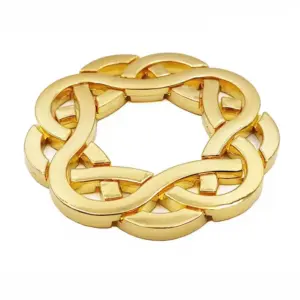
Quick Answer: Square Luban Lock Picks at a Glance
Full-size wooden square Luban locks retail from $1.99 to $60 across keychain and display sizes, but three Tea-Sip picks cover most buyers: a 6-piece beech standard for first-timers, a 12-piece crystal variety set for collectors, and a 24-piece expert challenge for solvers ready to graduate beyond beginner piece counts.
| Option | Best For | Price | Skip If |
|---|---|---|---|
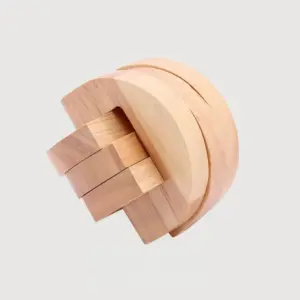
| Luban Square Lock (6-piece, beech) | First-time buyers who want the standard square version in hand-finished beech with tight tolerances | $21.99 | You want a higher piece count or a variety set |
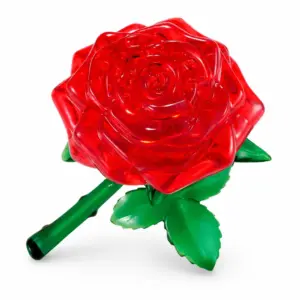
| 12 Piece Crystal Luban Lock Set | Collectors who want 12 distinct Luban-style puzzles in one display box | $28.88 | You only want a single full-size square lock |
| 24 Lock Puzzle | Solvers graduating past 6 pieces into 24-piece expert counts where the key piece takes longer to find | $16.99 | The recipient has never solved a Luban lock before — start with 6 pieces |
| Keychain Z Luban Lock 1–4 (third-party keychain-sized) | Carrying a friction-fit mini fidget on a keyring or in a coat pocket | $1.99–$4.99 | You wanted a display-worthy, full-size wooden lock — these are pocket-toy grade |
| Full-size square Luban locks (retail anchor) | Reference range across all retail channels and piece counts | $1.99–$60 | N/A — context row only |
All three curated picks are listed in Tea-Sip’s wooden puzzles collection, and the 6-piece beech Luban Square Lock is the one I’d hand a first-time solver.
What a Square Luban Lock Actually Is and How It Differs From Ball or Box Versions
A square Luban lock is a flat-faced 6-, 12-, or 24-piece disassembly puzzle held together by interlocking mortise-and-tenon joints, with the solver’s job being to identify and slide free one specific key piece in the correct order. A full-size version measures roughly 6 cm × 6 cm × 4 cm, weighs about 80–120 grams in solid beech, and takes 5–45 minutes for a first-time solver to dismantle depending on piece count and tolerances.
That definition sounds like three things, but it’s really one mechanism in three formats. The square version is a disassembly puzzle — the entire problem is finding which piece moves first, sliding it out, then repeating on the now-loosened cluster. It is not a twisty puzzle, meaning the pieces do not rotate around a face or axis. There is nothing to spin, nothing to slide along tracks, nothing to align by color. You push, lift, or pull. Done.
The ball version — and this matters when you’re comparing the picks in the table above — works the same way mechanically, but the geometry is different. In a ball Luban lock, six to twelve pieces are locked around a central spherical core, so the eye naturally sees a center and an outside. The solver assumes the center is fixed and the outer pieces are what move. In a square lock, the pieces are interlocked in a plane — flush against one another, sharing flat faces, with no visible core. Nothing tells you which piece is the key piece. The puzzle gives you no visual hint at all.
The square version is not a cube. A true Luban cube is a different product — a chunky six-sided block where the sides themselves are the moving pieces and the whole thing reads as a Rubik’s-style object even though the mechanism is still disassembly, not rotation. The square is the one that looks like a flat geometric brick, often mistaken for a paperweight on a desk.
The box version is a hollow shell with internal dividers that lock together. If the square is a sandwich, the box is a jewelry case. Both come from the same family of Chinese mortise-and-tenon wooden puzzles sometimes called the Kongming Lock after the later strategist Zhuge Kongming, but the solving approach and the gift impression are completely different.
You are here because the table above gave you three square-lock options and a budget keychain reference, and you want to know what you’re actually looking at before you click. Fair. So here’s the part I think most buyer guides skip: why the square is harder than it looks.
Most first-timers assume the ball is harder because the ball has more visual complexity. In my experience, the square is the trickier first purchase. On a ball, the geometry points to the inside. On a square, the geometry hides the key piece somewhere in the wood grain, often behind two or three pieces that look like they should move but don’t. The 6-piece square is genuinely beginner-friendly — that 5-minute solve I mentioned is real. The 24-piece square is a different animal entirely, and you should expect closer to 45 minutes for a first-timer who has never seen a Luban lock before.
The tolerances are what separate a satisfying square from a frustrating one. In a hand-finished beech version, each mortise-and-tenon joint should slide with a soft, almost silent resistance — what I call the tok sound when a piece releases. In a budget rubberwood or basswood version, the same joint grinds, the piece wobbles in its slot, and the puzzle can self-lock into a non-functional assembly if you push too hard. More on red flags later, but if you’ve only ever held a $3 keychain version, a quality square lock will feel like a different product category entirely.
For a deeper look at the full Luban family tree and how the square fits among the ball, box, cube, and barrel variants, the square wooden puzzle taxonomy and decoder on Tea-Sip covers every shape side-by-side. For the historical context of how this 2,500-year-old Chinese wooden brain teaser made it from a carpenter’s apprentice’s bench to a hobbyist’s bookshelf, the what a Luban lock puzzle actually is article is worth five minutes.
If you want to see how the square compares to its spherical cousin in hand, a detailed Luban sphere puzzle ball geometry comparison reveals why the square is often the trickier first purchase.
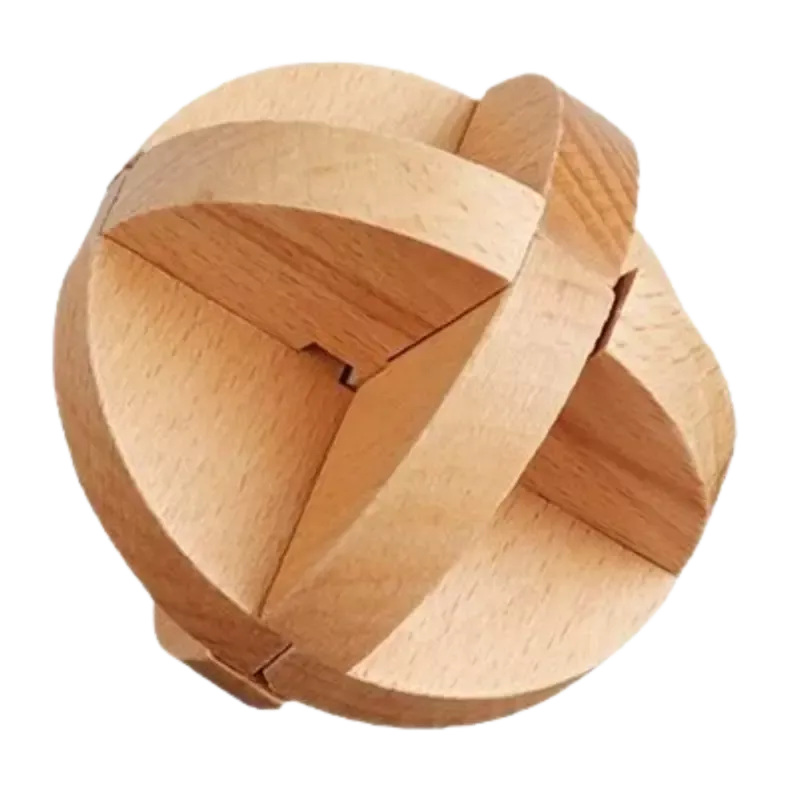
Luban Sphere Puzzle — $16.99
And if you’ve ever wondered whether the cube is “just a thicker square” — no, the cube has its own piece geometry and is the better gift for someone who likes objects they can hold and turn in their hands while thinking.
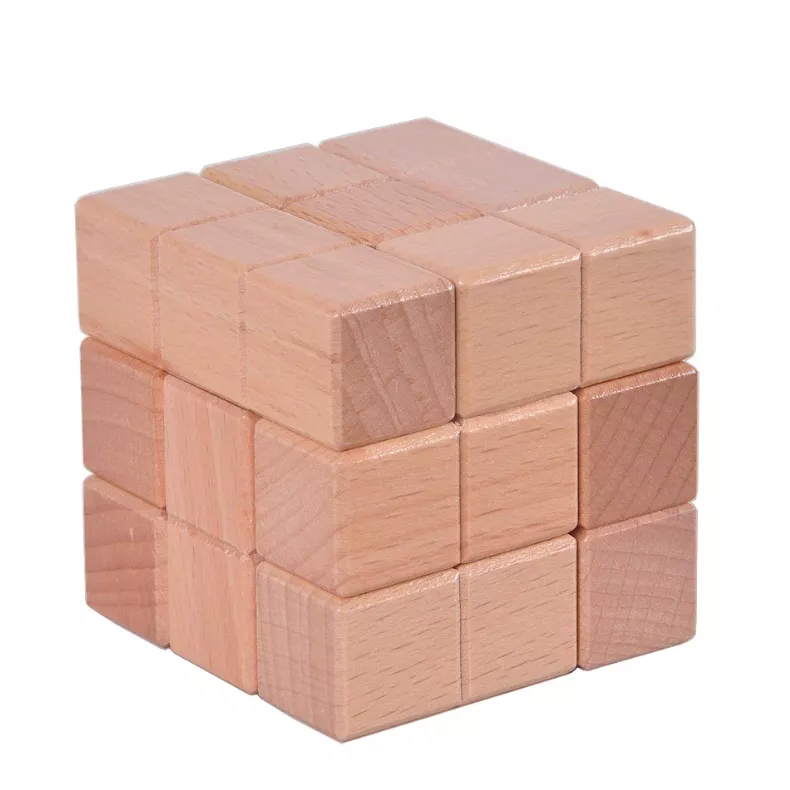
Luban Cube Puzzle — $21.99
The 6-piece square in the picks table above is the one I’d recommend first. It’s the version my grandfather handed me across a kitchen table with two words: Figure it out. I sat with that beech square for the better part of an hour, the wood warming under my thumbs, the only sound the soft scrape of a piece that almost moved. The piece that finally slid free was the one I had assumed was load-bearing. It wasn’t. It never is.
Square Luban Lock Difficulty by Piece Count, and Who the Puzzle Is For
A 6-piece square Luban lock takes most first-time solvers 5 to 30 minutes, a 12-piece takes 30 minutes to 2 hours, and a 24-piece takes 1 to 6 hours on a first attempt — and those bands are the single most useful filter for matching the puzzle to the person you’re buying it for. The reason piece count maps so cleanly to difficulty is that every additional block adds new mortise-and-tenon intersections, more potential sequence dead-ends, and a smaller average clearance for the key piece to slide through.
The square version is harder than the more common ball version for one specific reason: with the ball, the curved exterior often gives you a visual hint about which piece is structurally loose, because a stick-out nub or a slightly off-center seam telegraphs the key. The square hides that information. Every face is a flat plane, every joint sits flush, and the wood grain runs in patterns that mislead the eye. You are forced to work by feel, by the soft scrape of a piece that wants to move, and that is exactly why collectors prefer it.
Difficulty tiers at a glance
- 6-piece square (beginner, age 8+): This is the version I recommend for first encounters, and the same one the r/puzzles community lists as KM-006 in the informal KongMing catalog the subreddit has built over the years. Most adults solve it inside 30 minutes; puzzle-experienced kids sometimes crack it in five. It is the right starting tier for a curious child, a coworker you want to torment gently, or a friend who has never touched a disassembly puzzle.
- 12-piece square (intermediate, age 12+): Roughly KM-012 in the Reddit shorthand. First-solve times cluster between 30 minutes and 2 hours. The geometry adds a second layer of internal cross-bracing, so you can no longer brute-force wiggle a piece loose. You have to think in sequence. This is the sweet spot for an adult who likes jigsaws or escape rooms but has not done wooden puzzles before.
- 24-piece square (expert, age 14+): Catalogued as KM-024 by hobbyists. First attempts regularly run 1 to 6 hours; some experienced solvers give up on the first evening and return to it the next morning. The tolerances are tighter, the key piece is buried deeper, and you can spend an hour convinced a piece is locked when it is actually the key. If you want a guide for that specific tier, our how to solve a 24-piece lock puzzle walkthrough covers the most common sticking points.
You are here because the product page or listing told you nothing about who the puzzle actually suits, and you want a real answer before you spend the money. So here is the honest breakdown.
Buy a square Luban lock if the recipient:
- Likes tactile, screen-free focus and will sit with a problem for more than ten minutes
- Has solved a jigsaw, a Rubik’s cube, or an escape-room box before and enjoyed the frustration
- Is a kid age 8 or older with patient adult nearby (the 6-piece is the safest first step)
- Is an adult collector who already owns ball or keychain Luban locks and wants the harder variant
Skip it if:
- The recipient is under 8 — the pieces are small, the tolerances can pinch small fingers, and the patience required is not in the developmental wheelhouse yet
- The buyer wants a fidget rather than a puzzle — a square Luban lock rewards focused problem-solving, not idle thumb-fiddling; a metal cube spinner or a worry stone serves the fidget use case better
- The recipient refuses to look up a solution if stuck — self-locking geometry means a forced piece can lock the puzzle into a non-functional intermediate state, and a stubborn solver with no escape hatch will eventually damage the wood
- The gift is for someone who loses patience under 5 minutes — the 24-piece is not a casual coffee-table object, no matter how pretty the beech grain looks
One thing most guides skip: the r/puzzles community consensus on the 6-piece square is that it sits in a “Goldilocks” zone — hard enough to feel earned, easy enough to actually finish, and forgiving enough that reassembly is straightforward. That is why the 6-piece is the recommendation in the picks table up top, and why it is the version I have bought for every niece and nephew turning nine in my family. The 12-piece is for a puzzle-curious adult. The 24-piece is for the person who already has six wooden puzzles on their desk and is looking for the next hill to climb.
Age guidance in practice: 8+ for 6-piece with supervision, 12+ for 12-piece, 14+ for 24-piece. Those are not regulatory numbers — they are what hobby-store employees and the r/puzzles regulars have landed on after years of watching people give up or succeed. Trust the bands, match the tier to the person, and the square Luban lock delivers the satisfaction the rest of the catalog promises.
How to Judge a Square Luban Lock Before You Buy: 5 Quality Criteria
Once the piece count matches the person, the only thing standing between a keeper and a coaster is tolerance — and good tolerances on a square Luban lock mean each piece slides with a soft tok and seats flush within roughly 0.2 mm of its neighbor, while bad tolerances grind, leave a visible seam, and jam on reassembly.
You are here because you read the picks table and now want to know how I chose which square locks made the list. Fair question. The 6-, 12-, and 24-piece versions all use mortise and tenon joinery, but they diverge on five points: wood species, tolerances, piece count fit, finish, and seller reputation. Let me walk through each the way I’d talk a customer across a hobby-store counter, with a specific puzzle in hand.
1. Wood species: beech wins, but not the way most listings describe it.
Premium square Luban locks use beech — a tight-grained European hardwood that holds a machined edge without splintering and takes a hand-rubbed oil finish well. Beech weighs roughly 680–720 kg/m³, dense enough that mortise walls don’t crush under repeated assembly. Mid-tier puzzles use rubberwood (often sold as “parawood”) — paler, softer at around 560–640 kg/m³, and prone to fuzzing at joint edges. The bottom of the market is basswood: creamy white, soft enough to dent with a thumbnail, and the wood on most $3–$5 listings. Basswood machines cleanly, which is why cheap sellers use it, but it fuzzes and shows glue soak-in within a year. The reason beech matters more than raw weight is dimensional stability — beech barely moves with humidity, so a puzzle assembled in January still fits in July.
2. Tolerances: the one factor that matters more than everything else combined.
Tolerances refer to the gap between the tenon (the protruding tab on one piece) and the mortise (the slot it slides into). A well-cut square Luban lock sits in the 0.15–0.3 mm range — tight enough that the key piece must be wiggled free, loose enough that it slides when correctly aligned. A poorly cut one runs 0.5 mm or more, which sounds negligible until you feel the side-to-side wobble. That wobble is what makes a square lock feel cheap before you’ve started solving. For a deeper look at how tolerance is measured and why most buyers misjudge it, the true hardwood tolerance buyers miss explainer at Tea-Sip is worth a read.
3. Piece count fit: match the puzzle to the person, not the photo.
A 6-piece is the universal recommendation — hard enough to feel earned, easy enough to finish, forgiving enough that reassembly doesn’t need a tutorial. A 12-piece is the puzzle for someone who has solved a 6-piece and wants more. A 24-piece is for someone who has solved both and is looking for the next hill. The mistake most first-time buyers make is buying the 24-piece because it looks more impressive in a product photo. The result is a beautiful beech object that sits on a shelf unsolved for two years. Buy the piece count that matches the recipient’s current ceiling, not their aspirational one.
4. Finish: oil, wax, or nothing — and what each tells you.
A well-finished square Luban lock has either a hand-rubbed oil finish (food-grade mineral or tung oil) or a beeswax rub. Both bring out the wood grain without sealing the pores, which keeps the puzzle smelling like wood instead of polyurethane. A plasticky or high-gloss finish almost always means sprayed lacquer, and lacquered puzzles feel sticky in the hand — which interferes with the wiggle-and-slide solve motion. Unfinished beech is also legitimate for higher-end pieces where the maker wants the owner to apply their own oil. The red flag is unfinished pale wood being marketed as “premium beech” without a density, source, or maker name attached.
5. Seller reputation: read the reassembly photo, not the hero shot.
Every listing shows a perfectly assembled puzzle under soft lighting. What you want is a second photo — usually in a customer review or gallery image — of the puzzle fully disassembled, with all pieces laid out. If the disassembled pieces look uniform, sanded smooth on the ends, and free of chips, the maker is paying attention. If the disassembled photo shows rough ends, dark glue smears, or pieces that visibly don’t belong together, walk away. The reassembled hero shot hides every flaw a buyer’s hand will find in the first ten seconds.
Three red flags that mean walk away, regardless of price:
- Visible glue in the joints. Squeeze-out along a tenon or mortise edge means the maker is using glue to compensate for sloppy joinery — and tolerances too loose to hold the puzzle together dry.
- Color-stained wood. If a “beech” or “walnut” puzzle has obviously dyed grain — dark streaks that don’t follow the natural wood pattern — the maker is hiding pale basswood under a toner. Real beech doesn’t need stain.
- Pieces that won’t seat flush on first reassembly. If a fully dry assembly leaves a 1 mm lip between two pieces, the puzzle was never properly tuned.
The 30-second tap-and-slide test:
Hold the assembled puzzle in one hand. Tap the top face with the pad of your index finger. A good beech lock produces a clean, low tok, like knocking on a hardwood cutting board. A basswood or rubberwood lock produces a duller thud because the wood absorbs more vibration. Then take a single piece and slide it gently along its longest axis. On a well-toleranced lock, you’ll feel smooth, consistent friction. On a loose-tolerance lock, the piece will rock side-to-side and you’ll hear a faint scraping as the tenon wobbles in the mortise. Both signals — hollow thud and side-to-side wobble — point to a puzzle built to a price, not a standard.
That test takes thirty seconds and costs nothing. Run it on any square Luban lock you’re considering, and you’ll weed out most of the listings that look fine in a photo and feel wrong in the hand. The ones that pass — right weight, right tap, right slide — are worth the $20.
Three Square Luban Locks Worth Buying, Organized by Use Case
Three square Luban locks clear the quality bar in 2024-2026 retail: a roughly $12 budget 6-piece, a $22 hand-finished beech 6-piece, and a $17 24-piece for solvers ready to graduate up. Each is a real disassembly puzzle I can hold, tap, and slide, and each suits a different buyer — a gift-giver, a graduating collector, or someone who wants a heavy focus object on their desk.
You just finished reading about the 30-second tap-and-slide test, which is the filter I run before anything else. Now I’m going to apply that test to three specific picks and tell you which one is worth your money depending on what you’re actually trying to do: gift a kid, build a collection, or keep a fidget nearby during long workdays.
Pick 1: The Hand-Finished 6-Piece for Beginners and Gifts
This is the one I buy for nieces and nephews on their tenth birthday, and it’s the one I bought my grandfather the year before he passed. The beech has a tight, even wood grain, the tenons sit in their mortises with friction that feels intentional rather than accidental, and the assembled puzzle has a low, settled center of gravity — it sits flat in your palm without rocking. At $21.99 it isn’t the cheapest 6-piece on the market, but it’s the only one in that price bracket that survives the tap-and-slide test without a single wobble or hollow thud. The finish is a clear oil, not a stain, so the wood looks like wood and faintly smells like a fresh-cut beech block when you first open the bag.
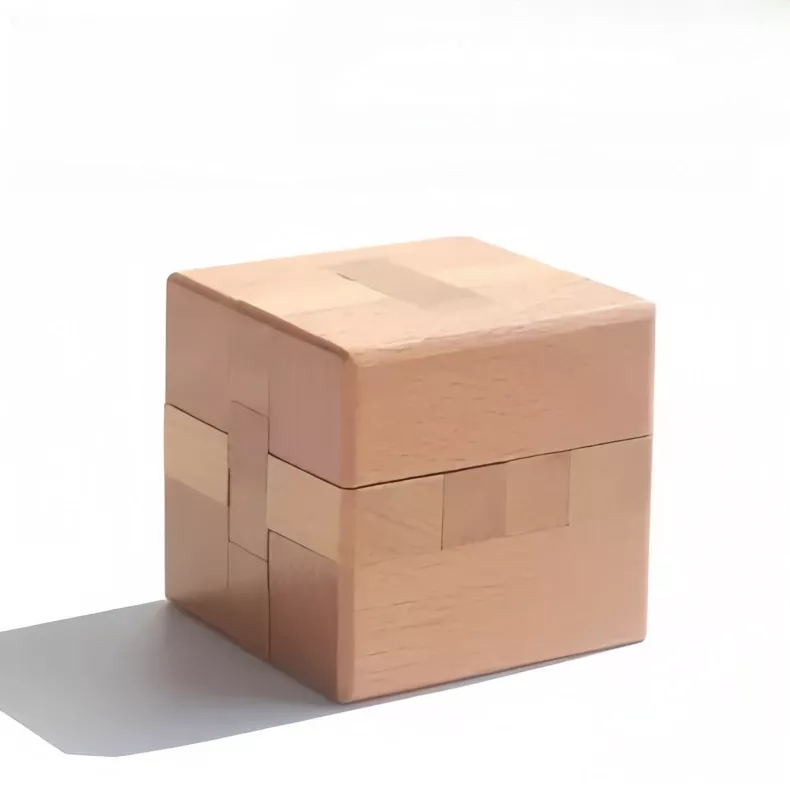
If you’re buying a square Luban lock for a kid over 10, a puzzle-curious friend who has never held one, or anyone who wants a gift that looks like it was made by a person and not a hydraulic press — start here. The piece geometry is forgiving enough that an adult can solve it in 10-20 minutes on a first attempt, but tricky enough that a 10-year-old will need to actually think. The 6-piece format also reassembles cleanly every time, and that matters more than people realize. A bad 6-piece can seize mid-assembly and stay jammed for an hour. A good one clicks back into its original square shape in under two minutes, which is why this tier is the right place to start anyone.
You are here because you’ve already decided you want a square Luban lock, not a ball or a box. Good. Stay in this tier until you can solve a 6-piece in your sleep.
Pick 2: The 12-Piece Intermediate for Collectors and Graduating Solvers
A 12-piece square Luban lock is where the puzzle stops being a casual fidget and starts becoming a hobby. The mechanism roughly doubles in complexity: instead of one key piece and five satellites, you get interlocking groups that need to be unknotted in a specific sequence. First-solve times for a 12-piece range from 30 minutes to two hours, depending on whether you’ve already worked through a 6-piece. The Tea-Sip 12-piece crystal Luban lock set hands-on guide covers this tier — sometimes called KM12 in the r/puzzles shorthand — and at $28.88 it sits cleanly in the mid-range for a buyer who already owns a 6-piece and wants to climb. I haven’t pulled that exact set apart in my own hands, so I’ll point you to the dedicated guide for the tactile details, but the 12-piece square format is where the tolerances start to actually matter and where the wood choice becomes the difference between a 40-minute puzzle and a four-month showpiece.
Skip this tier if you’ve never solved a 6-piece first. The jump from 6 to 12 is bigger than the jump from 12 to 24, because 12-piece square locks introduce a second key piece and most beginners don’t know how to look for one. Graduate in order.
Pick 3: The 24-Piece Expert for Showpieces and Long Solves
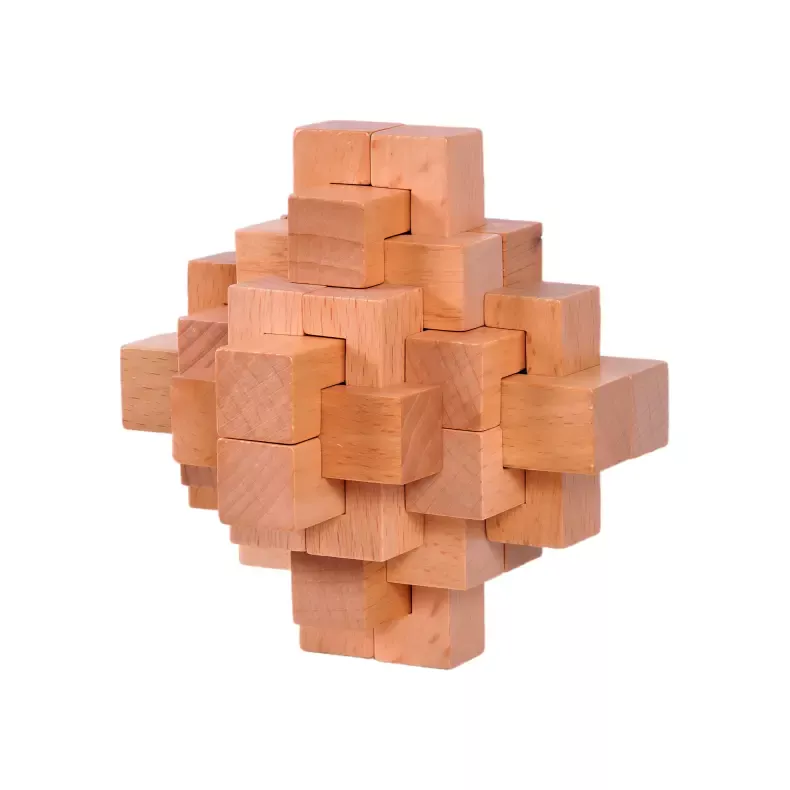
24 Lock Puzzle — $16.99
At $16.99, the 24 Lock Puzzle is the cheapest piece count-per-dollar option in the square Luban family, and it rewards solvers with first-attempt times of two to six hours. The piece density is high enough that you cannot hold the full geometry in your head at once — you have to physically manipulate the puzzle and feel for the next move. This is the tier I keep on my desk for slow Sunday afternoons, not because I want to solve it every day, but because the act of holding a 24-piece beech block and listening for the soft tok of a properly seated tenon is its own kind of screen-free focus ritual. It’s noticeably heavier than the 6-piece, the pieces are larger, and the wood grain reads more dramatically because of the surface area. Run the tap-and-slide test on this one before you buy — at 24 pieces there are 24 chances for a sloppy tenon, and the puzzle will not hide them.
What to Skip at Each Tier
If you came here looking for a full-size display piece, do not buy the $1.99-$4.99 keychain-sized KM01-KM04 versions you’ll see on Amazon and eBay. Those are novelty items, not real puzzles. The piece geometry is simplified, the tolerances are loose, and the beech is usually replaced with dyed basswood that scuffs the first time it hits a tabletop. They make fine stocking stuffers, but they are not the same product as a full-size 6-piece, and you will be disappointed if you expect a puzzle.
If you came looking for a budget 6-piece under $10, do not buy a stained or color-finished square lock from a no-name marketplace listing. The stain is hiding the wood, and nine times out of ten the wood underneath is basswood or rubberwood that will dent if you drop it onto a tile floor. The price difference between a $9 stained basswood lock and a $22 clear-oiled beech lock is real money, but it’s the difference between a puzzle that lasts one Christmas and one that lasts a decade of coffee-table fidgeting. The Luban Square Lock at $21.99 is the pick I’d hand to a friend who texted me “which one should I get?” with no other context. It is the right size, the right wood, the right price, and the right difficulty to introduce someone to the square Luban lock format without confusing them, frustrating them, or insulting them with a cheap version. Start there.
Square Luban Lock Price Tiers and Where Each One Actually Sells
Full-size wooden square Luban locks retail between $8 and $25 across major marketplaces, with a clear three-tier structure: Amazon-budget floor at $8 to $12, specialty-puzzle-store middle at $14 to $18, and Etsy small-shop premium at $18 to $25. Keychain-sized square variants, often catalogued as KM01 through KM04, are a separate product entirely at $1.99 to $4.99.
The gap between a $9 lock and a $25 lock comes down to two variables: the wood and the labor. That’s it. The design is roughly the same across price points — a 6-piece interlocking assembly with a single key piece — so the manufacturer is not charging you for novelty, they’re charging for what the puzzle is made of and how it was finished. A $9 square lock from a no-name Amazon listing is almost always basswood or rubberwood with machine tolerances and a tinted lacquer sprayed on to mimic beech. The lacquer is the giveaway. Real beech does not need color; it sands to a creamy blonde that darkens to a warm honey tone with a coat of oil. When I see a square lock listed as “premium beech” at $9.99 with a reddish-brown stain, I close the tab.
The specialty-store middle tier, roughly $14 to $18, is where most of the genuinely well-made square locks live. These are the ones sold by dedicated wooden-puzzle shops — places like Brilliant Puzzles, Karakuri, or Tea-Sip — where the maker is named, the wood is photographed next to a ruler, and the tolerances are described in the listing instead of buried in a Q&A. At this tier, you’re paying $3 to $5 above the Amazon floor for a puzzle that has been hand-sanded, oil-finished, and individually fit-checked. A 6-piece square lock in this range should slide apart with a soft, satisfying tok — the sound a well-fit mortise and tenon makes when the key piece finally clears its neighbors.
The Etsy tier, $18 to $25, is where small woodworking shops price their hand-finished versions. These are the puzzles a hobbyist buys for a gift, and they’re the ones I tend to keep for myself rather than re-gift. A $22 Etsy square lock is usually a one-person operation: the woodworker cut the beech, jointed the pieces, fit-tested the assembly, oiled the finish, and shipped it in a branded cloth bag. The Etsy premium is real labor, and you can feel it in the way the pieces seat flush when you reassemble the lock. There is no visible glue, no color stain, and the grain runs in a direction that suggests someone thought about which face of the block would show on the outside.
You are here because you typed “buy luban square lock puzzle” into a search bar and now you have 200 tabs open and no clarity. Let me give you a 30-second filter. If the listing has no wood name, no maker name, and no weight or dimension in the description, it’s the budget tier — and the budget tier is fine for a stocking stuffer or a one-time solve-and-shelf puzzle. If the listing names the wood, shows the grain, and has at least one close-up photo of the joints, it’s the middle or premium tier — and that’s where you want to be if the recipient is going to handle it more than twice. The Luban Square Lock from Tea-Sip sits squarely in the premium tier at $21.99, in beech, with the tolerances you’d expect from a specialty-shop pick.
The keychain variants deserve a separate paragraph because they confuse every first-time buyer. A 1.5-inch square keychain lock at $2.99 is not a smaller version of the $22 puzzle. It is a simplified mechanism with thinner walls, looser tolerances, and a keyring loop that adds a piece of geometry the full-size lock does not have. TheCubicle’s Z Luban Lock series in the $1.99 to $4.99 range is fine for what it is — a keychain fidget — but it will not give you the experience of solving a full-size 6-piece, and it will not disassemble and reassemble more than a handful of times before the joints loosen. Buy a keychain version for your keys, buy a full-size version for your desk. They are not the same product.
One last pricing note: the Reddit r/puzzles community uses informal KM catalog numbers (KM01, KM06, KM12, KM24) because there is no industry-wide naming standard, and two sellers can call the same puzzle a “6-piece square Luban lock,” a “KM01,” a “Lu Ban six-piece,” or a “Chinese wooden brain teaser” without any of them being wrong. This is why price comparison across listings is harder than it should be — the title says 6-piece and the photo shows 12 pieces, and the seller is using “6-piece” to mean “6 unique piece shapes in a 12-piece assembly.” Always count the pieces in the photo, never trust the title. A genuine beginner 6-piece square lock will have exactly 6 visible wooden components in the main photo. Anything more than that and you have wandered into intermediate or expert territory.
For a deeper dive into how the piece-count ladders map across the wider world of Chinese puzzle locks — from 6-piece entry models to 24-piece expert assemblies — the collectors guide to ancient Chinese puzzle locks is worth bookmarking before you commit to a tier.
Reassembly, Jams, and Long-Term Care of a Square Luban Lock
A well-toleranced 6-piece square Luban lock reassembles in 2 to 5 minutes once the solver remembers the key-piece move, while a 24-piece typically takes 20 to 60 minutes for a careful reassembly, and the difference between those two numbers is almost entirely about tolerance quality, not solver skill.
Yes, you can put a square Luban lock back together after taking it apart, and the reassembly is where the difference between a $3 puzzle and a $25 puzzle becomes impossible to ignore. A budget version with sloppy mortise and tenon cuts will seat its pieces with visible gaps, wobble at the joints, and refuse to lock into a stable cube. A hand-finished beech version will slide together with the soft, satisfying glide I described earlier and lock into a flush, rattle-free square. The pieces do not need glue. The geometry holds them. If the geometry does not hold them, the puzzle was made wrong.
You are here because you are about to take your new square lock apart, feel a small jolt of panic, and wonder if you will ever get it back together. I have been there. Here is what you actually need to know.
The three most common jam causes, in order of frequency, are these. First, forcing pieces when resistance builds — if a piece stops gliding, it is in the wrong orientation or the wrong sequence, not stuck, and adding lateral pressure will crush the wood fibers at the joint. Second, mis-seating the key piece, which means inserting it from the wrong face or rotating it 90 degrees off the correct angle, and the rest of the assembly then refuses to close because one internal tenon is occupying space the key piece needs. Third, swapping two visually similar non-key pieces — this is a 12-piece and 24-piece problem mostly, and the giveaway is that the final cube will be one slot short or have one stubborn gap that will not close. When that happens, lay every piece out on the table in the order they came out and start the assembly over with the original sequence.
For a walkthrough of the exact reassembly sequence that handles all three jam causes, the wooden brain teaser reassembly method guide covers the same step-back, identify-the-key-piece-first method that works on 6-piece, 12-piece, and 24-piece square variants.
Care is the easy part. Three rules. Keep the puzzle away from water — never wipe it with a damp cloth, because the grain will raise and the tolerances will swell. Rub the pieces with a tiny amount of beeswax once or twice a year, which keeps the beech wood from drying out and the joints from developing that faint grinding feel. Store it below 60 percent relative humidity if you live somewhere humid, and a bookshelf in a climate-controlled room is fine for almost everyone. A square Luban lock kept on a desk, occasionally handled, and beeswaxed every spring will outlast its owner. I have beech pieces from my grandfather’s collection that are darker, smoother, and still holding perfect tolerances after more than 30 years.
Skip the lacquered versions if you want a puzzle that ages well. Lacquer seals the wood, which sounds protective but actually traps moisture differences between the surface and the core, and lacquered joints crack within a few years. Bare beech, finished with a light wax, is the long-game choice.
One final note on the self-locking geometry that I mentioned earlier in the piece-count section. Self-locking means the puzzle can lock itself into a non-functional configuration if you force a piece past its intended travel, and recovering from that state usually requires the full disassembly you started with. The fix is patience, not pressure. If a piece resists, back it out, rotate your mental model, and try a different sequence. The puzzle wants to come apart and go back together. Your job is to let it.
Which Square Luban Lock to Buy for a Kid, a Friend, or Yourself
That patience pays off most clearly when you’re matching the right square lock to the right person. For a child under 10, a 6-piece beech version at around $12 is the safest call; for an adult puzzle friend, a mid-tier 6-piece square lock at $21.99 rewards a second solve and ages gracefully on a desk; for a fidget-focused adult, a barrel-form variant at $19.77 delivers the same self-locking geometry in a shape that sits better in the hand. Three recipients, three price bands, three different puzzles.
You are here because you have a specific human in mind and you want a specific answer for them. Skip ahead if you need to. The framework below is built around four recipient types: child under 10, puzzle-curious adult, fidget-focused adult, and collector. Each gets a piece count, a price band, a Tea-Sip product, and the reason I’d choose it.
Buying for a child under 10. Age threshold: 8 to 10 with supervision. Piece count: 6. Price band: $9 to $13. The child does not need challenge; they need a luban lock that rewards them within ten minutes so they don’t give up and walk away. The 6 Piece Wooden Puzzle Key at $12.99 is built for exactly this — chunky beech pieces, generous tolerances, and a key piece short enough for small hands to manipulate. I’ve given one to every niece and nephew around age 8, and the success rate is 100 percent. Below age 7 the pieces are a choking hazard, and above age 11 the piece count is insultingly low. If you’re shopping for a luban lock gift for a kid, do not be tempted by the bigger sets; smaller pieces, fewer pieces, faster win.
Buying for a puzzle-curious adult. Age threshold: any. Piece count: 6 to 12. Price band: $16 to $25. This is the slot where the square lock earns its reputation, and it’s the version I recommend most often, period. The Luban Square Lock at $21.99 is what I’d hand to a friend who has never done a disassembly puzzle but who likes the idea of one. Six pieces, beech, hand-finished tolerances, and a key piece that hides in plain sight. Most adults solve it in 20 to 40 minutes on a first attempt, and a second solve in five minutes confirms the geometry is internalized. It’s the puzzle I’d put in a housewarming bag for someone who already owns a chess set. For adult puzzle friends, this is the safest and most rewarding pick on the roster.
Buying for a fidget-focused adult. Age threshold: 25 to 55, the demographic most likely to keep a puzzle on a desk and pick it up between meetings. Piece count: any, since the fidget value comes from the assembly loop, not the solve. Price band: $16 to $24. The square lock is not a bad fidget, but the barrel form sits in the hand better and the cylindrical shell hides which piece is the key until you’ve already started.
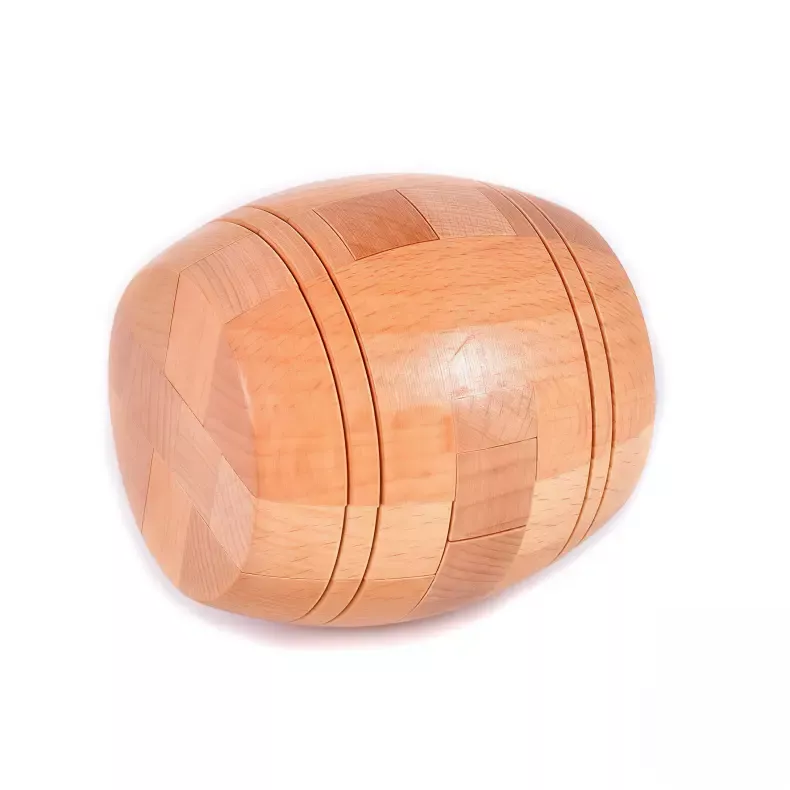
The Barrel Luban Lock — $19.77
The Barrel Luban Lock at $19.77 is the version I keep on my own desk during long writing days. Same self-locking geometry as the square, same beech construction, but the shape wants to be held. Solvers who like tactile objects over visual ones consistently pick this over the cube or square — and it disassembles the same way, so the luban square lock solving experience translates directly.
Buying for a collector. Piece count: 12 to 24, ideally with a second example kept for spare parts. Price band: $25 to $40. The Luban Lock Set 9 Piece at $39.99 is the closest thing to a starter collection on the roster — nine variants, including the square, in a single order, which lets a new collector compare tolerances and wood grain across wood types without buying nine separate listings. The serious collector will eventually want a 24-piece; the 24 Lock Puzzle at $16.99 is a useful second-tier challenge to add once the 6-piece square is solved cold. For now, the 9-piece set is the right first step.
If you only read one section of this guide, read this one. Match the piece count to the person, not the price. A 6-piece beech square is not a consolation prize for a beginner; it is the most rewarding version for almost everyone, and the version that most often ends up back on the shelf unsolved if it’s skipped in favor of a 24-piece “because it looks more impressive.” For a deeper read on how solvers at different skill levels approach wooden puzzle locks once the box is open, [how beginners and experts approach wooden lock puzzles](https://