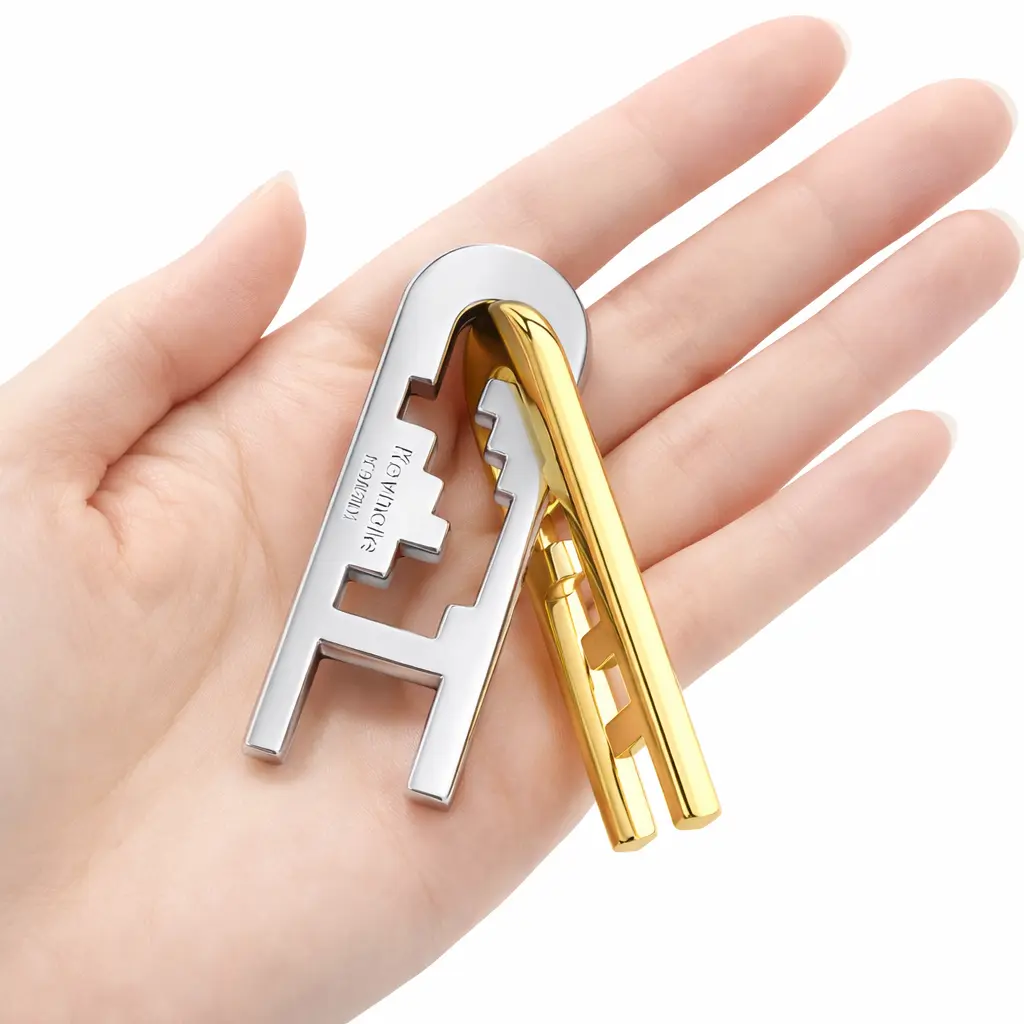
Thirty seconds in, you think you understand it. Two flat metal pieces — one gold, one silver — interlocked through what looks like a simple slot. Pull them apart. Easy.
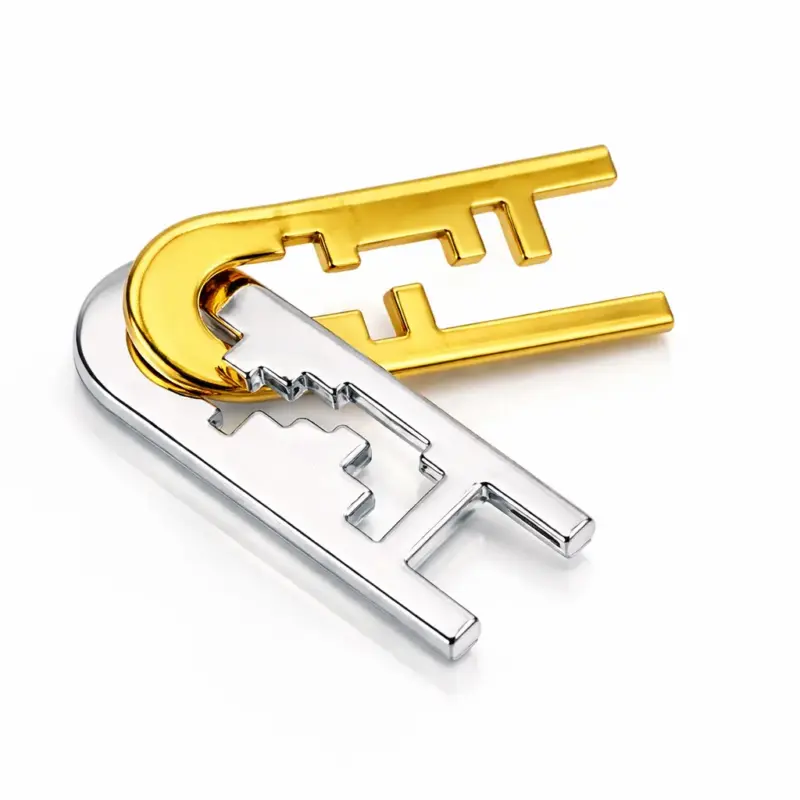
Cast Keyhole Gold & Silver
Two interlocking metal pieces. One gold, one silver. Simple at first glance — flat surfaces with angled notches that look like the edge of a key. But slide them together, and those flat cuts become a twisting 3D maze. The challenge: separate the two pieces without forcing anything. Then put them back. That second part is where confidence goes to die.
- Chrome and gold-tone polished finish
- Pocket-sized: fits in one hand
- Approximately 75mm tall when assembled
- No tools, no hints, just spatial logic
- Solve, reset, challenge a friend
Five minutes later, the gold piece has traveled a full loop around the silver one and landed right back where it started. You haven’t separated anything. You’ve just completed a circle you didn’t know existed.
That’s the Cast Keyhole puzzle in one sentence: a maze disguised as a key.
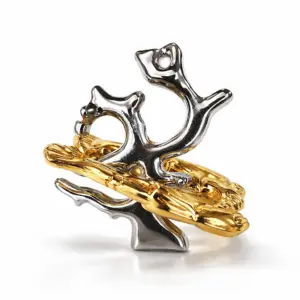
The Cast Keyhole puzzle in its assembled state — two interlocking metal pieces that form a hidden 3D maze.
I’ve spent the better part of a week with this puzzle on my desk, picking it up between tasks, turning it over during phone calls, and slowly mapping the path that separates these two deceptively simple pieces. What follows is the most thorough breakdown you’ll find anywhere: every move, every dead end, every moment where spatial reasoning fails and muscle memory takes over.
But first, a warning. If you want to solve this yourself — and you should, because the breakthrough moment is worth every minute of frustration — stop reading after the overview section. Bookmark this page for later. The step-by-step walkthrough below will rob you of that satisfaction if you read it too soon.
What You’re Actually Holding
The Cast Keyhole consists of exactly two pieces. The gold piece has a rounded arch at one end and a series of stepped notches along both sides — like the teeth of a key, but offset at irregular intervals. The silver piece mirrors that general shape but with its own unique notch pattern. A small hole near the top of each piece allows them to interlock through what initially looks like a standard slot-and-tab connection.
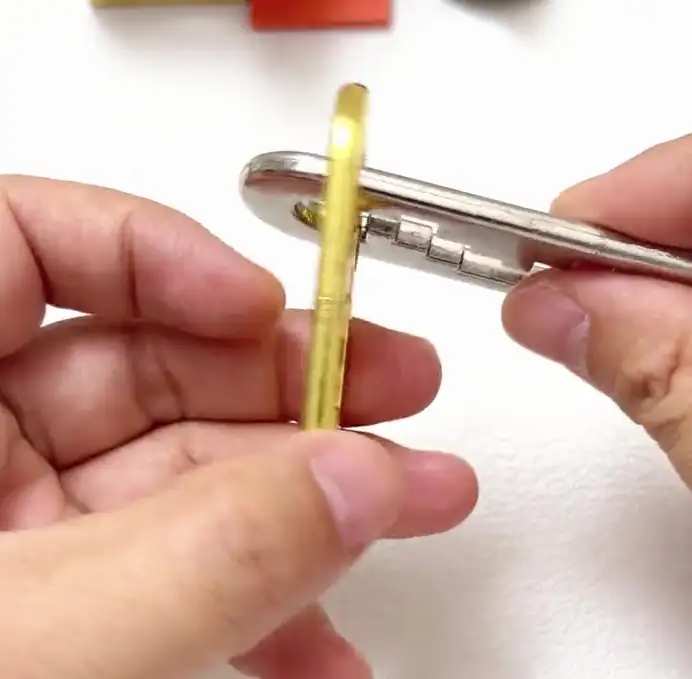
Side view reveals the puzzle’s true nature — the flat pieces create a three-dimensional navigation challenge.
Here’s what makes it devilish: viewed from the front, the puzzle looks two-dimensional. Just slide piece A out of piece B. But the notches exist on both faces of each piece, creating channels that force three-dimensional movement. You can’t simply pull the pieces apart in a straight line. The silver piece must navigate through, around, and over the gold piece’s internal architecture — flipping, rotating, and sliding through specific notch alignments that only work in one sequence.
The puzzle measures approximately 75mm tall when assembled and weighs enough to feel substantial in your hand. The gold-tone and chrome finish catches light nicely, though the gold piece scratches more readily than the silver one. After a few solving sessions, you’ll notice wear marks tracing your most-used grip points — a physical record of your attempts.
The design comes from Finnish puzzle designer Vesa Timonen, and the theme is “Groove” — a reference to the channels that guide (and trap) your movements. If you enjoy cast metal brain teasers that test spatial logic, this one sits squarely in the intermediate-to-hard range. It’s rated a difficulty level 4 on a 6-point scale, which translates roughly to “demanding” on a standard puzzle difficulty metric.
Why Most People Get Stuck
Before we get to the solution, understanding why this puzzle defeats people is more useful than memorizing the steps. Three psychological traps catch nearly everyone.
Trap 1: The flat-plane assumption. Your brain sees two flat pieces and assumes the solution lives in two dimensions. Slide left, slide right, pull apart. But the offset notches create a hidden third axis of movement. Until you start rotating the pieces perpendicular to each other, you’re solving a different puzzle than the one in your hands.
Trap 2: The false progress loop. The notch pattern allows the silver piece to travel a surprising distance along the gold piece — far enough that you think you’re close to separation. Then you hit a dead end, reverse, and end up exactly where you started. This loop exists by design. The puzzle teaches you the mechanism through frustration before revealing the exit.
Trap 3: Rushing the notch alignment. Each step requires precise positioning before the next move becomes available. If you force a rotation when the notches aren’t aligned, you either jam the pieces or bounce backward. Patience isn’t optional here — it’s part of the mechanism.
Understanding these traps doesn’t spoil the puzzle. It reframes your approach. Instead of random experimentation, you start asking the right question: “Which notch aligns with which channel at this specific angle?”
A research paper published in Cognitive Science found that mechanical puzzles activate both the prefrontal cortex and the motor planning regions simultaneously — a dual-load cognitive exercise that improves spatial reasoning over time. The Cast Keyhole is a near-perfect example of this principle in action. Your hands learn the path before your conscious mind can map it. If you’re curious about how different puzzle types engage the brain, the guide to mechanical puzzle collections explores this territory more deeply.
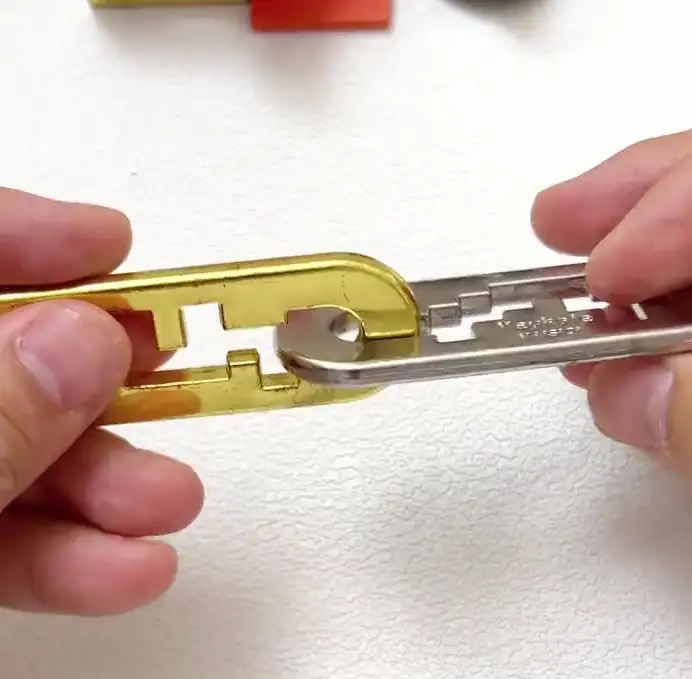
Both pieces laid flat — notice how the notch patterns appear simple from above but create complex channels when interlocked.
The Complete Solution: Step-by-Step With Photos
Last chance to stop reading if you want to solve it yourself.
Here is the full disassembly sequence, photographed from my hands. Each step requires the previous one to be complete. Skip ahead and nothing will line up.
Step 1: Position the Pieces at 90 Degrees
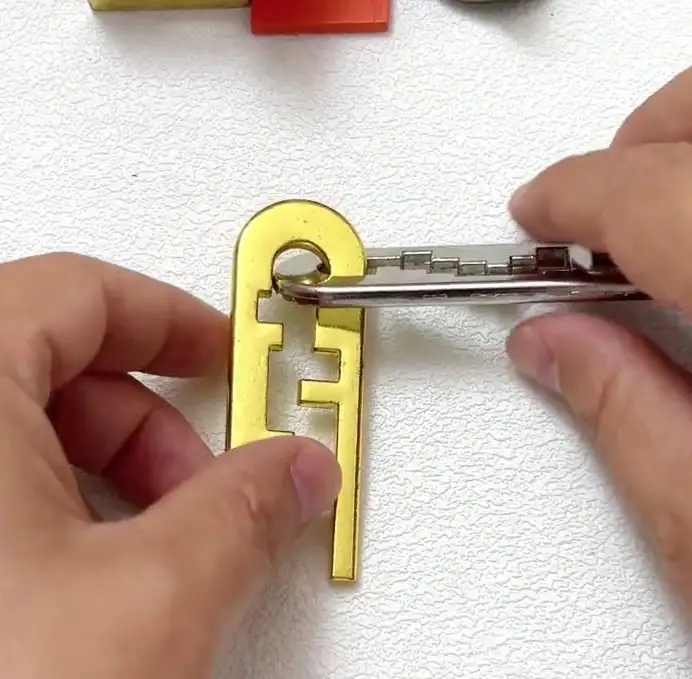
Hold the silver piece facing you vertically. Now rotate the gold piece so it sits perpendicular — at a right angle — through the silver piece’s keyhole opening. The gold arch should be visible on the left side, poking through the top of the silver piece.
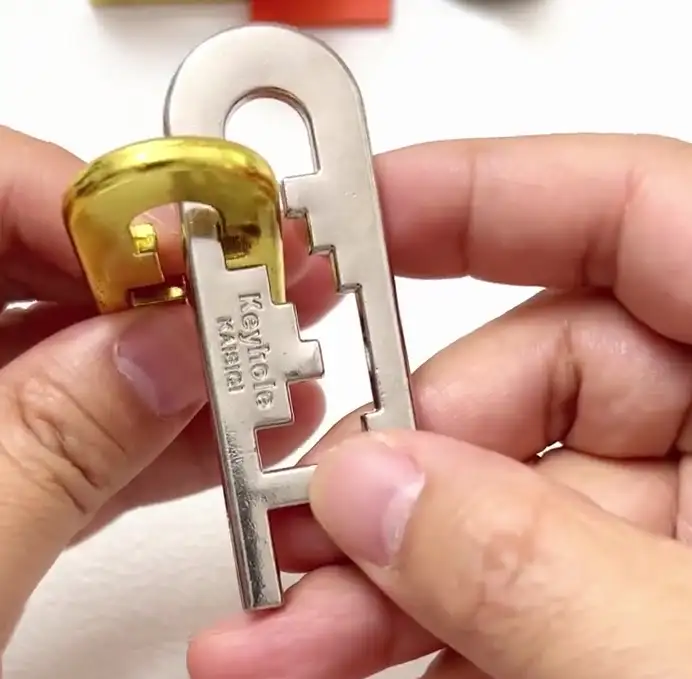
Step 1: Start with both pieces positioned at 90 degrees to each other. This orientation is critical — it unlocks the first channel.
This starting position is the key insight that unlocks everything. Most people hold both pieces in the same plane, which is exactly where the puzzle wants you to stay stuck. Think of it like a door handle — the handle turns perpendicular to the door before it opens. Same principle here.
If you’ve been trying to solve this for a while and haven’t tried the 90-degree orientation, this single adjustment will change everything. Puzzle designers often hide solutions in orientation changes rather than complex movements, and the Cast Keyhole exemplifies this perfectly.
Step 2: Flip the Gold Piece 180 Degrees
With both pieces at 90 degrees, take the gold piece and flip it to the left — a full 180-degree rotation. The gold arch will swing over the top of the silver piece and land on the opposite side. During this motion, the gold piece’s notches should slide through the corresponding channels in the silver piece.
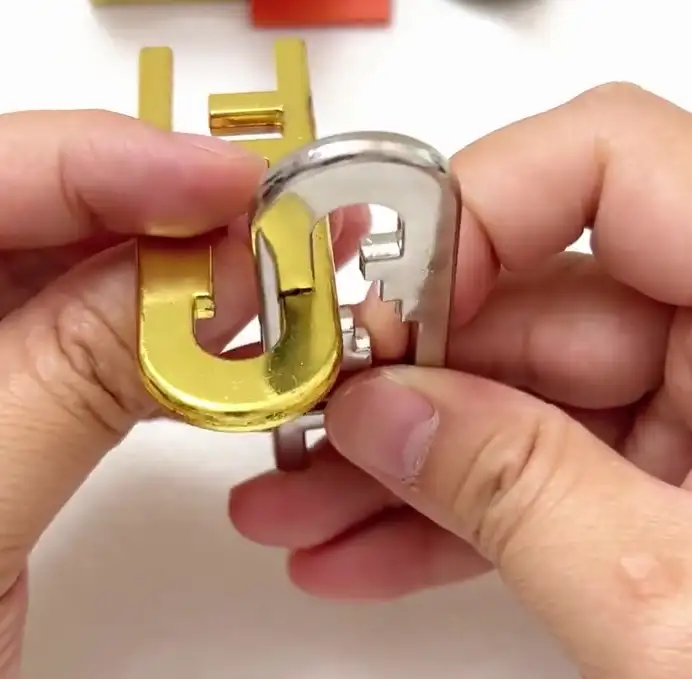
Step 2: Flip the gold piece 180 degrees to the left. The notches should glide smoothly through the silver piece’s channels.
This isn’t a forced motion. If you feel resistance, the notch alignment isn’t right. Back up slightly, adjust the perpendicular angle, and try again. The pieces should move with a satisfying, almost mechanical precision when positioned correctly.
The flip-and-slide combination is a common mechanism in cast metal maze puzzles. If you enjoy this type of movement, the Cast Hook metal brain teaser uses a similar flip-based technique with a different maze architecture, and the Gold Fish and Silver Coral Reef cast puzzle adds organic curves to the same underlying principle.
Step 3: Slide Down to the Next Notch
After the 180-degree flip, the pieces will be roughly side by side, both facing you. Now slide the silver piece downward one notch position. You’ll feel a small click or detent as the notch teeth engage the next channel.
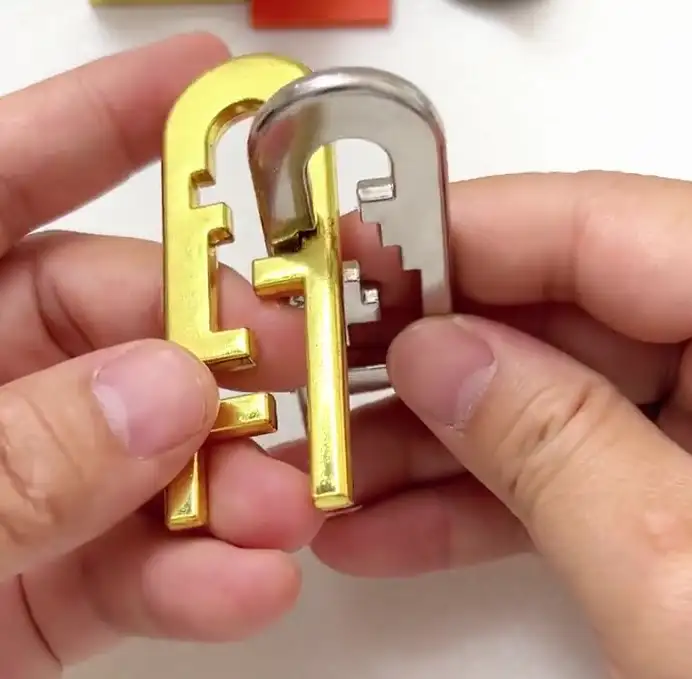
Step 3: After the flip, slide down one notch. The pieces should sit side by side like this — both arches visible.
This is where false progress lives. The slide feels productive, and it is — but there are several more notch positions to navigate before separation. Don’t rush to pull the pieces apart at this stage. You’re roughly one-third through the maze.
Step 4: Rotate and Navigate Through
Rotate the silver piece 90 degrees again so it’s perpendicular to the gold piece — same relationship as Step 1, but now the pieces are in a different relative position along the notch path. The silver arch should pass through the gold piece’s opening.
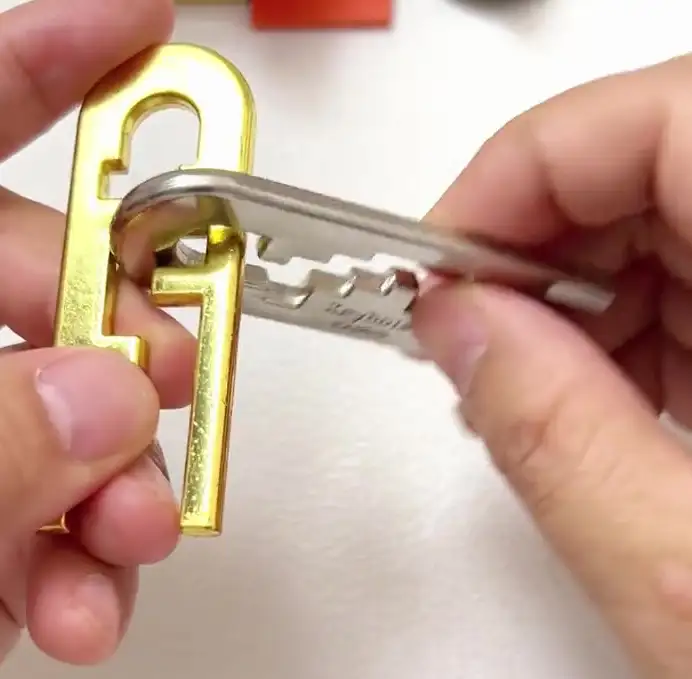
Step 4: Rotate the silver piece back to 90 degrees and continue navigating through the gold piece’s channels.
Each time you rotate back to 90 degrees, you unlock a new section of the maze. Think of it as turning a key in stages — each quarter-turn engages different pins. The puzzle’s name isn’t just decorative; the solving motion genuinely mimics the action of working a complex key through a multi-stage lock.
Step 5: Continue Sliding Through the Notches
Keep the pieces perpendicular and slide the silver piece along the gold piece’s stepped edge. The notch pattern will guide you — there’s only one path that allows smooth movement. If you hit resistance, you’ve overshot or haven’t completed the previous rotation fully.
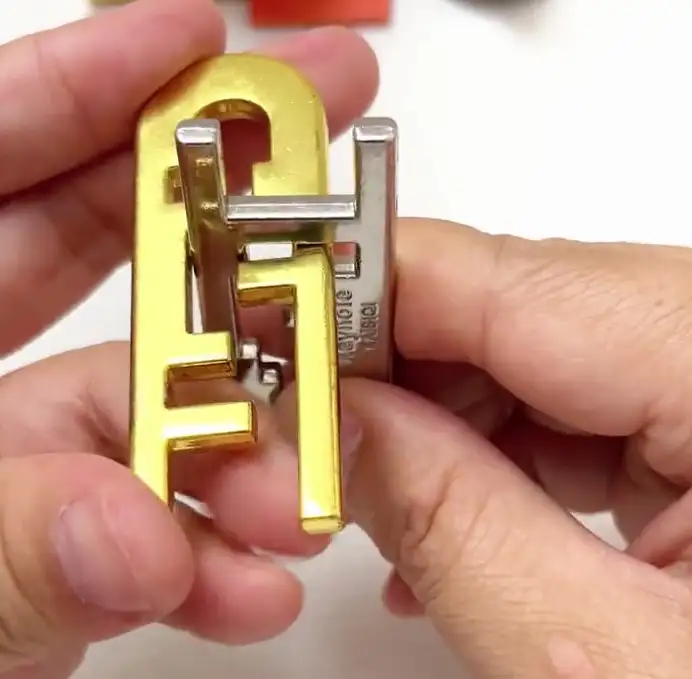
Step 5: Continue the slide. The notches act as guardrails — follow the path of least resistance.
This phase is the most meditative part of the solve. The pieces almost move themselves once you stop fighting the mechanism. I found myself entering a focused, almost flow-like state during this section — the kind of deep engagement that researchers at the University of Chicago call “task-intrinsic motivation.” You’re solving not because you want it finished, but because the act of navigating feels satisfying.
If that description resonates, you might appreciate puzzle locks that use similar sequential mechanisms or locking puzzle brain teasers that extend this multi-step engagement over longer solving sessions.
Step 6: Flip the Silver Piece
Now comes the second orientation change. Flip the silver piece over — another 180-degree rotation — so its notch pattern engages the gold piece from the opposite direction. The silver piece’s arch should swing clear of the gold piece’s body during this flip.
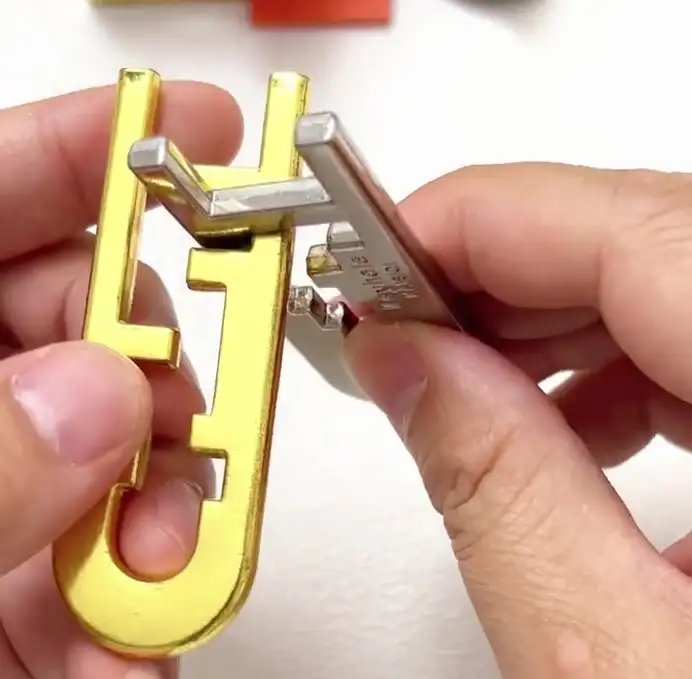
Step 6: Flip the silver piece 180 degrees. This opens the path to the final sequence.
This step catches people on the reassembly. The impulse is to flip the gold piece again (it worked before, right?), but the maze now requires the other piece to rotate. The asymmetry is intentional — it prevents muscle memory from carrying you through without spatial understanding.
Step 7: Counterclockwise Slide Through the Final Channel
With the silver piece flipped, slide it counterclockwise through the remaining notch positions. The motion follows the gold piece’s outer edge, threading through each gap in sequence.
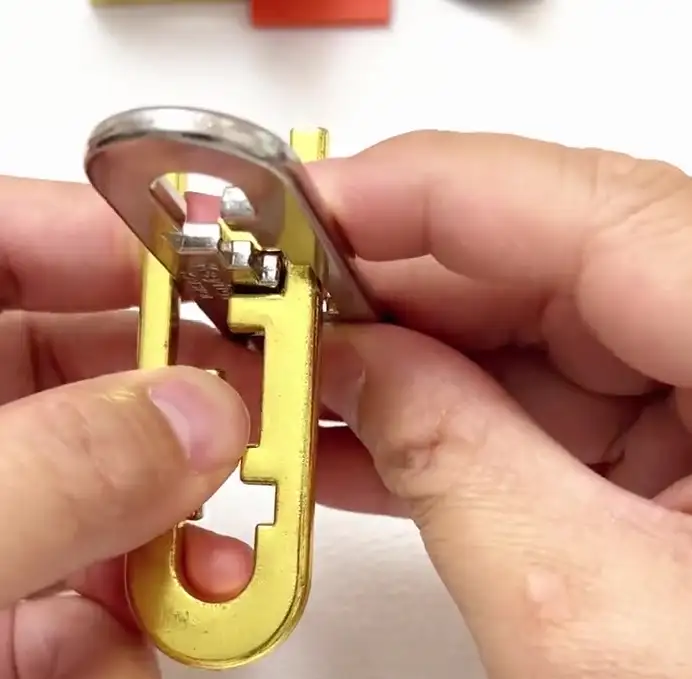
Step 7: Slide counterclockwise through the final channels. Almost there.
You’ll pass through three or four notch positions during this slide. Each one requires a slight adjustment — a tiny rotation or tilt — to clear the next tooth. If you’ve gotten this far, your fingers already know the required pressure. Trust them.
Step 8: Reach the Exit Gap
The gold piece has one specific gap — an opening wider than the rest — that serves as the exit point. When the silver piece reaches this gap after the counterclockwise journey, the path to separation opens. You’ll see clear space between the pieces for the first time.
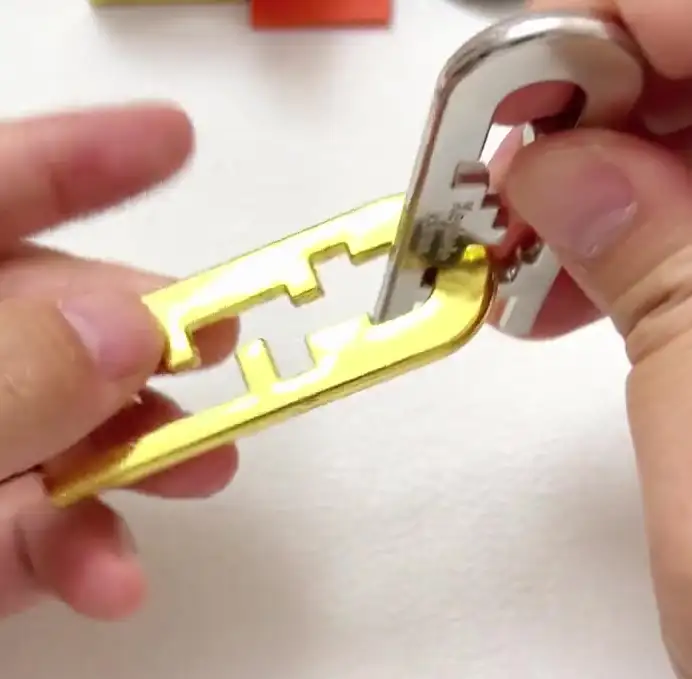
Step 8: The exit gap. When you see this opening, the silver piece can finally clear the gold piece.
This is the breakthrough moment. After several minutes of guided constraint, the pieces suddenly feel loose. The tension releases, and the separation that seemed impossible three minutes ago becomes almost effortless.
Final: Pieces Separated
Slide the silver piece out through the exit gap. The two pieces separate completely.
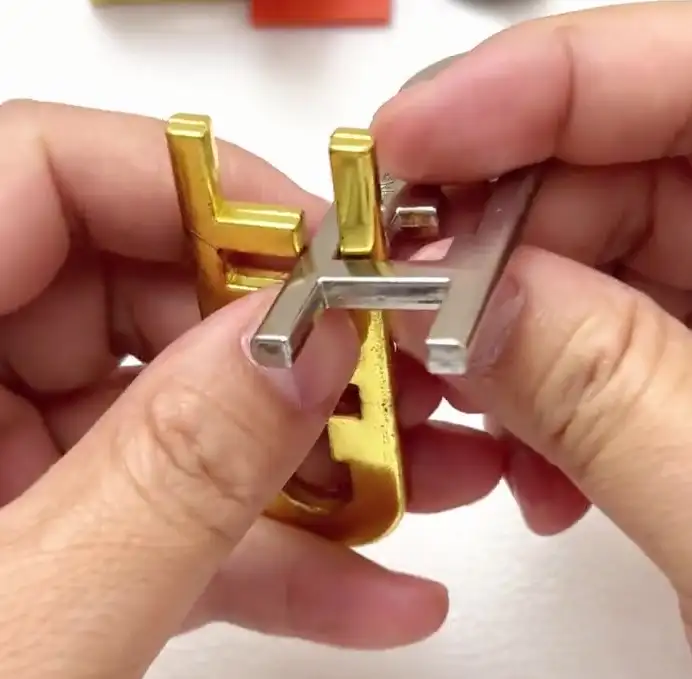
Solved. The gold and silver pieces separated after navigating the hidden 3D maze.
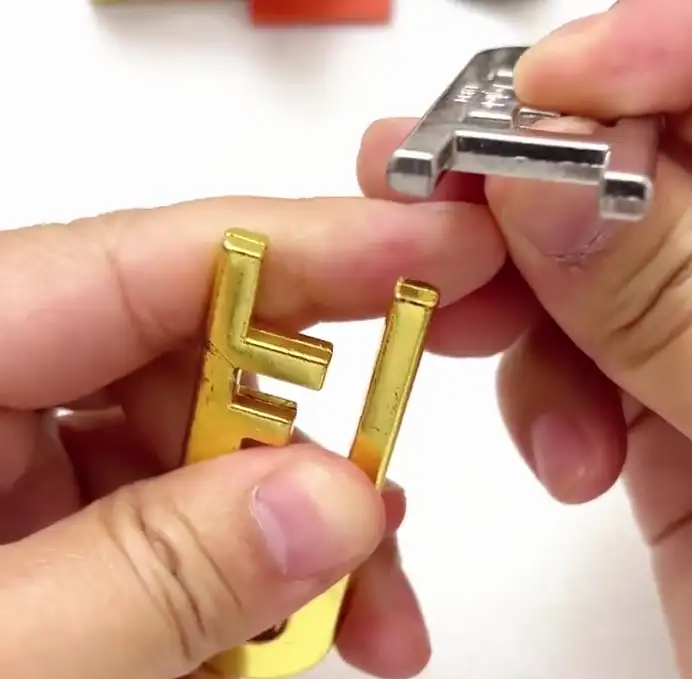
Both pieces laid separately — notice the notch patterns that created the maze path.
Congratulations. Now do it again. Seriously. The reassembly is the real challenge — and without the maze memory fresh in your hands, it feels like solving a completely different puzzle. Experienced solvers recommend waiting at least an hour before attempting to put the pieces back together. That gap forces you to reconstruct the path from spatial understanding rather than short-term motor memory.
The Reassembly Challenge (Harder Than You Think)
To put the Cast Keyhole back together, reverse the sequence: insert the silver piece through the exit gap, slide clockwise through the notch channels, flip the silver piece, continue navigating, flip the gold piece, and finish with both pieces in their original interlocked position.
Sounds simple when written out. In practice, the reassembly exposes a cognitive asymmetry: disassembly rewards exploration (try things until something works), while reassembly rewards spatial memory (remember and reverse what worked). Many solvers report the reassembly taking two to three times longer than the initial disassembly.
If that prospect excites rather than discourages you, the Cast Galaxy 4-piece silver puzzle takes the same reassembly principle and multiplies it — four interlocking pieces that must return to a precise configuration. And the Snake Mouth Escape puzzle adds an organic, asymmetric shape that makes spatial memory even more demanding.
Who Should Skip This Puzzle
Not every puzzle fits every solver. Here’s when the Cast Keyhole isn’t the right choice.
If you hate mazes in all forms. This is fundamentally a maze with metal components. If navigating a path through constrained channels doesn’t appeal to you in concept, the execution won’t change your mind.
If you want a quick desk distraction. First-time solving takes most people 10-30 minutes of focused effort. If you’re looking for a 60-second fidget break, something like a simple metal puzzle ring would serve you better.
If you’re buying for a young child. The pieces have sharp edges, are small enough to pose a choking hazard, and the difficulty level will frustrate anyone who hasn’t yet developed spatial reasoning skills. Age 12 and up is a reasonable minimum.
If you expect a brain-breaking challenge. Seasoned puzzle collectors who regularly solve level 5-6 cast metal puzzles may find this too straightforward. It’s rated level 4 for good reason — rewarding, but not devastating. If you want something that will keep you stuck for days, look at the higher-difficulty options in the metal puzzle collection.
What Makes the Cast Keyhole Design Brilliant
Most cast metal puzzles use one primary mechanism: rotation, sliding, or separation. The Cast Keyhole combines all three, layered in sequence. You rotate to unlock sliding channels. You slide to reach new rotation points. And you separate only after completing a full circuit of rotations and slides.
This stacked-mechanism approach is what makes the puzzle feel longer and more complex than it appears. The actual path from assembled to separated involves roughly 12-15 distinct moves, but the three-dimensional navigation makes each move feel like a small puzzle within the larger puzzle.
Vesa Timonen’s design also exploits a perception gap. The stepped notches look decorative — like the teeth of an ornamental key. Only when you engage with the puzzle do you realize every notch serves a functional purpose. Nothing is decorative. Every cut, every angle, every offset tooth exists to create or block a specific movement.
This is a hallmark of exceptional puzzle design: apparent simplicity concealing genuine complexity. The Three Brothers Lock Puzzle uses a similar deception — three pieces that look identical but behave differently. And the Jiutong Lock pushes the same concept into cylindrical geometry, where the sequential mechanism wraps around a central axis instead of a flat plane.
Tips for Your Second Solve (And Beyond)
After your first successful disassembly and reassembly, the puzzle transforms from a challenge into a skill exercise. Here’s what experienced solvers focus on during repeat sessions.
Speed runs. Time yourself. The first solve might take 20 minutes. By the fifth attempt, most people are under 3 minutes. The world’s fastest cast metal puzzle solvers complete similar-difficulty puzzles in under 30 seconds — a benchmark that requires the kind of automatic, unconscious motor planning that only develops through repetition.
Blindfold solves. Once you know the path, try solving by touch alone. This isolates the tactile feedback from each notch transition and builds a sensory map that your visual system doesn’t have. It’s also an excellent way to demonstrate the puzzle’s difficulty to friends — hand them the assembled puzzle after you’ve just solved it blind, and watch them struggle with what you made look effortless.
Teach someone else. The Feynman technique applies to puzzles as well as physics: if you can explain the solution clearly enough for someone else to follow, you truly understand the mechanism. Guide a friend through the steps without touching the puzzle yourself. You’ll discover gaps in your own spatial understanding that repetitive solving masked.
The Cast Keyhole as a Gift
This puzzle works well as a gift in several specific contexts. It’s compact enough to wrap easily, priced affordably, and has a visual appeal that doesn’t require puzzle knowledge to appreciate. The gold and silver contrast makes it look like an art object on a desk or shelf.
For puzzle-experienced recipients, pair it with something from a different mechanism family — a wooden brain teaser or a puzzle trick box — to create a varied challenge set. For first-time puzzle recipients, include a note saying “flip the pieces to 90 degrees” as a starting hint. It reduces initial frustration without spoiling the solving experience.
If you’re building a curated gift set around the Cast Keyhole, the screen-free gift guide has additional pairing ideas that complement a metal brain teaser without repeating the same puzzle type.
Frequently Asked Questions
How long does the Cast Keyhole puzzle take to solve? First-time solvers typically spend 10-30 minutes. The difficulty is front-loaded — once you discover the 90-degree orientation trick, the remaining steps follow more intuitively. Repeat solves drop to 2-5 minutes, and experienced puzzle solvers can complete it in under a minute.
What is the difficulty level of the Cast Keyhole? It’s rated level 4 on a 6-point difficulty scale, which places it in the “demanding” category. Most adult solvers can complete it without hints given enough time, but it’s challenging enough to stump people for 20+ minutes on a first attempt.
Is the Cast Keyhole puzzle good for beginners? It’s an excellent second or third puzzle for someone entering the cast metal puzzle hobby. Complete beginners might find it frustrating, but anyone who has solved at least one interlocking metal puzzle will have the spatial reasoning foundation needed. The satisfying “aha” moment when the 90-degree trick clicks makes it rewarding even for less experienced solvers.
Can the Cast Keyhole puzzle get stuck or jammed? Not if you avoid forcing the pieces. Every movement in the correct sequence feels smooth and nearly effortless. If you feel significant resistance, you’re either in the wrong orientation or haven’t completed the previous step fully. Back up and reposition — never force.
What material is the Cast Keyhole puzzle made from? The puzzle is made from zinc alloy with gold-tone and chrome plating. It weighs approximately 100 grams total — substantial enough to feel solid in your hand without being heavy. The gold-tone piece will develop surface scratches faster than the chrome piece, which adds character over time.
Is the reassembly harder than taking it apart? Considerably. Disassembly allows trial-and-error exploration. Reassembly requires you to remember the exact sequence in reverse. Many solvers report reassembly taking two to three times longer than the first disassembly. For a deeper challenge, try reassembling after a 24-hour gap.
Cast Keyhole Gold & Silver
Two interlocking metal pieces. One gold, one silver. Simple at first glance — flat surfaces with angled notches that look like the edge of a key. But slide them together, and those flat cuts become a twisting 3D maze. The challenge: separate the two pieces without forcing anything. Then put them back. That second part is where confidence goes to die.
- Chrome and gold-tone polished finish
- Pocket-sized: fits in one hand
- Approximately 75mm tall when assembled
- No tools, no hints, just spatial logic
- Solve, reset, challenge a friend
What’s the best way to start solving the Cast Keyhole? Position the two pieces at 90 degrees to each other rather than keeping them in the same plane. This single orientation change unlocks the first movement and reveals the puzzle’s three-dimensional maze structure. Most people who get stuck are trying to solve it in two dimensions.
How does the Cast Keyhole compare to other metal maze puzzles? It sits in the mid-difficulty range. Simpler two-piece cast puzzles might take 2-5 minutes for a first solve, while level 5-6 puzzles can take hours. The Cast Keyhole hits a sweet spot — complex enough to be satisfying, accessible enough to complete in a single sitting.
Is the Cast Keyhole good as a desk fidget? Excellent. Once you know the solution, the smooth rotation-slide-rotation cycle becomes almost meditative. The metal-on-metal feedback and the weight of the pieces make it a satisfying sensory experience. Many owners keep it assembled on their desk and solve it during calls or thinking breaks.
Where can I find the Cast Keyhole puzzle solution if I’m stuck? You’re looking at the most comprehensive step-by-step photo guide available. If the photos above aren’t enough, try this: focus on the 90-degree orientation (Step 1) and the counterclockwise direction (Step 7). Those two insights unlock the rest.
What age range is appropriate for the Cast Keyhole? The puzzle is appropriate for ages 12 and up. The small size and pointed edges make it unsuitable for young children. Teenagers and adults will get the most enjoyment from it, particularly those with developing or established spatial reasoning skills.
Can I solve the Cast Keyhole puzzle without the solution guide? Most people can, given 15-45 minutes of focused experimentation. The key breakthrough is discovering that the pieces must be rotated perpendicular to each other, not kept flat. If you figure that out independently, the rest of the maze reveals itself through systematic exploration. Save this guide for when frustration exceeds patience.