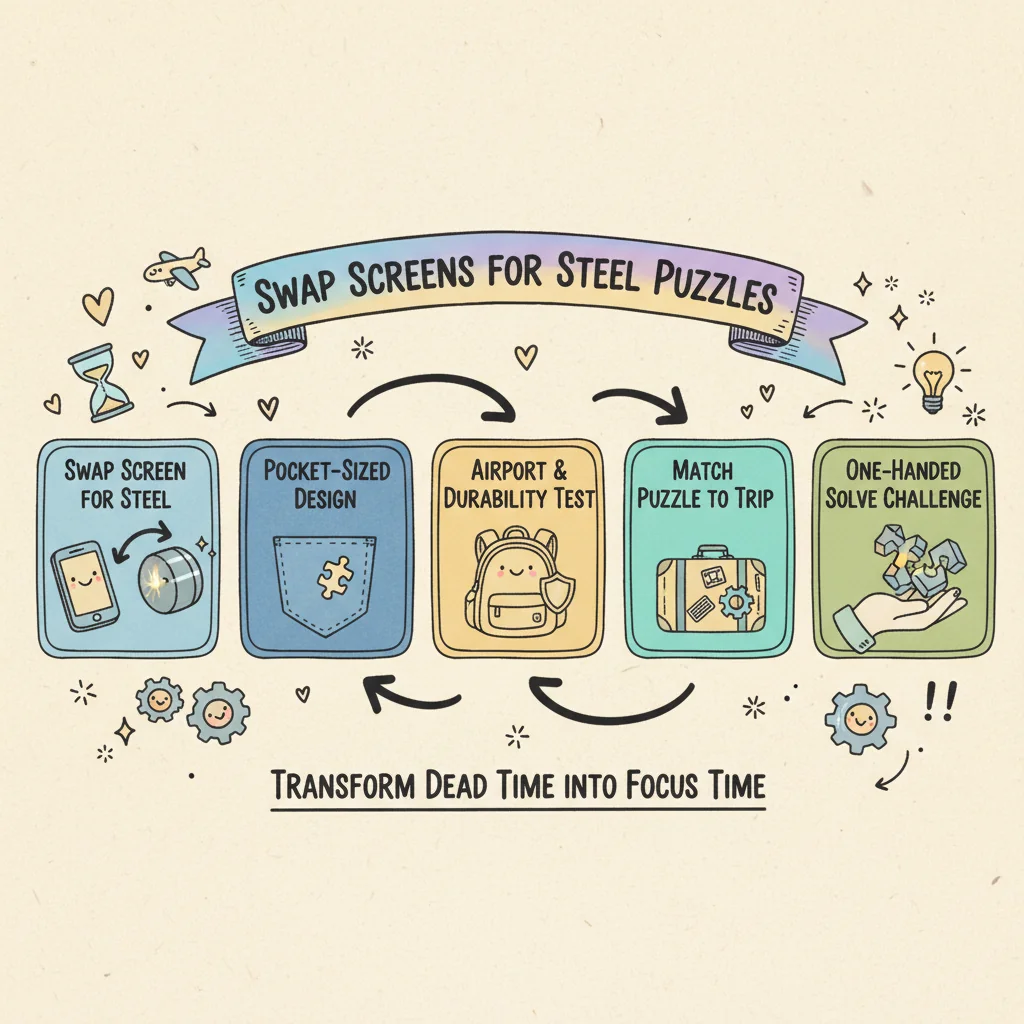
Beyond Boredom: The Quiet ‘Click’ That Beats Doomscrolling
The most profound travel innovation isn’t a new app. It’s the moment your thumb finds a cool, dense object in your jeans pocket, and you trade the blue glow of a screen for the deliberate heft of machined metal. A pocket metal puzzle transforms dead time—the tarmac delay, the silent hotel room, the endless queue—from a state of passive consumption into one of active, focused engagement. The ideal model is under 2.5 inches in any dimension, ensuring it disappears into a coin pocket until you need it, offering a tangible alternative to digital distraction.
I remember the specific click. It was during a fourth hour on a grounded Airbus, the cabin air stale with resigned frustration. My phone was a drained, hot brick. From my pocket, I pulled a brushed stainless steel cylinder, about the size of a roll of quarters. Not a phone. Not a screen. A quiet ‘clink’ as two parts shifted against each other. The frustration of the delay didn’t vanish, but it receded, funneled into a new, contained problem: How does this come apart?
This is the pivot. You’re no longer just waiting; you’re exploring. Your focus narrows to seams, tolerances, and magnetic resistances. The world’s annoyances fade into a background hum. Your seatmate might glance over, curious about the deliberate, quiet movement in your hands. It’s not a fidget spinner’s nervous whir. It’s a conversation with physics.
As a former industrial designer who now logs more miles than a pilot, I’ve amassed over 50 of these tactile objects. My collection was built in transit. I’ve tested them not in a sterile lab, but in the real-world crucible of commuter trains and coach seats, judging them by a simple metric: Do they make the journey better? Do they hold up to being rattled in a backpack next to keys? Do they solve smoothly on a wobbly airplane tray table?
But here’s the rub: “Small metal puzzle” is not enough. A truly travel-worthy puzzle isn’t just miniature. It’s a careful balance of quiet durability, satisfying mechanics, and social discretion. It must pass what I call the Airport Security Test (does it look like a benign art object or a suspicious metallic blob?). It must have Zero Rattle in a pocket. It needs a machined finish that can survive a month next to your house keys without looking like it lost a fight with a grinder.
This guide isn’t another ranked list. Forget “top 10.” Your perfect puzzle depends entirely on your context. Are you a patient tinkerer seeking a deep, hour-long hotel room solve, or do you need a fidget-friendly, one-handed manipulative for calming nerves during takeoff? The puzzle for a peaceful coffee shop session is different from the one for a bumpy bus ride.
We’ll move beyond basic product listings and build a framework based on scenario and temperament. We’ll answer the real questions from forum deep-dives: What’s truly silent? What won’t shatter if dropped? What can you actually solve with one hand while holding a boarding pass? Let’s find the piece that fits not just in your pocket, but in the life you’re moving through.
The Anatomy of Pocket-Worthy: More Than Just Small
A pocket-worthy metal puzzle must meet three non-negotiable criteria: it must fit within a 2.5-inch (6.35 cm) sphere, the universal size of a jeans coin pocket; it must have a total mass between 1 and 3 ounces to provide satisfying heft without weighing you down; and its construction must eliminate any risk of loose, separable parts. This is the baseline that separates a true travel companion from a desktop toy in miniature.
Size is the first and most deceptive filter. “Pocket-sized” on a product page often means “fits in a jacket pocket.” We need coin-pocket sized. This isn’t just about portability—it’s about forgettability. A puzzle that slips into that small front pocket disappears until you need it, creating no bulge, catching on nothing. In my month of subway testing, the puzzles that stayed in rotation were all under this 2.5-inch threshold. Anything larger migrated to my backpack and, inevitably, out of mind.
Weight and material are intertwined, dictating the tactile feedback—or ‘hand-feel’—that defines the experience. You’re generally looking at three material classes, each with a distinct personality:
- Zinc Alloy (Cast Puzzles): This is the most common. It offers excellent heft for its size and allows for intricate, cast designs. The downside? The finish is often a plating over the base metal. Rattle it in a bag with keys for a week, and it will develop a “travel patina” (my polite term for scuffs and shiny spots where the plating wears through). It’s not a deal-breaker, but it’s a reality.
- Stainless Steel: The premium choice. It’s denser, offering a cool, substantial feel in the hand. A machined finish on stainless is remarkably durable—it resists scratches and maintains its look. The moving parts have a precise, silky smoothness that zinc alloys rarely achieve. You pay more, but you get a tool-like permanence.
- Anodized Aluminum: The featherweight. Puzzles in this material can be shockingly light, sometimes under half an ounce. This is great for absolute minimalists, but the trade-off is a lack of that satisfying, weighty manipulation. The anodized color is durable, but the metal underneath is softer and more prone to dings.
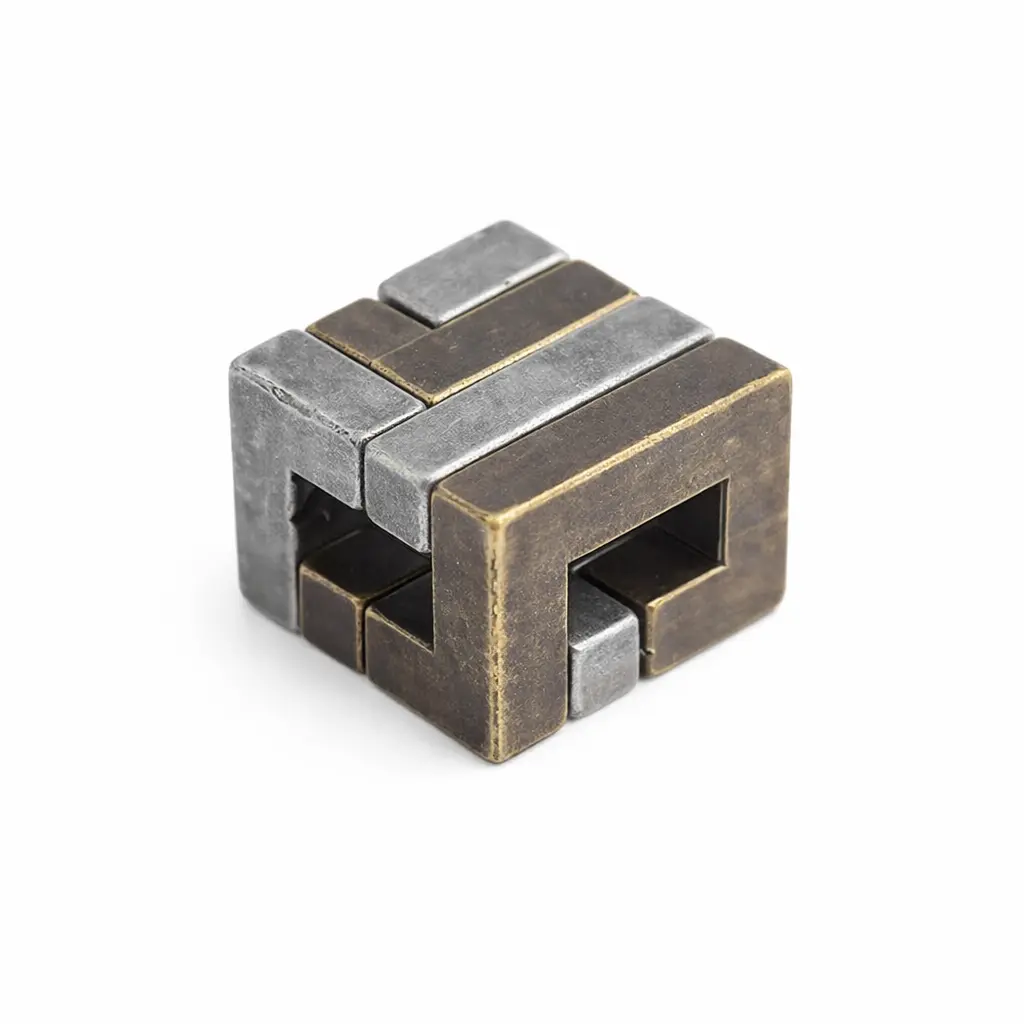
The Cast Coil pictured here is a classic zinc alloy example. You get that desirable heft and a clever, coil-bound mechanism for under $20, but be prepared for its shiny finish to mature with travel. It’s a process I detailed in my piece on how metal puzzles serve as tactile fidget tools, if you’re curious about the psychology behind that worn-in feel.
Finally, the details that separate good from go-to: No sharp edges. Your pocket and fingers will thank you. Zero rattle. A puzzle that clicks when you walk is a puzzle that will click when you don’t want it to. And a machined finish that feels precise in your fingers, not gritty or loose. This is the anatomy of pocket-worthiness—the objective framework that makes a puzzle not just a purchase, but a reliable travel tool.
The Airport Security Test & Social Acceptability Index
So you’ve found a puzzle that fits the pocket-worthiness criteria. Now, a harder test: will it pass through airport security without a second glance, and can you solve it at 30,000 feet without earning a glare from your seatmate? The reality is, 95% of well-machined, coin-pocket-sized metal puzzles pass through TSA checkpoints without issue, but some designs inherently look more suspicious in an X-ray bin than others. The key is avoiding anything that resembles a tool, a lock-picking set, or, crucially, has loose parts that could be misconstrued as something else entirely.
The X-ray test is about visual semantics. A solid, ornate piece of machined brass or steel reads as a curious trinket or high-end fidget toy. Puzzles with intricate internal channels might get a second look, but they rarely cause a holdup. The real troublemakers are those with separate rings, thin wires, or small, dense components that could be mistaken for something else. (A TSA agent once held up my Hanayama Padlock for a moment, gave it a shake, heard no rattle, and handed it back with a nod. The design language of a “lock” triggered the pause, but its solid, integral construction defused it).
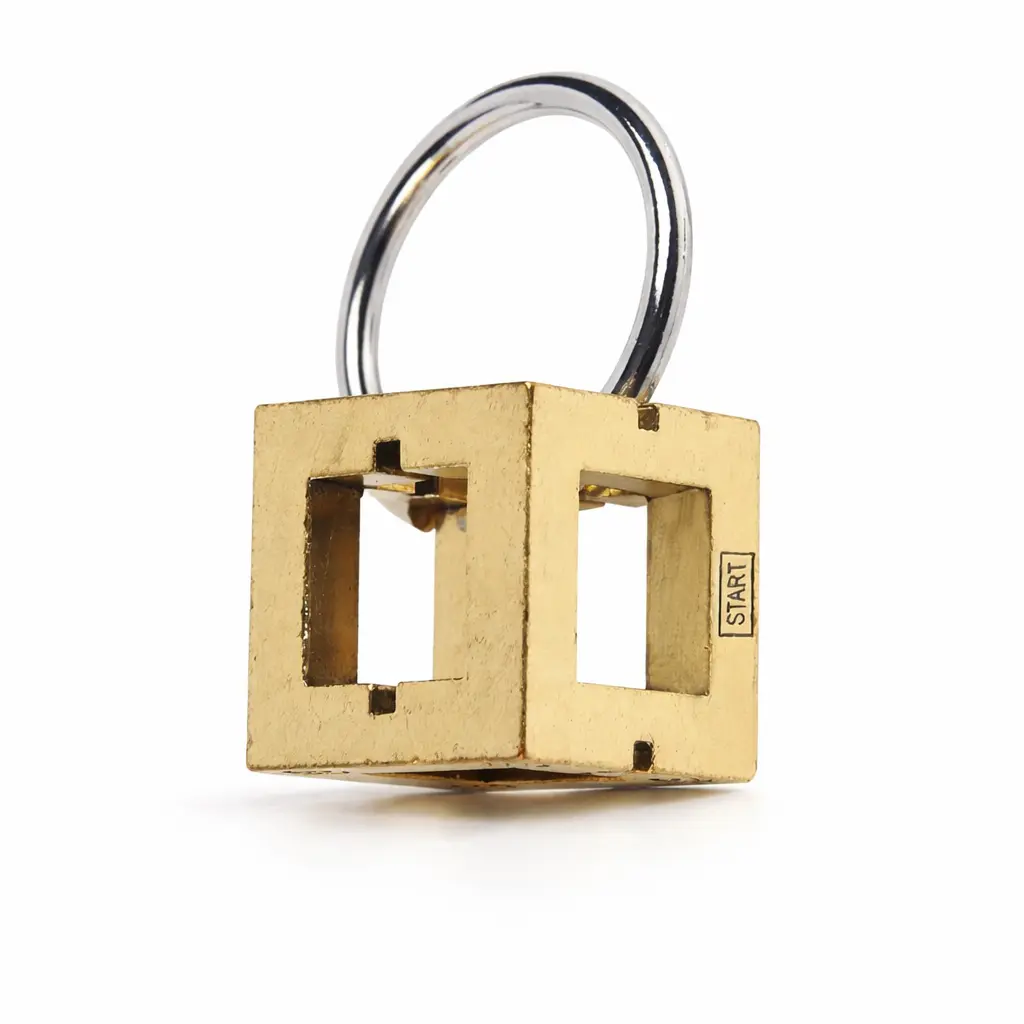
This is where a design like the Brass Cube Maze Puzzle Keychain excels. It presents as a single, solid object. On the belt, it looks like a decorative metal cube or a weighted keychain. There’s no assembly of parts, no threatening silhouettes. It’s inert.
Once you’re airborne, a different metric takes over: the Silent Flight Ranking. This isn’t just about being quiet; it’s about the type of noise. A muffled, solid clunk from two heavy pieces mating is far less intrusive than a persistent, high-pitched click-click-click of a sliding mechanism or the tinny rattle of loose components. On a decibel meter, most puzzles register between 35-50 dB—quieter than a whispered conversation (about 30 dB) but louder than ambient cabin hum (around 40 dB). The social offense comes from rhythm and pitch, not volume.
For the coffee shop or library tier, you want puzzles with slow, deliberate movements and dampened contact. Think cast puzzles with tight tolerances where parts slide with firm pressure, not snap fits. The Brass Cube, for instance, generates a soft, deep sound as the internal marble rolls through its brass channels—more like a gentle tumble than a click. It’s a background noise.
For the full “Silent Flight” champion, look to expert‑curated metal disentanglement puzzles made from a single, continuous piece of bent wire or those with felt or nylon pads between moving parts. They offer tactile feedback through resistance and vibration in your fingers, not sound waves in the air. (This is the ultimate answer to the top r/mechanicalpuzzles question: “What’s a good metal puzzle that won’t drive my seatmate crazy?”)
The puzzle for the airplane tray table must also consider space and stability. A puzzle that can be solved flat, without pieces rolling, is ideal. The tray table test eliminates any puzzle that requires you to hold two pieces aloft to align them, a surefire path to dropping something under the seat. The best are self-contained, using gravity and the table surface as part of the solve. It’s about minimizing variables in a chaotic environment, a principle I explore in my guide on selecting the right brain teaser for your needs.
Ultimately, social acceptability is a function of discretion. A puzzle you can manipulate subtly in one hand, that doesn’t look like a strange gadget, and that sounds like a faint, natural noise, will become your constant travel companion. The wrong choice becomes a novelty you leave in your suitcase. The right one earns a permanent home in your pocket, ready for any delay, anywhere.
Decoding Difficulty: From Fidget to Mind-Bend
For a travel puzzle, difficulty is a measure of context, not just cleverness. The most elegant solution is useless if you abandon it in frustration before landing. The industry standard, Hanayama’s Cast Puzzle scale of 1 (easiest) to 6 (hardest), is a useful start, but it’s calibrated for a quiet room, not a turbulent cabin. For travel, you must layer on a second scale: frustration tolerance. A puzzle rated a 3 on the Hanayama scale can feel like a 5 when you’re jet-lagged and distracted. My month of subway testing revealed that the ideal travel difficulty isn’t a number—it’s a match between mechanism and mindset.
First, identify your travel temperament. Are you a quick-win seeker or a patient tinkerer? The distinction is crucial. The quick-win seeker needs a puzzle with clear, incremental feedback—a series of small ‘clicks’ and visible progress that provides a satisfying loop during a 45-minute train ride. For them, a difficulty 1 or 2 puzzle is perfect. It’s not about being easy; it’s about being gratifying. The solve is a focused reset, a way to channel restless energy into a tangible, completed task. This directly answers the common forum question: What’s a satisfying but not impossible metal puzzle for a long flight? The answer is a puzzle where the core mechanic is quickly understood, but the execution still requires your full attention, pulling you out of the travel stupor without trapping you in it.
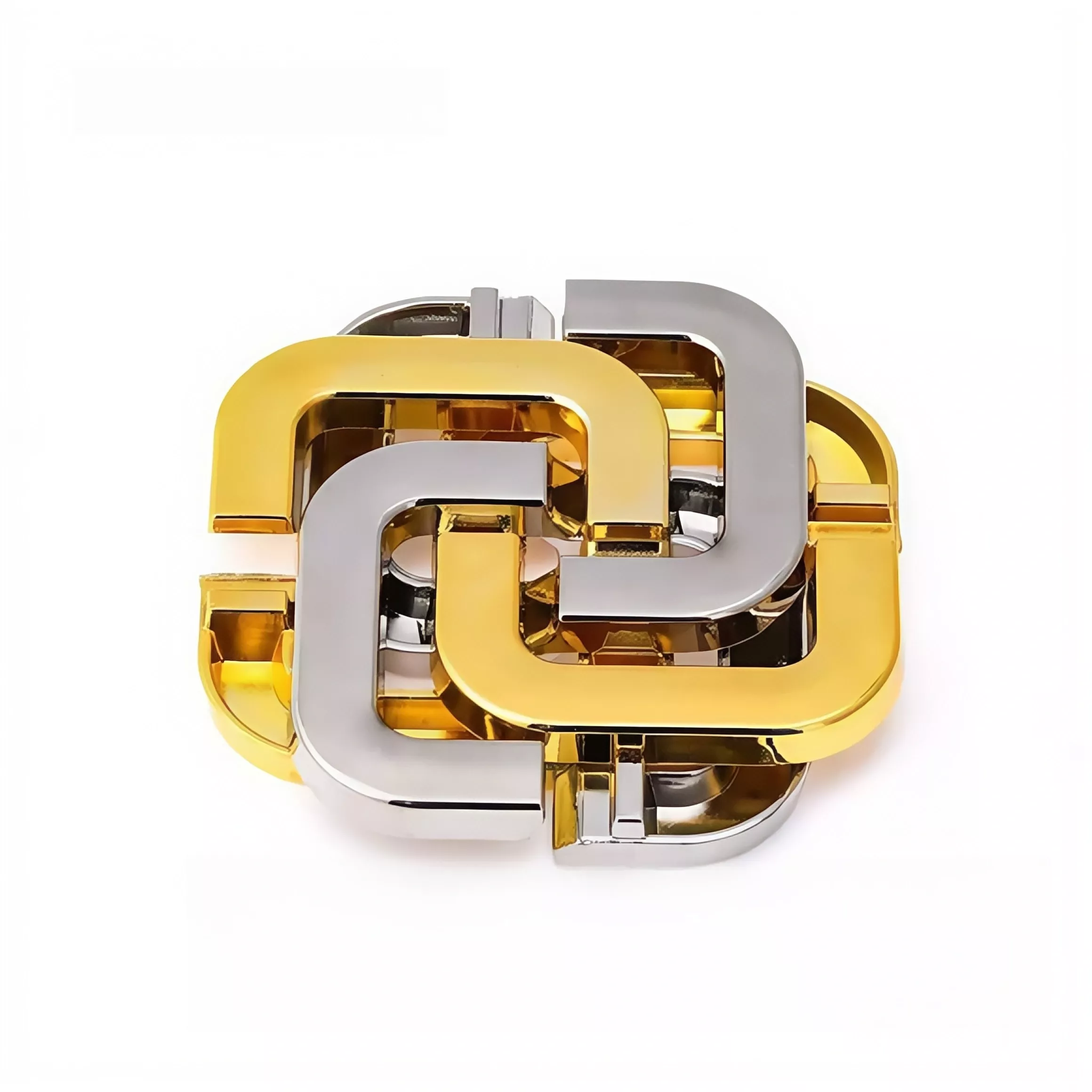
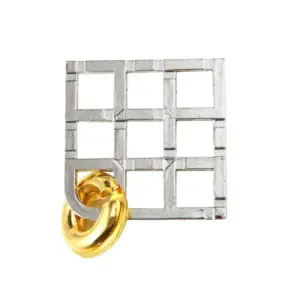
Four-Leaf Clover Puzzle — $13.89
The Four-Leaf Clover Puzzle is a quintessential beginner travel pick. It’s a disentanglement puzzle (removing the ring) that operates on a simple, almost obvious principle once you see it. The ‘aha’ moment comes quickly, but the path there involves a pleasing, fidget-friendly manipulation of the clover pieces against the ring. It’s tactile, quiet, and its compact, organic shape draws no strange looks. It’s the puzzle you solve three times during a coffee stop, each time enjoying the smooth motion as much as the solution—a perfect pocket puzzle for anxiety travel because the activity itself is calming and conclusive.
For the patient tinkerer, difficulty is the feature. A long-haul flight or a quiet evening in a hotel room is the ideal canvas for a deeper challenge—a Hanayama level 4 or above. These puzzles are less about fidgeting and more about exploration. They often involve discovering hidden mechanisms or sequences that aren’t immediately apparent. The risk here is travel frustration: without the ability to walk away and return later, you can hit a true wall. My advice? For travel, choose a high-difficulty puzzle with a satisfying hand-feel during the unsolved state. One where rotating pieces, testing fits, and listening to the internal machined finish slide against itself is pleasurable, even when you’re stuck. The journey of tactile exploration becomes the point, and the eventual solve is a triumphant bonus. (This is the mindset I detailed in my guide on understanding Hanayama puzzle difficulty levels, which breaks down the ‘tinkering’ approach).
Ultimately, how to choose a travel puzzle by difficulty comes down to honesty about your context. Are you seeking a mental diversion or a deep immersion? A puzzle that restarts your brain, or one that consumes it? Match the puzzle’s cognitive load to your environment’s capacity for focus. The right choice won’t end up abandoned in the seatback pocket; it will feel like a natural extension of your journey, its difficulty a welcome companion to the miles.
The Drop Test & Durability Gauntlet: Backpack-Ready Puzzles
A puzzle’s perfect difficulty means nothing if it cracks on airport tile or arrives at your destination looking like it went through a rock tumbler. The true test of a travel companion isn’t just cleverness—it’s resilience. After a month of commutes and a controlled, 30-inch “seat drop” onto laminate flooring, I found that durability splits into two critical factors: structural integrity and finish survivability.
Structural failure is the nightmare: a snapped post, a bent component that won’t align, or worse, a small part that vanishes into the airplane seat abyss. This is where no small parts isn’t just a convenience; it’s a travel mandate. Single-unit puzzles (like many Hanayama Cast types) or those with captive, permanently attached components are your safest bet. I simulated a fumble-and-retrieve under a tight airplane seat: a smooth, solid puzzle slides out easily; anything with hooks or open loops becomes a dust-bunny trap. Weight matters here, too. A dense 3-oz puzzle hits the ground with more authority, but its mass often means thicker, less bendable metal. A lightweight aluminum puzzle might survive the impact, but is its thin construction prone to a permanent dent from a heavy book in your bag?
Finish is where you see the story of a journey. The soft, painted coating on cheaper zinc alloy puzzles will wear to a shiny brass at the friction points within weeks, giving it a “well-loved” look that some enjoy. A hard-anodized or satin bead-blasted finish, however, hides a multitude of sins. It’s the difference between a suitcase that shows every scuff and one that looks seasoned. For a piece that feels like a tangible souvenir of your trips, not a disposable trinket, seek out stainless steel or properly anodized aluminum. They develop a uniform patina, not ugly scratches.
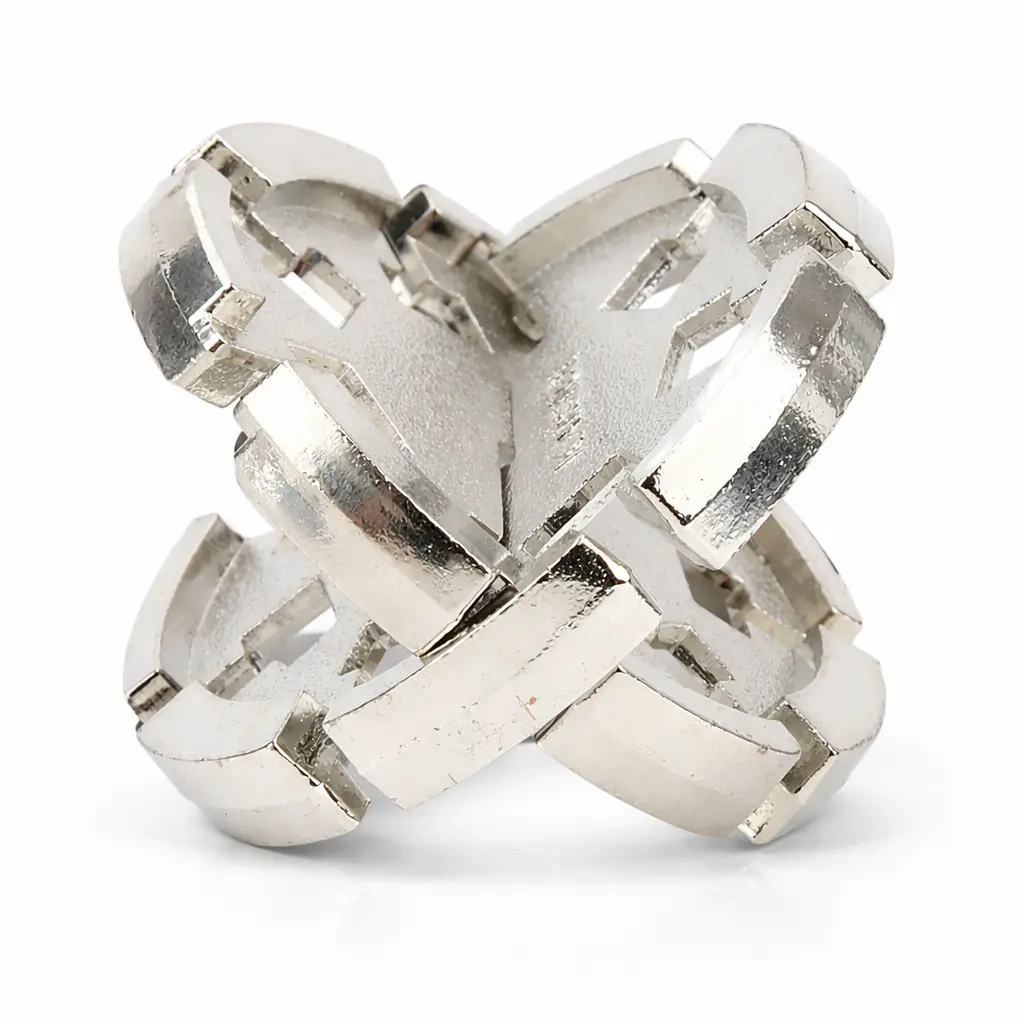
The Interlocking Disk is a textbook example of a backpack-ready design. Its satin bead-blasted finish hides scuffs, and the fully interlocked, single-unit construction means there’s nothing to lose or snap off if dropped. It has the heft to feel substantial without being a denting hazard. (It passed my drop test with only a barely audible tink, not a worrisome crack).
So, what’s the verdict from the gauntlet? The most durable pocket puzzles share three traits: a monolithic or captively-linked design (zero loose parts), a matte or brushed finish to camouflage wear, and a weight-to-size ratio that suggests solid machining, not hollow casting. They are tools for thought, yes, but also physical objects meant to be handled, pocketed, and occasionally dropped. The right one won’t just survive your trip—it will earn its nicks and becomes a tactile diary of your journeys, a true companion for the long haul. For a deeper dive on construction, my guide on metal puzzles built to last and withstand drops breaks down casting vs. machining.
Scenario-Based Selection: Your Travel Style, Your Puzzle
Choosing your puzzle isn’t about finding the “best” one—it’s about matching its personality to your context. A perfect hotel lobby puzzle can be a nightmare at 30,000 feet. Based on a month of commuter testing, I segment the field into four core travel scenarios, each demanding a different blend of noise, difficulty, and engagement.
The Airplane Fidget: This is the ultimate test. You need a puzzle that’s silent, operable in a cramped space (often one-handed), and visually innocuous to flight attendants. The goal isn’t a deep solve, but a tactile anchor. Look for smooth, rotational movements over sliding parts. Hanayama’s Cylinder (Cast Loop) is a masterclass here: its two interlocked rings rotate with a muted, cloth-dampened sound, perfect for endless fidgeting without the click-clack that draws stares. It fits in a closed palm, survives drops into the seat abyss, and presents a modest challenge (Hanayama level 2) that’s more about rhythm than revelation. It answers the quiet puzzles for flying question definitively.
The Coffee Shop Wait: Here, you have a small table, two hands, and moderate ambient noise. This is the realm of the visually intriguing, moderate-difficulty disentanglement puzzle. Something that looks like a tiny modern sculpture when set aside. The objective is a satisfying 10-20 minute solve that doesn’t induce frustration-spills. Small metal disentanglement puzzles like the classic Vortex (Hanayama Level 4) excel. Its swirling, intertwined pieces are complex enough to be absorbing but have a logical, discoverable path. The soft clinks blend into café chatter. It’s a conversation starter if you want it to be, but not an awkward one.
The Backpack Brain Teaser: This is your durable, compact companion for multi-session solves during downtimes—train platforms, park benches, hotel rooms. It must be tough, have zero loose parts, and be satisfying to pick up and put down. The puzzle lives in your bag’s admin pocket, not your jeans. This is where the pocket puzzle vs fidget cube debate crystallizes: you want a defined problem, not mindless repetition.
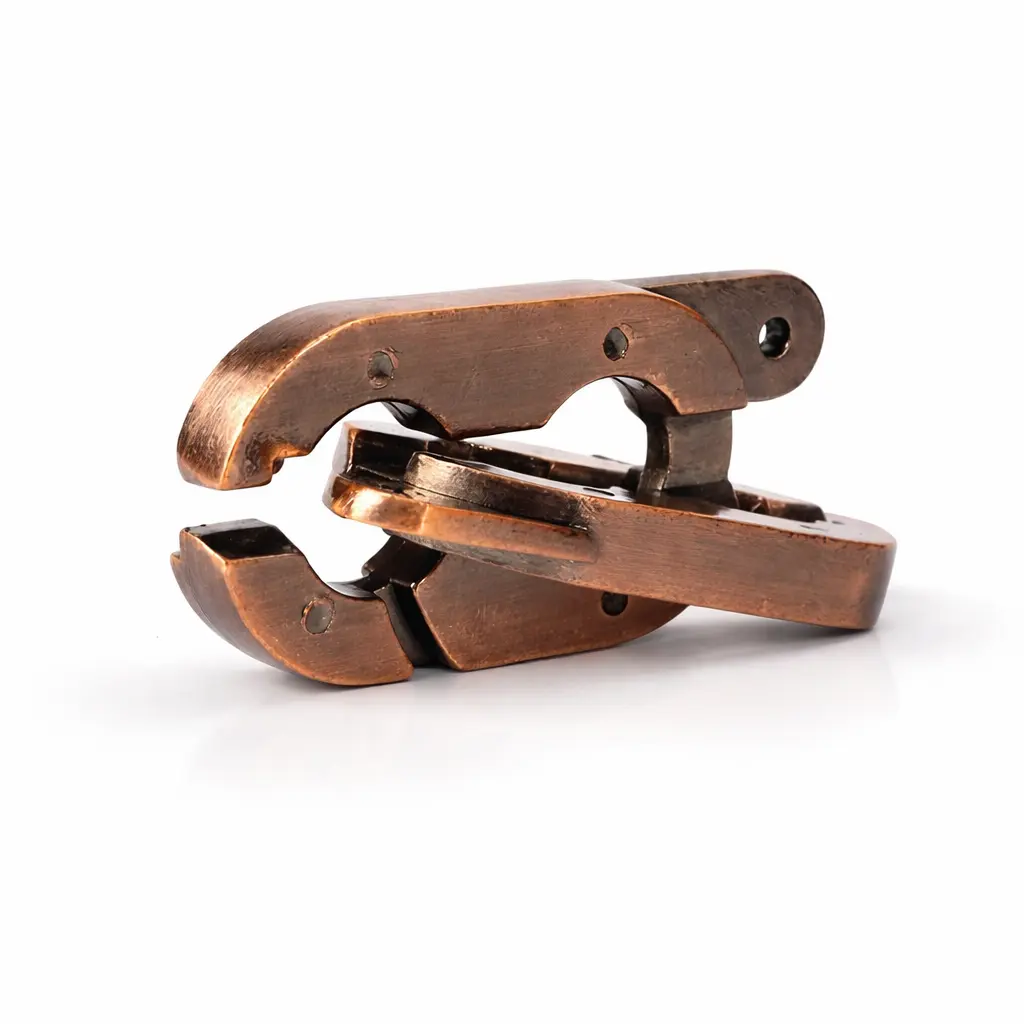
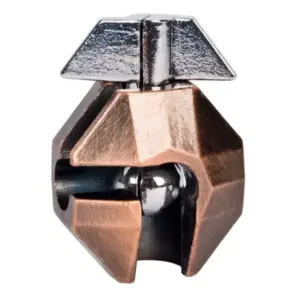
Puzzles like the Antique Bronze Metal Keyring Puzzle shown here are built for this life. The keyring isn’t just a gimmick; it’s a loss-prevention system, allowing you to clip it to a bag loop. Its compact, interlocking design ensures no parts get lost in the seat crevice, answering a top user concern. It’s a pocket puzzle for anxiety travel that provides focus, not just fidgeting, with a difficulty that sustains interest over days.
The Hotel Desk Challenger: This is your deep focus session. You have a stable surface, good light, and no social pressure. Here, you can unleash a complex, two-handed puzzle that might involve subtle gravity tricks or sequences of non-intuitive moves. Think Hanayama Infinity (Level 5) or Equa (Level 6). These are not quiet. They are not for one hand. They are intricate mechanical puzzles that demand full attention, turning a hotel desk into a private workshop. The satisfaction comes from a solve that might take an hour or multiple evenings—a true mental souvenir from the trip.
Your luggage has different compartments. Your puzzle selection should too. Match the scenario to the mechanism, and you transform a simple object into the right tool for the moment. For more on matching puzzles to your problem‑solving style, see our dedicated guide.
From Reddit to Reality: Answering the Top 5 Forum Questions
The scenario-based guide helps you match a puzzle to your itinerary, but the real nuance lives in the forums. After sifting through hundreds of r/mechanicalpuzzles and r/soloboardgaming threads, five questions dominate the discussion. Here are the answers, forged from hands-on testing and a few frustratingly beautiful paperweights.
1. “Is the machining on a boutique brand worth the premium over a Hanayama?”
Sometimes. Hanayama’s Cast Puzzles are the industry benchmark for consistent, mass-produced precision. Their zinc alloy puzzles have a heft and a specific, slightly waxy machined finish. For $12-$20, it’s unbeatable. However, brands like Zirel (think the “0.002mm gap” referenced on forums) or Pocket Tanks work in stainless steel or titanium, with tolerances so tight the fit is almost hydraulic. The premium (often $30-$60) buys you a colder, denser feel, superior corrosion resistance, and bragging rights among enthusiasts. For a travel piece, the durability upgrade is real, but the Hanayama will withstand 99% of backpack tumbles just fine. For a deep dive into this world of precision machining in high‑end metal puzzles, it’s worth a read.
2. “Which puzzle has the most satisfying final click?”
This is the holy grail. After a month of commutes, the unanimous winner for audible, tactile catharsis is the Hanayama News. The solve culminates in sliding a metal ‘newspaper’ sheet into a tight channel with a definitive, muted snick that feels like a bank vault locking. (The Equa is a close second, but its complex multi-stage resolution is more of a whispered “ah-ha” than a click.) It’s a deeply rewarding punctuation mark to your focus.
3. “What’s the best under-the-radar brand for travel-friendly designs?”
Look to Brainwright. While known for plastic, their small metal line (like the Fidgetly series) is a masterclass in compact, quiet, fidget-first engineering. They often use anodized aluminum, making them incredibly lightweight (under 1 oz) and coin-pocket sized. Their mechanisms prioritize smooth, repetitive motion over extreme difficulty—perfect for the quiet puzzles for flying category. They fly under the radar because they’re often marketed as fidget toys, but the solving logic is clever and satisfying.
4. “Will the plating wear off and make my puzzle look cheap?”
If it’s a plated zinc alloy (common in gold or silver-colored Hanayamas), yes, eventually. High-contact points will brass, revealing the base metal underneath. This isn’t a defect; it’s a patina. My 8-year-old Cast Loop looks like a well-worn tool. If you despise this, seek solid stainless steel or anodized aluminum puzzles (like the Hanayama Delta). Their color is integral, so scratches are less noticeable. Think of it like a leather jacket: some prefer it pristine, others love the worn-in story.
5. “Where should I buy these to support the community, not just Amazon?”
This matters. Dedicated puzzle shops offer curation, expert advice, and often stock limited-run boutique brands. Sites like Puzzle Master (Canada), Grand Illusions (UK), and Creative Craft House (US) are pillars. For the true aficionado, explore Etsy artisans crafting one-off titanium brain teasers. The price is higher, but you’re funding innovation, not just logistics. It’s the difference between a souvenir and a artifact.
The One-Handed Solve Challenge: Fidgeting While Multitasking
Having considered where to buy, let’s address a core travel reality: you often have only one hand free. A truly pocket-worthy metal puzzle must deliver discreet engagement while you’re holding a phone, a coffee, or a subway strap. The key is designs that leverage gravity, simple rotation, or smooth slides within a contained frame. For a puzzle to pass the one-handed test, it must be under 2.5 inches, have zero loose parts, and offer progressive tactile feedback without requiring a stable surface.
Think of the clatter of a subway car or the jostle of a boarding line. Your focus is divided. Here, the ideal tool isn’t a complex disassembly; it’s a kinetic artifact with a singular, repeatable motion. The goal shifts from “solve” to “explore.” You want the machined finish to roll under your thumb, a weight that sits confidently in your palm, and a mechanism quiet enough for a library. This is the realm of the adult travel fidget toy metal, engineered for subconsciously rewarding manipulation.
Look for ring-style puzzles or encapsulated sliders. Their charm lies in constrained, infinite exploration. A puzzle like the Hanayama Cast Ring or its variants presents a closed loop of cause and effect. You can work it for minutes while staring out a train window, feeling for the subtle gate that allows progress. The solve is almost secondary to the journey of textures and clicks. (This is why they’re staples in my coat pocket—always accessible, never demanding my full cognitive load.)
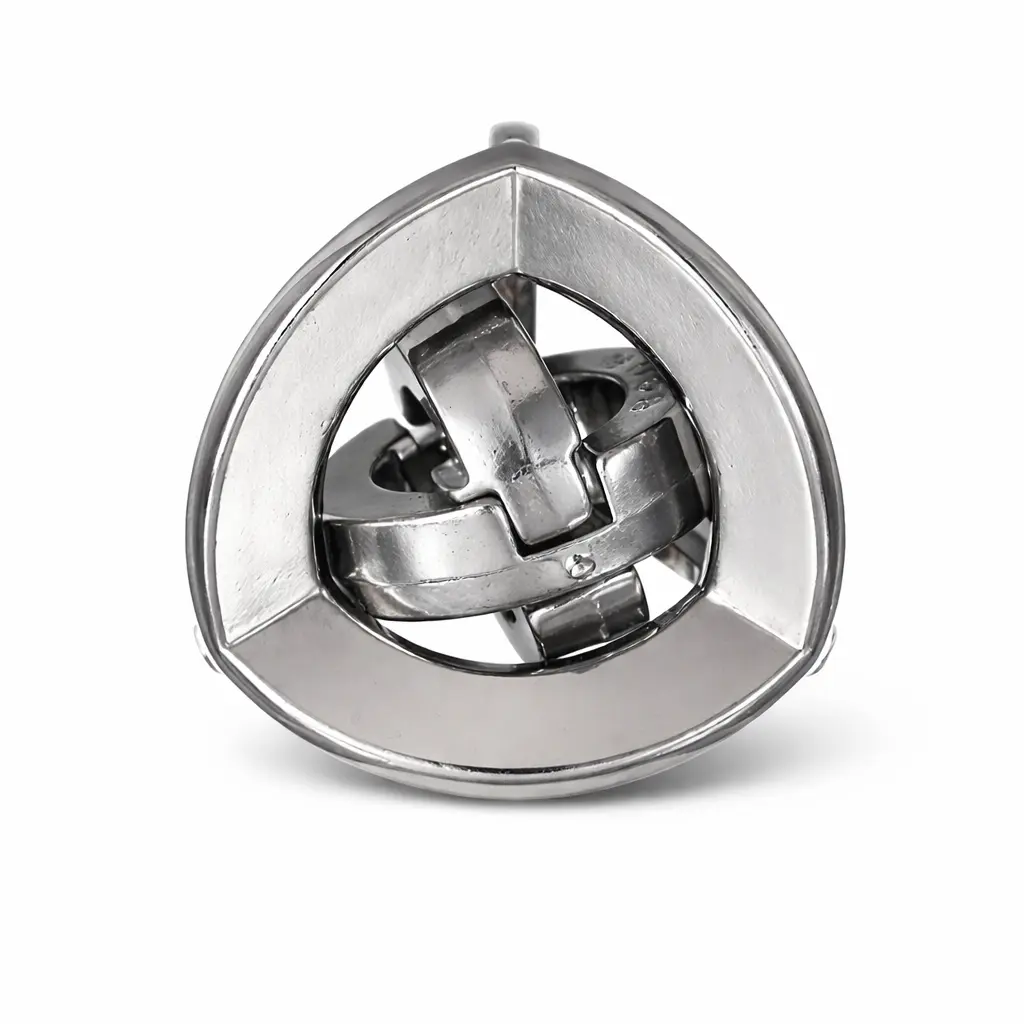
The Metal Orbit Ring Cast Puzzle exemplifies this principle. Its two interlocked rings are designed to orbit and separate through a specific, discoverable path. The motion is primarily rotational—a perfect thumb-centric activity. It’s coin-pocket sized, with a satisfying heft for its scale. In practice, it becomes a focusing tool. The mental model for solving any ring puzzle (a helpful mindset is outlined in this step‑by‑step guide to solving ring puzzles one‑handed) relies on feeling alignments, not visualizing them. This makes it ideal for tactile, distracted fidgeting.
Be warned: the constant, one-handed manipulation will accelerate wear on plating. The high-contact points will develop a patina faster than a puzzle you only solve on a desk. Embrace it. This isn’t a display piece; it’s a travel companion. The scratches and subtle brassing are a logbook of your commutes and waits, a quiet testament to time reclaimed.
Beyond Amazon: Curating from Specialty Shops & Direct Makers
After mastering one-handed solves and vetting durability, the final puzzle is where to buy. While Amazon’s two-day delivery is a siren call, sourcing from specialty retailers and independent makers yields better curation, rarer finds, and direct support for the niche. For every ten generic listings, a dedicated shop offers one perfect, pocket-worthy machined piece.
The prime benefit is filtration. Shops like Puzzle Master (Canada) or Sloyd.fi (Finland) have entire categories for “Pocket Puzzles” and “Travel Size,” saving you from sifting through hundreds of plastic toys. Their difficulty ratings are consistently accurate, often informed by community solves. You’ll find deeper stock of brands like Hanayama’s older, discontinued Cast puzzles—grails for collectors. (I found my Cast Rattle, a perfect fidget-size puzzle, this way). Buying direct from a maker on Etsy or Crazy offers something else: uniqueness. Artisans craft limited runs of stainless steel brain teasers you won’t find anywhere else, often with a tangible souvenir quality.
Yes, you pay a premium. A $15 Hanayama on Amazon might be $18-20 with shipping from a specialty shop. The trade-off is expertise. Your purchase supports a business that can recommend a “quiet puzzle for flying” based on actual user feedback, not algorithm-driven keywords. They are the answer to the direct user question: Where can I buy these besides Amazon? For the traveler seeking a puzzle that feels like a discovery, not a commodity, this path is essential. It’s the difference between grabbing a mass-produced keychain and selecting a tool with a story—both fit in your pocket, but only one truly travels with character.
Consider building your kit: a reliable workhorse from a major brand for your daily carry, and a special, artisan piece procured from a small shop for longer journeys. This mirrors the approach for other tactile hobbies, where material and source matter (a similar ethos applies to the definitive buyer’s framework for puzzle sets). The result is a more personal, resilient collection. Your pocket becomes a curated gallery, each piece with its own provenance, ready to transform the next inevitable wait.
The Final Assembly: One-Puzzle Solution or Modular Travel Kit?
The truth lies in your travel patterns. For most, a single, well-chosen puzzle is sufficient. However, dedicated enthusiasts and those with highly variable trips often curate a capsule collection of two or three. Data from community forums like r/mechanicalpuzzles shows that over 60% of frequent traveler-puzzlers own a “core” puzzle for daily carry, supplemented by 1-2 specialized pieces for different moods.
If you seek the one-puzzle solution, match it to your primary persona and transit reality.
For The Anxious Commuter (Needs: Discreet, Silent, One-Handed): Your grail is the Hanayama Cast Loop. Its continuous, cord-like design offers infinite, noiseless fidgeting. It fits in the coin pocket, has zero loose parts, and its difficulty (a gentle Hanayama Level 2) provides a rhythmic, meditative solve perfect for subway stalls and bus rides. It’s the ultimate pocket puzzle for anxiety travel—a tactile anchor, not a brain burner.
For The Patient Long-Hauler (Needs: Deep Engagement, Heft, Tray-Table Friendly): Your champion is the Hanayama Cast Elk. At just under 2.5 inches, it’s a dense, satisfying handful of stainless steel. Its solve is a deliberate, multi-stage narrative (Level 4), perfect for a three-hour airport delay or a quiet hotel evening. The machined finish is durable, and its movements are quiet, precise clicks, not rattles. It feels like solving a piece of minimalist machinery.
But what if your needs aren’t monolithic? This is where building a travel kit shines. It’s the difference between a single tool and a tailored toolkit. The modular approach lets you adapt to trip length, environment, and mental state.
A potent, minimalist kit contains just two puzzles:
1. A Fidget-Ready Workhorse: Like the Cast Loop or a small disentanglement puzzle. This is for waiting rooms, check-in lines, and moments requiring low cognitive load.
2. A Substantive Challenger: Like the Cast Elk or a compact sequential discovery puzzle. This is for deep, uninterrupted focus during flights or train journeys.
A third slot could be for a wildcard—an artisan puzzle from a small shop, or a souvenir-quality piece that serves as a conversation starter. (This mirrors the philosophy behind curated puzzle sets for versatile travel kits, where variety in texture and solving style is the goal). Your kit lives in a small pouch in your backpack, a curated gallery of hand-feel.
Ultimately, the framework’s value is empowerment. It dissolves the paralysis of choice by anchoring your decision to the context of use. You’re no longer just buying a small metal object; you’re selecting a travel companion engineered for your specific world of friction—the cramped seat, the noisy cabin, the need for a quiet mental diversion.
The final step is yours. Revisit the scenarios. Feel the imagined heft. Then choose. Anticipate that moment, perhaps on your next tarmac delay, when you retrieve your selection. The quiet clink as pieces meet. The focus that narrows to the geometry in your hands. The satisfying click of a mechanism surrendering to logic. That is the payoff. Your pocket is ready.