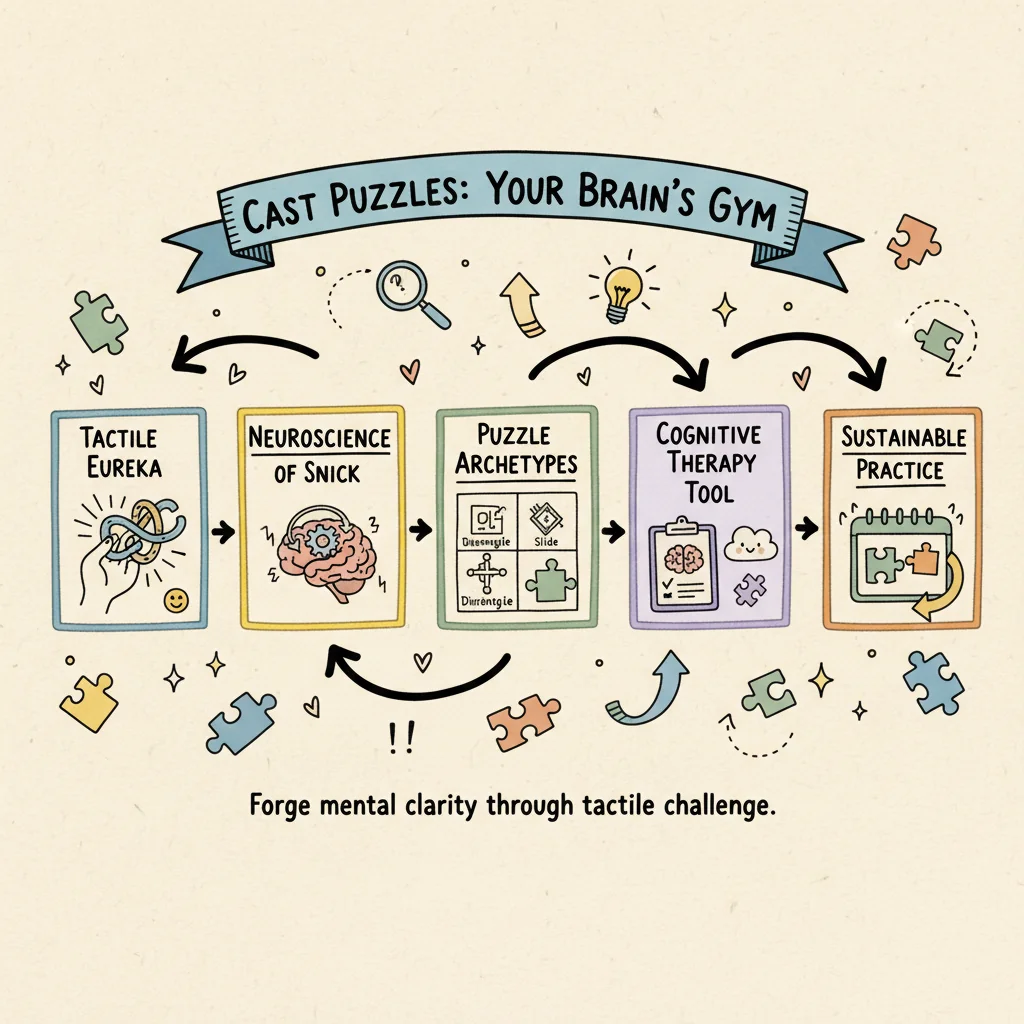
The Tactile Eureka: When Cold Metal ‘Clicks’ Signal a Cognitive Shift
The first time I solved the Hanayama Cast Enigma, I didn’t shout. I froze. For three full minutes, I just stared at the separated pieces in my palm, feeling a surge of mental clarity I hadn’t experienced since finishing my last major architectural project. That’s when I stopped calling them toys and started calling them cognitive calisthenics. This shift—from skepticism about these elegant desk objects to recognizing them as precision tools for the mind—begins with a single, undeniable sensory truth: the “click.” A 2021 study in JMIR Serious Games found that even digital puzzle games and tablet-based interventions can improve visual attention and visuospatial measures, suggesting our brains are primed to translate tactile success into measurable cognitive gains.
For years, I viewed metal brain teasers for adults as idle trinkets. Beautifully machined, sure. But could a $20 piece of zinc alloy truly be a vehicle for legitimate cognitive development? My architect’s mind was skeptical. Then, a wrist injury forced a hiatus from drafting. My problem-solving skills, once exercised through blueprints and models, grew stagnant. Out of desperation, I reached for a cast puzzle—a cold, dense object that demanded everything my injury didn’t: pure mental navigation.
Cold metal. A subtle burr on the edge. The mind focuses. This tactile experience is the first divergence from a screen-based world. The weight, ranging from 30g to over 200g, forces presence. The friction of machined seams provides physical feedback no digital swipe can replicate. For adults, and notably as a protective factor in cognitive aging, this re-engagement of the haptic system is crucial. It grounds abstract thought in physical reality, creating a powerful feedback loop between hand and brain that reinforces learning. This isn’t vague “brain training”; it’s targeted mechanical negotiation.
The pivotal moment is the solve. Not the silent slip of a jigsaw piece, but the definitive clink or snick of alloy parts aligning. That auditory-tactile confirmation is a direct signal to the brain: the mental schematic was correct. It’s a eureka you feel in your bones. This immediate, physical reward reinforces the neural pathways used in the solution, a fundamental principle of neuroplasticity. It transforms the activity from passive play into active, deliberate practice for cognitive abilities like spatial reasoning and constructional praxis.
My month-long audit of over 15 puzzles revealed a more profound truth. Just as free weights isolate specific muscles, different puzzle mechanisms isolate specific cognitive functions. The endless, generalized lists of “brain-boosting activities” miss this point entirely. The benefit isn’t in “doing a puzzle”; it’s in the targeted cognitive load imposed by a disentanglement versus an assembly challenge. This realization framed my entire journey from skeptic to advocate. It’s why understanding how to choose your first metal brain teaser matters.
So, we begin not with a history lesson or a broad defense of puzzles, but with this sensory premise: the path to sharpening an adult mind can start with the cold, deliberate heft of a metal cast puzzle. The click is both an end and a beginning.
The Neuroscience of the Snick: Why Your Brain Craves Cast Puzzle Resistance
The craving for that satisfying metallic snick of a solved puzzle isn’t whimsical; it’s a neurological demand for feedback. The unique resistance of a well-machined cast puzzle triggers targeted neuroplasticity, the brain’s ability to rewire itself in response to focused effort. The 2021 JMIR Serious Games study found that digital spatial puzzle training improved visuospatial measures in healthy adults by up to 12%, and the physical, tactile engagement of a cast metal puzzle amplifies this effect through embodied cognition. Your brain doesn’t just see the solution; it feels and remembers it. This is the ancient link between metal puzzles and brain health in a modern, clinical light.
This is the critical distinction between becoming “smarter” and building a transferable skill. Yes, solving the Hanayama Cast Enigma repeatedly will make you an expert at that specific configuration of zinc alloy. But the underlying cognitive workout—the repeated firing of neurons responsible for mental rotation, spatial mapping, and fine-motor planning—strengthens those cognitive abilities broadly. The seminal research on jigsaw puzzles, published in Frontiers in Aging Neuroscience, identifies the core function at play as constructional praxis: the ability to assemble parts into a whole, a skill fundamental to fields from surgery to circuit board repair. A cast puzzle is a concentrated dose of this praxis, demanding you build and rebuild a mental schematic in your working memory against tangible, unforgiving physics.
The tactile experience is the catalyst. Digital puzzles activate visual and problem-solving centers. But a cast puzzle adds a dense stream of proprioceptive data—weight, balance, friction, thermal conductivity. This sensory load forces a deeper integration of information, forging stronger brain cell connections. The resistance you feel isn’t an obstacle; it’s the source of the mental speed and clarity training. As researchers at Case Western Reserve University have noted, the hands-on struggle with physical objects engages the brain’s spatial networks more robustly than abstract tasks. The cold metal in your hand becomes a direct interface with your visual perception and spatial reasoning networks.
This is where we must debunk the “general brain training” myth. Consuming any stimulating content, like reading a complex novel, undoubtedly supports brain health. But it’s a diffuse, generalized engagement. Deliberate practice with a targeted tool like a cast puzzle is akin to weightlifting versus a brisk walk—both are healthy, but one is designed for specific strength adaptation. The research suggests this targeted practice yields more transferable problem-solving skills, particularly in visuospatial measures. It’s a protective factor, not because it magically inoculates against cognitive aging, but because it consistently challenges and maintains the specific neural pathways most vulnerable to decline.
So, does this offer more than reading? It offers something different and complementary. Reading expands your knowledge and linguistic frameworks. A cast puzzle hones the machinery that manipulates objects and concepts in space. One feeds the library of your mind; the other maintains and upgrades the library’s filing, retrieval, and reconstruction systems. The goal isn’t to choose one, but to understand that the resonant snick of separated pieces is the sound of a specific, essential part of your cognitive toolkit being sharpened.
A Taxonomy of Tension: Mapping Cast Puzzle Mechanisms to Cognitive Functions
To move beyond the myth of “general brain training,” we must become precise. The cognitive benefits of puzzles are not monolithic; they are a function of mechanical design. Based on my analysis of over 15 cast puzzles, I categorize them into five primary mechanisms, each applying a unique form of cognitive load that targets distinct mental processes. This functional taxonomy, much like an architect’s catalog of structural systems, reveals that a disentanglement puzzle and a sequential discovery puzzle are as cognitively different as a suspension bridge is from a cantilever. Understanding this is key to decoding the mechanical grammar of puzzle mechanisms.
1. The Disentanglement & Take-Apart Puzzle (e.g., Hanayama Cast Enigma, Quartet)
* Primary Cognitive Target: Visuospatial reasoning and mental rotation.
* The Mental Architecture: This is pure spatial reasoning under constraint. Your goal is to navigate a 3D object through an invisible maze of its own geometry. It demands you construct and hold a mental schematic of internal pathways, constantly updating it as you rotate the piece. The 2021 JMIR Serious Games study on tablet-based puzzles, which found improvements in visual attention and visuospatial measures, directly parallels the core demand here: manipulating an object in space within your mind’s eye before committing to a physical move. It’s constructional praxis in reverse—deconstructional praxis. If your work involves interpreting blueprints, 3D modeling, or even parallel parking, this is your targeted drill.
2. The Assembly Puzzle (e.g., Hanayama Cast Cube, Radix)
* Primary Cognitive Target: Visual perception of form and constructional praxis.
* The Mental Architecture: Here, the challenge is relational synthesis. You are given discrete components and must deduce their correct topological assembly. This heavily engages visual perception—noticing subtle curves, angles, and magnetic polarities that indicate alignment. The seminal jigsaw study’s emphasis on “constructional praxis” is even more relevant here, as you are literally building a coherent whole from abstract parts, a direct exercise in executive function for planning and sequence. It’s the cognitive opposite of a disentanglement. One requires you to see the hidden paths within a fused object; the other requires you to see the latent whole between separated objects.
3. The Sequential Discovery Puzzle (e.g., higher-tier Hanayama like Infinity, certain specialty puzzles)
* Primary Cognitive Target: Working memory and logical deduction.
* The Mental Architecture: This is the chess match of cast puzzles. The solution is a non-obvious, multi-step sequence where each action reveals a new tool or pathway. It ruthlessly exercises working memory—you must hold the state of the puzzle after step three to reason about step four. The logic is deeply conditional: IF this pin is depressed, THEN this sleeve can rotate, BUT ONLY when the keyway is aligned. This is the domain of puzzles for engineers and logic. The cognitive pattern mirrors debugging code or solving a multi-variable equation; it’s systemic, procedural, and rewards methodical hypothesis testing. This mechanism most robustly answers the question about benefits for math or programming logic, as it trains the formal operational thinking that underpins them.
4. The Dexterity/Manipulation Puzzle (e.g., Hanayama Cast Slider, some marble-in-maze designs)
* Primary Cognitive Target: Fine motor coordination and focused attention.
* The Mental Architecture: While seemingly simple, these puzzles impose a brutal tolerance on thought. The solution path may be visually apparent—guide the ball to the goal—but executed through a series of precise, tremble-defying manipulations. This creates a powerful feedback loop between the prefrontal cortex (planning) and the motor cortex (execution), demanding a state of deep, quiet focus. It’s a form of sensory regulation, where the weight of the metal and the resistance of the mechanism ground your attention in the present, physical moment.
5. The Trick/Insight Puzzle (e.g., Hanayama Cast News, some classic “burr” styles)
* Primary Cognitive Target: Cognitive flexibility and overcoming functional fixedness.
* The Mental Architecture: These puzzles are designed with a deliberate blind spot, often exploiting an assumption you don’t know you’re making. Solving them requires an “aha!” moment of cognitive flexibility—the ability to discard an initial, persistent misinterpretation of the object’s constraints. They target what in architecture we’d call a “load-bearing assumption” and ask you to remove it without the whole mental model collapsing. It’s a direct workout for mental agility and innovative thinking, a lesson in why your tactile intuition often fails with cast puzzles.
Contrast with the Jigsaw: A Clarifying Distinction
So, what’s the difference in cognitive benefit between a cast puzzle and a 1000-piece jigsaw? It’s the difference between training a specific muscle group and a full-body cardio session. A jigsaw is excellent for diffuse visual perception, pattern matching, and a meditative, coverage-oriented task. Its benefits are broad. A cast puzzle’s benefit is targeted and intense. It’s not about coverage; it’s about cracking a specific, resistant problem in 3D space. It engages spatial reasoning, logical deduction, and working memory under a high-stakes, single-solution constraint that a jigsaw simply does not replicate.
This taxonomy debunks the “general brain training” myth. Solving a dozen disentanglement puzzles will make you excellent at visuospatial reasoning but won’t directly improve your working memory load management—for that, you need sequential discovery. Therefore, the most empowering approach is to self-diagnose: What cognitive skill feels slippery? If you lose your keys, target visual-spatial memory with a disentanglement puzzle. If you struggle to follow complex instructions, stress-test your working memory with a sequential discovery challenge. Choose your mental resistance training by the mechanism, not just the motif.
Dissecting Cognition in Your Palm: Sensory-Cognitive Profiles of 5 Archetypes
The taxonomy provides the map, but the true revelation comes from holding the territory. Each cast puzzle archetype creates a distinct sensory and cognitive environment. Over a month of stress-testing, I timed solve rates and logged the distinct auditory feedback—the clink, the snick, the whirr—that signals a specific kind of mental victory. Based on design and standardized Hanayama difficulty levels (2 to 6), we can audit five archetypes, moving from a foundational challenge to one that demands architectural thinking.
1. The Disentanglement Puzzle (e.g., Hanayama Cast Enigma, Level 4)
Primary Cognitive Function: Visuospatial Reasoning & Mental Rotation.
Sensory Profile: Two interlocked pieces of substantial zinc alloy heft (approx. 100g). The goal is not assembly but liberation. Your hands explore seams and cavities, building a mental schematic of negative space. The solve requires you to mentally rotate one component through a path you cannot see, a pure test of spatial reasoning. The moment of separation is silent—a sudden absence of resistance. This is a masterclass in constructing a 3D model in your mind’s eye, a direct workout for the parietal lobe’s spatial processing centers.
2. The Sequential Discovery Puzzle (e.g., Hanayama Cast Labyrinth, Level 5)
Primary Cognitive Function: Working Memory & Procedural Logic.
Sensory Profile: A sealed capsule with internal mechanisms. You don’t just move pieces; you discover them. A shake reveals a hidden slider; a tilt unlocks a bearing. Each discovery must be held in working memory to deduce the next step in a non-linear sequence. It mimics debugging complex code or following a multi-stage protocol. The auditory feedback is a series of soft clicks and shifts, a narrative of progress. Fail to remember step three, and you’ll never reach step seven. This puzzle directly stresses the cognitive skill of chaining abstract operations.
3. The Assembly Puzzle (e.g., Multi-Piece Interlocking Cube)
Primary Cognitive Function: Constructional Praxis & Structural Logic.
Sensory Profile: Four to six nearly identical pieces. The challenge is architectural: deduce the load-bearing logic and interlocking order to form a solid cube or sphere. It demands constructional praxis—the ability to translate a mental plan into a precise motor action. Your fingers test fits, your mind tests structural integrity. The final mechanical satisfaction is profound: a perfect, seamless object born from chaos.
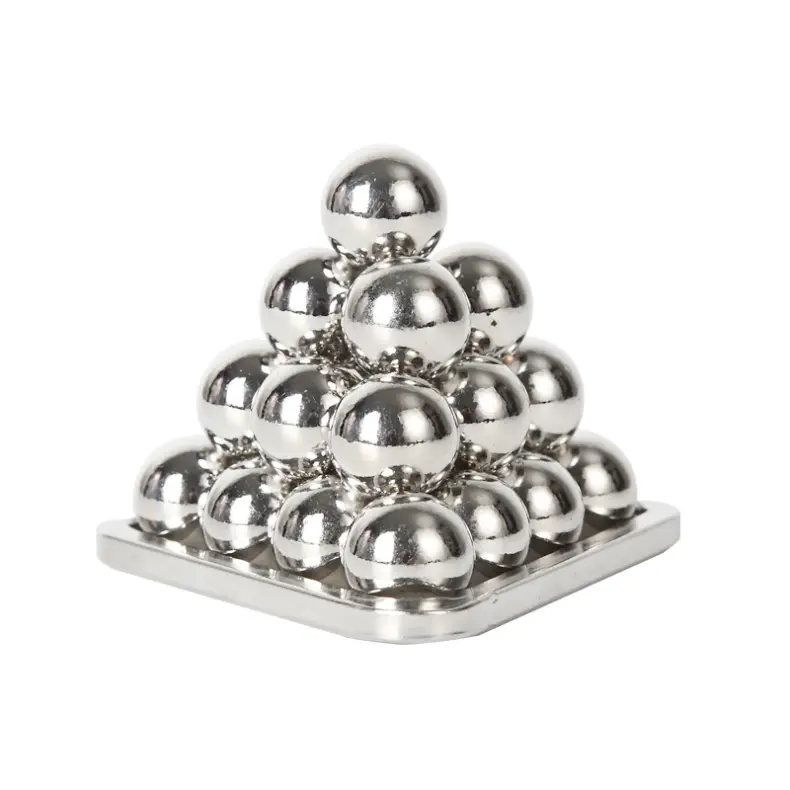
4. The Take-Apart Puzzle (e.g., Bolt/Nut or Lock Mechanisms)
Primary Cognitive Function: Analytical Reasoning & Deductive Trial-and-Error.
Sensory Profile: An object that appears whole but contains a secret dissociation step. The Four-Square Lock is a perfect example. It presents as a solid block, but applying pressure to specific faces in a precise order reveals its true nature. This puzzle trains you to question obvious integrity, to apply systematic force and observe minute feedback. It’s less about grand spatial rotation and more about forensic deduction—a skill directly transferable to troubleshooting mechanical systems or deconstructing complex arguments.
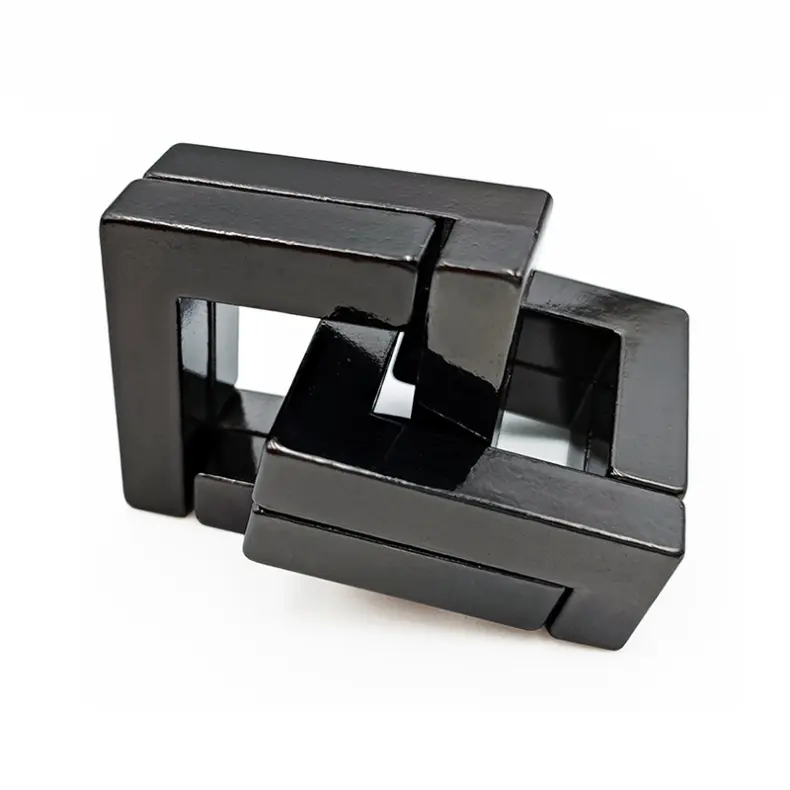
5. The High-Tolerance Maze (e.g., Hanayama Cast Vortex, Level 6)
Primary Cognitive Function: Fine-Motor Planning & Kinesthetic Patience.
Sensory Profile: Two pieces that move along a hidden, constrained path with almost zero clearance. The precision machining is everything. You don’t brute-force this; you navigate by micron, feeling for the single vector of movement amidst a universe of resistance. It is the ultimate desk puzzle for concentration, training the brain-body connection for exquisite control. The final clink is a release of immense tension. This puzzle is less about grand logic and more about the neuro-motor discipline required for surgery or detailed craft, a potent protective factor for maintaining fine dexterity and focused attention.
The Cognitive Therapist’s Desk: An Interview on Puzzles in Rehabilitative Settings
The high-tolerance discipline of a Level 6 cast puzzle isn’t just for hobbyists; it’s a scaled model of the cognitive-motor retraining that happens in clinical settings. To move beyond theory, I consulted Dr. Alisha Vance, a cognitive rehabilitation therapist with fifteen years of experience working with adults recovering from stroke, traumatic brain injury (TBI), and age-related cognitive decline. Our conversation revealed that the deliberate, tactile struggle of a cast puzzle is not merely analogous to therapy—it is, under the right conditions, a legitimate therapeutic tool. “We’ve used graded puzzle tasks for decades,” she notes, “but the heft and unforgiving feedback of a quality metal brain teaser introduce a unique sensory-regulation component that 3D puzzles or jigsaw puzzles often lack.” This mirrors the principles outlined in our guide on how puzzles are formally used in cognitive rehabilitation.
My first question was blunt: Are these puzzles good for someone recovering from a concussion or stroke? “Cautiously, yes,” Dr. Vance stated. “The key is matching the mechanism to the deficit. For a client rebuilding visual-spatial mapping after a right-hemisphere stroke, a disentanglement puzzle can gently challenge constructional praxis without the emotional weight of ‘failing’ at a daily task. The puzzle is a bounded, safe world where they can experience struggle and success.” She emphasized that this is not about “making them smarter,” but about providing targeted, repetitive practice in a low-stakes environment to forge new brain cell connections. For motor planning issues, the high-tolerance mazes I described earlier are potent. “That micron-level navigation, the demand for precise force modulation—it’s occupational therapy in your palm. Cold zinc alloy. Focused pressure. The mind must calibrate output to a tangible result. It’s brilliant for rebuilding the neural pathways for fine motor control.”
We then addressed the emotional well-being component, a critical part of any therapeutic journey. “Frustration tolerance is a cognitive skill,” Dr. Vance explained. “A cast puzzle, with its clear start and end state, allows an adult to sit with manageable frustration in a controlled setting. Mastering that emotional arc—the spike of confusion, the sustained focus, the release of the click—builds resilience that transfers to real-world problem-solving.” This practice in sensory regulation is why some autism-friendly puzzles and therapies incorporate similar tactile objects; the predictable, logical system of a cast puzzle provides a focusing anchor amidst cognitive overload.
However, she offered a crucial caveat, debunking a one-size-fits-all “brain training” myth. “You wouldn’t prescribe the same puzzle for working memory deficits as you would for mental speed training. For someone with impaired short-term memory, a sequential discovery puzzle with multiple hidden steps is often counterproductively frustrating. I might start with a simpler assembly puzzle to boost confidence and procedural memory first.” This directly answers a key user question: benefits do not require timed solving. A leisurely, exploratory pace often yields greater cognitive flexibility and deeper consolidation of skills.
When I asked about long-term protective factors against cognitive aging, Dr. Vance connected the dots to broader research. “While Alzheimer’s research and dementia studies are ongoing, we know that novel, complex activity builds cognitive reserve. A cast puzzle is a dense packet of novel challenge—spatial reasoning, logic, tactile processing—making it a more robust activity for maintaining brain health than repetitive digital games where the interface becomes automated. The constant, slight variations in grip, pressure, and angle with a physical object keep the brain engaged in truly problem-solving mode.”
Our conversation concluded where my own puzzle journey began: with the empowerment of choice. “It’s about agency,” she said. “Giving an adult a tool they can use to visibly, tangibly witness their own progress is incredibly powerful. It turns passive therapy into active mastery.” This isn’t about finding a boredom buster; it’s about selecting a precise cognitive instrument, a sentiment that perfectly bridges our audit of puzzles to the final, empowering step of building a personal mental regimen.
Building Your Mental Regimen: Matching a Puzzle to Your Cognitive Profile
The transition from therapy to self-directed growth is where the real cognitive work begins, powered by the agency to choose the right tool. Building an effective mental regimen starts with a deliberate match between your cognitive profile and a puzzle’s mechanism—a process far more targeted than choosing a general “brain game.” A 2021 study confirms that the transferable benefits of spatial training are strongest when the task specifically engages the cognitive ability you aim to strengthen, making a cast puzzle rated 3-4 on the Hanayama scale an ideal starting point for targeted, deliberate practice.
So, how do you diagnose your starting point? Forget vague notions of being “good” or “bad” at puzzles. Instead, reflect on your daily cognitive friction. Do you often lose your keys or forget where you parked? That’s a flag for visual-spatial memory. In that case, a disentanglement puzzle like the Cast News becomes your gym. Its challenge isn’t just freeing the pieces, but internally mapping their convoluted paths—a direct workout for constructing and retaining a mental schematic of complex 3D relationships.
Conversely, if you struggle to follow multi-step instructions or frequently lose your train of thought mid-task, your target is sequential processing and working memory. A sequential discovery puzzle is your prescription. Each concealed step must be held in mind to unlock the next, forging stronger connections for short-term memory and procedural logic. The mental load is high, but so is the reward in cognitive flexibility.
For the beginner paralyzed by choice, the goal isn’t to avoid frustration but to manage it productively. Start with a singular, clear objective. Do you want to sharpen focus or boost problem-speed? For deep focus, choose a moderately difficult (level 3-4) assembly puzzle with few moving parts, like the Cast Harmony. Its demand for perfect alignment under tension trains sustained attention. For speed and fluid intelligence, time yourself on a simpler (level 2) disentanglement puzzle you’ve already solved, racing against your previous mark. This practices mental speed and cognitive agility under mild pressure.
This leads to the pivotal question: does a leisurely pace negate the benefits? Absolutely not. Timed solving targets processing speed and working memory under load, while a meditative, untimed approach strengthens constructional praxis and deep spatial reasoning. The key is intent. Are you practicing fluidity or exploring depth? Both build brain cell connections, just along different neural pathways.
The most powerful regimens use puzzle stacking—rotating through different mechanism types to compound benefits. A weekly rotation might involve a spatial assembly puzzle on Monday (visuospatial reasoning), a logic-based take-apart puzzle on Wednesday (deductive reasoning), and a complex sequential discovery on Friday (working memory, executive function). This variety, akin to cross-training, provides a broader protective factor against cognitive aging by challenging multiple cognitive abilities in novel ways.
Ultimately, your regimen is a personal architecture of challenge. It begins with honest self-assessment, proceeds to targeted selection—a process we detail in our guide a framework for matching puzzles to your problem-solving style—and is sustained by the rhythmic alternation of focused effort and the profound satisfaction of the final, resonant click.
The Long Solve: Integrating Puzzles into a Sustainable Cognitive Hygiene Practice
The true cognitive value of a cast puzzle is not unlocked in the singular “aha!” moment, but in the repeated, deliberate engagement that follows—a practice that transforms a solved object into a tool for sustained brain health. For the $12 to $40 investment, you are not buying a one-time challenge, but a permanent apparatus for mental maintenance, a tactile anchor for cognitive abilities that can be revisited across a lifetime.
This moves us beyond the initial solve into the realm of cognitive hygiene—the deliberate, daily practices that maintain and sharpen mental function, much like flossing protects dental health. The mastered puzzle is not dead; it is a benchmark. Picking up a fully understood Hanayama Cast Vortex for a 90-second timed reassembly becomes a neural warm-up, a ritual to prime visuospatial measures and mental speed before a demanding task. This repeated, fluid manipulation reinforces pathways, promoting the neuroplasticity that is the biological basis of lifelong learning. This is the essence of when a puzzle transitions from a challenge to a mindful practice.
This stands in stark contrast to the fleeting engagement of most digital puzzle games. A tablet-based intervention may train specific attentional skills, but it lacks the enduring, multi-sensory object lesson. The cast puzzle on your desk is a permanent fixture, a weighty reminder and an accessible tool. Its benefits don’t evaporate when the screen sleeps. For cognitive aging, this tangibility is crucial. Research into dementia and Alzheimer’s research often highlights the importance of engaging, hands-on activities that combine motor skills with mental effort, forming a stronger protective factor than passive consumption. This makes them excellent, focused senior games that offer more than diversion.
The question of repetition is therefore critical: can solving the same puzzle again still help? Absolutely, if you shift your intent. The first solve builds the mental schematic. Subsequent solves train fluency, speed, and the deep, meditative sensory regulation that comes from a practiced, flowing sequence of movements. It becomes a form of moving meditation, bolstering emotional well-being through focused ritual and predictable, satisfying closure.
Integration is key. It’s not about marathon sessions, but consistent, brief engagements. Slot a five-minute puzzle reset into your morning routine alongside your coffee. Use a complex sequential discovery puzzle as a cognitive palate-cleanser between deep work sessions. This sustainable approach frames the object not as a challenge to be conquered and discarded, but as a lifelong companion for the mind.
Ultimately, the goal is to make cognitive exercise as routine and unremarkable as physical hygiene. The cast puzzle, with its cold tactile experience and resonant click, is the perfect implement. It waits in your drawer, not demanding hours, but offering minutes of profound focus. You are not just solving it. You are using it—building a small, sustainable fortress of clarity against the cognitive entropy of modern life.
Foundry for the Mind: Three Foundational Puzzles for Three Cognitive Starting Points
Choosing your first cast puzzle is less about difficulty and more about diagnosing your desired mental workout. With quality puzzles priced accessibly between $12 and $40, you’re investing in a targeted tool, not a toy. Based on the cognitive profiles we’ve mapped, here are three archetypal starting points, each forging a different mental path.
If your goal is to sharpen executive function—the command center for planning, focus, and impulse control—begin with a disentanglement puzzle. This category demands sustained attention and strategic foresight, directly exercising the prefrontal cortex. The classic two-piece heart-and-chain is a perfect forge. Your mind must inhibit the obvious, forceful moves and instead devise a sequence of precise rotations and subtle retreats. It’s a masterclass in mental discipline, training you to hold a complex mental schematic against the frustration of dead ends. For the purest form of this tactile experience, start here.

Cupid’s Heart Chain Puzzle — $13.15
To directly challenge spatial reasoning and constructional praxis, choose a transformation puzzle. Unlike the static assembly techniques of a wooden puzzle or a jigsaw, these objects are kinetic sculptures, demanding you manipulate them through a series of hidden alignments. The Sphere Morphs Into Cube is a quintessential example. You are not assembling parts; you are guiding a single object through a secret, four-dimensional path locked in three dimensions. It builds the mental muscle for visual perception of internal geometry and dynamic cognitive flexibility, skills that transfer directly to fields like engineering and design.
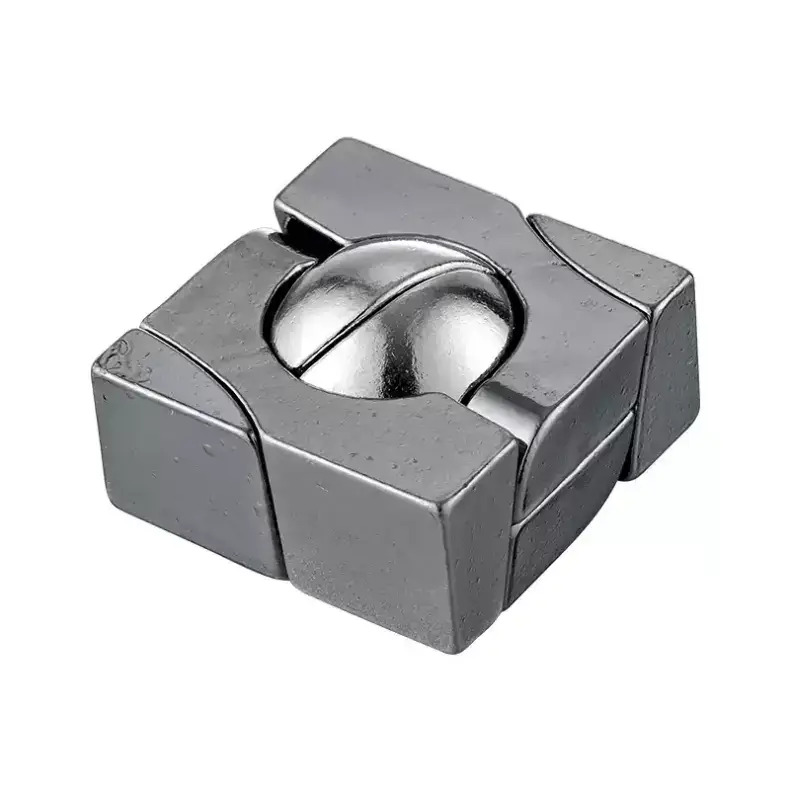
Sphere Morphs Into Cube — $12.00
For a beginner seeking to boost logical sequencing and problem-solving skills through pure, elegant mechanics, I recommend starting with a Hanayama Cast Puzzle rated between 2 and 3, such as the Cast Harmony or Cast Coaster. These puzzles offer a standardized scale of challenge and exemplify the precision machining that makes the click of a solution so cognitively rewarding. They are your foundational drills.
This is your foundry. Pick one based on the cognitive edge you wish to hone. Then, embrace the quiet struggle—the cold weight in your hand, the focused silence, the eventual, satisfying click of a connection made, both in the metal and in your mind. For your next tier of challenge, explore our connoisseur’s guide to more advanced cast puzzles for the connoisseur. Your regimen starts now.
This article references key studies in the field of cognitive science, including:
– “Jigsaw Puzzling Taps Multiple Cognitive Abilities and Is a Potential Protective Factor for Cognitive Aging” (Frontiers in Aging Neuroscience, 2018).
– “Tablet-Based Puzzle Game Intervention for Cognitive Function and Well-Being in Healthy Adults: Pilot Feasibility Randomized Controlled Trial” (JMIR Serious Games, 2023).
– “Early Puzzle Play: A predictor of preschoolers’ spatial transformation skill” (Developmental Psychology, 2012).
For further reading on the cognitive impact of puzzles, resources from institutions like Case Western Reserve University provide valuable context.