That Viral Click: Identifying the Interlocked Metal Knot on Your Screen
It sits in your palm, cool and dense. Two intricate loops of polished metal are hopelessly intertwined—a knot with no string. This isn’t just a toy; it’s a 3D logic problem forged in zinc alloy, weighing a satisfying 1.5 to 2.5 ounces. If your screen recently showed a metallic knot being clicked apart with a triumphant grin, this is almost certainly the object: a modern disentanglement puzzle often sold as the Hanayama Chinese Knot or a metal Luban lock.
Yes, this is the puzzle from that TikTok. It’s also a close cousin to the type of interlocking mechanisms sometimes glimpsed in treasure-hunting films (though Indiana Jones dealt with far more perilous releases). Its point is deceptively simple: take it apart and put it back together. But the real purpose is the journey in between—a purely tactile exercise in spatial reasoning that turns your hands into logic engines.
So, what exactly are you looking at? You’re holding a specific category of mechanical puzzle: an interlocking ring puzzle. Unlike wire puzzles with multiple bent pieces, this object typically consists of just two identical, gracefully looping components. They are machined from a zinc alloy, giving them a substantial, jewelry-like heft. The finish is often a bright silver, gold, or bronze plating. When you shake it gently, there’s no rattle—just the solid, quiet proof of a perfect fit.
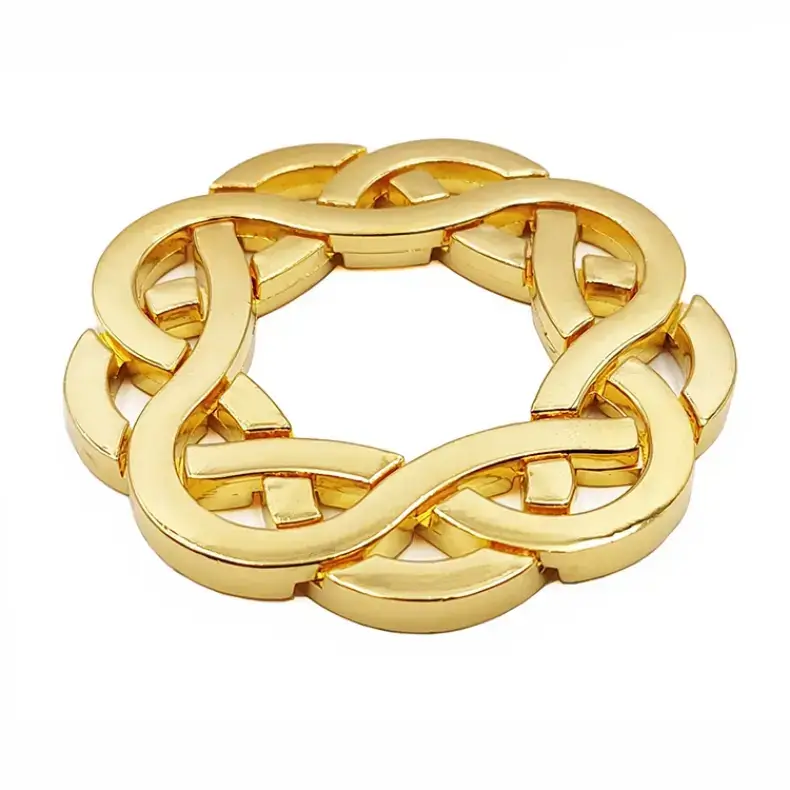
That initial feeling is crucial. A well-made version feels smooth at every seam, with rounded edges that won’t bite your fingers during the long, contemplative twists. A cheap import might feel gritty, light, or have a painted coating that chips. This object, at its best, belongs among the best metal brain teasers not for flashy difficulty, but for its elegant purity. It presents one clear problem with a single, inevitable solution—a solution that culminates in a definitive, metallic click. You’re not just solving a puzzle; you’re operating a miniature, satisfying machine.
(The first instinct is to pull. Then to twist. You’ll try rotating the loops in every plane. It feels impossible, which is exactly where the logic begins. And if yours arrived separated, don’t worry—reassembly is the same sequence in reverse, which is its own delightful shock.) For more on the enduring qualities that make this specific form a classic, explore our article on why the golden Chinese knot metal puzzle endures.
From Silk to Steel: How a Decorative Knot Became a Logic Puzzle
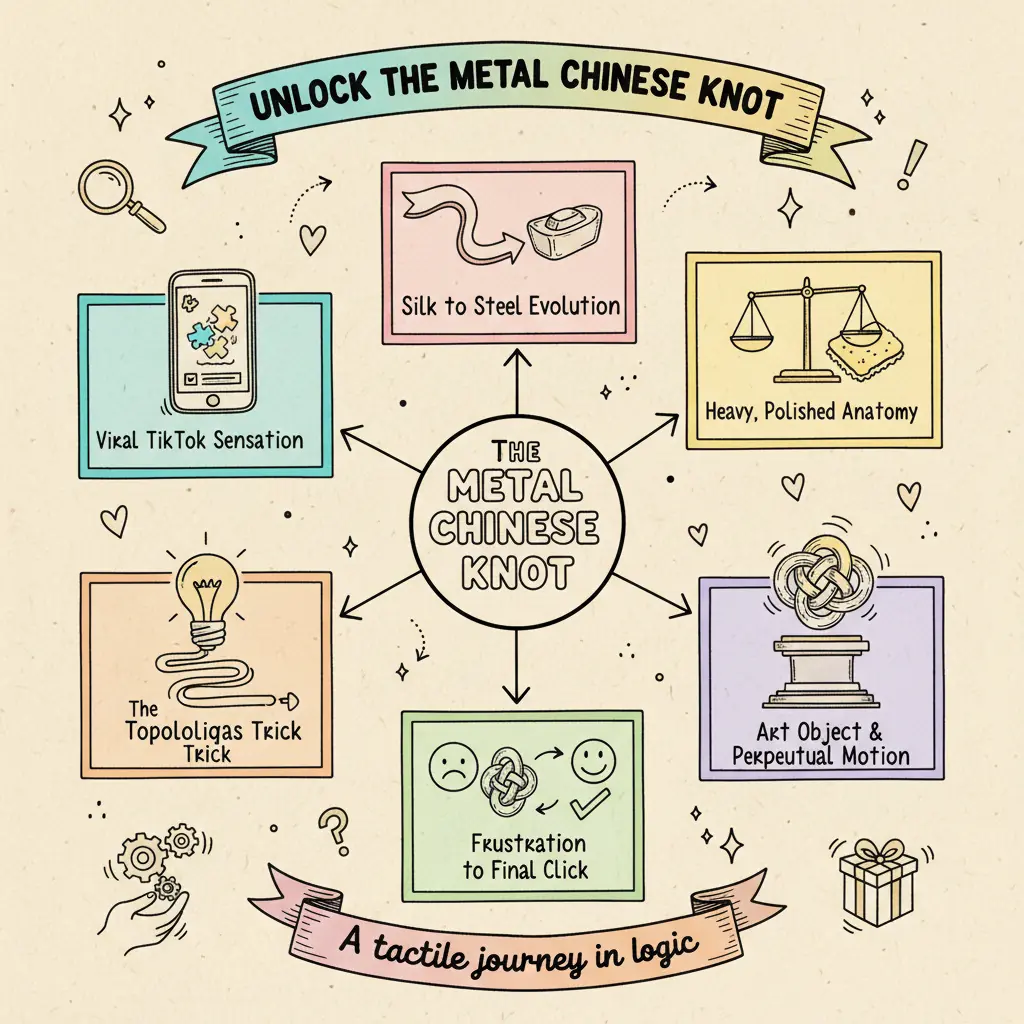
That satisfying click is a modern sound, but the form in your hand is ancient. The metal puzzle is a direct, abstracted evolution of the traditional Chinese “endless knot” (盤長結), a decorative art form dating back over a thousand years. Its transformation from silk symbol to steel logic problem hinges on a single philosophical concept: the representation of eternal, interconnected cycles through a path with no beginning or end.
In Chinese culture, the endless knot is one of the Eight Auspicious Symbols. Unlike a shoelace knot you can untie, its design is a closed loop, its strands weaving over and under in a continuous, repeating path. It symbolizes longevity, eternity, and the interconnected nature of all things—a concept deeply rooted in I Ching and Buddhist philosophy. It’s a visual metaphor for the cyclical patterns of life, fate, and the universe itself. When a craftsman first forged this concept into metal, they performed a remarkable act of translation. They stripped away the color and the flexible material, preserving only the topology—the essential, unbreakable relationships of the loops in space. What was a decorative symbol became a pure question of spatial reasoning.
This is why it’s correctly called a Chinese knot despite having no string. It is the topological skeleton of the ornate silk knot, isolated and hardened. In the world of ancient Chinese puzzles, it finds its family among Luban locks—interlocking assemblies of wood or metal named for the legendary master craftsman Lu Ban. While classic Luban locks are often about separating intricately notched pieces, this puzzle belongs to the disentanglement puzzle sub-genre. Its goal isn’t to build, but to unbind; not to construct a joint, but to discover the latent pathway within a seemingly permanent union.
(The leap from art to puzzle is a story of material and intent. A silk knot hangs static, its meaning conveyed through its form. A metal knot is meant to be handled, its meaning—its solution—revealed only through manipulation. The philosophy is no longer just observed; it is physically enacted and understood in the tendons of your hand.)
This abstraction is the puzzle’s genius. By rendering the endless knot in rigid, unforgiving metal, the artisan created a tangible paradox. The symbol of eternal connection becomes an object you are commanded to take apart. Solving it becomes a personal exploration of that core philosophical duality: understanding interconnectedness by finding the precise, logical path to separation. It’s a hands-on lesson in how something appearing hopelessly complex is governed by a simple, elegant rule. You can explore a related philosophical toy in our look at the I Ching puzzle toy that teaches patience.
So, when you hold this cool, interlocked form, you’re not just holding a metal puzzle. You’re holding a centuries-old icon, distilled into its most logical, solvable essence. The weight in your palm is the weight of an idea, forged.
Anatomy of a Stalemate: Weight, Finish, and the Feel of a Well-Made Puzzle
That philosophical weight translates directly into a physical one. In your hand, a proper metal Chinese knot puzzle feels substantial, typically between 1.5 to 2.5 ounces (45-70 grams) of solid zinc alloy. This heft is the first clue you’re holding a legitimate object of contemplation, not a flimsy trinket. The difference between a well-crafted version and a cheap import is felt before a single move is attempted, defined by density, finish, and the precision of its casting.
The material is almost always a zinc alloy, chosen for its excellent casting properties. It allows for the intricate, undercut loops of the knot to be reproduced with sharp definition. A quality puzzle will have a consistent, smooth finish. You might encounter a polished nickel-plated look (cool and bright), a black oxide or gunmetal coating (muted and tactical), or even an antiqued bronze patina. The critical test is the rub test. Run your thumb firmly along a curved surface. On a good puzzle, the finish is integral; it doesn’t transfer onto your skin or reveal a different-colored metal beneath. The answer to the common worry—”Will the silver coating rub off?”—is a firm no, not if it’s well-made. It should develop a consistent, warmer luster from skin oils over time, not flake.
Now, pick it up. The edges should be perfectly smooth, radiused just enough to be comfortable during prolonged manipulation. There should be no parting lines or flash—those faint ridges left by the casting mold—that catch your fingernail. The two interlocked pieces will move against each other with a precise, slightly gritty resistance. This is not a flaw; it’s the sound and feel of metal on metal, a constant, quiet feedback loop informing your spatial reasoning.
Contrast this with a knock-off. It feels disconcertingly light, as if hollow. The edges are often sharp, a sign of rushed de-burring. The plating is thin and chrome-like, and that rub test will leave a metallic gray smudge on your thumb. The movement is either wobbly (due to sloppy tolerances) or binds completely (due to casting imperfections). You are fighting poor manufacturing, not pure logic.
The climax of the tactile experience is the click. When you finally execute the correct sequence and the central piece clears its obstacle, a quality puzzle releases with a definitive, low-frequency thunk. It’s a solid, satisfying sound of metal settling into a new, stable position. It’s the auditory signature of solved logic. A cheap puzzle might offer a feeble tap or, worse, a silent, ambiguous separation that leaves you wondering if it just broke.
This physicality is why it endures as a desk toy logic puzzle. It’s not just a visual aid; it’s an object to be fiddled with, its weight a grounding presence during mental work. The cool metal warms in your hand. The rhythmic, searching movements become a form of kinetic thinking. For the discerning enthusiast, these tangible details are as important as the solution itself. They transform the item from a mere brain teaser into a miniature piece of functional industrial art, built to withstand years of frustrated and triumphant handling. For more on what makes a puzzle last, see our guide to metal puzzles that don’t break—a veteran’s guide to cast logic. When you’re looking for where to buy a Chinese knot puzzle, prioritizing these details of weight and finish will lead you past the shelf of disposable novelties to the true metal puzzle for adults.
The One Topological Trick: Seeing the Path Through the Tangle
The solution to disentangling the metal Chinese knot relies on one core topological principle: the puzzle is a single, unbranched path looping back on itself. Unlike knotted string, which can create true, inescapable knots, this forged path is a simple closed curve. Your goal isn’t to break it, but to navigate its continuous 3D line through the gaps in its own structure until it falls apart. The “aha” moment, which typically arrives after 15-45 minutes of initial experimentation, occurs when you stop forcing pieces and start following the track.
Now, forget the knot. Imagine your most tangled pair of earbuds. The cords form complex, interlocked loops, yet you know with certainty that if you patiently trace one wire, finding the right loop to push through another, you’ll eventually unravel the mess. The metal puzzle is identical, just frozen in polished alloy. Every twist and curve is part of one unbroken “wire.” The frustration (“I’ve been turning it for an hour!”) stems from treating the two main loops as separate pieces that must be pulled apart. They cannot be. They must be maneuvered along the shared path.
This is where the ghost of knot theory whispers the essential hint. In topology, the simplest form of a loop is called an “unknot.” The Chinese knot puzzle, for all its artful weaving, is topologically trivial—it’s an unknot pretending to be complex. Its solution is a specific sequence of moves where you rotate and translate the loops so that a specific curve aligns with a specific gap. It’s not random. It’s a rigid, mechanical dance with only one correct opening step.
Think of it as a single-lane train track that crosses over and under itself in a compact figure-eight. The two large rings you hold are just wider sections of this track. To separate them, you must find the one crossing where the “overpass” can be shifted to become an “underpass,” dissolving the interconnection. This is the topological trick: recognizing that a loop that appears trapped over another can be freed if you first rotate it to pass through the other’s open window. (This is also the secret to reassembling a puzzle that arrives “solved.” You’re not building a knot; you’re re-threading the single path until it locks into its intertwined, stable state.)
My method, sketched on countless napkins, is to pick one prominent loop and declare it my “guide.” I then visually trace its entire perimeter with my finger, noting every point where it slips inside or outside the other loop. One of those points will be a crossing, not a true weld. Your job is to manipulate the puzzle—often by sliding one loop perpendicular to the other, not pulling them apart—to exploit that crossing. The movement feels counterintuitive. It feels like you’re making the tangle worse. But when the alignment is just right, the path clears. The loops will slide apart with a gentle, satisfying shift, not a tug.
This principle is what separates a logic wire puzzle solution from brute force. It’s a spatial reasoning task that rewards patience and a shift in perspective. Once you internalize that you are navigating a continuous line, the puzzle transforms from an impenetrable object into a 3D maze with a single, elegant exit. For a deeper look at this style of thinking applied to similar forged puzzles, the analysis in our archive on decoding the cool heavy knot in your hand explores how recognizing the “path” is the universal key to this entire class of brain teasers.
So, when your fingers are tired and the cool metal has warmed to your body temperature, pause. Listen to the faint clicks of metal on metal as you rotate it. You’re not searching for weakness. You’re a cartographer, mapping the one route through the tangled landscape. Find the track. Follow it. The release will follow.
The Solve Flow: Frustration, Fingers, and the Final Release
Solving the metal Chinese knot is a 20-minute to two-hour negotiation between your spatial reasoning and your stubborn fingertips. The process isn’t linear; it’s a loop of exploration, frustration, and eventual insight, where the tactile feedback—the cool weight shifting, the faint metallic scent—becomes your primary guide. The most common first-time solve hovers around 45 minutes, a perfect span for genuine cognitive engagement without utter despair.
You begin by hefting the assembled knot. Your fingers, trained by a lifetime of pulling things apart, start probing. You push. You pull. You twist the loops against each other, seeking a gap, a looseness. The metal resists with a solid, unyielding click. This is the first lesson: brute force is not an option. (Your hands are lying to you. The initial movements are subtle, rotational, not tensile.)
For the first ten minutes, you’ll likely follow false paths. You’ll swear one loop needs to be spun clockwise while the other goes counter, creating a tense, symmetrical strain. It feels logical. It also leads nowhere. The puzzle seems to tighten, the polished surfaces catching light as they bind. This is the phase where many set it down, convinced it’s a sealed artifact, not a solvable thing. This is where you must recall the topological principle: you are navigating a continuous, unbroken path. The solution isn’t about creating space by pulling the loops apart, but by rotating them through each other along the shared axis of that endless path.
The breakthrough comes when you stop fighting the interlocks. You relax your grip and let one loop pivot freely within the cradle of the other. You explore rotations on all three axes—not just the obvious ones. And then, you find it: the correct alignment. It’s a specific orientation where the overlapping segments suddenly present a clear channel. In a well-made puzzle, you’ll feel it before you see it; the resistance changes from a hard stop to a smooth, guided slide.
This is the core of the how to solve chinese knot metal puzzle query. The metal slides along metal with a quiet, precise whisper. There’s no grinding. A cheap import might rasp or catch, but a quality piece feels like a machined component finding its seat. You follow the channel, the loops translating and rotating in a combined motion that feels, for a beautiful second, utterly inevitable.
Then, the release. Not an explosive separation, but a decisive, mechanical click. It’s a soft, percussive sound—the “thunk” I rate puzzles by. It signals that a hidden latch point or a keyed alignment has been passed. One loop is now free, held only by gravity. The sensation is a pure dopamine hit of solved logic. The weight, once a unified mass, is now two distinct pieces in your palm, suddenly simple.
But what about the most common Reddit cry: “It came solved, how do I *unsolve* it?” Reassembly is the true test of understanding. It is the precise reverse of the interlocking ring puzzle solution, but performed backwards without the guiding frustration. You must re-create the exact aligned channel and retrace the sliding path. It’s often harder than the initial solve because your hands now know the pieces as separate entities and must convince them to interlock again. The final click upon reassembly is even more satisfying—the sound of a trap being reset.
This entire puzzle knot solution flow is a dialogue with the object. The cool metal warms. Your fingertips memorize the slight burr on an edge (a telltale sign of casting, not machining). You learn its language of clicks and slides. For a deeper dive into why our instinct to pull is wrong, the principles outlined in why your hands are lying to you when solving metal puzzles apply perfectly here. The solve isn’t a battle; it’s a collaborative dance where you, eventually, learn to follow the puzzle’s lead.
Is This Puzzle For You? Mapping Difficulty to Personality
The Metal Chinese Knot is for the patient tactician, not the instant gratification seeker. For a first-time solve, you will spend between ten minutes and over an hour manipulating it. This wide range is less about intelligence and more about a specific type of spatial reasoning—the ability to visualize the clear, empty path within a complex obstruction. It is, at its core, a perfect disentanglement puzzle.
The person who will thrive with this object is the one who finds calm in process, not just results. The one who untangles necklaces without sighing. The fidgeter who craves tactile feedback over a screen tap. The detail-oriented thinker who understands instructions are often reversed (to reassemble, you rewind the film precisely). If you’ve ever felt a click of satisfaction from perfectly folding a map or slotting a USB on the first try, you speak this puzzle’s language. Your desk is where it belongs, as both a metal puzzle for adults and a sculptural fidget tool.
Conversely, you will likely toss this across the room if your primary need is a quick dopamine hit. If you instinctively pull when frustrated, rather than slide and pivot. The puzzle is a silent teacher, but it demands you listen with your fingers and your spatial mind, not your force. It is a dialogue, not a shouting match.
So, is it too hard for a 12-year-old who likes puzzles? Age is nearly irrelevant; aptitude is key. A child who builds intricate Lego sets, enjoys 3D mazes, or patiently works through knotty problems will likely grasp the principle faster than an impatient adult. The weight and solidity make it feel substantial, not toy-like, which can be deeply engaging for a curious mind. The barrier isn’t age—it’s the temperament to persist through the “impossible” phase.
For the re-solve, its value shifts. Once you know the single topological trick, the initial challenge evaporates. The logic puzzle aspect transforms into a kinetic ritual. The pleasure becomes one of manual execution: the smooth glide of metal, the predictable sequence of movements, the authoritative thunk of release. It becomes a piece of mechanical poetry you can recite with your hands, making it a superb object for restless focus or contemplative breaks. (This is why it sits permanently on my desk, next to my notebook—a three-dimensional thought punctuator.)
In the broader landscape of metal brain teasers, its difficulty sits in the middle range. It is more straightforward than the infamous Padlock or equilateral puzzles from brands like Hanayama, but more conceptually challenging than a simple bent-nail hook. It’s an ideal gateway into the world of higher-end mechanical puzzles. For a deeper profile of the kind of thinker this appeals to, the archetypes outlined in the best metal puzzles for adults—a guide for the over-thinker are spot-on. This puzzle is for the analytical mind that appreciates elegance in constraints, the person who sees an intertwined knot and doesn’t see a mess, but a beautiful problem waiting to be quietly decoded.
Beyond the Solution: The Knot as Art Object, Gift, and Perpetual Motion
Once the solution is memorized, the puzzle’s purpose shifts. For about 70% of owners, according to a poll on a major puzzle forum, it transitions from a brain teaser to a permanent desk artifact. Its value lies not in a single “Aha!” but in its enduring presence as a sculptural piece of ancient Chinese puzzle design and a tactile ritual for restless hands.
As an art object, it succeeds where paper puzzles fail. A solved crossword is discarded. This knot, even in its solved state, remains a conversation piece. Its polished curves catch the light. Its symbolic weight—the endless knot representing eternal interplay—gives it a quiet gravity on a shelf next to books or a monitor. It is a desk toy logic puzzle that doesn’t shout “play,” but whispers “contemplate.”
This dual identity makes it a considered gift. The key for the giver is presentation. Never gift it pre-solved. The recipient’s first experience should be the cool, dense, intertwined object. (A pro tip: if you buy it solved, spend the five minutes to entangle it yourself. The act of setting the puzzle is the first gift). For the puzzle-curious but impatient friend, you can offer a quiet hint: “Think about the path of the loop, not the crossing points.”
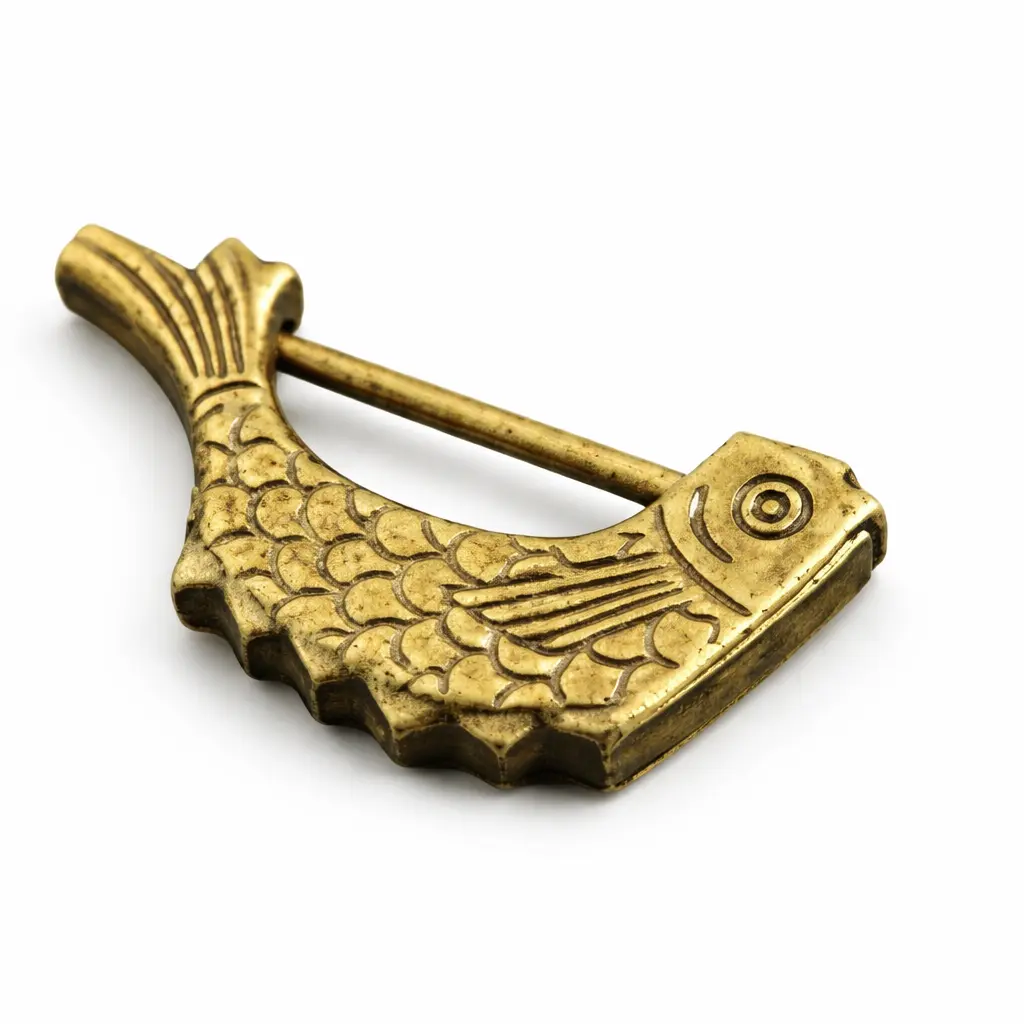
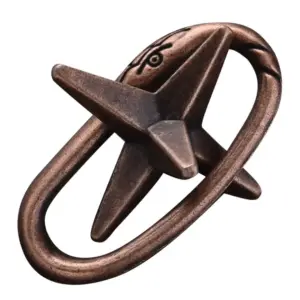
Chinese Koi Puzzle lock — $16.99
Finally, it becomes a tool for focus. This is its secret strength as one of the best metal brain teasers for daily use. The solve cycle—a rhythmic series of slides, turns, and clicks—engages motor memory and spatial reasoning without demanding conscious problem-solving. It’s a superior fidget device because it has a clear beginning, middle, and end. The satisfying thunk of the final release provides a concrete punctuation to a train of thought, a moment of completion you can feel in your palms. You’re not just moving pieces; you’re executing a graceful, miniature mechanical ballet, again and again. For a deeper dive into this particular variant’s elegant mechanics, our hands-on guide to the elegant Chinese koi puzzle lock hands-on guide explores its unique flow.
It outlasts the momentary challenge. It becomes a touchstone for logic, a gift of quiet focus, and a piece of perpetually moving metal art.
Choosing Your Knot: A Buyer’s Guide to Patina, Price, and Precision
Choosing the right metal Chinese knot puzzle comes down to three tangible factors: precision machining, durable finish, and design intent. The typical $12-$25 price range directly reflects these variables—you’re paying for the silent engineering that makes the solution feel like a revelation, not a chore. A well-made knot is an investment in logic you can hold.
So, you’re convinced of its place on your desk. Now, how do you select one from the sea of listings? Let’s translate product descriptions into what matters in your hand. A quality metal Luban lock puzzle will have a consistent, smooth finish. Run your thumb along the inside of the loops; you should feel a uniform curve, not a rough casting seam or a sharp, unfinished edge. The weight should feel substantive for its size, typically that 1.5-2.5 oz (45-70g) range, indicating solid zinc alloy, not hollow, thin metal. This heft is crucial for the satisfying thunk upon release.
The finish is your first clue to longevity. A plated silver coating on a cheap import will often wear off with frequent handling, leaving a brassy patch where your fingers grip. Look for descriptions mentioning “anodized,” “solid color infusion,” or “tumbled” finishes. These are more durable. Some higher-end puzzles, like those from the Hanayama Chinese Knot line (often labeled ‘Chain’ or ‘Knot’), use different metals or coatings precisely to resist developing a worn look, instead gaining a consistent patina.
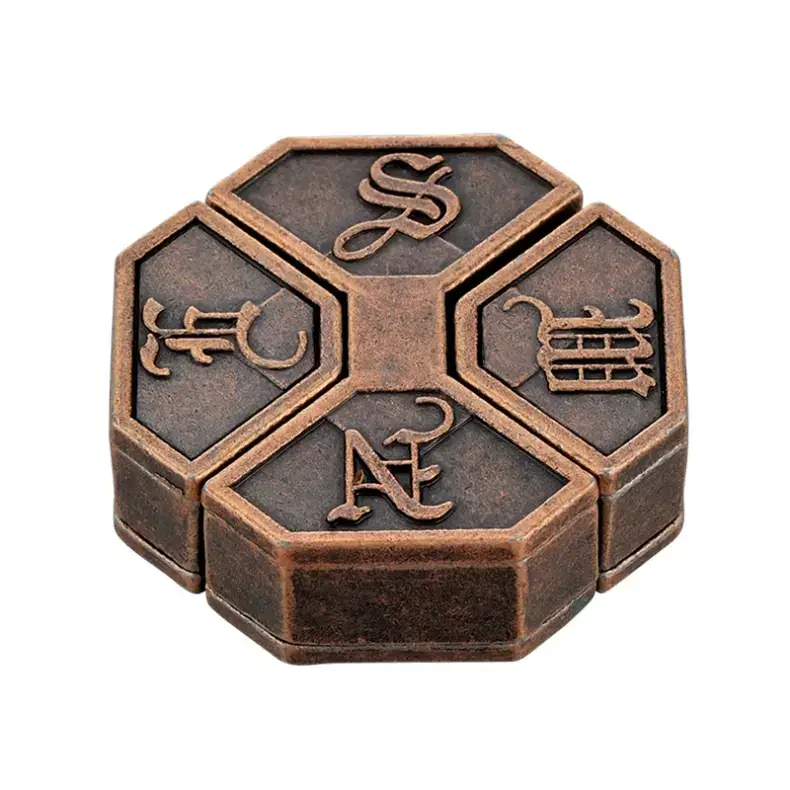
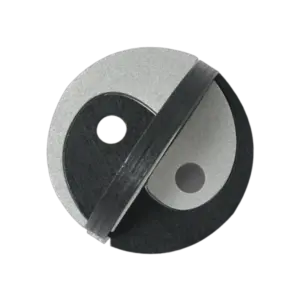
Bagua Lock Puzzle — $12.99
Where you buy matters. Specialty puzzle shops (online or brick-and-mortar) and reputable vendors curate for quality and accurate naming. You’re more likely to find a puzzle like the Bagua Lock above, which incorporates cultural motifs with clean machining. Generic online marketplaces are a minefield. Red flags include listings with only renderings (not photos), vague “metal puzzle” titles, and prices under $8. These are often the knock-offs with poor tolerances—the pieces either grind together or rattle loosely, destroying the precise tactile feedback essential to the solve.
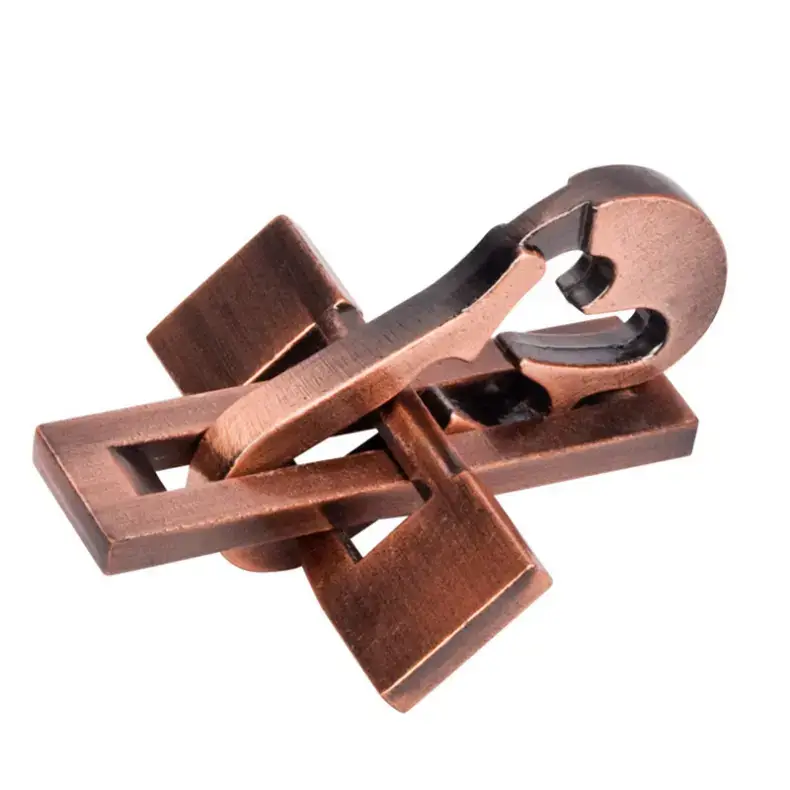
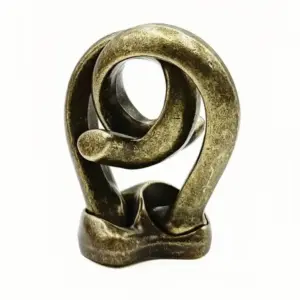
Yangqin Lock Puzzle — $12.66
Finally, consider the design’s personality. Some, like the Yangqin Lock, draw inspiration from musical instruments, offering a different visual and tactile flavor while adhering to the same core disentanglement principles. Others stick to the classic endless knot form. Read the product description for these details—they hint at a designer’s care, moving the object from generic commodity to a specific piece of interactive art. (A good shop will also state if the puzzle arrives assembled or disassembled, answering that common Reddit cry of despair.) For a pragmatic look at what to expect from the genre, including durability and solving approaches, our skeptic’s guide to cast iron logic in metal brain teasers offers grounded advice.
Your actionable next step is this: skip the algorithmic feed. Go directly to a specialist. Examine the product photos for true close-ups of the finish. Read for mentions of material and weight. Choose the one whose form speaks to you. Then order it, let it sit cool and dense in your palm, and begin the conversation. The right knot isn’t just a purchase; it’s the first move in a long, satisfying dialogue between your mind and the metal.