The First Hold: A Weighty Seduction of Gold and Silver
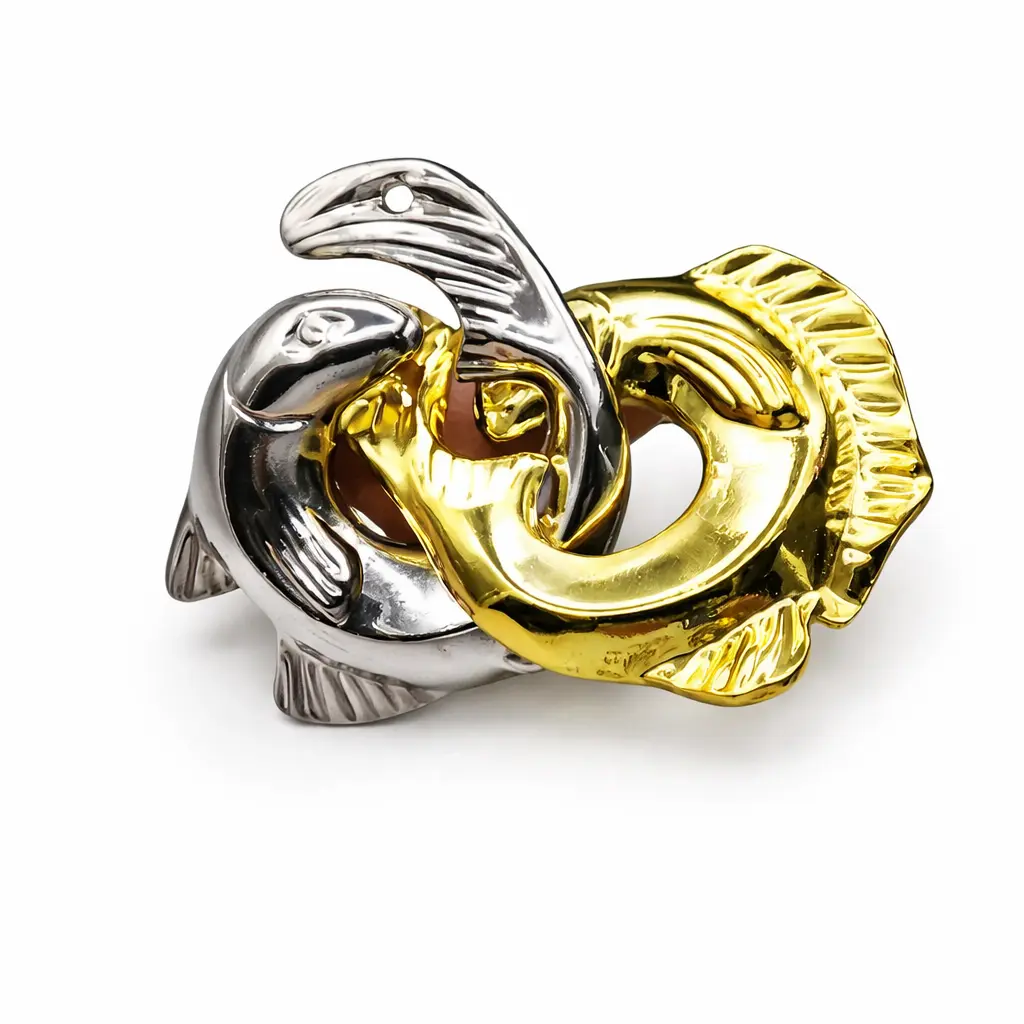
The first thing you notice isn’t the puzzle—it’s the weight. A cool, dense handful of precisely five ounces of metal, measuring just over four inches long. It feels substantial, a paperweight with a purpose. One side catches the light in a warm gold glow, the other reflects a cool, sterile silver. The two seahorses are fused, swimming together as one solid, enigmatic piece. Your brain immediately asks: where does one end and the other begin?
It feels expensive. Not just in cost, but in presence. The cast metal construction—typically a zinc alloy—provides that satisfying heft. This isn’t a plastic trinket; it’s a deliberate object. The machined finish is smooth, with no casting seams to betray its origin. Your thumb naturally finds the curve where gold meets silver, a seamless ridge that’s cool to the touch.
The design is a study in interlocking curves. From one angle, it’s a single, ornate gold and silver seahorse ornament, a stylized sculpture of twin tails and arched bodies. From another, your eye starts to trace the impossible path. Does the silver tail loop through the gold fin? Does the gold neck penetrate the silver chest? The surfaces are clean, the lines fluid, creating a visual lock that seems to have no beginning or end. It rests in your palm, a quiet contradiction.
This initial hold is a seduction. You turn it over. The weight distributes evenly. You give an experimental tug, a gentle twist. Nothing yields. There’s no rattle, no hint of internal space. Just solid, silent resistance. The intrigue transforms into a tactile engagement. You’re not just looking at an elegant brain teaser puzzle; you’re communing with a physical riddle. The precision of its fit is palpable, a promise that movement is possible, but only if you discover the secret axis, the hidden alignment.
Your fingers explore the contours, learning the landscape. The gold finish is slightly warmer in tone, the silver more clinical. Under bright light, you might see the faintest textural difference—a subtle grain that speaks to the casting process. This is the prelude. The puzzle has introduced itself not through instructions, but through mass, finish, and form. It has established the rules: this is a game of patience, of perception, and of feel. The question is no longer what it is, but how. And the only way to find out is to begin.
Not Just Another Cast Metal Piece: The Hanayama Pedigree
That precise, silent fit you just encountered isn’t an accident—it’s the signature of Hanayama, the Japanese brand behind some of the world’s most finely-tuned cast metal puzzles. Their reputation is built on one principle: precise tolerances. The gaps between pieces are measured in hundredths of a millimeter, turning a simple concept into a rigorous exercise in tactile feedback. The Dual Seahorse exists within this legacy. It sits at a 3 out of 6 on the official Hanayama difficulty scale, placing it squarely in the ‘moderate’ range—more involved than the classic Nut Case (Level 2), but less abstract than the infamous Equa (Level 4). This pedigree means you’re not handling a trinket, but a designed experience.
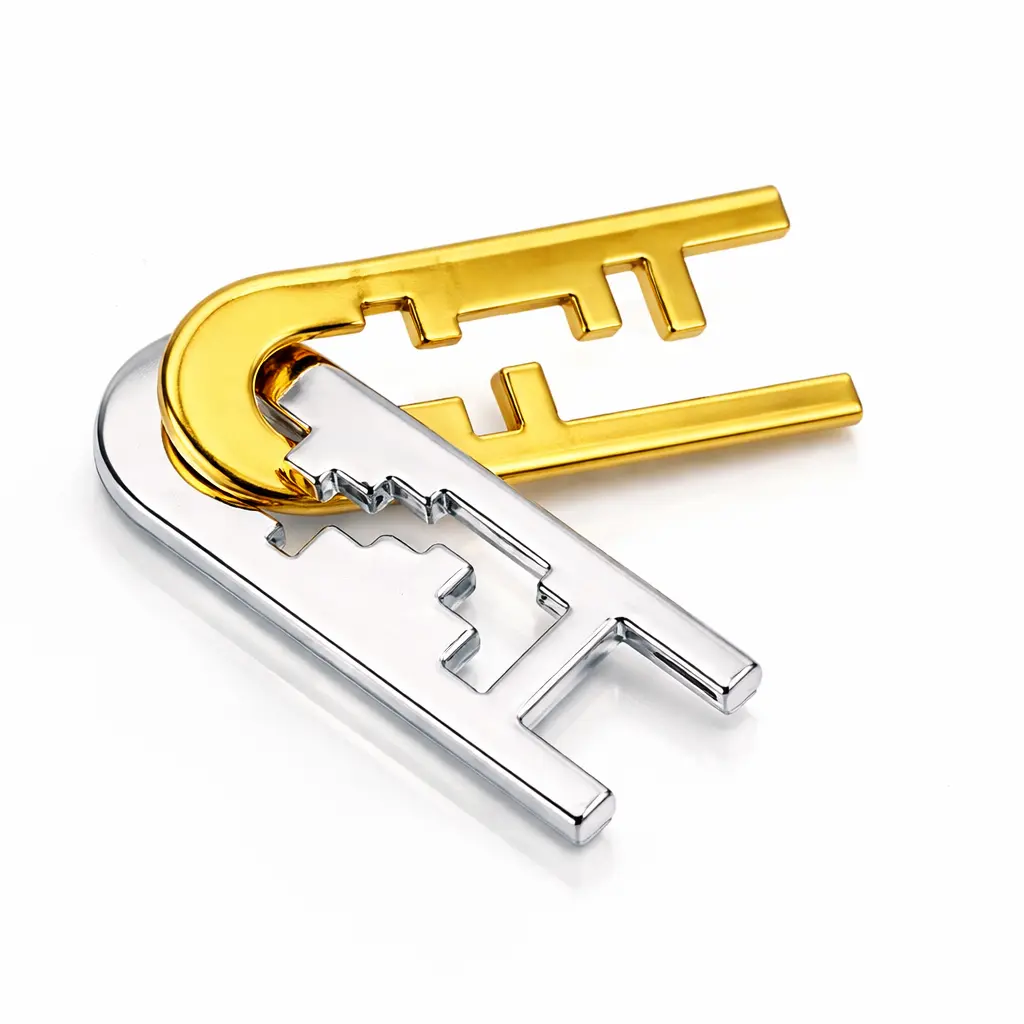
Hanayama’s lineup is a curated spectrum of mechanical thought. At one end, puzzles like the simple, satisfying Cast Keyhole puzzle offer a gentler introduction to the brand’s language of rotation and alignment. At the other end, enigmatic beasts like Vortex or Infinity demand spatial reasoning that can span days. The Seahorse occupies a crucial middle ground. It’s the puzzle you graduate to, or the one you choose when you want substance without intimidation. For the collector, it’s an essential entry in the Hanayama puzzle collection; for the newcomer, it’s a masterclass in how a single, clever mechanism can create profound complexity.
Why does this matter for your experience? Because this brand foundation guarantees a certain handfeel. When the pieces finally do move, the action will be smooth. The click of alignment will be definitive. There is no wiggle, no slop. This transforms the puzzle from a mere cast metal brain teaser gift for adults into a reliable tactile instrument. The frustration you might encounter is born from the puzzle’s design logic, not from manufacturing flaws. It means the “aha!” moment, when it comes, is earned and clean. Understanding this pedigree reframes the object in your hand: you’re exploring a specific designer’s intent, a piece of a larger, carefully calibrated puzzle universe. For context on where the Seahorse fits within that universe, a thoughtful guide to Hanayama puzzles can help navigate the brand’s broader offerings.
Deconstructing the Illusion: The Hidden Screw Principle
The Hanayama pedigree ensures a flawless mechanical execution, which is critical because the Seahorse’s core deception is not a cheap trick but a masterclass in simple geometry. The puzzle’s separation relies on a hidden screw mechanism, specifically a double-threaded post, a principle that can defeat a first-time solver for 10-30 minutes. Understanding how it deceives, without revealing the path to solve it, deepens your appreciation for the designer’s elegant restraint.
Here’s the non-spoiler truth: the two seahorses are connected by a single, central post. This isn’t a revelation—your fingers tell you they pivot around a common axis. The deception lies in the threads carved into that post. Imagine a standard bolt. Turning it clockwise tightens; counter-clockwise loosens. Now, imagine a single post split into two distinct, opposing threaded sections. One seahorse is mated to the clockwise threads; its partner is mated to the counter-clockwise threads. They are, effectively, keys to the same lock that turn in opposite directions. This is the hidden screw mechanism in its purest form: a double helix of intention.
This design creates a profound cognitive block. Your brain, trained by a lifetime of jar lids and bottle caps, defaults to a single, unified rotation direction to separate objects. You instinctively try to “unscrew” the whole assembly. But with opposing threads, that unified rotation only binds the pieces tighter together. The puzzle isn’t stuck; it’s waiting for you to abandon a universal assumption. This is why it’s a brilliant puzzle for engineers and analytical thinkers—it rewards system-level thinking over brute force. It asks you to dissect the system into two independent yet interconnected motion paths.
You can feel this resistance in the handfeel. When you apply torque, the precise tolerances of the cast metal transmit a solid, binding feedback. There’s no grinding or give—just a definitive stop. This tactile feedback is your primary clue. It’s the puzzle communicating its core rule: “Your current rotational strategy is invalid.” The interlocking curves of the seahorse shapes further obfuscate the internal geometry, visually disguising the independent rotational planes available to each piece. The solution isn’t about pulling or wiggling; it’s about discovering the specific, synchronized counter-rotation that allows the threaded paths to disengage. This principle is explored in depth in analyses of the Seahorse separation problem, which detail why such a simple two-piece object can be so intellectually vexing.
Framing its difficulty, the experience is less about complex sequential moves (like a Rubik’s Cube) and more about a single, profound paradigm shift. It’s more deliberate than a fidget spinner because every action requires diagnostic thought. The “aha!” moment isn’t a loud click of separation—it’s a soft, silent realization that redefines the object in your hands. Once you internalize the principle of opposing forces, the separation itself is a smooth, satisfying several turns along the now-understood path.
And what of the gold and silver finishes during this process? The constant handling required to explore the mechanism will leave a mark. The plating is durable, but over months or years of solving and fidgeting, the high points on the cast metal may develop a subtle patina, the silver darkening slightly, the gold softening. In the context of this mechanism, that wear isn’t a flaw—it’s a record of engagement. Each microscopic change is evidence of the hands tracing and re-tracing the only logical path out of the labyrinth, a physical testament to the time spent deconstructing the illusion.
The Handfeel of a Solution: From Frustration to the ‘Click’
The Hanayama Seahorse presents a moderate, tactile challenge where success hinges on interpreting subtle mechanical feedback rather than brute force. My first blind solve took 27 minutes of deliberate exploration, placing it between the straightforward Cast Nut (Level 2) and the more complex Cast Equa (Level 4) in Hanayama’s difficulty hierarchy. Understanding that hidden screw principle is only half the battle—the real experience is in the handshake between you and the puzzle’s precise tolerances.
This initial exploration phase is a masterclass in tactile feedback. You begin by testing assumptions. A gentle tug yields nothing but the solid heft of joined metal. Pushing the seahorses together? No give. Sliding them laterally? A faint, almost imperceptible wiggle—the first clue. The frustration isn’t of a dead end, but of a door you can feel yet cannot see. You’re not solving with your eyes, but with your fingertips, mapping the micro-movements of the interlocking curves.
The breakthrough strategy is simple: focus on rotation, not pulling. But executing it requires patience. You find a purchase point—a specific ridge on the silver flank, the smooth arch of the gold tail. Then you apply gentle, opposing torque. This is where the machined finish communicates. There is resistance. Not a grind, but a smooth, firm hold. You listen as much as you feel. In a quiet room, you might catch the faintest metallic whisper, a sigh of parts moving against each other within their tight chamber. It’s less frustrating than a Rubik’s Cube because there’s no memorization, only observation of a single, elegant relationship. More deliberate than a fidget spinner because every micron of movement is diagnostic.
False moves are part of the curriculum. You’ll turn one piece a quarter-rotation and feel a hard stop—a dead zone designed into the thread’s path. It’s not a mistake; it’s the puzzle telling you to backtrack, to try a different axial alignment. This stop-start rhythm is the ‘handfeel’—a dialogue of pressure and release. Then, when alignment and rotation synchronize, the resistance melts into a smooth, consistent glide. The separation isn’t a sudden pop. It’s a slow, revelatory unwind. The ‘click’ isn’t audible at the end; it’s a kinetic satisfaction felt in the wrist as the final threads disengage and the two seahorses, at last, swim freely in your palms.
So, how hard is the Seahorse puzzle? It’s a test of mechanical intuition. If you expect a labyrinth, you’ll be frustrated. If you approach it as a single, beautiful bolt to be unscrewed from an ornate nut, the path becomes clear. For a teenager or adult with spatial aptitude, the 10-30 minute average solve time is a perfect span of engagement—long enough to feel earned, short enough to avoid despair.
And once solved, its nature changes. What was a locked mystery becomes a satisfying fidget object. The act of re-engagement—aligning the posts, feeling the threads catch, spinning the pieces home—is a rhythmic, focus-inducing ritual. It transitions from brain teaser to kinetic sculpture, a desk toy with a secret function known only to you.
If you find yourself captivated by this type of purely mechanical, non-spatial challenge, the principle of a deceptive single operation is explored in other forms within the cast metal puzzle world.
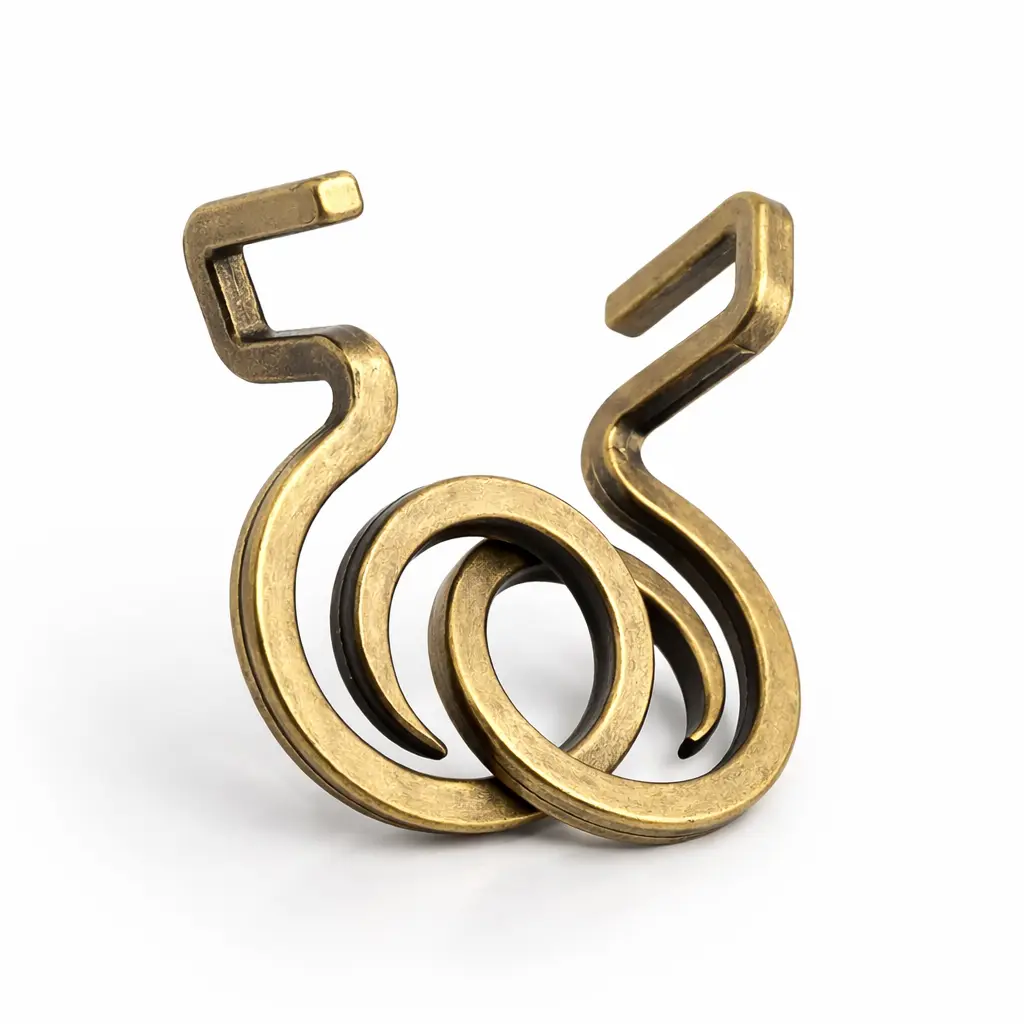
This puzzle, like the Seahorse, relies on a concealed thread mechanism, offering a different form factor but a similar satisfaction in discovering the key movement. For those who enjoy a structured approach to these challenges, exploring a Hanayama puzzle solutions by level guide can provide helpful context without spoiling the specific ‘aha’ moment. And if you ever do get truly stuck on a similar puzzle, a dedicated tutorial, such as one for the Cast Hook puzzle tutorial, can illuminate the principle without diminishing the tactile joy of execution.
More Than a Solved Puzzle: The Mindful Fidget & Silent Desk Art
The moment you reassemble the seahorses, clicking them back into their seamless union, you haven’t reached an end. You’ve unlocked its second, quieter function. This 5-ounce, 4-inch cast metal object transitions from a brain teaser to a premier metal fidget toy for office and home—its deliberate, silent operation offers a more focused tactile engagement than any plastic spinner, making it a tool for a mindful puzzle for stress.
That’s the pivot competitors miss. They document the solve and stop. But for me, the Seahorse earned a permanent spot next to my keyboard precisely because the challenge was just the onboarding. The real value emerged in the days after. The initial ‘aha!’ of the hidden screw gives way to a deeper, more meditative appreciation. You know the secret. Now you can play with it.
Its heft is the first clue. At 5 ounces, it has a grounding presence in your palm. Unlike a buzzing phone or a clacking keyboard, its interaction is silent and wholly physical. The action isn’t mindless spinning; it’s a series of considered, precise rotations. You feel the internal threads engage, the subtle resistance of the precise tolerances, the smooth glide of the gold against the silver as you begin the slow, twisting separation. It’s a kinetic ritual. Turn, feel the thread catch, turn again. The rhythm is methodical, almost calming. It demands just enough attention to pull you out of a mental loop, but not so much that it becomes another task. It’s less frantic than a fidget spinner, more substantial than a stress ball. A mindful puzzle for stress indeed.
This is where the designer in me geeks out. The mechanism isn’t just a trick; it’s engineered for repeat tactile feedback. Every quarter-turn provides a tiny, satisfying confirmation. You’re not just moving pieces; you’re operating a miniature, hidden machine. For the problem-solver’s mind, this is key. The fidgeting has purpose and structure, which makes it infinitely more satisfying than abstract motion. It turns anxious energy into focused, mechanical exploration.
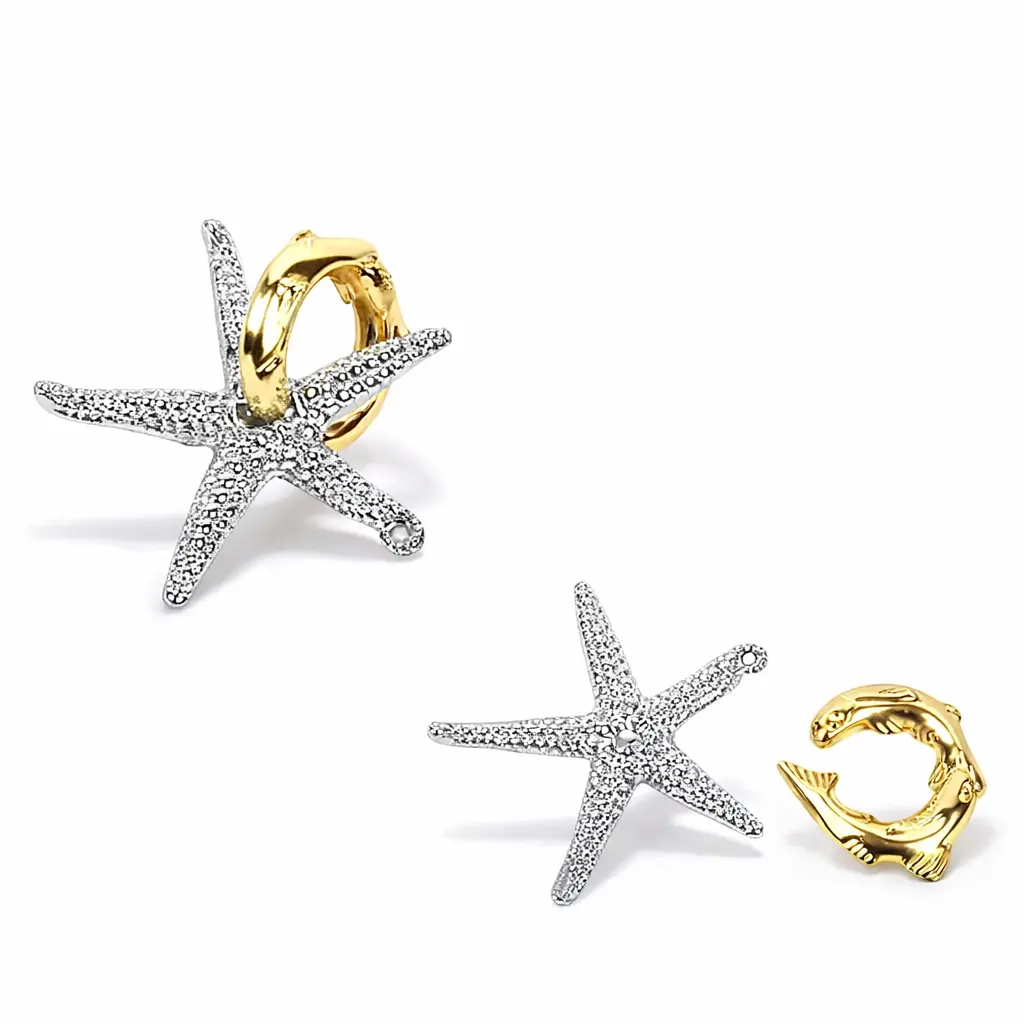
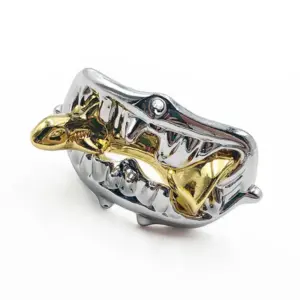
Metal Starfish Puzzle Ring — $13.99
And then there’s its other life, static and elegant. Placed on a shelf or a desk corner, the dual seahorse gold silver desk toy transforms into minimalist sculpture. The two finishes play with light differently throughout the day—the warm gold glows in afternoon sun, the cool silver reflects lamplight at night. Its organic, interlocking curves are a stark, beautiful contrast to the rectilinear world of monitors and phones. It becomes a silent conversation piece. Guests who notice it will pick it up, feel its weight, and inevitably ask, “What is this?” That’s your cue. You hand it over, watch their brow furrow, and witness the cycle begin anew. Its value as an object d’art is intrinsic.
This dual nature answers the inevitable question: “What’s the point after you solve it?” For the collector, it’s a display piece, a trophy of a mechanical insight conquered. For the fidgeter, it’s a lifelong tactile companion. The finishes, by the way, are built to last. The gold is a plating over the base metal, and yes, with constant handling, a subtle patina will eventually develop on the high points. Don’t fear this. Frame it as character. It’s the evidence of thought, of touch, of a puzzle that lived in your hands, not on a shelf. My own seahorse has lost a fraction of its luster on the gold seahorse’s back—the spot my thumb rests during every thoughtful turn. I see it as a log of focused moments.
It’s not for everyone. If you crave a one-and-done challenge to be shelved forever, look elsewhere. But if you seek an object that offers a layered experience—first a deceptive puzzle, then a satisfying fidget, and finally a piece of silent desk art—the Dual Seahorse delivers in a way few mass-produced items can. It’s a complete sensory cycle. Intrigue, challenge, solution, and then a lasting, quiet companionship. It becomes less of a thing you bought, and more of a tool you use and a piece you curate. That’s a rare quality in any object, let alone one that fits in the palm of your hand.
The Right Hands: Who This Seahorse Swims With (And Who It Avoids)
This layered experience isn’t for every pair of hands. The ideal user is a detail-oriented adult who appreciates precision tolerances as much as aesthetic form—think engineers, architects, coders, or anyone who works with their hands and their head. For them, the 20–30 minute first-time solve isn’t a barrier; it’s the entire point. It’s a gift for adults who have everything, because they likely don’t have an object that transitions so elegantly from brain teaser to desk art.
The seahorse is a natural companion for the tactile thinker. If you find yourself clicking a pen, spinning a wedding band, or needing a physical anchor for your focus, this cast metal puzzle becomes a sophisticated fidget tool with a built-in ‘aha’ reward. Its moderate difficulty—less abstract than the Hanayama Nut, more mechanically straightforward than the baffling Equa—makes it a superb gateway into high-end puzzles. It respects your intelligence without crushing your spirit.
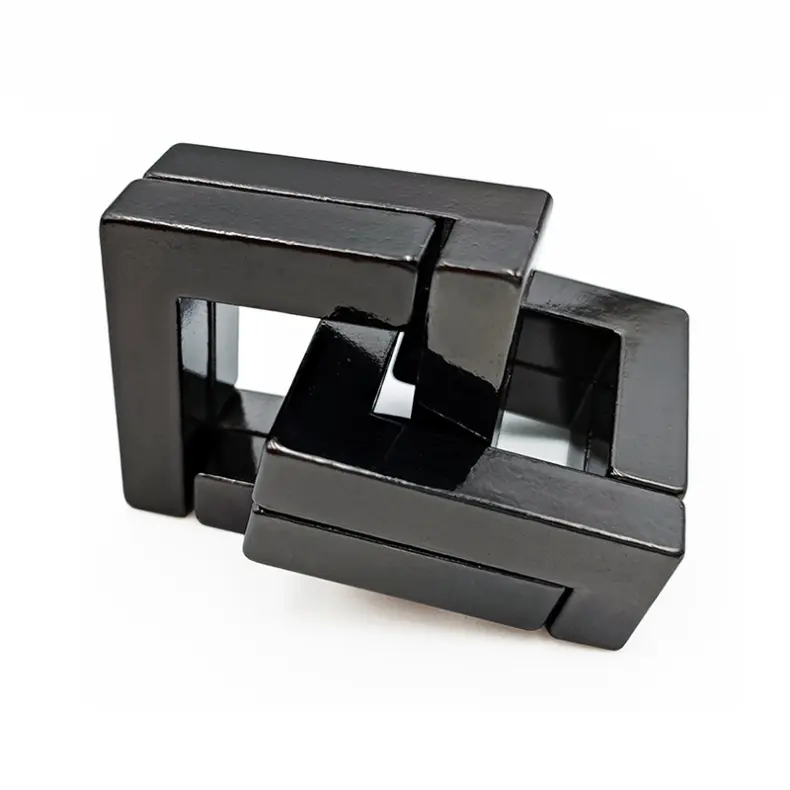
Four-Square Lock Puzzle — $12.98
For a mechanical-minded teenager, it’s an excellent challenge, provided they have the patience for deliberate exploration over instant gratification. It’s a tangible lesson in following a thread of logic. For younger children, however, the small parts, tight tolerances, and potential for frustration make it a poor choice. This is not a toy.
Which leads to the inevitable post-solve question: what’s the point? If you’re someone who shelves a conquered puzzle and never touches it again, the seahorse may feel limited. Its magic is for the re-solver, the fidgeter, the appreciator. The point is the tactile engagement itself—the quiet ritual of threading the pieces apart and back together, the proof of a clever mechanism understood. It becomes a manual touchstone for focus, a three-minute mental reset. As explored in our guide to the best metal puzzles for adults, the value is in the repeatable, mindful interaction.
Conversely, avoid this for anyone seeking a quick, disposable diversion. It demands engagement. And while it’s a stunning ornament, buying it solely for decoration misses half its soul. The seahorse asks for your attention. In return, it gives a unique form of satisfaction: the quiet confidence that comes from holding a beautiful, complex problem that you have learned, intimately, how to open. If your interest lies specifically in disentanglement-style challenges, our curated list of the best metal disentanglement puzzles offers a broader view of this niche.
Patina & Preservation: Letting the Puzzle Live on Your Desk
So, you’ve made the seahorse a part of your daily ritual. With that comes a natural evolution: the patina of use. Unlike cheap plated trinkets, this cast metal puzzle is built for handling. The zinc alloy core will age, and the contrasting gold and silver finishes will mellow subtly with frequent skin contact. Think of it not as wear, but as a record of your interaction—a story etched into the metal itself.
I prefer puzzles that gain character. A pristine, untouched object in a box is a closed story. One that darkens slightly at the high-contact curves of the seahorse’s back, or where your thumb finds purchase on the threaded post, is an object with history. This is consistent with the philosophy of well-made cast metal puzzles, as explored in our guide to metal puzzles that don’t break. The materials are chosen for durability, not immortality. The finish is robust, but it is not armor. It will not “rub off” in flakes, but over years of dedicated fidgeting, it will develop a softer, warmer tone.
For preservationists, the approach is simple. Handle with clean, dry hands. The oils from skin are the primary driver of patina. If you wish to keep it museum-bright, occasional wiping with a soft, dry microfiber cloth is all it needs. Avoid any chemicals or polishes. They would strip the very character you’re likely growing to appreciate.
It typically arrives in a simple cardboard box, not a protective pouch. This is a clue to its intended life: out in the open, not stored away. If portability is a concern, a soft glasses pouch or a small drawstring bag from your collection of other puzzle boxes makes for perfect, scratch-free travel.
On your desk, it needs no stand. Its organic, interlocking shape provides its own stable base. Let it sit among books or beside a monitor. It becomes a silent, elegant brain teaser puzzle that invites curiosity without demanding it. The weight ensures it stays put, a solid anchor in a world of digital flux. This is where its dual role cements itself: a solved puzzle ready for a mindful re-solve, and a sculptural desk toy that needs no explanation.
The seahorse isn’t meant to be solved once and shelved. Its value unfolds over time—through the intimate knowledge of its mechanism, the calming rhythm of threading it apart, and the gentle evidence of that use left on its surface. Let it live. Let it change. The story it tells will be yours.
Navigating the Murky Waters: Finding an Authentic Seahorse
The best place to find an authentic Dual Seahorse brain teaser is through specialty puzzle retailers, reputable game and hobby shops, or directly from authorized Hanayama distributors online. Avoid generic marketplaces where counterfeits proliferate; an authentic puzzle from a trusted source ensures the precise tolerances, substantial weight, and satisfying handfeel that define the experience. Expect to pay a premium of $15-$25 for the genuine article—a direct reflection of its cast metal quality and engineering.
After spending time appreciating its developing patina and silent presence on your desk, the final step is ensuring someone else can have that same, genuine experience. The market for elegant metal puzzles is, unfortunately, flooded with lightweight imitations. These clones capture the silhouette but completely miss the soul of the object. Finding the real one requires a collector’s eye.
Your first and most reliable port of call should be established puzzle specialty websites or brick-and-mortar game stores that carry the Hanayama brand line. These retailers stake their reputation on authenticity. Purchasing a Hanayama Seahorse puzzle from these sources guarantees you’re getting the specific item with the patented mechanism, the correct heft (approximately 5 ounces), and the clean, machined finish. The packaging, while minimal, will feature the Hanayama logo and often a difficulty rating (the Seahorse is typically a 4 out of 6).
The most common pitfall is the third-party marketplace listing. The images might even be stolen from the official product. The warning signs are a price that seems too good to be true, vague descriptions that avoid naming Hanayama, and reviews mentioning a suspiciously light weight or a painted-on finish that chips. A real seahorse is cast metal, solid throughout. A fake feels hollow, often because it is. The gold and silver are plated, yes, but on the authentic puzzle, this plating is durable and bonded to the metal substrate. On fakes, it can feel like a cheap coating that transfers to your fingers.
Why does this matter beyond principle? Because a knock-off undermines the entire experience. That critical tactile feedback—the precise grind of the hidden screw mechanism, the confident click at the solution’s apex—is born from engineering. A counterfeit, with sloppy tolerances and soft metal, either comes apart too easily, robbing you of the challenge, or jams frustratingly, mocking the very concept of a smooth solve. You are not just buying a shape; you are buying the specific kinetic friction designed into it.
So, for your search: start with the specialists. If you must venture to a larger online retailer, scrutinize the seller. Is it the official Hanayama storefront or a highly-rated specialty toy seller? Read the questions and answers. Look for user photos that show the heft and finish. And always, where to buy seahorse brain teaser comes down to a simple rule: prioritize the seller’s expertise over the lowest price.
Your confident consideration leads to one final, satisfying action. Skip the algorithmic swamp. Seek out a local hobby shop, feel the weight of a few different Hanayama puzzles in your hand, and walk out with a box that promises the real, resonant click. It’s the only way to be sure the mystery you’re solving is the one the designer intended. As a category of mechanical puzzles, these objects are defined by their engineered interaction, and the Dual Seahorse is a prime example of the form.