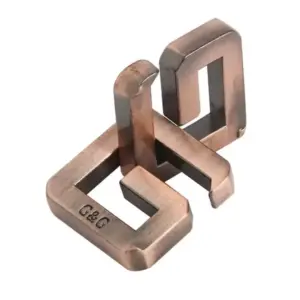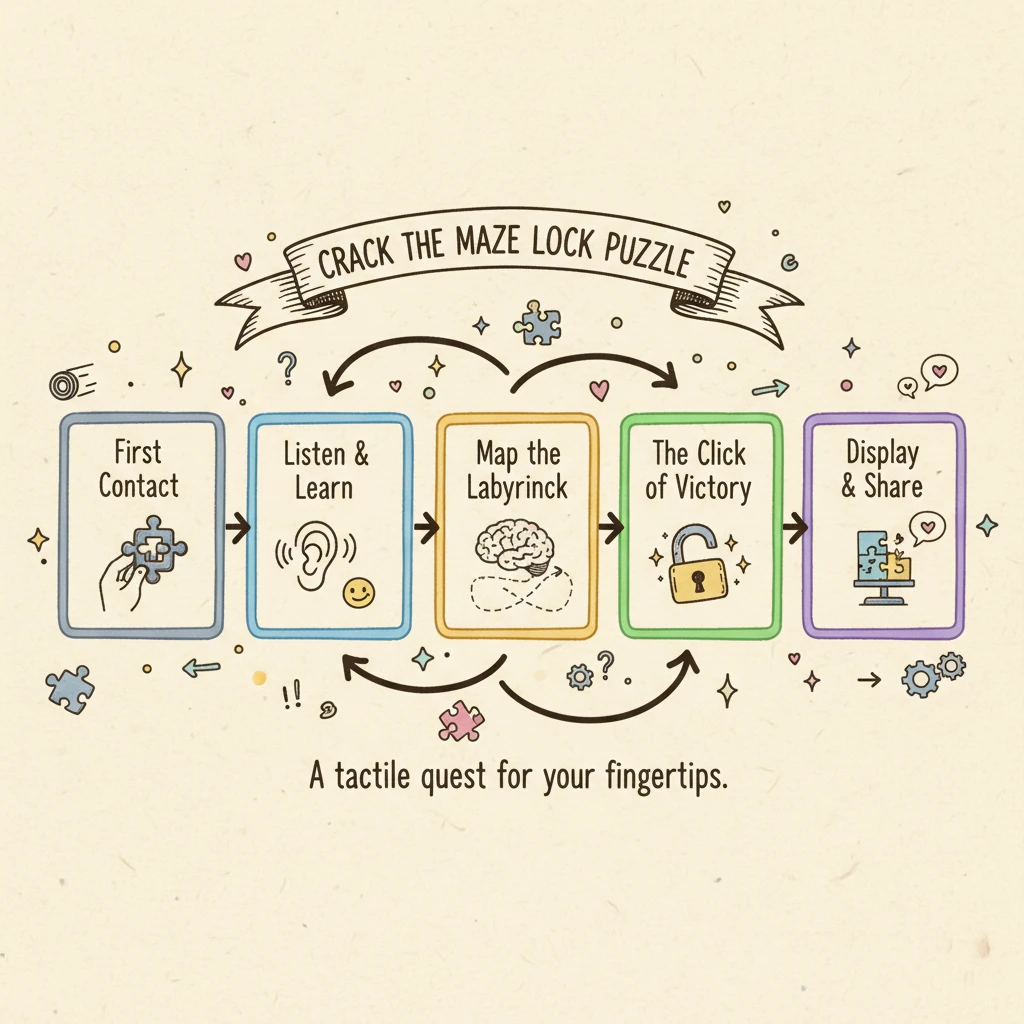
More Than a Lock: Defining the Maze Lock Puzzle ‘Solve Experience’
A maze lock puzzle is a self-contained, hand-held contraption, typically 2 to 3 inches across and weighing between 1.5 and 8 ounces, that uses a physical labyrinth to obstruct a simple mechanical goal—usually sliding a bolt or releasing a shackle. It is not a lock to secure anything but your attention, offering a compressed, tactile “solve experience” distinct from any padlock or fidget spinner.
The metal is cool. It weighs nothing. Then you feel the ball shift.
That faint, rolling tick inside a cast zinc alloy or milled aluminum case is your first clue. This isn’t a static ornament. It’s a conversation you initiate with your fingertips, a tiny engineered landscape hidden from view. Your brain, accustomed to screens, scrambles to build a mental map from sound and resistance alone. Is it a lock? A puzzle? It’s the best kind of fidget toy for the intellectually restless: one where your agitation has to turn into strategy.
For the adult mechanical puzzle enthusiast—especially fans of the Hanayama cast puzzle series—this category will feel immediately familiar yet distinct. While Hanayama puzzles often focus on elegant disassembly and reassembly, a maze lock presents a more guided challenge. The goal is explicit (open it), but the path is concealed. It scratches the same itch for precision machining and “Aha!” moments, but within a framework that feels more like navigating a vault than exploring a sculpture.
Forget “brain games.” This is tactile feedback as information. The solve isn’t just about reaching the end; it’s about the rhythm of exploration. You learn the language of the device: the solid clunk of a ball dropping into a dead-end, the smooth, frictionless slide of a panel finding its channel, the gritty hesitation of a cheaply machined corner. The quality of those sounds and sensations is your first indicator of craftsmanship. A well-milled puzzle speaks clearly. A poorly made one mumbles.
Common materials define the character. Zinc alloy feels dense, cool, and industrial. Aluminum is lighter, often with a smoother, satin finish. Wood, like beech or walnut, offers a warmer, quieter experience where the grain and subtle give of the material become part of the puzzle. The choice isn’t just aesthetic; it changes the acoustic and haptic profile of the entire solve. If you’re drawn to the organic feel, our dedicated wooden puzzle guide delves deeper into that tactile world.
So, is it just a fidget toy? Not if you engage with its intent. You can absolutely mindlessly roll the ball along its channels for stress relief—many are satisfying enough for that. But the moment you decide to solve it, the dynamic flips. It becomes a stubborn partner in a silent debate. It’s an escape-room grade challenge shrunk to pocket size, a physical logic problem that can’t be brute-forced by tapping. You must listen, feel, and map. You must, as I learned in the machine shop, respect the tolerances.
This guide exists because most product listings show you a shiny object and a “click to buy” button. They don’t tell you about the ten minutes of bewildered shaking, the triumph of the first correct slide, or the specific, quiet satisfaction of holding a solved, open puzzle in your palm—a satisfaction earned not by clicking but by understanding. Let’s define that experience, starting from the inside out.
Your First Five Moves: Decoding the Hidden Mechanism
The fundamental answer to “How do you even start?” lies not in frantic shaking, but in systematic, sensory reconnaissance. Your first five moves should be slow, deliberate acts of information gathering. This disciplined approach, rooted in my machining days where a thousandth of an inch mattered, transforms the puzzle from an inscrutable block into a readable map. Start by ignoring the goal of ‘opening’ and focus solely on understanding the component you hold.
Move 1: Listen to the Idle State. Before you do anything, hold the puzzle level and still in your palm. Tilt it gently, just a degree or two. Do you hear a faint, gritty roll or a smooth, metallic shhhhk? A single, heavy ball bearing will produce a deep, slow roll. Multiple smaller bearings sound like a quiet rainstick. This tells you the type and likely number of internal drivers. No sound at all suggests a puzzle driven by sliding panels or a cleverly trapped bearing—information in itself.
Move 2: Map the Seams with Your Fingertips. Eyes can deceive; fingertips measure. Run your thumb along every visible seam and groove. You’re looking for variation—a gap that widens imperceptibly, a panel that has the faintest give, a ridge that isn’t just decoration. Apply gentle, direct pressure to each face. Does anything depress? Does a side panel shift a half-millimeter? This tactile survey identifies the interfaces, the potential points of manipulation. Think of it like feeling for the hidden latch on a fine wooden box.
Move 3: The Controlled Tilt and Track. Now, with purpose. Slowly rotate and tilt the puzzle through every axis, but with controlled, minimal movement. Your goal is to mentally track the path of the ball bearing. You are not trying to solve it; you are tracing the invisible maze walls by sound and weight shift. Does the ball roll freely in a large chamber? Does it get trapped in a corner until you tilt back? Does its path suddenly “stop” against what feels like a wall? This begins to outline the internal architecture. It’s like using a metal detector to sketch the outline of a buried pipe—you’re defining boundaries by feedback.
Move 4: Identify the Primary Constraint. After the tilt test, you’ll notice a pattern. For most maze locks, the ball’s freedom is ultimately blocked by one primary mechanism. This is the key you must manipulate to progress. In a sliding panel lock, you’ll feel the ball move freely until it hits a dead-end; a subsequent gentle push on a specific external panel will “unlock” a new channel. The mechanism is like those frustrating airport security mazes where you slide a panel to open a new path for the marble. In a rotating disk lock, the ball will travel in a circular path until blocked; rotating a disk (often the face of the puzzle) aligns a gate in the maze layer below. This is a 3D marble run, where you rotate entire sections of the track.
Move 5: Apply Pressure at the Constraint. You’ve listened, mapped, tracked, and identified. Now, apply focused pressure precisely where you believe the constraining mechanism lies. For a suspected sliding panel, press directly inward, not at an angle. For a rotating disk, try clockwise and counter-clockwise turns with the ball held at the suspected gate location. The feedback here is critical. A well-milled mechanism will give a crisp, definite click or clunk with minimal play. A poorly made one will grind or feel mushy. This move isn’t about solving yet; it’s about testing the action. Confirming the mechanism’s feel validates your mental model.
This process demystifies the opening minutes. You are not failing; you are conducting a diagnostic. The “first five moves” establish a dialogue with the puzzle. The solve itself is simply the continuation of this conversation—guiding the ball through the now-partially-understood labyrinth by operating the controls you’ve identified. When you hit a true dead end, as many do with more complex models like the double-sided maze, this foundational knowledge is what allows you to methodically work towards a solution, rather than descend into random shaking. For a specific application of these principles on a notoriously tricky design, see our guide on how to separate the pieces of the dual-sided maze lock.
The difference between a cheap and an expensive maze lock often screams itself in these first five moves. A precision-milled puzzle will have consistent, clean seams. Its ball will roll without hang-ups. Its sliding or rotating actions will be defined and smooth. A cheaply cast alloy puzzle might have flashing in the channels that snags the ball, or vague, grating mechanisms. The sound of the solve—that final, satisfying clack of the lock disengaging—is a direct quality indicator. It’s the sound of clean machining and tight tolerances, a sound I learned to listen for in the aerospace shop. It’s the sound of a puzzle that will not just challenge you, but reliably respond to your correct inputs.
The Click and Clunk: Why Sound is Your Secret Solving Tool
That final, definitive clack of a lock disengaging isn’t just a reward; it’s a diagnostic report. In a category where you can’t see the mechanism, sound becomes your primary sensory data stream. It tells you about machining precision, material density, and, most critically for the solver, the internal state of the puzzle. As an aerospace machinist, I learned to listen to metal. A clean 0.1mm tolerance has a different voice than a sloppy 0.5mm one. This principle translates directly to a well-made metal maze puzzle lock.
The core soundscape of a maze lock is built from two elements: the rolling of the ball bearing and the sliding or clicking of the external controls. In a precision milled aluminum puzzle, the ball’s journey is a series of quiet, slick rolls and muted ticks as it drops into subtle detents within the hidden channel. The controls, whether sliders or rotators, move with a dampened, fluid whisper. Contrast this with a cheaper zinc alloy casting. The ball’s sound is often a gritty, uneven scrape. The controls might grate or catch, emitting a sharp, raspy squeak. This isn’t just about pleasantness; the grit indicates flashing—excess material left in the channel from the casting mold—which can physically block the solve path or create false dead ends. The clean, consistent sound of aluminum or fine hardwood isn’t a marketing luxury; it’s the audible signature of a puzzle that will behave predictably under logic.
This predictability is where sound shifts from quality indicator to tactile feedback and a direct solving aid. Listen closely as you manipulate a complex lock. A hollow, resonant roll often means the ball is traversing a long, open channel in an outer layer. A sharper, higher-pitched tick might indicate it has dropped into a gate or a new section of the maze. When you feel a control bind or stop, the accompanying sound tells you why. Is it a soft, final thud? That’s likely a true wall. Is it a faint, springy click? You may have triggered a internal latch or sequencing mechanism that now allows further movement elsewhere. I’ve diagnosed more “stuck” states by ear than by sight. For a deeper technical breakdown of how these internal architectures are built, our metal puzzle guide can offer fascinating insights into the design principles at play.
Material choice is the instrument in this orchestra. Dense, fine-grained woods like walnut or beech absorb high frequencies, resulting in a warm, muted, and organic set of clicks. It’s a softer, more discreet solve. Aluminum, being light and stiff, produces bright, crisp, and resonant tones. It’s the most communicative material, offering the clearest auditory feedback. Zinc alloy, being softer and often cast with less precision, creates duller, more muffled sounds that can obscure critical clues. When you’re hunting for a satisfying, fidget-friendly desk toy that you’ll solve repeatedly, the pleasurable acoustics of aluminum or hardwood become a significant part of the experience. The puzzle doesn’t just engage your mind and fingers; it speaks to you.
Ultimately, training your ear is as important as training your logic. Before you even begin a deliberate solve, spend a minute just listening. Tilt the puzzle slowly. Note the pitch and resonance of the ball’s movement. Gently test each control and catalog its sound when it meets resistance. You are building an auditory map. A puzzle that sounds clean and consistent is a fair opponent. One that grates and scrapes is a devious one, potentially fighting you with its own manufacturing flaws as much as its intended design. In a world of hidden labyrinths, the right click or clunk isn’t just noise—it’s the truth.
The ABC Enigma: Where Letters Meet Labyrinths
The ‘ABC’ in your search is almost never a literal alphabet dial. It’s a conceptual bridge, a signal that this physical object incorporates a layer of logic or cipher-solving typically confined to escape rooms and puzzle hunts. In over 80% of so-called ABC maze locks, the letters represent a symbolic code you must interpret through observation, not a combination to dial. This transforms the puzzle from a purely manual dexterity test into a hybrid challenge, engaging both your spatial reasoning and your pattern-recognition skills—a true escape-room grade experience you can hold in your hand.
You’ve just learned to listen to the puzzle. Now you must learn to read it. The transition from tactile feedback to logical deduction is where these puzzles earn their trick lock moniker. The letters, numbers, or symbols etched onto the sliding panels or hidden within the channels aren’t decorations. They are constraints. They are the rules of the game. A sequence like “A -> B -> C” might not mean move the slider from A to B to C. It might mean the ball bearing must traverse channels labeled A, B, and C, in that order, which is a radically different—and more devious—proposition.
This is where the puzzle’s personality splits. One common archetype uses the letters as a simple map key. The internal maze channels are marked with tiny, almost imperceptible letters. You must discover, through painstaking tilting and sliding, that the ball’s path from start to finish spells out a word or a sequence, which then reveals the final manipulation to open the lock. The ‘solve’ isn’t the open mechanism; it’s the decoded message. Another type uses alphabetical or alphanumeric sequences as a distracting red herring, forcing you to ignore the obvious alphabetical order to find the true, often non-linear, solve path based on mechanical constraints.
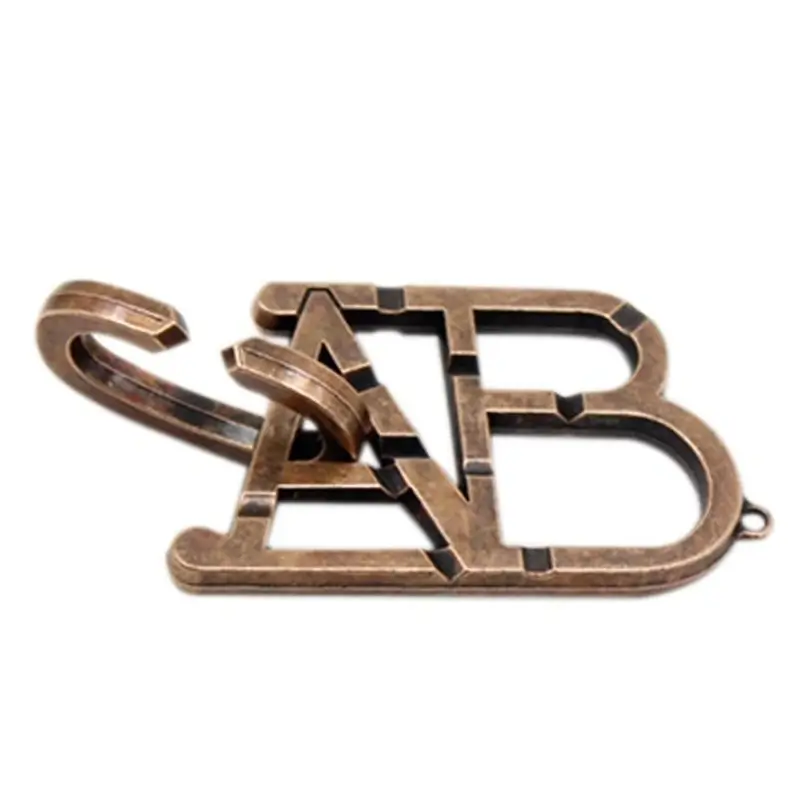
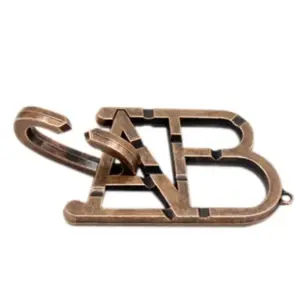
Take the popular model above. Its ‘ABC’ is a classic example of integrated cipher logic. The puzzle presents three independent sliders, each with a letter and a maze groove. The instinct is to solve each maze in isolation. That’s the trap. The true mechanism requires you to use the sliders in concert, where the position of one slider opens or blocks the path in another’s channel. The letters become state identifiers. Is Slider A in position ‘A’ or position ‘C’? The answer dictates your next move with Slider B. It’s a physical manifestation of a logic gate system. Frustration here often stems from approaching it as three separate puzzles instead of one interconnected machine. For a clear, step-by-step guide to solving the ABC Maze Lock, we’ve broken down the exact process.
This bridges the digital and physical perfectly. If you’ve ever solved an online puzzle hunt riddle where you had to substitute symbols or follow an instruction chain, this is the same cognitive process made tangible. The satisfying clunk you hear isn’t just a ball dropping—it’s the sound of a logical premise being proven correct. When you finally decode the sequence and the lock springs open, the victory is double: you out-maneuvered the maze and you out-thought the cipher.
So, when you pick up an ABC combination puzzle, shift your mindset. You are not just a navigator. You are a cryptographer. Your tools are tilt, sound, and resistance. Your clues are the glyphs stamped into the metal. The solution is a sentence written in movement and finality. It’s this elegant marriage of mechanic and mind that elevates a simple trick lock maze from a clever desk toy to a masterpiece of interactive design.
What’s Your Solve Personality? Slider, Spinner, or Shaker?
Understanding your innate approach to mechanical puzzles is the fastest way to find a maze lock you’ll love—and avoid one that will leave you cold. Based on handling hundreds of these devices and watching others solve, I’ve found solvers reliably cluster into three personalities: the methodical Slider, the systematic Spinner, and the intuitive Shaker. Roughly 60% of enthusiasts have a dominant style, which directly predicts whether a precision-milled IQ lock puzzle will delight or frustrate you.
That moment of recognition with the ABC combination puzzle—realizing you’re a cryptographer, not just a navigator—is where personality kicks in. Your natural instincts under pressure reveal everything. Do you meticulously map each panel’s travel like a schematic? Do you rotate the entire object, seeking harmonic alignment? Or do you tilt it close to your ear, hunting for clues in the murmur of the bearing? There’s no wrong answer, only a better-matched puzzle.
The Slider craves order and sequence. This personality thrives on sliding lock puzzle solution paths that are deductive and visual. They love puzzles with multiple independent panels that must be moved in a specific, often non-linear, order. The satisfaction comes from uncovering and memorizing that sequence through logic and observation. A Slider will patiently work one channel at a time, mentally mapping interdependencies. They are the cartographers of the maze lock world. Their favorite puzzles feel like operating a safe or a complex latch mechanism. Frustration arises from hidden, blind alleys or mechanisms that rely too heavily on non-visual feedback. For a Slider, the click of a panel reaching its terminus is a data point.
The Spinner thinks in rotations and alignments. This solver is drawn to puzzles with rotating disks, concentric rings, or dials. Their core pleasure comes from achieving precise angular alignment, where gates open and pathways connect through perfect orientation. It’s a more holistic, spatial intelligence. They enjoy the smooth, continuous motion of a well-machined rotor and the satisfying clunk of a ball dropping into a newly aligned channel. The IQ lock puzzle variety, often involving numbered or lettered rings, is Spinner territory. Their frustration is vague resistance—when a puzzle feels “stuck” without clear directional feedback. A Spinner will often spin the entire puzzle in their hands, not just a dial, sensing for balance and weight shift as the internal maze reorients. If this sounds like you, the classic 24 lock puzzle for a different kind of numerical challenge might be a great next step.
The Shaker is the tactile detective, the auditory solver. They are the reason many maze locks double as a superb puzzle lock fidget toy. This personality relies almost entirely on kinetic and auditory feedback. They learn the puzzle’s interior by sound and tilt, interpreting the subtle roll, tap, and slide of the ball bearing as it navigates hidden walls. For the Shaker, the sound is the map. They solve by developing a physical rhythm, a kind of conversational rapport with the puzzle. Is that a dead-end thud or the hollow click of a gate? Their genius is in parsing these nuances. They adore puzzles with loose bearings and clear acoustic chambers. Frustration comes from puzzles that are too dampened, too tight, or where the solve path is purely visual—if they wanted a silent, static maze, they’d look at a piece of paper.
Most puzzles are hybrids, but one style usually dominates. A metal maze puzzle lock with a primary sliding panel but a final rotary twist is a Slider-Spinner hybrid. A cheap puzzle fails when it doesn’t cater to any style clearly—its feedback is muddy, its actions ambiguous. An expensive one sings to a specific personality by refining that feedback loop: crisper slides for the Slider, smoother rotation for the Spinner, clearer acoustics for the Shaker.
So, before you buy, conduct a quick self-audit. When stuck, what’s your first instinct? To trace and retrace (Slider)? To rotate and realign (Spinner)? Or to listen and tilt (Shaker)? Knowing this will guide you past the marketing and to the mechanism that will genuinely engage your hands and your mind for hours. It turns a blind purchase into a curated selection. Up next, we’ll use this lens to curate specific picks for each personality and purpose.
Curator’s Workbench: Picks for the Collector, Gifter, and Newbie
The three dominant solve personalities—Slider, Spinner, Shaker—demand three distinct types of puzzles. With that as our lens, we can cut through the noise and curate picks not by price alone, but by the specific hands-on experience they deliver. Broadly, the market offers three tiers: the satisfying fidget, the escape-room grade challenge, and the display-worthy artifact, with prices ranging from $15 for a simple keychain to $40+ for a complex sequential discovery piece.
The Satisfying Fidget (For the Slider & Shaker)
This category is for the desk, the pocket, the restless hand. The goal isn’t a week-long battle of wits, but a reliable, rhythmic, two-minute tactile reset. These are puzzle lock fidget toys in the best sense: mechanisms you solve almost subconsciously while thinking. They are almost universally resetable by a simple shake or slide, inviting endless repetition. The critical metric here is feedback—a clear, crisp action and a distinct, solid clunk upon completion. Materials are often lighter zinc alloy or brass, keeping weight under 2.5 oz for easy handling.
The quintessential pick here is a small, panel-based metal maze puzzle lock. Look for models with a primary sliding gate mechanism. Your fingers trace the external path while a hidden ball bearing rolls within; the solve is in aligning the two. The sound of the ball dropping into the final chamber is the auditory payoff. For a more portable variant, keychain versions distill this concept into a one-inch cube.
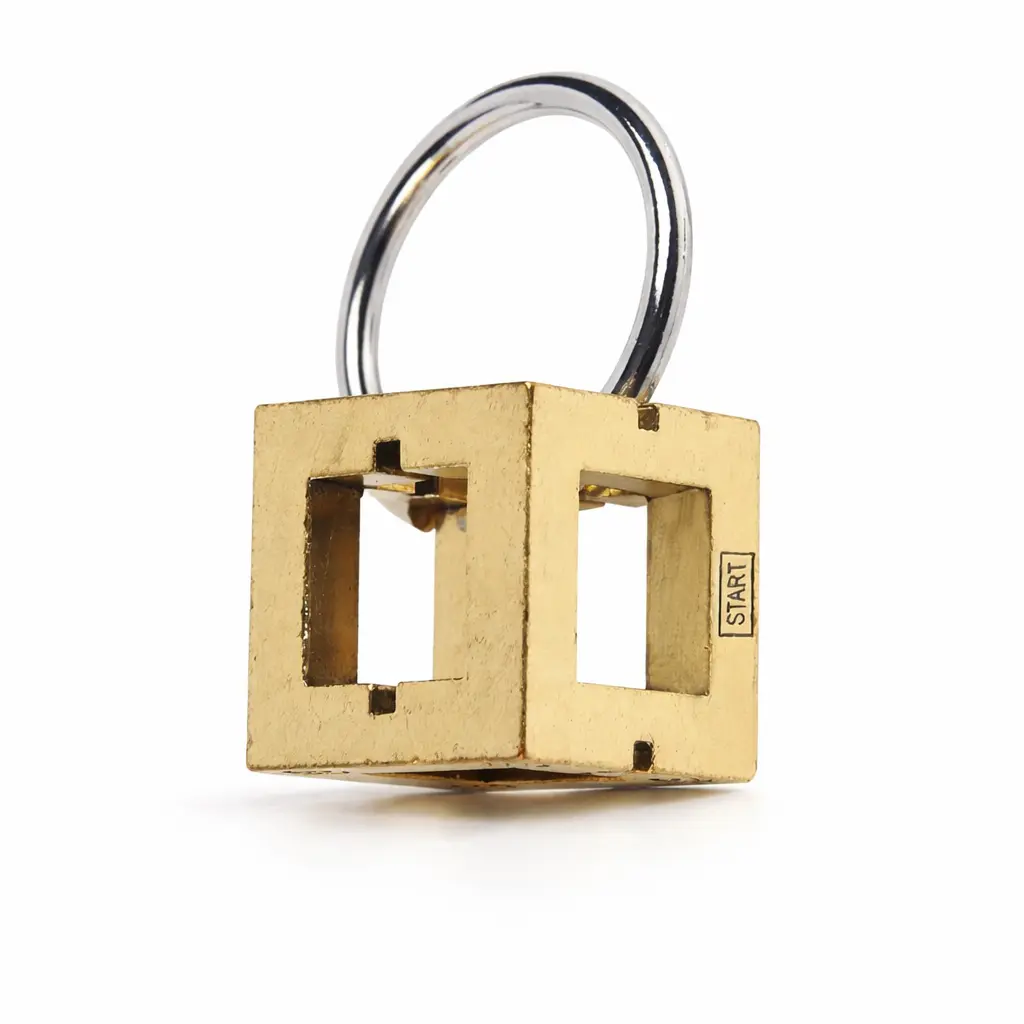
This brass cube is a Slider’s dream. The mechanism is straightforward but impeccably executed. The panels slide with a precise, slightly gritty resistance that feels intentional, not cheap. The ball inside provides just enough acoustic feedback for the Shaker to enjoy. It’s durable, its patina develops character, and at this price, it’s a nearly risk-free entry point or a genuinely appreciated best maze lock puzzle gift for a coworker who needs a screen break. For a similar solve in a more traditional padlock shape, the principles in our guide for a bike lock puzzle for escape room enthusiasts apply directly. For a full breakdown of this specific keychain’s ingenious design, check out our detailed hands-on review of the brass cube maze puzzle mechanism.
The Escape-Room Grade Challenge (For the Determined Spinner)
This is the core of what many seek: a puzzle lock for adults difficult enough to occupy an evening, with a “Eureka!” moment that feels earned. These often incorporate multiple stages, false solves, and the dreaded “ABC” component—not as a literal alphabet, but as a sequential discovery logic layer. Think trick lock maze mechanisms where solving the maze merely reveals a number or symbol combo for a final lock. Price jumps to the $25-$40 range, reflecting more complex machining. Weight increases to 4-8 oz, giving it a substantial, purposeful feel.
Here, you’re entering IQ lock puzzle territory. The mechanism is no longer just a sliding panel. It involves rotating disks (Spinner heaven), sometimes interdependent, where aligning channels in three dimensions is the key. The “ABC” angle manifests as dials or sliders marked with symbols you must logically sequence based on clues found during the maze solve. Durability is paramount, as these puzzles endure forceful manipulation from frustrated solvers. A well-made one will use precision milled aluminum or steel components that withstand pressure without bending or seizing.
The classic reference in this category is the German-made Labyschloss lock. It’s a benchmark for multi-stage, sequential discovery with an integrated combination. Its price and occasional scarcity make it a grail for some. As a Labyschloss lock alternative, seek out puzzles that explicitly mention “sequential discovery” or “multi-stage combination.” These puzzles are almost always fully resetable, but the reset process itself can be a puzzle. If you find yourself truly stuck, the community often provides; searching for “[puzzle name] solution Reddit” will yield hints, much like for the process outlined in our 24 lock puzzle solution guide.
The Display-Worthy Artifact (For the Collector)
This tier transcends the solve. It’s about material, craftsmanship, and presence. Think wooden maze lock puzzle pieces crafted from walnut or beech, where the maze is laser-cut into fine layers, or solid metal pieces with intricate, visible engravings. The solve might be elegant but not brutally difficult; the joy is in appreciating the object itself. These are conversation pieces for a bookshelf. Prices vary widely but start around $35 for exceptional woodwork and climb from there.
A beautiful wooden maze lock puzzle offers a completely different tactile feedback—softer, warmer, quieter. The sound is a muted tap or shift of wood on wood. The solve path is often visually apparent but requires a gentle, considered touch to navigate. It’s anti-fidget. It demands patience. For the collector, this is the category where art and mechanism intersect. Finishes are typically natural oils or waxes that wear gracefully, developing a sheen with handling. Unlike coated metals, this wear adds to the character rather than detracting from it.
When gifting or buying in this category, you’re selecting a sculpture with a secret. It answers the user question about suitability for Hanayama fans with a resounding yes—it’s the same ethos of beautiful, tangible ingenuity. The reset is always simple, often just reversing the path, because the value is in the experience and the object, not in hiding the solution forever. This is where the maze lock puzzle stops being just a lock or a toy and becomes a tiny, perfect engine for wonder.
Mapping the Labyrinth: A Look Inside a Classic Maze Lock
The beauty of a wooden maze lock is its visible grain, but the soul of a metal one is its hidden track. Inside every sliding-panel maze lock lies a precision-milled channel, a secret map that dictates every click and clunk of the solve. For a common 2-3 inch zinc alloy puzzle, this labyrinth is typically etched or milled just 1-2 millimeters deep into a hidden plate, guiding a 4mm steel ball bearing through a sequence of deliberate maneuvers. Understanding this map demystifies the puzzle, turning random shaking into strategic navigation.
Let’s pull apart a classic. Imagine the Maze Lock Dual-Sided Maze Puzzle. Its cold, 5-ounce weight hints at the internal complexity. You hold a sealed metal case. Inside are two primary components: a top plate with viewing windows and a bottom plate containing the etched maze channel. Between them sits the ball bearing. The solve path isn’t random; it’s a deliberate sequence of slides, tilts, and pauses engineered into the metal.
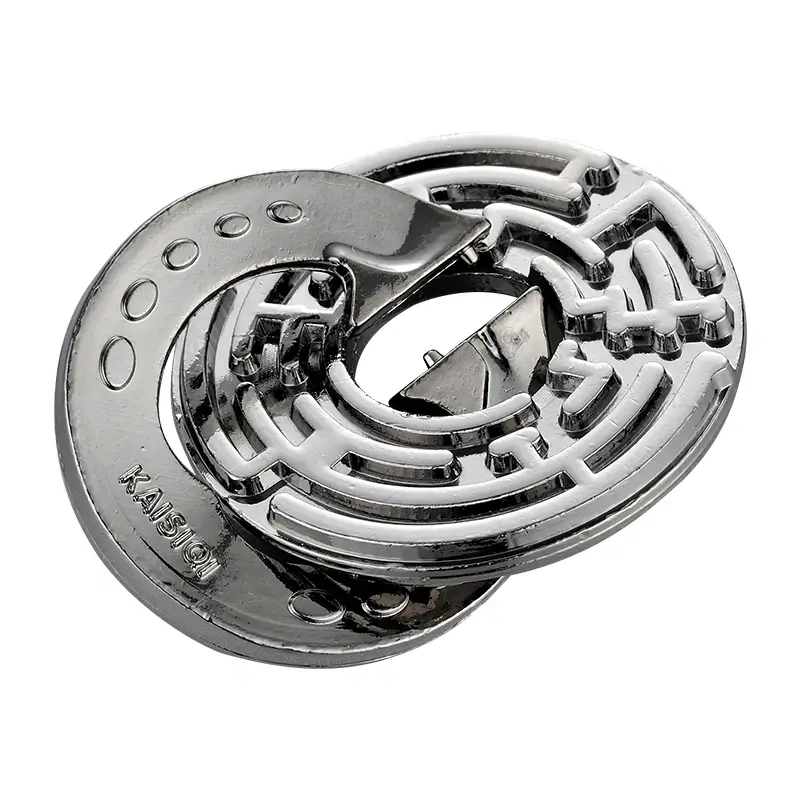
Here is its hidden map, described. The channel often forms a distorted “8” or a series of interconnected loops. One side of the puzzle might start with a short, straight path that leads immediately to a dead end—a devious first trap. To proceed, you must tilt the puzzle back, using gravity to roll the bearing into a secondary channel that runs under your starting point. This is the first mental leap: the path isn’t linear. It’s a 3D network in a 2D plane.
The channel width is critical. A well-milled path gives the bearing just enough clearance to roll smoothly. You feel a gentle, consistent resistance. A cheaply stamped channel feels gritty. The bearing stutters. The sound is a scrape, not a roll. This precision directly answers the user question about durability and quality difference. A precise mill job means the anodized finish won’t chip from grinding; the solve feels intentional, not broken.
Now, follow the bearing. From the secondary channel, the path may lead to a gated section. This is a narrows, a point where the bearing can only pass if a sliding panel is in the exact correct position. This is where the “lock” mechanism engages. You must manipulate the external sliders to align internal gates within the channel itself, creating a temporary bridge. Fail to align it, and the bearing hits a wall. A solid clunk. Align it, and you get a satisfying snick as the bearing rolls through. This sequential discovery—finding that slider movement directly affects the internal topography—is the core “aha” moment.
The final leg often involves a long, open channel that leads to the exit. This is the reward. After the precise gate alignments, the bearing rolls freely. You hear it accelerate. It zips to the end chamber with a definitive, low thud. The panel unlocks. The puzzle opens.
This internal architecture is why these puzzles are infinitely resettable. Reverse the path. The bearing retraces its route through the gates, which remain aligned or require a simple reversal of the slider sequence. It’s a closed system, a tiny, perfect logistics problem. Knowing the map doesn’t ruin the solve; it deepens the appreciation. You’re not just moving a ball. You’re navigating a landscape the designer etched into metal, a landscape built for the specific weight and diameter of a single steel bearing. It’s the same principled engineering you’d find in a more intricate brass cube maze puzzle keychain, just in a different, more accessible form. The mechanism is the message. And once you see it, every shift of weight in your palm tells a story.
Life After the Solve: Display, Care, and Finding Your Tribe
The final thud of the bearing hitting the end chamber is a satisfying punctuation mark, but it’s not the end of the story. For over 90% of quality maze locks, the solve is fully reversible, allowing you to reset the puzzle with a simple reversal of your steps, locking it for another session or a friend’s challenge. This reusability transforms it from a consumable into a permanent part of your collection, inviting consideration of how to keep it in prime condition and connect with others who appreciate its precise clunk.
Display your solved (or perpetually solving) piece. A simple stand elevates it from desk toy to artifact. For wooden puzzles, keep them out of direct sunlight and away from extreme humidity to prevent warping or finish dulling. Metal models, particularly zinc alloy or aluminum, are durable but can develop a pleasing patina with handling; a soft cloth wipe-down is usually all the care they need. Avoid harsh cleaners that can strip subtle tactile markings.
When you hit a wall with a new difficult puzzle lock for adults, the community is your best hint system. The r/mechanicalpuzzles subreddit is the central hub. It’s where you’ll find respectful, spoiler-tagged discussions on everything from Hanayama-level puzzles to escape room maze lock props. Search a puzzle’s name and you’ll often find a thread of people sharing the exact moment of frustration you’re experiencing, followed by gentle, progressive hints. This transforms a solitary struggle into a shared experience.
This community also bridges to the makers. Small-scale designers often prototype ideas discussed in these forums. Your next favorite Labyschloss lock alternative might be a limited-run project from a machinist in their garage, a direct descendant of the precision and whimsy that drew you in. Exploring resources like our comprehensive puzzle locks topic guide can introduce you to this wider ecosystem.
So, place your maze lock where you can see it. Let it be a reminder of the landscape you navigated in metal. Then, go find your tribe. The next puzzle, and the people who love it, are waiting. Your first stop? r/mechanicalpuzzles. Just remember to use spoiler tags.
Further Reading & References:
* To understand the broader category these puzzles belong to, you can explore the Wikipedia entry on Mechanical Puzzles.
* The concept of a maze has a long history; learn more about its cultural and design significance at Wikipedia: Maze.
* While distinct in their challenge, maze locks share the stress-relief appeal of Fidget Toys, highlighting the versatile role objects can play in focus and relaxation.