From Middle-Seat Misery to Mental Oasis: The Promise of the Pocket Puzzle
The promise of a portable brain teaser is simple: to transform a 90-minute tarmac delay or a middle-seat purgatory into a focused, rewarding screen-free mental workout, all without a single pixel. A truly travel-perfect puzzle must excel in four critical areas: pocket fortitude, silent operation, quick immersion, and replay value, shifting your mindset from passive endurance to active engagement. Unlike a dying phone, a well-chosen 2-ounce metal or spiral-bound puzzle offers a self-contained world of spatial reasoning that thrives where WiFi fails.
You know the scene. The cabin lights are dimmed, your phone battery blinks a dire 4%, and the chorus of snores and engine hum has morphed into a maddening loop. Your mind, craving engagement, starts to itch. This is the precise moment a pocket puzzle earns its keep.
It’s not about killing time. It’s about reclaiming it. As a former industrial designer turned puzzle collector, I see these objects as kinetic art—tiny machines for the mind. The solution isn’t another digital distraction; it’s the tactile feedback of a cold, anodized aluminum piece sliding into place. It’s the definitive snick of a perfectly machined part finding its home. That sound is a logic gate clicking shut in your brain, a small victory against the sterile boredom of transit.
This is the visceral alternative to scrolling: a deep, screen-free focus that calms itinerary anxiety and counters the sensory deprivation of cramped quarters. Your restless fingers and restless mind find a common purpose. (This is why the best puzzles for long flights no wifi aren’t just games; they’re cognitive anchors.)
But not every small puzzle is built for the chaos of a carry-on. Size is just the entry ticket. What separates a novelty from a travel companion is how it survives the journey—physically and mentally. What makes a brain teaser not just portable, but perfect for travel? The answer lies in a framework that prioritizes durability, discretion, depth, and design. Let’s build it.
Beyond ‘Small’: The Four Pillars of a Travel-Tough Brain Teaser
A truly travel-worthy brain teaser must excel in four specific areas beyond mere size: robust durability, discreet operation, rapid mental immersion, and layered replay value. This “Travel-Tough” framework, derived from road-testing over a dozen puzzles in actual transit, reveals that a premium durable travel puzzle is not just small, but engineered for the journey, with factors like a sub-5-ounce weight and zero loose pieces being non-negotiable.
Portability is a starting condition, not the finish line. To survive—and enhance—the rigors of travel, a puzzle needs Pocket Fortitude. This is structural integrity. It’s the confidence that your puzzle can live in a jacket pocket with keys, survive a drop onto airport tile, and endure the inevitable jostle of a bag under the seat without disintegrating or surrendering its parts to the abyss under 12B. Think one solid object (like a Hanayama Cast Puzzle’s zinc alloy construction) or a case that is the playfield (like Kanoodle’s 6 x 1.5-inch clamshell). No loose pieces means no frantic searches on a patterned airplane carpet. This pillar prioritizes puzzles built like kinetic armor.
The second pillar, Decibel Rating, is the unsung hero of considerate travel. It answers a critical user question: What’s a good puzzle that won’t annoy my seatmate? The ideal quiet brain teaser for plane travel operates at a library whisper or less. Magnetic slide puzzles often fail here with their distinct click-slide sound. A spiral-bound logic puzzle book is inherently silent, while a high-quality metal brain teaser, when manipulated with deliberate care, can offer near-soundless movement. (The decibel rating matters most on red-eyes or in the quiet car of a train—it’s a measure of your puzzle’s social grace.)
Next is the Focus Funnel—the puzzle’s ability to induce a state of deep flow quickly, even amidst boarding announcements and crying babies. This is cognitive architecture. A good travel puzzle acts as a “focus funnel,” drawing your scattered travel mind into a single, compelling channel of spatial reasoning or logic. It should have a low barrier to entry but a high ceiling of challenge, allowing you to bypass superficial distraction and engage within minutes. This is where sophisticated logic gates and clever mechanical interactions outperform simple dexterity toys; they give your anxious, itinerary-focused brain a concrete, solvable problem to latch onto, providing a genuine mental oasis.
Finally, Replay Architecture determines if your companion is a one-night stand or a lasting travel partner. A puzzle with a single solution (like some traditional disentanglement puzzles) has limited mileage. The best travel puzzles are systems, not just stories. Look for a “challenge booklet” with 120+ progressively harder problems (a hallmark of the SmartGames IQ series) or a mechanical design with multiple solution paths or extreme subtlety that demands repeated study to fully internalize. This pillar ensures the puzzle remains engaging across a weekend getaway or a multi-city tour, providing fresh mental terrain long after the first “aha” moment fades.
Together, these four pillars form a filter. They move us past vague claims of “fun” and into the realm of practical, satisfying performance. They help you identify the compact puzzle games for adults that isn’t just carried along, but actively relied upon.
Unpacking the Arsenal: Categories of Portable Puzzles for the On-The-Go Mind
Armed with the four-pillar framework, we can now map the landscape of single player travel puzzles, moving beyond generic labels to see how each category’s inherent form factor defines its travel persona. The right choice isn’t about the “best” puzzle in a vacuum, but about matching the puzzle’s physical and cognitive architecture to your journey’s specific constraints—be it a noisy train or a hotel room with limited table space. Let’s dissect the four dominant categories of portable puzzles.
Pack-and-Play Case Puzzles are the Swiss Army knives of the genre. Think SmartGames IQ series or Kanoodle: a book-sized plastic case, typically around 6 x 1.5 inches, that houses all components and doubles as the playfield. Their primary travel superpower is an impeccable Pocket Fortitude score; everything is latched shut, guaranteeing zero piece loss in a jostling bag. The Decibel Rating is often excellent—the soft plastic pieces make little to no sound. Where they truly shine is in Replay Architecture, often packing 120+ logic challenges of escalating difficulty into a single, slim volume. The trade-off? Focus Funnel can be slower. Setting up a challenge from the booklet requires a stable surface (your tray table works), and the logic is purely spatial, which for some, demands a quiet mind to engage. They are systems, not spontaneity.
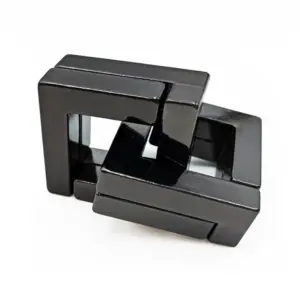
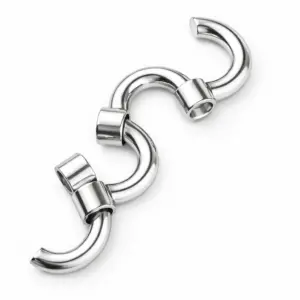
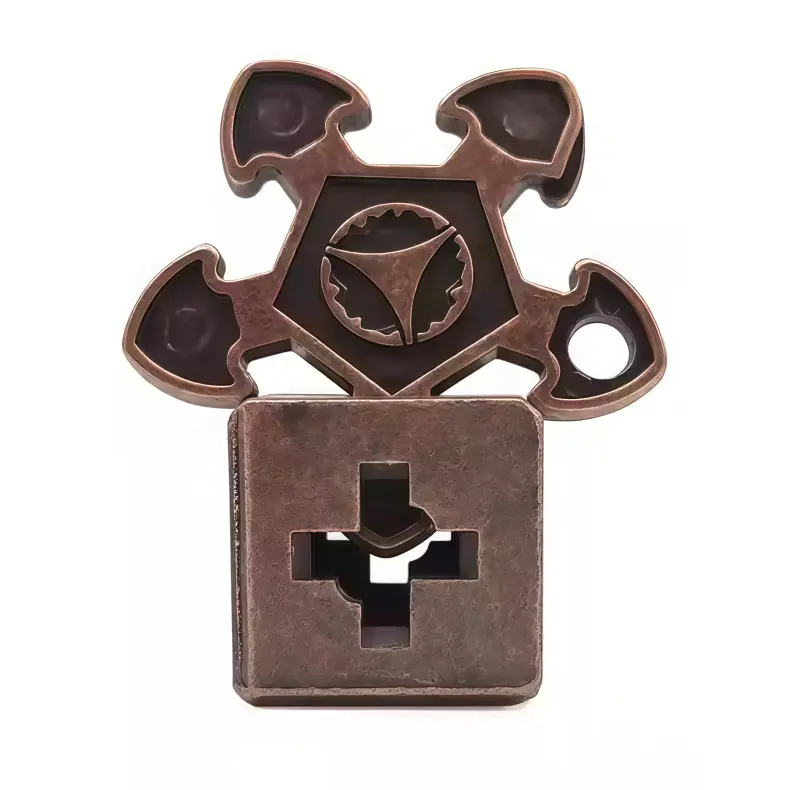
Handheld Mechanicals, epitomized by the Hanayama Cast series, are kinetic sculpture. These are single, self-contained objects—often machined from zinc alloy, weighing 2-4 oz—designed to be manipulated in the palm. Their Pocket Fortitude is legendary; it’s one solid, often anodized aluminum or metal piece with interlocking parts. The Decibel Rating varies wildly. A smooth,精密加工 puzzle might whisper, while others offer a series of definitive, satisfying clicks. (Test this at home before a quiet flight.) Their Focus Funnel is immediate and profound; the tactile feedback and spatial reasoning required create an almost meditative flow. The limitation is often Replay Architecture. Once solved, the mystery is spent, though the finest, like the infamous Shuriken Dart Edition, offer such a nuanced, multi-stage disassembly that re-solving them feels like re-reading a complex poem, revealing new layers each time. For a broader look at this art form, our guide to the most demanding cast puzzles is essential reading.
Spiral-Bound Book Puzzles represent the ultimate in minimal Packing Real Estate. These are not just books of puzzles, but books as puzzles—like the “Montague Island Mysteries” series popular on Reddit, where you solve a narrative mystery by folding pages, drawing lines, and decoding clues directly on the pages. Their Pocket Fortitude is absolute (it’s a book), and their Decibel Rating is library-perfect. The Focus Funnel is deep and narrative-driven, ideal for getting lost in a story. The Replay Architecture, however, is linear; once the mystery is solved, it’s done. This category is perfect for the traveler who wants a long, immersive, and utterly silent experience for a single journey, trading replayability for profound immersion.
Magnetic Slide Games are the modern evolution of the classic sliding tile puzzle. Pieces are encased under plastic or glass, moved via magnets or grooves. Their Pocket Fortitude is high—no loose parts—but their Decibel Rating can be a drawback, featuring a distinct click-slide sound that may not suit a sleeping cabin. Their Focus Funnel is quick, based on familiar pattern-matching logic. Replay Architecture is typically limited to a set number of pre-set challenges or one endlessly variable goal (like assembling a picture). They excel as visual-spatial distractions but may lack the deep, sequential logic bite of other categories.
Consider the Packing Real Estate visually: a chunky plastic case consumes a defined, wallet-sized slot in your bag. A spiral-bound logic puzzle book lays flat and thin against a laptop. A single metal cast puzzle disappears into a jacket pocket or the zippered mesh of a backpack, ready for instant deployment. This isn’t just about size—it’s about how the object integrates into the chaotic ecosystem of your carry-on, ready to transform a moment of dead time into a session of focused flow.
Deep Dive 1: The Silent Contenders – Spiral Books & Magnetic Mazes
For travelers who prioritize stealth and zero risk of piece-loss, two categories dominate: spiral-bound logic puzzle books and magnetic slide games. The spiral book, like the popular ‘Montague Island Mysteries,’ offers a Decibel Rating of zero and over 80 puzzles in a 5×8 inch footprint, while a magnetic maze provides a self-contained spatial challenge with a near-silent shfft of moving pieces. Both solve the “loose pieces under the seat” fear, but they engage the mind in fundamentally different ways.
Let’s apply the framework. First, the spiral-bound logic puzzle book. Its Pocket Fortitude is exceptional—it’s a folio of paper and ink, immune to baggage handlers. Its Decibel Rating is perfect silence, making it the undisputed champion for overnight trains, libraries, or a partner sleeping inches away. The Focus Funnel is deep but narrative-driven. You’re not manipulating an object; you’re entering a self-contained logic universe, cross-referencing clues on a grid to deduce who stole the artifact or what day the gardener worked. This is its neuroscience-lite superpower for travel: it substitutes itinerary anxiety with a controlled, solvable mystery. The Replay Architecture is vast, limited only by page count, and each puzzle is a fresh logic gate to navigate.
The Reset Problem simply doesn’t exist here. You turn the page. (This is its secret grace when you’re wedged in a middle seat.) The challenge is entirely cerebral, with no tactile feedback beyond the scritch of your pencil—a trade-off the pure logician accepts. For the traveler seeking a pocket-sized logic puzzle for adults that demands pure deduction, this is a pinnacle. It’s not a toy; it’s a portable case file.
Now, consider the magnetic slide puzzle. Imagine a glossy tile, often under a clear plastic window, that you guide through a labyrinth or into a target pattern with hidden magnets. Its Pocket Fortitude is also superb—a sealed, often credit-card-thin unit. The Decibel Rating is where we get nuanced. The best are near-silent, with a soft shfft of friction, but cheaper models can produce a plasticky click-tap with each move. Always test before a quiet flight. Its Focus Funnel is immediate and visual. This is spatial reasoning in its purest, most flow-inducing form. The benefit here is countering the physical confinement of travel; your mind expands into manipulating the virtual space of the puzzle grid, a liberating contrast to a cramped airline seat.
However, the Replay Architecture is often this category’s limit. Many offer one primary puzzle (solve the maze, complete the picture) with minor variations. The satisfaction comes from perfecting your route or beating your time, not from an endless supply of novel challenges. The Reset Problem is typically easy—just slide the piece back to the start—but can be frustrating if you’re dozens of moves deep and need to backtrack without a stable surface.
So, who wins in silent contention? It’s a choice between narrative and spatial cognition. The brain teaser book for travel is for the word-and-logic person who wants to disappear into a layered problem for hours. The magnetic maze is for the visual thinker who needs a kinetic, immediate spatial distraction. Both are stellar travel games with no loose pieces. The book offers infinite reset and absolute silence. The maze offers instant tactile engagement but a more finite replay loop. For the former industrial designer in me, the magnetic maze is a satisfying piece of consumer design—elegant, simple, purpose-built. But the puzzle collector knows the spiral book’s depth is hard to surpass when you’re three hours into a flight and the real world outside the window has faded away.
Deep Dive 2: The Tactile Icons – Hanayama Cast Puzzles & Kinetics
For the true connoisseur of tactile feedback, the silent, flat world of books and slides gives way to a more profound mechanical conversation. Enter the Hanayama Cast Puzzle and its kin: the quintessential metal brain teaser puzzle portable enough for any journey. Typically crafted from zinc alloy and weighing a satisfying 2-4 ounces, these are objects first, puzzles second—kinetic art that demands to be held. They score a perfect 10 for Pocket Fortitude; they are a single, dense, impossibly lost-piece-proof entity. But their true travel worthiness is a more nuanced tale of sound, satisfaction, and the infamous mid-flight Reset Problem.
This is where the industrial designer in me swoons. The machined finish of anodized aluminum or brass, the cool heft in your palm, the precision of a thousandth of an inch clearance between interlocking parts—these are puzzles built to the tolerances of a watch. The solve isn’t just visual; it’s a physical dialogue. You learn its language through subtle pressure, exploratory rotation, and that definitive snick of a correct move aligning. It’s a deeply personal, immersive focus funnel. (Forget the airport terminal; you’re reverse-engineering a miniature alien artifact.)
But let’s apply the framework ruthlessly. Decibel Rating: Variable. This is the critical travel differentiator. A puzzle like the Cast Marble or Cast Cylinder operates with muffled, internal rolls and shifts—a quiet companion. Others, like the Cast Labyrinth or Cast News, deliver louder, definitive clicks. On a Decibel Rating scale, you must choose your seatmate’s tolerance. The solve, however, is always a loud, gratifying series of metallic clicks in your mind.
Replay Architecture is their shared, beautiful flaw. Most have a single, elegant solution path. Once solved, the mystery is spent… for now. The high replay value doesn’t come from new challenges, but from the months-later reset, where muscle memory fades and you get to rediscover the logical sequence from scratch. It’s a long-game replay. If you’re new to the genre, a dedicated Hanayama puzzle buy guide can help you navigate the difficulty levels and find your perfect match.
So, which is the best Hanayama puzzle for travel with high replay value? For portability and a quieter, deeply sequential solve, the Cast Cylinder (or its sibling, the Cast Coil) is a top contender. It’s a compact disc of interlocking rings, offering a supremely satisfying series of aligned rotations. It feels less like a puzzle and more like operating a safe from a heist movie. These are classic examples of durable metal puzzles built to last a lifetime of journeys.
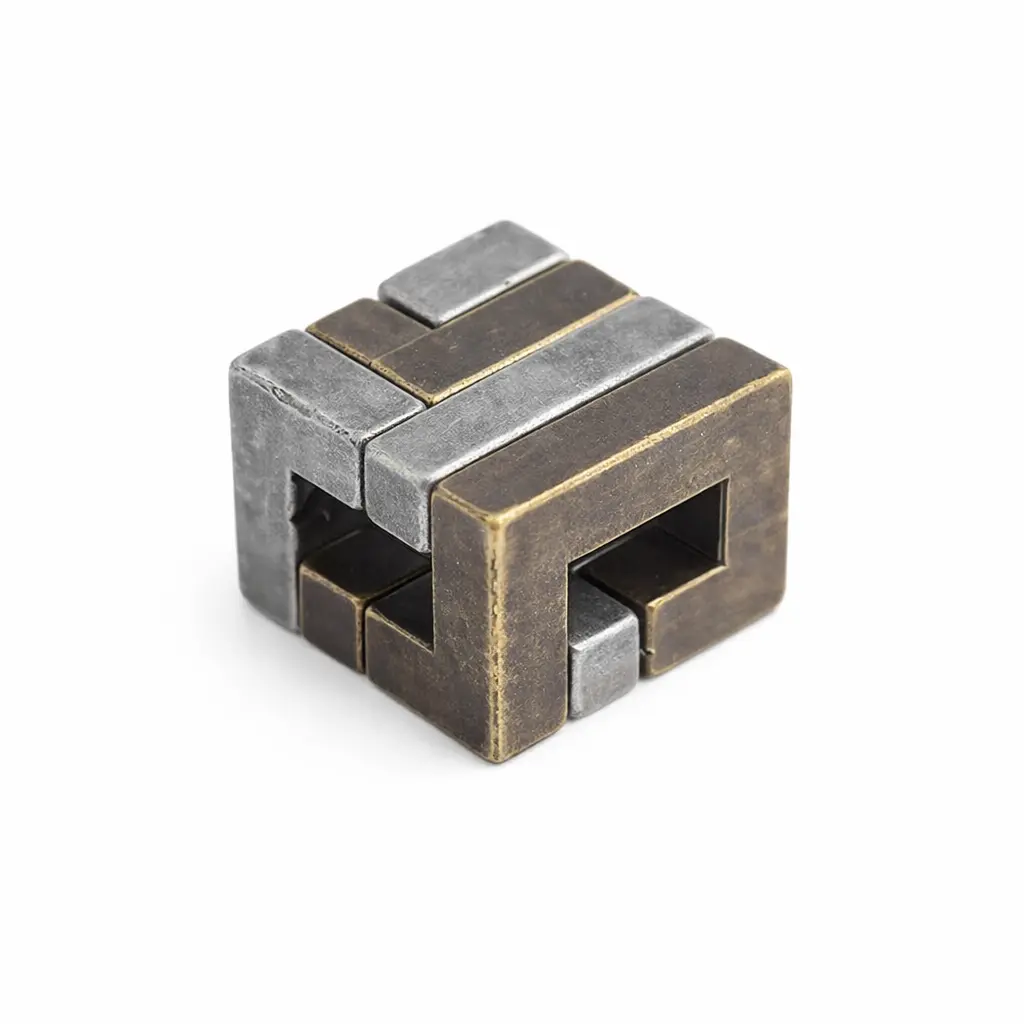
For those who want their mechanical puzzles for on the go to be literally keyed to their journey, the genre of puzzle keychains is unbeatable. They merge absolute portability (it’s on your keys!) with often-simpler, fidget-friendly challenges. The Brass Cube Maze Puzzle Keychain, for instance, presents a classic ball-in-maze challenge but executed in a gorgeous, clinking brass frame. Its Decibel Rating is higher, but as a keychain, it lives outside your bag, taking zero packing real estate. It’s a permanent travel companion for idle moments anywhere. For a full breakdown of this specific piece, see our Brass Cube Maze keychain guide.
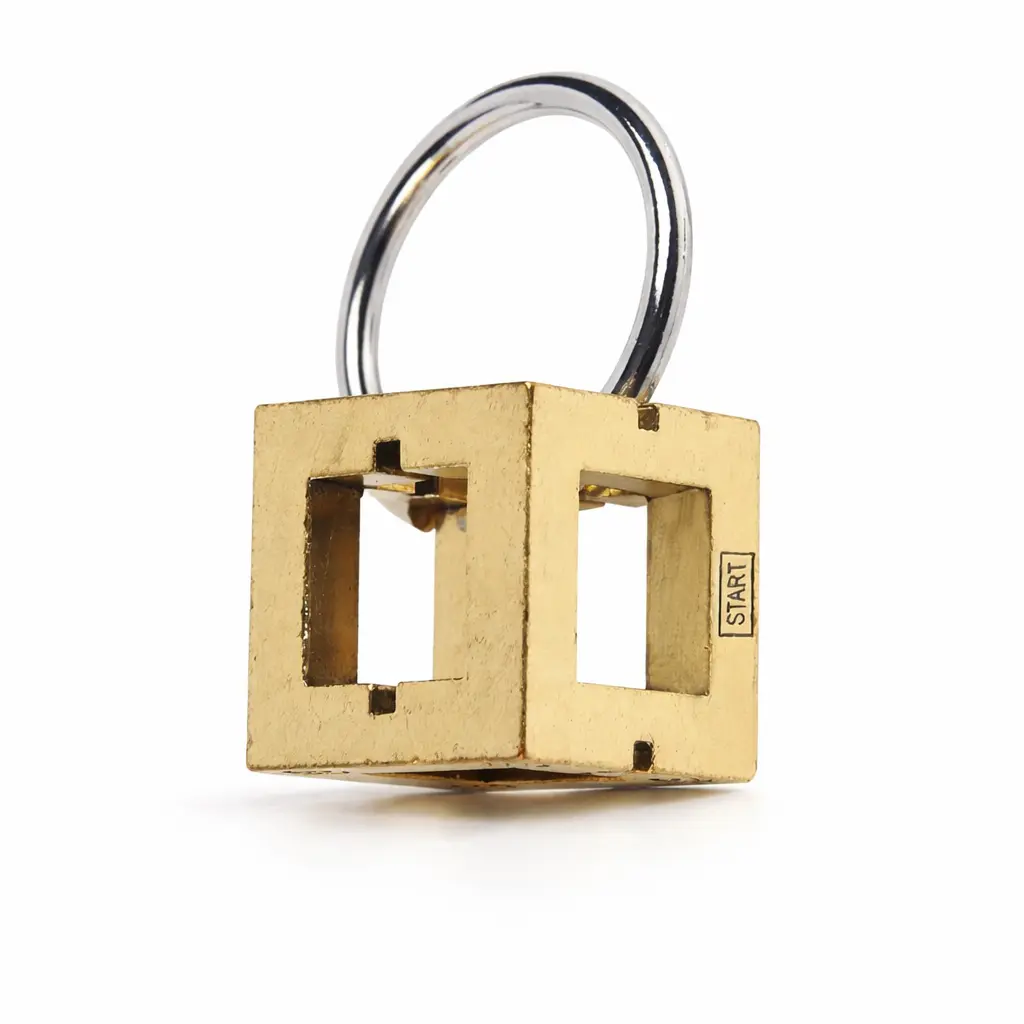
Now, the Reset Problem. This is the true test of a travel-tough mechanical puzzle. When you finally solve a complex interlocking cast puzzle at 30,000 feet, triumph quickly curdles into a new challenge: How do I get it back to the start without a table? Some, like the Cast Key, can be reset in hand through careful reversal. Others become a wriggling, semi-solved mess that demands a flat, stable surface—aka your downgraded tray table. My pro-tip: Before you travel, practice the reset blindfolded. If you can’t do it by feel alone, tucked in a coach seat, consider that puzzle more of a destination hotel challenge than an in-transit one. If you get perpetually stuck, a guide on how to solve metal brain teasers can be a lifesaver.
The tactile icons are for the traveler who views constraint as a catalyst for deeper appreciation. They offer no endless challenge booklet, just a single, perfect problem manifested in metal. They are the ultimate pocket-sized logic puzzles for adults who find as much joy in the object’s cold weight and flawless seams as in the solution itself. Choose for heft, choose for sound, but above all, choose for the sheer tactile pleasure of a world-class thing that just happens to be a prison for your curiosity.
Deep Dive 3: The Logic Labs – Pack-and-Play Case Puzzles
If the tactile icons are minimalist art, these are full laboratories of logic, delivering 120+ distinct challenges from a single, self-contained case. This category—exemplified by the SmartGames IQ series and Kanoodle—masterfully solves the Reset Problem by design, making them supremely practical for the restless, solution-hungry traveler.
The core genius here is the Replay Architecture. Unlike a single-solution cast puzzle, these are systems. A compact case, typically no larger than a passport, houses all components and doubles as the playing field. You’re given a challenge booklet with a target pattern, and your task is to arrange the provided pieces—be they twisted rods, pentominoes, or colored beads—to fit. The progression from ‘Starter’ to ‘Wizard’ is a masterclass in escalating cognitive load, perfectly calibrated to turn a two-hour flight delay into a focused session of spatial reasoning. (This makes them an outstanding answer for a bored teenager; the built-in progression provides a clear ‘next step,’ preventing frustration or disengagement.) The portable puzzle challenge is virtually endless.
Now, apply our framework. Pocket Fortitude is high, but with a caveat. The cases are durable plastic, and all pieces are tethered to the unit—zero risk of loss under the seat. However, consider the packing real estate. While slim, the classic clamshell case is a rigid rectangle. It won’t conform to a pocket’s curve like a spiral book or a single metal piece. This is a ‘dedicated pouch in your personal item’ puzzle, not a true jeans-pocket companion. Decibel Rating is nearly perfect. The soft plastic or rubberized pieces manipulate with a faint, inoffensive rustle or tap. You could solve these in a quiet train car without a single dirty look.
The Focus Funnel, however, is where these puzzles truly differentiate themselves for travel. They are logic gates made physical. For the traveler whose mind is buzzing with itinerary anxiety or cramped-quarter irritability, the act of working through a predefined, sequential challenge provides a structured mental runway. It commands a specific type of attention—less about abstract tactile exploration, more about directed problem-solving—which can be profoundly calming. This makes them a top contender for the query: best IQ twist or fit for travel when the goal is structured engagement without open-ended frustration.
But let’s get to the critical, real-world pro tip promised earlier: resetting an IQ Twist in a cramped seat. The puzzle is solved when all pieces fit flat. To reset, you must pop them out. Without a table, this can feel like defusing a bomb. Here’s the method: Cup the open case in your left hand. Use the thumb of your right hand to press firmly and vertically down on the edge of one piece, leveraging the case’s own rim as a fulcrum. It will pivot up and out cleanly, caught safely in your cupped palm. Repeat. It’s a quiet, controlled operation that proves these puzzles are engineered for real-world use.
Are they exhausting on a long-haul flight? The beauty of the challenge booklet is that you control the intensity. You can bash your head against a ‘Master’ challenge, or you can cruise through a few ‘Starter’ levels for a satisfying, low-stakes mental stretch. It’s this scalability that makes them a versatile pocket puzzle challenge for any segment of a journey. They are the workhorses of the travel puzzle world: not always the most glamorous objects on their own, but unparalleled in delivering dense, varied, and perfectly contained cognitive engagement mile after mile. For official details on a classic in this category, see the manufacturer’s page for the Kanoodle Game.
The Traveler’s Matchmaker: A Decision Matrix for Your Journey
Choosing your travel companion shouldn’t require another puzzle. It’s the final step of our framework: aligning the perfect portable brain teaser puzzle with the specific texture of your journey, from a chaotic airport terminal to a quiet hotel balcony. Based on the four pillars and our deep dives, this matrix is your final tool. Forget generic lists; this is about finding the object whose pocket fortitude, decibel rating, focus funnel, and replay architecture map directly to your trip’s constraints and your mind’s cravings.
For the Anxious Flier or Quiet Commuter: You need absorption without audible disturbance.
* Primary Need: A low decibel rating and a strong focus funnel to override travel stress.
* Your Match: Spiral-Bound Logic Puzzle Books or Magnetic Slide Games. The book is utterly silent and offers narrative immersion—ideal for calming itinerary anxiety through structured logic. A quality magnetic slide puzzle provides quiet tactile manipulation; the soft click-slide is often masked by ambient noise. These are your definitive quiet brain teasers for plane travel and library-quiet trains.
* Best For: Long-haul red-eyes, packed commuter trains, or any scenario where you share close quarters with sleeping travelers.
For the Weekend Warrior or Minimalist Packer: Your bag space is precious, and your trip is short.
* Primary Need: Maximum pocket fortitude in a minimal footprint. The satisfaction-to-packing-cube-ratio must be exceptional.
* Your Match: A Hanayama Cast Puzzle (specifically level 4-5 for depth). Options like Cast Vortex or Cast News are exemplary metal brain teaser puzzle portable units. They occupy less space than a wallet, weigh 2-4 oz, and survive a pocketful of keys. The single-object, no-loose-pieces design is the ultimate durable travel puzzle. You get one deeply satisfying spatial challenge that feels like kinetic art. The process of choosing your metal brain teaser is part of the fun.
* Best For: Weekend getaways, business trips, or as a constant “just-in-case” pocket puzzle challenge living in your everyday carry.
For the Logic Purist or Long-Haul Strategist: You want depth, variety, and a system to master.
* Primary Need: High replay architecture. You’re not solving a puzzle; you’re learning a logic system over hours.
* Your Match: Pack-and-Play Case Puzzles like the IQ series or Kanoodle. Their 120+ challenges in a case are a compact puzzle game for adults that functions as a self-contained logic gym. They are the definitive single player travel puzzles for building sequential reasoning skills, perfect for countering the mental fog of a 10-hour flight. The case-as-board solves the reset problem neatly.
* Best For: International flights, long train journeys, or hotel isolation where you can methodically work through a challenge booklet from starter to master levels.
For the Tactile Seeker with Itchy Fingers: Your brain engages through your hands. You crave tactile feedback and mechanical intrigue.
* Primary Need: A deeply satisfying physical interaction and complex spatial reasoning.
* Your Match: Higher-level Hanayama puzzles (Level 6) or sophisticated mechanical puzzles for on the go like the Puzzle Twist types. These are objects you fidget with intelligently. The process of discovering moves through weight, balance, and hidden mechanisms provides a deep, screen-free flow state. The definitive snick of a correct move is a private reward. (This is the category for the Reddit user asking, “I love Hanayama—which one has high replay value?”—look for multi-stage disassembly puzzles like Cast Laby).
* Best For: Road trips (as a passenger), coffee shop downtime, or any journey where you can appreciate an object’s machined finish as much as its solution.
Let’s simplify it further. Ask yourself two questions at the baggage drop:
1. What’s my primary trip environment? (Noisy/Shared, Cramped, Isolated/Quiet)
2. What’s my primary mental goal? (Calm Anxiety, Kill Time, Seek Deep Challenge, Satiate Tactile Hunger)
Your answers point you to a category. From there, you’ve already done the hard work. You understand the packing real estate of a chunky case versus a slim book. You know how to silently reset an IQ Twist mid-flight. You see puzzles not as toys, but as elegantly engineered tools for focus. Now, the only journey left is the one happening between your hands and your mind.
Pro Packing & Play: Etiquette, Reset Hacks, and Tactile Travel Lore
The final piece of the travel-tough puzzle isn’t a product—it’s the practiced art of integrating these objects into your journey. Based on a month of road-testing in coffee shops and cross-country flights, proper packing and etiquette are what transform a good puzzle from a potential nuisance to a seamless travel companion. For example, storing magnetic slide puzzles flat and separate prevents unintended magnetization that can ruin the challenge.
Packing for pocket fortitude means treating puzzles like precision instruments. Keep metal puzzles in their included pouches or a soft glasses case to prevent scratches and muffle any potential sound in your bag. Spiral-bound books are hardy, but a rigid folder in your personal item prevents a bent spiral from ruining your spatial reasoning. This solves the hidden “reset problem” before it starts.
Now, for the Decibel Rating in practice. On a quiet train or red-eye, your puzzle’s soundscape matters. The click-slide of a magnetic game or the faint rustle of a puzzle book page is acceptable. The definitive snick of a Hanayama cast piece separating, however, is a sound best reserved for moments when your cabin mates are awake. (If you must solve a clacky one, do it muted under a blanket—a true Reddit-approved hack.)
The mid-flight reset is the ultimate test. For case puzzles like IQ Twist, use the lid as a stable tray on your lap to corral pieces. For a Hanayama, the solution is often reverse-engineering; the same tactile logic that got it apart will get it back together (and if you’re stuck, this guide to the real way to solve metal puzzles is invaluable). This addresses the last nagging user question: no, pieces won’t roll away if you treat the puzzle as a self-contained system.
Your confident decision is now complete. You’re not just packing a distraction. You’re carrying a tactile key to a better state of mind, a physical entry point into the vast and satisfying world of mechanical puzzles. Go find that moment—perhaps in a sun-dappled airport chair—where the only journey that matters is the silent, satisfying click of a perfect move.