Quick Answer: Which Metal Grenade Lock Puzzle to Buy at Each Budget
The “metal grenade lock puzzle” keyword covers three distinct price tiers — a sub-$10 budget cast alloy version, an $11–15 mid-tier cast metal brain teaser, and the authentic Hanayama at $25+ — and the $8 version is mechanically a different product from the $25 one despite identical-looking product photos.
| Budget Tier | Best For | Price | Skip If |
|---|---|---|---|
| Sub-$10 Budget (AliExpress, Temu, Shein cast alloy) | First-timers curious about a metal disentanglement puzzle who don’t want to risk more than a takeout lunch | ~$8–12, often shipped from overseas sellers with CE-marked packaging | You expect the tooth-and-ring mechanism to feel precise — budget cast versions frequently arrive with rough teeth that bind mid-solve, and quality swings wildly from listing to listing |
| $11–15 Mid-Tier (Tea-Sip cast metal brain teaser) | Most adult buyers — clean cast construction, reliable tooth engagement, and the best balance of price and tactile honesty at this price point | $11.98 at Tea-Sip | You’re a collector who specifically wants the Hanayama-branded box on the shelf, or you already own one and want a harder next step |
| $25+ Premium (Hanayama cast metal brain teaser) | Hobbyists and gift-buyers who want the authentic Japanese cast metal brain teaser with a recognized finish that holds up to repeated handling | ~$25+ at specialty puzzle retailers | You’re on a tight budget, or you’ve never solved a two-piece metal disentanglement puzzle before and aren’t sure you’ll enjoy the format |
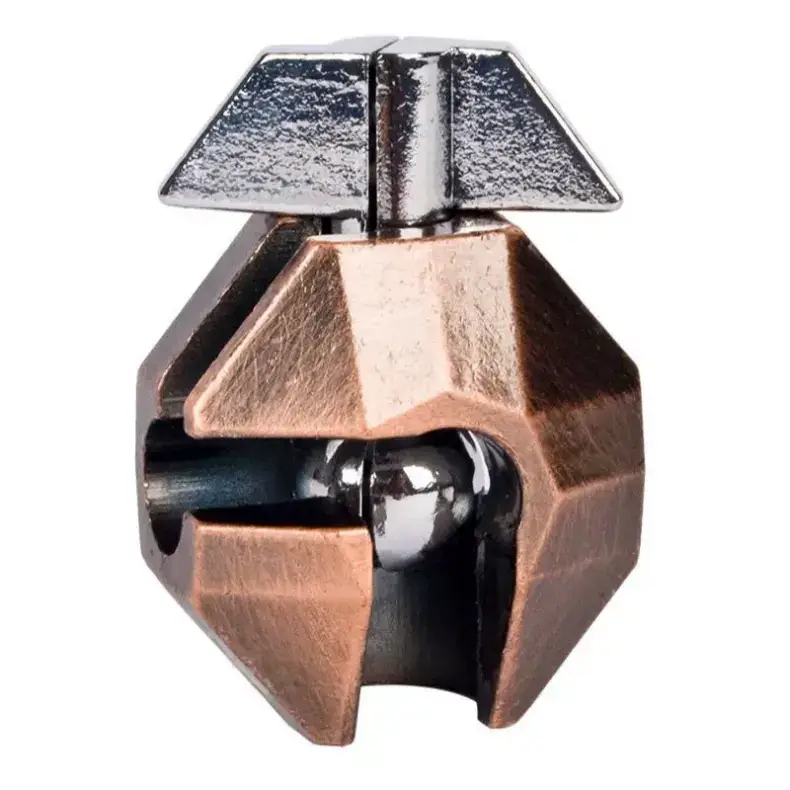
The short version: The Tea-Sip Metal Grenade Lock Puzzle at $11.98 is the top pick for most buyers — it sits in the mid-tier where cast quality is reliable, the tooth engagement is clean, and the price is roughly half what you’d pay for the Hanayama. The budget $8 versions technically work but gamble on a miscast part. The Hanayama is a genuine cast metal brain teaser, worth the premium only if you specifically want the Japanese-made original or you’re adding to a collection.
Why One Keyword Returns Three Different Products: The Grenade Lock Tier Problem
A search for the metal grenade lock puzzle returns listings from $8 to $30+ that share a name but differ in mechanism quality, weight, and plating. This price spread isn’t market inflation — it reflects three genuinely different products sold under one keyword, each with distinct internal tolerances and finish quality.
The Quick Answer section just pointed you toward a $11.98 mid-tier pick. That’s the right call for most people. But to understand why it sits where it does in the market — and what you’re actually trading away at the $8 and $25 ends of the spectrum — you need to know how the grenade lock market got so fractured in the first place. The short version: one original design, three factory tiers, and almost no transparency about which is which.
The three tiers, in plain terms:
Tier 1 — Budget cast alloy ($8–$12). These are the listings you’ll find on AliExpress, Temu, and Shein, often listed as a 3D unlock puzzle, CE-marked and marketed as an educational toy to both children and adults. The cast alloy is typically a zinc-based mix, the pieces are noticeably lighter in the hand than mid-tier or Hanayama versions, and the internal tooth-and-ring mechanism is functional but rough. Tolerances are loose. When they work, they work. When they don’t, the buyer usually assumes they broke the puzzle.
Tier 2 — Mid-tier rebranded cast ($12–$15). This is the category the Tea-Sip Metal Grenade Lock Puzzle at $11.98 falls into, alongside a handful of other direct-to-consumer puzzle shops. The factories are largely the same Chinese foundries producing Tier 1, but the buyers specify tighter tolerances, better plating, and pre-shipment inspection. The result: a grenade lock that solves smoothly out of the box, holds its finish past extended use, and has a tooth engagement that feels deliberate rather than accidental. It’s the same design as the $8 version — same two pieces, same basic silhouette — built to a different spec.
Tier 3 — Hanayama ($25+). The Hanayama is the original. It’s a cast metal brain teaser from a recognized Japanese manufacturer, widely described as a tricky design. The finish is tighter, the weight is heavier in the hand, and the click when teeth engage has a watchmaker’s precision. Hanayama typically sells through specialty retailers rather than direct to consumers in most regions, and the price reflects both the manufacturing standard and the distribution chain. Buyers who have compared side-by-side consistently report tighter tolerances than the Chinese cast versions. The mechanism is excellent, and that excellence is exactly what you’re paying for.
Why this happens. The grenade lock originated as a Hanayama design — a mechanical puzzle in the classic disentanglement puzzle family, two pieces that must be fully separated and reassembled through a specific sequence of rotations. Once the design existed, it was reverse-engineered and white-labeled by Chinese factories within a few years. Those factories now produce for every tier: the cheapest runs go to marketplace sellers with minimal QC, the mid-tier runs go to direct brands that care about repeat customers, and Hanayama continues to make their own version in Japan to a separate standard entirely. Same blueprint. Three production lines. No shared quality control.
Two pieces. That’s the whole puzzle.
The practical consequence for a buyer is this: the keyword “metal grenade lock puzzle” doesn’t point to a product. It points to a category. And within that category, the $8 to $30 range isn’t a quality gradient — it’s three different products that happen to share a name and a silhouette. The 7 tests that prove the Hanayama vs generic cast price gap walk through the difference in weight, plating durability, and mechanism feel across all three tiers. The Quick Answer recommendation at $11.98 is the tier where cast quality, plating durability, and mechanism smoothness all line up without requiring you to pay the Hanayama premium or gamble on a marketplace listing.
Inside the Metal Grenade Lock: The Tooth-and-Ring Mechanism Explained
The metal grenade lock consists of two cast pieces that must be disassembled and reassembled through a specific sequence of rotations. Sourced catalogs describe the design as two cast halves with an internal interlocking tooth arrangement that holds the puzzle together until the correct move sequence is applied.
Two pieces. That’s the whole puzzle.
Except not really — because the two pieces are doing a lot of talking to each other on the inside.
Pick up any grenade lock and the silhouette tells you almost nothing. The grenade shape, the little lever on top, the seam where the two halves appear to meet — that’s all cosmetic. The actual mechanism is hidden inside the ring, and it works like this: the inner component sits inside the outer ring, held in place by an internal interlocking feature that has to be sequenced in the right order before the two pieces will separate. One source describes the solution as a “tilt-and-slide angle to release the pin from the grenade body” — a mechanical move rather than a strength move. Your job is to find that sequence and let the mechanism release.
The solution involves a short sequence of distinct moves, and here’s the part most buyers don’t realize: the exact moves can differ between production runs and tiers. What works on a clean mid-tier cast may bind or jam on a budget copy because the internal geometry of the cast isn’t held to the same standard.
That mechanical honesty is what “smooth tooth engagement” actually means. When you rotate the inner piece inside the ring on a well-made version, the internal features ride over each other with a firm, even click — each tooth landing in its notch with a small, satisfying tactile event. You can feel the detents. On a budget cast version, the same rotation feels mushy. The teeth don’t click into place; they slide. Sometimes a tooth catches partway and binds, and a buyer who hasn’t handled the good version assumes the puzzle is defective. It isn’t defective. It’s just out of tolerance — the cast alloy didn’t fill the mold cleanly, and the tooth that should be a sharp ridge is a soft hump instead.
The internal spring force is the other piece of the puzzle most reviews skip. On a well-made version, the spring tension is calibrated so the inner piece resists your input just enough to make each move deliberate, then releases decisively when the teeth clear the final position. In a cheap cast version, the spring force is either too soft (the piece feels loose and the puzzle falls apart before you’ve earned the solution) or too stiff (the teeth never align because you can’t compress the piece far enough to clear the obstruction). Both failure modes look like a broken puzzle. Neither is a broken puzzle. Both are manufacturing shortcuts in the cast tolerance.
So when you see an unboxing video of a grenade lock and the reviewer is rotating the two pieces back and forth trying to find the release, pay attention to what you hear. A clean, watch-like tick-tick-tick as the teeth engage means the cast is sound. A gritty scrape or a vague sliding sound means the teeth didn’t form properly in the mold, and no amount of solving is going to make that version feel right.
That’s the baseline. Now you know what the inside of a grenade lock is supposed to do, and — more importantly — what it sounds and feels like when it isn’t doing it.
Sub-$10 vs $12-15 vs $25+: Three Price Tiers Side by Side
Now that you know what the inside of a grenade lock is supposed to feel like — that clean, watch-like tooth engagement with a decisive release — the next question is obvious: which price tier actually delivers that feeling? Because the market for “metal grenade lock puzzle” is not one product at three prices. It’s three genuinely different objects hiding behind a single keyword, and the differences show up the moment you start turning the two pieces in your hand.
The sub-$10 budget grenade lock (~$8-12 on AliExpress, Temu, and Shein) typically uses an unspecified zinc alloy in a lighter cast, the $12-15 mid-tier rebrands the same Chinese cast with better QC and tighter tolerances, and the $25+ Hanayama uses a refined cast alloy with hand-finished tooth engagement.
Tier 1: The $8-12 Budget Cast Alloy
Budget grenade locks from marketplace sellers typically arrive in minimal packaging, and the first thing most buyers notice is the cast finish — rough at the grenade’s pin seam, with a faint mold line visible to the eye. On the first test solve, the tooth mechanism can grind audibly: a scratchy, metallic scrape that suggests the teeth haven’t been post-finished after the cast.
These budget versions typically ship with CE certification, target both children and adults in their listings, and use an unspecified “alloy” or zinc alloy in their spec sheets. The two-piece disentanglement mechanism technically works, and you can solve the grenade lock puzzle, but the tactile honesty isn’t there. A common failure mode is the plug feeling either too soft or too stiff, leading buyers to assume the puzzle is broken when the cast is simply inconsistent.
The honest tradeoff: if you want the grenade lock shape on your desk for under ten dollars, this tier delivers the visual. Don’t expect the tooth engagement to match a higher-tier grenade lock puzzle review. The plating on a typical budget cast will show wear at the high-contact points after frequent handling — a natural result of soft cast metal against itself.
Buy this tier for the shape, not the mechanism.
Tier 2: The $12-15 Mid-Tier — The Best Value for Most Buyers
This is the sweet spot, and it’s where the Metal Grenade Lock Puzzle from Tea-Sip sits at $11.98. It currently holds a 4.96/5 rating from 5 customer reviews, and the difference from the budget tier is immediately tactile. The cast finish is cleaner, the mold line barely visible, and the tooth engagement has that decisive tick-tick-tick described above.
The mid-tier is still a Chinese cast — the same factories supply this price range — but the QC is tighter. The spring pocket is more consistent, the teeth are post-finished enough to engage smoothly, and the plating holds up better over repeated solves. At around $12, this is the version to hand to someone who has seen the grenade lock on social media and wants to know what the actual experience feels like. It’s a cast metal brain teaser under $20 that respects the ingenuity mechanism.
For most buyers, the mid-tier grenade lock is the right buy. The mechanism works the way it’s supposed to, the finish holds up over time, and you’re not paying a premium for the brand name attached to the $25+ tier. If you want to know whether you like this category of metal puzzle before committing to a collector price, this is the version that answers that question honestly. First-time solvers should expect a meaningful sitting — fast enough to feel achievable, slow enough to feel earned.
For most buyers, this is the grenade lock to buy.
Tier 3: The $25+ Hanayama — For Collectors and Completionists
The Hanayama version from Japan is a different category of object. It’s a cast metal brain teaser in the middle of their line, with a denser cast, hand-finished tooth engagement, and spring tension calibrated so each move feels deliberate.
The difference between a Hanayama and a budget cast is the difference between a wind-up watch and a quartz movement. Same basic interlocking mechanism. Different universe of execution. The Hanayama is the grenade lock you buy if you already know you like mechanical puzzles, if you’re a collector working through Hanayama’s catalog, or if you want a pocket puzzle that will outlast a decade of fidgeting. It’s a premium metal object the budget cast is not.
The tradeoff is straightforward: you’re paying roughly 2.5x the mid-tier price for a mechanism refinement that most casual solvers won’t consciously register on a first solve. If you’ve never held a high-end cast puzzle, the mid-tier will feel excellent. If you have, nothing else will.
Only buy this tier if you already know you want it.
Which Tier You Should Actually Buy
If you’re buying a grenade lock because you saw it on TikTok and want to know what the fuss is about, the Tea-Sip mid-tier at $11.98 is the right call — it’s the version that delivers the real mechanism at a price that doesn’t ask you to commit to a hobby. If you’re a hobbyist who already owns three or four Hanayama cast puzzles and this is the next one for the shelf, the $25+ tier is the only tier. If you’re just looking for the cheapest version of the shape, the $8-12 tier exists — but the internal mechanism is what was cut to hit that price.
What Smooth Tooth Engagement Actually Feels Like: A Hands-On Quality Checklist
On a quality grenade lock, each tooth engagement produces a distinct, repeatable click with consistent spring resistance; on a miscast budget version, the same motion produces a grinding, mushy, or variable resistance that the buyer mistakes for the puzzle being too tight.
Now that you know which tier matches your budget, here’s how to know within the first ten seconds of holding one whether the specific copy in your hand is worth keeping — or whether you just paid shipping for a miscast part that will never solve cleanly.
The Two-Sound Rule
Every working grenade lock produces two distinct mechanical sounds as you rotate the ring. A spring sound — the soft resistance of the internal coil as it tracks the track groove — and a tooth sound, the sharper click when the internal tooth drops into or out of a notch. On the Hanayama and on a well-cast mid-tier grenade lock, those two sounds are clearly separated in your ear. On a budget cast where the tooth profile is incomplete or the spring is undersized, you get one mushy sound. That’s the mechanism telling you the cast tolerance failed.
Five Checks Before You Solve
Run through this on first unbox — before you’ve even tried to take it apart:
- Ring rotation — Turn the ring 360 degrees with no internal pressure. It should rotate with even resistance. Lumps, sticky spots, or a section that “catches” indicate a miscast inner race.
- End-stop feel — At the rotation limits, you should feel a firm mechanical stop, not a soft spring wall. Soft stops mean the cast tooth is rounded where it should be square.
- Weight in hand — A genuine cast grenade lock feels like a dense pocket coin. Mid-tier and Hanayama versions feel substantial in the hand; sub-$10 cast copies often come in noticeably lighter because the metal casting uses less material.
- First tooth engagement — Apply inward pressure on the ring while rotating. The first click should occur at the same rotational position every time you reset the puzzle. Inconsistent engagement point = the tooth and notch aren’t mating properly.
- Two-solve test — Solve it twice in a row without forcing. If the second solve requires more force than the first, the spring is binding against the cast wall — and it will only get worse.
The Long-Use Tell
Plating wear tells the truth about casting quality. After extended use, the high-contact points on a budget cast start showing base metal through the finish — usually at the ring’s rotation peaks where finger pressure concentrates. The mid-tier holds longer because the plating thickness is more consistent across the surface. A Hanayama will outlast both, not because the plating is magic, but because the cast underneath is dimensionally stable enough that the plating doesn’t get micro-abraded by internal misalignment.
What to Do If Yours Fails the Checks
Don’t assume the puzzle is broken. Assume the cast is bad. A miscast grenade lock isn’t a “harder” version of a good one — it’s a version where the mechanism was never properly machined in the first place. Return it and pick another from the same listing, or step up a tier where the casting tolerance is monitored rather than hoped for.
For a deeper breakdown of what your hand should be feeling during the cast quality test, the 5 in-hand tests that spot a knockoff grenade lock walks through the same diagnostics with video reference.
Difficulty, Real Solve Times, and Why Cheap Cast Versions Bind
The grenade lock sits in the middle of the cast metal brain teaser difficulty range, and adult first-time solvers on a clean cast typically take a focused sitting to find the path — while budget cast versions turn that window into a frustration session where the buyer believes the puzzle is jammed rather than solvable.
That’s the real story behind the difficulty label on the box. It isn’t a speed-puzzle metric. It isn’t a “genius-only” warning. It’s a mid-range rating where a patient beginner can solve it on a first sitting — if the mechanism cooperates. The “if” is doing all the heavy lifting in that sentence.
Two pieces. That’s the whole puzzle. The grenade lock is a disentanglement puzzle: a smaller inner ring trapped inside a larger grenade-shaped outer shell, held by a series of internal teeth that must be aligned, rotated, and walked past each other in a specific sequence. No hidden compartments. No missing pieces. No trick. Just geometry and patience. On a well-cast version, the internal tooth mechanism clicks into discrete positions you can feel through the metal — positive engagement points that tell you you’re on the right track. You should be able to feel the moment when a tooth releases. That tactile feedback is the entire reward loop.
Except not really. That feedback only exists on a properly machined cast.
Here’s what happens on a bad one. The solver rotates the ring, feels resistance, assumes they’ve hit the correct “trick” position, and pushes harder. The resistance increases because the teeth are grinding against a miscast inner wall rather than seating into a designed notch. The solver backs off, tries the opposite direction, gets the same mushy resistance, and starts cycling through micro-adjustments that go nowhere. Twenty minutes in, they set it down and say “I think mine’s broken.” It isn’t broken. The internal cast is off by a fraction of a millimeter — enough to ruin the tooth engagement without being visible from outside.
That’s the binding failure mode nobody warns you about. A budget cast alloy grenade lock from an unverified marketplace listing doesn’t just take longer to solve. It creates a false negative loop where the solver assumes they missed a step, when in reality the mechanism was never manufactured to the tolerances required for the intended solve path. First-time solve windows stretch from a reasonable sitting to a long afternoon. Frustration replaces the satisfying click. The puzzle goes in a drawer and never comes out.
On the real Hanayama version, the same solver would have felt each tooth seat within the first few minutes. The mental challenge would still be real — the grenade lock is genuinely a mid-tier mental challenge and nobody should pretend otherwise. But the tactile honesty of the mechanism would confirm progress instead of denying it. That’s the difference between a cast metal brain teaser that teaches you something and one that teaches you to give up.
A practical framing for anyone reading this before buying: expect a meaningful first-solve sitting for an adult on a quality cast, expect to want to set it down and come back to it at least once, expect a real “aha” moment when the final tooth releases and the two pieces separate. Don’t expect a 60-second fidget. Don’t expect a multi-day nightmare. The grenade lock is the “weekend afternoon on the porch” tier of mechanical puzzle difficulty, and it’s the right level for most people buying a cast metal brain teaser for themselves or as a gift.
If you want the full breakdown of how cast puzzle difficulty ratings map to actual solving experience, the cast puzzle difficulty levels explainer goes deeper into the rating philosophy.
The single most important thing to know before you buy: difficulty is fixed by the design, but your experience of that difficulty is entirely determined by cast quality. A mid-range rating on a clean cast feels like a clever puzzle. A mid-range rating on a miscast feels like a broken product. Buy accordingly.
Plating Wear and Long-Term Ownership Notes
The plating on most metal grenade lock puzzles — including the Hanayama — begins to show visible wear at the high-contact tooth and ring points after extended use, with budget zinc alloy versions losing finish noticeably faster and developing a dull patch within a short window of daily handling.
Buy the puzzle, solve it a few times, and one of two things happens. You either shelve it and forget it, or it becomes a desk-resident fidget. The grenade lock is the second one. The weight is right, the size fits the hand, and the mechanical movement is satisfying enough to pick up between meetings. The plating tells the whole story of its use.
Two pieces. That’s the whole puzzle. But those two pieces grind against each other every time you solve, and nowhere is that contact more punishing than at the tooth-and-ring engagement points on the internal cast metal mechanism. The finish doesn’t fail uniformly — it fails in three specific spots. The raised ridges along the outer ring where your thumb presses during rotation. The seam where the two halves meet, because metal-on-metal accumulates plating loss fastest there. And the internal tooth mechanism, hidden until you disassemble, which shows up externally as a faint silver streak from the hidden working parts underneath.
Budget zinc alloy versions fail first, and noticeably faster than mid-tier or premium versions. The plating is thinner, and once it wears through you’ve got a gray patch no amount of polishing restores. Still solves fine. Looks tired.
Mid-tier cast metal brain teasers in the $12-15 range do noticeably better. The Tea-Sip metal grenade lock puzzle at $11.98, for instance, ships with a plating over a denser base alloy, and the underlying metal takes longer to show through. Expect a longer clean-solve window before visible wear appears, and even then it’s a soft patina rather than a stripped patch. A mid-tier compact puzzle still photographs well for a gift shot or a puzzle subscription box insert.
The Hanayama sits in its own category. Harder plating, denser base alloy, tighter internal tooth tolerances so there’s less grinding during engagement. Owners consistently report what could be called honest wear — slight silvering on the outer ridges, faint polish on the seam, but no flaking, no patchy discoloration, no exposed base metal. The mechanism still feels like a watch movement. Tactile honesty, intact.
Except not really.
What you actually want to know: does plating wear make the puzzle worse? No. A worn grenade lock still solves. The teeth still engage. The two pieces still separate. What changes is the aesthetic — and for a cast metal puzzle living on your desk, aesthetics matter. Pristine finish signals “new.” Worn finish signals “loved.” Neither is wrong, but only one photographs well for the Instagram shot of the Christmas gift you gave your friend.
One last data point. The plating wear is purely cosmetic until it isn’t. On a budget cast with thin plating, once the coating wears through to the base zinc, the underlying metal can start oxidizing in humid conditions. A light coat of mineral oil on the high-contact points periodically prevents this entirely. On a denser cast or the Hanayama, the base alloy is stable enough that oxidation isn’t a concern, and the worn finish develops a patina most puzzle collectors actively prefer.
The real answer to “will the finish wear off”: yes, on every version, at every price point, somewhere over a long use window. The only question is whether you want that wear to look like honest patina or a stripped budget product. Buy the version whose long-term wear pattern matches the version of yourself who’ll be holding it in six months.
Who Should NOT Buy a Metal Grenade Lock Puzzle
The metal grenade lock puzzle is a poor choice for buyers who want a silent desk fidget, who are shopping for a child under 10, or who expect a Hanayama-quality mechanism at a $9 price point — and that short list is longer than most affiliate guides will admit.
Before deciding which version of yourself will be holding this cast metal puzzle in six months, it’s worth asking whether you should be holding it at all. Some puzzle owners keep one as a desk fidget. It is a mechanical fidget, though, and that distinction matters more than buyers realize.
You want something silent. This is not a silent puzzle. Even the Hanayama grenade — the smoothest version in the trio — makes an audible click when the teeth engage. The budget cast alloy versions grind, chirp, and occasionally produce a metallic squeal when a tooth catches a rough edge. If you work in an open office, a library, or a shared apartment and want a pocket puzzle you can manipulate without drawing stares, look at a friction-fit smoother instead. The grenade lock announces itself.
You’re buying for a child under 10. The grenade lock is officially rated at a mid-range difficulty, and even the cheapest cast versions demand the same internal manipulation. A 10-year-old with strong spatial reasoning can crack it inside a focused sitting. A 7-year-old will give up in frustration and decide they hate mechanical puzzles — the opposite of what a gift is supposed to do. For a younger child, a different cast metal puzzle with a faster payoff works better.
You want premium feel at budget price. A $9 grenade lock and a $25 grenade lock are not the same product with different labels. The tooth engagement, the plating thickness, the cast density — all of it differs. If a $9 version is your only option, fine, but adjust your expectations. You are buying a puzzle that will function, not one that will glide.
You need a single-step solve. This is a two-piece disassembly and reassembly. There is no “pop” moment, no magic trick reveal. If your buyer wants a quick dopamine hit, a different disentanglement puzzle with a faster release move delivers better.
You have limited hand strength or grip pain. The cheap cast versions bind under any pressure variation. A budget version with a tight tooth ring can become physically impossible to solve for someone with grip limitations. The Hanayama is more forgiving, but only marginally. Skip this category entirely if hand strength is a concern — pick a larger cast piece with smoother contact surfaces instead.
You want it solved in under five minutes. The honest first-solve window across all three tiers is a meaningful stretch for an adult who has never seen the tooth mechanism. That is the puzzle’s actual contract with you. If that window is too long, this is the wrong metal brain teaser.
The grenade lock is a satisfying, tactile, genuinely clever mechanical puzzle. It is also not for everyone, and pretending otherwise does the buyer a disservice. Skip it cleanly if any of the above describes you — there are better fits in the same cast metal puzzle category that will serve you longer.
Our Top Metal Grenade Lock Puzzle Picks by Use Case and Budget
The best grenade lock to buy depends on whether the buyer’s priority is mechanism quality, gifting value, fidget-style desk use, or first-puzzle experience. Three cast metal options from the Tea-Sip roster cover the realistic decision points a buyer faces under $15 — and the grenade lock itself at $11.98 is the only one in this list that is actually the grenade lock.
If you self-screened out of the grenade lock using the previous section, you are ready to buy. Here is exactly which listing to hit at the price you want to spend, organized by the situation that brought you to the page.
Best for gifting under $15: the grenade lock itself
The Metal Grenade Lock Puzzle at $11.98 is the only version in this guide that actually solves the grenade lock problem. Two pieces, mid-range difficulty, and the tooth-and-ring mechanism that gives the mechanical puzzle its identity. At under twelve dollars it sits comfortably inside the price ceiling most gift shoppers set for a stocking stuffer, a small desk add-on, or a “I saw this and thought of you” purchase — without crossing into the $25+ bracket where the Hanayama lives.
The honest tradeoff at this tier: plating wear shows up after extended use on cast alloy bodies, and the tooth engagement is one clear step below a Japanese-cast version. For a gift that gets solved once or twice, displayed on a shelf, and occasionally picked up for a fidget — that tradeoff is invisible. For a hardcore hobbyist who will solve it fifty times a month, it is visible. Match the buyer to the tier.
Verdict: The grenade lock at $11.98 is the only product in this guide that is actually the grenade lock — buy it here if the recipient is a curious adult who has never held the puzzle before.
Best for daily desk fidget and pocket carry: the Cast Hook
Not every buyer actually wants a grenade. A surprising number of readers came here wanting a small cast metal brain teaser that lives on a desk, gets picked up between meetings, and offers a quick release without a long solve commitment. For that use case, the grenade lock is the wrong tool — the solve is too long and the binding surface area is too aggressive for casual fidgeting against the fingertips.
The Cast Hook Metal Brain Teaser at $13.99 is the compact puzzle alternative that fits the desk-fidget job better. Its hook-and-ring construction is shorter to solve, the contact surfaces are smoother against the thumb and forefinger, and the form factor sits comfortably in a palm or a jacket pocket. The mechanism is different — no grenade-style tooth ring — but the tactile honesty is in the same family of cast metal disentanglement puzzles, and it is a friendlier pocket carry for one-handed fidgeting.
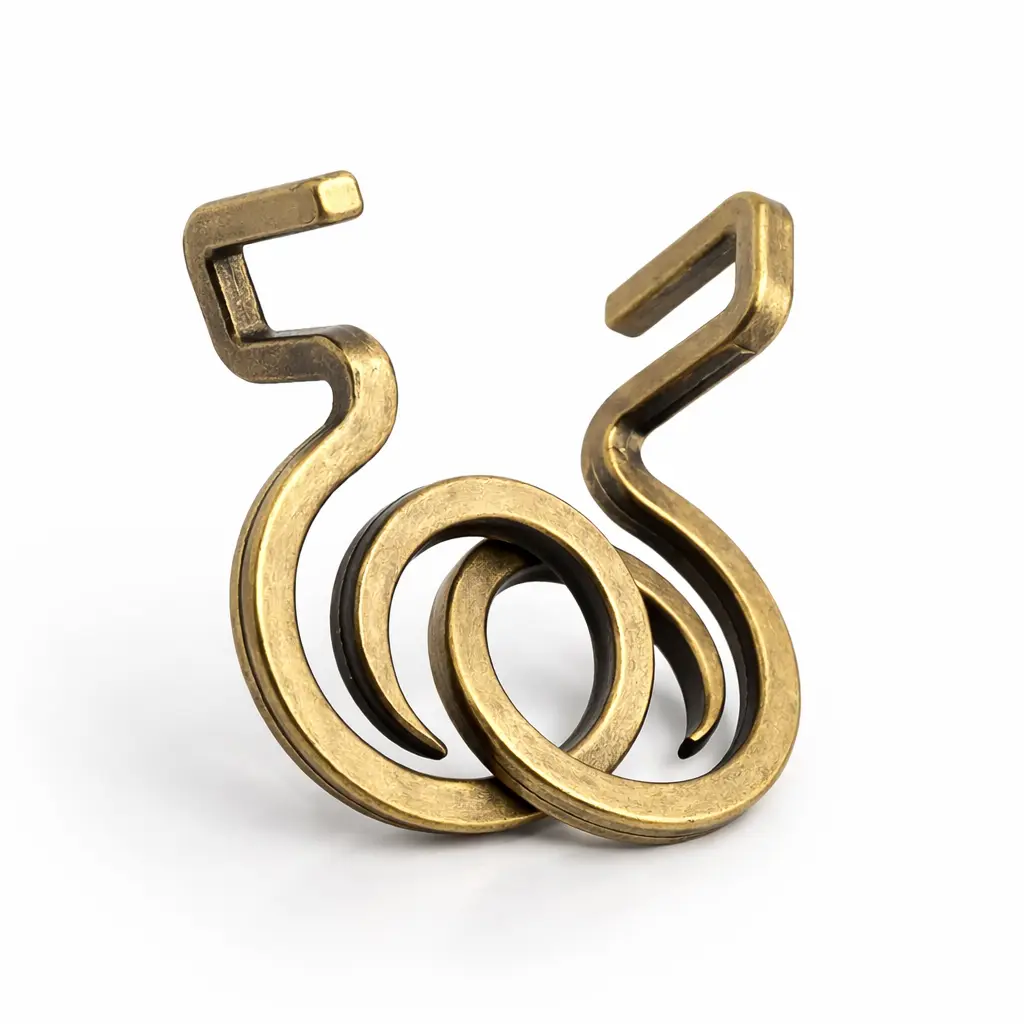
Verdict: Buy the Cast Hook for a daily desk fidget; the grenade lock is the wrong tool for that job.
Best for a first-time solver who wants a friendlier entry
The grenade lock is rated at a mid-range difficulty. For a first-time solver who has never seen a tooth-and-ring mechanism before, that rating translates to a real first-solve window, and the budget cast versions turn that window into a frustration session. A first-puzzle gift that someone gives up on in fifteen minutes is not actually a gift — it is a paperweight.
The Metal Crab Puzzle Cast Brain Teaser with Gold Ring at $13.99 is a more forgiving introduction to the cast metal brain teaser category. Its two-piece construction is similar in spirit to the grenade, but the ring release is a more intuitive motion than the internal tooth sequence, and the gold-and-silver contrast makes the contact point visually obvious to a beginner. A first-time solver who cracks the crab in a focused sitting has a much better chance of staying curious about the grenade lock as a second purchase later — and of understanding the mental challenge before the difficulty rating hits.
For readers still browsing the broader category, the 7 most popular metal puzzles buyers are choosing right now gives a wider cast metal cross-section — including a few options outside the grenade’s tooth-and-ring family.
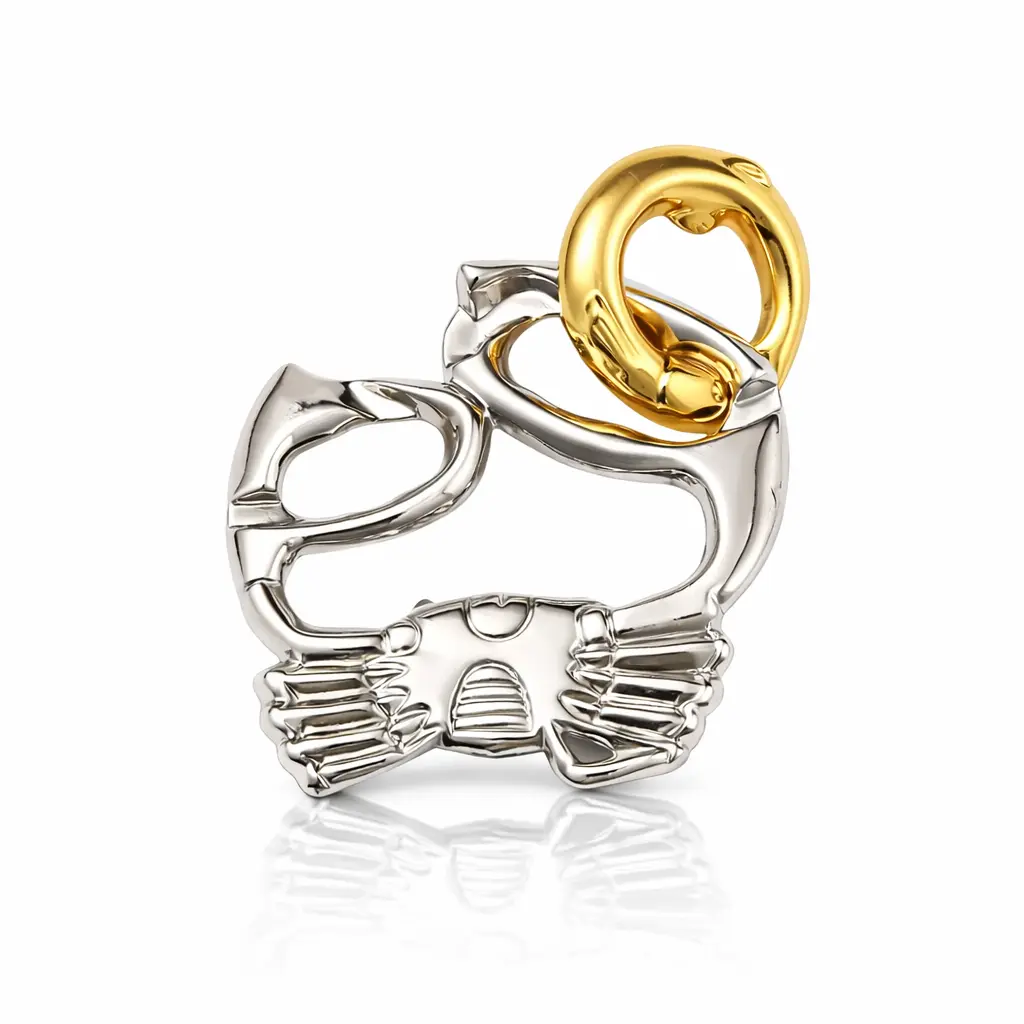
Verdict: For a first-puzzle gift to an adult who has never held a cast metal brain teaser, the crab is a smarter hand-off than the grenade.
What to skip at this price
Do not pad the cart with a second grenade lock “in case the first is defective” — the defect rate on cast alloy grenade locks is low, and a second copy is just a second puzzle that will go unsolved. Do not buy the grenade lock for a child under 12; the binding pressure and the plating wear profile are both wrong for small hands. And do not chase a Hanayama listing at three times the price unless the recipient has specifically asked for one — the mechanism improvement is real, but it does not register on a casual first-time solve.
The grenade lock is a good interlocking puzzle. It is not a universal one. Pick the use case that matches the person, buy once, and let the solve be the reward.
Frequently Asked Questions About the Metal Grenade Lock Puzzle
The Hanayama grenade lock retails around $25+ at specialty puzzle retailers, while budget cast alloy versions sell for approximately $8–12 on marketplace sites — a $13–17 gap that shows up the first time you test the tooth mechanism. Before you commit to either end of that range, these are the questions first-time buyers ask most, answered with the same hands-on honesty the rest of this buying and solving guide was built on.
Is the Hanayama grenade lock worth the higher price over cheap versions?
Yes — the mechanism improvement is real and measurable. The Hanayama’s tooth engagement feels like a watch movement, and the precision cast means teeth seat fully without binding under rotational pressure. For a casual buyer who will solve it once and shelve it, the premium is not justified. For someone who will run hundreds of solve cycles and notice plating wear at the contact points, the upgrade is worth every dollar of the $25+ price tag.
How hard is the grenade lock puzzle for a beginner?
Mid-range. The grenade lock sits in the middle of the cast metal brain teaser difficulty range — well above beginner take-apart puzzles, but well below the two-piece disentanglements that can absorb a full afternoon. A first-time solver should plan on a meaningful sitting of focused attention, with at least one stuck moment before the tooth-and-ring path becomes obvious.
Are the $8 AliExpress grenade locks the same design as the Hanayama?
Same two-piece concept, same general silhouette, and a very similar tooth-and-ring interlock. But the tolerances, alloy quality, and finishing are worlds apart. Budget cast alloy versions frequently ship with visible seam lines, rough interior surfaces, and binding under rotational pressure. The mechanism idea is shared; the tactile honesty is not.
How long does a first solve take?
Most first-time solvers finish a quality grenade lock in a focused sitting. Budget cast versions can stretch that window considerably because binding friction hides the correct path. Plan on a real mental commitment rather than a quick fidget on a clean cast, and plan on substantially longer if the cast is rough.
Is the grenade lock puzzle a good gift for an adult?
For an adult who already enjoys mechanical puzzles, cast metal brain teasers, or escape-room-style challenges, the grenade lock is one of the better gifts in the $12–15 range. For a casual recipient who wants a quick fidget, it will sit unsolved in a drawer. Match the gift to the person’s tolerance for quiet frustration.
Will the metal plating or finish wear off with repeated solving?
Yes. At the high-contact points, plating wear becomes visible after extended use on cast alloy versions. The Hanayama’s finish holds up noticeably longer thanks to denser casting and a more durable surface, but no version is immune. If you solve daily, expect the shine to dull at the tooth entry over time.
Can kids solve the grenade lock?
Not recommended under 12. The binding pressure is uncomfortable for small hands, and the sequencing logic reads as random rather than solvable. Teens with patience can manage it. For a younger child, a simpler take-apart cast metal puzzle offers a better first experience with the format.
What does the grenade lock’s difficulty rating actually mean in practical terms?
It is a mid-range cast metal brain teaser — a category that requires sequencing and a single moment of insight, but no specialized dexterity or unusual spatial reasoning. The easiest take-apart cast puzzles sit below it; the top-tier two-piece disentanglements can swallow a full day. The grenade lock is solvable in one sitting by most adults without specialist tricks.
How do I spot a miscast version in an unboxing video before opening?
Before you crack the box, look for three red flags: visible seam lines running along the grenade body (a sign of poor mold parting), flashing or extra material at the split between the two halves (casting overflow that should have been removed), and inconsistent color between the two pieces (plating mismatch). Any of these signals a miscast that may bind mid-solve or never separate cleanly — see our 4-model unboxing teardown for what a clean cast actually looks like.
If you are ready to stop comparing and start solving, the Metal Grenade Lock Puzzle is the listing to check first. Two pieces, one mechanism, one honest solve — the rest is up to your hands.