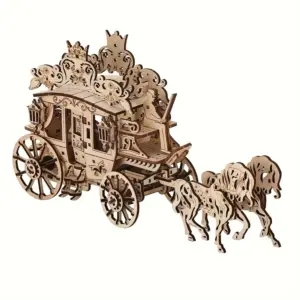
Quick Answer: Wooden Brain Teaser Review: Burr, Box, or Disentanglement?
Choose a burr or interlocking assembly puzzle from a named maker for a reliable first solve; choose a puzzle box when the reveal matters more than the mechanism; avoid unbranded string-and-bead sets under $10 unless you want a desk object, not a challenge. Three checks change the pick: mechanism type, wood species and joinery tolerance, and a difficulty band that matches the solver.
The 6-in-1 Wooden Brain Teaser Set at $38.88 is the strongest starting point for most buyers because it bundles six distinct Luban-style mechanisms in one box, letting a beginner compare what actually clicks with their hands before committing to a single harder puzzle.
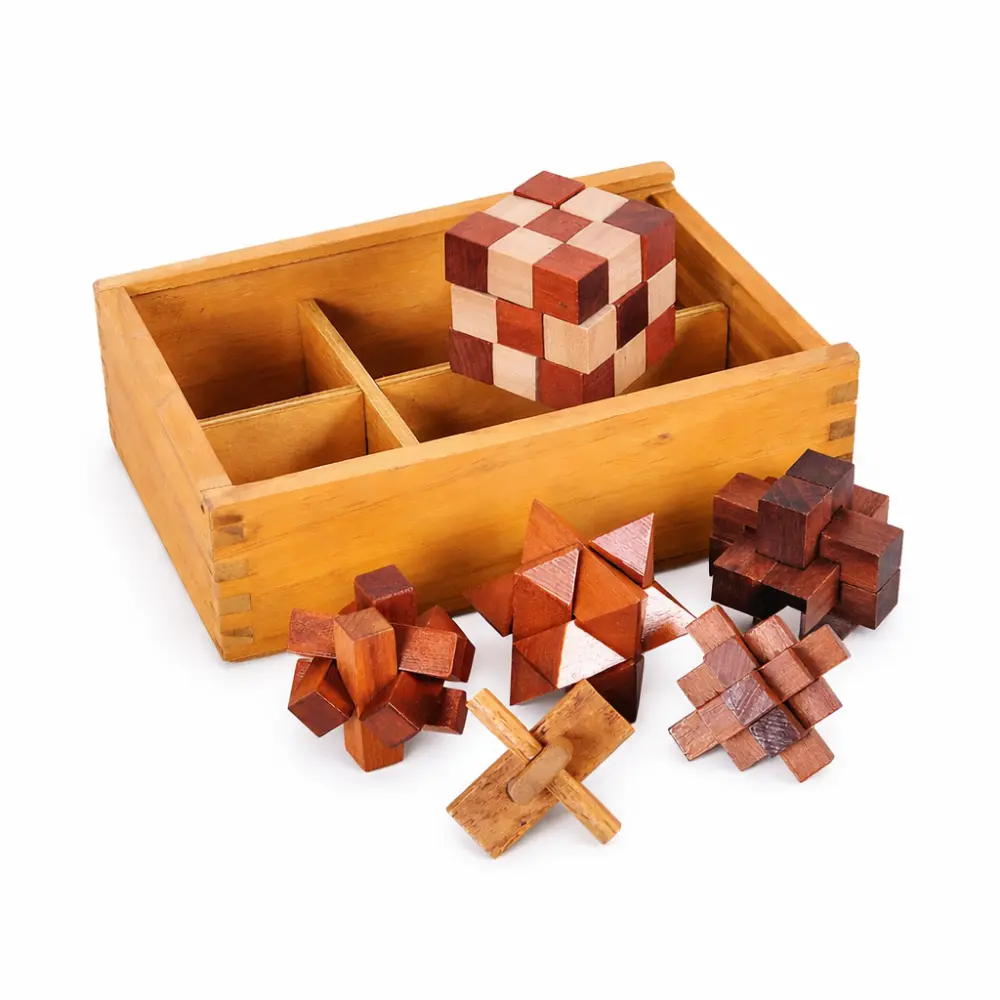
Decision table: which mechanism fits your situation
| If the buyer wants… | Mechanism type | Why it fits | What to check before buying |
|---|---|---|---|
| A reliable first solve | Burr or interlocking assembly (6–12 pieces) | Piece count and notch layout give repeatable difficulty | Tolerance of kerf cuts; included solution sheet |
| A gift with a reveal | Puzzle box | Hinged reveal adds theater beyond the solve | Hinge play, internal clearance, finish |
| A hands-on fidget | Sliding lock or disentanglement | Repeated hand movement, not a one-time solve | Pin smoothness, whether pieces bind under humidity |
| The hardest single challenge | High-piece burr (12+) or sequential lock | More notches, more dead-end states to rule out | Maker reputation; whether solution is sold separately |
The conditional rule: if the recipient has never solved a wooden brain teaser, start with the 6-in-1 set above; if they already own one, escalate to a single-mechanism specialist like the 54‑T Cube Puzzle or the 12 Piece Crystal Luban Lock Set. Check the product page for the current price.
01. Burr vs. Interlocking vs. Disentanglement vs. Puzzle Box: How Each Wooden Mechanism Actually Works
The decision table above tells you which mechanism to buy for which goal; this section tells you what each mechanism actually demands from your hands and your patience, so the match holds up after the unboxing. A mechanical puzzle is, at its core, a physical object where the solver must find a sequence of moves that achieves an objective, usually by disentanglement, assembly, or disassembly. Wooden versions lean on geometry, friction, and joinery rather than the microscopic tolerances that govern high-end metal puzzles, which is why a well-cut wooden burr can feel honest and predictable in a way that a finicky metal disentanglement rarely does.
Burr puzzles are the baseline of the wooden brain-teaser world. A burr is a solid-packing assembly: multiple notched sticks (the classic configuration uses six non-identical pieces, as cataloged in the Kubiya Games collection) interlock along perpendicular axes so that the assembled shape appears to be a single block of wood. The challenge is finding the move sequence that lets the central piece escape. A burr is NOT a “pull-apart” toy and it is NOT a jigsaw — nothing is glued, nothing is glued-together-then-ripped, and the goal is disassembly, not construction in the usual sense. Burrs are usually made from beech, maple, or walnut, ship in piece counts from 6 to 24, and reward solvers who can hold a 3D sequence in working memory. They fit first-time puzzlers who want a clean “aha” moment and engineers who like tracing elimination trees.
Interlocking assembly puzzles are the closest cousin to a burr but with a critical difference: the goal is to BUILD the final shape, not take it apart. Pieces slot together without glue or fasteners, and the solver must discover the order of insertion that allows the last piece to seat. The 7 Color Soma Cube Puzzle is a textbook example: seven pieces, one cube, hundreds of wrong assemblies, exactly one correct one. Interlocking assembly is NOT the same category as a burr even though both involve “interlocking” wood, and the confusion here is the single most common reason buyers end up with the wrong puzzle for their skill level.
Disentanglement puzzles reverse the logic entirely. Two or more rigid pieces (often joined by a cord, a pin, or a sliding rail) start linked together, and the solver must separate them through a specific sequence of rotations, lifts, or slides. The Sliding Lock Puzzle, co-branded with Jean Claude Constantin and sold through Kubiya Games, uses sliding-movement logic that feels nothing like a burr — your hands work in two dimensions, not three. Disentanglement puzzles are NOT assembly puzzles, are NOT usually “harder” than burrs, and are the best fit for someone who wants a hand-mantra object they can pick up, solve, reset, and repeat.
Puzzle boxes add theater. The mechanism is a hidden release (a magnet, a sequential slide, a pin-and-notch trick) that opens a hinged lid to reveal a compartment. The reward is the reveal itself, not the disassembly. Puzzle boxes are NOT pure logic puzzles; they tolerate brute-force prodding in ways a burr never will, which is why they make better gifts than training tools.
The misconception to retire before you buy anything: interlocking is not a synonym for hard. Piece count is not difficulty. A tight, well-cut 6-piece burr can defeat a sloppy 12-piece assembly, and a 30-piece interlocking set can be a ten-minute solve if the notches are oversized. Judge by mechanism and tolerance, not by the number on the box. Your next action: pick one mechanism from the four above, then check kerf tolerance and solution-sheet inclusion before you commit.
02. How to Judge a Wooden Brain Teaser Online: Wood Species, Kerf Tolerance, Finish, and Solution Sheet
A wooden brain teaser is worth buying when the listing names the maker, names the wood species, and includes a solution sheet; if any of those are missing, the listing is almost certainly a commodity SKU. Two of the three checks can be verified in about ten seconds from the product photos.
The wood species you can actually hear and feel
The wood a puzzle is cut from changes three things: the sound when pieces knock together, the weight in the hand, and how the surfaces hold up after months of desk-drawer friction.
- Beech. The default for entry-level burrs and most budget sets. Pale, light, dense enough for clean cuts. It sounds muted when pieces click — a soft “tok” rather than a ring. Most common because it laser-cuts cheaply, not because it’s the best.
- Maple. Slightly lighter than beech, with a brighter tap and a creamy color that photographs well. Maple burrs feel quick in the hand, but the softer grain can fuzz along kerf edges if the laser is running too hot.
- Rosewood (and rosewood-family tropical hardwoods). Dense, oily, noticeably heavier. Rosewood rings when pieces meet — a clear, bell-like note experienced solvers learn to recognize. It resists denting better than beech or maple, which matters for a burr you solve and reset often.
- Walnut. The heaviest common puzzle wood. Dark chocolate color with a duller, lower-pitched sound than rosewood. Ages well and hides handling marks.
- Cherry. Warm reddish tone that darkens with UV exposure. Mid-weight, with a sound between maple and walnut. Often chosen for display-grade pieces where appearance matters as much as mechanism.
A practical cross-check: two burrs cut from the same file but in different wood feel like different puzzles. The rosewood version “answers” when a piece moves; the beech version is quieter and more forgiving of sticky fits.
Kerf tolerance: the cut you can’t see in a thumbnail
Kerf is the width of material removed by the saw or laser. A tight kerf means the notch barely opens when the piece moves; a sloppy kerf means the notch is too wide and the piece wobbles inside its housing. Exact kerf depends on the cutting method (laser, CNC, scroll saw) and the sheet thickness, so don’t trust a specific millimeter number in a listing without measuring on arrival.
Why this matters more than piece count: a 6-piece burr with tight kerf demands a precise sequence and rewards careful probing. A 12-piece burr with loose kerf can solve by gravity alone, because each piece has enough play to escape the interlock without the right move. Tea-sip’s solve notes make a useful point here: wood tolerates imprecise construction better than high-end metal puzzles, but only above a baseline. Drop below that baseline and the puzzle stops being a logic challenge and becomes a parts-bin exercise. For a closer look at what separates a calibrated kerf from a commodity cut, see the true hardwood tolerance breakdown.
You can’t measure kerf from a product photo, but you can spot two tells: visible gaps between pieces in a solved-state image, and fuzzy or burnt notch edges (a sign the laser was running too hot or too fast).
Finish and solution sheet: what their absence signals
A finished wooden puzzle has been lightly oiled, waxed, or sealed. Unfinished beech feels dry and grabs skin. A wax or oil finish lets pieces glide, which directly affects solve feel. Listings that say “natural wood” without mentioning any finish usually mean raw.
An included solution sheet, even a QR code to a PDF, is a maker signal. Workshop catalogs like Kubiya Games’s routinely include solutions because they expect the puzzle to be unsolved. A listing with no solution reference and no maker name is buying on hope. Crafty Puzzles maintains a free archive of solutions and assembly instructions, a useful fallback for puzzles shipped without a sheet, but the easier path is to skip the listing that doesn’t include one.
The one action before you click “add to cart”
Open the listing photos on a desktop, zoom past 100%, and inspect the notches. Look for consistent edge color (a sign of clean cutting), tight gaps between pieces, and any visible wobble. If a maker’s name appears in the description, search it. A 30-second check of a workshop’s catalog is the difference between a calibrated puzzle and a parts drawer.
03. Wooden Brain Teasers Worth Buying, Organized by Mechanism and Use Case
After the kerf-and-finish inspection passes, the next question shifts from “is this well-made?” to “is this the right puzzle for the recipient and the moment?” Use case, not popularity or piece count, is the right filter for choosing a wooden brain teaser, and each pick below is paired with the recipient and solving context it actually fits, plus one observable check before you buy.
Burr puzzles for adult first-timers
The baseline for any burr collection is a 6-piece non-identical interlocking wooden burr, which the Kubiya Games catalog describes as a foundational burr configuration. Piece count alone is misleading: a sloppy 12-piece burr with wide kerf cuts is easier to assemble than a tight 6-piece, and that is why difficulty labels from unverified sellers are unreliable. For a first-timer who has never solved a wooden puzzle, a set that bundles a range of burr-style challenges removes the guesswork about which difficulty band to start with. The 6-in-1 Wooden Brain Teaser Set covers that range in a single package, with multiple mechanism types so the recipient moves from one challenge to the next rather than stalling on a single hard burr. For a hands-on walkthrough of how the six mechanisms in the default set compare, the 6-in-1 wooden brain teaser set guide maps each mechanism to its difficulty band. For a buyer who wants a single-puzzle entry point in the same difficulty family, the Luban Cube Puzzle sits one tier below the set and serves as a clean standalone burr.
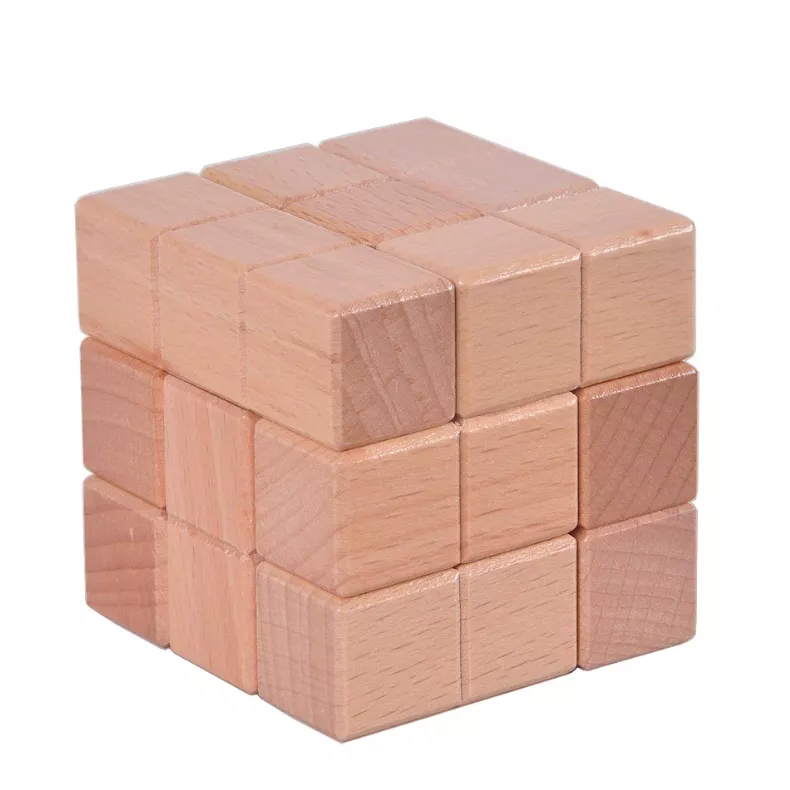
Luban Cube Puzzle — $21.99
What to check before buying: confirm the listing shows visible notch detail at zoom, names a wood species (beech, maple, rosewood, walnut), and includes a solution sheet or QR code to a PDF. A maker name in the description is a positive signal; its absence is the same red flag at any price.
Interlocking assembly puzzles for engineers and spatial-reasoning solvers
Interlocking puzzles where pieces must be assembled into a final solid form appeal to solvers who think in three dimensions. For a compact desk footprint, the 54‑T Cube Puzzle fits a coffee-mug space and demands a clear mental map before the first move. The 7 Color Soma Cube Puzzle is the next step up in cognitive demand: seven pieces, hundreds of possible assemblies, and only a handful that form a complete cube.
What to check before buying: count the pieces in the listing photo and confirm the final assembled shape, since “interlocking” gets applied loosely to anything with notches. If the seller states precision-cut pieces, that wording signals tighter tolerances than “hand-finished.”
Puzzle boxes for gift-reveal moments
A puzzle box is judged on the reveal, the moment the lid releases after a sequence of slides, pin pulls, or notch alignments. The 3D Wooden Treasure Box delivers the gift-reveal format with multiple mechanical steps, while the 3D Wooden Puzzle Safe with Combination Lock adds a working combination mechanism on top of the assembly challenge, which suits a recipient who values the container as much as the solve.
What to check before buying: confirm the solution is included (printed sheet, QR code, or linked PDF); verify internal dimensions if the box must hold a specific item; look for photos of the box in its solved (open) state, because closed-only photos hide whether the mechanism actually works.
Budget burrs under $20 for casual desk fidgeting
For a desk-drawer pickup rather than a weekend project, sub-$20 burrs work as repeatable hand challenges without the cognitive load of a hard single puzzle. The Blockade Puzzle is a compact wooden burr that stays interesting past the first solve because the assembly path offers more than one viable order. If a lighter, more portable form factor fits a secondary location (car, kitchen, shared office), the 12 Piece Crystal Luban Lock Set extends the same logic with a transparent casing that makes the notch geometry visible mid-solve.
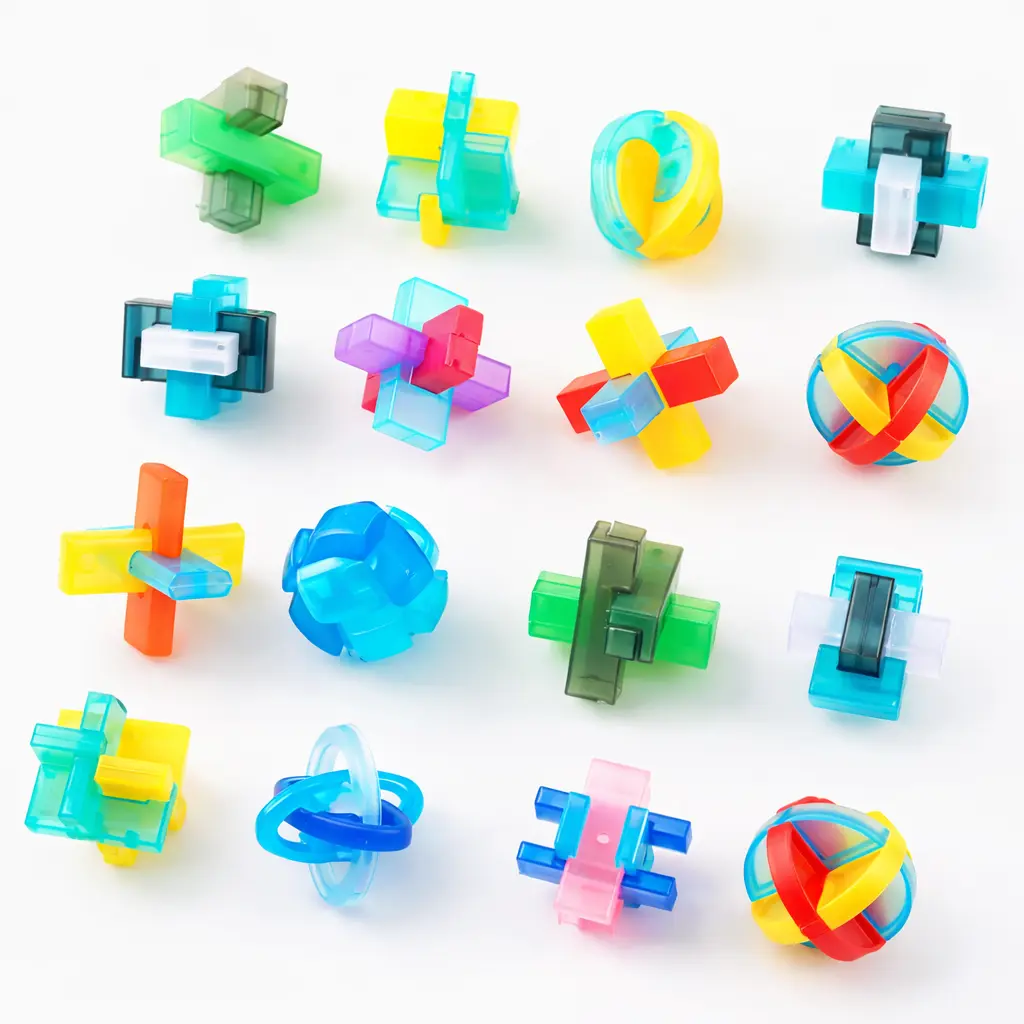
What to check before buying: the listing should still name a material, a piece count, and a maker. Anything that hides those three details at this price point is the same red flag that applies at $50.
The single buying action
Pick the use case first, then the puzzle. The 6-in-1 Wooden Brain Teaser Set covers the most ground for a first-time adult buyer; the burr, interlocking, box, or budget pick from the buckets above wins once the recipient or the moment is specific.
04. Why Piece Count Fails as a Difficulty Indicator, and How to Calibrate Real Difficulty
Piece count is not a reliable difficulty signal because a tight 6-piece burr can defeat a sloppy 12-piece one, so the only honest check is the maker’s stated difficulty band combined with the kerf tolerance visible in product photos. Manufacturers inflate piece count because buyers scan marketplace results by number, and “12 pieces” reads as more value than “6 pieces” — even when the 6-piece puzzle contains internal notches that require dozens of moves to release.
The geometry of the solve creates difficulty, not the count of parts. A 6-piece non-identical interlocking burr, the baseline configuration used by established makers like Kubiya Games, requires the solver to identify a single internal “key” piece whose removal unlocks the rest. A 12-piece cube-style assembly typically distributes constraint across every face, so any one piece may be removable from several orientations. The first demands insight; the second rewards brute-force rotation. Active Gear Reviews’ write-up of the Professor Puzzle Wooden Brain Teaser illustrates the gap: that puzzle is described as moderate to high difficulty and rewardingly complex despite a piece count marketplace listings would call beginner. Complexity lives in notch geometry, not the part tally.
Three observable checks for real difficulty
- Look for a stated difficulty band from the maker, not a star rating. “Level 3 of 5” paired with a published solution sheet is more honest than “hard” stamped on a $6 listing.
- Inspect kerf tolerance in product photos. Visible gaps between assembled pieces mean the burr was cut too loose; it will feel mushy and may self-disassemble in a bag.
- Count internal notches, not external pieces. Six pieces with four internal notches each is a fundamentally different problem than twelve pieces with one notch per face.
For buyers who want a deeper walkthrough of why the 6-piece burr behaves the way it does, the six-piece burr puzzle guide covers the internal-key mechanism in detail.
Gift-matching matrix: pick by recipient, not by piece count
| Recipient | What they actually need | Tea-Sip puzzle that fits |
|---|---|---|
| Anxious fidgeter | Smooth, repeatable sliding motion, not a one-shot solve | Blockade Puzzle — wooden sliding mechanism, repeatable |
| Engineer partner | High internal complexity, visible joinery, a brag-worthy solve | 18 Piece Wooden Puzzle — 18 interlocking wooden pieces |
| Parent–child (10+) | 6-piece burr with included solution sheet, manageable on a table | 6-in-1 Wooden Brain Teaser Set — six mechanisms, solution included |
| Retiree | A reveal moment, not a struggle — a box that opens when solved | 3D Wooden Puzzle Treasure Box — jewelry-box style reveal |
The matrix works because each recipient’s payoff differs. The fidgeter wants the same motion repeated; the engineer wants the puzzle unrepeatable; the duo needs a co-solving activity; the retiree wants the drawer to open. Piece count cannot tell you which of those the gift delivers, only a recipient-first question can.
The single buying action
Stop comparing piece counts and start comparing recipient payoffs. The 6-in-1 Wooden Brain Teaser Set remains the strongest default for an unspecified adult recipient because it spans six distinct mechanism types at one price point; for a named recipient, walk the matrix above and pick the matching row. If a listing hides its difficulty band, kerf tolerance, or maker name, treat the missing detail as the answer and move on.
05. Red Flags on Amazon and Etsy: How to Spot a Low-Quality Wooden Puzzle Before Checkout
The previous section closed with “treat the missing detail as the answer and move on,” and that only works if you know which details to look for. Walk away from a wooden brain teaser listing if the maker’s name is missing, no solution sheet is included, the difficulty label is vague, or the kerf cuts look uneven in close-up photos. Each gap is a signal, not a quirk, and they cluster on the listings most likely to disappoint.
1. The maker’s name is missing or generic.
A listing that says “handmade wooden puzzle” with no workshop, no brand, and no about-page is the most common warning sign. Established makers (Kubiya, Siebenstein-Spiele, Pelikan, Bits and Pieces, Professor Puzzle) print their name on the piece, the box, and the solution sheet. If all three are missing, the seller is reselling an unbranded factory run.
2. No solution sheet and no hosted PDF.
A missing solution sheet is the single biggest buyer pain point across the category, and third-party archives like Crafty Puzzles exist precisely because lost sheets are common. If a listing doesn’t ship one, doesn’t link to one, and the maker’s site has no archive, assume you’ll be searching YouTube before you solve. For a closer look at how a 6-piece burr’s internal key mechanism differs from a 12-piece assembly, the six-piece burr puzzle guide traces the move sequence that releases the central piece.
3. The difficulty label is just “hard” or “expert.”
A useful label names a band (easy, moderate, hard, expert) AND a piece count, a notch count, or an estimated solve time. “Hard” alone tells you nothing: a 6-piece burr with sloppy kerf can be easier than a tight one, regardless of label. If the seller won’t quantify, they probably haven’t solved it.
4. Photo crops hide the notches and pin holes.
The notches are where the puzzle works or fails. If every photo is a hero shot of the finished shape with no macro view of the kerf cuts, the seller is hiding the only evidence of tolerance. Ask for a 1:1 macro of the notch before paying.
5. Stock photography reused across multiple sellers.
Reverse-image search the main photo. If the same image appears on five different listings at different prices, the puzzle is a generic factory unit resold at varied markups, same tolerance problems, whoever you buy from.
6. Wood species described only as “natural wood” or “eco-friendly.”
“Natural wood” isn’t a species. Beech, maple, rosewood, walnut, and cherry each behave differently under kerf cuts. A puzzle that won’t name its wood is either hiding a low-grade material or doesn’t know what it’s selling. Either is a reason to ask before you pay.
The single practical next action
Message the seller with two requests before checkout: the maker or workshop name, and a 1:1 macro photo of the notches. If they answer both within a day with usable detail, the listing is probably safe. If they ignore you, send a stock answer, or refuse the notch photo, treat the silence as the answer and pick a different listing. The 6-in-1 Wooden Brain Teaser Set is the default when the marketplace doesn’t pass the test.
Frequently Asked Questions
A wooden brain teaser is worth buying when the listing names a maker, shows close-ups of notch joinery, and includes a solution path you can fall back on; skip listings that hide all three. The questions below are the ones readers actually ask before they commit to a purchase.
What if I’ve never solved a wooden brain teaser before?
Start with a graded set rather than a single unknown. The 6-in-1 Wooden Brain Teaser Set walks you from a level-1 interlocking piece to a level-6 assembly, so you learn the mechanics in order. Look for explicit level labels, not a vague “hard” tag.
Are wooden burrs harder than metal Hanayama puzzles?
They reward different skills. Wood puzzles tolerate slightly looser kerf cuts and lean on spatial reasoning; metal puzzles demand precision moves and finer finger control. Tea-sip’s 200-solve review notes that wood is more tolerant of imprecise construction than high-end metal. Neither is universally harder, only differently hard.
Do wooden brain teasers come with solutions?
Reputable makers include a paper sheet or a QR code. If the listing does not mention one, ask before you pay. Public archives such as Crafty Puzzles and YouTube reassembly videos cover most common mechanisms, but the original-maker solution is more reliable than a third-party post.
Why does one wooden puzzle cost $5 and another $50?
Tolerance. A $5 burr is cut on commodity tooling with visible kerf wobble; a $50 burr from a named workshop is sanded, finished, and dimensionally checked. The expensive one solves smoothly and survives hundreds of disassemblies. Judge by maker name and finish, not by price tag alone.
Can wooden brain teasers break?
Yes, especially along thin notches under torque. Harder dense woods (rosewood, walnut) resist chipping better than soft beech. A piece that arrives loose at the joint will only get looser.
What works as a desk fidget without being trivial?
A sliding lock or a 54-T Cube Puzzle — both offer repeatable short solves between tasks rather than one long session.
Best gift for a 12-year-old vs. an adult?
A 6-piece burr with a printed solution suits a 12-year-old new to mechanism puzzles; a graded set like the 6-in-1 covers both a beginner and an adult recipient in one purchase, which is why it is the default gift in this guide.
Your next step: run the red-flag checklist from the previous section, then pick the mechanism that matches the recipient. The 6-in-1 Wooden Brain Teaser Set remains the default when the marketplace listing does not pass the test.
Where to Start
If the difficulty, mechanism, and use-case checks above match, start with 6-in-1 Wooden Brain Teaser Set. Check the current product page for the specifications that matter to your choice.
Still comparing options? Revisit the decision table and use-case buckets above to compare the same decision criteria, rather than restarting the search from scratch.
Sources and verification
- Product details and current specifications: Tea-Sip product page
Last updated: August 4, 2026