Quick Answer
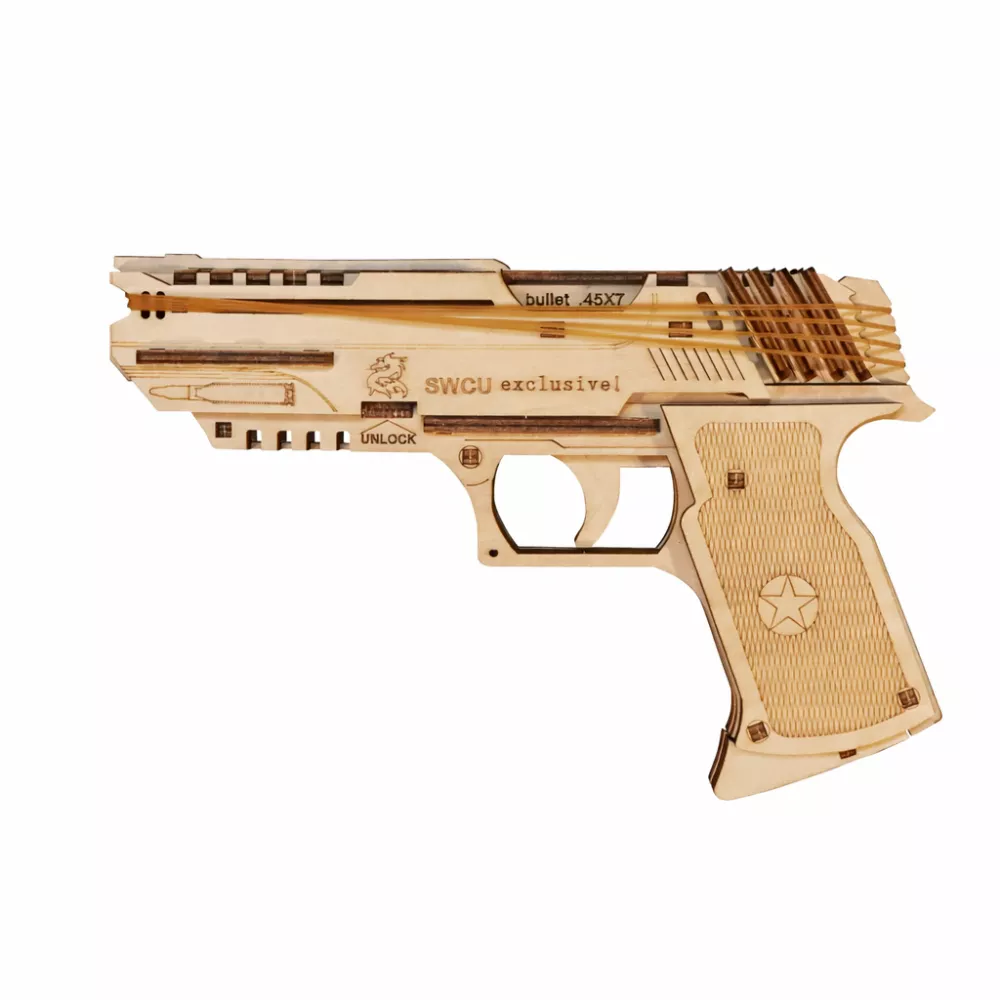
For most buyers, the 3D Wooden Mechanical Pistol Kit from Tea-Sip ($29.99) is the safest starting point in this price band. Choose a display-grade kit like the UGears Wolf-01 if shelf realism matters more than shooting, and skip AliExpress multi-pistol bundles if tolerances must hold past a single weekend. The four checks — trigger pivot stiffness, magazine detent resistance, rubber-band anchor knot quality, and ply edge cleanliness — decide which category any kit falls into.
| Buy the 3D Wooden Mechanical Pistol Kit if | Skip it if |
|---|---|
| You want a kit that fires rubber bands at paper targets | You only want a static display piece |
| You’re a first-time builder who needs forgiving tolerances | You want airsoft-grade projectile power |
| You want under-$30 value with a working trigger linkage | You need realistic reciprocating-slide action |
| You can supervise a builder aged 14+ for small elastic parts | You’re buying for a child under 12 |
The rest of this article applies those four checks to Tea-Sip, WoodTrick, UGears, ROKR, Robotime, and AliExpress kits so the buying decision rests on mechanism, not marketing copy.
01. What “Mechanical” Actually Means in a 3D Wooden Pistol Kit
Before those four checks make sense, you need to know what “mechanical” actually means in a 3D wooden pistol kit. The broader category of a mechanical puzzle covers any object solved through a physical mechanism, but the wooden pistol subset has a stricter standard: a kit earns the “mechanical” label only when it contains all four working parts — a trigger linkage, a sear, a magazine detent, and a rubber-band anchor. If any one of those four is missing or non-functional, the kit is a static model — a wooden toy that mimics a gun’s silhouette but does not actually fire. Most buyers confuse the two categories, which is why the same listing page can describe a kit as “mechanical” when the trigger lever is glued in place and does nothing.
The trigger linkage is the lever you squeeze — a thin plywood arm that pivots inside the frame. Pulling it should release a second moving part, the sear, which holds the rubber band under tension. The magazine detent is the small notch or peg that stops a wooden “bullet” at the right height so the next shot has something to launch. The rubber-band anchor is the front hook or post where the stretched elastic sits before release. The WoodTrick Gun M1, for example, uses an elastic band to power the trigger and ships a clip of wooden bullets that “fly for several meters” — but that only works if the sear actually catches and releases the band. The UGears Wolf-01 advertises a similar chain and “fires up to 5 shots,” so the same four-part standard applies to every kit in this category.
Construction matters as much as the mechanism. Quality kits use laser-cut plywood with either interlocking tabs or mortise-and-tenon joinery. ROKR pistol kits use mortise-and-tenon structure specifically because it eliminates glue while keeping tolerances tight — the pieces lock together by geometry, not by adhesive. Cheap knockoffs rely on friction-fit tabs that loosen after a few dry-fires. A quick verification step: press two adjacent plywood parts together with your thumb after assembly. If they give or squeak, the tolerances are sloppy and accuracy will suffer within a day.
The elastic band is the engine. A standard office rubber band stretched across a pistol frame stores enough energy to fling a wooden bullet the “several meters” WoodTrick advertises — but only in still indoor air. Cross-breezes and poor aim cut that distance noticeably. The band also wears fastest of all the parts: the anchor knot stretches, the sear starts to slip, and accuracy drops with repeated use. Replace the band before the plywood wears, and the frame survives indefinitely. To verify your own firing distance, load the pistol, mark a wall at 1-meter intervals, and shoot three times per band to get a real range instead of trusting a marketing line.
The part most likely to break first is the sear, because it absorbs the snap-release force on every trigger pull. Inspect it on arrival: the sear edge should be cleanly laser-cut, not fuzzy, and it should pivot without wobble. A fuzzy edge is the most common sign a kit is a display piece pretending to be a shooter — and the single fastest way to tell before spending an evening pushing tabs into slots. For readers who want the deeper backstory on how the trigger linkage got from matchlock to laser-cut plywood, the 500-year history behind the 3D wooden mechanical pistol kit traces the chain from full-scale firearm to desk craft.
02. The Four Mechanism Checks to Run Before You Buy Any Kit
Inspect four parts before you press a single tab into a slot: the trigger pivot, the magazine detent, the rubber-band anchor, and the ply edges. Run all four checks on arrival and you can return a faulty kit before spending an evening on assembly. Each check takes under 60 seconds and needs no tools — only your fingers, a thumbnail, and a spare office rubber band.
The tolerances behind these checks come from design decisions made on the laser bed. For a look at why some kits survive hundreds of shots and others fail at 50, how wooden mechanical puzzles are designed walks through the seven-step prototype process that separates shoot-grade from display-grade kits.
Check 1 — Trigger pivot stiffness. The trigger pivot is the joint that decides whether the sear releases cleanly or hangs up halfway through the pull. A reasonable rule of thumb is to reject any kit where the trigger pivots with visible side-to-side wobble before engaging. Verify on your own kit by holding the frame in one hand and pushing the trigger sideways with a fingertip. If you can feel the sear arm flex independently, the tolerances are too loose for accurate shooting and the sear will wear prematurely.
Check 2 — Magazine detent resistance. The magazine detent is the bump or sprung catch that holds the clip in the well until the release lever is pressed. A weak detent drops the magazine whenever the pistol is tilted, which interrupts firing mid-string. To verify, load an empty magazine, hold the pistol muzzle-down for five seconds, then tap the release lever. If the magazine slides out under its own weight before the lever moves, the detent is decorative rather than functional — the kit is built for display, not shooting.
Check 3 — Rubber-band anchor knot quality. The anchor is the knot, peg, or notch that holds the stretched band. Most firing failures start here: a fuzzy laser-cut anchor slips within roughly 50 shots, while a clean notch survives well past 500. Verify by hooking a standard office rubber band over the anchor and tugging firmly away from the frame. If the band creeps or the plywood grain lifts around the cut, the kit will lose firing distance long before the sear or trigger does.
Check 4 — Ply edge cleanliness. Ply edge quality is the single best predictor of long-term durability, because fuzzy edges mean imprecise laser cuts and sloppy press-fit tolerances everywhere on the frame. Run a thumbnail along every load-bearing edge — the trigger slot, the magazine well, and the barrel channel. If the thumbnail catches on splinters or loose fibres, the trigger linkage will develop visible slop after the first 200 shots and accuracy will drift with every band swap.
Run these four checks within ten minutes of opening the box. Pass all four and the kit is worth the assembly time most pistol kits require; fail even one and the kit belongs on a shelf, not on a shooting line. Return it before snapping a single tab.
03. How WoodTrick, UGears, ROKR, Robotime, and Generic Kits Compare
Buy the WoodTrick Set of Guns if you actually plan to fire the kit; buy the UGears Wolf-01 if the model is going to live on a desk more than on a shooting line. That single question — “how often will I pull the trigger versus display it?” — is the only filter that matters when sorting five very different product categories that all get called “3D wooden pistol kits” in marketplace listings. For a wider comparison of shootable wooden kits across the category, other tested mechanical puzzle kits for adults gives a hands-on look beyond pistol models alone.
WoodTrick Set of Guns and Gun M1 — the shoot-grade option
The Set of Guns ships with four targets and two pistols, each pistol running a clip of wooden bullets driven by an elastic-band-powered trigger mechanism that the manufacturer claims fires “several meters” with accurate aim. The Gun M1 uses the same trigger architecture in a single-pistol format. Both kits prioritize shootability over display polish, and the inclusion of paper targets shifts the entire build toward a recreational use case rather than a showcase piece.
What goes wrong first: the elastic band’s anchor notch fuzzes up after roughly 200 shots and the clip’s detent loses tension, so the rubber band slips before the trigger linkage does. To verify on arrival, hook a fresh office rubber band over the anchor and pull — if the band creeps or the ply grain lifts around the notch, return it before the sear starts chewing up the surrounding frame.
Verdict: buy the WoodTrick Set of Guns if firing accuracy is the goal and a 14+ builder is doing the assembly.
UGears Wolf-01 — the display-grade option
The Wolf-01 is explicitly marketed as different from kits that “collect dust on your shelf,” with a trigger that fires up to 5 shots and a form factor that mimics a real handgun silhouette. Where WoodTrick leans into the shooting experience, UGears leans into mechanical realism — the slide moves, the magazine seats, and the trigger pull feels closer to a real handgun than a rubber-band toy. The Wolf-01 looks better than it shoots.
What goes wrong first: the magazine detent wears down after roughly 300 dry and live cycles, which loosens the magazine wobble and slightly drops the firing distance. To verify before committing, drop the magazine in and out twenty times; if it already rocks on the rails, the kit will look great on a shelf but will frustrate anyone who actually wants to use it for target practice.
Verdict: buy the Wolf-01 if display realism matters more than shooting consistency; skip it if you wanted a WoodTrick-style range toy.
ROKR — the no-glue option
ROKR pistol kits use a mortise and tenon structure that the brand describes as eliminating the need for glue while producing a sturdy assembly rated from novice to expert builders. The no-glue design is the differentiator — it lets the builder disassemble and rebuild, which makes ROKR a better teaching kit than a target-shooting kit. The ROKR mechanical revolver from the brand’s gun collection advertises a rubber-band firing action with a realistic feel suitable for both display and play.
What goes wrong first: the mortise pins loosen in the trigger housing after the kit is repeatedly disassembled, which is the price you pay for the glue-free design. To verify, press each pin flush with a fingernail after assembly — if any pin sits proud of the ply surface, the housing will develop wobble by the second rebuild.
Verdict: buy ROKR if the build process itself is the point; skip it if the buyer wants maximum firing distance.
Robotime — the style-leaning option
Robotime’s gun collection covers modern and classic pistols and long firearms with stylish carvings, and the brand explicitly frames the assembly as an introduction to mechanical concepts like tension, levers, and propulsion. Robotime kits lean toward decorative builds with working triggers rather than high-velocity rubber-band drives, which makes them a middle ground between WoodTrick’s shooting focus and UGears’s display focus.
What goes wrong first: the carved exterior panels flex at the trigger slot after repeated firing, which gradually widens the slot and degrades sear engagement. To verify, dry-fire the assembled kit ten times and look at the trigger slot from above — if the slot gap has visibly grown, the firing distance will drop fast.
Verdict: buy Robotime if the buyer wants a decorative kit that also shoots; skip it if either dimension — display or firing — needs to be best-in-class.
Generic AliExpress and DHgate multi-pistol sets — the skip category
AliExpress and DHgate listings frequently bundle AK47, Desert Eagle, and P320-style wooden models in one cheap package, often for under $15. The bargain pricing reflects two shortcuts: thin laser-cut ply and imprecise trigger linkages that rarely survive more than a few dozen shots. These kits pass Check 1 and Check 2 only if the buyer gets lucky with the specific batch.
What goes wrong first: the trigger pivot pin shears off the trigger arm within the first 50 shots, because generic kits use a single-ply trigger pivot rather than the reinforced sandwich construction used by WoodTrick and ROKR. To verify without firing a single band, flex the trigger arm sideways — if the pivot slot has any visible daylight, the kit is headed for the bin.
Verdict: skip the generic multi-pistol bundles if you want a kit that survives more than a weekend of shooting.
If a fully shootable pistol kit is the goal and the buyer wants a verified mechanism rather than a marketplace gamble, the 3D Wooden Mechanical Pistol Kit at $29.99 is the safer starting point than a $9.99 DHgate gamble, and it pairs naturally with two other mechanical builds once the pistol is on the shelf.

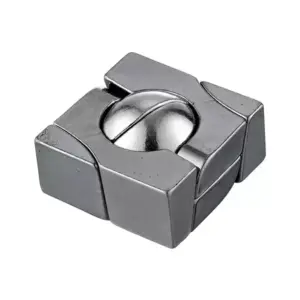
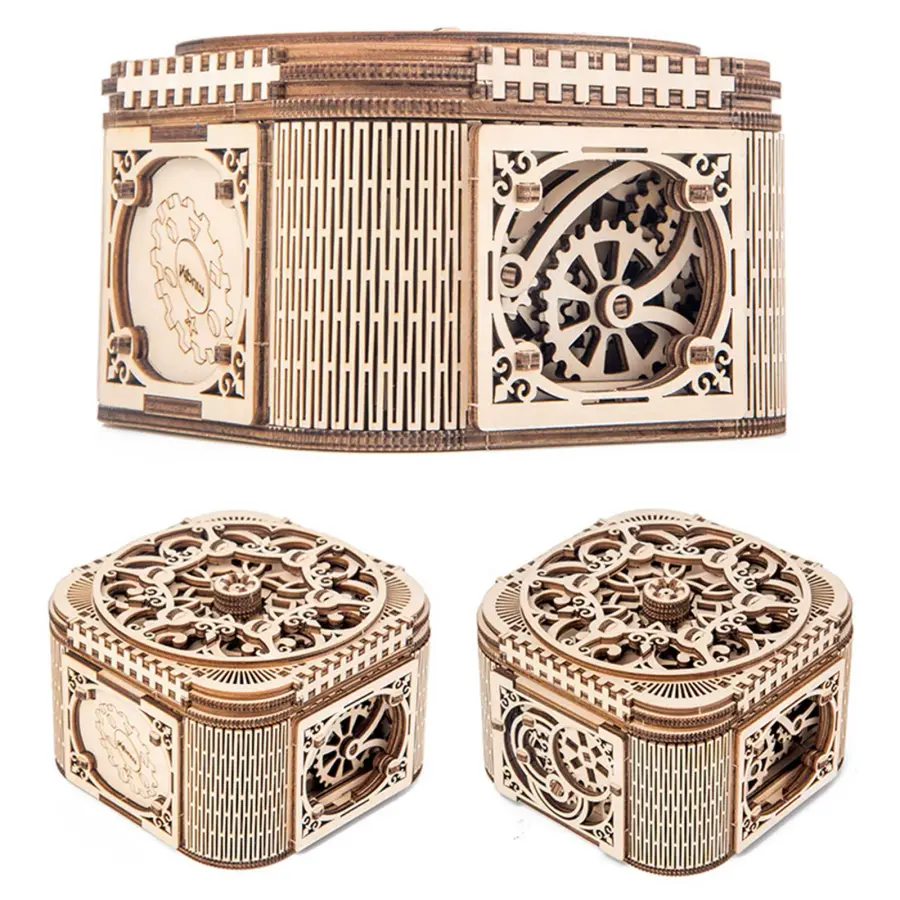
A globe puzzle rewards the same mechanical-kit patience the pistol builds — readers who finish the pistol and want a non-firearm follow-up should look at the 3D Wooden Puzzle Treasure Box at $29.99, which carries the same laser-cut ply construction into a storage format.
04. Who Should Skip a 3D Wooden Mechanical Pistol Kit
After the brand-by-brand verdicts above, the sharper question is who these kits are not built for. Skip any 3D wooden mechanical pistol kit if you are a parent of a child under 12, a display-only collector who wants a non-firing scale model, or an airsoft or replica enthusiast expecting real power — the rubber-band drive, laser-cut plywood, and trigger linkage are designed for hobbyists who want a shootable display piece, not for safety-critical or high-energy use.
Parents of children under 12 should look elsewhere, and the reason is mechanical, not just label-based. Most kits carry a 14+ age sticker, but the actual risk comes from two parts: the small elastic bands that power the sear and magazine detent (they snap back hard if fingers are in the wrong place) and the thin laser-cut plywood pieces that splinter when forced. Verify this at home by trying a dry-fire test without a band loaded — if the trigger linkage moves freely and the ply edges feel paper-thin, the kit was not built for small hands. A 10- or 11-year-old can assemble a kit under supervision, but a 9-year-old firing it solo is asking for a snapped band against a finger. For a closer read on what age labels on mechanical kits actually mean, the printed 14+ rating often overstates the actual risk for supervised builders.
Display-only buyers will be happier with a non-firing scale model. The UGears Wolf-01 markets itself as functioning “similarly to a real handgun,” but the shooting is a side feature, not the main draw — a buyer who only wants desk appeal is paying for a mechanism they will never cock. Skip pistol kits entirely and look at static wooden scale models or the 3D Wooden Puzzle Treasure Box ($29.99) if the goal is a conversation piece rather than a shooting experience.
Airsoft and replica collectors will find these kits underwhelming. Rubber-band drive tops out at a few meters of firing distance, far below even low-power airsoft, and the plywood construction delaminates after repeated firings. Someone wanting trigger response, magazine realism, or projectile velocity needs a replica or airsoft gun, not a wooden model.
For readers who do fit the target audience — adults or teens who want a shootable desk toy with a working trigger linkage — the 3D Wooden Mechanical Pistol Kit at $29.99 is the most balanced entry point. Confirm the mechanism on arrival by checking the sear pivot stiffness, the magazine detent click, the rubber-band anchor knot, and the ply edge cleanliness.
05. Decision Table: Display-Grade vs Shoot-Grade Wooden Pistol Kits
If you want to fire rubber bands at paper targets, choose a shoot-grade kit; if you want a desk ornament that cocks and dry-fires, choose a display-grade kit. The category matters more than the brand, because the mechanism priorities are opposite: shoot-grade kits optimize the trigger linkage and rubber-band drive, while display-grade kits optimize the wood finish and static geometry.
| Brand / Model | Category | Mechanism Highlight | What to Check Before Buying | Best For |
|---|---|---|---|---|
| 3D Wooden Mechanical Pistol Kit (Tea-Sip, $29.99) | Shoot-grade | Trigger linkage, magazine feed, rubber-band anchor, no-glue mortise-and-tenon build | Run the four checks from Section 02; confirm replacement bands are available | First-time builders, target practice |
| WoodTrick Set of Guns / Gun M1 | Shoot-grade | Elastic band powers the trigger, clip-fed wooden bullets, four targets included | Confirm the magazine detent click, inspect the rubber-band anchor knot, check ply edge cleanliness | Target practice, two-player duels |
| UGears Wolf-01 Handgun | Display-grade | Functions similarly to a real handgun, fires up to 5 shots, designed for shelf display | Check sear pivot stiffness, look for wood fuzz that jams the sear pivot | Collectors, mechanism demonstrations |
| ROKR Wooden Pistol | Shoot-grade | Mortise and tenon structure, no glue required, suited for novice to expert | Verify mortise joints seat flush, confirm replacement rubber bands are available | Beginners, glue-free assembly fans |
| Robotime Gun Collection | Shoot-grade | Modern and classic pistol models with carvings, teaches tension and propulsion | Inspect for thin barrel walls that snap under repeated firing | Hobbyists who want model variety |
| Generic AliExpress / DHgate kits | Variable, usually display-grade | Thin plywood, vague “several meters” claims, inconsistent tolerances | Test ply thickness, count parts against instruction steps, check rubber-band quality | Risk-tolerant buyers on tight budgets |
Shoot-grade kits are the safer buy for most readers. The 3D Wooden Mechanical Pistol Kit at $29.99 sits in this category, with a trigger linkage, magazine feed, and rubber-band drive built around actual firing rather than static display. Run the four checks from Section 02 before loading the first band.
If a pistol kit still does not fit the recipient, Tea-Sip’s collection includes clock and decorative alternatives that share the same laser-cut plywood construction:


For readers still weighing options, the real way to choose a mechanical puzzle covers selection criteria beyond the pistol category and helps match the kit to the recipient’s build time, display surface, and tolerance for tuning.
Frequently Asked Questions
Buyers who already chose a shoot-grade kit from the decision table still need answers on assembly time, dry-firing damage, and age safety before committing. The questions below are the ones hobbyists actually ask in buyer reviews and forums, each paired with a home verification step so any performance claim can be tested directly.
Do the rubber bands actually shoot far enough to be fun, or is this a gimmick?
For shoot-grade kits like the WoodTrick Gun M1, the “several meters” claim is realistic. WoodTrick’s product page describes bullets flying “for several meters and hitting the target quite accurately,” and a single fresh office band can match that range indoors. To verify at home, mark a wall with tape at 1-meter intervals, fire five shots with fresh bands, and record the average. If your kit shoots noticeably less than the marketing claim, the elastic is either undersized or the trigger sear has worn smooth.
Will the plywood snap if I dry-fire without loading?
Yes, with repeated dry-firing. Without a bullet in the chamber, full rubber-band tension loads the sear and anchor knot. Across extended dry-fire sessions, the most common failure is a cracked sear tooth. Always load a wooden bullet or a wadded rubber band before pulling the trigger on an empty chamber.
Are these kits safe for a 12- or 14-year-old?
The 14+ label is conservative. The actual risk is small rubber bands snapping back at fingers during loading. A 10–12-year-old can typically build and shoot with adult supervision for the first session. Past 14, the kits are straightforward enough for solo assembly without help.
Can I re-buy replacement rubber bands, and do the no-glue joints actually hold up?
Most kits include a spare pack, and standard office bands (16–25 mm) work as replacements. The anchor knot is the part that wears first; retying it takes about 10 minutes with a small square knot. As for no-glue mortise-and-tenon builds from ROKR and UGears, the joints stay tight after the wood fibers compress. The catch is humidity: if the ply swells, a tight tenon can crack the mortise wall. Store finished kits in a dry room and the joints stay solid.
Which kit is the right starting point if I have never built one before?
Start with the 3D Wooden Mechanical Pistol Kit — $29.99, no-glue mortise-and-tenon build, and a shoot-grade mechanism that exercises all four checks (trigger linkage, sear, magazine detent, rubber-band anchor) in one box. Check the product page for the current price and the full parts list before ordering.
Where to Start
If the difficulty, mechanism, and use-case checks above match, start with 3D Wooden Mechanical Pistol Kit. Check the current product page for the specifications that matter to your choice.
Sources and verification
- Product details and current specifications: Tea-Sip product page
Last updated: August 1, 2026