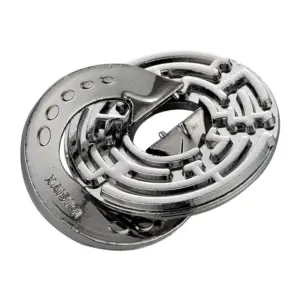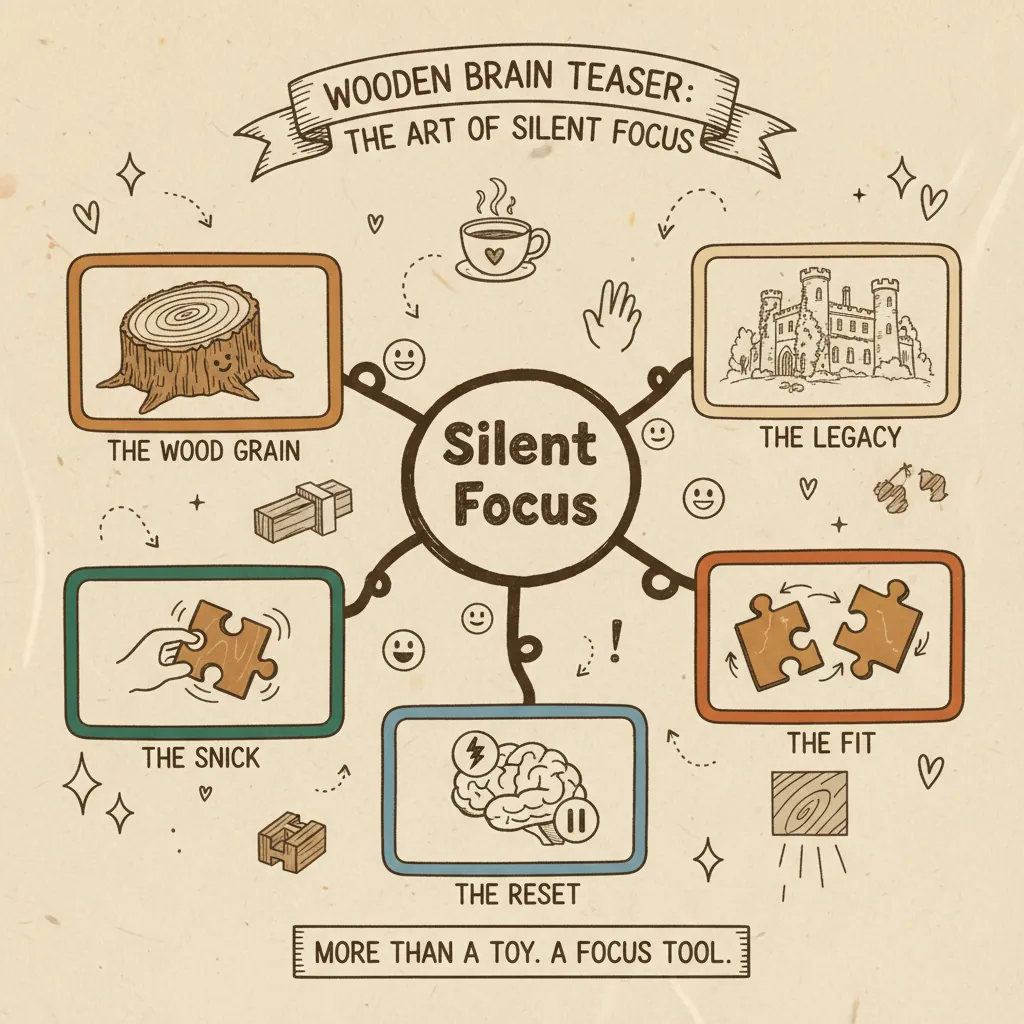
The third time the notched beechwood stick slipped from my grip and clattered onto my mahogany desk, I didn’t reach for it. Instead, I sat back, took a long sip of lukewarm oolong, and watched the afternoon sun catch the grain of the wood. My hands were restless, a side effect of a three-hour strategy meeting that could have been an email, but my mind was finally beginning to quiet. That is the hidden utility of a high-quality wooden brain teaser: it doesn’t just occupy your fingers; it forces a hard reset on your nervous system.
After testing over 200 mechanical puzzles—ranging from $500 limited-edition brass trick boxes to dollar-store plastic junk—I’ve realized that timber offers something metal cannot. There is a friction to wood, a literal “give” in the material that mirrors the way human logic works. It isn’t binary like a metal bolt. It’s organic. My thesis is simple: the most rewarding wooden puzzles are those that punish impatience and reward observation. If you try to force a solution, the wood will bind, the grain will protest, and you’ll find yourself staring at a pile of notched sticks with no idea how they ever fit together.
The Architecture of Silence: Why We Fidget with Timber
There is a specific joy in foundational techniques for interlocking blocks that predates modern manufacturing by centuries. When you hold a well-carved puzzle, you aren’t just holding a toy; you’re holding a legacy of joinery that once held empires together. Most of the pieces in my collection rely on the mortise-and-tenon principle—the same logic used in the Forbidden City to ensure buildings could withstand earthquakes without a single iron nail.
Unlike metal puzzles, which often feel cold and clinical, a wooden brain teaser has a “voice.” You can hear the slight snick when a key piece slides home. You can feel the warmth of the beechwood as it absorbs your body heat. In a digital age where our hands mostly touch glass and aluminum, the tactile resistance of wood is a grounding wire. It’s why I keep a rotating selection on my desk; they are the ultimate screen-free ritual for sharpening focus.
6-in-1 Wooden Brain Teaser Set
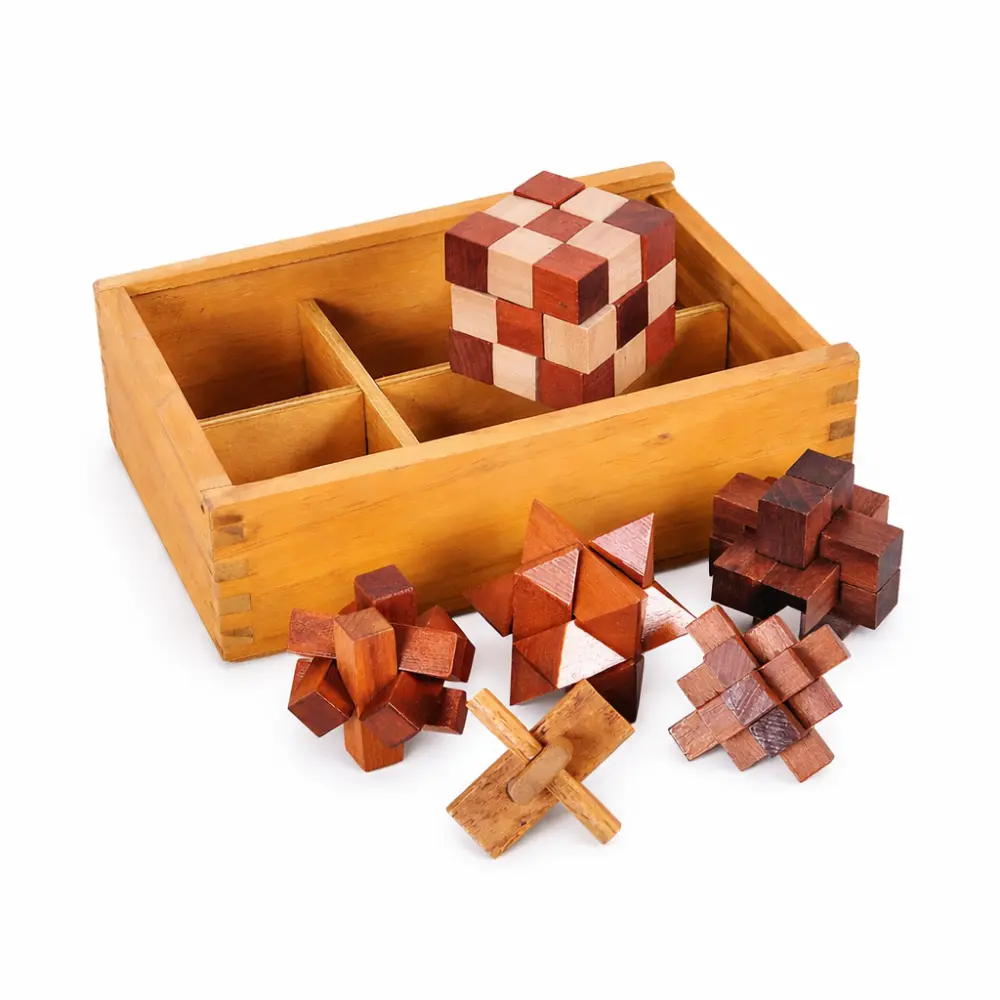
If you are looking for a comprehensive entry point into this hobby, the 6-in-1 Wooden Brain Teaser Set ($38.88) is essentially a masterclass in palm-sized engineering. I spent about forty minutes with the “star” variant in this set last Tuesday, and it’s a perfect example of why I love solid beechwood. The pieces are carved with enough precision that they stay together under gravity, but they won’t yield unless you find the specific “key” piece.
One of the sticks has a slightly different internal notch—a subtle deviation that locks the entire structure. Pull the wrong one, and you’re left with a chaotic heap. Rebuilding it requires a level of spatial reasoning that most people haven’t used since high school geometry. For under forty dollars, you’re getting six distinct challenges that look as good on a bookshelf as they feel in the hand. It’s the set I recommend to people who say they “aren’t puzzle people” because the tactile feedback is so immediate and satisfying.
The Tao of the Notch: Philosophy in Your Pocket
Many of these designs are deeply rooted in Eastern philosophy, specifically the concept of Wu Wei, or “effortless action.” I’ve watched friends turn red in the face trying to pull apart a curated collection of timber logic by sheer strength. They treat the puzzle like an enemy to be conquered. But wood doesn’t respond to conquest; it responds to alignment.
Take the Wood Knot Puzzle ($16.99), for instance. It’s a six-piece hardwood knot that demonstrates the Taoist teaching that “great form has no shape.”
Wood Knot Puzzle
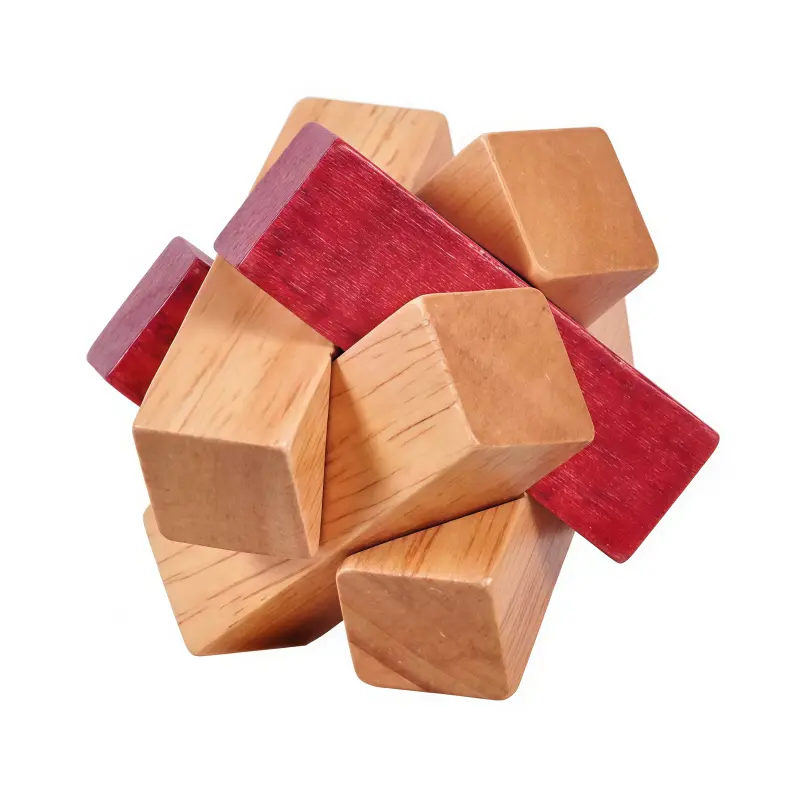
The Wood Knot Puzzle ($16.99) is a deceptively simple-looking object that will humiliate you if you approach it with arrogance. There are no screws, no glue, and no hidden magnets—just pure geometric harmony. I’ve found that the best way to solve this is to stop looking for the “exit” and start looking for the “foundation.”
As the description suggests, it’s a mindful practice. The pieces are precisely crafted so that they only slide in one specific sequence. If you’ve ever felt like your brain is “stuck” after a long day of spreadsheets, spending ten minutes trying to reassemble this knot acts as a mechanical meditation. It’s a quiet lesson in how complex structures are often held together by the simplest, most humble parts.
Why Your First Solve Will Likely Be an Accident
There is a phenomenon in the puzzle community I call “The Accidental Discovery.” You’ll be sitting there, mindlessly sliding pieces back and forth, and suddenly—click—the whole thing opens. You didn’t mean to do it. You don’t know how you did it. This is the moment where most people fail: they try to put it back together without understanding the path they took.
This is especially true with disentanglement puzzles like the Tricky Wooden Ring Puzzle ($12.89).
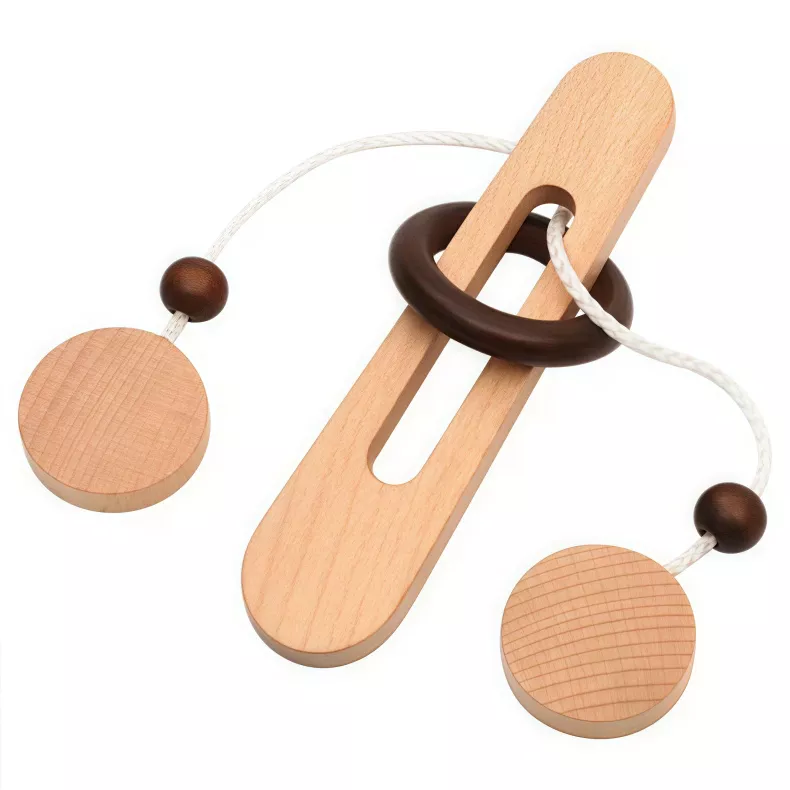
Tricky Wooden Ring Puzzle — $12.89
I’ve seen people spend hours trying to “force” the ring through a gap that clearly won’t accommodate it, ignoring the hidden pathways that require folding and rotating. Similarly, the Looking Back ($16.99) puzzle uses 12 sticks of varying lengths to create a romantic, tricky design that demands a literal “look back” at your previous steps to find the solution.
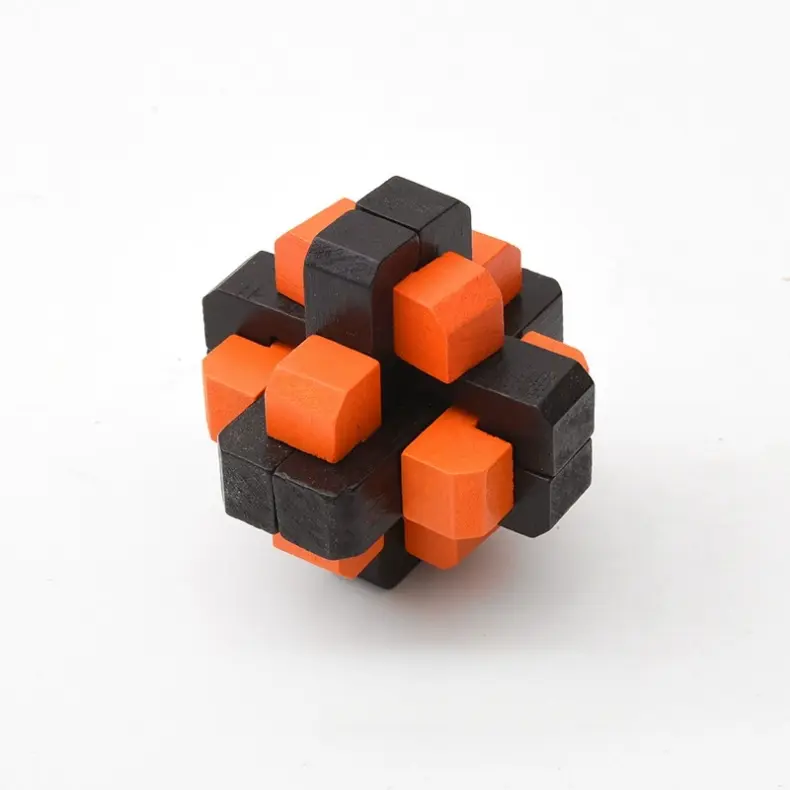
Looking Back — $16.99
The Peak Moment: The Engineer vs. The Ten-Year-Old
I once conducted an informal experiment in my living room. I handed a complex interlocking wooden cube to a mechanical engineer friend and a similar one to my ten-year-old nephew. The engineer immediately began looking for seams, calculating tolerances, and trying to apply a systematic grid-search to the problem. He was frustrated within fifteen minutes because the wood didn’t behave like the CAD software he used at work.
The ten-year-old, however, simply turned the puzzle over in his hands, feeling for the one piece that “jiggled” more than the others. He wasn’t thinking about the structure; he was listening to the material. He solved it in six minutes.
This is the peak insight of the wooden brain teaser hobby: Expertise is often a barrier to discovery. We get so caught up in how we think a mechanism should work that we stop noticing how it actually works. In a mechanical puzzle, the solution is usually hiding in plain sight, masked only by our own expectations. When you finally “get the One,” as the Ring Rescue ($14.99) puzzle description beautifully puts it, the earth gets calm and the spirit gets sharp.
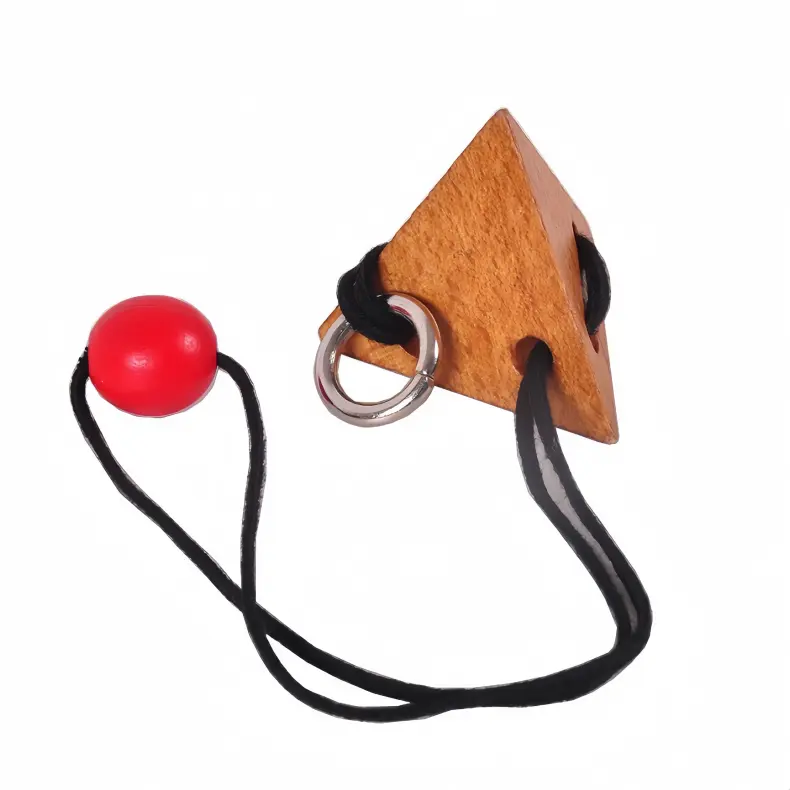
Ring Rescue — $14.99
The Ring Rescue is a triangle of rope, a bead, and a ring that seems impossible until you stop pulling and start seeing. It’s a small, quiet lesson in attention that costs less than a fancy lunch.
The Art of Effortless Problem Solving
If you want to graduate from basic interlocking blocks to something that feels more like a “key” to a secret, you have to look at the 6 Piece Wooden Puzzle Key ($12.99).
6 Piece Wooden Puzzle Key
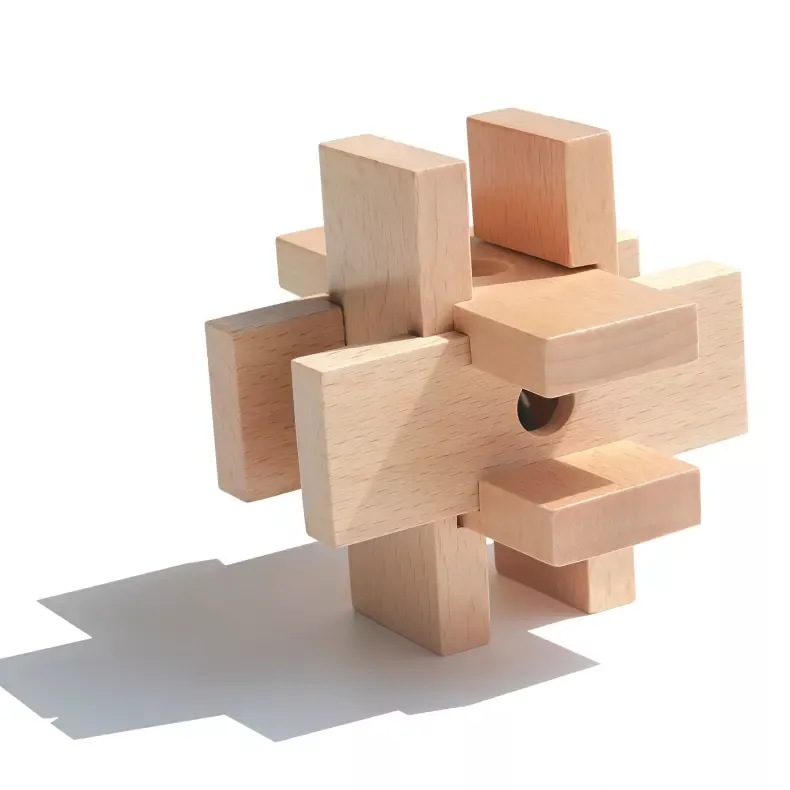
The 6 Piece Wooden Puzzle Key ($12.99) is the antithesis of the modern, noisy world. It’s six pieces of hardwood, zero electronics, and infinite replayability. I’ve had this specific model on my desk for three weeks, and I still find myself taking it apart just to feel the way the patterns emerge naturally.
It teaches the art of Wu Wei—when you stop forcing solutions, the complexity dissolves. The finish on this is minimalist and clean, making it a perfect gift for someone who appreciates high-end design but hates clutter. It’s one of those rare objects that actually makes your desk look more organized when it’s sitting there. It’s a “key” not just in shape, but in the way it unlocks a calmer state of mind.
Beyond the Cube: Spheres and Sisters
Not every wooden brain teaser follows the standard 3D cross or cube format. Some of the most challenging ones involve creating symmetry from chaos using unconventional shapes. The Molecular Ball Puzzle ($16.99) is a prime example.
Molecular Ball Puzzle
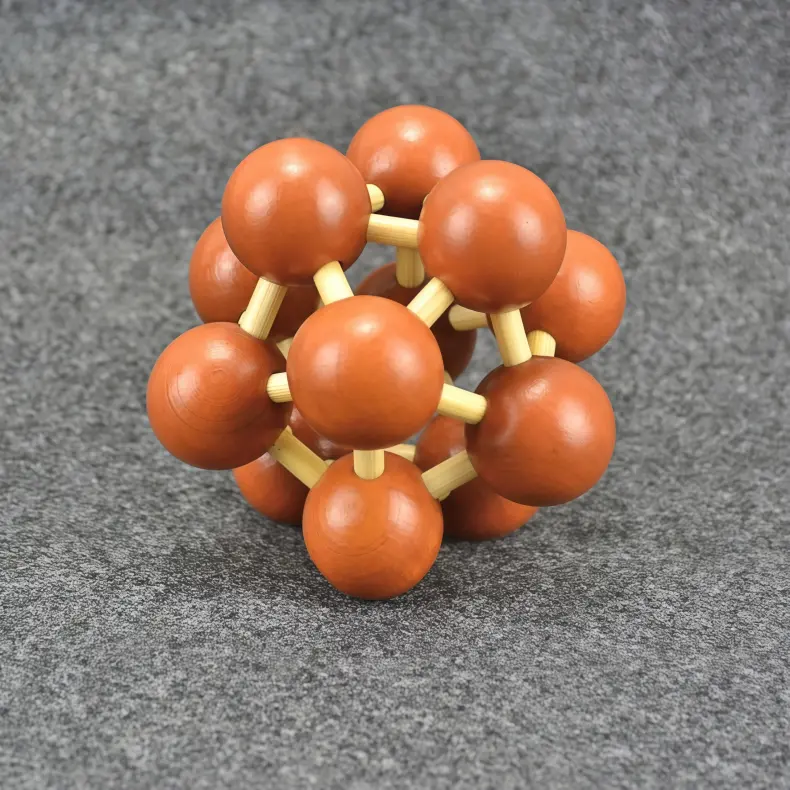
Constructing a flawless sphere from wooden balls and rods without a single drop of glue or a stray screw is a feat of “Wisdom Disguised as Play.” The Molecular Ball Puzzle ($16.99) is an heirloom-quality piece that I often use as a “palate cleanser” between more frustrating locking puzzle brain teasers.
The rods have to be inserted at exactly the right angle to support the weight of the spheres as the structure grows. It’s screen-free ritual at its best. I’ve noticed that this one specifically appeals to people who enjoy strategic board games that demand similar foresight, as you have to plan three moves ahead to ensure the last ball doesn’t collapse the entire “molecule.”
If that sounds too clinical, the Six-Angle Twelve Sisters ($14.99) offers a more poetic challenge.
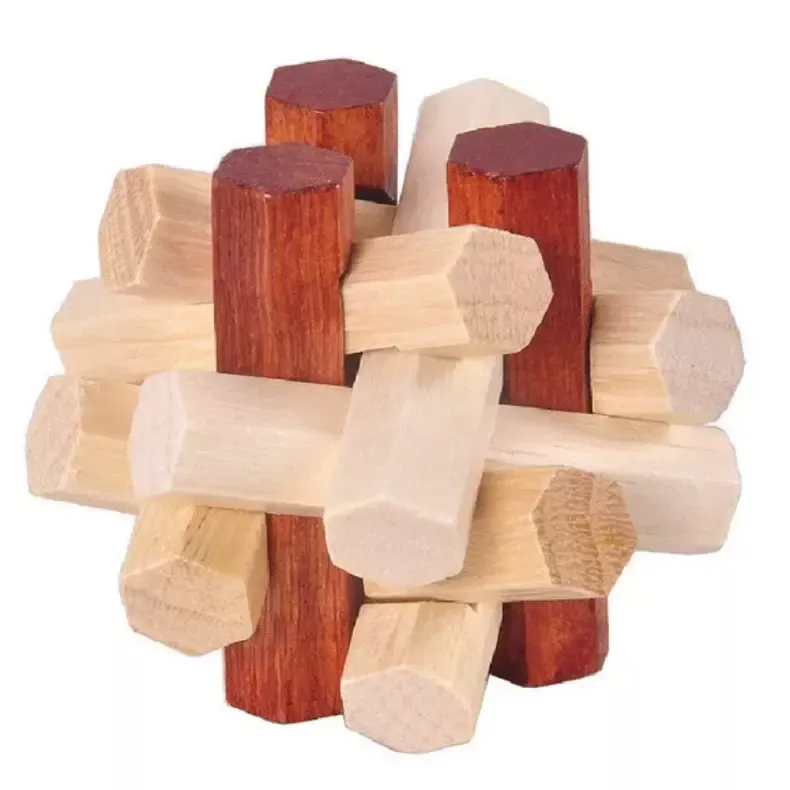
Six-Angle Twelve Sisters — $14.99
It’s a 12-piece puzzle that emphasizes balance and yielding. It’s based on the idea that when things are too “proud,” they topple. It’s a fantastic mindful desk toy that serves as a constant reminder to stay grounded.
The Burr and the Cube: Classic Interlocking Logic
No discussion of wooden brain teasers is complete without mentioning the “Burr” puzzle. The term “burr” likely comes from the finished puzzle’s resemblance to a seed burr. These are the heavy hitters of the wooden puzzle world.
Six-Piece Burr
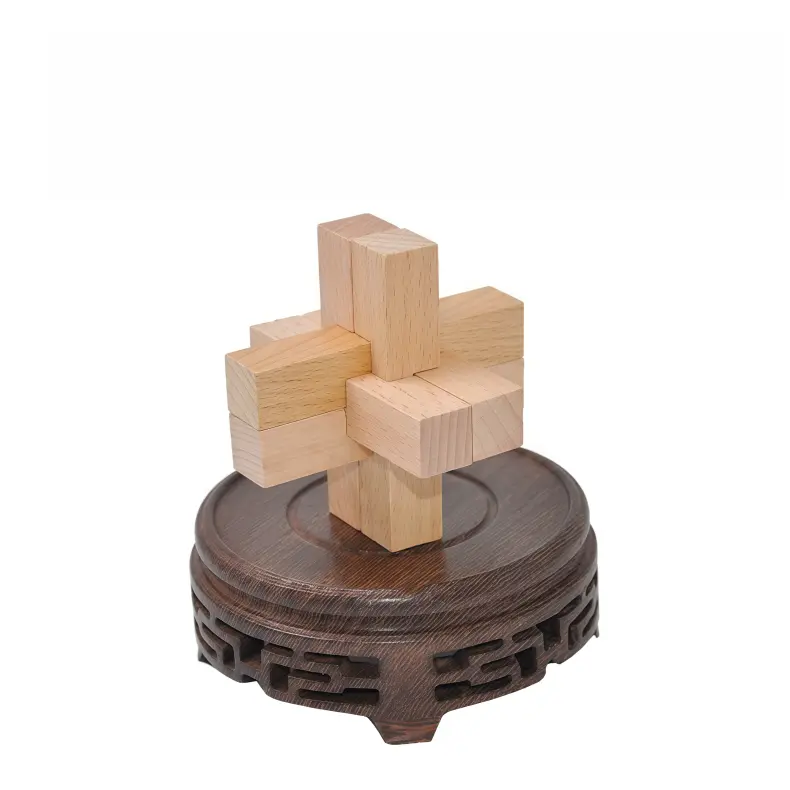
The Six-Piece Burr ($17.99) is the quintessential interlocking design. Every piece plays a vital role; there is no excess and no shortcuts. In my testing, I found that the tolerances on this specific version are tight enough to feel high-end, but not so tight that seasonal humidity changes make it impossible to solve.
It rewards those who seek understanding over force. If you find yourself tugging hard on a piece, you’ve already lost. The real wealth of this puzzle is measured in the clarity you feel when the internal “smooth path” is revealed. It’s a classic for a reason, and at under twenty dollars, it’s an essential part of any serious collection.
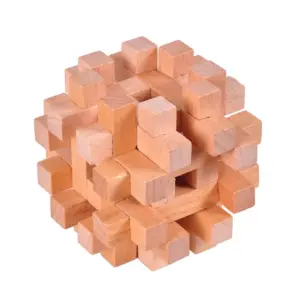
For those who want a variation on this theme, the Luban Cube Puzzle ($21.99) takes the mortise-and-tenon concept and applies it to a 3x3x3 grid.
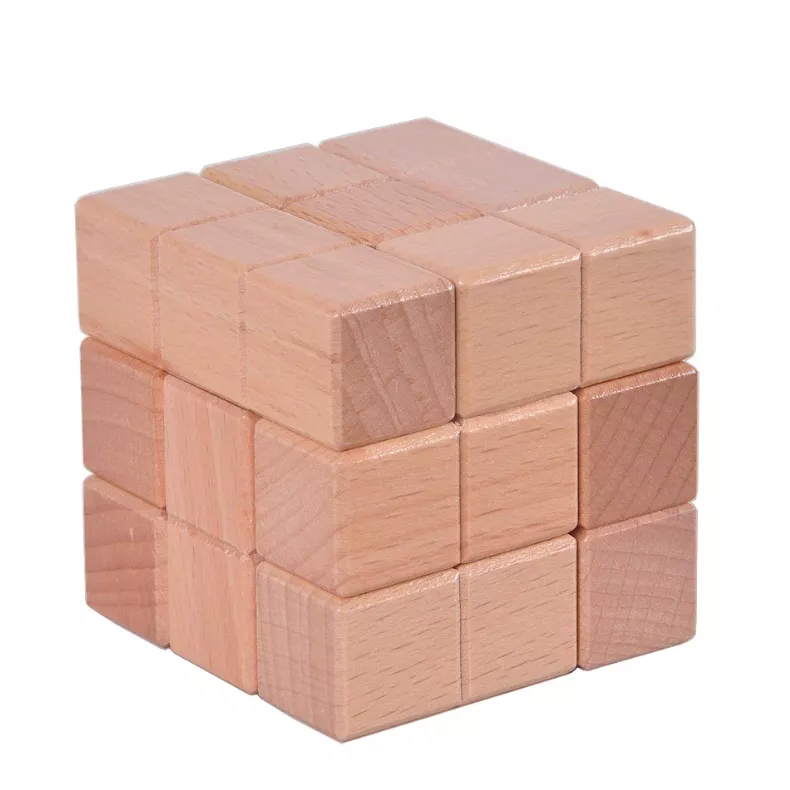
Luban Cube Puzzle — $21.99
It uses 6 or 7 notched blocks that must be fit into a perfect cube. It’s a hidden “magic” challenge where every piece has exactly one spot. It’s excellent for training 3D spatial reasoning, and I often recommend it as a digital detox for people who need to step away from digital logic games for a screen-time break.
Frequently Asked Questions About Wooden Brain Teasers
How do I solve a wooden puzzle if I get completely stuck?
The most effective way to solve a wooden puzzle at home is to resist the urge to look up the solution immediately. Instead, focus on “mapping” the movement. If a piece moves even a millimeter, ask yourself why. What notch is allowing that movement? If you’re truly desperate, YouTube is your friend—searching for “wooden puzzle solution” will yield thousands of videos. However, I’ve found that stepping away and returning with fresh eyes is usually more effective than following a video step-by-step.
Are wooden puzzles durable enough for kids?
Most quality wooden brain teasers, like those made from beechwood or bamboo, are incredibly durable. However, they aren’t indestructible. Because they rely on precise friction, if a child (or a frustrated adult) tries to force a piece, the wood can splinter or the “key” notch can wear down. I recommend these for ages 8 and up. For younger children, the physical challenge is often overshadowed by the temptation to use the pieces as building blocks—which is fine, but it won’t help their spatial reasoning much.
What is the difference between a Burr puzzle and a Luban lock?
Technically, they are very similar. “Luban Lock” is the traditional Chinese name for these interlocking puzzles, named after the legendary carpenter Lu Ban. In the West, we often refer to them as “Burr” puzzles. Both rely on the same mortise-and-tenon joinery. The main difference is often in the aesthetic and the specific notched patterns used, but the core logic—finding the single piece that unlocks the rest—remains the same.
Why does my wooden puzzle feel “stuck” sometimes?
Wood is a living material. It breathes. If you live in a very humid environment, the wood can swell slightly, making the tolerances tighter. Conversely, in very dry air, it can shrink, making the puzzle feel loose or even fall apart on its own. If a puzzle feels stuck, don’t force it. Try moving it to a room with different humidity for a day, or simply use a tiny bit of paraffin wax on the sliding surfaces to smooth the action.
Is it better to start with wood or metal puzzles?
I always tell beginners that wood is more forgiving but metal is more precise. A metal puzzle usually has a very clear “yes/no” feel—it either moves or it doesn’t. Wood has a bit of “maybe” in it. For a desk toy, wood is superior because it’s quieter and more tactile. If you want a high-intensity, high-frustration challenge, go for metal. If you want a meditative, tactile experience, stick with wood.
How do I maintain the finish on my wooden puzzles?
You really don’t need much. The natural oils from your hands will actually help season the wood over time, giving it a nice patina. If the wood starts to look dull after a few years, a light rub with food-grade mineral oil or beeswax will bring back the luster. Avoid chemical furniture polishes, as they can leave a sticky residue that ruins the friction necessary for the puzzle to function.
Can these puzzles really improve memory or IQ?
While “improving IQ” is a heavy marketing claim, there is genuine research showing that 3D spatial puzzles help maintain cognitive flexibility. They force your brain to rotate objects in a mental space, which is a specific type of intelligence. More importantly, they provide a necessary break from the dopamine loops of digital devices, which helps with overall focus and attention span.
What should I look for when buying a wooden brain teaser as a gift?
Look for the type of wood. Beechwood and Samena wood are excellent for their weight and durability. Avoid “mystery wood” or puzzles that feel exceptionally light, as they are often made from cheap plywood that will splinter. Also, consider the “reset” factor—can the person put it back together? A puzzle that is easy to take apart but impossible to reassemble can sometimes be more frustrating than fun for a casual hobbyist.
Are there “impossible” wooden puzzles?
In the world of mechanical puzzles, “impossible” usually just means “sequential discovery.” Some puzzles require you to find a hidden tool inside the puzzle to unlock the next stage. While none of the ones listed here are truly impossible, the Wood Knot Puzzle ($16.99) is about as close as you’ll get for under twenty dollars. It’s a genuine test of sanity.
Why do some wooden puzzles have a red bead or a ring?
These are typically disentanglement puzzles. The goal isn’t to take the structure apart, but to navigate a specific element (like a ring or a string) through a maze of obstacles. These are often based on ancient topological problems. They are fantastic for people who like “fiddling” rather than “building.”
How do I store my collection?
Keep them out of direct sunlight, which can fade the wood and cause it to crack over time. A simple bookshelf or a dedicated “puzzle tray” works wonders. I personally like to keep mine in a glass-fronted cabinet; they look like small pieces of abstract sculpture when they aren’t being used.
What is the “key piece” in an interlocking puzzle?
In almost every interlocking wooden puzzle, there is one piece that has fewer notches than the others. This piece is designed to slide out first. Once it’s removed, the “void” it leaves behind allows the other pieces to shift. Finding this piece is 90% of the battle. If you can identify the key piece, the rest of the puzzle usually falls apart in seconds.
The One Puzzle That Teaches You How All the Others Work
After years of fiddling, I’ve come back to the same conclusion: the best puzzle is the one that stays on your desk. It’s not the most expensive one, nor the one with the most pieces. It’s the one that you pick up absentmindedly while you’re thinking about something else. The 6-in-1 Wooden Brain Teaser Set ($38.88) remains my top recommendation for this very reason. It offers enough variety that you won’t get bored, but each individual puzzle is small enough to be solved in a single sitting.
If this deep dive into timber logic clicked for you, the next logical step is exploring the world of sequential discovery, where the puzzles actually hide tools to help you solve them. But for now, start with the basics. Put down the phone, clear a small space on your desk, and let your hands remember what it feels like to solve a problem that you can actually touch. In a world of infinite digital noise, there is nothing quite as loud as the silent click of a wooden piece finally finding its home.