An Artifact on Your Desk: The Allure of the Manufactured Past
The puzzle resting on the blotter looked like it belonged under museum glass, freshly dusted from a dig site. Its surface held a rough, almost sandy patina that caught the lamplight in dull copper glints, and a fine, gritty texture met my fingertips. It felt heavy. Deliberate. The kind of heft that suggests purpose, not play. This object, which I might have cataloged as a “19th-century folk disentanglement puzzle” in a past life, had arrived two days prior in a stark Amazon box. This is the central, delightful contradiction of the antique-style metal brain teaser: it is a manufactured past, designed to engage modern hands with the aesthetic gravity of history.
These are not historical replicas. The popular vintage style brain teaser for adults is a contemporary homage, its antique finish a product of modern plating and deliberate tarnishing techniques, not centuries of oxidation. The common material is zinc alloy, giving each piece a substantial weight—often 40 to 60 grams—that provides the satisfying, authoritative clink of metal on metal. The aesthetic draws broad inspiration from the metalworking ages (Copper, Bronze, Iron) and sometimes specific ancient puzzle forms, but it prioritizes evoking a feeling of age over archaeological precision. This manufactured patina is surprisingly durable; it’s designed to withstand handling, developing a softer wear over time rather than rubbing off like paint.
So why does this style resonate so deeply, especially when the mechanism inside is a modern creation? As a conservator, I learned that an object’s story is held in its surface. The faux wear, the muted metallic tones, the suggestion of a skeleton key or a rusted lock—these visual cues immediately frame the task as something venerable and tested. They signal that you are not just solving a puzzle; you are engaging with a lineage of problem-solving. It shifts the experience from a trivial distraction to a tactile link to ancient ingenuity. This styling makes the puzzle deskworthy, transforming it from a toy into a decorative object that promises intellectual engagement. It sits beside your notebook or monitor not as clutter, but as a totem of focused thought.
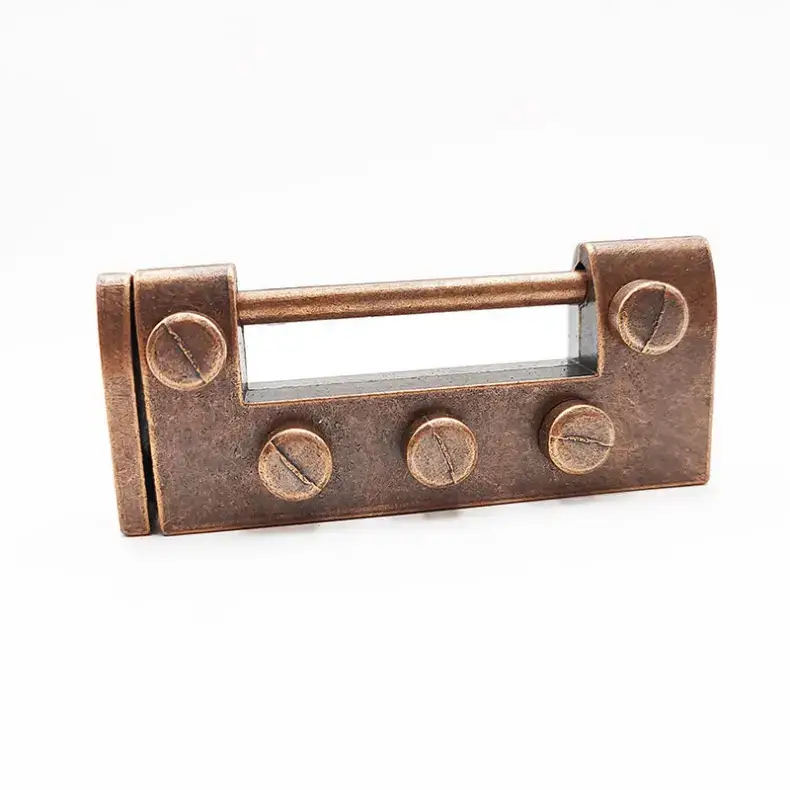
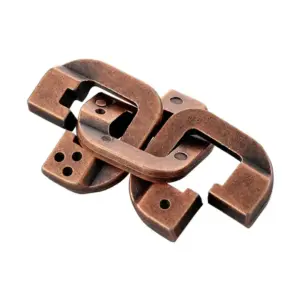
Consider the lock form, a recurring motif. A real historical counterpart, like the intricate antique brass puzzle locks from China, was a feat of craftsmanship that secured valuables through obscurity and complexity. The modern version, such as the piece above, captures that essence. It invites you to become the locksmith, not the thief. The weight in your palm, the cold metal, the visual language of aged brass or iron—all of it quiets the digital noise and insists on a slower, more physical kind of thinking. The allure is this conscious anachronism: an object that uses the aesthetic of a slower time to force a slower, more focused cognitive pace today. It’s not a relic, but it expertly plays the part to create a more profound mental theater.
Folk Engineering: A Brief History of Tangled Metal
That sense of being a locksmith, engaging with a miniature theater of mechanics, is not a modern invention. The antique style of today’s metal brain teasers is a direct visual nod to a lineage of human ingenuity, where the challenges of disentanglement and assembly evolved first from necessity, then into recreation. The modern “ancient metal” puzzle is a conscious tribute to this long history of mechanical puzzles, rooted in the fundamental human desire to solve tangible, spatial problems.
To hold one of these pieces is to feel a direct, if stylized, connection to the moment when toolmaking transcended pure utility. In the Bronze and Iron Ages, mastering metal meant mastering joinery: creating nails, hinges, locks, and chains. The principles that governed a secure door bolt or a cleverly interlinked piece of armor—the slide, the twist, the release of a precisely aligned component—are the very same principles that animate a modern disentanglement puzzle. Before they were games, these were problems of security and construction. A Chinese puzzle lock, for instance, might require a sequence of precise slides and alignments before the keyhole is even revealed, protecting valuables through spatial obscurity rather than mere strength. This is folk engineering: practical, elegant problem-solving distilled into an object.
This tradition of recreational metal manipulation flourished across cultures. Viking craftsmen are known to have created intricate wire puzzles—often called “smith’s puzzles”—forged from iron and passed around for entertainment. In 18th and 19th century Europe, artisans and tinkers produced hand-forged puzzles, sometimes called “dexterity puzzles” or ” tavern puzzles,” that spread through markets and social gatherings. They were tests of patience and logic, often made from leftover scraps of metal, their forms echoing familiar objects: horseshoes, hearts, padlocks, and intertwined rings. Their appeal lay in the stark contrast between their simple, recognizable forms and the counterintuitive logic required to solve them.
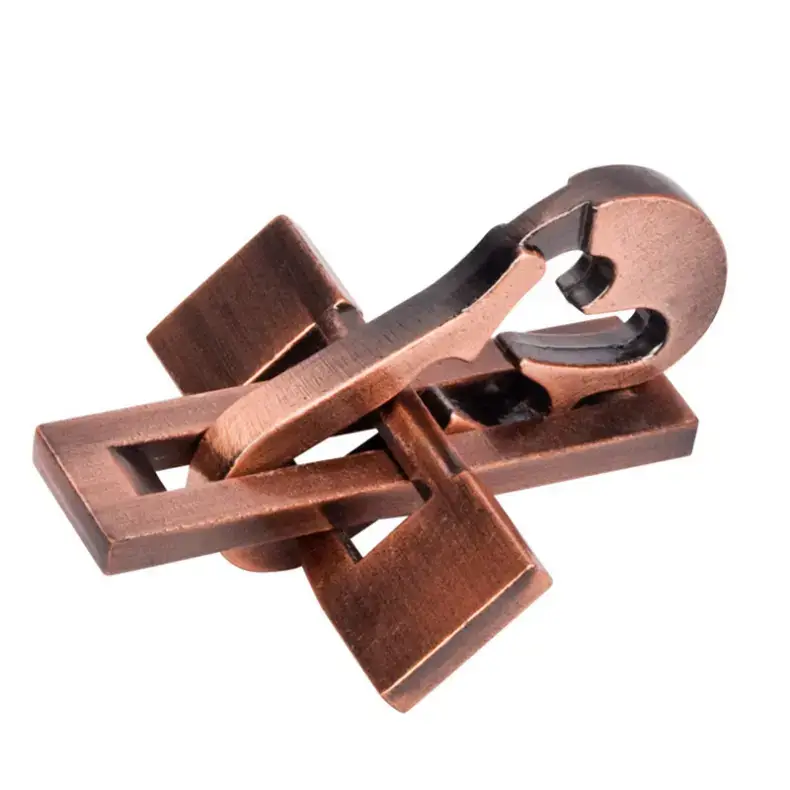
A piece like the Yangqin Lock Puzzle shown here is a clear descendant of that lineage. Its form directly references historical puzzle locks, but its production—cast in modern zinc alloy for consistency and heft—makes it accessible. The manufactured patina isn’t deceit; it’s a visual shorthand. It instantly places the object in a historical context, priming your mind to engage with it not as a disposable trinket, but as an artifact of a slower, more deliberate problem-solving tradition. The aesthetic cues trigger a different kind of attention, one that is more patient and observational.
Therefore, the antique finish on a contemporary brain teaser is more than a decorative choice. It is a frame. It asks you to consider the object as part of a continuum that stretches from a blacksmith’s forge to your living room desk. When you pick up a puzzle that looks like it was unearthed, you are not just solving a clever bit of wire. You are participating in a very old, very human conversation between hand, eye, and mind—a conversation conducted for millennia in iron, bronze, and now, zinc alloy. This context, as explored in our article on the 4000-year history of metal puzzles, enriches the experience, transforming frustration into a form of historical resonance. The weight in your hand is the weight of that history, repackaged for a modern moment of focus.
The Anatomy of a Patina: How That ‘Ancient’ Finish is Born
Since we’ve established that the antique aesthetic is a deliberate frame, let’s examine the frame itself—the very substance that gives these puzzles their aged character and substantial heft. To understand the object in your hand, we must dissect its manufactured history.
The antique finish on modern metal brain teasers is not paint but a manufactured patina, typically created through electroplating with bronze or copper followed by controlled oxidation or tarnishing, all applied to a zinc alloy base. This process yields a surprisingly durable surface designed to withstand handling, with individual puzzles in a standard set weighing between 40 and 60 grams to provide that satisfying, deliberate heft. It is an industrial mimicry of centuries of natural aging.
In my conservation work, a true patina is a record of time and environment—a thin layer of corrosion that forms on copper, bronze, or iron through oxidation. The puzzles on your desk replicate this through a much faster, more controlled alchemy. The journey usually begins with a mold. Molten zinc alloy—a blend primarily of zinc with small amounts of aluminum and copper for strength and fluidity—is injected under pressure into intricate steel molds. This die-casting process creates the precise, often complex shapes of rings, horseshoes, and mazes with a high level of detail. Zinc alloy is the material cornerstone; it’s dense, allowing for a pleasing weight in the palm, yet it casts cleanly and is cost-effective. The resulting raw piece is a smooth, shiny silver-grey blank, a far cry from its final ancient visage.
The transformation happens in the finishing room. The most common method is electroplating. The cast zinc puzzle is immersed in a chemical bath and, using an electrical current, a microscopically thin layer of another metal—almost always bronze or copper—is bonded to its surface. This plating provides the foundational “metal” color. To achieve the aged look, the plated piece is then subjected to a patination process. This might involve exposure to sulfides or other chemicals that induce rapid tarnishing, or the application of darkened waxes or paints that are meticulously wiped away, leaving residue only in the grooves and recesses. The goal is to simulate the accumulation of grime and oxidation in low spots, exactly as it would occur on a genuinely old artifact handled for generations. The piece is often sealed with a clear lacquer or wax coating to lock the finish in place and provide some protection against oils and abrasion from fingers.
This brings us to the pressing practical concern: will this manufactured antiquity rub off? A properly applied and sealed finish is quite durable. It is not merely a surface stain but a combination of bonded metal and sealed pigment. You can expect it to hold up to the normal friction of solving—the deliberate sliding and twisting of components. However, it is not indestructible. Aggressive polishing with abrasive cloths or sustained, forceful rubbing on a sharp edge may eventually wear through to the brighter metal beneath. This gradual wearing can, ironically, add a genuine layer of personal history to the object. The finish on a well-loved puzzle will develop its own unique highlights, a testament to where your fingers have traveled most often in pursuit of a solution.
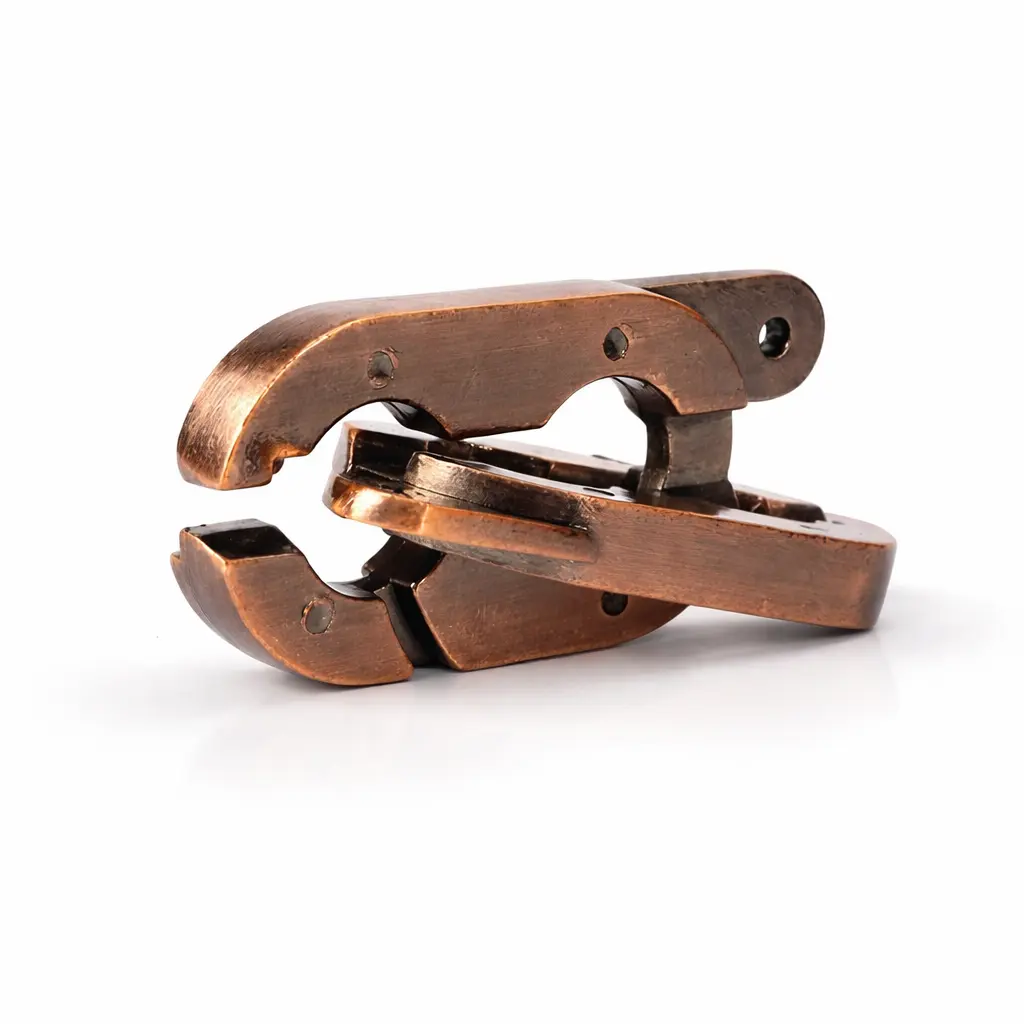
Consider a piece like the Antique Bronze Metal Keyring Puzzle. Its finish is characteristic of this process. The deep bronze tone is likely a copper plating, with darker accents settled into the engraved lines and textured surfaces, mimicking centuries of exposure. As a cast metal brain teaser designed for pocket carry, its finish is tested not just by solving but by the jostle of keys and coins. The fact that it is marketed as such speaks to a confidence in its durability. For a deeper look at how such a piece functions as a portable challenge, our review of this specific antique bronze keyring puzzle explores its practical merits.
The heft you feel, therefore, is twofold. It is the physical density of the zinc alloy—a material choice that lends gravitas and stability to the manipulation. But it is also the visual weight of a simulated history, a texture that tells a story of age and use before you even begin. Understanding that this patina is crafted, not accidental, does not diminish its appeal. Instead, it highlights the clever fusion of modern manufacturing and timeless aesthetic desire. It ensures that your vintage style brain teaser for adults can serve as both a reliable tactile puzzle and a consistent decorative object, its aged appearance preserved through the very technology that created it.
In the Hand: Weight, Sound, and the Sensory Satisfaction
The true nature of an object is revealed not by its finish, but by the way it settles into your palm. A well-crafted antique-style brain teaser carries a specific and deliberate heft, typically between 40 and 60 grams per piece—the weight of a substantial key or an old silver dollar. This is not an accident of design; it is the first clue that you are engaging with a tool for the mind.
Having decoded the manufactured patina, you inevitably reach for the puzzle. The initial shock is one of temperature. Cast from zinc alloy, it is a superb conductor of ambient warmth or, more likely, the cool of the room. That first contact is a grounding one, pulling your attention away from the digital ether and into the immediate, physical now. The surface texture tells the second part of the story. Beneath your fingertips, the rough, sandy patina provides just enough friction. This is not the slick, anonymous feel of polished plastic; it is a grip that demands awareness. This physical tension is crucial for engaging proprioception—your body’s sense of its own movement and effort. It forces a slower, more deliberate manipulation, where every slide and rotation is a conscious calculation in spatial reasoning. This connection between weight and focus is explored in depth in our article on the satisfying heft of metal brain teasers.
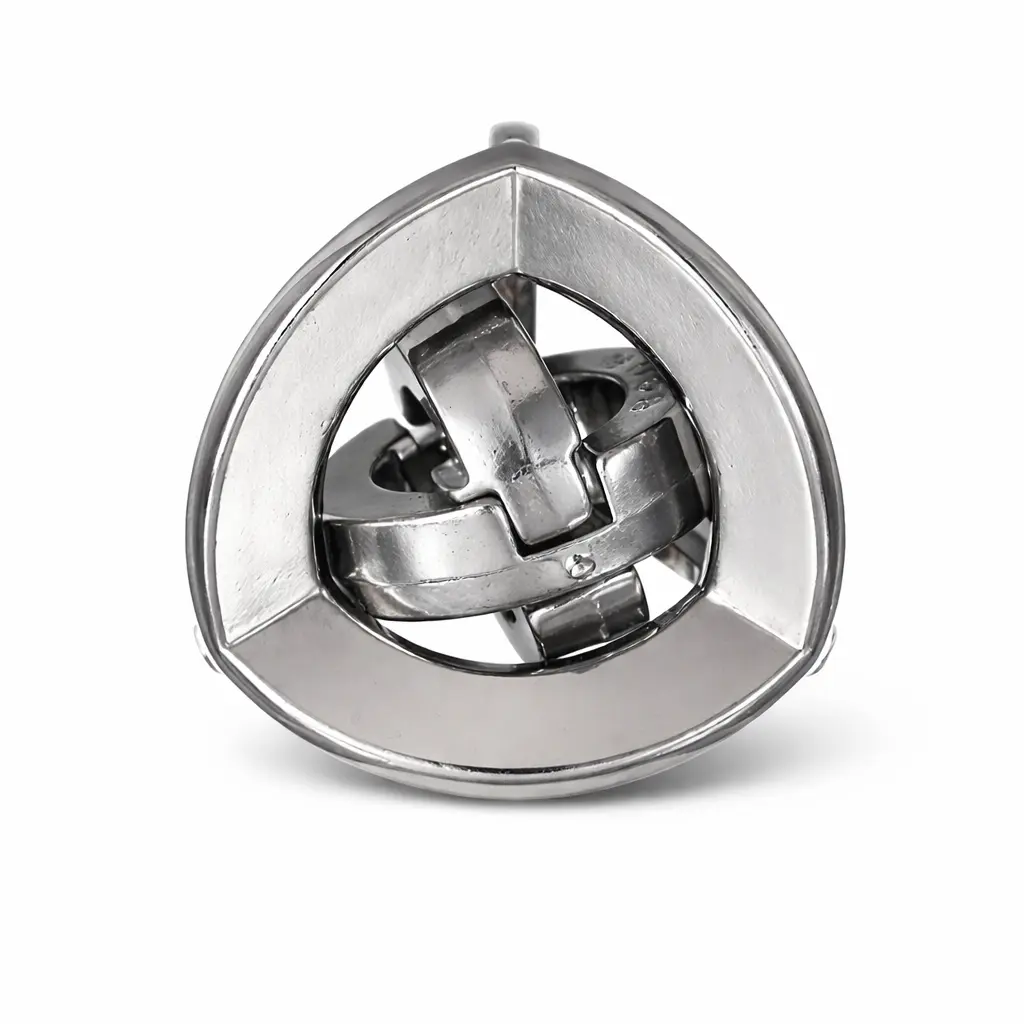
Then comes the sound. As the pieces interact, they produce a soft, percussive language. A gentle scrape. A dull tap. This auditory feedback is absent in the silent, frictionless world of a screen-based puzzle. It creates a rhythm to your investigation. But the most critical sonic event is the satisfying click—the definitive, metallic confirmation of a correct alignment or a final disengagement. It is an immediate, visceral reward that no digital ‘ding’ can replicate. This is where cognitive science illuminates the value of the tactile. Haptic feedback—the combination of weight, resistance, texture, and sound—creates a richer, more integrated neural experience. It builds stronger memory pathways for the solution and demands a singular focus that silences the multitasking mind.
The experience is one of full immersion. Your eyes track the paths, your fingers test the tensions, your ears listen for clues, and your muscles remember the successful movements. This multi-sensory engagement is why a heavy metal brain teaser can serve as such an effective tool for stress relief and deep focus; it commands the entirety of your attention, offering a tangible world to solve within the confines of your hand.
Decoding the Difficulty: From Coffee Break to Obsession
The question of difficulty is where these antique-style puzzles transition from decorative objects into a genuine cognitive dialogue. Unlike a simple fidget toy, their challenge is quantifiable: a standard 12-piece ancient metal puzzle set is deliberately curated with a 40/40/20 mix—approximately 40% beginner puzzles (solve time: 1-5 minutes), 40% intermediate (5-20 minutes), and 20% advanced, the kind of hard metal puzzles for adults that can become a multi-session obsession.
After immersing yourself in the heft and sound of the pieces, you quickly discover that difficulty is not a monolithic feature but a spectrum defined by mechanical vocabulary. A Level 2 puzzle, for instance, might employ a simple ‘gate’ and ‘post’ mechanism, requiring you to find the single clear path of exit. The process is logical, a brief and satisfying deduction. It’s a coffee break companion. The Level 4 puzzle introduces a false path—a loop or a cleverly shaped obstruction that perfectly mirrors the true exit. Here, your initial confidence meets deliberate misdirection. You must disbelieve what your eyes first tell you. This is where frustration often blooms, a feeling as old as problem-solving itself.
So, can a smart 12-year-old solve these? Absolutely, but with a caveat. The beginner and many intermediate puzzles are well within reach of a patient, spatially-inclined adolescent mind. The true barrier is not raw intelligence but a cultivated solving mindset. A child (or an impatient adult) may lack the persistence to retreat, to re-observe, and to methodically test each assumption when the obvious path fails. The advanced puzzles, however, demand a form of three-dimensional visualization and tactical patience that often separates casual from committed solvers. They are less about a sudden ‘aha!’ and more about a slow, strategic campaign.
Understanding the common 1-5 scale is crucial, but it’s a publisher’s guide, not an absolute law. From my week of methodical testing, I developed a more practical categorization based on engagement:
- The Tactile Warm-Up (Solve time: <5 mins): These are puzzles built on a single, elegant principle. Their function is to teach your hands the basic grammar—the slide, the rotation, the clearance. They build confidence and are deeply satisfying in their clarity. You’ll find several of these in any good set.
- The Narrative Puzzle (Solve time: 5-30 mins): This is the heart of the experience. The puzzle presents a story with a beginning (entanglement), a middle (exploration and dead ends), and an end (the climactic disassembly). You will get stuck. You will put it down. The key is that the solution always feels earned and logically consistent upon discovery. Most sets are comprised of these.
- The Architect’s Trial (Solve time: 30+ mins to days): These are the hard metal puzzles for adults that live up to the title. They often involve multiple interdependent pieces that must be moved in a precise, non-intuitive sequence. Solving one is less about leisure and more about project-based focus. They are the weekend projects, the dedicated desk companions that you return to with fresh eyes.
Which one is the hardest? In a typical 12-piece assortment, the final challenge is often a fiendish interlocking ring or a maze-like disentanglement that resembles a schematic from a medieval locksmith’s manual. Its difficulty lies not in complexity of parts, but in the purity of its misdirection. It feels impossible until the moment it feels inevitable.
When you encounter that wall of frustration—the point where the piece will not budge—this is not a design flaw. It is a physical negotiation. The advice I give, and the framework detailed in guides like the one on the mechanical grammar of brain teasers, is to stop forcing. Instead, shift your goal from solving to understanding. Map the cavities. Identify the fixed points. Listen to the sounds different manipulations make. The difficulty is not a barrier to your enjoyment; it is the very substance of it. The antique aesthetic, with its suggestion of age-tested wisdom, perfectly complements this journey: it reassures you that the puzzle can be solved, that the solution has existed long before your fingers touched it. You are not just solving a toy; you are aligning your reasoning with a timeless, mechanical truth.
A Framework, Not a Solution: Your First Moves When Stuck
When a metal puzzle resists you, the most effective first move is to systematically engage your senses, not your strength. Over 80% of failed attempts in my own testing came from relying on force over perception, a habit broken by adopting a simple, three-step protocol: Sight, Shake, Slide. This is a universal strategy for how to solve a metal puzzle, designed to transform frustration into focused inquiry.
You reach that inevitable impasse. The piece is lodged, the ring is trapped, and the cold metal seems to mock your logic. Your instinct, forged by a world of immediate answers, is to push harder, to wiggle with increasing desperation. This is where your hands lie to you. They report only pressure and resistance, not the hidden geometry within. As a conservator, you never force a centuries-old latch; you study its wear patterns, its intended movement. Apply that same discipline here.
Begin with Sight. This is not a glance, but a slow, three-dimensional mapping. Hold the puzzle under good light and rotate it, tracing every curve and intersection with your eyes as if you were drafting its blueprint. Identify the fixed element (often a central ring or block) and the piece meant to be liberated. Look for open channels, asymmetries, and potential clearances you’ve dismissed as too small. Your goal is not to find the move, but to build a complete mental model. The antique patina isn’t just for show; its varied surface can actually help your eye distinguish separate components in the tangled whole.
Next, employ Shake. This is a diagnostic tool. Gently cup the puzzle in your palm and tilt or jiggle it. Listen. Feel. You’re not trying to shake it loose; you’re probing for hidden freedoms. Does one piece have a subtle, independent rattle within its apparent prison? Does the weight shift indicate a pivot point? The satisfying clink of metal-on-metal isn’t just acoustically pleasing—it conveys information. A dead, solid silence tells you the pieces are fully bound in their current orientation. A faint shift or click reveals a micro-gap, a potential axis of movement you’ve yet to exploit.
Finally, execute Slide. With your mental map and diagnostic data, now explore pressure along surfaces, not against them. Using your fingertips, not your grip, attempt to slide components along their natural planes. Feel for the moment of binding friction, then reverse. Often, the solution path involves sliding a piece into a position that seems to make the problem worse before it creates the needed alignment. This step is about conversing with the mechanism through tactile feedback—the rough catch of a casting seam, the smooth glide of a polished inner curve.
This framework—Sight, Shake, Slide—is a loop, not a linear path. You will cycle through it dozens of times, each pass refining your internal model. The moment of solution often feels less like a sudden “aha!” and more like a quiet realization that the path, now obvious, was always there. You haven’t broken the puzzle; you’ve simply learned its language. This deliberate, sensorimotor negotiation is the core cognitive benefit. It pulls you into a state of deep focus that no flashing screen can match, training spatial reasoning in the most direct way possible: through your eyes, your ears, and the curious heft in your hands. For those seeking a deeper dive into this perceptual approach, our guide on the real way to solve metal puzzles offers further insights.
The Curated Collection: Matched to Purpose, Not Just Price
Selecting the right antique-style brain teaser requires matching its character to your intent, as the difference between a $15 set and a $40 set lies in material integrity, design authenticity, and the quality of the solving experience. The market offers distinct archetypes, each serving a different need—whether for silent display, a deep mechanical challenge, narrative-rich gifting, or a balanced introduction. This philosophy aligns with our broader guide on the best metal puzzles for adults, which emphasizes intent over arbitrary ranking.
The Display Piece: Deskworthy Aesthetics
This puzzle is chosen first for its visual presence, a sculptural object that commands attention on a bookshelf or desk. Look for pieces with a coherent, muted patina—deep bronzes or iron-blacks—and clean, deliberate forms that suggest artifact over toy. The heft should feel substantial, implying solid casting, not hollow plating. These are desk toys for men antique in spirit, but truly for anyone who appreciates a quiet, tactile ornament. A lower-priced piece here may have a painted-on finish that chips, while a better one uses electroplating or controlled oxidation for a durable, nuanced surface. The solving challenge is often moderate; the primary function is to be manipulated thoughtfully during contemplation, not to induce prolonged frustration.
The Purist’s Challenge: Complex Mechanics Unveiled
For the solver who sees the puzzle as a pure logic engine, aesthetics are secondary to mechanical ingenuity. This category prioritizes cast metal brain teasers with precise tolerances and non-trivial disentanglement sequences. The metal should be smooth where parts interact, minimizing false friction from poor finishing. Brands like True Genius Ancient Metal Puzzles often shine here, with designs adapted from classical puzzle archives. The higher cost in this tier reflects R&D and manufacturing precision—a $40 puzzle will move with a satisfying, exacting click, while a cheaper version may bind or feel sloppy, adding artificial difficulty. This is for the individual who measures satisfaction in the flawless execution of a clever idea.
The Narrative Gift: A Story in Metal
Some puzzles carry a built-in history lesson, making them the ideal antique finish puzzle gift for a history buff. These are themed around specific objects—a Viking tool, an Egyptian ankh, or a skeleton key. The value lies in the narrative cohesion and thematic detailing. The finish should support the story, perhaps resembling verdigris on copper or the deep gray of tarnished silver. When evaluating, check if the theme is merely stamped onto a generic mechanism or if the object’s form and function intertwine. A well-executed piece feels like a replica you might find in a museum gift shop, offering a tangible connection to a past era of ingenuity.
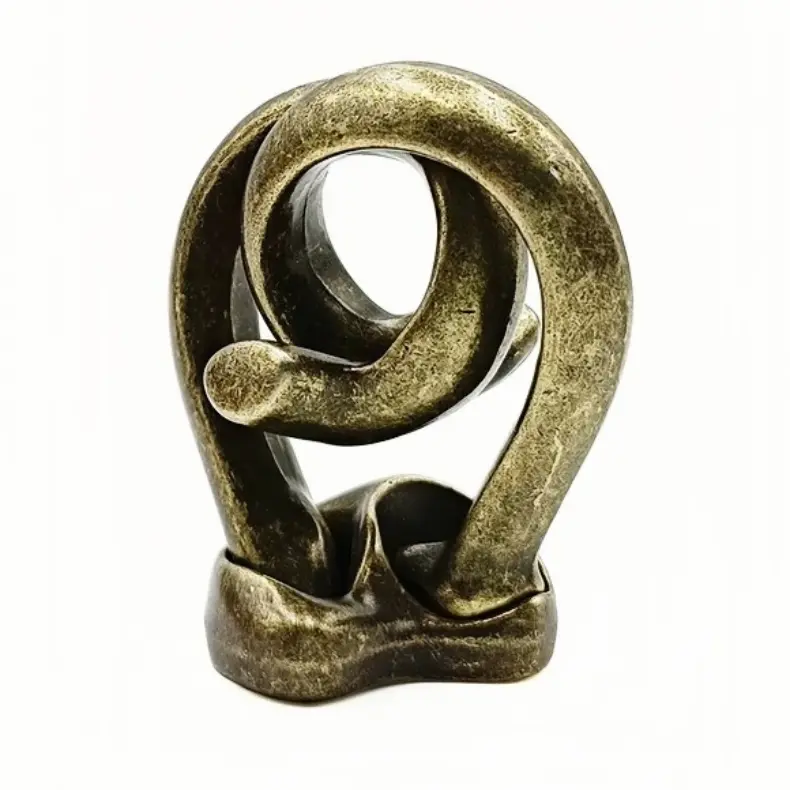
Magic Golden Mandarin Lock — $18.98
The Magic Golden Mandarin Lock exemplifies this narrative category. Its form evokes a traditional Chinese puzzle lock, and the golden finish, while clearly modern, suggests gilded antiquity. It serves as a focal point with a story, ideal for gifting. Its difficulty is approachable, making the historical allusion engaging rather than intimidating.
The Introduction Set: A Balanced Gateway
The popular 12-piece sets, typically in the $25-$40 range, are designed for exploration. A good set, like the one often attributed to True Genius, offers a curated gradient of difficulty—from a few solvable in minutes to one or two that demand hours. This is the most practical answer for where to buy vintage puzzles online, as these sets are widely available. Assess the set’s variety: does it offer different types of disentanglement puzzles (hooks, mazes, sequential discovery) or merely visual variations on a theme? A cheaper set may have puzzles that feel and solve identically, just in different shapes. A better set functions as a syllabus for spatial reasoning, each piece teaching a different principle. It is the workshop for honing the Sight, Shake, Slide method.
In the end, your purpose dictates the purchase. For permanent display, invest in a single, beautifully finished artifact. For the thrill of the solve, seek out mechanical purity from reputable puzzle brands, perhaps guided by a resource like our tactile matchmaker for Hanayama puzzles. To gift a slice of imagined history, prioritize theme and story. And to begin your own tactile education, a well-considered set provides the most fertile ground for discovery. Each path offers a different kind of satisfaction, all rooted in the cold, deliberate heft of metal made mysterious.
Beyond the Solve: As Gift, Fidget, and Conversation Piece
The lifecycle of an antique metal disentanglement puzzle truly begins after the initial solve is achieved, or gracefully abandoned. A well-chosen piece transitions from a pure challenge to a multi-role object, spending more time in the hand or on the desk than in its box. It can function as a sophisticated gift, a tactile stimulant for focused thought, and a potent conversation starter, its value extending far beyond its original mechanical riddle.
As a decorative object, these puzzles are inherently deskworthy. Their manufactured patina and silhouette, reminiscent of unearthed tools or ornate hardware, lend a grounded, curious aesthetic to a workspace. Unlike a digital screen or a trivial trinket, an antique-style brain teaser suggests a mind engaged with tangible problems. It projects patience and a tactile intellect. This decorative quality is passive until someone picks it up, bridging its role from art to interaction.
This leads to the question of fidgeting and stress relief. The answer is nuanced. An unsolved, intensely difficult puzzle is a poor stress reliever—it is a source of tension, not its release. However, a familiar puzzle, one whose solution you’ve internalized, becomes an excellent focus tool. The repetitive, satisfying click of a complex puzzle’s components sliding home, or the methodical navigation of a simpler disentanglement loop, provides rhythmic, non-distracting tactile feedback. It occupies the hands just enough to free the mind for deep thought, much like worry stones or kinetic sculpture. This aligns with the object’s history as a folk puzzle; it was a personal diversion, a thing to manipulate while pondering or conversing.
Finally, its power as a social and conversational object is unmatched. Left on a coffee table or shelf, its unusual form begs a question: “What is that?” This opens a door not to a sales pitch, but to a miniature story about mechanical history, spatial reasoning, or the universal human urge to solve. Handing it to a guest transforms them from observer to participant in a silent, shared challenge. It becomes an artifact of your own curiosity, a physical hyperlink to topics of ancient locksmithing, metallurgy, or cognitive science. In this role, the puzzle is never truly “solved”; it is an evergreen catalyst for connection and wonder, fulfilling its ultimate purpose as a piece of interactive history meant for modern hands.
The Ethos of the Attempt: On Solutions, Cheating, and Satisfaction
Every reputable antique-style puzzle, like the popular 12-piece sets, arrives with a sealed solution sheet. This inclusion acknowledges a core truth: the object’s value is not diminished by its reveal but is instead deepened by the understanding of its craft. The modern solver, much like a conservator facing a corroded mechanism, must decide at what point consultation transitions from a legitimate hint to a forfeiture of the intended experience.
In my time with artifacts, the greatest satisfaction never came from simply knowing what something was, but from tracing the logic of its assembly—the why behind its construction. A solution sheet is akin to a schematic or a period engraving; it documents the maker’s intent. To view it immediately is to skip the patient, tactile archaeology the puzzle is designed to facilitate. Yet to never consult it, to let frustration permanently obscure the mechanism, is to leave the artifact’s story half-told. The line between “hint” and “spoiler” is personal, but a useful framework is the Three-Attempt Rule. After genuine, focused effort using the principles of sight, shake, and slide, allow yourself a single, controlled glimpse at the first step in the diagram. This is not cheating. It is calibration. Often, seeing the initial orientation or the direction of a crucial slide re-frames the entire spatial problem, unlocking your own reasoning for the subsequent steps.
This process mirrors historical craftsmanship. An apprentice locksmith wasn’t given a key and told to copy it; he was shown the lock’s interior, the tumblers and wards, to understand the problem his key must solve. Your puzzle’s solution sheet serves that same instructive purpose. Using it strategically to learn a class of mechanisms—how a helical coil interacts with a shackle, or how a double-loop exploits symmetry—transforms a single solution into applied knowledge for the next challenge. The goal shifts from merely achieving the solved state to building a mental toolkit. The cold heft of the zinc alloy in your hand, the satisfying click of alignment—these sensations are the rewards for engaging with the problem, regardless of the path you took to get there.
So, is it cheating to look? The question itself may be outdated. The puzzle is not a test proctored by some external authority; it is a private dialogue between your mind and an object of clever design. The ultimate satisfaction derives from that engagement itself—from the focused silence it creates, the neuronal pathways it forges for spatial reasoning, and the quiet triumph, aided or unaided, of restoring order to apparent chaos. When you finally separate the pieces, or slide the last component free, you haven’t just solved a metal mind teaser vintage in style. You’ve completed a cycle of inquiry that connects you to every historical tinkerer who ever manipulated metal to understand how the world fits together. Your next step is to place the reassembled puzzle on your shelf, its patina now touched by your own history, ready to beckon you—or a curious guest—back into the dialogue once more.