Quick Answer
For adults choosing a logic puzzle that pairs metal and wood, start with a precision-cast metal disentanglement like the Cast Hook Metal Brain Teaser when a short, repeatable hand challenge matters most, and add a wood-bodied sequential lock or burr when presentation and replay value lead the brief. The hybrid category is defined less by brand and more by what each material is doing in the design — and three checks decide almost every purchase.
The three checks that change the pick:
- Mechanism type — disentanglement (separate the pieces), sequential discovery (open the box through steps), burr (assemble interlocking sticks), or assembly (take apart and rebuild). The mechanism dictates replayability and how the puzzle wears on a desk.
- Material function — confirm the metal is doing precision work (pins, rings, hinges, catches) and the wood is doing tactile and aesthetic work (body, frame, cover). If the wood is just a base plate, it is not a true hybrid.
- Difficulty calibration — match the rating scale to the mechanism. A level-6 metal disentanglement is a different beast from a level-6 wooden sequential box, and brands rarely share a scale.
| Use case | Pick from the Tea-Sip roster | What to check before buying |
|---|---|---|
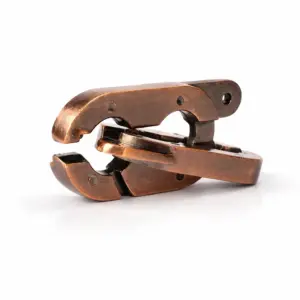
| First hybrid buy / repeatable desk fidget | Cast Hook Metal Brain Teaser — $13.99 | Confirm the hook motion has a clear tactile click at the release point; check that the metal finish does not grab on skin. |
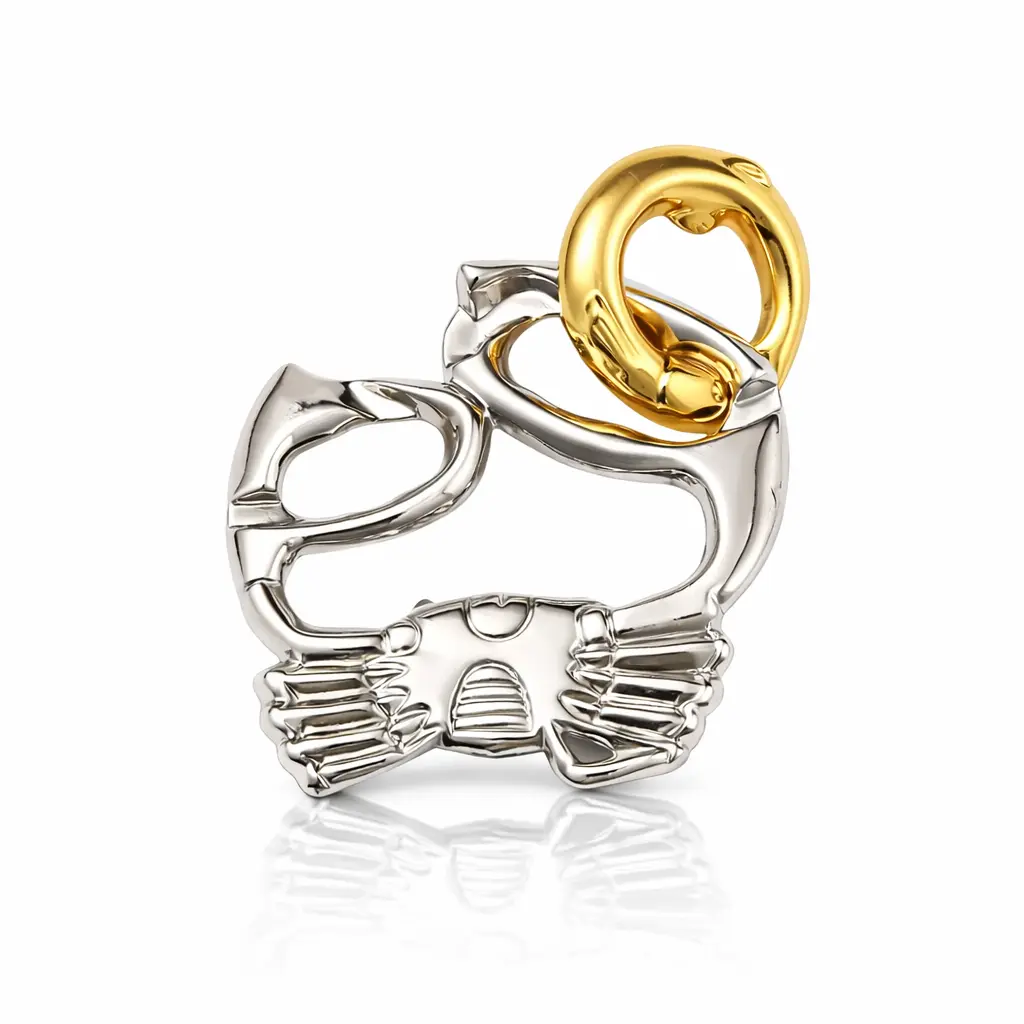
| Gift for a cast-metal collector | Metal Crab Puzzle Cast Brain Teaser with Gold Ring — $13.99 | Verify the gold ring moves independently of the body and that the cast seams are flush. |
| Two-ring orbit loop | Metal Orbit Ring Cast Puzzle — $14.99 | Confirm both rings orbit independently and that the closed form sits flat on a desk without rolling. |
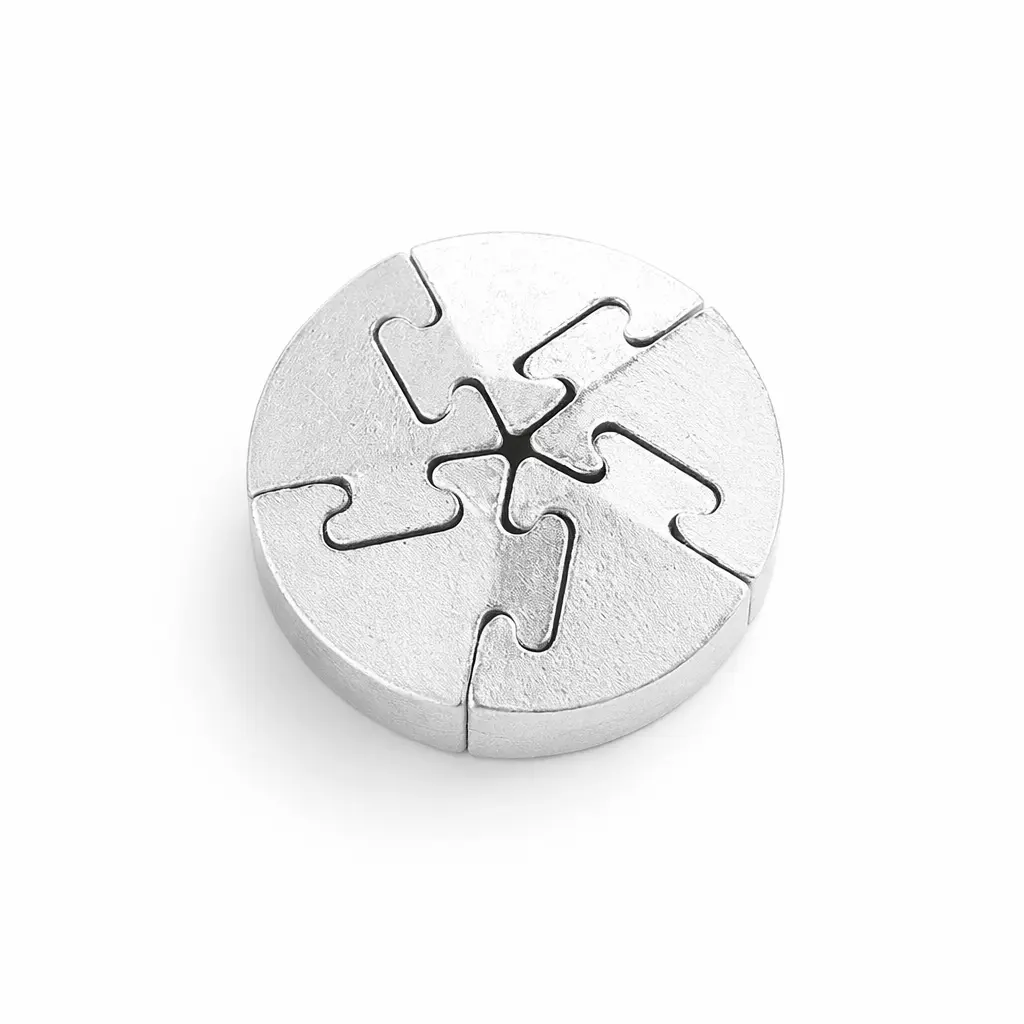
| Collection-grade, harder disentanglement | 5 Piece Cast Spiral Metal Puzzle — $16.99 | Confirm five distinct cast pieces (not welded) and that the spiral tolerances allow the documented solve path. |
| Portable pocket carry | Cast Coil Pocket Puzzle — $18.99 | Check closed dimensions against a standard shirt pocket and verify the coil returns to start position. |
When the goal is a true metal-and-wood mix rather than a metal puzzle that happens to sit on a wood shelf, the Cast Hook is the strongest single-piece starting point because its metal hook is the precision element the rest of the design rotates around, and the solve path is short enough to revisit during a coffee break. Move to the wood-bodied pieces once the disentanglement habit is set.
01. What ‘Metal-and-Wood Mix’ Actually Means in a Logic Puzzle
A metal-and-wood logic puzzle is a mechanical puzzle in which each material is doing work the other cannot do — metal carries the precision tasks (rings, pins, hinges, weighted cores, sliding gates, magnetic latches) while wood carries the tactile and aesthetic tasks (bodies, frames, lids, end caps). If a listing cannot tell you what the metal is for versus the wood, the hybrid is decorative rather than engineered, and buyers should keep looking.
Once the quick-answer shortlist is on the table, the next step is understanding why “metal plus wood” is even a category worth filtering for. Most listicles treat the material pairing as a styling choice — nice to look at, pleasant to hold, nothing more. The stronger reading is that hybrid logic puzzles are designed the way watch movements or fine tools are designed: every material is selected because of what it does at a specific stress point, not because it photographs well.
The material-function split. In a well-engineered hybrid, the metal components almost always sit at the moving interface. Cast or precision-cut rings, sliding pins, magnetic catches, and weighted cores all depend on tight tolerances and consistent mass, and metal holds those tolerances better than wood over years of handling. The wood, in turn, surrounds the metal: it forms the body, the frame, the lid, the base, the display cradle. Wood dampens sound at the moment of click, warms to the hand within seconds, and accepts oil or wax finishes that age gracefully. A reader who flips a hybrid over and asks “what is the metal actually doing here?” should be able to point to a specific task — a pin that must slide without play, a hinge that must rotate without wobble, a gate that must release at a precise moment. If the metal is purely ornamental, the puzzle is a wood puzzle with a metal sticker, not a true hybrid.
Why designers combine rather than choose one material. Four observable benefits show up across the strongest pieces. Acoustic contrast: the soft thunk of wood meeting wood against the sharp click of metal-on-metal gives the solver a feedback channel that pure-wood puzzles lack. Thermal contrast: cool metal against warm wood tells the fingers which component to manipulate, which matters when both hands are working different parts of a sequential-discovery box. Weight balance: a heavy metal heart inside a lighter wooden shell lets the puzzle feel substantial without becoming a desk weight, and lets the designer offset a sliding gate so it closes with authority rather than drift. Longevity: the metal absorbs the wear at every moving interface, so the wood body — the part a buyer actually sees — stays unmarked for years.
The buyer takeaway. Before any purchase, readers should be able to answer three questions about the listing: What is the metal doing? What is the wood doing? Where do the two materials meet, and what does that joint have to survive? A solid listing will name the mechanism (disentanglement, sequential discovery, burr, or assembly), describe the metal component’s role in plain language, and describe the wood’s role. A weak listing will say “metal and wood brain teaser” and stop there. The first is a design; the second is a product photo.
For readers who want a quick side-by-side on how metal-only, wood-only, and hybrid puzzles compare on the same axes, a separate metal puzzle vs wooden puzzle comparison walks through the trade-offs in more detail. The short version: hybrids earn their price when each material has a job, and they disappoint when neither does.
02. Which Mechanism Types Matter When You Buy a Hybrid Puzzle
Four mechanism families define the metal-and-wood hybrid category, and the family decides everything else — solve feel, tactile feedback, replay value, and whether the puzzle ends up in a hand every afternoon or on a shelf after the first solve. Pick a family first, then evaluate the hybrid construction within it.
The disentanglement is the most fidget-friendly. Goal: free one or more parts from each other, typically a hook, ring, or chain released from a frame through a specific sequence of passes — the defining trait of the disentanglement puzzle category. In a hybrid build, the metal does the precision work at the sliding interface — rings, hooks, wire guides — while the wood holds the frame steady, adds desk weight, and gives the eyes a warm anchor during long loops. Observable design feature: clean uniform gaps between metal parts, no visible casting flash at the joints, and a wood frame with crisp rather than fuzzy edges. Failure mode that signals a cheap build: rings that bind instead of glide, or hooks with burrs that catch on wood edges. Two hybrid examples that show how the frame changes the feel:
The sequential discovery, or puzzle box, is the slowest but the most gift-worthy. Goal: open the box step by step through hidden triggers — sliders, magnets, false bottoms, weighted panels — until the inner compartment releases. The wood forms the body and most of the visible mechanism; metal handles the locks, hinges, and small magnet arrays that give each step its satisfying click. Observable design feature: hidden seams, sliding panels with consistent reveal lines, and metal hardware that sits flush rather than proud. Failure mode that signals a cheap build: hinges with side-to-side slop, misaligned magnets, or wooden panels with visible glue lines at the joints.
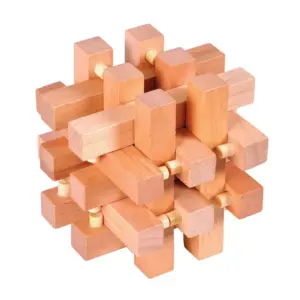
The burr is the most tactile and acoustic. Goal: separate interlocking wooden sticks, often six or more notched pieces, by sliding them along their long axis. The wood does almost all of the visible work; metal pins sometimes pass through the center to keep the puzzle reusable instead of letting it scatter on a table, and the click of wood-on-wood as a stick slides free is part of the reward. Observable design feature: precision-cut notches with sharp interior corners, end grain that matches across pieces, and any metal pin sitting flush with the wood face. Failure mode that signals a cheap build: visible glue lines, fuzzy edges, or pins that protrude even a fraction of a millimeter.
The assembly is one step beyond pure logic. Goal: take the puzzle apart, then put it back together, which is usually harder than the disassembly because the solver must remember the sequence in reverse and manage orientation throughout. The materials follow the same split as the other families — metal for moving parts, wood for bodies — but the count of possible states grows quickly with part count. Observable design feature: a part count that matches the listing’s stated difficulty, and moving interfaces that show the same material-function split as a good disentanglement. Failure mode that signals a cheap build: parts that only fit in one orientation but the listing doesn’t say so, leaving the solver to brute-force the rebuild by trial and error.
The directive. The mechanism family is the first filter. Before looking at brand, wood species, or finish, decide which family fits the use case: a disentanglement for desk fidget, a puzzle box for gift reveal, a burr for display and slow Saturday afternoons, an assembly for a longer evening project. Then, and only then, evaluate the hybrid construction using the same three material-function questions from the previous section. A disentanglement built with cast-metal hooks and a solid wood frame will behave very differently from a wood-bodied wire puzzle with stamped metal guides, even though both mix the two materials. Readers who want a wider view can compare these four families against the six types of metal puzzles to see where the hybrids sit in the broader landscape.
03. How to Match a Hybrid Puzzle to Use Case and Difficulty
Difficulty ratings do not transfer between mechanism families, so match the puzzle to the use case first and the number on the box second. A level-6 cast-metal disentanglement and a level-6 wooden sequential box measure completely different challenges, because one tests spatial untangling and the other tests hidden-step logic. The most reliable calibration tool is the observed first-solve duration for an adult first-time solver, not a printed star count. For a closer look at why cross-brand level numbers rarely line up, see why a level 5 can mean 3 minutes or 3 days.
The four use cases that decide the purchase.
Desk fidget / mindful break
A short-loop disentanglement with a weighted base is the right shape. Look for a cast-metal mechanism that resets quickly and a solid wood or composite frame that stays planted on the desk without sliding. The material role that matters most here is weight: metal at the moving parts and a denser wood at the base. The buyer check is the loop feel. A good piece returns to the start position with a satisfying click rather than a fussy re-thread. The mechanism families that fit are disentanglement and small wire-with-wood hybrids.
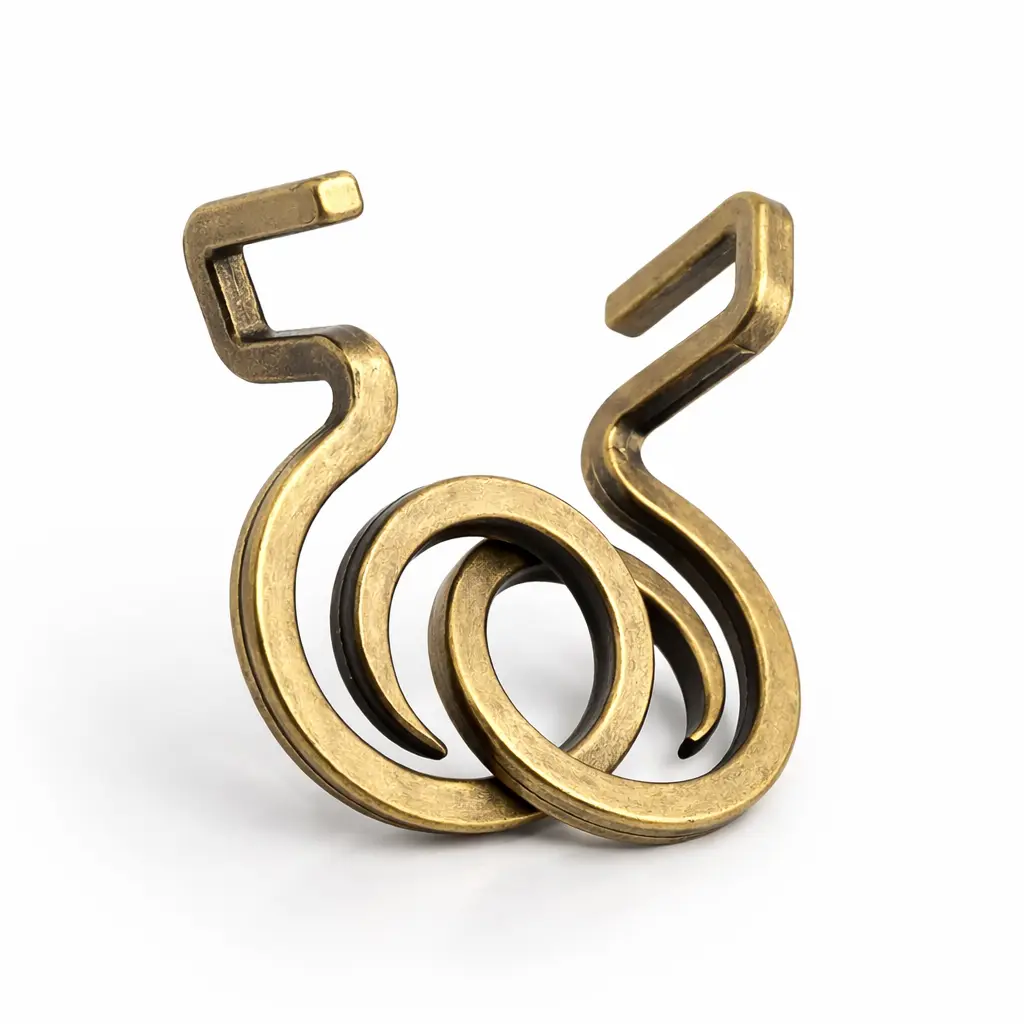
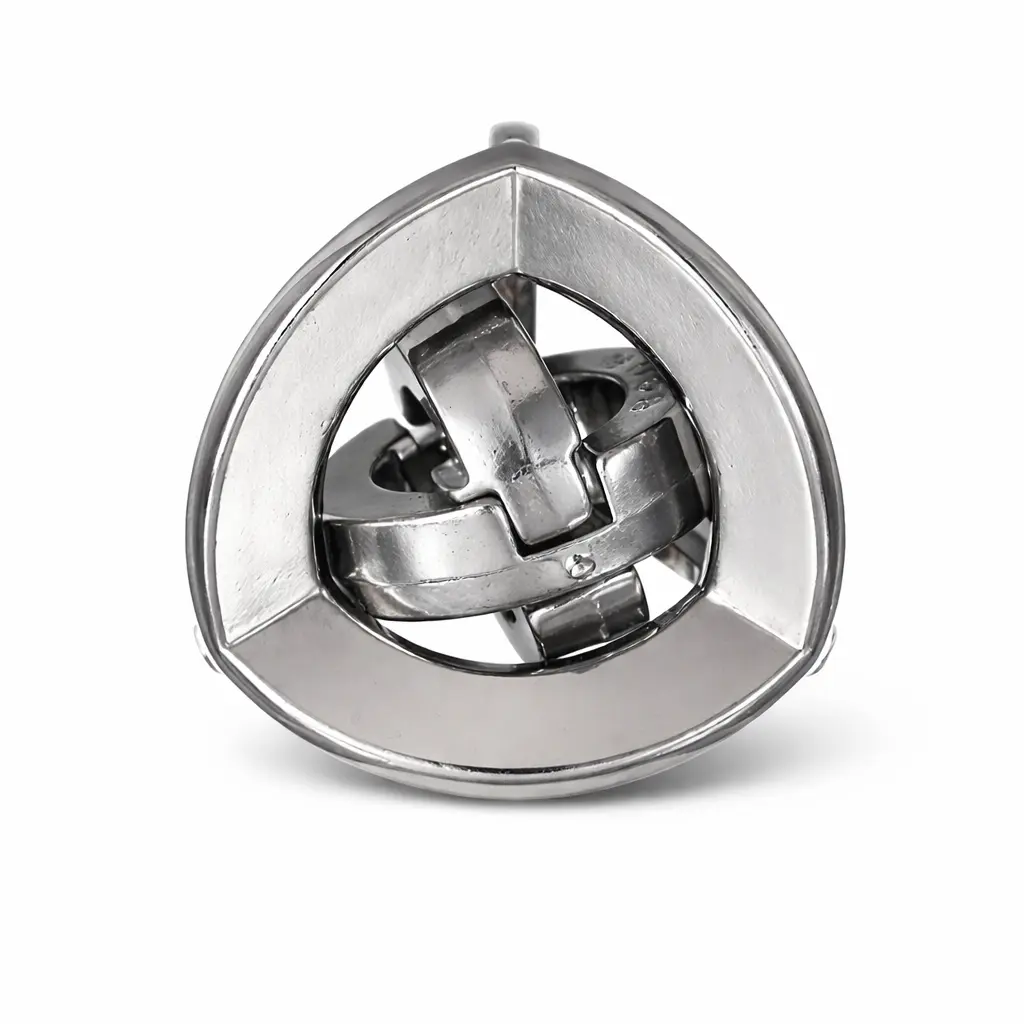
For a slightly more orbit-style loop, a two-ring cast mechanism serves the same function.
Display-worthy heirloom
A burr or sequential discovery box earns the shelf when the wood and the metal are both visible. Look for precision-cut joinery, an oiled or waxed finish, and metal pins, hinges, or locks that read as part of the object rather than hidden hardware. The material role that matters most here is finish: the wood should age well, and the metal should not tarnish aggressively. The buyer check is the joinery sightline, because gaps or misaligned seams are the fastest tell of a rushed build. The mechanism families that fit are burr and sequential discovery.
Gift-ready reveal
A sequential discovery box with staged openings is built for this moment. Look for hinges that operate smoothly, a sequence that builds over two to four steps rather than all at once, and packaging that supports the unboxing. The material role that matters most here is the hinge: a stiff hinge cheapens the experience even if every other component is excellent. The buyer check is the lid arc, meaning the way the box opens through its sequence. It should feel like a small stage direction, not a stuck drawer.
Collection-grade
Limited runs, named designers, and mechanism novelty define this lane. Look for a signed or numbered piece, a documented design lineage, and a mechanism that adds something the buyer does not already own. The material role that matters most here is attribution. The buyer check is the maker’s mark, because unsigned hybrids at premium prices are a yellow flag regardless of the material quality.
The one next action. Pick the use case first, then pick the mechanism family, then verify the single material role that matters for that use case. Weight for fidget, finish for display, hinge for gift, attribution for collection. Everything else on the listing, including difficulty stars, is secondary to that three-step path.
04. A Decision Table: Mechanism, Use Case, and What to Check
That three-step path — use case first, mechanism family second, single material role third — becomes concrete in the table below. Instead of asking “what’s the best hybrid puzzle,” the table asks which pairing of mechanism and use case actually serves the buyer, and what one observable check confirms the pairing before checkout.
Read the rows as mechanism families (disentanglement, sequential discovery, burr, assembly) and the columns as the four use cases from the previous section (fidget, display, gift, collection-grade). Cells that don’t make a clean pairing are left intentionally sparse; for example, a heavy burr puzzle is a poor fidget, and a quick disentanglement is a weak display piece. Forcing a mismatch wastes the buyer’s money and the recipient’s patience.
| Mechanism | Best use case | What the metal does | What the wood does | What to check before buying |
|---|---|---|---|---|
| Disentanglement | Fidget (short loops) | Holds the precision tolerance that lets rings or hooks slide; the weight that gives a satisfying “click” on release | Optional base or handle that warms the hand during repeated loops | Confirm moving parts have no burrs or play; check that the resting position is stable on a desk |
| Sequential discovery box | Gift, display | Powers the hinge and lock pins that define the sequence; resists wear across dozens of opens | Carries the finish that frames the unboxing; absorbs the sound of each step | Test the hinge arc — it should move through stages, not jam at one point |
| Burr (wood-bodied, metal-pinned) | Collection, display | Pins act as guides, keys, or internal limiters that control how the pieces part | Forms the precision-cut interlocking body; dictates the grain and finish visible on display | Ask whether the piece is signed or numbered; unsigned burrs at premium prices are a yellow flag |
| Assembly / take-apart | Display, collection | Welds or cast joints that define the single correct rebuild order | Houses the pieces between attempts; often the face the display shelf sees | Run a finger along the seams — any visible glue line or uneven join signals lower-tier finishing |
The disentanglement column is where most adult beginners land, because the solve loop is short, the loop is genuinely repeatable, and the metal’s precision work is visible the moment the puzzle is picked up. The Cast Hook Metal Brain Teaser is the lead example in that lane for a buyer who wants a compact, desk-friendly hybrid start. For a tighter ring-format option in the same family, the 4 Band Puzzle Ring follows the same mechanism logic at a smaller scale.
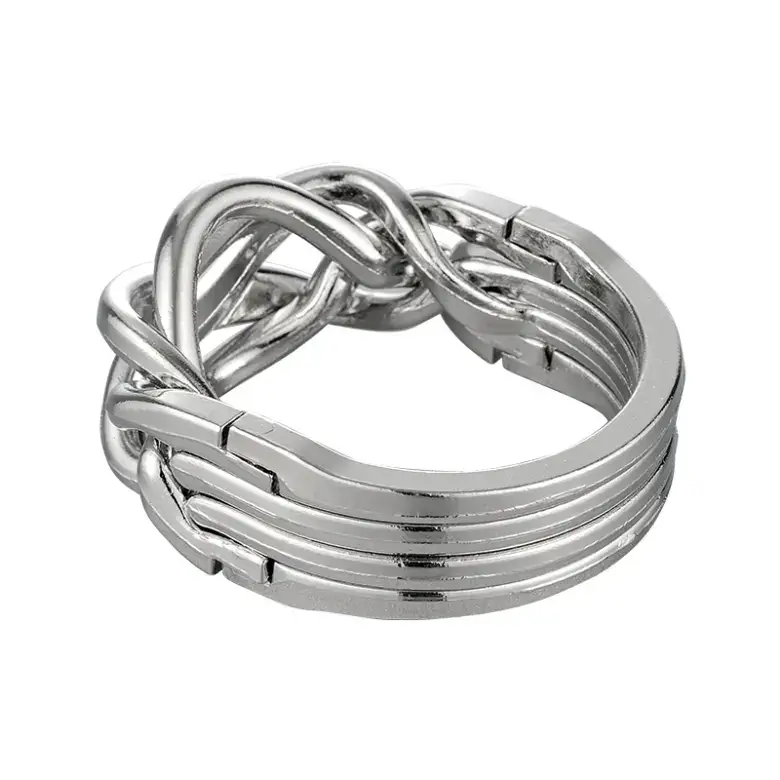
4 Band Puzzle Ring — $11.99
The one next action. Take this table to the product page, pick the single row that matches your use case and mechanism, and confirm one check before checkout. If that check passes, the hybrid is the right one.
05. How to Verify Build Quality Before You Buy a Hybrid Puzzle
A hybrid puzzle fails at the interface, so verify the interface first. The decision table matched mechanism to use case and pointed to a single product row; the checks below tell you whether the specific object on that product page will survive the role you’ve picked for it. Six observable signals, each tied to a failure you can predict before the package even arrives. For a more rigorous three-step protocol covering drop, scratch, and bend checks, this metal puzzle quality test protocol is a useful companion to the visual checks below.
Tolerance at the moving joint. In a disentanglement or sequential-discovery hybrid, a metal ring should glide on its pin, not click into place. A click means the pin is undersized or the bore is oversize, and the puzzle will loosen with every solve. Readers should look for product photos that show the gap between pin and ring at a 45-degree angle, not the flat glamour shots that hide the working surface.
Wood grain orientation and end-grain exposure. Long grain on the body ages into a deeper color and resists chipping. End grain on a contact face absorbs finish unevenly and chips first, especially where the user’s thumb lands. If a listing shows end-grain faces where the hand grips the puzzle, expect visible wear marks within weeks of regular desk use.
Finish type — oil vs. lacquer. Oil finishes feel warm and can transfer slightly to skin or fabric, but they re-coat easily. Lacquer sits on top, resists transfer, and tends to crack at moving joints when temperature changes. If the product page does not name the finish, assume oil and plan to re-oil every few months for any piece that lives on a desk full-time. The tactile feedback changes either way, so it is worth knowing which you are signing up for.
Hinge and pivot geometry. This is where metal usually lives in a hybrid. Look for a single continuous pin through the joint, not two stub pins meeting in the middle. Precision-cut hinges survive; the joined-stub version is the most common failure point on cast imports. A short fragment: one pin through, not two pins meeting.
Weight and balance. A top-heavy hybrid tips during play. If the wood body is hollow or unusually thin, the metal mechanism will dominate and the puzzle will roll out of your hand mid-solve. Readers should look for weight listed in grams rather than relying on photos alone, because cast metal is denser than most buyers expect and the balance is rarely visible in a studio shot.
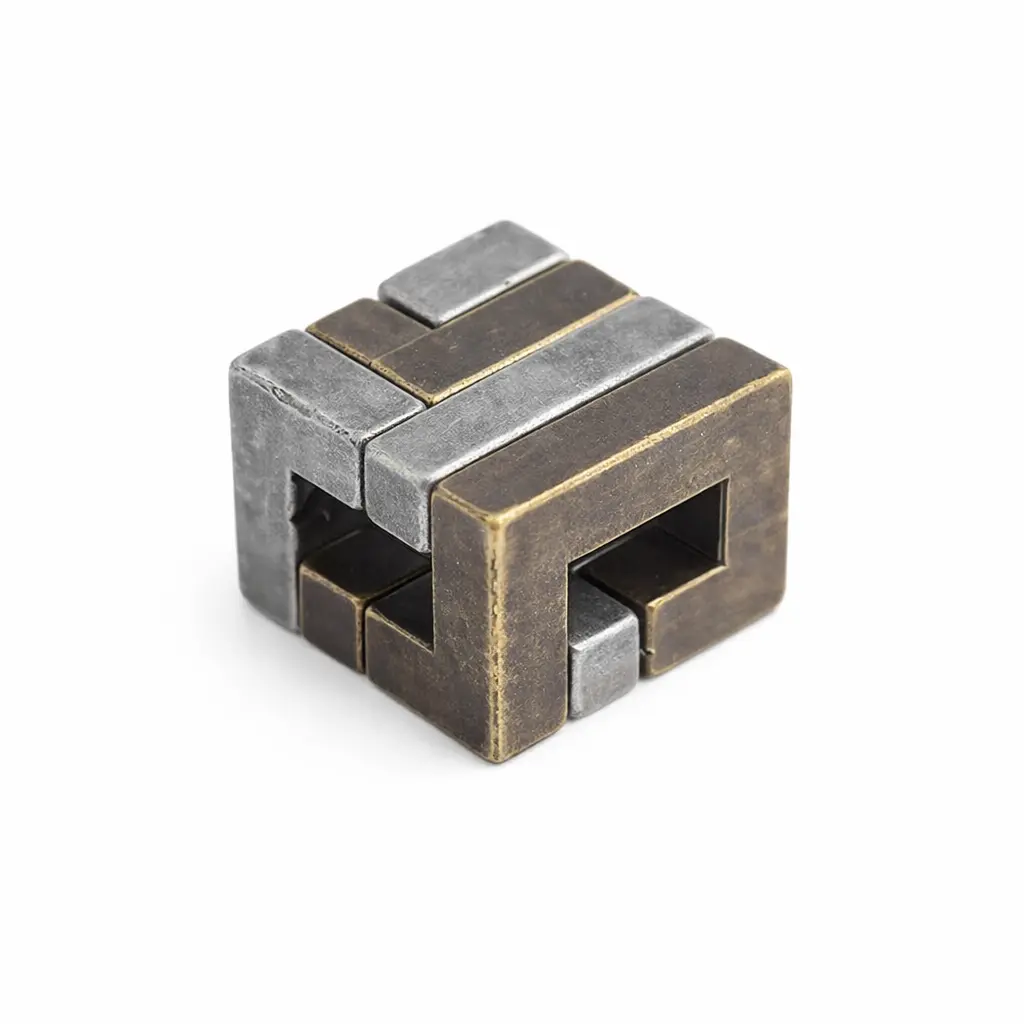
Cast Coil Pocket Puzzle — $18.99
Replacement parts and warranty signals. Makers who stock replacement pins, springs, or covers — and who publish a return window longer than 30 days — are signaling confidence in the build. One-off imports rarely offer either. A short fragment: the warranty page is the maker’s true spec sheet.
The one next action. If a listing shows only lifestyle photos and no close-up of the moving joint, assume the joint is the weak point. Message the seller for a macro shot, or walk away. The seller’s response — and their willingness to send one — is itself a build-quality signal that no product photo can replace.
Frequently Asked Questions
Metal-and-wood hybrid puzzles sit in a different design language from metal-only or wood-only ones, and the most common buyer questions come down to three decisions: whether a puzzle is truly a hybrid, how difficult it will feel, and which mechanism matches a specific recipient. Each answer below closes with a verification step readers can run before paying.
What counts as a metal-and-wood logic puzzle versus one with just a metal base?
A true hybrid uses both materials for different mechanical jobs — metal for precision work like rings, pins, or hinges, and wood for the body or housing that adds tactile warmth and acoustic contrast. A puzzle with a wooden base that never lets the wood affect the solve path is closer to a wood-framed metal puzzle than a hybrid. The check: does removing the wood change the difficulty or feedback?
Are hybrid puzzles harder than metal-only or wood-only ones?
Not categorically — difficulty tracks the mechanism, not the material. A level-6 cast metal disentanglement and a level-6 wooden sequential-discovery box aren’t comparable: the metal version is a short-loop spatial challenge, the wooden box is a long-form logic chain. Cross-brand ratings don’t align, so calibrate by mechanism and observed solve-time, not printed level numbers.
Which hybrid is the right first buy for an adult beginner?
Start with a short-loop disentanglement — one clear goal (free the ring, separate the hook) and an obvious “of course” moment when solved. Compact cast metal puzzles fit this slot: light, portable, finished in one sitting. Look for a single moving part rather than a multi-stage sequence.
How long do these puzzles usually take to solve the first time?
Solve time varies widely with mechanism and solver experience. There is no published first-solve time for most cast puzzles because it depends on whether the solver recognizes the mechanism. The verification step: search the puzzle name plus “solution” before buying. A clean walkthrough’s presence or absence is a better signal than any printed rating.
Can a metal-and-wood puzzle double as a desk fidget toy without wearing out?
Cast metal handles desk fidgeting well because precision-cut surfaces don’t degrade with handling. Wood is the soft variable — finish and joint type determine how a wood-bodied piece ages. Ask the maker whether the wood carries a sealant or hardwax finish; unfinished wood shows wear within weeks of pocket carry.
What’s a good metal-and-wood puzzle to gift someone who already owns Hanayama?
For a collector used to cast metal pieces from established makers, a wood-bodied disentanglement or sequential-discovery box is the natural next step — the mechanism is familiar, but the added weight, different acoustic feedback, and step-based logic give a fresh challenge. A compact cast metal hybrid with a wood display stand works especially well for gifting because it ships already framed for presentation.
The next step. Pick the mechanism that matches the use case (fidget, display, gift, collection), verify the moving joint and the wood finish, then check the product page for the current price. If the listing clears those three checks, buy; if not, keep looking. The hybrid category rewards patient verification over impulse selection.
Where to Start
If the checks above show that you need a compatible puzzle rather than another solve step, start with Cast Hook Metal Brain Teaser. Check the current product page for the specifications that matter to your choice.
Still comparing options? Walk back through the mechanism and use-case sections to apply the same decision criteria to each candidate, rather than restarting the search from scratch.
Sources and verification
- Product details and current specifications: Tea-Sip product page
Last updated: August 6, 2026