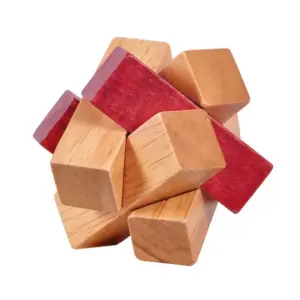
Quick Answer
The best beginner puzzle gift for a healthy retired dad is a graduated crystal lock set, and the 12 Piece Crystal Luban Lock Set is the top pick: a first-solve win in 30–60 minutes, a second puzzle for a follow-up, and gift-ready packaging without clinical framing. A beginner puzzle set works as a retirement gift when it (1) includes at least one puzzle the recipient can finish in 30–60 minutes for a first win, (2) doesn’t look therapeutic or medical, and (3) offers a second puzzle for a follow-up challenge. Skip sets marketed for memory loss or cognitive care unless that is the explicit reason for the gift. A mentally sharp, newly retired father is a beginner hobbyist, not a patient.
The four checks that guide the rest of this article:
- Variety — at least 4–6 distinct puzzles so he can try different types before committing
- First-solve timing — the opening puzzle should be finishable in 30–90 minutes
- Presentation — gift-ready packaging, included manual, storage case or display tray
- Replay value — graduated difficulty so a second or third puzzle feels like a step up, not a repeat
For most buyers, a compact mechanical disentanglement set is the strongest starting pick: small, tactile, and a puzzle a retiree can keep on his desk. The 12 Piece Crystal Luban Lock Set fits that profile and leads the comparison below.
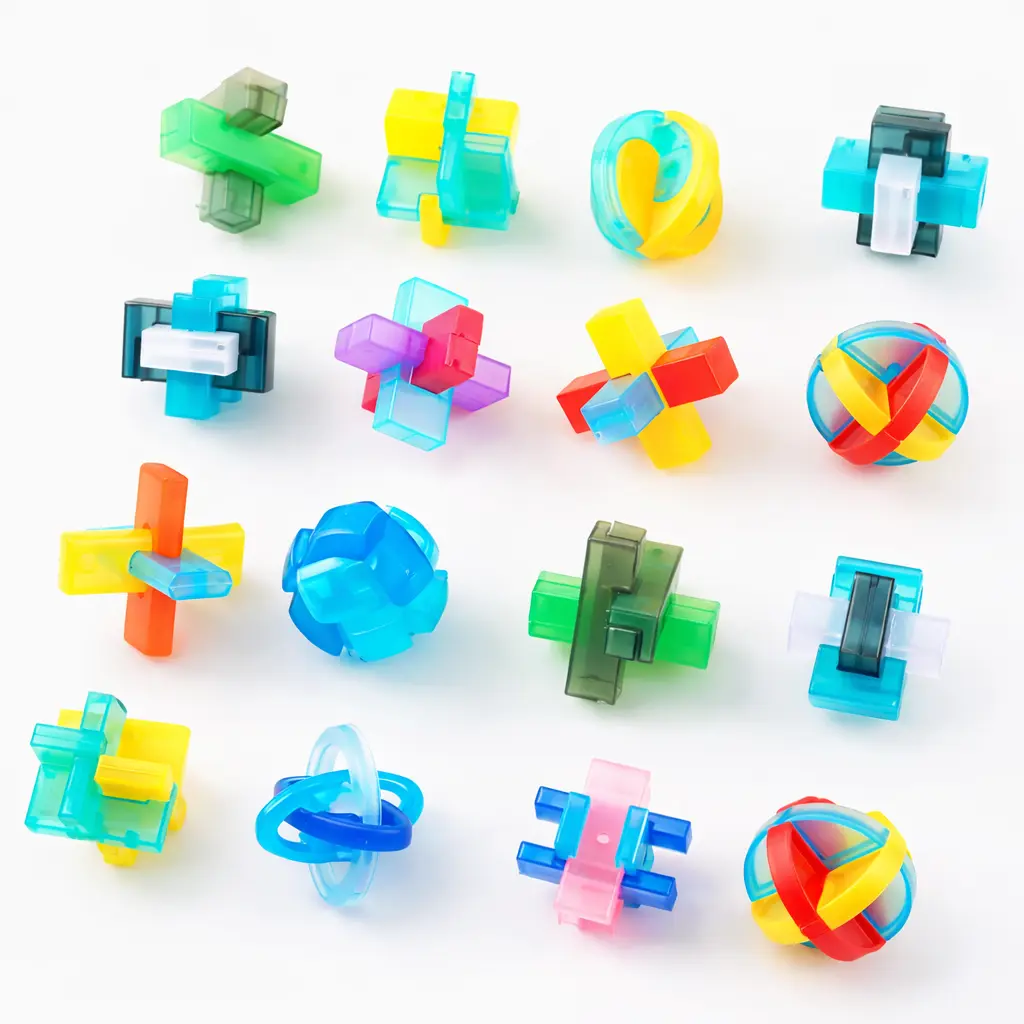
Decision Table: Best Beginner Puzzle Set Archetypes for a Retired Dad
| Archetype | First-solve time (estimate) | Gift-readiness | Best when… | Tea-Sip option |
|---|---|---|---|---|
| Multi-lock disentanglement set | 15–45 min per lock | High — boxed, manual included | Dad wants a desk puzzle he can pick up between tasks | 12 Piece Crystal Luban Lock Set |
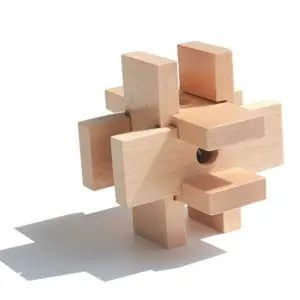
| Wooden brain teaser collection | 20–60 min per puzzle | High — display-worthy wood | Dad values craftsmanship and a visible object on the shelf | 6-in-1 Wooden Brain Teaser Set |
| Mechanical build kit (3D wood) | 60–180 min total build | Medium — project, not quick win | Dad enjoys hands-on assembly and a finished display piece | 3D Wooden Mechanical Pistol Kit |
| Spatial-shape puzzle (cube or pyramid) | 10–40 min per shape | Medium — pocket-sized | Dad wants a tactile, repeatable challenge | 54‑T Cube Puzzle or 6 Piece Steel Ball Pyramid Puzzle |
| Wearable puzzle (ring) | 5–20 min first attempt | Low–medium — novelty | Dad likes a conversation-starter he can carry | 4 Band Puzzle Ring |
If you can only verify one thing before checkout, verify the first-solve time. Any puzzle that demands more than 90 minutes on a first attempt risks frustration before the second puzzle gets a chance.
For a fuller look at retirement-party gift framing, see 7 unique puzzle gifts for a retirement party that spark connection.
01. What ‘Beginner’ Should Mean for a Healthy Retired Dad
Beginner means finishable in 30 to 90 minutes on the first attempt, not low piece count and not an age label. For a mentally sharp retired father, the right starting tier is a puzzle with a visible goal, a low instruction barrier, and a tactile feel that signals a real object. That definition separates a dignified retirement gift from a clinical one.
That rule cuts against the “senior puzzle” default that dominates search results. Most top recommendations lump retired dads with people who need cognitive support, then ship products packaged in clinical language with caregivers on the box. A healthy 65-year-old who just closed a 40-year career does not want a gift that reads as a medical aid. He wants a hobby entry point that respects his competence and fits the Saturday-morning hour he is suddenly trying to fill.
The reframe matters because you are the actual buyer, and your decision is not “what puzzles work for memory loss” but “what puzzles will my dad actually enjoy, finish, and pick up again next weekend.” Those are different purchase problems. The first asks for oversized pieces and safety features. The second asks for tactile satisfaction, a clear visual goal, and an instruction barrier low enough that he does not need to call you for help after the wrapping paper is off.
Three observable checks separate a true beginner puzzle from something that just claims to be one.
First-solve time is the primary signal. If the listing does not state an expected solve range, plan to verify it before checkout by reading customer photos and reviews that mention minutes or hours. Anything over 90 minutes on a first attempt is a project, not a beginner puzzle.
A clear visual goal matters as much as difficulty. The recipient should be able to look at the unsolved puzzle and see what “done” looks like — a separated key, a freed ring, an assembled shape. Puzzles that hide the end state, like a closed lock or a sealed box, work for solvers who already understand the genre. A retired beginner needs the finish line visible from the start.
Tactile satisfaction closes the loop. Wooden and metal puzzles tend to feel substantial in the hand, which signals “real object, not toy.” Lightweight plastic with thin walls reads as disposable. For a milestone retirement gift, the weight and finish in his palm is part of the experience.
One more filter worth naming: skip any product whose listing shows a model solving it while looking confused, a caregiver assisting, or copy that uses clinical framing. The packaging is the gift’s first impression, and a healthy retired dad will read a clinical package as a signal that the giver thinks he needs help he does not.
If a puzzle passes these checks and sits inside a set with two to four companions of graduated difficulty, it qualifies as beginner-friendly for a retired father. The next section maps which puzzle types typically clear that bar, and how each one reads on first contact.
For a closer look at how age labels on metal puzzles map to actual skill, see decoding age labels on metal puzzles.
02. Puzzle Types That Work for a First-Timer and Their First-Solve Times
A beginner puzzle set earns its place when the first puzzle inside it can be finished in 30 to 90 minutes on the very first attempt. If that first solve drags past an hour and a half, the recipient is already frustrated before he reaches the second puzzle, and the set gets shelved next to the spare remote. Pick the category first, then the set, not the other way around.
Wooden brain teasers. These are the category most often called “mechanical puzzles” in the puzzle world — tactile objects solved through manipulation rather than trivia, math, or strategy. That is exactly the mechanic a puzzle-new retiree needs, because nothing about the solve depends on remembering an old skill. The pieces sit in the hand, the moves happen in the hand, and the click of a solved lock is its own reward. The opening mechanism in a beginner set typically resolves in well under thirty minutes for a first attempt, with the harder pieces inside the same box stretching into the hour range as he settles into the rhythm. Confirm the specific timing for each piece on the product page before you buy.
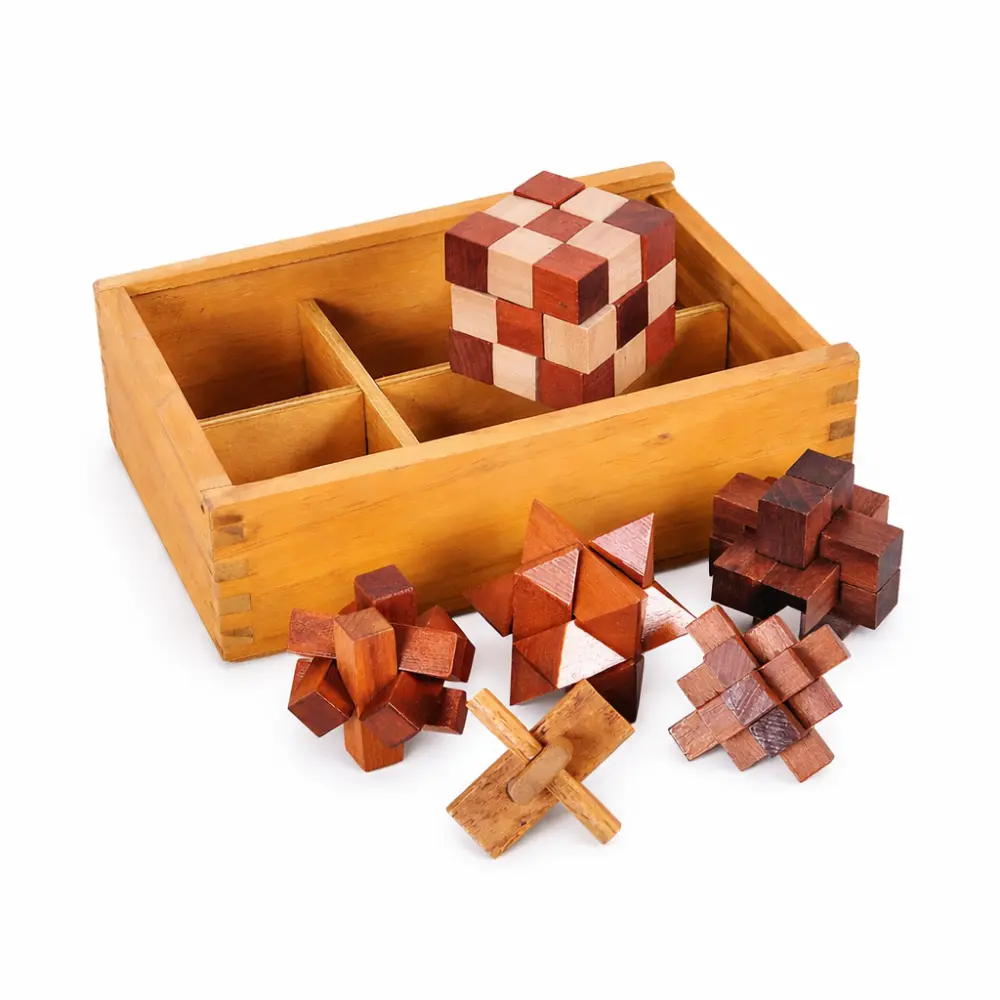
The other reason wooden brain teasers suit a true first-timer is that there is no single “right way” to start. He can pick the easiest-looking piece, fiddle with it, get nowhere, and put it down without losing progress. That low-failure loop is rare in adult hobby gear and is the single biggest predictor that a retired dad will reach for the box a second weekend in a row. To understand the lineage of one of the most popular shapes in this category, the history of the Luban lock puzzle is worth a quick read before you choose.
Large-piece jigsaws in the 100 to 300-piece range. A common beginner mistake is grabbing a 500-piece landscape and hoping the image does the work, but a true first-timer loses the thread of an image hunt before the second coffee. A 100 to 300-piece jigsaw with a strong, easily-readable image typically clears the table in one to three sittings for a beginner, though the actual time depends on the image complexity and whether he has a sorting tray. The completed puzzle can go straight into a frame for the den. The mechanism is the opposite of a brain teaser: the work is in the eyes, not the hands, and many puzzle-new retirees describe this as a more relaxing weekend than the manipulation puzzles above. If the dad is a visual thinker, this is the friendlier entry point.
3D wooden assembly puzzles. A 3D kit trades the “solve one trick” loop of a brain teaser for a longer, more rewarding build. A beginner 3D kit like the 3D Wooden Mechanical Pistol Kit typically lands somewhere in the one to three hour range for a first-timer who works patiently and follows the included manual, though smaller kits finish faster and larger kits can run the full afternoon. The reward is a finished object that sits on a shelf afterward, not a disassembled puzzle that returns to a box, and that visible end product matters for a retirement gift because it stays in the room as a reminder of the giver.
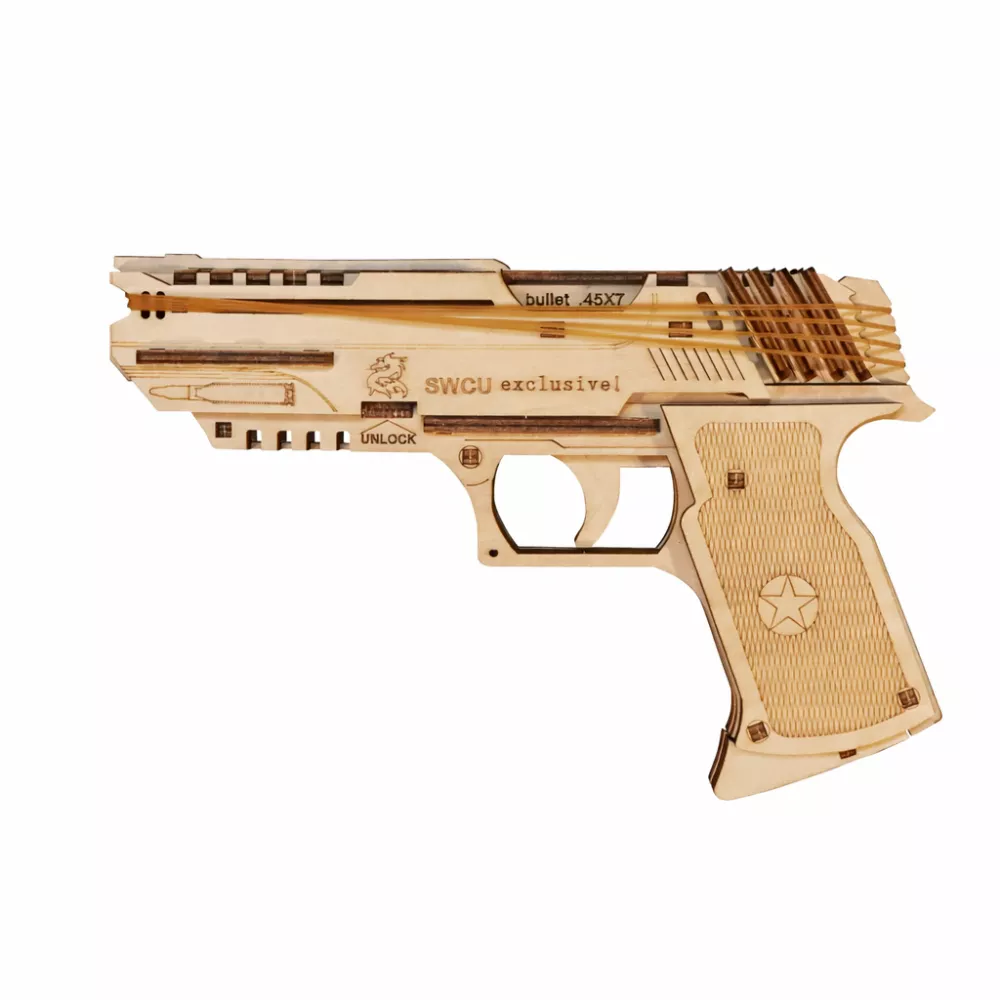
One caution: a 3D kit with hundreds of identical-looking parts and a poorly-translated manual can blow past the 90-minute first-solve ceiling. Before checkout, look at the page photos for the manual and confirm the piece count is below roughly 200 parts for a first-timer.
Mechanical disentanglements. These are the small metal or wooden loop-and-rod puzzles that fit in a coat pocket. First-solve time is usually five to thirty minutes depending on the mechanism, the replay value is essentially unlimited, and a retired dad can keep one on the kitchen table the way he once kept the morning paper. The downside is that the cheapest versions feel disposable in the hand, so weight and finish matter more here than in any other category on this list.
The next action, if your dad has never touched a puzzle before: start with a wooden brain teaser set in the four to six piece range, because it gives him a quick first win in the hand and a graduated set of follow-ups for the next few weekends.
03. Why a Graduated Set Beats a Single Puzzle for a Retirement Gift
A graduated set with two to four puzzles of increasing difficulty outperforms a single puzzle for a retirement gift because the moment your dad finishes the first one, he has a visible “next step” waiting. That turns a one-off present into a hobby he can settle into during his first months of free time. Single puzzles tend to end up in a drawer after one solve; a graduated set gives him Saturday mornings, not a single Saturday.
The previous section landed on a four-to-six piece wooden brain teaser set as the safest opening move. This section extends that logic: the real advantage of a set is not the number of puzzles, it is whether the puzzles get harder in a way he can feel, and whether the packaging tells him this is a milestone, not a stocking stuffer. Use the four checks named in the opening — variety, first-solve timing, presentation, and replay value — and apply each one to the retirement transition specifically.
Variety. A retired dad with newly empty weekdays is not the same shopper as a hobbyist who already owns fifteen brain teasers. He needs enough range to discover what clicks — a disentanglement to fidget with during a phone call, a shape puzzle for the kitchen table, a lock or box for slow weekend focus. A bundle that mixes three or four distinct mechanisms gives him that exploration without forcing a second purchase a month later. The 12 Piece Crystal Luban Lock Set, listed at $28.88 on the product page, is structured exactly this way: twelve distinct locks at graduated difficulty, so the simpler mechanisms resolve in a single sitting and the harder ones give him a reason to come back to the kitchen table for a few weekends.
First-solve timing. The first puzzle in any beginner set should finish in roughly thirty to sixty minutes. If the opening puzzle demands two hours and a quiet room, your dad is more likely to feel tested than engaged, and the rest of the set will sit untouched. When you compare sets, read the product photos for the simplest-looking lock or shape in the box — that is your day-one win, and it should look approachable, not intimidating.
Presentation. A retirement gift is opened on a milestone afternoon, often with a card and a glass of something. The packaging has to carry that weight. A printed manual, a fitted storage box, and clean photography signal that the giver thought about the moment, not just the object. If the product page shows loose parts in a plastic bag with no instructions visible, keep looking.
Replay value. Mechanical and lock puzzles replay indefinitely because the mechanism is the puzzle, not a one-time image. Wooden disentanglements and cast metal puzzles can sit on a desk for years and still get picked up during a quiet evening. Single-use kits — a 3D model he builds once and then shelves — do not give the same return for a transition that may reshape his routine for a decade.
One practical step before checkout: confirm the set you are buying actually graduates in difficulty (the product page should show a range of mechanisms or piece counts), and that the first item in the box is visibly simpler than the last. If those two conditions hold, the gift will outlast the retirement party. For a closer look at how piece count changes the calculus, see the 3-pack vs 9-pack dilemma for a wooden brain teaser set.
04. Beginner Puzzle Set Archetypes Compared: First-Solve Time, Format, and Gift Readiness
Match the archetype to how your dad will actually spend his first week of retirement, not to a generic “best puzzles” ranking. A compact hand-held disentanglement puzzle fits the man who wants a five-minute coffee break challenge. A graduated wooden brain-teaser set fits the dad who will sit at the kitchen table on Saturday morning and want a full hour of focus. The “What to check” column below is the single condition that separates a good set from a frustrating one for a first-timer.
| Archetype | Typical First-Solve Time | Format | Gift-Readiness Signal | What to Check |
|---|---|---|---|---|
| Graduated brain-teaser / lock set (top pick) | 10–60 min per puzzle | A series of small objects that grow in difficulty across the box | Storage box or fitted case, printed manual, no clinical copy on the page | The first piece in the box is visibly simpler than the last, and the first solve finishes in under an hour |
| Large-piece jigsaw set | 1–3 hours per puzzle | Flat image, large-format pieces, a poster or reference sheet | Sturdy box, separate reference poster, sorting tray | Piece size suits adult hands; product photos do not show a caregiver assisting |
| 3D wooden model kit | 2–6 hours per build | Pre-cut wooden sheets, no glue, moving parts when finished | Wood quality visible in photos, manual with diagrams, finished display value | Build time fits his patience; the finished object suits a room he actually uses |
| Mechanical disentanglement set | 1–20 min per puzzle | Cast metal or wooden pieces designed to be separated and rejoined | Felt-lined box or pouch, solution card, pocketable size | Pieces feel solid in hand; instructions show the goal clearly before he starts |
| Mixed-hobby starter set | 5–45 min per item | Assorted small puzzles of different types in one box | Variety visible on the product page, shared storage, cohesive theme | Every item looks like part of one gift, not a grab bag of leftovers |
A graduated brain-teaser or lock set is the safest top choice for a healthy retired dad because it gives him both a quick first win and a longer follow-up. The 12 Piece Crystal Luban Lock Set is built around exactly that progression: a graduated series of crystal locks in one box, each its own small challenge, presented as a collectible object rather than a clinical activity. If your dad is the type to keep a small object on his desk and pick it up between tasks, a graduated lock set has the replay value the earlier section flagged — once he has solved a lock, the satisfaction of resetting it never wears out.
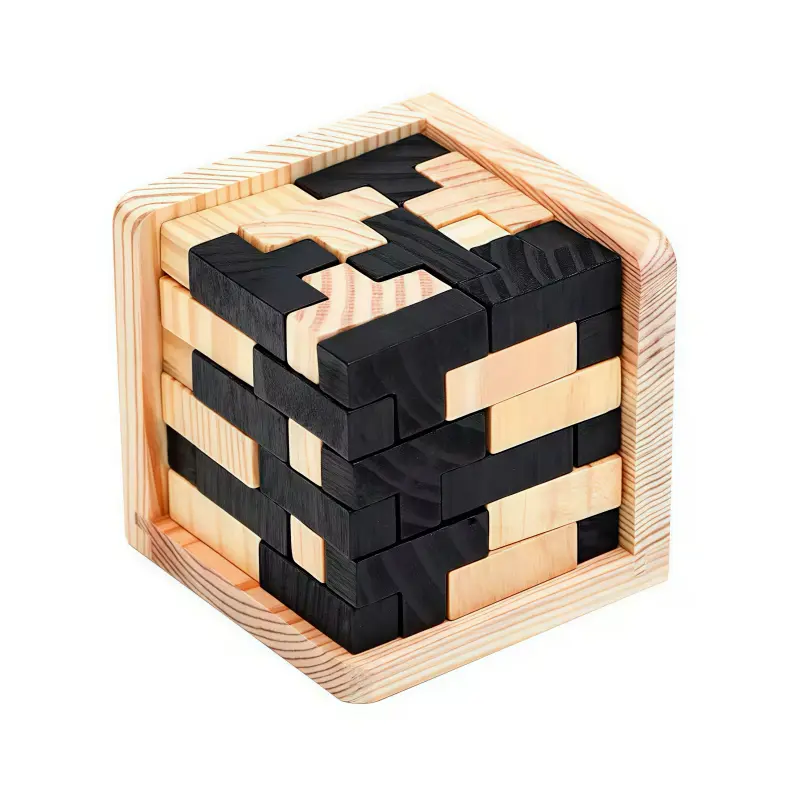
54‑T Cube Puzzle — $18.99
For the dad who would rather hold something than study a diagram, a small tactile puzzle earns its place on the gift list. The 54‑T Cube Puzzle is a wooden block puzzle in the form of a cube — small enough to hold in one hand, complex enough to reward short, repeatable sessions. The kind of object he can set on the nightstand and pick up during a quiet evening without committing to a full hour of focus.
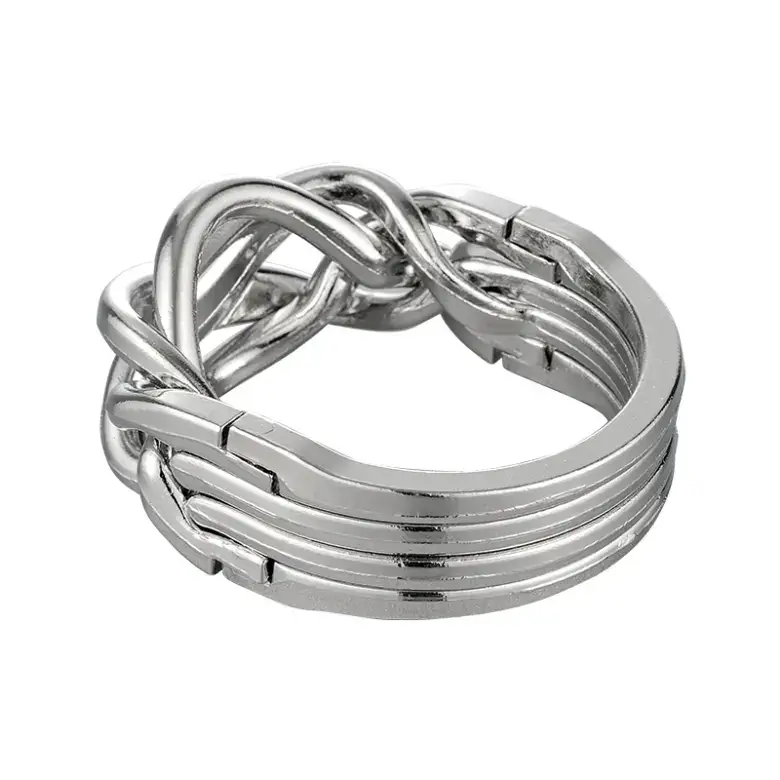
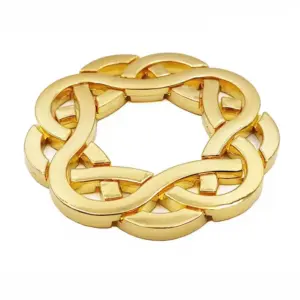
4 Band Puzzle Ring — $11.99
The 4 Band Puzzle Ring serves a different mood: a metal ring made of four interwoven bands, sized to be worn or displayed. If your dad already wears a ring or a watch, a puzzle ring slots into his existing routine instead of asking him to start a new one. Once assembled or taken apart, it goes back on the finger or sits in a box as a keepsake of the retirement year.
One practical next action before you check out. Decide which of three retiree moods your dad fits, then shortlist from that row of the table only.
- Quiet desk puzzle. Start with the graduated brain-teaser or lock set, or a mixed-hobby starter if he already keeps small objects on his desk.
- Coffee-table showpiece. Start with the 3D wooden model kit — something that earns its space by looking finished once built.
- Hand-held tactile object. Start with the mechanical disentanglement set or a small cube puzzle, sized to fit in one hand during a TV break.
If two of those moods describe him equally, the graduated set wins because it covers the third mood too — the included smaller locks double as pocket-sized desk breaks once the larger challenge is solved. For a personality-based shortlist, see puzzle gifts for dad based on his personality type.
05. How to Avoid the ‘Looks Like a Medical Product’ Trap
If the product copy uses phrases like “for those with memory loss,” or the photography shows a caregiver guiding an older adult’s hand, close the tab. A healthy retired dad will read that gift as condescending on the spot, and the moment of opening the box is ruined before he picks up a single piece. The fastest filter is to look at the listing as a stranger, not as a caring child — does this look like something a hobbyist would buy for himself?
That single visual gut-check matters more than piece counts, materials, or difficulty ladders, because most top-ranking results for this search are clinically positioned products. They were designed for a different recipient. Your dad deserves a gift that signals respect for who he is now, not pity for who he isn’t becoming.
Four red flags that signal the wrong product:
- Medical or clinical language: “memory support,” “therapeutic,” “engagement activity,” or any framing borrowed from occupational therapy rather than recreation.
- Caregiver-present photography: images showing a younger person guiding the user’s hand, or staged shots that resemble a care facility brochure.
- Plastic-only packaging with no visible storage: a blister pack or plain cardboard box suggests the product was designed for institutional distribution, not a personal milestone.
- Missing manual or instructions: serious beginner puzzles ship with a booklet explaining the goal and offering hints. A blank bag of pieces with no guide reads as disposable.
Four green flags that signal a dignity-first product:
- Wooden storage box or pouch: a reusable case gives the puzzles a permanent home on a shelf or desk, framing them as a collection rather than a single-use activity.
- Hobbyist or lifestyle photography: hands holding the puzzle at a workshop, on a coffee table next to coffee, or on a workshop bench. The viewer is meant to imagine themselves solving it alone.
- Age-neutral copy: words like “beginner,” “enthusiast,” or “starter set” that don’t reference age, health, or memory. These signals tell the recipient the gift was chosen because puzzles are interesting, not because he’s slowing down.
- Visible difficulty ladder: a set that includes two to four puzzles labeled from easy to medium, or that ships in graduated sizes, communicates that the giver thought about progression, not just a one-time distraction.
One practical next action before checkout. Open the product page, look at the first three photos, and read the first 100 words of the description. If any red flag appears, move on without scrolling further. The right gift for a retired dad will pass that scan in under thirty seconds. If the gift still feels too generic after running the red and green flags, return to the archetype table in the previous section and pick the row that matches how he already spends his free time.
Frequently Asked Questions
A beginner puzzle set is a good retirement gift when it skips clinically-positioned products, ships in a presentation case, and gives the recipient a first win in under one hour. The questions below cover the practical concerns most gift-givers raise after deciding a puzzle set is the right fit.
Is a jigsaw puzzle a good retirement gift, or should I pick brain teasers instead?
Both work, but they serve different purposes. A jigsaw ends when the last piece clicks. A brain teaser or mechanical puzzle lives on a desk for years and gets picked up during ten free minutes between errands. For a newly retired dad with suddenly unstructured time, a brain teaser set delivers more ongoing engagement. If he already loves jigsaws, a 300-500 piece art puzzle is a fine standalone gift.
How many puzzles should a beginner set include?
Two to four is the practical range. One puzzle is a single-use gift with no follow-up. Five or more starts to read as a stockpile. Three graduated puzzles — easy, medium, and a weekend project — match how a real hobby actually starts.
Are wooden brain teasers too hard for a true beginner?
Most beginner wooden brain teasers are designed to be solved in roughly 5-30 minutes on the first attempt when a hint card is consulted. The challenge is figuring out the move, not dexterity or hand strength. If a puzzle requires fine motor control, force, or tiny fingers to manipulate, it is not a beginner set.
How do I make sure a puzzle set doesn’t read as a product for someone with memory problems?
Skip any product whose photos show a caregiver’s hands, whose copy uses words like “therapeutic” or “engagement activity,” or whose packaging references health. Look for photography of a single adult solving the puzzle at home and copy that uses “beginner,” “starter,” or “enthusiast.” The 12 Piece Crystal Luban Lock Set passes this test — it presents as a graduated 12-puzzle collection in a case, not as a clinical aid.
What age range fits wooden mechanical puzzles?
Most wooden mechanical and metal disentanglement puzzles are labeled ages 14 and up, which is really a small-parts safety note rather than a cognitive ceiling. A mentally sharp 60- or 70-year-old has no upper difficulty limit — the only constraint is how much time he wants to spend on a single puzzle. Verify the specific age rating on the product page before checkout.
Can a puzzle set feel personal, or will it always read as generic?
It reads as personal when the set’s theme matches something he already enjoys — cars, music, mechanics, or travel. A presentation case is what shifts the perception from “gift card afterthought” to “collected hobby starter.” Check the packaging photos on the product page to confirm the gift-ready feel.
The next step is concrete. If the checks above are satisfied, view the current price and full description on the 12 Piece Crystal Luban Lock Set product page and order with enough lead time to wrap it before his first week of retirement ends.
Where to Start
If the recipient and occasion checks above match, start with 12 Piece Crystal Luban Lock Set. Check the current product page for the specifications that matter to your choice.
Still comparing options? Revisit the decision table above and the product pages listed in each row to compare the same decision criteria, rather than restarting the search from scratch.
Sources and verification
- Product details and current specifications: Tea-Sip product page
Last updated: August 24, 2026