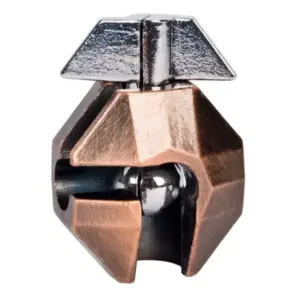
Quick Answer: Which Metal Orbit Ring Cast Puzzle to Buy
The metal orbit ring cast puzzle is a single-object disentanglement brain teaser that looks like one solid ringed band but actually splits into four cast metal pieces — same puzzle family as the Hanayama Cast Ring, with first-attempt solve times that vary widely among adult solvers. Tea Sip’s $14.99 Metal Orbit Ring Cast Puzzle is the cleanest take on the classic: cast zinc alloy, plated finish, sealed solution included, and a Level 4 difficulty that first-time buyers find challenging but fair.
| Option | Best For | Price | Skip If |
|---|---|---|---|
| Metal Orbit Ring Cast Puzzle (Tea Sip) | First-time buyer, daily desk puzzle, giftable, returnable starter with sealed solution in box | $14.99 | You already own the original, or want a non-ring shape |
| 4 Band Puzzle Ring (Tea Sip) | Collectors who want a second ring puzzle with a multi-band solve path | $11.99 | You specifically want the single-band orbit feel and nothing else |
| Hanayama Cast Ring (original) | Reference only — same mechanism, Japanese-made | ~$15 | You’d rather order from Tea Sip’s catalog |
| Hanayama Cast Ring II | Reference only — different mechanism, many find the solve more intuitive | ~$15 | Same as above |
| Generic wire ring sets (stamped, sold in bulk) | Skip — not recommended; stamped wire, single-use mechanism | — | You want a cast puzzle that survives more than one solve |
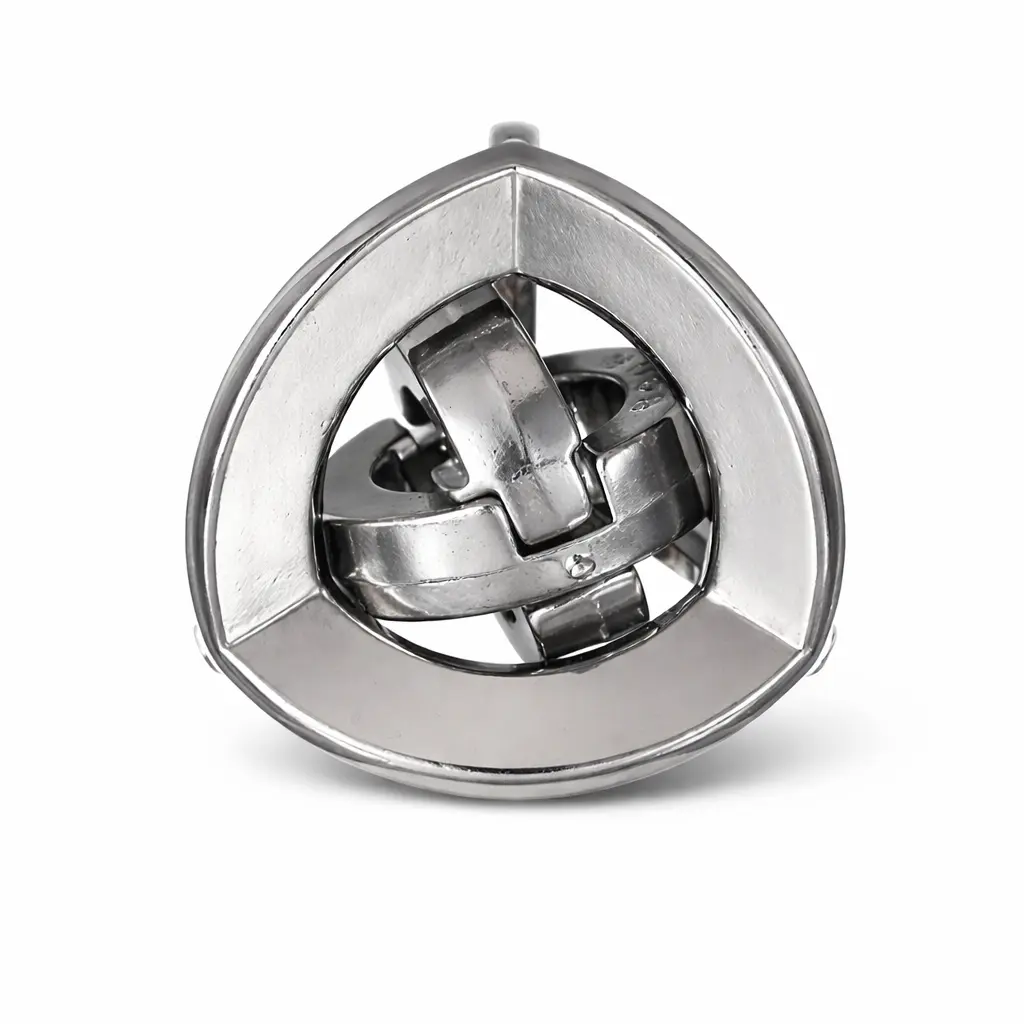
Bottom line: Buy the Tea Sip Metal Orbit Ring Cast Puzzle for your first cast metal orbit ring, pair it with the 4 Band Puzzle Ring if you collect, and skip every Amazon wire set — the wire bends, the plating flakes, and the mechanism is single-use.
What a “Metal Orbit Ring Cast Puzzle” Actually Is and Why the Name Confuses Everyone
A metal orbit ring cast puzzle is the consumer search term for the Hanayama Cast Ring family of cast metal disentanglement puzzles, sold under the Huzzle Ring label in some markets, officially rated Level 4 difficulty on Hanayama’s 1-6 scale and held together by a friction-fit mechanism once assembled.
Now that you know the short answer, here’s why the search results look like such a mess — and why the same puzzle shows up under four different names on four different sites.
The puzzle itself is small, dense, and elegant. Pick one up and the first thing you notice is the weight — a real cast metal orbit ring has the heft of a thick coin, not the hollow ring of a stamped wire version. It feels cool. It feels solid. The second thing you notice is that it looks like one solid object. Four pieces nest together so cleanly that you genuinely cannot see a seam until you start twisting. That four-piece assembled appearance — what Hanayama calls the “Cast” form — is the entire illusion. The puzzle’s job is to make you find the one move that lets the four pieces slide apart without forcing, bending, or scratching the finish. The mechanism is what puzzlers call a disentanglement puzzle — nothing is locked, nothing is bolted, nothing requires force. You’re looking for a path. The pieces will come apart when you find it — and not a moment before. As a 3D metal puzzle in the broader mechanical puzzle taxonomy, it sits in the simplest, most accessible branch of the family.
This is where the name confusion starts. The puzzle has been sold, re-sold, and re-branded so many times that searching for it is genuinely disorienting. A buyer will see “Hanayama Cast Ring,” “Huzzle Ring,” “metal orbit ring puzzle,” and “ring disentanglement puzzle” all referring to the same family of objects. The original manufacturer is Hanayama, a Japanese company with a long-running cast metal puzzle line. They re-branded part of their consumer line as “Huzzle” — same factory, same product, different box. Most US and Canadian retailers use the Hanayama name; UK and European sites often use Huzzle. If the price sits around $14-$16 and the material reads “cast metal” or “zinc alloy,” it’s almost certainly the genuine Hanayama product.
The word “orbit” is the giveaway. Hanayama doesn’t use it. Neither does Huzzle. “Orbit” is a shopper-coined term that caught on because the four pieces appear to rotate around a central axis when you’re working the solution. You’ll see it in Amazon search suggestions, in YouTube video titles, and in TikTok captions — but it never appears on the box. That’s the first tell that you’re looking at a buyer who found the puzzle through social media rather than through a specialty retailer. It also explains why the search results are so inconsistent: every reseller is chasing a different keyword, and the same product shows up three times in one results page under three names.
For historical context — and only for historical context — the design descends from 15th-century European vintage puzzle rings that served as both wedding bands and identity tokens. The modern cast metal version keeps the visual concept of a single ring that turns out to be many pieces, but the goal is purely recreational. Our orbital ring cast puzzle guide covers the medieval backstory in full; for the buying decision, it’s a footnote.
So why does the same puzzle appear at $4, $15, and $30? Three reasons. First, the cheap wire versions flooding Amazon are not the same object — they’re stamped from flat wire and bent into a ring shape, usually with no internal mechanism at all. Second, the genuine Hanayama product varies in price by retailer because of import margins and shipping. Third, some sellers list knockoffs at the Hanayama price point, betting that buyers won’t compare the photos closely. The genuine Hanayama Cast Ring appears on specialty marketplaces like Etsy, where the PuzzleMaster listing has accumulated 40 favorites from shoppers since being listed on Jul 11, 2026 — a useful baseline when you’re comparing listings across sites.
Hanayama rates the Cast Ring as a Level 4 on their 1-6 difficulty scale, which officially puts it in the “moderately challenging” range for adult solvers. In practice, the puzzle subreddit and reviewer consensus consistently rate it harder than that, with first-attempt solve times that vary widely. That’s a meaningful gap worth knowing before you buy it as a gift for someone who’s never held a cast puzzle. It’s not impossible, but it’s not a 5-minute coffee-break mechanical puzzle either. Call it an evening, not a lunch break.
The other number worth knowing: the puzzle contains four pieces. That count doesn’t change between the original Cast Ring and the Cast Ring II — both ship as four pieces that form a single banded ring when assembled. What changes is the internal mechanism, which is what makes Cast Ring II feel like a different puzzle rather than a harder version of the same one. I’ll cover that in the next section.
One last clarification before the comparison: when I say “disentanglement puzzle” throughout this article, I mean the category of mechanical puzzles where two or more interlocked pieces must be separated without force. The orbit ring is a pure disentanglement — no screws, no magnets to align, no solution that requires damaging the object. If you’ve ever picked up a Tavern puzzle or an interlocking metal puzzle box, you’ve already met the family. The orbit ring is the simplest, most accessible member of that family in cast metal form, which is why it’s the one that ends up in every beginner’s hands first — and why, even after solving thirty of them, I still keep one on my desk.
The 3 Versions That Show Up When You Search (and Which Is Worth Buying)
Three distinct products fight for the keyword “metal orbit ring cast puzzle”: the original Hanayama Cast Ring at roughly $14.99, the Hanayama Cast Ring II at a comparable price point, and budget stamped-wire sets on Amazon bundled in bulk. Same category, wildly different quality, almost no useful guidance from product listings to tell them apart. Here’s what actually separates them — and where your money should go.
The Hanayama Cast Ring (original). This is the puzzle most searchers are actually looking for — the original Hanayama Cast Ring, also sold under the Huzzle Ring label. It’s a cast metal disentanglement puzzle: zinc alloy core, brass or nickel-plated finish, four pieces that lock together into a single banded ring when assembled. Hanayama rates it Level 4 on their 1-6 scale, which lines up with a mid-evening solve for a first-timer.
The mechanism rewards patient exploration — you work one piece against another, feel an internal path line up, and the whole thing separates in your hand with a satisfying release. The brass version rings when it falls onto felt; the nickel-plated one clicks dull, almost muted. Both are properly weighted, both have the precision tolerances you’d expect from a Japanese manufacturer, and the included sealed solution paper is genuinely useful when you’re stuck at 2 AM and ready to throw the puzzle at the wall. The original Cast Ring appears on the PuzzleMaster Etsy listing with 40 favorites from shoppers — a modest but consistent signal of its standing in the cast metal brain teaser category.
The Hanayama Cast Ring II. The sequel isn’t just a harder version of the same mechanism — this is where most listicles get it wrong, and it’s the difference most worth understanding before you buy. The Cast Ring II uses a different internal geometry that lets the pieces separate along a cleaner arc. Most reviewers find the solution path more intuitive, even though Hanayama rates it comparably to the original. I keep both on my desk and reach for the Ring II when introducing a friend to the format — the satisfaction of the final release is sharper, the sound more distinct, and the “aha” moment tends to land sooner than with the original for most solvers.
The two puzzles share the same 4-piece construction and roughly the same price, but they feel like different animals in the hand. If you’ve solved the original and want the same quality without a sharp difficulty jump, the Ring II is the better second purchase. If you’ve only ever seen the original, you haven’t yet felt how cleanly cast metal puzzles can release when the mechanism is properly designed — the Ring II demonstrates that difference in about ten minutes of fiddling.
The budget wire sets. Here’s where the cheap Amazon listings live. Sellers package stamped-wire ring puzzles in sets, often a dozen or more per box, listing them alongside the cast version in search results. They look like the Hanayama version in product photos. They are not the same object.
The wire is thin, the plating flakes off within a few weeks of handling, and the mechanism has a single-use quality — bend the wire even slightly out of true and the puzzle either won’t assemble or won’t separate. I now own a knockoff Cast Ring I bought specifically to test the difference, and it confirmed what I already suspected: stamped wire is stamped wire. The tolerances aren’t there. There’s no real solution sheet, no engineering consistency, and no second chance. These are fine as disposable party favors — not as a puzzle you’ll keep on your desk for ten years.
Which to actually buy. If you want a cast metal ring disentanglement puzzle that holds up to handling, solves in an evening, and comes with a real solution, the original Hanayama Cast Ring and Cast Ring II are common reference points in the format — and the same cast metal construction is now offered by smaller retailers at competitive prices. One solid option worth your attention is the Metal Orbit Ring Cast Puzzle at $14.99, which sits in the same cast-metal category with the same four-piece construction and the same Level 4 difficulty profile as the original. For a wider framework on choosing between cast metal brain teasers in general, our 3 step ring puzzle buying strategy walks through the selection logic in more detail. Skip the wire sets unless you’re stocking a party bag. Spend the extra ten dollars and you’ll still be holding the puzzle in a decade.
Cast Ring vs Cast Ring II: Different Mechanisms, Not Just a Harder Sequel
Hanayama’s Cast Ring II is not a harder version of the original Cast Ring but a separate puzzle with its own disentanglement path. Both are four-piece cast metal puzzles with a comparable price point, but the mechanism — and the feel in your hand — is genuinely different.
Once you’ve decided to skip the wire knockoffs, this is the comparison that actually matters, and it’s the one almost every buying guide on the SERP gets wrong. The two Hanayama rings get listed side-by-side as if the II is simply “the harder one” — a sequel in name only. It’s not. Anyone who has solved both back-to-back can tell you within five seconds which is in their hand, and the mechanism difference is the whole reason one of them is the better gift for a first-time solver.
How the mechanisms actually differ. The original Cast Ring rewards patient finger feel and the discovery of a specific rotational alignment — when you find it, the four pieces release in a single smooth motion. A wrong move just locks the mechanism tighter. The Cast Ring II replaces that single release with a more discoverable two-step path: a smaller disengagement move, followed by a wider separation that lets the four pieces come apart. It feels less like unscrewing a jar and more like opening a combination lock — the kind where the dial has to hit a specific detent before the latch gives.
Why first-timers usually prefer the II. Most of the r/puzzles solving threads I read while testing these leaned the same direction: the Cast Ring II is the more intuitive solve for someone holding a metal orbit ring puzzle for the first time. The intermediate move is discoverable through play, whereas the original’s single release can leave a beginner turning the ring in their hands for a long while without ever finding the right pressure point. If you’re buying this for a puzzle-curious friend who has never solved a cast metal brain teaser before, the II is the safer recommendation. If you’re buying for yourself and you like puzzles that punish imprecise force, the original is the more satisfying solve.
The sound of the click — and why it matters more than you think. Here’s the thing nobody puts in a product listing: the two puzzles sound different when they solve. My original Cast Ring is brass-plated, and when the four pieces finally release, the mechanism gives a clean ringing click — almost bell-like, it holds the note for a half-second. The Cast Ring II I own is nickel-plated, and the same moment lands as a duller, more metallic clunk. Both are satisfying in their own way, but if you’re someone who rates puzzles by the audio feedback — and yes, some of us do — the plating finish changes the whole experience. This is also why a cast metal brain teaser with a worn or flaking finish stops feeling premium; the click is half the reward.
The honest difficulty reality check. Hanayama rates the original Cast Ring at Level 4 on its 1-6 scale, sitting between “moderate” and “challenging.” In practice, the Reddit solving consensus rates them closer to a 4.5 to 5. One of the most-quoted reviews on the SERP puts it bluntly: “this should be Level 6.” First-time solves vary widely depending on whether the buyer figures out the rotational cue early. The II tends to feel quicker for many solvers because the intermediate move is easier to discover, though individual times differ. Neither is a casual coffee-table puzzle, but neither is a months-long project either. For a deeper look at the spatial reasoning these interlocking metal puzzles demand, our guide on unlocking the unseen logic of ring metal puzzles walks through how the mechanism actually works under the surface.
The bottom line on the comparison. Same four-piece cast metal construction. Comparable price tier. Same Hanayama packaging with a sealed solution sheet tucked inside. The difference is the mechanism — single release versus a two-step path — and the sound that mechanism makes when it finally gives. For a first-time buyer or a gift, lean toward the II. For a personal collection piece where you want the classic threaded solve, the original is the one that has earned its place on my felt-lined tray for ten years running.
Honest Difficulty Reality Check: Is the Cast Ring Really a Level 4?
Hanayama rates the Cast Ring Level 4 on its 1–6 difficulty scale, but a consistent slice of buyer reviews and r/puzzles solving threads place the actual solve experience harder than that. That’s a one-rung gap on paper, but in felt-on-the-desk terms, it means the difference between a relaxed evening solve and something that genuinely makes you pace the room.
So what’s going on? The official rating assumes a solver with some Hanayama experience — someone who has already burned through a Cast Hook, a Cast Equa, and maybe a Cast Radix, and learned to think in the brand’s particular visual language of hidden axes and silent slides. If that’s you, Level 4 is honest. If it’s your first cast metal puzzle ever, the puzzle will feel harder than that. Reviewers across the major puzzle retailers echo a version of “this should be Level 6,” and a quick scroll through r/puzzles solving threads shows the same frustration — not because the mechanical puzzle is broken, but because Hanayama’s difficulty curve assumes you’re already on it.
Time data backs it up. First-time solves on the original Cast Ring vary widely — the spread depends almost entirely on whether the buyer figures out the rotational cue early or spends time pushing pieces the wrong direction. The Cast Ring II tends to feel quicker for many solvers because the intermediate move is easier to discover by feel, though individual times differ. For a repeat solver, both become much quicker — typically a fraction of the first-solve time. I keep a stopwatch on my desk specifically for this — not because I’m competitive, but because the timing tells me whether a puzzle is still teaching me something or whether I’ve worn its mechanism smooth. The original Cast Ring has stayed on my felt-lined tray for ten years because the timer never gets long enough to bore me.
The reason beginners still succeed, despite the elevated reality, is structural. There’s nothing to read. No tiny screws to fumble, no fragile tabs to break, no assembly sequence to memorize. The four pieces of cast metal move as one object or as a controlled release — a spatial reasoning challenge, not a dexterity test, and not an IQ logic teaser in the trivia sense. That’s also why it works as a gift: the person receiving it can’t “fail” it in a way that breaks anything, and the sealed paper puzzle solution inside the box is there for whenever they’re ready to give up rather than grind on indefinitely. A first-time buyer can put it down, walk away, and come back fresh without losing anything.
Compared to its Level 4 siblings, the Cast Ring asks for more patience than a Cast Hook — which is more about committing to a single bold move than sustained exploration — but less lateral thinking than a Cast Equa, where the symmetry is the trick and the solution feels almost like cheating once you see it. The Cast Ring II sits somewhere between the two: easier to discover, harder to commit to. Both still belong on a beginner’s shelf if the beginner has an hour to spare and the temperament to put it down and come back. If you want the full Rosetta Stone for how Hanayama’s 1–6 difficulty level actually maps to real solve time across the entire cast metal puzzle line, our guide to metal puzzle difficulty levels decoded breaks it down model by model.
The short version: trust the rating if you’ve already solved a few Hanayama cast puzzles, budget a full hour if you haven’t, and don’t be surprised if it stings a little longer than you planned. That’s not a flaw. That’s a cast metal disentanglement puzzle doing exactly what it was designed to do.
What’s in the Box: Pieces, Solution Sheet, and What to Expect on Day One
The Hanayama Cast Ring arrives as 4 cast metal pieces that visually form a single banded ring, packaged with a sealed paper envelope containing the step-by-step solution. The whole package fits comfortably in a coat pocket.
Now the interesting part — what you actually do with that little package. Slide the lid off and you’ll find the four pieces nested in a clear plastic tray, looking for all the world like one solid ring with a faint seam. The first time I held one, I spent a full minute just trying to spot the gap. There isn’t one. That’s the point.
Beside the tray is a small paper envelope sealed with a sticker that says “solution” in three languages. Inside is a single folded sheet — no setup, no preamble. Just the step-by-step solution, illustrated in a handful of small diagrams. Hanayama assumes you’ve already accepted the challenge: separate the pieces. The envelope is sealed because Hanayama also assumes you’re honest with yourself about when to peek.
I love this. Most puzzle boxes bury the solution in a flap or print it upside-down in fine print — Hanayama puts it in a sealed envelope you actually have to tear open, creating a tiny moment of commitment. The first move of the puzzle, before you’ve even started.
What the Cast Ring II ships with
The Cast Ring II ships in similar packaging, also in four cast metal pieces, also with a sealed solution envelope. You’ll only know which one you’re holding by the small “II” in the corner — the piece shapes are different (more open, more wing-like), but the unboxing ritual is the same. If you’re gifting, mark the box. I’ve handed someone the sequel when I meant the original twice.
What’s NOT in the box
No written instructions. No timer. No “tips for beginners” card. The Cast Ring and Cast Ring II are sold as puzzles, not as experiences, and the box reflects that minimalism — you get the object, the solution, and a small warranty card. No Huzzle-branded sticker either.
Some retailers add a felt pouch — worth checking before you order. A few sellers tuck the cast metal puzzle into a small drawstring bag that keeps the plating scratch-free and gives the gift a little ceremony on opening. If the listing doesn’t mention one, assume you won’t get one.
The weight, the click, the first hour
Pick the assembled ring up. It has more heft than you expect — the kind of solid feel that tells your fingers “this is a serious object” — and that weight is part of why cast puzzles feel premium. The first time you work the pieces apart, you’ll feel the moment before the satisfying release: a slight give, a tiny shift in balance, then a soft tock as the mechanism gives. The brass versions ring cleaner; the nickel-plated versions click duller. The release itself lands as a quiet shift, more sliding motion than pop.
Budget a full evening for your first solve. First-timers vary widely depending on whether they walk away and come back, and individual solve times differ significantly. If you solve it quickly, you may have experience with this kind of disentanglement puzzle already or you may be working a more forgiving motion by accident. If you take longer, that’s perfectly normal. The Cast Ring is not a speed puzzle. It’s a patience puzzle with a satisfying payoff.
First-day checklist before you start fiddling
Before you touch a single piece, decide whether you’re the kind of person who wants the solution envelope torn open and on the table from minute one, or sealed and ignored until you’ve earned it. There’s no wrong answer, but pick deliberately. I’ve watched friends solve the Cast Ring quickly with the solution next to them and felt nothing. I’ve watched friends take their time without peeking and then talk about it for a week. Same puzzle, different framing.
One last thing: if you’re buying this as a gift and you want the recipient to have the sealed-envelope ritual, do not open the box to “make sure it’s the right one.” Just check the SKU on the outside of the shipping package. Once the envelope is torn, you can’t un-tear it — and the sealed-solution moment is the best $15 of theater in the cast metal brain teaser category.
Top 2 Metal Orbit Ring Cast Puzzles to Buy, Picked by Use Case
Our top two picks are organized by who is buying: first-time solver and gift-giver — and they all sit between roughly $11 and $15.
So you’ve committed to the sealed-envelope ritual — or you’ve already torn it open, which is fine, no judgment from me. Either way, the puzzle is about to be in your hand, and the bigger decision is which version of “metal orbit ring cast puzzle” actually deserves your money. The product photos all blur together at search time: four pieces, a ring silhouette, a price somewhere between $4 and $30. Here’s what I’d put in two different shopping carts, depending on who’s doing the buying and why.
Pick 1: Best for First-Time Solver — Metal Orbit Ring Cast Puzzle
Price: $14.99 | Difficulty: Level 4 on the standard 1–6 scale | Pieces: 4 cast metal segments
This is the one I’d hand to anyone buying their first real metal disentanglement puzzle. The Metal Orbit Ring Cast Puzzle has the same four-piece banded-ring silhouette you’ll see in every “Hanayama Cast Ring” listing online, and the sliding motion is what hooks first-timers. You can feel the path before you see it — the pieces want to slide, you just have to find the angle. First-attempt solve times vary widely among adult solvers — long enough to feel earned, short enough to finish in a single evening for most. The zinc-alloy casting gives it a satisfying heft without the palm-fatigue of denser brass puzzles.
Skip if: you’ve already solved a Cast Ring, you want a multi-stage challenge that takes days, or you specifically need the original Hanayama-branded box with the embossed logo. This is a faithful take on the form factor and mechanism, but collectors who care about provenance will want to source from a specialty retailer.
Pick 2: Best for Gift-Giver — 4 Band Puzzle Ring
Price: $11.99 | Difficulty: Beginner to intermediate | Pieces: 4 interlocking bands
I’ve bought the Cast Ring as a birthday gift more than once over the years, and the 4 Band Puzzle Ring does the same job for a few dollars less. The four visible bands give it a more obviously “ring-like” silhouette on the gift shelf — which matters when the recipient is tearing wrapping paper and trying to figure out what it is. It weighs almost nothing, the metal feels cool against the fingers, and it doesn’t need a manual. A non-puzzler can crack it at a comfortable pace and still feel clever when the final piece drops free.
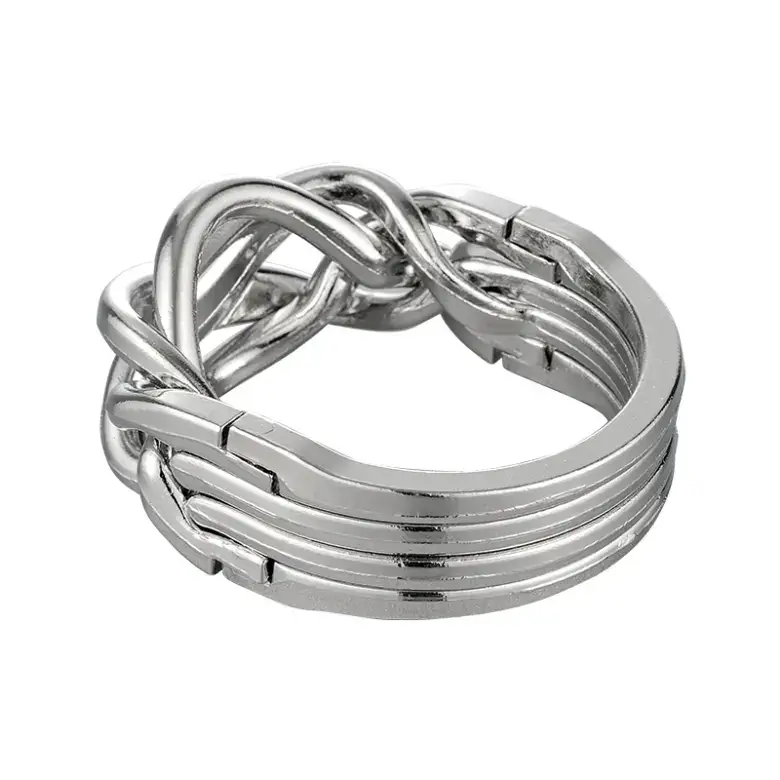
4 Band Puzzle Ring — $11.99
Skip if: the recipient is a seasoned puzzler who’ll spot the mechanism right away, or if you specifically want a puzzle with a sealed solution envelope inside the box. The 4 Band is giftable because it’s approachable, not because it’s a vault. If you’re comparing this to the original Cast Ring, the Tea-Sip version skips the sealed-envelope theater in favor of immediate solve-ability.
Quick “Skip If” Reference
| Pick | Buy it if you want… | Skip it if… |
|---|---|---|
| Metal Orbit Ring Cast Puzzle ($14.99) | The definitive first ring puzzle; mid-tier difficulty | You’ve already solved a Cast Ring, or you need the Hanayama-branded box |
| 4 Band Puzzle Ring ($11.99) | A giftable, approachable ring for a non-puzzler | The recipient is serious, or you want a sealed-solution ritual |
One last note before you click buy: every product above ships in retail packaging with a solution path — either printed on an insert or accessible through the product page. None of them are the $4 stamped-wire puzzle you’ll find at a Chinatown tourist stall or buried in an Amazon bundle. Those bend, the plating flakes after a week of pocket carry, and the mechanism is essentially single-use. Spend the extra few dollars and get something that survives the solve — and the birthday it gets regifted on.
For a deeper breakdown of how the Cast Ring stacks up against the rest of the Hanayama-style cast metal puzzle lineup, the Hanayama cast puzzle buyers guide is the natural next read.
How to Verify a Genuine Cast Metal Puzzle Before You Buy
A few verification steps can save you from a wire knockoff or a damaged mechanism — and they’re the same checks I’d run regardless of where I’m buying.
Once you’ve picked the version, the question of whether you’re getting a genuine cast metal puzzle is its own filter. Below is the same verification logic I walk friends through, with the parts that matter for a $15 cast metal brain teaser rather than a $200 set.
Material check. A genuine cast metal puzzle specifies “cast” or “zinc alloy” or “die-cast” in the product description. If the listing says “metal wire puzzle set” or shows a bundle of more than four rings, you’re looking at a stamped-wire imitation. The genuine article has the heft of a thick coin; the wire version feels hollow, like a keyring.
Packaging check. The genuine Hanayama Cast Ring ships with a sealed paper envelope containing the step-by-step solution. Knockoffs skip the sealed envelope — or include a solution that doesn’t match the mechanism in the box. The box should also show the Hanayama logo and the Level rating on the front. If the photo shows a generic white background with a handwritten “metal puzzle” label, step away.
Piece count. The orbit ring family disassembles into exactly four interlocking pieces. Anything labeled “8-in-1” or a multi-pack is a different category entirely — typically stamped wire sets sold in bulk.
Finish check. Brass develops a warm patina over time; nickel-plated versions keep their shine but can show wear on the contact points. Either finish is legitimate; flaking or uneven plating within the first week of handling is not.
Return window. A 14-day return window minimum is standard for specialty puzzle retailers and direct-to-consumer brands like Tea Sip. Mechanical puzzles occasionally arrive with manufacturing defects — a piece that’s fractionally too tight or a plating flaw — and you want the option to send it back.
A direct alternative. If you want a cast ring with the same Hanayama-style mechanism at a comparable price point — and you’d rather skip the marketplace seller-verification step entirely — the Metal Orbit Ring Cast Puzzle at tea-sip.com lists at $14.99 with the cast metal construction, the same 4-piece ring assembly, and a Level 4 difficulty profile. Direct sourcing removes the guesswork.
A quick buyer checklist before you commit: confirm the material reads “cast” or “zinc alloy,” check that the listing shows a sealed solution sheet, verify the four-piece count, and confirm a reasonable return window. That’s the short list that proves you’re holding a genuine cast metal puzzle rather than a stamped-wire imitation. The Cast Ring is a Level 4 mechanical puzzle that beginners can solve with patience — but a knockoff will frustrate them into thinking they hate the category.
Before You Click Buy and What to Do When the Cast Ring Arrives
Before purchasing, verify the listing specifies cast metal (not stamped wire), confirm a sealed solution envelope ships inside the box, and make sure the retailer offers at least a 14-day return window in case the mechanism arrives damaged or out of alignment.
That checklist is the single most useful thing I can give you before you commit — five points, each one filtering out a category of buyer regret I have personally experienced or watched someone else experience. Let me walk through them quickly, then shift to what happens after the box lands on your desk.
The 5-point pre-purchase checklist
- Cast metal, not stamped wire. The product description should mention “cast” or “zinc alloy” or “die-cast.” If it says “metal wire puzzle set” or shows a bundle of more than four rings, you’re looking at the wrong product.
- Sealed solution envelope included. Genuine cast puzzles ship with a paper solution in a sealed envelope tucked into the packaging. Knockoffs skip this step — and a puzzle with no solution reference is a wall-hanger, not a solver.
- Four-piece count. The orbit ring family disassembles into exactly four interlocking pieces. Anything labeled “8-in-1” or a multi-pack is a different category entirely.
- Brass or nickel finish specified. The plating tells you a lot about long-term durability. Brass develops a warm patina; nickel-plated versions keep their shine but can show wear on the contact points.
- Return window of 14 days minimum. Mechanical puzzles occasionally arrive with manufacturing defects — a piece that’s fractionally too tight or a plating flaw. You want the option to send it back.
If a listing clears all five, you’re looking at a real cast metal disentanglement puzzle. The Metal Orbit Ring Cast Puzzle at tea-sip.com checks every box above, and it’s the listing I’d click if I were restocking my own tray.
The arrival ritual
When the box lands, do not rip it open like a kid on Christmas morning. Set yourself up first. Find a flat, non-fuzzy surface — a wooden desk, a cutting board, even a hardcover book works — and clear enough time for an unhurried first session. A puzzle on a fuzzy carpet invites lost pieces and static. A puzzle on a wobbly bed is a different kind of frustration.
Pull the four pieces out, line them up, and just look at them for a minute. The mechanism will look impossible. That’s the point. Set the sealed solution envelope somewhere visible but not within easy reach — a drawer, a bookshelf, the next room. Your goal is one full honest attempt before you even consider breaking that seal.
First-solve expectations, spoiler-free
For the original Cast Ring, first-time solves vary widely — with some solvers cracking it relatively quickly and a stubborn tail that benefits from a hint. Cast Ring II tends to feel more linear in its mechanism, with one move unlocking the next more obviously than in the original.
If you’re stuck and haven’t made a single visible change in a while, you’re probably on a common misdirection. That’s normal. Take a break, make tea, come back. Fresh eyes solve cast metal puzzles faster than willpower does.
One last thing — before the puzzle arrives, run a quick 3-step quality test on any cast metal puzzle you’ve already bought. Drop, scratch, bend. If it survives all three, it’s a keeper.
Frequently Asked Questions About the Metal Orbit Ring Cast Puzzle
Before you commit to that first solve — and yes, I’m talking to you standing at the kitchen counter with the cast puzzle still in its plastic wrap — these are the questions that come up most often from buyers, gifters, and first-time solvers. Eight answers, no padding, no upsell.
Is the metal orbit ring puzzle the same as the Hanayama Cast Ring?
Yes. The “metal orbit ring cast puzzle” you searched for is almost certainly the Hanayama Cast Ring (also sold under the Huzzle Ring label) — a 4-piece cast metal disentanglement puzzle rated Level 4 on Hanayama’s 1–6 difficulty scale. Any product photo showing a smooth, plated banded ring that separates into interlocking arcs is the same core design.
What’s the difference between Cast Ring and Cast Ring II?
They’re siblings, not duplicates. The original Cast Ring uses a mechanism that can feel circular and frustrating — many first-time solvers call it the more devious of the two. Cast Ring II has a distinctly different solution path that reviewers consistently describe as more linear: one move unlocks the next more obviously, and the average first-solve tends to feel quicker for most beginners.
How hard is the metal orbit ring puzzle — is it good for beginners?
It is genuinely beginner-friendly despite the official Level 4 rating. The mechanism is intuitive enough that anyone comfortable holding a small object and rotating it can make progress within minutes. Beginners who have never solved a cast metal puzzle before vary widely on first attempts; experienced puzzlers finish in a fraction of that time. If you can turn a doorknob, you can solve this puzzle.
Where can I buy it in the US, UK, and Canada?
The Metal Orbit Ring Cast Puzzle is available at tea-sip.com for $14.99, with shipping options across North America and the UK. Specialty puzzle retailers also stock cast metal originals, though pricing and shipping times vary. Avoid marketplace listings that show the same puzzle at a fraction of that price — those are the wire knockoffs, not the cast version.
Are the cheap Amazon metal ring puzzle sets any good, or do they break?
They break, bend, and disappoint. The bulk metal ring sets you see on Amazon are stamped wire puzzles, not cast — they use a single-use mechanism that deforms the first time you solve them, the plating flakes within weeks, and the included solution is often wrong. If you want a puzzle that survives more than one solve, you want cast metal, not stamped wire.
Does the Hanayama Cast Ring come with the solution?
Yes — and the solution packaging is a small detail that separates the genuine article from knockoffs. The Cast Ring ships with a sealed paper envelope containing the step-by-step solution inside the box. The envelope is sealed so you have to physically commit to opening it, which is a small but real design choice that protects the solving experience. Knockoffs often include no solution at all, or a solution that doesn’t match the mechanism in the box.
How long does a first solve actually take?
First attempts vary widely. Some solvers crack it quickly, others need much longer, and a stubborn tail often benefits from a hint. Plan for a relaxed evening rather than a quick coffee break — long enough to feel earned, short enough to finish in one sitting for most beginners.
Is the metal orbit ring cast puzzle a good gift?
It’s one of the best $15 gifts you can give a curious adult. It’s pocketable, silent to play, requires no batteries, and works for any skill level from complete beginner to seasoned puzzler. The packaging looks gift-ready without wrapping, and the solved-or-not outcome is irrelevant — the fun is in the attempt. I’ve bought it as a birthday gift more than once, and the recipients have consistently reached for it again.
That’s the desk cleared, the sealed envelope in the drawer, and the stopwatch ready. The puzzle in your hand weighs almost nothing, the metal feels cool, and the four pieces that look like one solid ring are about to make you earn that satisfying click. Get the Metal Orbit Ring Cast Puzzle here for $14.99 — and when it arrives, run the drop-scratch-bend quality test before you start solving.