Two Ounces of Cold, Anodized Mystery
The weight is surprising. Two ounces of cold, anodized metal in your palm — one piece a tangle of silver coral, the other a loop of two golden fish. Your first instinct is to pull. They don’t budge. This is the Hanayama Cast Reef.
This object is first a sensory encounter. The gold catches the light, a warm, brassy yellow against the cool, polished silver of the coral. It’s compact, roughly 2.5 inches square, fitting neatly in a closed fist. The zinc alloy is smooth, almost slippery, with a perfectly uniform finish that speaks of industrial precision. It is, officially, a Level 3 metal disentanglement puzzle from Hanayama’s Marine series, designed by Akio Yamamoto and stamped with Mensa approval. The goal is deceptively simple: separate the intertwined gold fish from their silver coral reef prison, then put them back together. For $13 to $25, you buy this moment of elegant confusion.
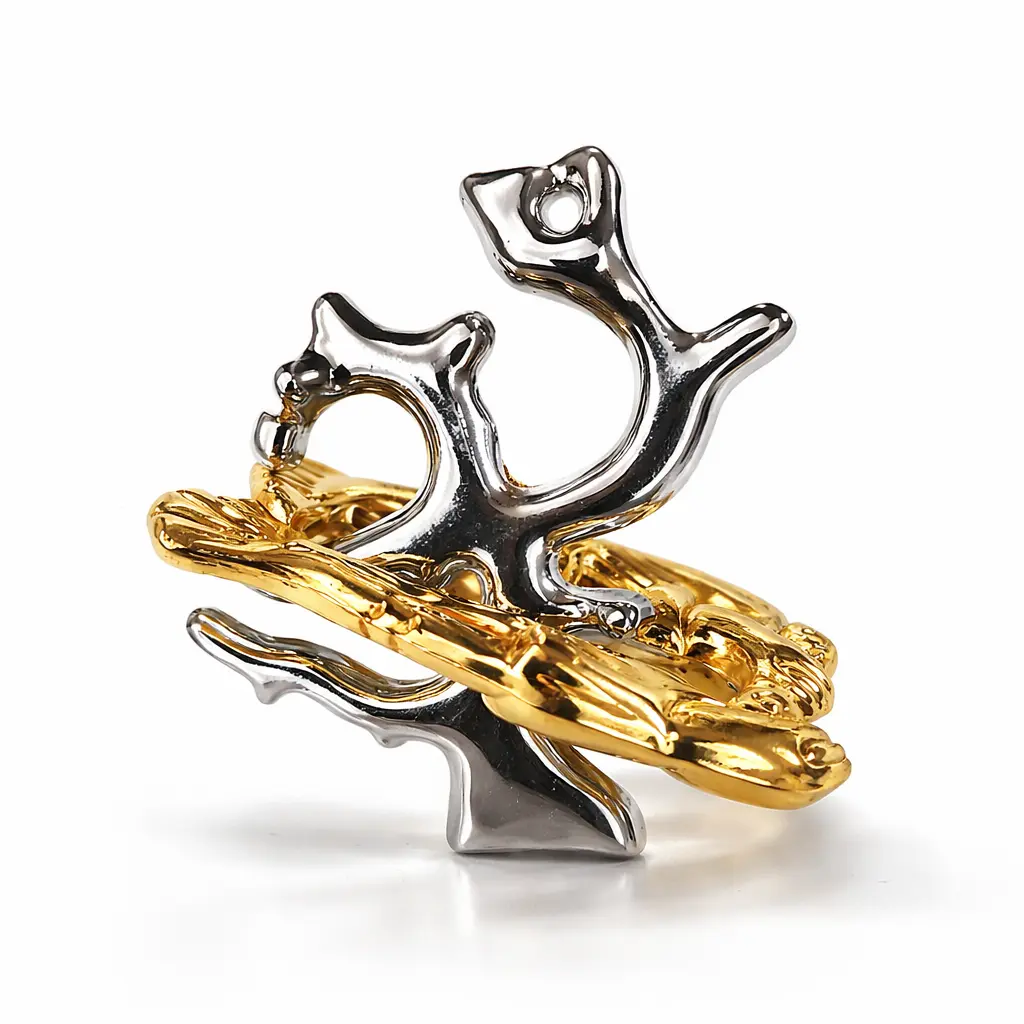
You turn it. The pieces slide against each other with a soft, metallic whisper, never fully free. The fish, connected nose-to-tail in a Möbius-like band, weave through the coral’s organic gaps. It feels deliberate, almost narrative. This isn’t just a random tangle; the shapes imply a story. From an industrial design standpoint, the contrast isn’t merely decorative—it provides immediate visual feedback on the orientation and relationship between the two independent pieces. As noted in guides like this Hanayama puzzle buying guide, this clarity is a signature of thoughtful puzzle design.
Before the intellectual challenge, there is this simple tactile engagement. The coolness of the metal warms slowly in your hand. The finish resists fingerprints. You are not just solving a problem; you are handling a small, dense artifact of mechanical intent.
Akio Yamamoto’s Tale: The Gobies and the Coral Tangle
The implied story in your hand is not an accident. The Cast Reef’s design by Akio Yamamoto for Hanayama’s Marine series is directly inspired by a specific marine behavior: two tiny goby fish seeking refuge within the labyrinthine branches of a coral head, only to become mechanically trapped by their own chosen sanctuary. This biological vignette, moving beyond mere decoration, is the foundational constraint that shapes the entire puzzle’s elegant engineering problem.
Akio Yamamoto, a designer responsible for several entries in the Cast series, often begins with a simple, kinetic concept. Here, the concept is symbiotic entanglement. In nature, gobies and coral have a mutualistic relationship; the fish gain protection, the coral may benefit from cleaning. Yamamoto’s narrative twist is one of ironic consequence: the very structure that provides safety also creates an inescapable snare. This isn’t a violent tangle, but a peaceful, persistent deadlock. The two golden fish are cast as a single, continuous loop—a clever representation of their identical fate and intertwined path. The silver coral is not a cage with bars, but a porous, complex environment with openings that seem passable but are ultimately restrictive.
This narrative directly dictates the pieces’ geometries. The coral piece is all negative space and organic, asymmetrical lobes. It isn’t a solid block; it’s a perimeter. Its challenge lies not in bulk, but in the specific alignment and orientation of its gaps. The twin-goby loop, meanwhile, has two distinct “fish” profiles linked by smooth, curved arches. The critical mechanical insight is that the loop must navigate the coral’s interior topology, where the solution is not about force, but about discovering the precise rotational sequence and positional alignment that mirrors a fish slipping through a narrow crevice. The shapes force you to think in three dimensions and consider the entire path, not just a single point of contact.
As explored in analyses like this one on puzzle design through mechanical engineering, the best disentanglement puzzles often model real-world objects or scenarios because they provide intuitive, non-mathematical constraints. You instinctively understand that a fish cannot phase through solid coral; it must find a physical path. This biomimicry bridges whimsy and logic. You’re not just manipulating abstract metal; you’re reasoning through the designer’s stated story: “How did they get in, and therefore, how must they get out?”
The consequence is a profoundly satisfying cohesion between theme and mechanism. Every twist of the wrist, every attempt to slide the gold through the silver, feels like testing a hypothesis about the fishes’ predicament. The “aha” moment, when it comes, feels like discovering the secret of the coral’s architecture that the gobies missed. It transforms the solve from a generic metal brain teaser into a tactile story with a beginning (entanglement), a middle (the search for the path), and an end (successful extraction). The Cast Reef, therefore, stands out in the Marine series not just for its striking two-tone finish, but for being a near-perfect literal representation of its designer’s narrative premise in mechanical form.
Decoding ‘Level 3’: What That Rating Really Feels Like
Hanayama’s “Level 3” rating is a precise calibration, not a vague suggestion. On their official 6-point scale, where 1 is a gentle mechanical warm-up and 6 is a multi-session ordeal, Level 3 marks the crucial pivot from intuitive play to deliberate, principle-based solving. For the Cast Reef, this translates to a median solve time of 20 to 45 minutes for a first attempt—long enough to feel genuinely earned, but short enough to avoid desk-flipping frustration.
This rating isn’t about raw complexity or the number of moves. A Level 6 puzzle like Cast News is a labyrinth of shifting plates and hidden gates. A Level 1, such as Cast Vortex, is solved through obvious, pleasing rotation. The Cast Reef’s Level 3 challenge is one of perception. The solution path is logical and singular, but your initial spatial perception of the interlock is deliberately misled by the organic, tangled forms of the fish and coral. Your eyes tell you the gold is trapped in multiple places at once. The “aha” moment comes not from discovering a secret compartment, but from re-seeing the negative space within the silver reef piece, identifying the single, convoluted channel through which the entire gold loop must travel. It’s a test of visual re-framing.
So, is it a good gift for a puzzle beginner? Absolutely, with one caveat. It is the ideal second puzzle. Give a true novice a Level 1 or 2 to build confidence in the language of cast metal—the way pieces slide, the tolerances, the feel of a solution. The Cast Reef is what you gift them next. It teaches the core tenet of high-level disentanglement: the solution is almost always a path you’re not considering because the puzzle’s aesthetic design is expertly camouflaging it. It’s a lesson in looking differently, not just harder.
This puts the Cast Reef in a sweet spot among its siblings. It’s more substantial than the trivial Cast Ring (Level 1), yet far more accessible and immediately engaging than the abstract, mathematical Cast U&U (Level 4). Its difficulty is conversational. You can pick it up, wrestle with its premise, and likely reach the satisfying “click” of separation within a single sitting without hints. This makes it perpetually pick-up-able, a key trait for a good desk brain teaser. After the first solve, re-solving becomes a 60-second meditative ritual—you remember the principle, not a sequence of steps, and executing it remains pleasurable.
Where does it sit among other Level 3 cast puzzles? This is where subjective feel matters. Compared to the Cast Harmony (also Level 3), which involves aligning symmetrical sliding plates, the Reef’s challenge feels more organic and discovery-based. Against the Cast Galaxy, another stellar Level 3 entry, the Reef is less about sequential assembly and more about holistic separation.
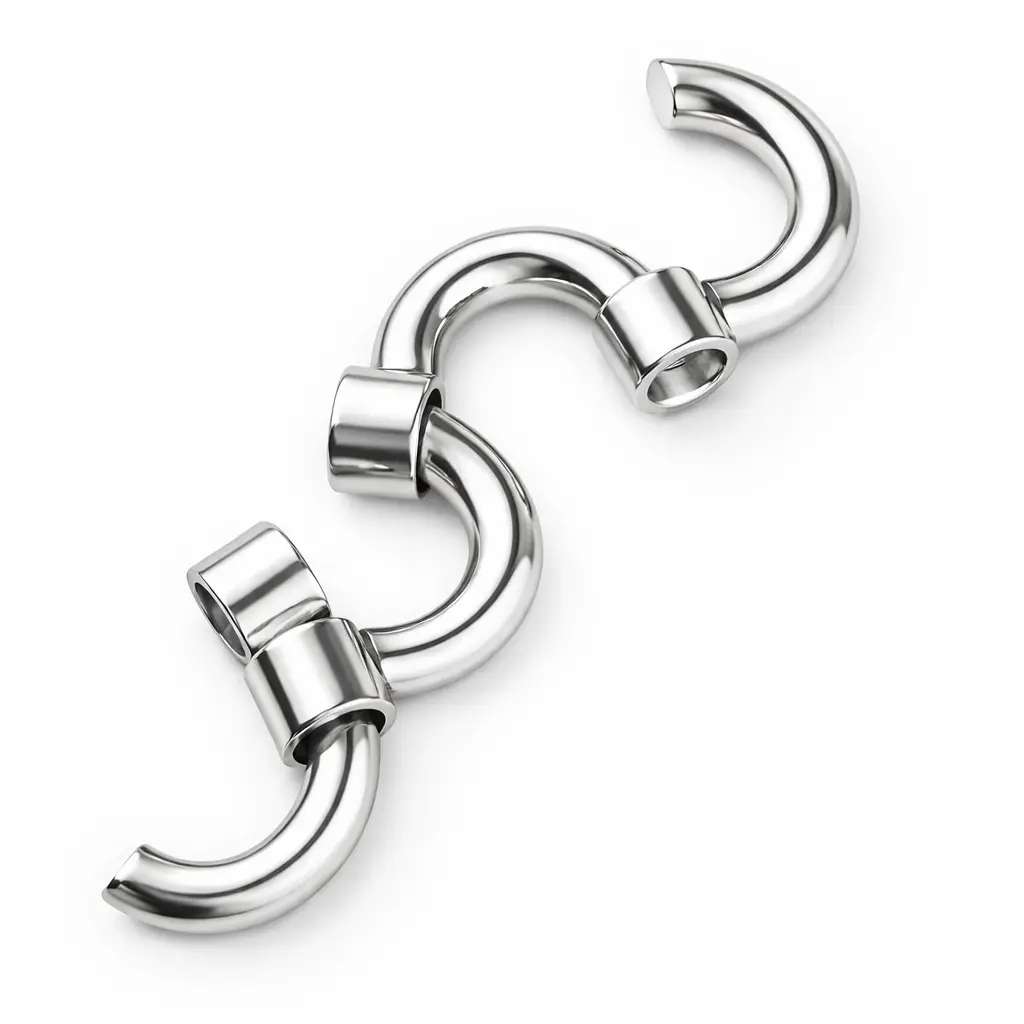
Cast Galaxy 4-Piece Silver — $14.88
The Galaxy asks you to build a structure; the Reef asks you to understand a relationship. This distinction is central to understanding Hanayama cast puzzle solutions by level—they grade the type of cognitive load, not just its intensity. Level 3 often houses these elegant principle-based puzzles, where the barrier is a single, clever insight.
Does the gold coating wear off? With normal handling—solving, fidgeting, displaying—the durable anodized finish holds up remarkably well. This isn’t paint; it’s a hard electroplated color. You might see a slight sheen change on the highest friction points over years of use, but no flaking. The puzzle is built to be manipulated, its cool metal and smooth finish enduring hundreds of cycles from entangled to solved and back.
Ultimately, “Level 3: Moderately Challenging” is Hanayama’s promise of a substantive, self-contained experience. It guarantees you will be legitimately stuck, but not hopelessly lost. For the Cast Reef, the rating perfectly matches the designer’s tale: the gobies are well and truly stuck, but the logic of their escape is embedded in the very coral that traps them. Your job is to see it. The satisfaction is in that shift of perception, a quiet mental victory that weighs two ounces and fits perfectly in the palm of your hand.
The Solve: A Symphony of Click, Shift, and Aha
The solve is a process of intimate, iterative negotiation with the metal, where the initial twenty minutes are often spent simply learning its language of resistance. You don’t brute-force the Cast Reef; you listen to it. The first true move isn’t a separation, but a discovery of a specific, counterintuitive alignment—a precise orientation where the pieces, still locked, suddenly gain a whisper of slack. This moment typically arrives after 15 to 45 minutes of exploration for a new solver, marking the transition from random manipulation to directed effort.
You begin with heft and slide. The weight distribution is a constant clue. Two ounces seems negligible until you feel it migrate from the center of your palm to your fingertips as the pieces pivot. The anodized finish is impeccably smooth, offering no purchase for your skin, only the barest hint of friction. This forces a delicate touch. You’re not gripping; you’re cradling, nudging.
The sound is critical. Hanayama’s best puzzles have an acoustic signature, and the Cast Reef is a percussionist. There’s the dull, solid thud of a dead-end impact. Then there’s the target sound: a clean, high-pitched satisfying click. It’s a tiny, metallic tock that resonates in the hollows of the coral piece. That click is your first tangible feedback, an audible confirmation you’ve found a true vertex in the solution path, not just another false intersection. It’s the puzzle saying, “This is a real gate. Remember it.”
This is where the tactile feedback becomes your primary sense. Vision is almost a distraction. You close your eyes. Your fingers map the cool geometry—the smooth curve of a fish’s back, the jagged bite of a coral branch. The process is one of shift and settle, click and re-center. You learn the sequence of these shifts: a gold loop rotates through a specific silver aperture, the weight drops, you re-grip, then a subtle tilt unlocks a new plane of motion. It feels less like pulling things apart and more like persuading two shapes to dance through each other in slow motion.
Frustration is part of the score. You’ll hit the plateau. You’ve found the clicks, you’ve felt the shifts, but the Reef puzzle remains obstinately solved only in your mind’s eye, not in your hand. This is the crux of the disentanglement. The principle is understood—the gobies must exit the coral in a way that mirrors their entrapment story—but the physical execution demands a precise choreography. One misaligned angle and everything seizes up. The smooth metal mocks you. You set it down. You pick it up.
Then, the aha moment. It doesn’t arrive as a shout, but as a quiet, definitive slide. When the final alignment is perfect, the gold fish don’t so much escape as they simply flow free. The separation is sudden, silent, and utterly satisfying. The two pieces sit in your palm, distinct. The tangled story has been parsed. The relief is physical and intellectual.
But a true cast puzzle isn’t solved once. The reassembly is the second half of the conversation, and it’s often where true mastery is tested. For the Cast Reef, it’s a mercifully logical mirror of the disassembly. If you understood the exit, you can reverse-engineer the entrance. The clicks and shifts guide you home. After the first solve, the entire process—from tangled to separated and back—can be completed in under a minute, transforming it from a daunting challenge into a fluid, mechanical ritual. This repeatable nature is key to its longevity; it becomes a fidget object with a complete narrative arc.
For those seeking a deeper grammar behind these movements, the principles at play in the Cast Reef are part of a broader language of mechanical puzzles. As explored in resources like Unlock Any Metal Puzzle: The Mechanical Grammar Of Brain Teasers, the dance of the gobies and coral is a classic study in rotational interlocking and sequential freedom, a three-dimensional logic problem rendered in pleasingly cold, anodized metal. The solve is the experience of translating that logic from mind, to hand, to the definitive, percussive proof of a satisfying click.
Cast Reef vs. The Marine Series: A Collector’s Side-by-Side
The Cast Reef’s transition from a frustrating challenge to a fluid, mechanical ritual is what cements its place on a collector’s shelf. But how does it stack up against its siblings in Akio Yamamoto’s Marine series? For a collector, the Reef is a standout middle-ground piece: more mechanically elegant than the Cast Dolphin, more visually striking than the Cast Seahorse, and built with an anodized finish that shows remarkably little wear even after hundreds of cycles, directly answering the common worry about the gold coating.
Place the Reef beside the Cast Dolphin. The Dolphin is often the gateway. Its two identical, sleek silver pieces are a pure lesson in symmetric rotation. The tactile feel is smoother, almost slippery. The solve is a shorter, more direct conversation. The Reef, by contrast, is a dialogue. The asymmetrical shapes—the organic coral tangle versus the looping fish—force your brain out of seeking mirrored movements. The Dolphin teaches a basic principle; the Reef adds narrative and visual misdirection to that principle. The gold and silver contrast isn’t just decorative; it’s functional, helping you track which piece is which during the more complex rotational dance.
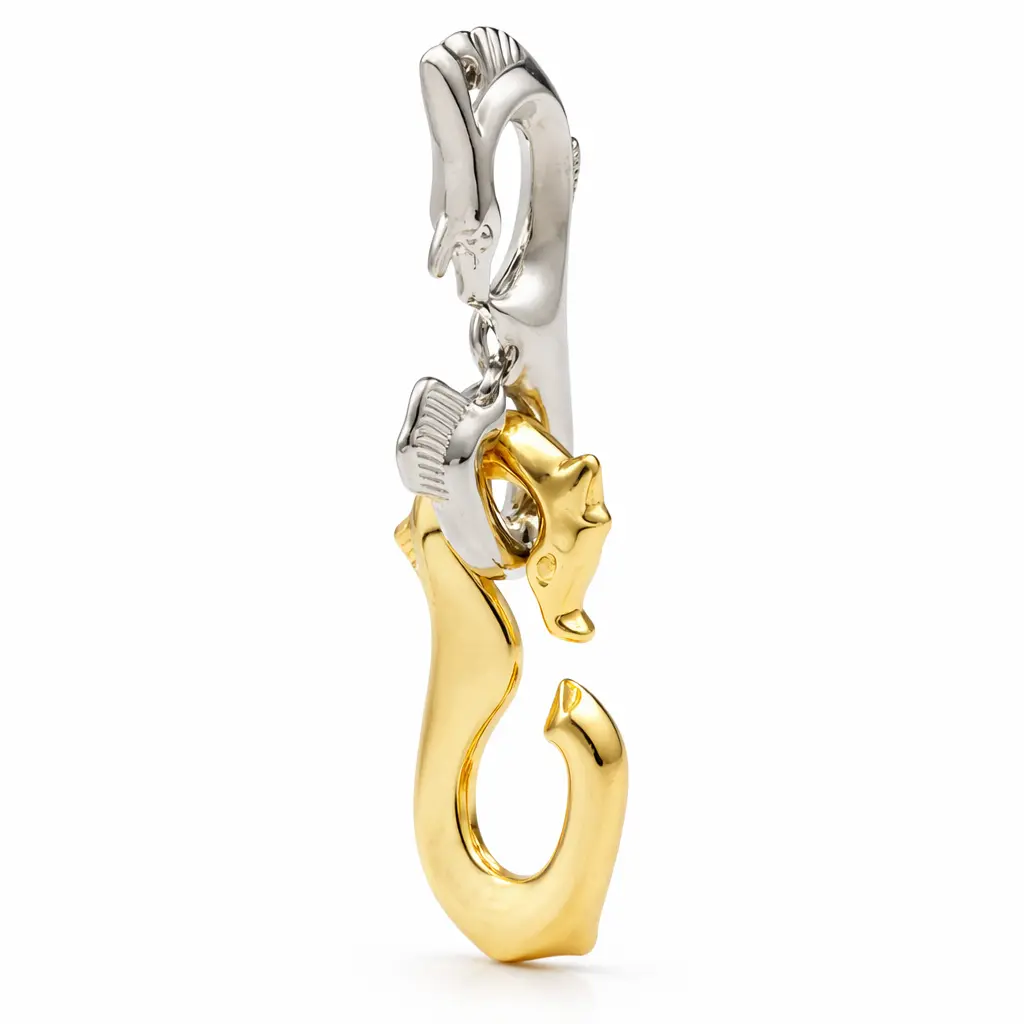
Then consider the Cast Seahorse. This is a different beast entirely—a Level 2 that consistently fools the overthinker. Its two intertwined seahorses, often in this gold and silver finish, present a problem that feels deceptively simple. The solution hinges on a subtle, non-intuitive axis of movement that many miss, making its lower difficulty rating a fascinating case study in psychological block. The Reef is more mechanically transparent by comparison; its challenge is in executing a sequence, not discovering a hidden vector. For a nuanced look at why the Seahorse trips people up, The Seahorse Separation Problem delves into that specific cognitive trap.
The tactile comparison is where my designer’s bias shows. All Hanayama puzzles use a zinc alloy with a thick, anodized coating. The Reef’s coral piece has a slightly textured, matte feel from its intricate casting. The gold fish loop is polished smoother. After six months of occasional handling—picking it up, solving it, handing it to friends—my unit shows no flaking or discoloration. The coating is durable. You’ll get micro-scratches on the high points if you’re not careful, a soft patina of use, not wear. It’s built to last as a desk brain teaser you can fidget with for years.
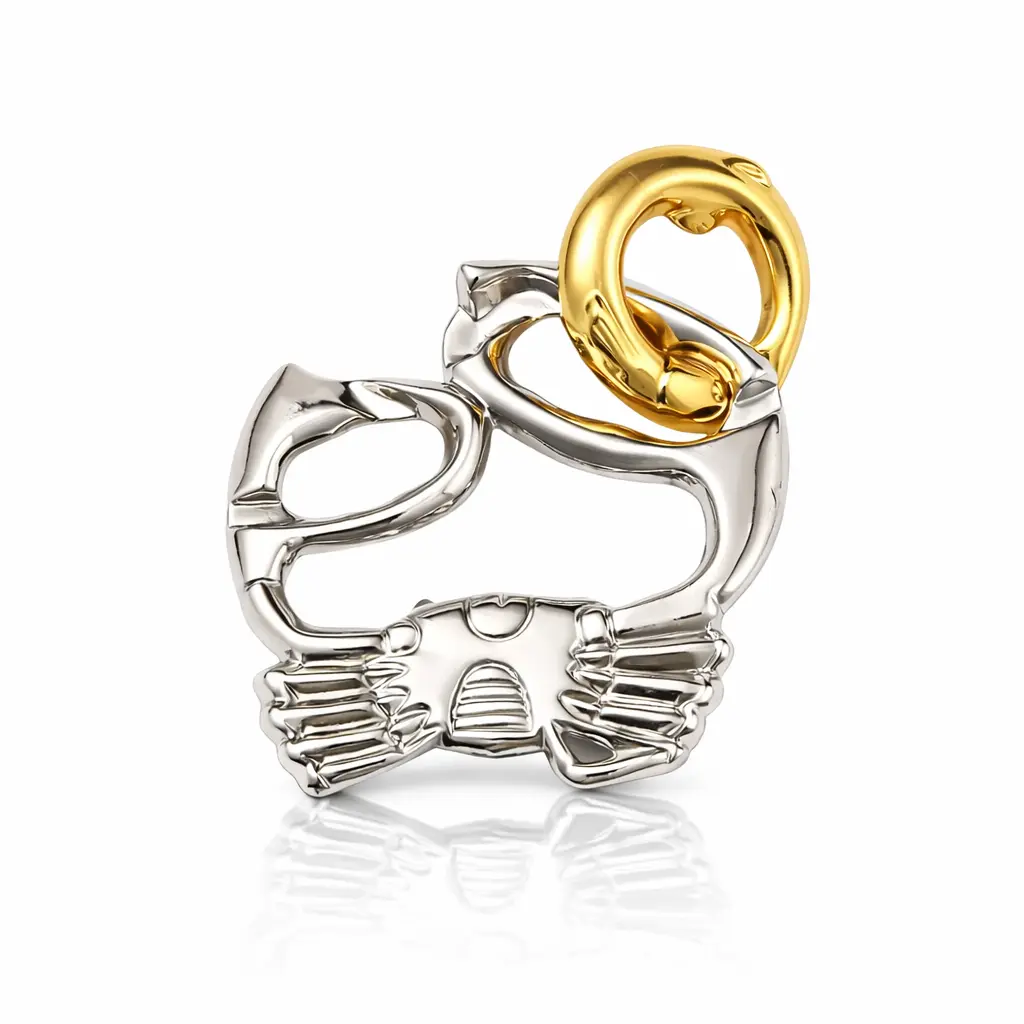
Against other thematic entries like the Cast Crab (which introduces a separate ring element, adding a layer of complexity), the Reef holds its ground through elegance. The Crab is a busier, multi-step disentanglement. The Reef is a focused, two-piece ballet. Its value is in that focus. You’re paying for a specific, refined experience, not just more metal. For a dedicated guide on that more complex crustacean, see this metal crab puzzle guide.
So, is it worth the money? If your collection values aesthetics and a satisfying, repeatable mechanical action, absolutely. It sits perfectly between beginner and expert. It’s more visually rewarding than the Dolphin, more substantial than the Seahorse. It’s a puzzle that, once solved, doesn’t retire to a drawer. The contrast of gold and silver makes it a conversation piece. It becomes a desk ornament with a secret—a static sculpture that you, and only you, know contains a graceful, hidden motion. In the Marine series lineup, the Cast Reef isn’t the hardest or the simplest. It is perhaps the most complete.
Beyond the Solve: The Puzzle as Persistent Object
A solved Hanayama puzzle often loses its charge. Not the Cast Reef. The mechanical satisfaction of its “aha” moment is just one act in its story. The true test of its design is what happens next: it becomes a persistent object, a 2.5-inch sculpture of cold-anodized metal that remains engaging long after the secret is known. This is where it surpasses its purpose as a mere brain teaser and earns its keep on your desk, transitioning from a one-time challenge to a lasting display piece.
The key is its fidget-object potential. Unlike multi-step disentanglements that feel like a chore to repeat, the Cast Reef’s core action is pleasingly simple to execute once understood. The smooth glide of the golden goby loop through the silver coral’s aperture, followed by that decisive, soft clink of metal meeting metal, is a mechanically satisfying cycle. It’s a kinetic ritual, a tactile feedback loop perfect for idle hands during a phone call or a moment of thought. The weight is just right for palming, and the finish—cool, smooth, and slightly grippy—invites handling.
This invites a display choice. Do you keep it assembled, a testament to the coral’s protective tangle? Or separated, telling the story of the freed fish? Both states are visually compelling. As a desk ornament, the contrasting gold and silver catches lamplight differently throughout the day, creating a small, shifting focal point. Its abstracted biological forms are subtle enough for an office but intriguing enough to prompt questions. It’s a quiet conversation starter that reveals a person’s curiosity: “What is that?” is a far more interesting opener than most desk knick-knacks provide.
This leads to the practical question of durability. Does the gold coating wear off? With normal handling as a fidget or display item, the anodization is remarkably resilient. It’s not a plating that will chip; it’s a color-infused surface layer. Over years of aggressive, daily fidgeting, you might see a slight polish on the highest contact points—a patina of use, not a defect. This robustness reinforces its role as a permanent object, not a fragile collectible.
For the puzzle beginner who asked if this is a good gift, this permanence is the strongest argument. A one-trick puzzle can disappoint after the solve. The Cast Reef offers a layered return: the initial intellectual victory, followed by the ongoing sensory pleasure of its mechanism, capped by its enduring aesthetic value. It’s a gift that keeps presenting itself, changing from a challenge to a companion.
Ultimately, Akio Yamamoto’s narrative finds its full circle here. The story of the gobies and the coral isn’t just a clever premise for the entanglement; it’s a design philosophy for the object’s entire lifecycle. The “separation” is the climax, but the reunited state—the fish nestled safely within the reef—is the satisfying, restful conclusion. You can choose to leave them in that harmonious, solved state on your shelf, a tiny metal diorama of a crisis averted. The Cast Reef doesn’t demand you solve it again and again. It simply, patiently, offers the possibility—a lasting interplay of story, mechanics, and form that makes it more than the sum of its two anodized parts.
The Verdict: Who Should Cast Their Line For This Reef?
The Hanayama Cast Reef is a worthwhile acquisition for the tactile thinker who values mechanical elegance and aesthetic permanence over sheer, brutal difficulty. Priced between $15 and $25, it occupies a sweet spot as a moderately challenging, visually striking object that justifies its cost through enduring design, not just a fleeting “aha.” It is not the hardest puzzle in the series, but it is arguably one of the most coherent as a narrative told in anodized metal.
So, who is this specific tangle of gold fish and silver coral for? Three distinct audiences come to mind.
First, the budding puzzle enthusiast or the thoughtful gift-giver. This is the ideal candidate I referenced earlier. The Cast Reef’s Level 3 rating is genuine—it presents a tangible, logical hurdle but is devoid of the abstract, sometimes maddening complexity of higher-tier Hanayama puzzles. A beginner can realistically conquer it with persistent, logical fumbling, and that victory is profoundly satisfying. The object’s beauty and robustness mean the gift’s value doesn’t evaporate post-solve; it transitions seamlessly into a desk ornament and fidget piece, a constant reminder of a challenge met. If you’re seeking one of the best metal puzzles for adults that is accessible but not condescending, this is a premier choice.
Second, the collector of beautiful, interactive objects. This isn’t just for the puzzle shelf. As we explored, the Cast Reef’s contrasting finishes, pleasing heft, and smooth mechanical action make it a standout decorative piece. It invites handling. For someone who appreciates the tactile feedback of well-made things—the satisfying click of precision parts, the cool slip of metal—it functions as a superior executive toy or a focal point on a bookshelf. Its story provides a conversation starter that a simple sculpture lacks.
Third, the Hanayama completist or series admirer. Within the Marine series, the Cast Reef holds a unique position. It’s more approachable than the Dolphin yet more narratively and mechanically interesting than the simpler designs. It exemplifies Akio Yamamoto’s philosophy of embedding a story directly into the disentanglement problem. For the collector, it’s a essential, representative chapter in the larger story of cast metal puzzles.
Who should look elsewhere? The puzzle veteran seeking a multi-hour cerebral siege may find the Cast Reef a brief engagement. Its charm is in its elegant efficiency, not a protracted war of attrition. Similarly, if your sole interest is in the most fiendish, solution-obscuring challenge possible, your money is better spent on a Level 5 or 6 from Hanayama’s catalogue. The Cast Reef is a clever sonnet, not an epic novel.
Where to buy Cast Reef? As a popular and long-standing member of the Hanayama lineup, it is widely available. Specialty puzzle retailers like Puzzle Master or Serious Puzzles consistently stock it. Major online marketplaces, including Amazon, are reliable sources, though prices can fluctuate. For the best assurance of authenticity, purchasing from an authorized puzzle seller is recommended. You are looking for the official packaging that states “Hanayama Cast Puzzle” and “Mensa Approved.”
In my final estimation, this Cast Reef puzzle review concludes that Akio Yamamoto’s design succeeds precisely because it refuses to be just one thing. It is a mechanical puzzle with a sensible difficulty curve, a sensory object with a delightful sound and feel, and a miniature sculpture with a built-in fable. The gold fish and silver coral are not merely themes; they are the direct inspiration for the interlocking principle, making the eventual solution feel inevitable and poetic. It is a holistic piece of design that respects both your intellect and your appreciation for form. If that combination appeals to you, then the Cast Reef is not just a purchase—it’s a small, enduring pleasure to be discovered, solved, and admired.
Opening Scene and Core Thesis
The weight is surprising. Two ounces of cold, anodized metal in your palm — one piece a tangle of silver coral, the other a loop of two golden fish. Your first instinct is to pull. They don’t budge. This is the Hanayama Cast Reef. Its purpose is deceptively simple: free the intertwined gold fish from the silver coral reef. But this is not an abstract metal disentanglement puzzle; it is a specific story, a tiny mechanical fable cast in metal that defines its entire solving experience and elevates it beyond a simple brain teaser.
The core thesis of this Cast Reef review is that its genius lies in this marriage of narrative and engineering. Every competitor notes the objective. Almost none explore why designer Akio Yamamoto chose this particular story of two gobies and a coral, a choice that transforms a random challenge into a coherent, satisfying principle. The biological inspiration—a real-world behavior where fish like gobies interact intricately with coral structures—is not decoration; it is the direct source of the puzzle’s internal logic. This article dissects that journey from initial tactile intrigue to intellectual satisfaction, analyzing how a level 3 cast puzzle achieves depth through constraint, and why this small object earns a permanent place not just in a collection, but on a desk. Your hands-on experience begins with that first, cool, confounding touch, the start of a proper real way to unbox brain teasers.