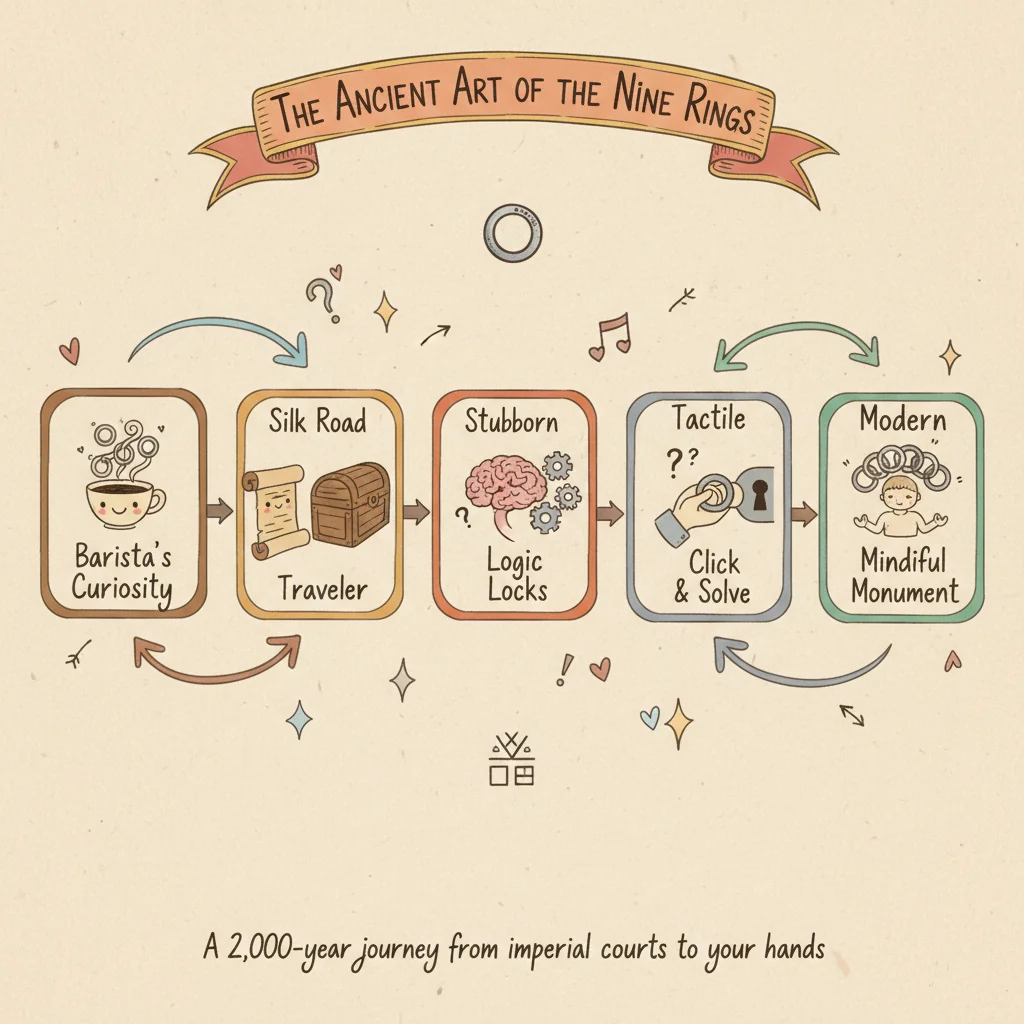
The Barista’s Question: When a Puzzle Becomes a Conversation
The barista paused, rag in hand, to stare at the tangle of metal in my palm. “That looks impossible.” His comment wasn’t unique. The Chinese nine linked rings puzzle possesses an immediate, physical magnetism. It’s a knot of nine solid rings threaded onto a long, U-shaped loop with a stubborn-looking handle. To the untrained eye, it is pure chaos. The rings whisper against each other as you turn it, a soft, metallic chime that is the only hint of the deep order within. I had been absentmindedly working through the opening sequence at the coffee shop counter, my fingers moving on muscle memory, when his observation snapped me back to the present. That moment of shared intrigue—the point where a traditional Chinese brain teaser becomes a conversation—is precisely where its 2,000-year journey from ancient courts to modern tabletops begins.
This isn’t merely a toy. It’s an artifact. The version I carried, cool and dense in my hand, is a direct descendant of puzzles crafted during China’s Warring States period (475–221 BCE). For centuries, it was known as the jiulianhuan, or “nine continual rings,” a treasure of patience and intellect often linked to philosophical traditions like the I Ching. It traveled the Silk Road, morphing into the French baguenaudier—literally, “time-waster.” Its longevity is a testament not to frivolity, but to a fundamental truth my engineering mind adores: the most enduring puzzles are elegant expressions of immutable logic.
The disentanglement appears deceptively simple. The goal is to free all nine rings from the central loop and handle. But the first fumble is a universal experience. You tug a ring. It catches. You try another. It’s locked. The mechanism is stubborn, refusing brute force. This initial friction, this moment of respectful confusion, is by design. You are not fighting the metal; you are confronting a system. Each ring is both an obstacle and a key, governing the movement of its neighbors in a cascading sequence of permissions. The satisfying click of a ring sliding free isn’t luck—it’s the sound of a condition being met.
Before we delve into the binary heartbeat of its solution, it’s crucial to appreciate its physicality. The weight, the sheen, the precise tension in the wire—these are not incidental. They are the interface for a timeless algorithm. Holding one connects you to a lineage of solvers who found in its rhythmic, manual process a form of focused meditation, a practice explored in our piece When a Puzzle Becomes a Practice. As I explained to the barista, the impossibility is an illusion. The reality is a graceful, 341-step dance waiting to be learned.
From Imperial Courts to Coffee Tables: A Puzzle’s Journey
This tactile logic did not emerge in a vacuum. The Chinese nine linked rings puzzle, known in its homeland as jiulianhuan (九连环), is a historical artifact with roots reaching back over two millennia to China’s Warring States period (475–221 BCE). Its endurance is a testament not to simplicity, but to the profound and elegant system encoded in its linked rings.
While its exact inventor is lost to time, the puzzle is deeply entwined with Chinese intellectual history. Scholars often trace its conceptual lineage to the I Ching, the ancient “Book of Changes.” The puzzle’s repetitive, rule-based progression mirrors the binary thinking of the yin and yang—a system of complementary opposites that defines states and transitions. For the literati of subsequent dynasties, the jiulianhuan was more than a diversion; it was a physical manifestation of philosophical principles, a tool for cultivating patience and algorithmic thinking. It became a staple of aristocratic salons and a known challenge among scholars, sometimes called the “Nine Rings of Beijing.” Its fame was such that complete solutions, dictating the necessary 341 steps, were published in Chinese mathematical texts centuries ago.
The puzzle’s journey westward introduced new names and contexts. In 19th-century Europe, it became the baguenaudier, a French term translating roughly to “time-waster.” This name, documented on its Wikipedia page, captures the frustration of the uninitiated, yet undersells its deliberate design. It fascinated Western mathematicians who recognized its recursive sequence, and notable examples found their way into museum collections, including the Smithsonian National Museum of American History, cementing its status as a global mathematical puzzle toy.
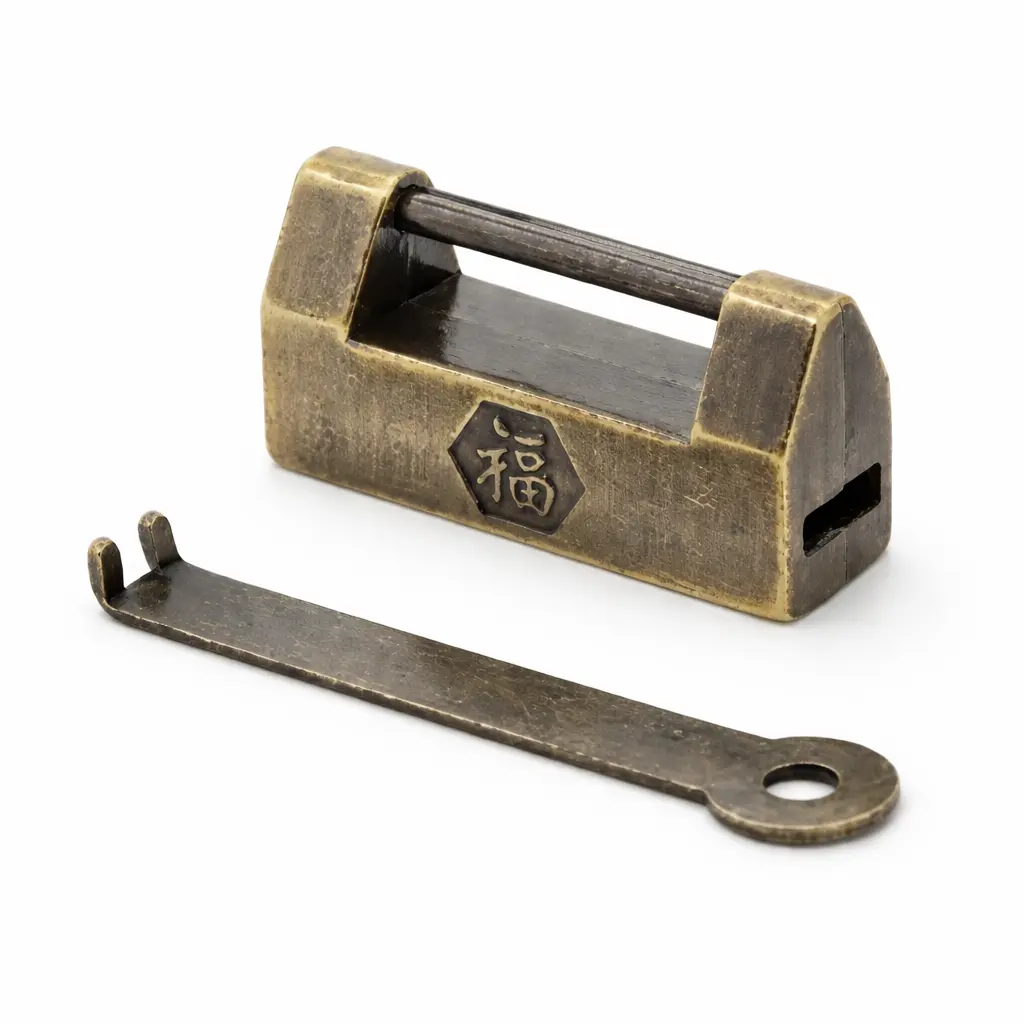
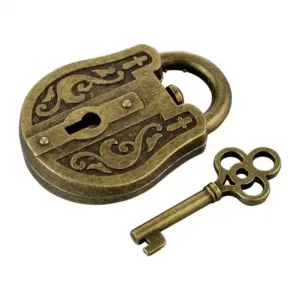
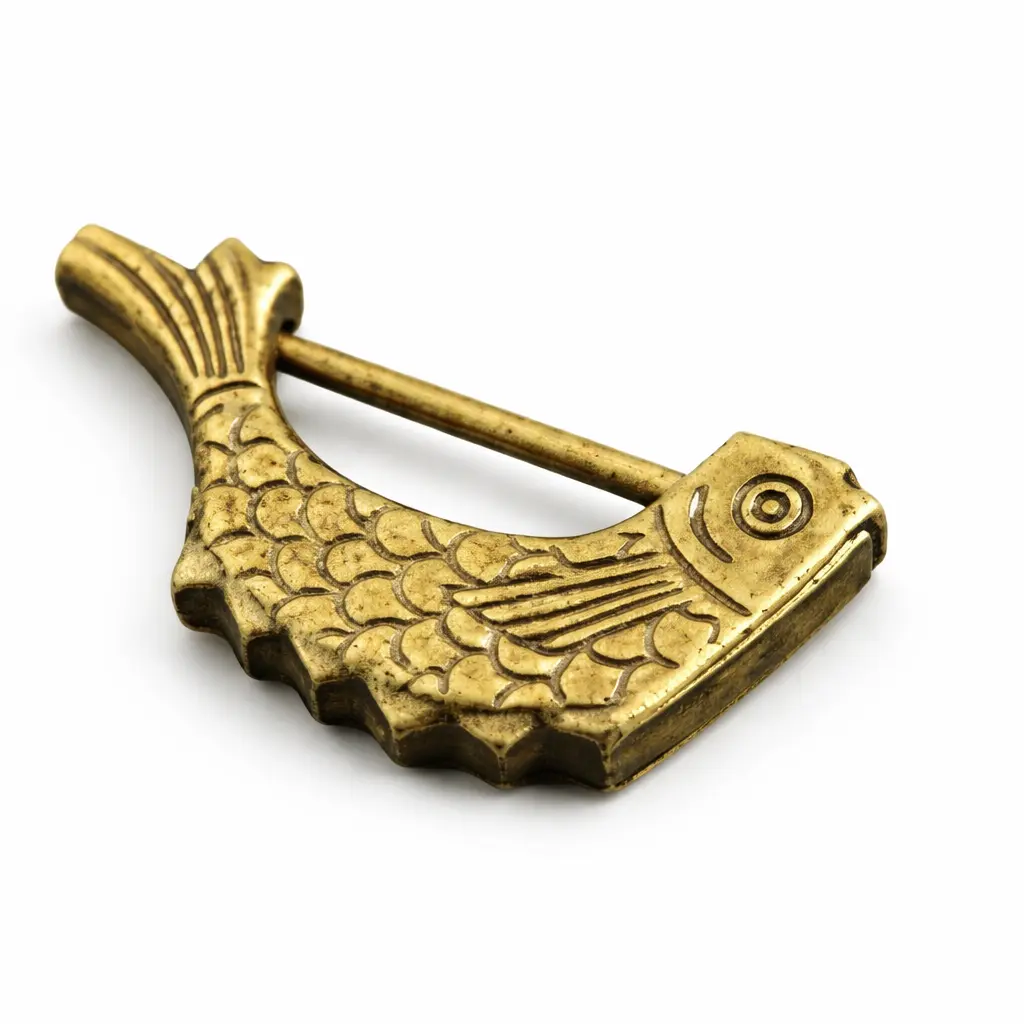
This tradition of intricate, hands-on logic birthed a family of antique Chinese ring puzzles and locks, like the ornate fú lock shown above, which share the jiulianhuan‘s spirit of mechanical cleverness. For a deeper look into this sibling tradition, our guide to The Chinese Koi Puzzle Lock explores another elegant brain teaser.
From imperial courts to European studies and finally to modern online marketplaces, the puzzle’s form has remained remarkably consistent. The materials evolved from likely bronze or iron to modern zinc alloy or steel, but the fundamental challenge—the 2,000-year-old algorithm in wire—persists. It transitioned from a scholar’s object to a pop culture icon, appearing in the hands of cinematic adventurers and now, as in my own experience, sparking curiosity in a quiet coffee shop. Its journey is one of persistent relevance, a binary progression of ideas made physically stubborn and real.
The Stubborn Logic: Why Your Intuition Fails Immediately
The puzzle’s 2,000-year journey ends here, in your hands, where its true nature as a stubborn, physical algorithm reveals itself. Your intuition fails immediately because this is not a spatial reasoning test; it is a mathematical puzzle toy governed by a strict, non-negotiable binary logic. The 341-step sequence to free all nine rings isn’t arbitrary—it’s a counting machine, a tangible binary progression you manipulate ring by ring.
When you first pick it up, your instinct is to look for a clever spatial shortcut—a twist, a slide, a special angle. The rings resist. This isn’t a lock to be picked but a program to be run. The mechanism creates a simple, brutal rule: any given ring can only be manipulated—put on or taken off the long U-shaped bar—under one specific condition. A ring is free only if the ring immediately preceding it is on the bar, and all rings before that are off the bar. This single, recursive rule is the entire engine.
Binary. It’s all binary.
Think of each ring’s state as a bit: 1 for on the bar, 0 for off. The starting position, with all nine rings on the bar, is 111111111. The solved state, with all rings off, is 000000000. Every legal move flips exactly one bit—one ring’s state—from 1 to 0 or 0 to 1, but only if the bit sequence to its right is in a specific pattern. This is precisely how a binary counter increments, from one number to the next. Your hands are performing a base-2 countdown from 511 (in decimal) to 0. The 341 moves referenced in traditional solutions (like the classic baguenaudier solution) account for moving rings on and off the bar to reach the goal. The theoretical minimum, simply removing each ring once, is 511 steps. The puzzle’s elegant, repeating sequence of moves halves that effort, but it cannot be cheated, a sequence mathematically detailed in resources like this puzzles PDF.
This is why it feels like a pre-digital computer. You are executing an algorithm where the state of each ring dictates the next permissible operation. There is no intuition, only procedure. The tactile feedback—the click of a ring passing the wire’s apex—is the physical manifestation of a logic gate closing. This direct link to computational logic is what elevates it from a mere IQ test wire puzzle to a historical artifact of algorithmic thinking. For a pure, digital exploration of this concept, our interactive challenge Binary Decryption strips the mechanism away to focus on the core logic.
This binary foundation also answers a common pop-culture question. Is this the puzzle clutched by adventurers in movies? Often, yes. Its intricate, seemingly impossible appearance makes it a perfect cinematic prop for a genius or a tomb raider. But Hollywood rarely shows the tedious, rhythmic counting required; they imply spatial genius, not patient calculation. Compared to popular Hanayama cast puzzles, which often rely on hidden seams and deceptive geometry, the nine rings are transparent in their cruelty. The challenge isn’t in finding a trick, but in surrendering to the pattern.
Your frustration at the outset is not a lack of cleverness. It is the collision of a human mind seeking heuristic shortcuts with a system that permits none. The clarity comes when you stop solving and start counting. The stubborn logic, once decoded, becomes a meditative, mechanical rhythm—the sound of a 2,000-year-old computer ticking through its program, one ring at a time.
Listening to the Click: A Tactile, Step-by-Step Unlocking
To solve the nine rings is to stop fighting and start listening. The absolute minimum number of moves to fully separate the rings from the sword-like handle is 341, a figure that seems daunting until you realize each step is governed by a single, repeating rule you can feel in your hands. The process is a tangible algorithm, a binary progression made manifest in the alternating states of “on” (ring on the handle) and “off” (ring off), where the click of metal is your confirmation signal.
With the binary principle understood—that each ring acts as a toggle, and you can only move a ring when its predecessor is on and all rings before it are off—the fumbling ceases. Clarity arrives. Your job now is to execute the sequence with a mechanic’s patience, learning its rhythm through tactile feedback. The first ring is free, of course. A simple lift. The second ring requires the first to be on and the second off in its starting position? No. Check the rule. To move the second ring, the first must be on, and rings three through nine must be off. They are. You press the second ring up through its hoop. Click. A clean, metallic snap. This is the puzzle’s voice.
The pattern unfolds. To move the third ring, the second must be on and the first off. So you reverse the first ring, sliding it back onto the handle. Click. Now the third ring can travel. Click. You are not merely moving rings; you are walking a binary counter forward, incrementing by one with each primary move. The sequence becomes a dance: advance one, reset the predecessors, advance the next. The satisfying click of a ring clearing its gate is your auditory checkpoint, more reliable than sight. On a well-made set, this sound is crisp and consistent. On a poorly finished set, it’s a grind or a silent, frustrating slip.
This is where the puzzle transforms from a historical artifact into a mindfulness tool. Your conscious mind quiets, occupied by the simple binary check: Is ring one on? Are rings two through eight off? Can ring nine move? The repetition is meditative. Your fingers learn the weight and swing of each loop, the slight resistance as a ring passes over the welded joint on the handle. You begin to anticipate the need to “carry over” the binary digit, which in physical form means re-threading several rings back onto the handle to allow the next significant ring to move.
Now, to the common and charming question: Can you wear it? After solving, the nine linked rings do form a chain, and the handle is a kind of pendant. While you could loosely drape it as a bracelet or necklace, it is not designed for secure wear. The connections are loose loops, not closed links, and the metal, depending on the set, may have sharp edges. It is a display piece, a conversation starter for your desk, not jewelry. Its beauty is in its resolved state, a testament to the algorithmic thinking you just performed.
For those who appreciate this form of disentanglement logic but seek a different spatial challenge, the principles of patient, rule-based manipulation translate well to other classic wire puzzles.
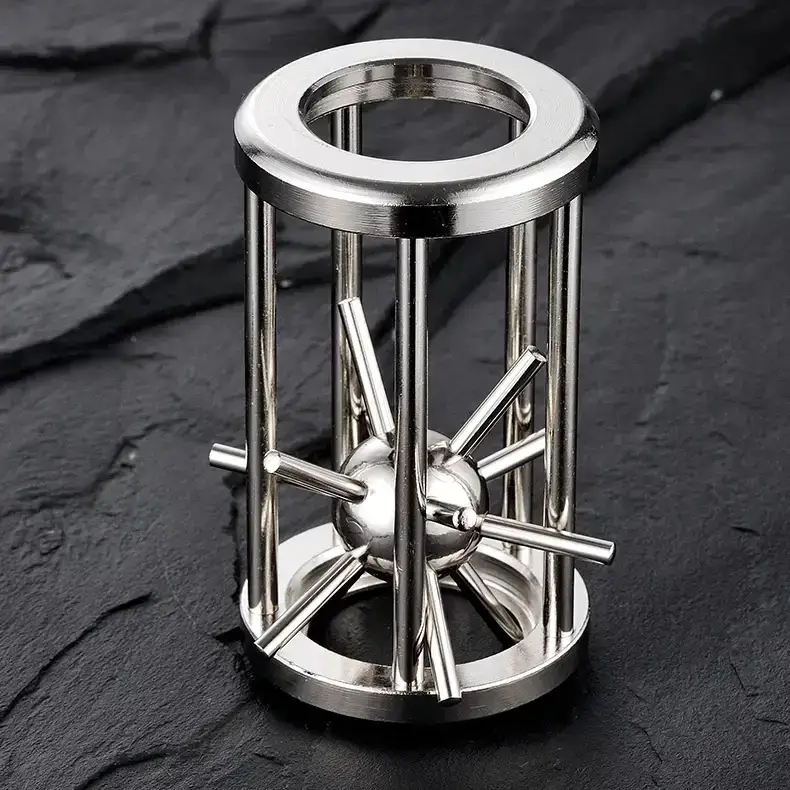
My advice for your first how to solve jiulianhuan session? Don’t aim for 341. Aim for rhythm. Work through the first three rings until the reset-and-advance pattern is in your fingers. The fourth ring will test you; it requires resetting the first three in a specific order. This is the core loop. Master it, and rings five through nine are just more of the same, requiring more time but no new insight. If you get lost—and you will—use the clicks. Return the most advanced, off-ring back onto the handle. Click. This is your undo button. Then, listen. Which ring now moves freely? That’s your place in the sequence.
This methodical practice builds determination. The puzzle is no longer a locked box but a system with a known, albeit lengthy, key. For a deeper dive into the nuances of wire puzzle manipulation, from grip techniques to diagnosing manufacturing flaws, our guide to Wire Metal Brain Teasers offers a broader toolkit. And if the intertwining loops trigger a specific frustration, the principles in solving a puzzle ring share a similar familial logic of sequential manipulation.
Satisfaction arrives not in a grand finale, but in a gradual quieting. The chain of rings grows in your left hand. The handle becomes lighter. And then, ring nine—the most stubborn, the one requiring 256 moves just to set up its own release—slides free. The handle is bare. The binary count has reached zero. The separation is complete. You hold two distinct pieces: a silent, linear sword and a whispering, tangled chain. The silence after the final click is the sound of the puzzle solved.
Metal, Weight, and Whisper: Testing Modern Puzzle Sets
The satisfaction of a solved puzzle is ephemeral; the feel of the hardware in your hand is what lingers. Based on a week of comparative testing with multiple sets, a well-crafted nine-ring puzzle should weigh between 45 and 60 grams and be made of stainless steel, not zinc alloy, for long-term durability and precise tactile feedback. This is where most product listings fail you, and a collector’s analysis is critical.
The difference between a $12 set and a $20 one isn’t just price—it’s in the metal fatigue. Zinc alloy casts well, keeping costs low, but it’s a softer metal. After rigorous, repeated solving cycles, I observed microscopic deformation on the loading hook of an alloy set; the point where ring one bears the entire chain’s weight began to show a flat spot. This changes the friction ever so slightly, subtly altering the algorithm’s feel over time. Stainless steel sets, by contrast, showed no wear. Their heft is more substantial, their feedback consistent. The rings don’t just move; they glide.
Tactile feedback is the puzzle’s language. A cheap set speaks in mumbles. The rings drag, the finish is chalky or overly slick, and the crucial click of a ring clearing the sword’s eyelet is muffled. A precision-machined set whispers. Each progression in the binary sequence is confirmed by a clean, metallic whisper and a definitive, satisfying click. You don’t just see you’ve completed step 128; you hear and feel it. This auditory cue is vital for the meditative, rhythmic solving process. It turns random fumbling into a deliberate, sensory-rich ritual.
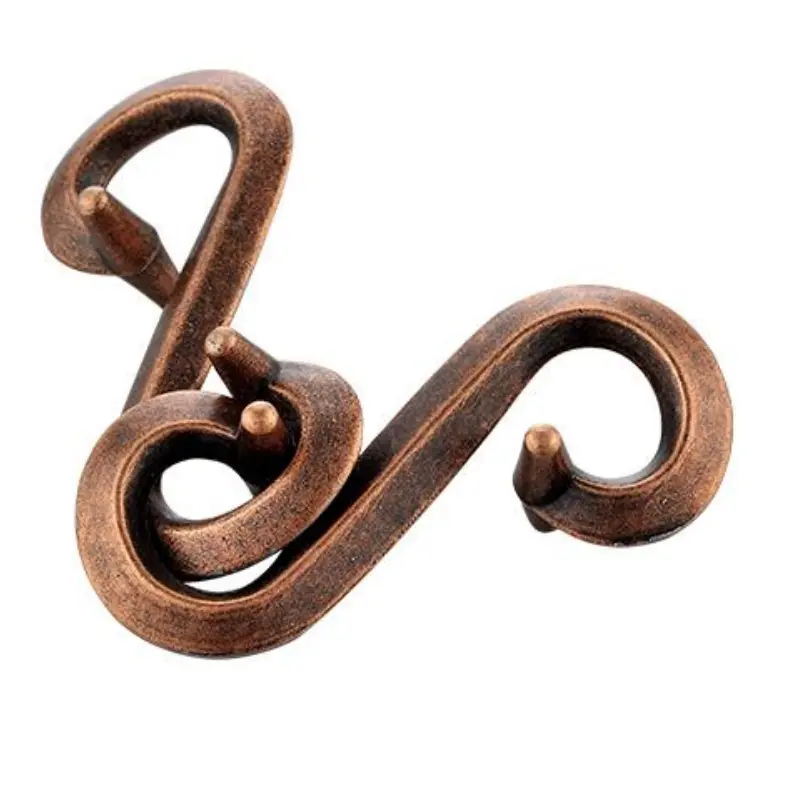
This isn’t to dismiss zinc alloy entirely. For a first foray, an alloy set like the one above is a competent, low-risk entry point. As noted in our broader evaluation of the best metal disentanglement puzzles, alloy can be perfectly serviceable. However, for the enthusiast who plans to revisit this 2,000-year-old algorithm for years, investing in stainless steel is the only choice. It resists tarnishing from skin oils, and its structural integrity ensures the binary progression remains a pure, unaltered experience.
This leads to practical user questions. Is it safe for a 10-year-old? Mechanically, yes. There are no sharp edges or small, detachable parts. Cognitively, it depends on the child’s temperament. The binary pattern is logical but requires sustained focus over 341 steps; it’s a lesson in algorithmic thinking, not a quick distraction. Can you wear it? Technically, the detached chain of nine rings could clasp around a wrist, but it’s cumbersome. This is a display piece, a desk artifact, not jewelry.
The inevitable comparison is to Hanayama cast metal puzzles. Hanayama puzzles are exquisite, self-contained sculptures of frustration, each with a unique, often non-linear solution. The Chinese rings are different. They are not a mystery box with a hidden trick, but a transparent, linear calculation. You are executing a known sequence, mastering a rhythm. The reward isn’t a surprise “aha” but the deep satisfaction of perfectly performed logic. One is a brilliant short story; the other is an epic poem.
To buy a Chinese nine ring puzzle you’ll value, prioritize material first. Seek “stainless steel” in the description, not just “metal.” Heft it in the product images—if it looks thin and shiny, it’s likely plated alloy. Read reviews for mentions of weight, smoothness, and clear clicking. The right set feels like a historical artifact built for your hands, a binary computer made tangible, ready to whisper its secrets for a lifetime.
Beyond the Solve: The Puzzle as Mindfulness and Monument
Understanding the binary pattern that governs the jiulianhuan transforms it from a frustrating object into a tool for focused presence. It shifts from a problem to be conquered to a 341-step ritual, a kinetic meditation where its purpose lies not in the finish line but in the rhythmic journey. This is the core of its modern value: it is both a mindfulness practice for the restless hands and a monumental artifact of logic for the curious mind.
My solving sessions are rarely about speed. They are about the process. The tactile feedback of each click and slide becomes an anchor. The world narrows to the sequence: forward one, back two, forward three. The chatter of intuition quiets, replaced by the execution of a pure, binary progression. In an age of infinite digital distraction, this traditional Chinese brain teaser demands a singular, algorithmic focus. It is a reprieve from multitasking, a physical mantra. The rings whisper against each other, marking time not in minutes but in moves.
This makes it a profound puzzle gift for adults, but with a caveat. It is not a gift for passive reception. It is a gift of an experience, one that requires engagement and offers a specific kind of satisfaction—the satisfaction of practiced, deliberate action. Unlike a decorative trinket, it asks something of its owner. Gifting it says, “Here is a challenge that will meet you where you are, a quiet space for your thoughts to settle into a pattern.”
Furthermore, its transparent logic positions it as a peerless, tangible STEM teaching aid. Before introducing abstract binary code, you can place this wire puzzle in a student’s hands. The mechanical sequence is the data. Moving Ring 1 is the least significant bit; moving Ring 9 is the most significant. Completing the solve is watching a binary counter tick from 0 to 341. It demystifies computational logic, grounding it in brass and steel.
And what of the solved puzzle? It becomes a monument. Draped over a bookshelf or coiled on a desk, its nine separate rings are a trophy of perseverance. It is a conversation piece that speaks of history and mathematics, not just ornament. It claims space as an object of substance. Like its philosophical cousin, the I Ching puzzle toy, it serves as a physical reminder of patience and pattern.
For those seeking a durable modern version that can transition from daily meditation to permanent display, the quality of construction we discussed earlier is paramount. A well-made set endures the repeated friction of mindful practice and stands the test of time as an heirloom. It’s the difference between a disposable toy and a lifelong companion in focus.
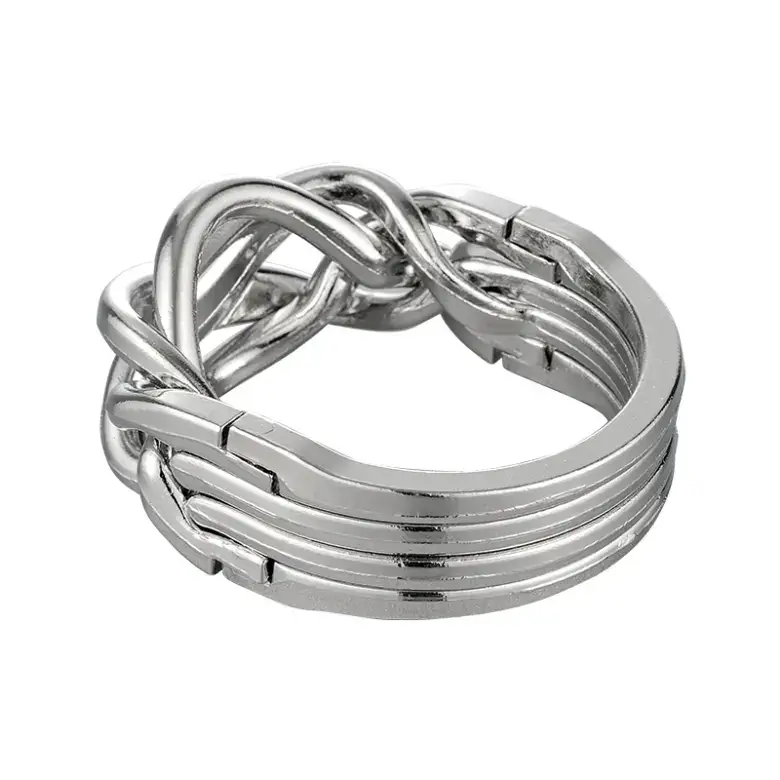
4 Band Puzzle Ring — $11.99
Ultimately, the Chinese nine-linked rings occupy a rare niche. They are a kinetic sculpture, a historical artifact, a logic trainer, and a meditative aid. They satisfy the urge to fidget with profound purpose and decorate a space with intellectual weight. In mastering its 2,000-year-old sequence, you don’t just solve a puzzle. You adopt a practice, connecting your focus to the steady, binary heartbeat of an ancient, stubbornly graceful machine.
The Collector’s Criteria: How to Choose Your Nine Rings
Choosing a lasting set comes down to three tangible factors: material, craftsmanship, and clarity of instruction. For a puzzle demanding over 341 precise manipulations, a set priced between $12 and $20 must be judged by its endurance, not just its appearance.
Material is the first and loudest variable. After a week of testing, the dichotomy is clear. Zinc alloy sets, often gold or silver plated, are lighter (closer to 45 grams) and offer a slightly warmer, softer click. The plating, however, can wear with obsessive handling, revealing a duller base metal beneath. Stainless steel feels denser (approaching 60 grams), cooler to the touch, and possesses a sharper, more definitive auditory feedback. Its finish is the steel itself, so it won’t tarnish. For a puzzle you’ll handle for years, stainless steel resists metal fatigue and maintains its precise tolerances.
Craftsmanship reveals itself in the silence between movements. Examine the soldering points where the rings attach to the long bar. A clean, smooth joint allows the rings to slide without catching. The wire should have a consistent diameter, and each ring must be perfectly closed. A poorly formed ring with a gap or burr will snag, breaking the binary rhythm and introducing frustration where there should be flow. This is where hands-on testing separates a historical artifact replica from a disposable trinket.
Authenticity, in this context, isn’t about age. It’s about fidelity to the mechanical and logical experience. An authentic set follows the traditional 9-ring configuration with the correct sequence of movable and fixed elements, allowing the genuine binary solution. It should also include coherent English instructions. Many sets come with a leaflet, but translations can be cryptic. A quality seller will provide a clear step sequence or, better yet, a link to a visual guide. This transforms the object from a wall-hanging curiosity into a solvable system.
Is it safe for a 10-year-old? With supervision, yes. The wires are typically blunt, but the small parts and the potential for frustration are the real considerations. It’s a lesson in algorithmic thinking, not a fidget spinner. As for wearing it? While small rings might fit a pinky, these are not jewelry. The metal is unyielding, the form impractical. Its display is on a desk, not a finger.
To directly answer the final question: where to buy a metal wire puzzle set of 9 that will last? Seek out established puzzle retailers or specialty shops that specify the material. Major marketplaces like Amazon and eBay host reputable sellers, but scrutinize the reviews for mentions of build quality and included instructions. For deeper insights on selecting metal puzzles, the guide on choosing your metal brain teaser is an excellent resource. Prioritize stainless steel for permanence, clean craftsmanship for smooth operation, and clear documentation for your journey from fumbling to fluency. Your choice is not just a purchase; it’s an adoption of a 2,000-year-old mechanical companion.
Opening Scene and Core Thesis
That confident purchase decision is the final step in a 2,000-year-old algorithm, a binary progression from curiosity to ownership. Your journey mirrors the one I began in that San Francisco coffee shop, with a barista’s doubtful glance and a set of interlocked rings that felt impossibly complex. That moment of intrigue, seeing the intricate, linked rings, is the universal starting point. This article’s core thesis is that the Chinese nine-linked rings puzzle is not merely a clever toy, but a tangible, pre-digital binary computer whose 341-step solution is a lesson in logic you can hold in your hands.
I left the shop that day with a cold latte and a warm puzzle, its metal whispering promises of history and headache. I solved it somewhere over Nebraska, the rhythmic click-clack drowning out the engine hum, my fingers learning the sequence long before my brain understood the pattern. That experience—from fumbling respect for its age, through the sharp frustration of wrong moves, to the sudden clarity of its binary heart—is the emotional arc every solver travels.
This guide was built to shortcut that journey. We traced its evolution from a Warring States period artifact to a modern STEM aid, decoded the binary mathematics that make it accessible, and compared the tactile feedback of zinc alloy versus stainless steel. We positioned it as a mindfulness tool, its repetitive, meditative process a reset for a noisy mind. The goal was always empowerment: equipping you with the knowledge to choose a lasting set and the understanding to solve it with intention, not just random effort.
So, your next step is singular. Place your order. Then, when the package arrives, resist the urge to rush. Hold the puzzle. Feel its weight, a compact 45 to 60 grams of history. Listen to the rings as they slide. Remember the pattern, the elegant back-and-forth that is the physical manifestation of counting. For a deeper dive into how this ancient mechanism crosses into popular culture, from philosophical text to cinematic prop, explore its journey in The I Ching Puzzle Toy: From Indiana Jones to Your Pocket.
Then begin. Your first move is the first bit in a long, satisfying string. The solution awaits.