Quick Answer: How to Choose a 3D Wooden Puzzle Clock DIY Kit Gift for Adults
Yes — a 3D wooden puzzle clock DIY kit is a strong gift for any adult who enjoys model building and has several free hours to dedicate to the build. The kit must use a real mechanical movement (gear train, escapement, pendulum), ship with a printed English manual, and include laser-cut plywood parts. Skip it if the recipient dislikes model-building or expects a finished clock in a box.
Before you buy, run the following checks on the product page or box: (1) the clock movement type — mechanical pendulum or quartz insert, (2) the components — plywood thickness, number of pre-cut pieces, whether the movement is included, (3) the documentation — step count, diagram quality, and whether tools beyond the box are required, (4) the display format — wall-mounted or desktop, and (5) the time estimate — a range rather than a single minimum number.
| Decision Check | What to Look For | Why It Matters |
|---|---|---|
| Movement type | Mechanical pendulum with escapement and gear train, not a hidden quartz insert | Determines whether the finished clock is truly mechanical and how long it runs between windings |
| Wooden components | Laser-cut plywood with clean edges, visible ply count, and a finish that holds up to handling | Thin or splintering parts break during assembly and look cheap on the wall |
| Assembly documentation | Numbered steps, full diagrams, and a printed manual | Decides whether a first-time builder can finish without quitting |
| Display format | Wall-mounted or desktop display options clearly described | A wall clock needs a back-hanger solution; a desktop model needs a stable base |
| Time estimate | A range, not a single minimum number | Most kits quote a fast build; first-time builders should plan for more time |
For a first kit that meets all three checks, the 3D Wooden Puzzle Clock DIY Kit is the direct starting point.
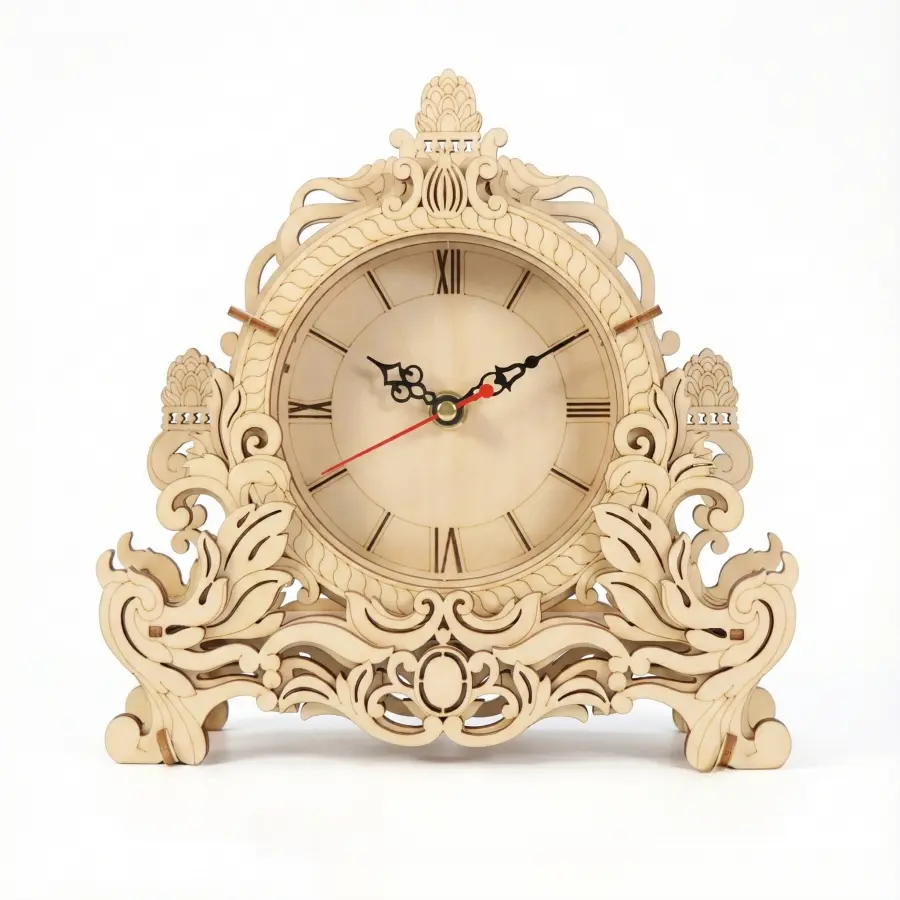
Action: Open the product page and confirm the movement type, the piece count, and the assembly-time range before adding it to the cart.
01. What a 3D Wooden Puzzle Clock Kit Actually Is and What ‘DIY’ Means Here
A 3D wooden puzzle clock kit is a working mechanical timepiece in kit form, and “DIY” here means the builder assembles the gear train, pendulum, and wooden case from laser-cut plywood pieces — not a wooden frame around a hidden quartz module. The finished build is meant to be displayed: wall-mounted above a desk or standing as a desktop piece. The “puzzle” in the name follows the same idea as a mechanical puzzle: a problem solved through a physical mechanism rather than wordplay or trivia.
Once the reader opens the product page, they should see flat plywood sheets with parts pre-cut by laser, a small bag of hardware (axles, washers, hands, pendulum bob), a separate movement module, and a printed instruction manual. The builder’s actual job is the part most casual gift descriptions skip: pressing the laser-cut plywood pieces out of the sheets, sanding any flash off the tabs, sorting the gears, and assembling the frame so the gear train, escapement, and pendulum all line up inside the wooden case. For a closer look at the actual build sequence, a step-by-step guide to assembling a wooden clock puzzle walks through each stage of the assembly.
The mechanism is what separates a satisfying kit from a cheap one. A real mechanical movement uses a wound spring or a hanging weight to drive a gear train through an escapement — the small catch-and-release device that produces the tick. The pendulum regulates the escapement, which regulates the gear train, which turns the hands. When the box says “pendulum” and “mechanical” together, that mechanism is the clock. A quartz insert, by contrast, is a battery-powered module the builder drops into a pre-cut slot. Both will tell time, but only the mechanical version rewards the builder with visible cause and effect — wind the spring, the pendulum starts, the tick begins, the hands move.
“DIY” in this category covers two very different builds. One is a mechanical wooden clock kit: the builder assembles the gears, mounts the movement, attaches the pendulum, and ends up with a clock that works because of the parts they put together. The other is a wooden craft with a quartz module: the builder assembles a decorative case, drops in a battery movement, and ends up with a clock that works in spite of what they built. From a gift perspective, both are valid presents, but only one is a mechanical wooden clock kit in the engineering sense.
The visual tell is in the photos. A true mechanical wooden clock kit shows exposed gears, a pendulum hanging below the clock face, and a movement module the builder mounts to the frame. A quartz-insert craft shows a finished wooden frame and a clock face with no visible mechanism.
Action: Scan the product page for “mechanical movement,” “pendulum,” and “gear train.” If all three appear next to photos of exposed gears and a swinging pendulum, it’s a real mechanical build. If only “clock” and “wooden” appear, treat it as a decorative craft with a battery insert.
02. How to Judge Build Quality Before You Buy: Four Observable Checks
Once you’ve confirmed a kit uses a real mechanical movement, the next decision is whether the wooden components will survive assembly and look good on a wall afterward. The highest-leverage check is plywood quality: well-made laser-cut plywood holds its shape under gear tension, while thinner boards warp and split around the movement mount.
Check 1: Plywood Quality and Thickness
Wooden clock kits use laser-cut plywood for the structural panels, and plywood quality matters for two reasons. First, the clock movement applies constant torque to the frame: the hour and minute hands press against the central shaft, the pendulum pulls on the escapement mount, and the gear train transfers rotational force through the body. A board that is too thin flexes under that load and can crack around the movement mount. Second, the finished clock hangs on a wall or sits on a desk under its own weight; thin plywood sags at the mounting points, and the face shifts off-center.
What to check on the listing: Look for an explicit thickness in the specifications. If the listing says only “wood” or “laser-cut wood” with no number, ask the seller before buying.
Check 2: Laser-Cut Edge Cleanliness
Clean laser-cut edges are dark brown, slightly charred, and uniform across the entire perimeter. A clean edge means the laser power was tuned correctly: enough to cut through, not so much that it burns the surrounding wood. Messy edges — deep scorch marks, ragged fibers, or visible tear-out — mean the laser was either underpowered or overpowered.
Clean edges also tell you the parts will press-fit together. A 3D wooden puzzle clock depends on tab-and-slot joinery: gears spin on axles pressed into side panels, the pendulum hangs from a pivoting arm, and the clock face mounts flush against the frame. If the slots are burned too wide, the tabs rattle. If the slots are too tight, the plywood splits when the builder pushes the pieces together.
What to check on the listing: Customer photos. Listings with only studio shots hide edge quality. Listings with builder photos showing partially assembled frames let you see the actual cuts.
Check 3: Pre-Cut Piece Count
The number of pre-cut pieces correlates loosely with assembly complexity, but more importantly it tells you how the mechanism is built. A 3D wooden puzzle clock with a real gear train needs separate pieces for each gear (hour gear, minute gear, escape wheel), each mounting bracket, the pendulum arm, the pendulum bob, the face plate, the hands, and the frame. A kit with 50–100 pre-cut pieces is a typical mechanical build. A kit with 20–30 pre-cut pieces is usually a quartz-insert craft with a decorative frame.
What to check on the listing: Look for the parts list. A mechanical kit lists gears by name (escape wheel, minute wheel, hour wheel) and shows the movement module as a separate component.
Check 4: Instruction Quality
This is the check most gift buyers skip, and it’s the one that determines whether the recipient finishes the build or abandons it halfway. A workable instruction manual for a 3D wooden puzzle clock has three things: English text, step-by-step diagrams, and an exploded view of the full assembly.
English text matters because many kits originate with Chinese-language manuals; the English translation, if present, sometimes runs to a single folded sheet with no diagrams. Step-by-step diagrams matter because clock assembly is sequential: the gear train goes in before the face plate, the pendulum mount goes in before the movement module, and the hands press on after the face is mounted. An exploded view matters because it tells the builder how all the pieces relate before they start pressing tabs together.
What to check on the listing: Look for sample pages from the manual in the product photos. Look for the words “step-by-step” or “illustrated” in the description.
The Assembly-Time Trap
Most kits quote a minimum build time on the box: “2–4 hours,” “3–5 hours.” That number is the time an experienced model builder needs, working without interruptions, with a clean table and good light. A first-time builder will take longer than the quoted time, because they read each step twice, test-fit pieces that need to be re-cut, and stop to figure out which gear is which.
For a gift, the quoted time matters because it sets the recipient’s expectation. If the box says 3 hours and the build takes 7, the recipient may feel they failed at a task that should have been easy. If the box says 3 hours and the build takes 4, the recipient feels competent and finishes the clock.
What to check on the listing: Look for a quoted time range, and assume the actual time for an adult first-time builder sits at the longer end of that range. A kit quoted at a few hours should be budgeted as a full weekend afternoon, not a single evening.
One Action Before You Pay: Run these four checks against the product page: confirm plywood thickness in the specs, scan customer photos for clean laser-cut edges, count the pre-cut pieces in the parts list, and look for sample pages from the English instruction manual. If all four pass, the kit will build.
03. Mechanical vs Quartz Movement: The Single Biggest Quality Divider
A 3D wooden puzzle clock kit with a real mechanical movement is the gift to buy when the recipient wants to see gears turn and a pendulum swing; a quartz-movement kit is the gift to buy when the recipient wants a clock that simply shows the correct time with zero maintenance. The movement type — not the wood, not the design — decides what the finished object actually is.
The mechanical option. A mechanical movement in a wooden clock kit means a gear train driven by a wound spring or hanging weight, with a pendulum that regulates the escapement. The builder assembles the gear frame, attaches the pendulum, and the swing of the pendulum keeps the time. The visible payoff after assembly is the gear train: teeth meshing, the escapement clicking once per swing, the pendulum arcing back and forth in plain view. This is the kit a builder wants to show off because the mechanism is the decoration.
The quartz option. A quartz-movement kit uses a small battery-powered clock module — usually a round movement with an hour and minute hand that ticks in a smooth second-by-second sweep or a once-per-second step. The wooden frame becomes purely a decorative housing. There is no gear train to assemble, no pendulum to connect, no escapement to align. Assembly is faster because the builder is essentially building a wooden picture frame around a pre-made clock insert. The payoff is accuracy and silence: quartz movements typically run on a single AA battery and require no winding or leveling.
Five observable checks for telling them apart on a listing.
- Gear train visibility. A mechanical kit will show photos of exposed gears, a visible escapement wheel, and a frame designed to leave the mechanism open to the air. A quartz kit will show a solid back panel or a closed face where the hands emerge through a hole.
- Pendulum swing. A real pendulum that connects to the escapement is the strongest mechanical signal. A pendulum that hangs decoratively from a quartz module is just a moving ornament.
- Ticking sound. Mechanical movements tick once per pendulum swing, so the rhythm is slow and steady. Quartz movements either sweep silently or click in a faster, more uniform pattern.
- Time accuracy. Mechanical pendulum clocks drift based on pendulum length, level, and air movement. Quartz movements hold time as accurately as the battery allows.
- Power source. Mechanical kits need winding or a hanging weight and may need occasional leveling. Quartz kits need a battery, replaced once a year or so.
Which one to gift, matched to the recipient. Choose mechanical when the recipient enjoys mechanism, likes to display moving parts, and will appreciate spending the extra assembly time on the gear train. Choose quartz when the recipient wants a building project, not a mechanism study — when the goal is the meditative assembly and a clean-looking wall clock at the end.
One detail most listings bury. A mechanical kit with a pendulum requires the builder to thread a thin suspension spring, attach the pendulum to the escapement fork, and level the case on the wall. None of this is hard, but all of it is real work. If the listing shows only the finished clock and never the back of the movement or the pendulum connection, the manual is probably thin. Ask the seller for a sample page that shows the escapement assembly step before you buy.
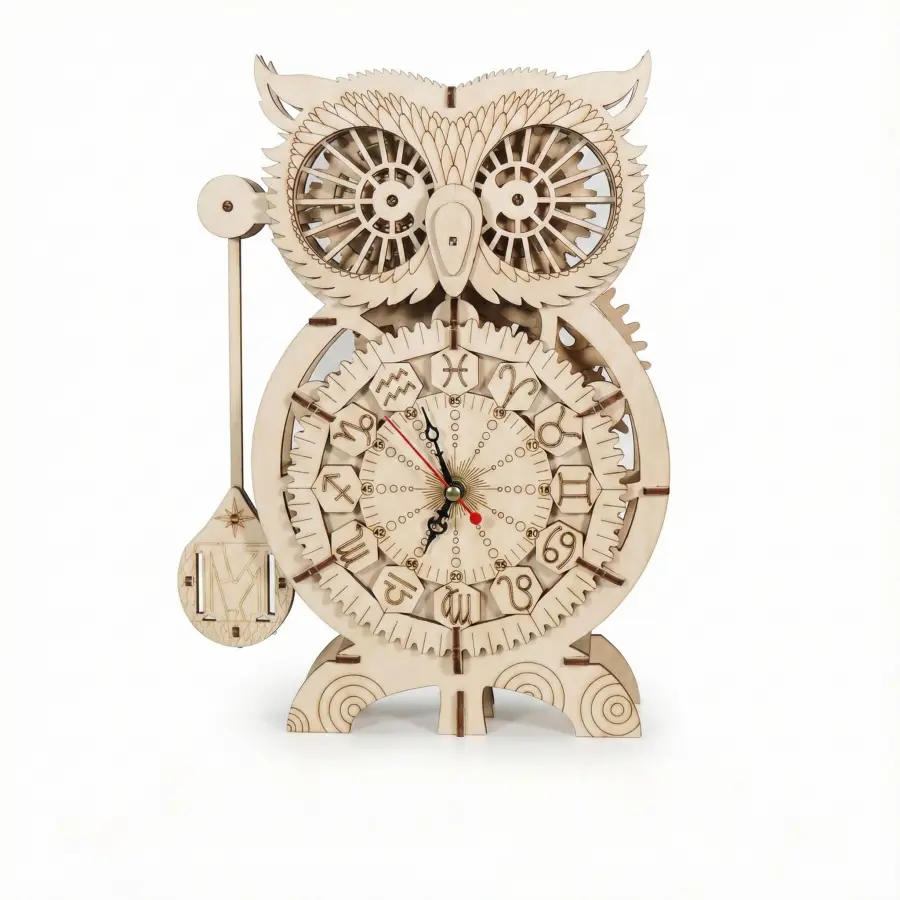
A mechanical clock kit like the Zodiac Owl shows the gear train through the open lattice, so the builder can watch the pendulum drive the escapement after the build. That visible mechanism is the entire reason to pick a mechanical kit over a quartz one.
One Action Before You Pay: Before you commit to a movement type, ask the listing two direct questions: is the movement mechanical with a pendulum connected to the escapement, or is it a quartz module? If the answer is vague, assume quartz and price the kit accordingly.
04. Matching the Kit to the Recipient, the Style, and the Gift Occasion
The most common gift mismatch is choosing a high-piece-count mechanical clock for a casual hobbyist, or a small desktop display for someone who already has a wall full of working timepieces. The right 3D wooden puzzle clock kit matches three observable traits: the builder’s patience, the room where the finished clock will live, and the design language the recipient already surrounds themselves with.
Start With the Recipient’s Actual Building Habits
The first filter is honest self-report. Ask whether the recipient has finished any model kit, Lego Technic set, or scale build in the last two years. If yes, a laser-cut wooden clock kit with a visible mechanical movement and a real gear train is a reasonable next step. If no, a simpler build — fewer pre-cut pieces, a single afternoon of assembly, and a quartz movement so the gift still functions even if the build is set down halfway — is a safer call.
The 3D Wooden Puzzle Clock DIY Kit sits in the middle of that range: a real mechanical wall clock with a pendulum, escapement, and visible gear train, aimed at an adult who enjoys a hands-on project but does not need a week-long build to feel satisfied.

Map Design Style to the Room, Not to Your Imagination
Wooden clock kits come in recognizable visual families, and each one suits a different interior.
- Steampunk and mechanical-exoskeleton styles show the gears, pendulum, and escapement through open lattice. They look right in a study, workshop, or a room with exposed brick, dark wood, or vintage décor.
- Architectural and abstract styles — exposed columns, stacked geometric frames, clean lines — suit a modern apartment, an office desk, or a hallway where the clock reads as a sculpture as much as a timepiece.
- Nature and figurative styles — owls, animals, ships, fantasy builds — suit a shelf or desktop display rather than a primary wall clock, because the shape usually has a strong focal point and weaker wall-clock readability from across a room.
If the recipient’s living space already leans steampunk or vintage, the Zodiac Owl Mechanical Clock Puzzle and a similar exposed-gear style will read as a chosen object. If their space is more Scandinavian or minimalist, an architectural wooden clock kit with cleaner lines will look like it belongs.
Match the Occasion to the Build Commitment
Gift occasion sets a soft deadline in the buyer’s head, and the kit’s assembly time has to fit inside it. A birthday or holiday gift usually lands on a single weekend, so a kit quoted at 4–6 hours of typical build time is realistic. A milestone gift (anniversary, graduation, retirement) gives the builder permission to take two or three weekends, so a 6–10 hour build becomes a project rather than a chore. A housewarming gift benefits from a smaller build the recipient can finish and hang in the first week.
For a housewarming where the recipient is not a hardcore hobbyist, a tabletop build that doubles as home decor is often the safer call.

A decorative ship or carriage build keeps the hobbyist spirit without committing the new homeowner to a multi-evening project on top of unpacking boxes.
The Gift-Occasion Checklist
- Recipient skill: Have they finished a model kit recently? If not, choose a smaller piece count.
- Time available: One weekend or three? Match the kit’s typical assembly time, not its minimum.
- Movement type: Mechanical with pendulum and escapement, or quartz? Confirm before paying.
- Display location: Wall-mounted showpiece or shelf/desk object? The recipient’s room should dictate the design family.
- Design language: Does the recipient already own steampunk, vintage, or minimalist décor? Match the kit to what they actually live with.
- Replacement parts: If a pre-cut plywood piece snaps during assembly, is there a spares bag or a seller contact?
If the recipient collects figurines or display objects rather than wall décor, a non-clock wooden build — the Royal Carriage, for instance — covers the same hands-on satisfaction without forcing a clock into a room that does not need one.

For a wider view of adult wooden puzzles beyond the clock family, the best wooden 3D puzzles for adults roundup is a useful second opinion before checkout.
One Action Before You Pay: Pick the design family that matches the room the recipient already has, then confirm the movement type is mechanical with a visible pendulum and escapement. If either answer is uncertain, ask the seller directly before the kit ships.
05. Decision Table: Which Kit Style Fits Which Adult Builder
Choose a steampunk wooden clock for the recipient with industrial decor and a tinkerer’s patience; choose a nature-themed pendulum clock for a plant-filled reading nook; choose an architectural clock for a home office; choose an abstract clock for a design-minded living room. The remaining question is whether the build itself will be a quiet weekend or three spread-out evenings.
| Style | What it looks like | Movement (verify) | Best room fit | Recipient personality | What to check |
|---|---|---|---|---|---|
| Steampunk | Brass-toned gears, exposed cogs, industrial dials | Often mechanical pendulum; confirm before buying | Study, loft, industrial decor | Tinkerer, history buff, engineer-adjacent | Visible escapement; pendulum actually present |
| Nature | Owl, tree, leaf, animal silhouettes | Mechanical or quartz — confirm on box | Reading nook, bedroom, plant-filled room | Nature lover, birder, quiet hobbyist | Theme reads at distance; clock face legible |
| Architectural | Visible gear trains, columns, geometric symmetry | Usually mechanical, but varies | Modern office, library, gallery wall | Architect, engineer, math/logic-minded | Whether the frame and movement arrive pre-assembled |
| Abstract | Minimal lines, asymmetric shapes, art-deco feel | Quartz most common at this price | Living room, hallway, desktop display | Design-minded, contemporary art lover | Working clock or display sculpture |
The fastest way to read a product photo for builder fit is to ignore the marketing angle and look at three things: the density of small laser-cut plywood pieces, the visible gear train and escapement, and the pendulum connection point. Dense parts and many gears mean 6+ hours of assembly. Sparse pieces and a quartz module mean a 2–3 hour build that a first-time model maker can finish.
For a recipient who loves the steampunk look but doesn’t need a wall clock, a steampunk-themed mechanical kit sits in the same family.
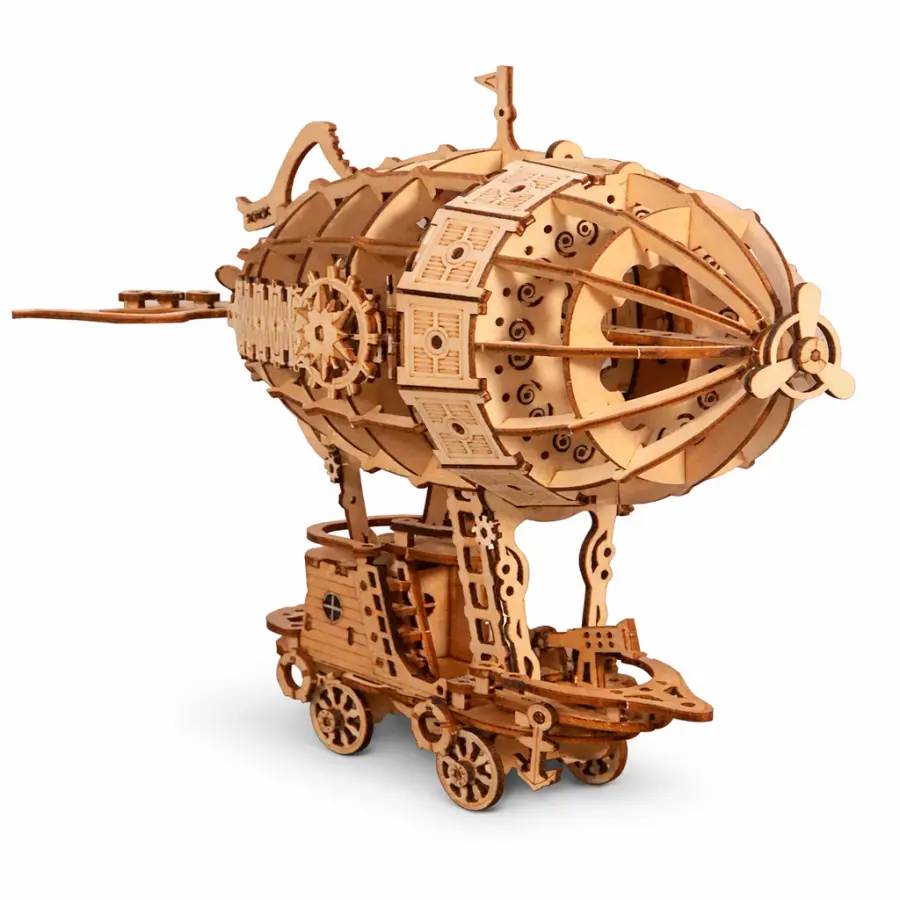
The exposed-cog visual language reads as a sibling to a steampunk wooden clock and gives a mechanical-puzzle fan a second build to finish after the first one comes off the wall.
For a recipient drawn to visible engineering, a mechanical pistol kit with a visible firing mechanism offers a related challenge.

It tests the same hand-skill and instruction-reading patience without requiring a wall to hang the finished piece on.
The most common mismatch is style-fit but patience-overshoot. A clock that ends up in a drawer because the build took twelve hours instead of the advertised four is a worse gift than a less perfect-looking clock the builder actually finished. Ask whether the recipient prefers one quiet weekend on a single build or three evenings of progress — that answer decides whether to lean into the 4-hour or 8-hour end of the assembly-time spectrum.
For a broader sweep of mechanical wooden kits sharing the same construction logic as a clock kit, the best mechanical 3D jigsaw picks roundup shows what else a hobbyist builder might enjoy after finishing a first clock.
One Action: Pick the column above that matches the recipient’s room, confirm the “What to check” item on the product page, then buy.
Frequently Asked Questions
Does a 3D wooden puzzle clock actually keep time properly once built?
Yes, when the kit uses a genuine mechanical movement driving a pendulum-regulated escapement, the finished piece is a working wall or desktop timepiece rather than a decorative shell. The timekeeping accuracy depends on movement type and how vertically stable the assembled case sits. Verify by checking the product page for a visible gear train, a pendulum, and the movement specification — if the listing only shows a battery slot behind a printed dial, it is a quartz insert, not a mechanically driven wooden clock.
How long does it take to assemble a 3D wooden clock kit?
Most kits quote a minimum build time, not a typical one, so a stated “3 hours” often becomes 6–8 hours for a first-time builder, and mechanical-clock kits with gear trains and pendulum linkages commonly run 6–10 hours. Confirm the piece count and movement inclusion on the product page, then add a buffer to the advertised time when planning a gift build.
Are these kits suitable for someone who has never built a model before?
Some are, some aren’t. Kits with under 100 pre-cut pieces, numbered parts, and a quartz movement are genuinely beginner-tolerant. Kits with a mechanical movement and exposed gear train require more patience and finer finger work. Match the recipient to the kit rather than the other way around.
What tools are needed — is anything beyond the box required?
Most laser-cut plywood kits ship with the only tool genuinely required: a small craft knife or the included wooden pick. Verify the “what’s in the box” line on the product page — if it says “no tools required,” the kit is gift-ready; if it lists tools separately, factor in a small add-on.
Can the finished clock be hung on the wall or is it desktop only?
Both formats exist, and the difference is structural. Wall-mounted kits include a back-hang slot or keyhole cut into the rear frame. Desktop kits have a flat base or enclosed stand. Check the product photo’s orientation and the dimensions column before ordering.
Is a 3D wooden clock kit a good gift for someone who isn’t really crafty?
It is a good gift only if the recipient enjoys hands-on building — otherwise the half-finished kit will sit in a drawer. Pair it with a small “build afternoon” commitment so the gift comes with a time, not just a box.
One action: Confirm the tool, orientation, and movement type on the 3D Wooden Puzzle Clock DIY Kit product page, then order.
Where to Start
If the recipient and occasion checks above match, start with 3D Wooden Puzzle Clock DIY Kit. Check the current product page for the specifications that matter to your choice.
Sources and verification
- Product details and current specifications: Tea-Sip product page
Last updated: August 27, 2026